 Скачать презентацию UNPREPAREDNESS IN THE GREAT RECESSION By LIM Chong
bc87b70ae58bd9701a330b31c1103e1b.ppt
- Количество слайдов: 10



UNPREPAREDNESS IN THE GREAT RECESSION By LIM Chong Yah Albert Winsemius Chair Professor of Economics Director, Economic Growth Centre School of Humanities and Social Sciences Nanyang Technological University SINGAPORE SNG Hui Ying Lecturer (Economics) Fellow, Economic Growth Centre School of Humanities and Social Sciences Nanyang Technological University SINGAPORE (copyright © August 2009 by Lim Chong Yah) 1
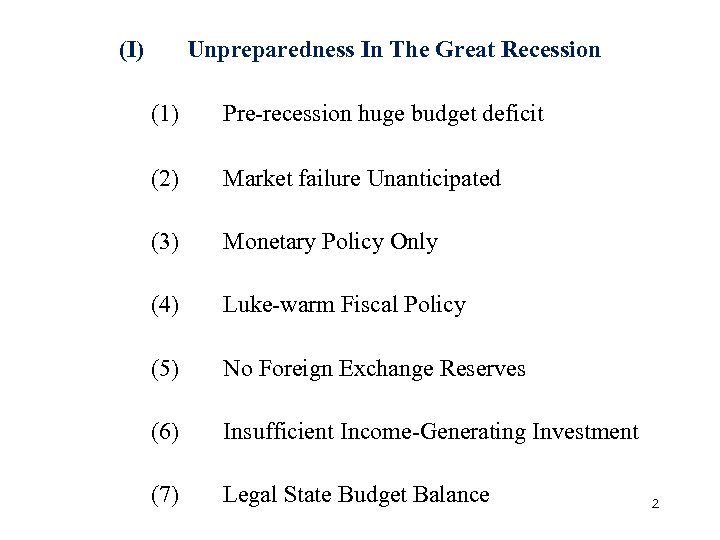
(I) Unpreparedness In The Great Recession (1) Pre-recession huge budget deficit (2) Market failure Unanticipated (3) Monetary Policy Only (4) Luke-warm Fiscal Policy (5) No Foreign Exchange Reserves (6) Insufficient Income-Generating Investment (7) Legal State Budget Balance 2
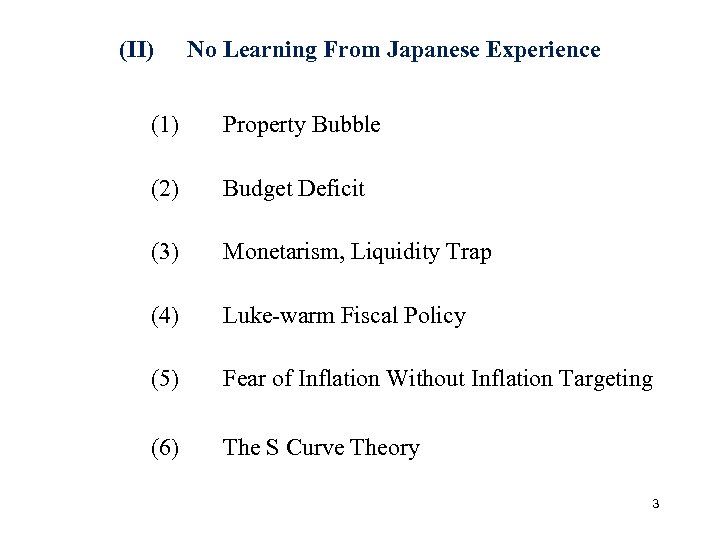
(II) No Learning From Japanese Experience (1) Property Bubble (2) Budget Deficit (3) Monetarism, Liquidity Trap (4) Luke-warm Fiscal Policy (5) Fear of Inflation Without Inflation Targeting (6) The S Curve Theory 3
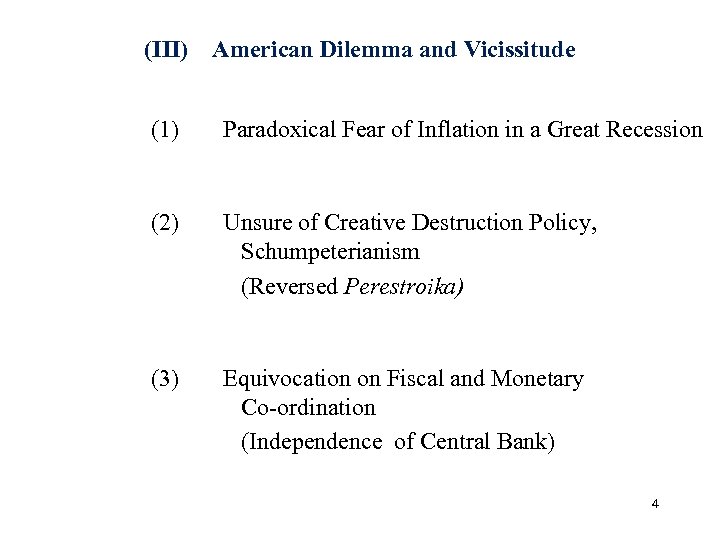
(III) American Dilemma and Vicissitude (1) (2) Unsure of Creative Destruction Policy, Schumpeterianism (Reversed Perestroika) (3) Paradoxical Fear of Inflation in a Great Recession Equivocation on Fiscal and Monetary Co-ordination (Independence of Central Bank) 4
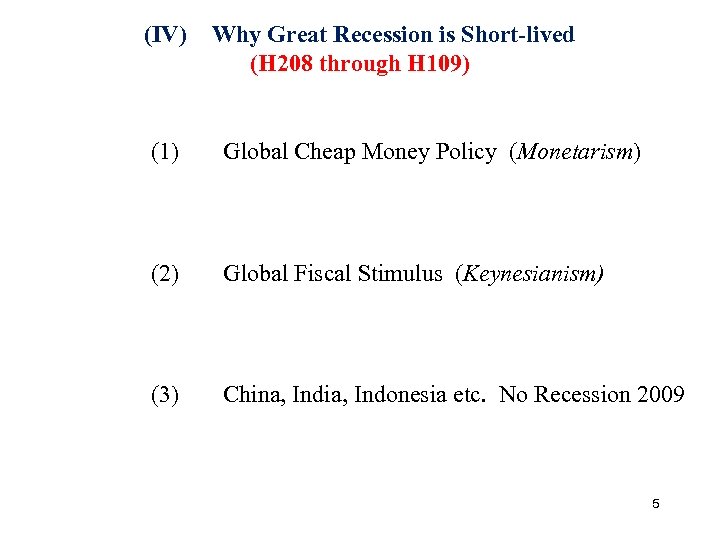
(IV) Why Great Recession is Short-lived (H 208 through H 109) (1) Global Cheap Money Policy (Monetarism) (2) Global Fiscal Stimulus (Keynesianism) (3) China, India, Indonesia etc. No Recession 2009 5
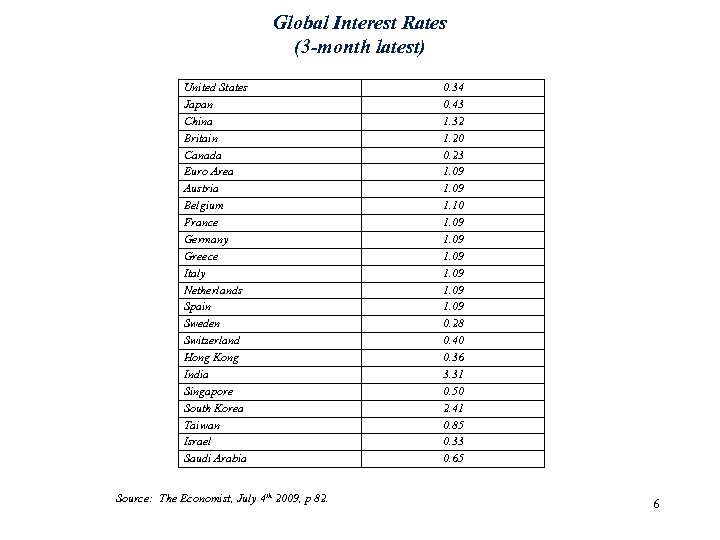
Global Interest Rates (3 -month latest) United States Japan China Britain Canada Euro Area Austria Belgium France Germany Greece Italy Netherlands Spain Sweden Switzerland Hong Kong India Singapore South Korea Taiwan Israel Saudi Arabia Source: The Economist, July 4 th 2009, p 82. 0. 34 0. 43 1. 32 1. 20 0. 23 1. 09 1. 10 1. 09 0. 28 0. 40 0. 36 3. 31 0. 50 2. 41 0. 85 0. 33 0. 65 6
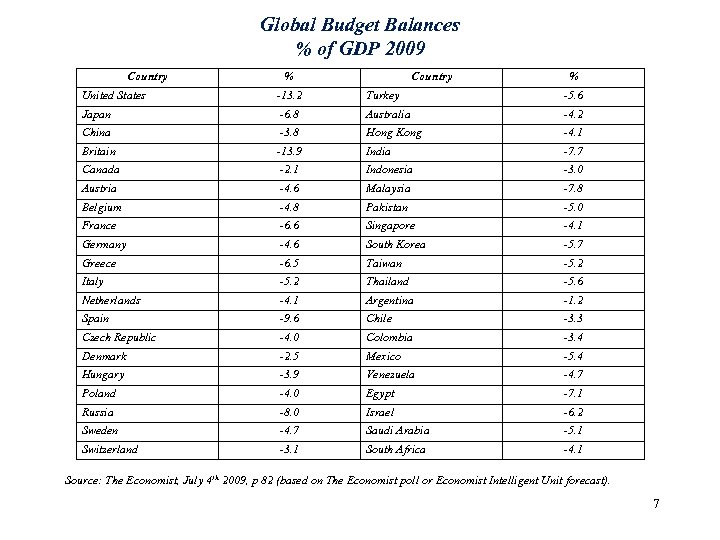
Global Budget Balances % of GDP 2009 Country % United States -13. 2 Turkey -5. 6 Japan -6. 8 Australia -4. 2 China -3. 8 Hong Kong -4. 1 Britain -13. 9 India -7. 7 Canada -2. 1 Indonesia -3. 0 Austria -4. 6 Malaysia -7. 8 Belgium -4. 8 Pakistan -5. 0 France -6. 6 Singapore -4. 1 Germany -4. 6 South Korea -5. 7 Greece -6. 5 Taiwan -5. 2 Italy -5. 2 Thailand -5. 6 Netherlands -4. 1 Argentina -1. 2 Spain -9. 6 Chile -3. 3 Czech Republic -4. 0 Colombia -3. 4 Denmark -2. 5 Mexico -5. 4 Hungary -3. 9 Venezuela -4. 7 Poland -4. 0 Egypt -7. 1 Russia -8. 0 Israel -6. 2 Sweden -4. 7 Saudi Arabia -5. 1 Switzerland -3. 1 South Africa -4. 1 Source: The Economist, July 4 th 2009, p 82 (based on The Economist poll or Economist Intelligent Unit forecast). 7
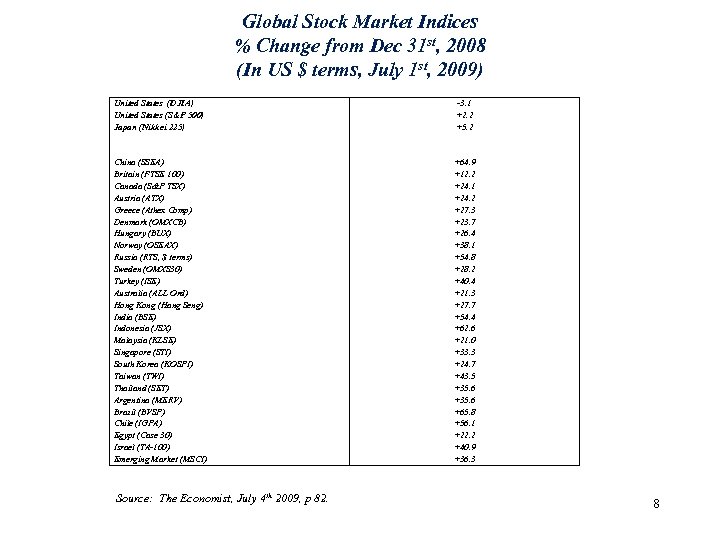
Global Stock Market Indices % Change from Dec 31 st, 2008 (In US $ terms, July 1 st, 2009) United States (DJIA) United States (S&P 500) Japan (Nikkei 225) -3. 1 +2. 2 +5. 2 China (SSEA) Britain (FTSE 100) Canada (S&P TSX) Austria (ATX) Greece (Athex Comp) Denmark (OMXCB) Hungary (BUX) Norway (OSEAX) Russia (RTS, $ terms) Sweden (OMXS 30) Turkey (ISE) Australia (ALL Ord) Hong Kong (Hang Seng) India (BSE) Indonesia (JSX) Malaysia (KLSE) Singapore (STI) South Korea (KOSPI) Taiwan (TWI) Thailand (SET) Argentina (MERV) Brazil (BVSP) Chile (IGPA) Egypt (Case 30) Israel (TA-100) Emerging Market (MSCI) +64. 9 +12. 2 +24. 1 +24. 2 +27. 3 +23. 7 +26. 4 +38. 1 +54. 8 +28. 2 +40. 4 +21. 3 +27. 7 +54. 4 +62. 6 +21. 0 +33. 3 +24. 7 +43. 5 +35. 6 +65. 8 +56. 1 +22. 2 +40. 9 +36. 3 Source: The Economist, July 4 th 2009, p 82. 8
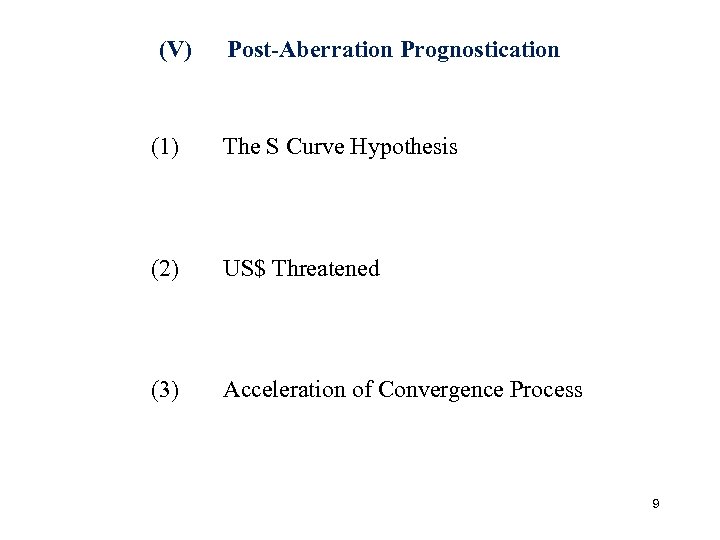
(V) Post-Aberration Prognostication (1) The S Curve Hypothesis (2) US$ Threatened (3) Acceleration of Convergence Process 9

Have A Good Day THE END Cheers and God Bless 10
Скачать презентацию UNPREPAREDNESS IN THE GREAT RECESSION By LIM Chong
bc87b70ae58bd9701a330b31c1103e1b.ppt