Скачать презентацию Unless otherwise noted the content of this course
c19ee915cba82315d9a606d4e4a5f822.ppt
- Количество слайдов: 23
 Unless otherwise noted, the content of this course material is licensed under a Creative Commons Attribution 3. 0 License. Copyright 2008, Dr. Stephen Bayne. The following information is intended to inform and educate and is not a tool for self-diagnosis or a replacement for medical evaluation, advice, diagnosis or treatment by a healthcare professional. You should speak to your physician or make an appointment to be seen if you have questions or concerns about this information or your medical condition. You assume all responsibility for use and potential liability associated with any use of the material. Material contains copyrighted content, used in accordance with U. S. law. Copyright holders of content included in this material should contact open. michigan@umich. edu with any questions, corrections, or clarifications regarding the use of content. The Regents of the University of Michigan do not license the use of third party content posted to this site unless such a license is specifically granted in connection with particular content objects. Users of content are responsible for their compliance with applicable law. See http: //www. dent. umich. edu/license/ for more information. Mention of specific products in this recording solely represents the opinion of the speaker and does not represent an endorsement by the University of Michigan. Viewer discretion advised: Material may contain medical images that may be disturbing to some viewers.
 IMPRESSION MATERIALS Part 1 and Part 2 Stephen C. Bayne University of Michigan School of Dentistry Ann Arbor, Michigan sbayne@umich. edu
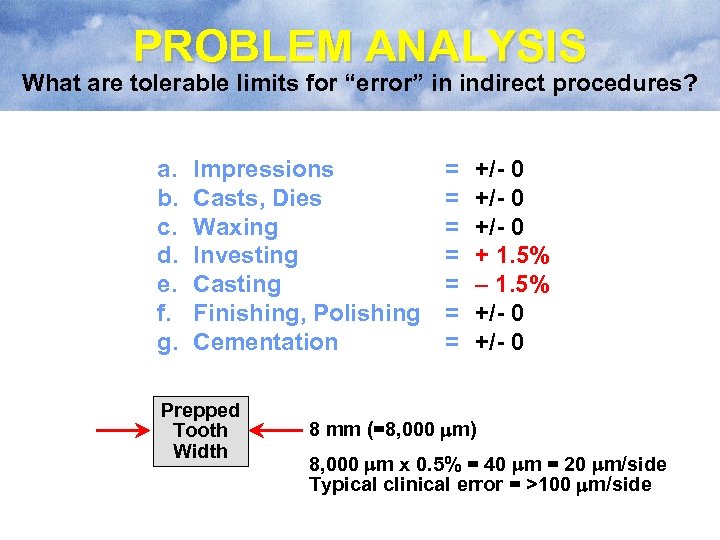 PROBLEM ANALYSIS What are tolerable limits for “error” in indirect procedures? a. b. c. d. e. f. g. Impressions Casts, Dies Waxing Investing Casting Finishing, Polishing Cementation Prepped Tooth Width = = = = +/- 0 + 1. 5% +/- 0 8 mm (=8, 000 m) 8, 000 m x 0. 5% = 40 m = 20 m/side Typical clinical error = >100 m/side
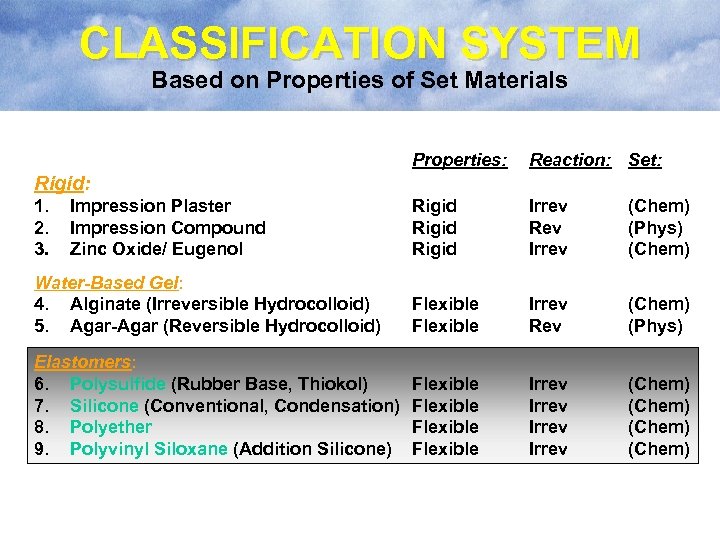 CLASSIFICATION SYSTEM Based on Properties of Set Materials Properties: Reaction: Set: Rigid Irrev Rev Irrev (Chem) (Phys) (Chem) Water-Based Gel: 4. Alginate (Irreversible Hydrocolloid) 5. Agar-Agar (Reversible Hydrocolloid) Flexible Irrev Rev (Chem) (Phys) Elastomers: 6. Polysulfide (Rubber Base, Thiokol) 7. Silicone (Conventional, Condensation) 8. Polyether 9. Polyvinyl Siloxane (Addition Silicone) Flexible Irrev (Chem) Rigid: 1. 2. 3. Impression Plaster Impression Compound Zinc Oxide/ Eugenol
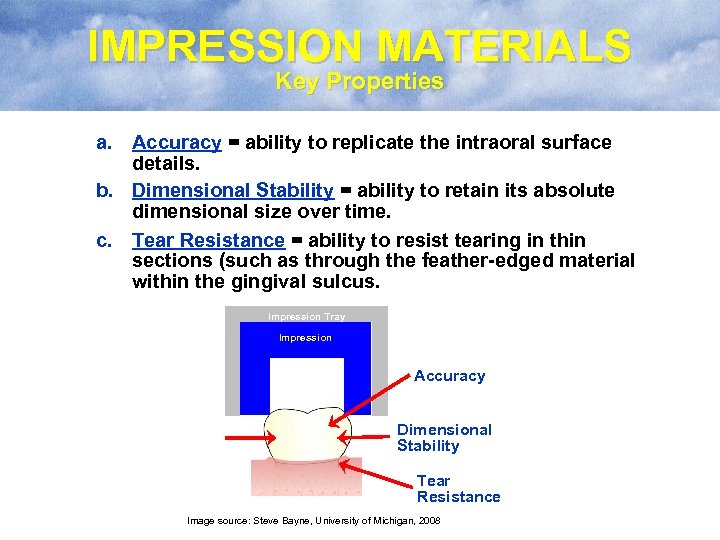 IMPRESSION MATERIALS Key Properties a. Accuracy = ability to replicate the intraoral surface details. b. Dimensional Stability = ability to retain its absolute dimensional size over time. c. Tear Resistance = ability to resist tearing in thin sections (such as through the feather-edged material within the gingival sulcus. Impression Tray Impression Accuracy Dimensional Stability Tear Resistance Image source: Steve Bayne, University of Michigan, 2008
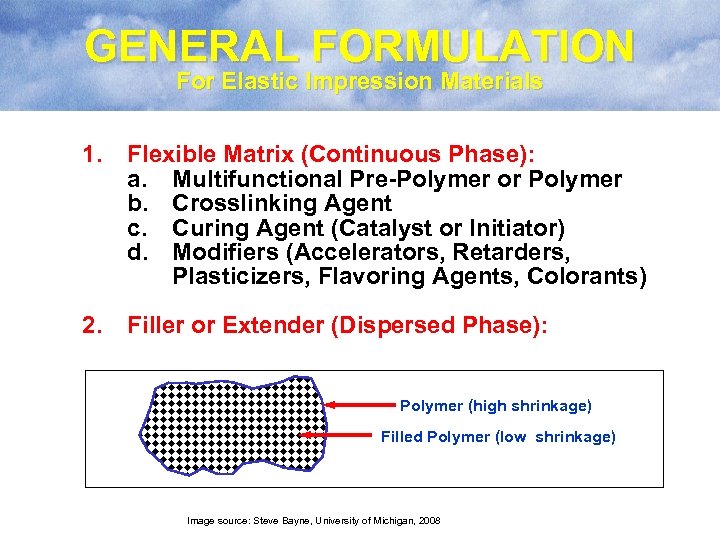 GENERAL FORMULATION For Elastic Impression Materials 1. Flexible Matrix (Continuous Phase): a. Multifunctional Pre-Polymer or Polymer b. Crosslinking Agent c. Curing Agent (Catalyst or Initiator) d. Modifiers (Accelerators, Retarders, Plasticizers, Flavoring Agents, Colorants) 2. Filler or Extender (Dispersed Phase): Polymer (high shrinkage) Filled Polymer (low shrinkage) Image source: Steve Bayne, University of Michigan, 2008
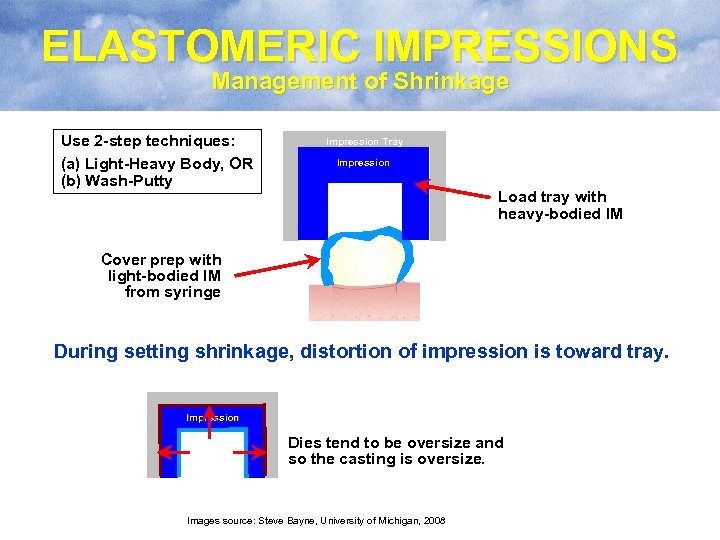 ELASTOMERIC IMPRESSIONS Management of Shrinkage Use 2 -step techniques: (a) Light-Heavy Body, OR (b) Wash-Putty Impression Tray Impression Load tray with heavy-bodied IM Cover prep with light-bodied IM from syringe During setting shrinkage, distortion of impression is toward tray. Impression Dies tend to be oversize and so the casting is oversize. Images source: Steve Bayne, University of Michigan, 2008
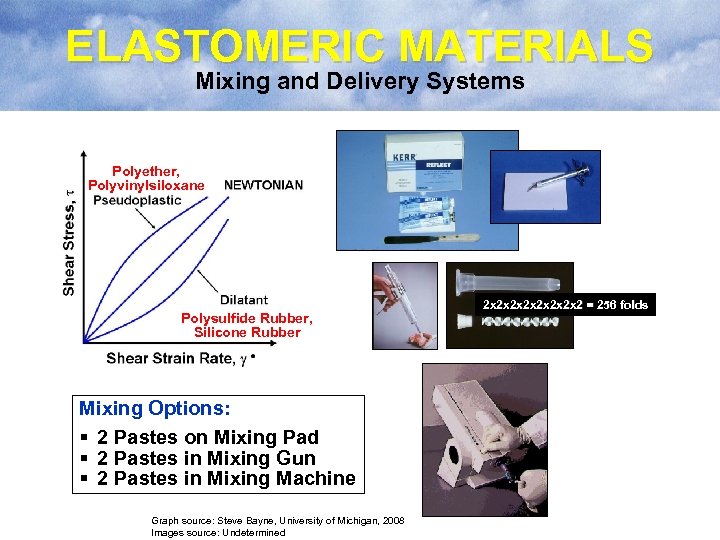 ELASTOMERIC MATERIALS Mixing and Delivery Systems Polyether, Polyvinylsiloxane Polysulfide Rubber, Silicone Rubber Mixing Options: § 2 Pastes on Mixing Pad § 2 Pastes in Mixing Gun § 2 Pastes in Mixing Machine Graph source: Steve Bayne, University of Michigan, 2008 Images source: Undetermined 2 x 2 x 2 = 256 folds
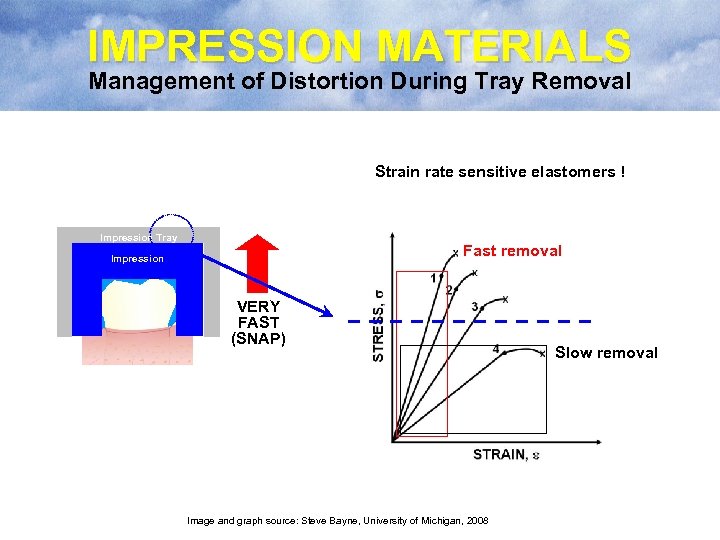 IMPRESSION MATERIALS Management of Distortion During Tray Removal Strain rate sensitive elastomers ! Impression Tray Fast removal Impression VERY FAST (SNAP) Image and graph source: Steve Bayne, University of Michigan, 2008 Slow removal
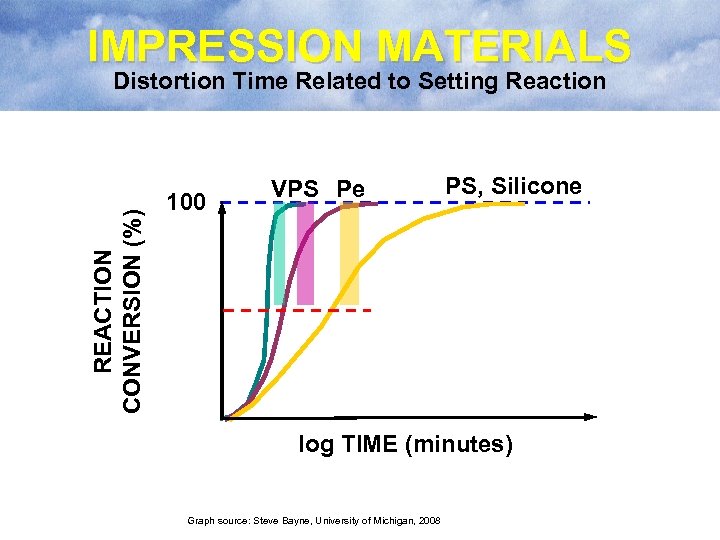 IMPRESSION MATERIALS REACTION CONVERSION (%) Distortion Time Related to Setting Reaction 100 VPS Pe PS, Silicone log TIME (minutes) Graph source: Steve Bayne, University of Michigan, 2008
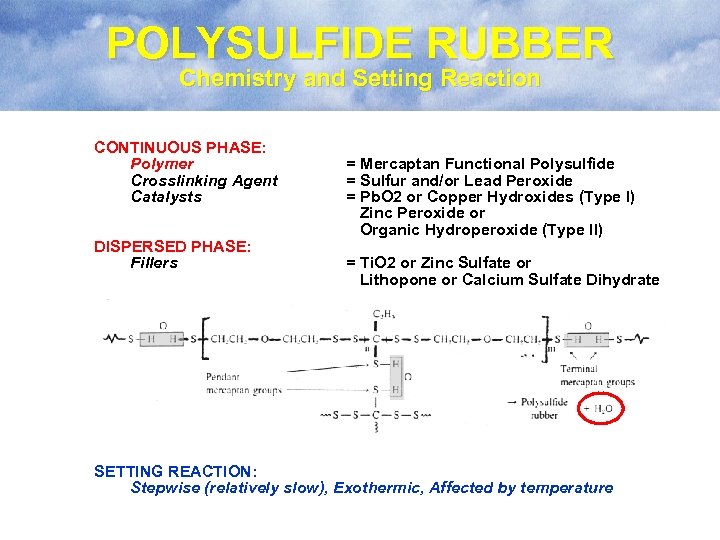 POLYSULFIDE RUBBER Chemistry and Setting Reaction CONTINUOUS PHASE: Polymer Crosslinking Agent Catalysts DISPERSED PHASE: Fillers = Mercaptan Functional Polysulfide = Sulfur and/or Lead Peroxide = Pb. O 2 or Copper Hydroxides (Type I) Zinc Peroxide or Organic Hydroperoxide (Type II) = Ti. O 2 or Zinc Sulfate or Lithopone or Calcium Sulfate Dihydrate SETTING REACTION: Stepwise (relatively slow), Exothermic, Affected by temperature
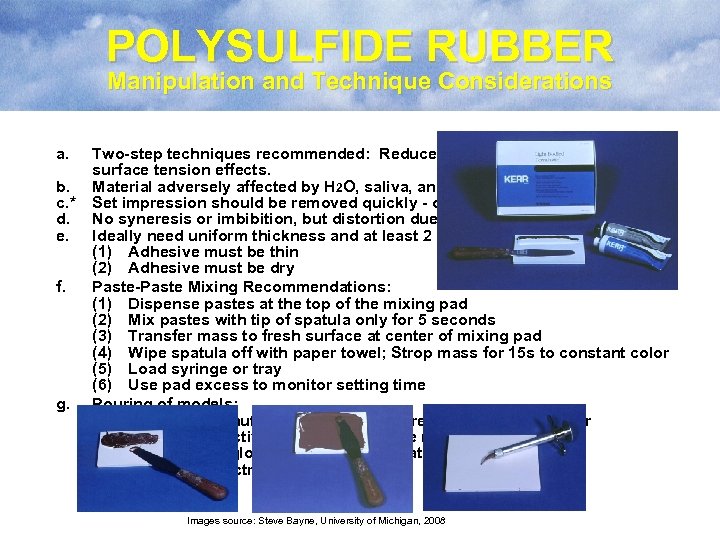 POLYSULFIDE RUBBER Manipulation and Technique Considerations a. b. c. * d. e. f. g. Two-step techniques recommended: Reduces air entrapment and surface tension effects. Material adversely affected by H 2 O, saliva, and blood. Set impression should be removed quickly - do not rock tray. No syneresis or imbibition, but distortion due to continued reaction. Ideally need uniform thickness and at least 2 mm thick for accuracy. (1) Adhesive must be thin (2) Adhesive must be dry Paste-Paste Mixing Recommendations: (1) Dispense pastes at the top of the mixing pad (2) Mix pastes with tip of spatula only for 5 seconds (3) Transfer mass to fresh surface at center of mixing pad (4) Wipe spatula off with paper towel; Strop mass for 15 s to constant color (5) Load syringe or tray (6) Use pad excess to monitor setting time Pouring of models: (1) Wait 20 -30 minutes before pour for stress relaxation to occur (2) RB is non-reactive with model and die materials (3) Be careful of glove powder contamination of impression (4) RB can be electroplated Images source: Steve Bayne, University of Michigan, 2008
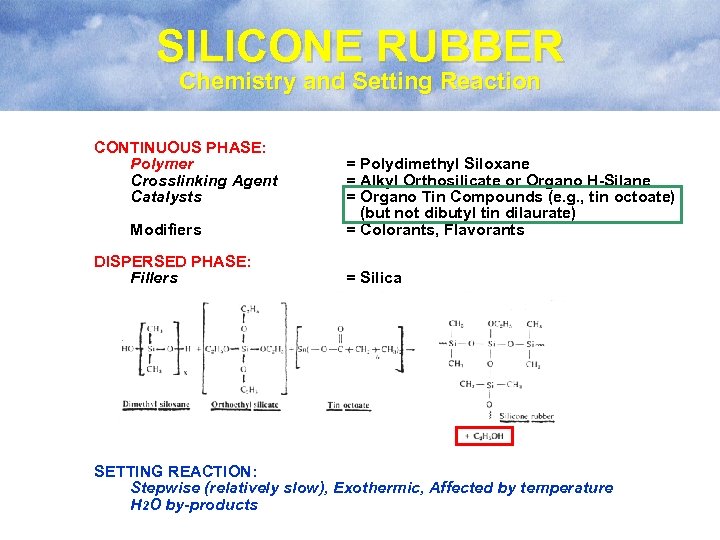 SILICONE RUBBER Chemistry and Setting Reaction CONTINUOUS PHASE: Polymer Crosslinking Agent Catalysts Modifiers DISPERSED PHASE: Fillers = Polydimethyl Siloxane = Alkyl Orthosilicate or Organo H-Silane = Organo Tin Compounds (e. g. , tin octoate) (but not dibutyl tin dilaurate) = Colorants, Flavorants = Silica SETTING REACTION: Stepwise (relatively slow), Exothermic, Affected by temperature H 2 O by-products
 SILICONE RUBBER Manipulation and Technique Considerations a. b. c. d. e. Limited shelf-life: Unstable in tubes. Requires mechanical retention or special tray adhesives No syneresis or imbibition, but continued polymerization shrinkage. Better dimensional stability than RHC but more expensive Pouring of models: (1) More flexible so more chance for distortion during removal (2) Wait 20 -30 minutes before pour for stress relaxation to occur
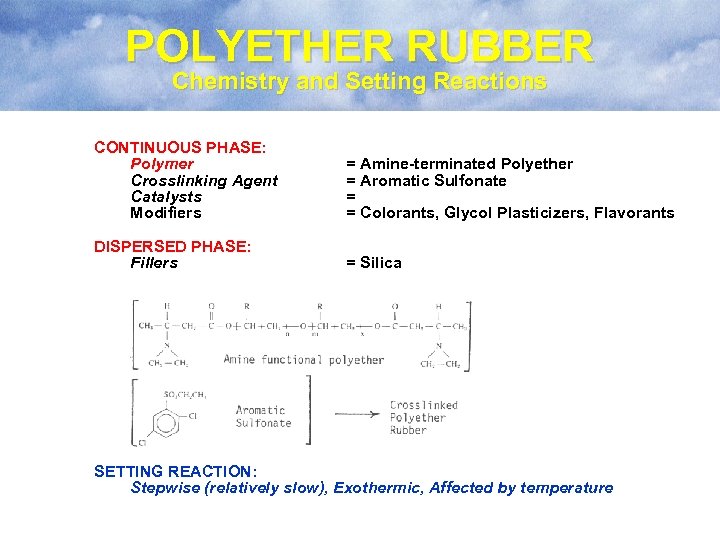 POLYETHER RUBBER Chemistry and Setting Reactions CONTINUOUS PHASE: Polymer Crosslinking Agent Catalysts Modifiers = Amine-terminated Polyether = Aromatic Sulfonate = = Colorants, Glycol Plasticizers, Flavorants DISPERSED PHASE: Fillers = Silica SETTING REACTION: Stepwise (relatively slow), Exothermic, Affected by temperature
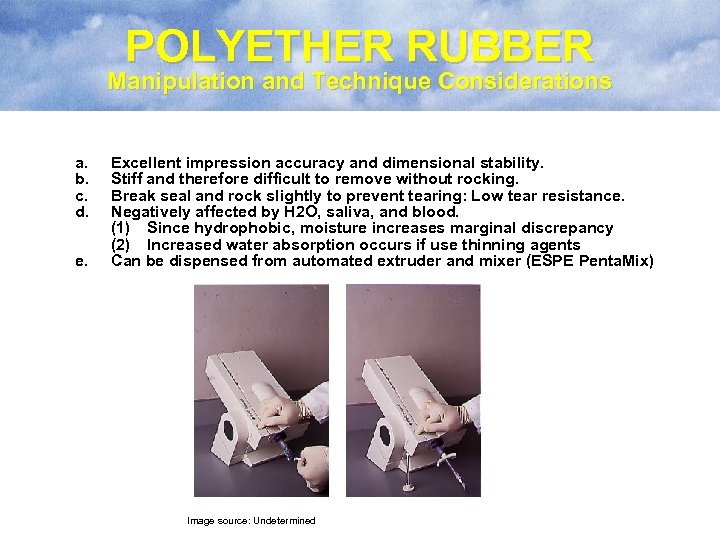 POLYETHER RUBBER Manipulation and Technique Considerations a. b. c. d. e. Excellent impression accuracy and dimensional stability. Stiff and therefore difficult to remove without rocking. Break seal and rock slightly to prevent tearing: Low tear resistance. Negatively affected by H 2 O, saliva, and blood. (1) Since hydrophobic, moisture increases marginal discrepancy (2) Increased water absorption occurs if use thinning agents Can be dispensed from automated extruder and mixer (ESPE Penta. Mix) Image source: Undetermined
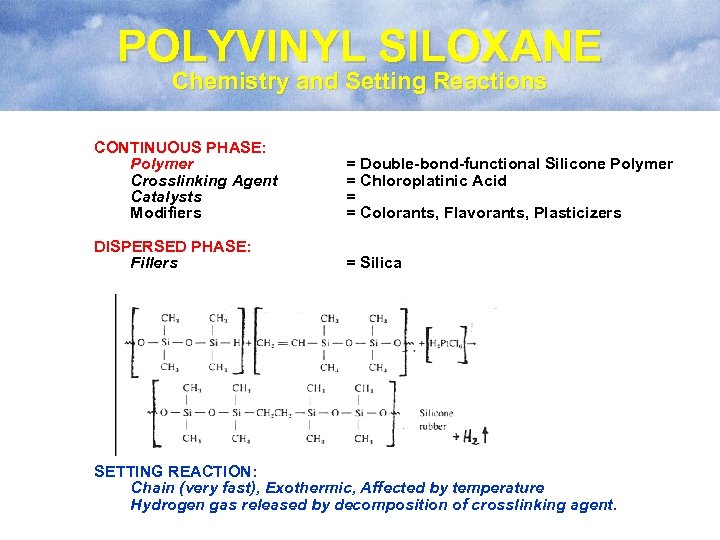 POLYVINYL SILOXANE Chemistry and Setting Reactions CONTINUOUS PHASE: Polymer Crosslinking Agent Catalysts Modifiers = Double-bond-functional Silicone Polymer = Chloroplatinic Acid = = Colorants, Flavorants, Plasticizers DISPERSED PHASE: Fillers = Silica SETTING REACTION: Chain (very fast), Exothermic, Affected by temperature Hydrogen gas released by decomposition of crosslinking agent.
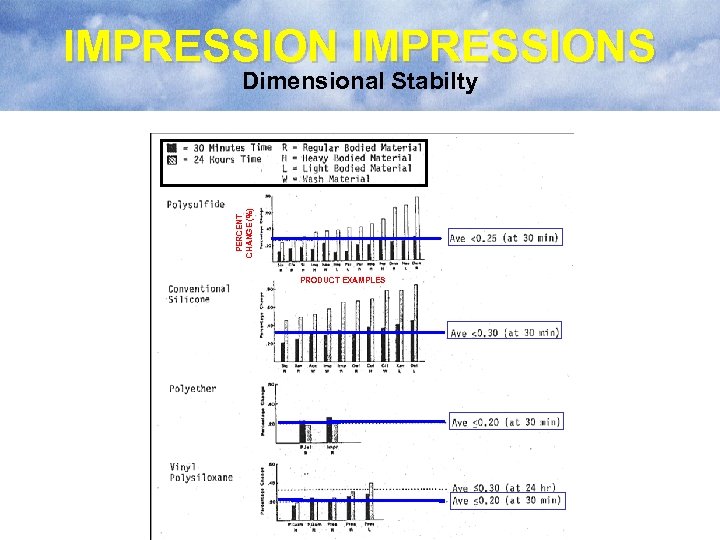
 POLVINYLSILOXANE Manipulation and Technique Considerations a. b. c. BEST impression material for dimensional stability: Pouring should be delayed at least 4 hours for H 2 out-gassing. Pouring can be delayed up to 7 -to-10 days (or indefinitely). Stiffness makes removal difficult. Most material dispensed using auto-mixing gun and mixing tips
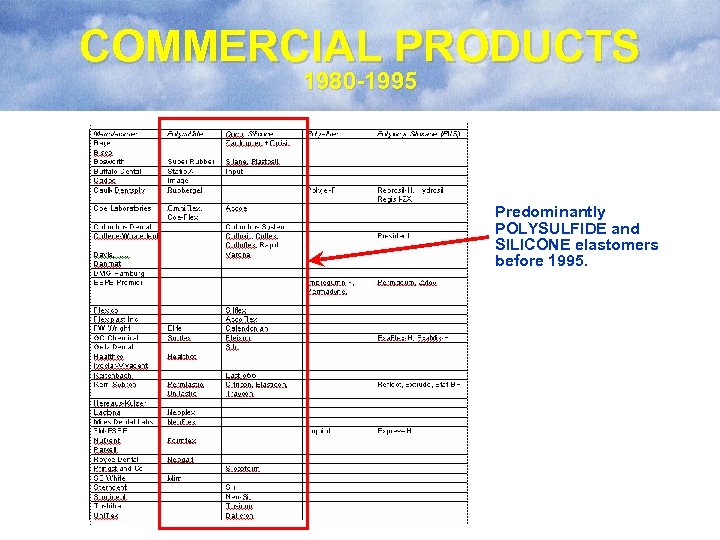 COMMERCIAL PRODUCTS 1980 -1995 Predominantly POLYSULFIDE and SILICONE elastomers before 1995.
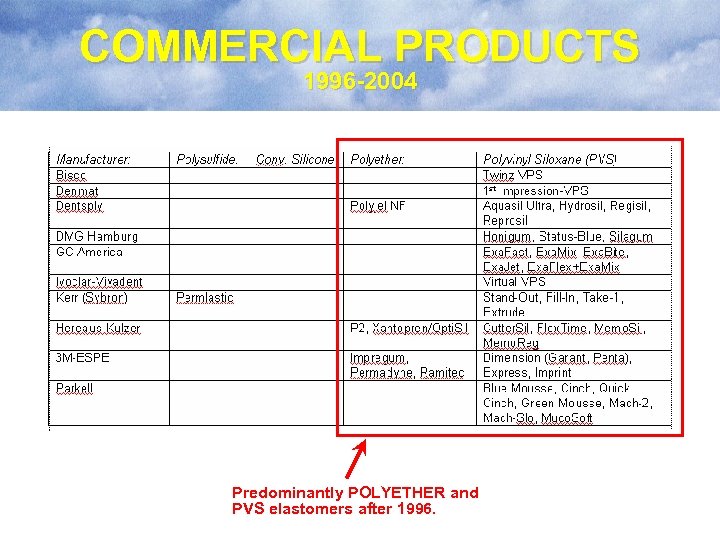 COMMERCIAL PRODUCTS 1996 -2004 Predominantly POLYETHER and PVS elastomers after 1996.
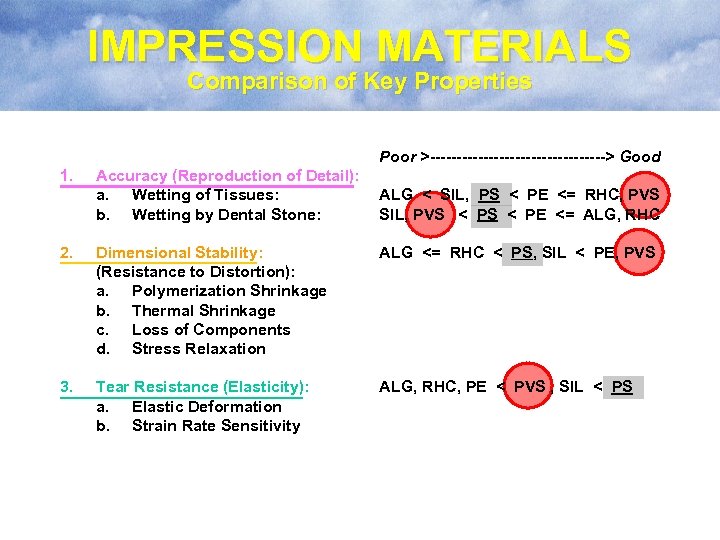 IMPRESSION MATERIALS Comparison of Key Properties Poor >-----------------> Good 1. Accuracy (Reproduction of Detail): a. Wetting of Tissues: b. Wetting by Dental Stone: ALG < SIL, PS < PE <= RHC, PVS SIL, PVS < PE <= ALG, RHC 2. Dimensional Stability: (Resistance to Distortion): a. Polymerization Shrinkage b. Thermal Shrinkage c. Loss of Components d. Stress Relaxation ALG <= RHC < PS, SIL < PE, PVS 3. Tear Resistance (Elasticity): a. Elastic Deformation b. Strain Rate Sensitivity ALG, RHC, PE < PVS , SIL < PS
 IMPRESSIONS PERCENT CHANGE (%) Dimensional Stabilty PRODUCT EXAMPLES