 Скачать презентацию University Politehnica of Bucharest Artificial Intelligence and Multi-Agent
3943545e6ba283ccb81855a96d431799.ppt
- Количество слайдов: 15



University “Politehnica” of Bucharest Artificial Intelligence and Multi-Agent Systems Laboratory http: //turing. cs. pub. ro/ai_mas I-TRACE PROJECT, 1 st Partners Meeting, Catania, November 25 -26, 2005
I-TRACE PROJECT, 1 st Partners Meeting, Catania, November 25 -26, 2005 University “Politehnica” of Bucharest § § § Founded in 1818 Comprises 13 faculties specialised in several domains of engineering sciences Houses 37 Research Centres, among which 4 were recognized as Centres of Excellence at national level and 8 grew into Multi-User Research Infrastructures with the support of the Romania - World Bank Program. Has bilateral co-operation agreements with 74 universities from Europe, America, Asia and Africa Is member of international academic organizations such as: CESAER, EUA, IAU, AUF Actively participates in R&D international programmes like: COST, FP 5, FP 6, CORINT, NATO, Socrates, etc. http: //www. pub. ro
I-TRACE PROJECT, 1 st Partners Meeting, Catania, November 25 -26, 2005 Faculty of Automatic Control and Computer Science Created in 1966 § Offers degrees in “Computer Science and System Science” § Undergraduate and graduate programmes: § § Bachelor of Science in: • Computer Science and Engineering • Automatic Control and Applied Informatics § Master of Science programmes § Ph. D. programmes http: //www. acs. pub. ro
I-TRACE PROJECT, 1 st Partners Meeting, Catania, November 25 -26, 2005 Faculty of Automatic Control and Computer Science u Department of Computer Science and Engineering u Department of Automatic Control and Systems Engineering u Department of Control and Industrial Informatics • Excellence in teaching and research • Scientific research, as well as design, consulting, and expertise activities are carried out in: – Research centers – Research laboratories and research groups http: //www. acs. pub. ro
I-TRACE PROJECT, 1 st Partners Meeting, Catania, November 25 -26, 2005 AI-MAS Laboratory § Cognitive multi-agent systems: l coordination mechanisms l automated negotiation l MAS architectures l multi-agent learning § Models of affective computing § Constructive e-learning § Agent-based tools for cooperative learning and tele -working http: //turing. cs. pub. ro
I-TRACE PROJECT, 1 st Partners Meeting, Catania, November 25 -26, 2005 AI-MAS § The targeted areas of applications are: l l e-commerce l mobile environments l virtual environments for learning l § organisation coordination CSCW The AI-MAS Laboratory is member of FP 6 Agent. Link III: Network of Excellence for Agent. Based Computing, and was also a member of FP 5 Agent. Link II
I-TRACE PROJECT, 1 st Partners Meeting, Catania, November 25 -26, 2005 AI-MAS - Partnerships § LIPN, Université Paris Nord, Institut Galilée • EU Socrates Programme, E-learning project § École Nationale Superiéure des Mines de Saint-Etienne • EU Socrates Programme, Theses en co-tutelle § École Polytechnique de l'Université de Nantes • DEA-ECD between EPUN and UPB, E-learning project, EU Socrates Programme
I-TRACE PROJECT, 1 st Partners Meeting, Catania, November 25 -26, 2005 Some projects § Projects financed by the World Bank • A system for organisational design and coordination using intelligent agents, 1999 -2002 • Education Program on Intelligent Agents Technology, 2001 -2002 § International projects • Agents intelligents, Grant of AUF, 2001 -2002 • Continuous Education Program on Intelligent Agents Technology and Knowledge Processing, Socrates-Erasmus IP, 2001 • Représentation logique des connaissances pour les agents intelligents, Grant of AUF, 1999 -2000 § Participation in the current EU projects • Central European Centre for Women and Youth in Science, FP 6, 2004 -2007 • EU-NCIT: NCIT Leading to EU-IST Excellency, FP 6, 2005 -2007
I-TRACE PROJECT, 1 st Partners Meeting, Catania, November 25 -26, 2005 One of our current projects § Research on emotional agents l Emotions have been shown to have an important impact on several human processes such as decision-making, planning, cognition, and learning § Focus research on: l l An artificial tutor endowed with synthesized emotions according to a BDE (Belief-Desire-Emotion) model (developed by our group) Analyzes possible student reactions my means of an emotion sensing glove and how these reactions may be influenced by the tutor actions
I-TRACE PROJECT, 1 st Partners Meeting, Catania, November 25 -26, 2005 Proposed contribution to I-TRACE A 1. Investigate the use of pen-based input and graphical interaction to understand how annotational capabilities may be used for educational activities: § What does exist? (documentation) § Integration of annotation techniques in an on-line module of the course DSA A 2. Study of the impact of hand-written note-taking, sketching, and graphical annotation on learner's preferences, learning styles, and the provided added value: § Study cognitive/learning styles § Study of the impact of hand-written note-taking, sketching, and graphical annotation on learning styles A 3. Evaluation of the interfaces allowing pen-based graphical interaction
I-TRACE PROJECT, 1 st Partners Meeting, Catania, November 25 -26, 2005 Proposed contribution to I-TRACE A 4. Use of pen based input and graphical interaction for creating cognitive (mind) maps for: § summarising lectures § supplementary readings A 5. Evaluation of the added value and impact of the use of cognitive maps on increasing efficiency of the learning process § Conduct several experiments with a target group of 20 students at DCS A 6. Study of different aspects related to standardization and interoperability and drawing directions for a set of proposed standards relevant to pen-based graphical interaction in ODL (LET) to be sent to ISO/JTC 1/SC 36. § ? ? depending on available results
I-TRACE PROJECT, 1 st Partners Meeting, Catania, November 25 -26, 2005 Learning styles § Tennant (1988) defined cognitive styles as "an individual’s characteristic and consistent approach to organizing and processing information" § In many situations, cognitive styles and learning styles are used interchangeably. § Generally, cognitive styles are more related to theoretical or academic research, while learning styles are more related to practical applications. § A major difference between these two terms is the number of style elements involved. Cognitive styles are more related to a bipolar dimension while learning styles are not necessarily either/or extremes. § There are several classifications of cognitive styles, according to different dimensions. § Cognitive/learning styles in the literature have been viewed in three
I-TRACE PROJECT, 1 st Partners Meeting, Catania, November 25 -26, 2005 Learning styles Active learners understand new information by doing something with it. § Sensing learners like learning facts and solving problems by well established methods. § Visual learners understand new information best by seeing it in the form of pictures, demonstrations, diagrams, § charts, films, and so on. Sequential learners understand new information in linear steps where each step follows logically from the previous one. § Reflective learners prefer to think about new information first before acting on it. § Intuitive learners prefer discovering new relationships and can be innovative in their § approach to problem solving. Verbal learners understand new information best through written and spoken words. § § Global learners tend to learn in large jumps by absorbing material in a random order without necessarily seeing any connections until they have grasped the whole concept.
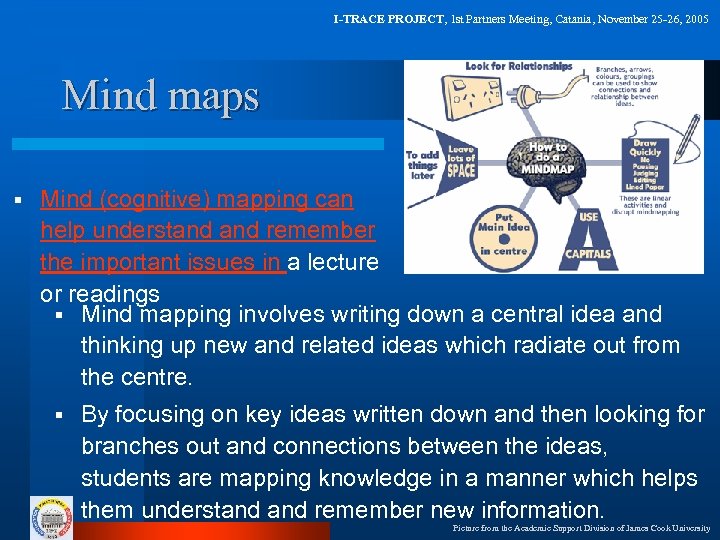
I-TRACE PROJECT, 1 st Partners Meeting, Catania, November 25 -26, 2005 Mind maps § Mind (cognitive) mapping can help understand remember the important issues in a lecture or readings § Mind mapping involves writing down a central idea and thinking up new and related ideas which radiate out from the centre. § By focusing on key ideas written down and then looking for branches out and connections between the ideas, students are mapping knowledge in a manner which helps them understand remember new information. Picture from the Academic Support Division of James Cook University
I-TRACE PROJECT, 1 st Partners Meeting, Catania, November 25 -26, 2005 Proposed output § An interactive collaborative course module and assessment module on Data Structures and Algorithms – Y 1 § A set of good practices of use of hand-written note-taking, sketching, and graphical annotation of teaching materials in Computer Science with focus on DSA – Y 1 § A minimal set of relevant features for characterising the learner’s preferences and the learning style, particularly focussed on graphical interaction techniques. - Y 1 end + Y 2 – beginning § An interactive module to construct cognitive maps using pen based input – Y 2 § A set of relevant good practices of use of cognitive maps to enhance learning efficiency – Y 2 § Survey results of A 3 and A 5. – Y 1 and Y 2 We shall also bring our contribution to project Website, by providing relevant materials, to the reports elaborated by the project, and dissemination of results.
Скачать презентацию University Politehnica of Bucharest Artificial Intelligence and Multi-Agent
3943545e6ba283ccb81855a96d431799.ppt