


 Скачать презентацию University of Washington Department of Electrical Engineering EE
bcda429a92d5bd772068a0860b128540.ppt
- Количество слайдов: 51
 University of Washington Department of Electrical Engineering EE 512 Spring, 2006 Graphical Models Jeff A. Bilmes
 Outline of Today’s Lecture • Class overview • What are graphical models • Semantics of Bayesian networks Lec 1: March 28 th, 2006 EE 512 - Graphical Models - J. Bilmes 2
 Books and Sources for Today • Jordan: Chapters 1 and 2 Lec 1: March 28 th, 2006 EE 512 - Graphical Models - J. Bilmes 3
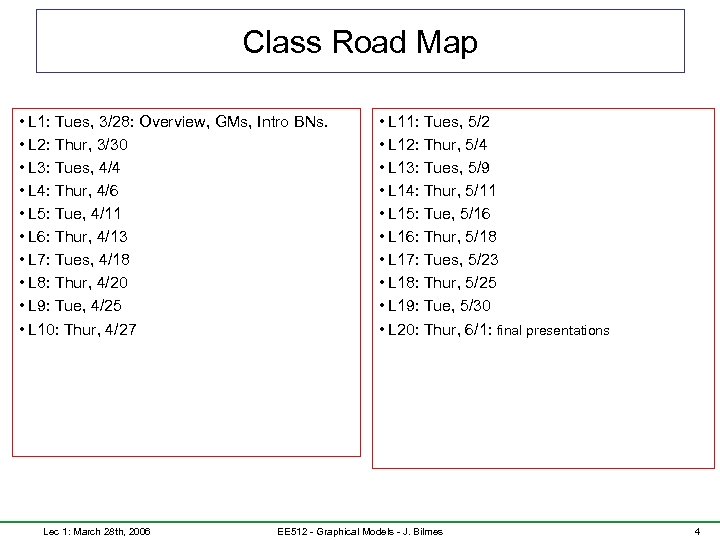 Class Road Map • L 1: Tues, 3/28: Overview, GMs, Intro BNs. • L 2: Thur, 3/30 • L 3: Tues, 4/4 • L 4: Thur, 4/6 • L 5: Tue, 4/11 • L 6: Thur, 4/13 • L 7: Tues, 4/18 • L 8: Thur, 4/20 • L 9: Tue, 4/25 • L 10: Thur, 4/27 Lec 1: March 28 th, 2006 • L 11: Tues, 5/2 • L 12: Thur, 5/4 • L 13: Tues, 5/9 • L 14: Thur, 5/11 • L 15: Tue, 5/16 • L 16: Thur, 5/18 • L 17: Tues, 5/23 • L 18: Thur, 5/25 • L 19: Tue, 5/30 • L 20: Thur, 6/1: final presentations EE 512 - Graphical Models - J. Bilmes 4
 Announcements • READING: Chapter 1, 2 in Jordan’s book (pick up book from basement of communications copy center). • List handout: name, department, and email • List handout: regular makeup slot, and discussion section • Syllabus • Course web page: http: //ssli. ee. washington. edu/ee 512 • Goal: powerpoint slides this quarter, they will be on the web page after lecture (but not before as you are getting them hot off the press). Lec 1: March 28 th, 2006 EE 512 - Graphical Models - J. Bilmes 5
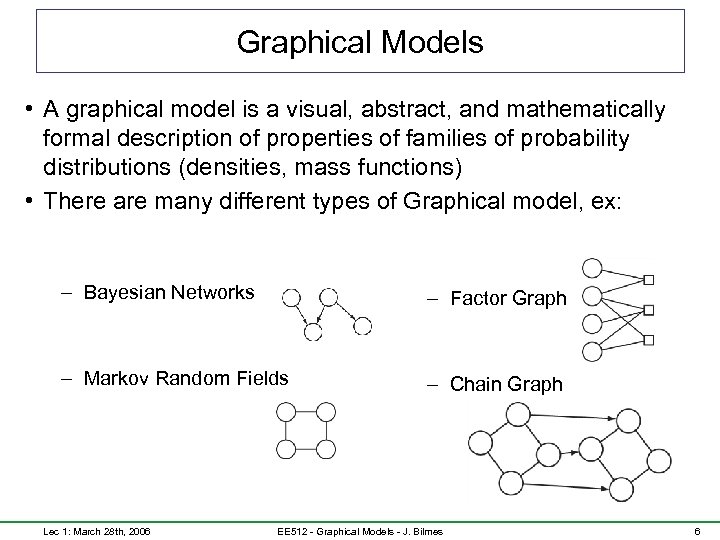 Graphical Models • A graphical model is a visual, abstract, and mathematically formal description of properties of families of probability distributions (densities, mass functions) • There are many different types of Graphical model, ex: – Bayesian Networks – Factor Graph – Markov Random Fields – Chain Graph Lec 1: March 28 th, 2006 EE 512 - Graphical Models - J. Bilmes 6
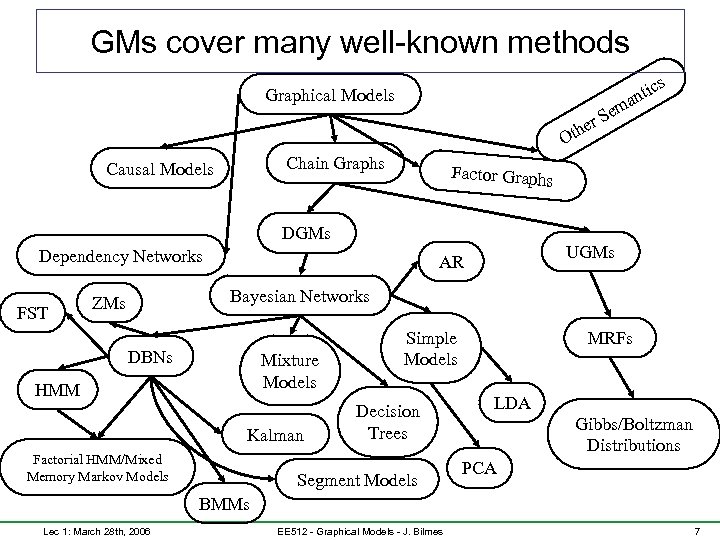 GMs cover many well-known methods Graphical Models em O Chain Graphs Causal Models S er th Factor Graphs DGMs Dependency Networks FST cs nti a UGMs AR Bayesian Networks ZMs DBNs Mixture Models HMM Kalman Factorial HMM/Mixed Memory Markov Models Simple Models Decision Trees Segment Models MRFs LDA Gibbs/Boltzman Distributions PCA BMMs Lec 1: March 28 th, 2006 EE 512 - Graphical Models - J. Bilmes 7
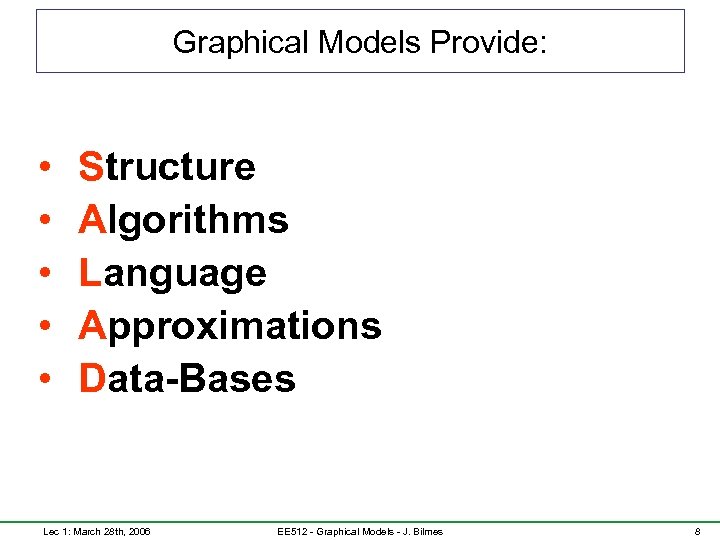 Graphical Models Provide: • • • Structure Algorithms Language Approximations Data-Bases Lec 1: March 28 th, 2006 EE 512 - Graphical Models - J. Bilmes 8
 Graphical Models Provide GMs give us: I. III. Structure: A method to explore the structure of “natural” phenomena (causal vs. correlated relations, properties of natural signals and scenes) Algorithms: A set of algorithms that provide “efficient” probabilistic inference and statistical decision making Language: A mathematically formal, abstract, visual language with which to efficiently discuss families of probabilistic models and their properties. Lec 1: March 28 th, 2006 EE 512 - Graphical Models - J. Bilmes 9
 GMs Provide GMs give us (cont): IV. Approximation: Methods to explore systems of approximation and their implications. E. g. , what are the consequences of a (perhaps known to be) wrong assumption? Data-base: Provide a probabilistic “data-base” and corresponding “search algorithms” for making queries about properties in such model families. Lec 1: March 28 th, 2006 EE 512 - Graphical Models - J. Bilmes 10
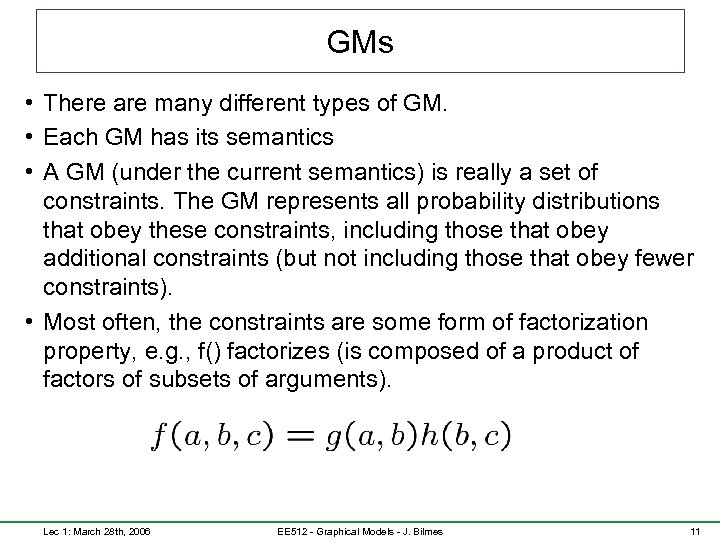 GMs • There are many different types of GM. • Each GM has its semantics • A GM (under the current semantics) is really a set of constraints. The GM represents all probability distributions that obey these constraints, including those that obey additional constraints (but not including those that obey fewer constraints). • Most often, the constraints are some form of factorization property, e. g. , f() factorizes (is composed of a product of factors of subsets of arguments). Lec 1: March 28 th, 2006 EE 512 - Graphical Models - J. Bilmes 11
 Types of Queries • Several types of queries we may be interested in: – Compute: p(one subset of vars) – Compute: p(one subset of vars| another subset of vars) – Find the N most probable configurations of one subset of variables given assignments of values to some other sets – Q: Is one subset independent of another subset? – Q: Is one subset independent of another given a third? • How efficiently can we do this? Can this question be answered? What if it is too costly, can we approximate, and if so, how well? These are questions we will answer this term. • GMs are like a probabilistic data-base (or data structure), a system that can be queried to provide answers to these sorts of questions. Lec 1: March 28 th, 2006 EE 512 - Graphical Models - J. Bilmes 12
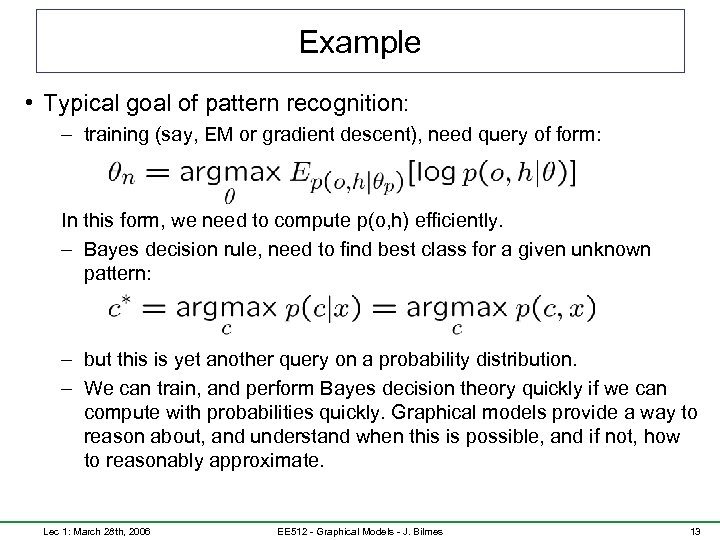 Example • Typical goal of pattern recognition: – training (say, EM or gradient descent), need query of form: In this form, we need to compute p(o, h) efficiently. – Bayes decision rule, need to find best class for a given unknown pattern: – but this is yet another query on a probability distribution. – We can train, and perform Bayes decision theory quickly if we can compute with probabilities quickly. Graphical models provide a way to reason about, and understand when this is possible, and if not, how to reasonably approximate. Lec 1: March 28 th, 2006 EE 512 - Graphical Models - J. Bilmes 13
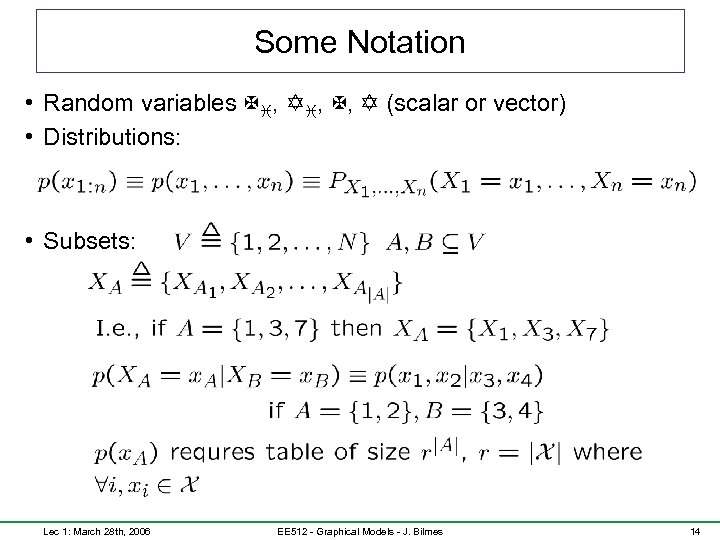 Some Notation • Random variables Xi, Yi, X, Y (scalar or vector) • Distributions: • Subsets: Lec 1: March 28 th, 2006 EE 512 - Graphical Models - J. Bilmes 14
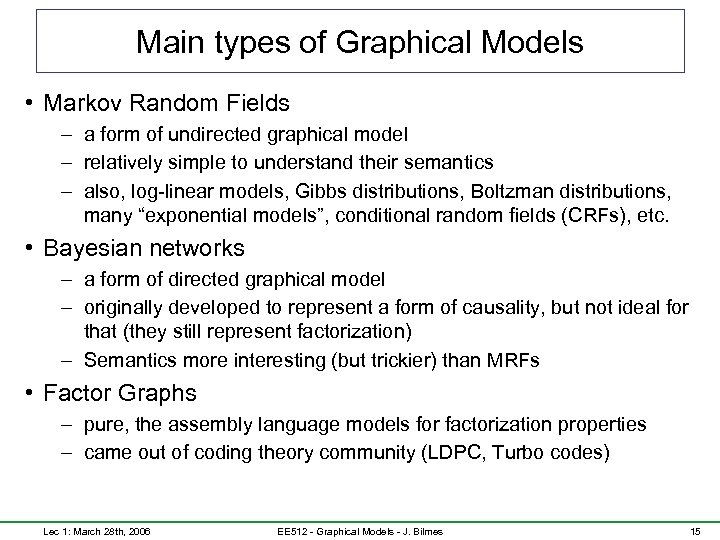 Main types of Graphical Models • Markov Random Fields – a form of undirected graphical model – relatively simple to understand their semantics – also, log-linear models, Gibbs distributions, Boltzman distributions, many “exponential models”, conditional random fields (CRFs), etc. • Bayesian networks – a form of directed graphical model – originally developed to represent a form of causality, but not ideal for that (they still represent factorization) – Semantics more interesting (but trickier) than MRFs • Factor Graphs – pure, the assembly language models for factorization properties – came out of coding theory community (LDPC, Turbo codes) Lec 1: March 28 th, 2006 EE 512 - Graphical Models - J. Bilmes 15
 Main types of Graphical Models • Chain graphs: – Hybrid between Bayesian networks and MRFs – A set of clusters of undirected nodes connected as directed links – Not as widely used, but very powerful. • Ancestral graphs – we probably won’t cover these. Lec 1: March 28 th, 2006 EE 512 - Graphical Models - J. Bilmes 16
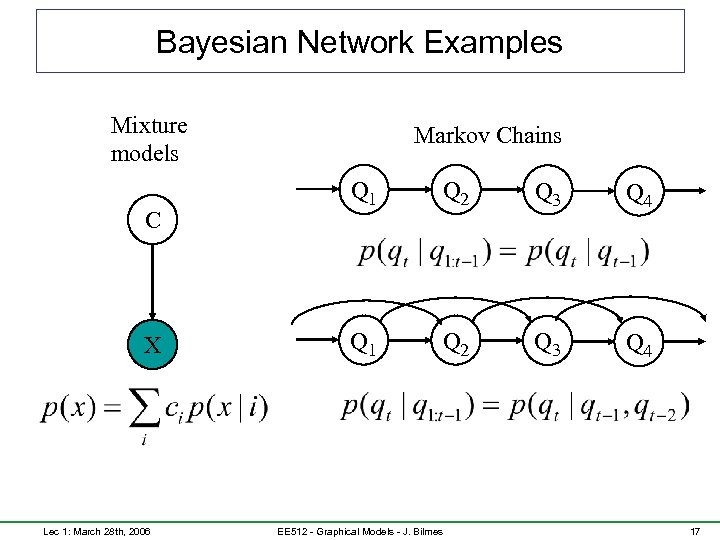 Bayesian Network Examples Mixture models C X Lec 1: March 28 th, 2006 Markov Chains Q 1 Q 2 Q 3 Q 4 EE 512 - Graphical Models - J. Bilmes 17
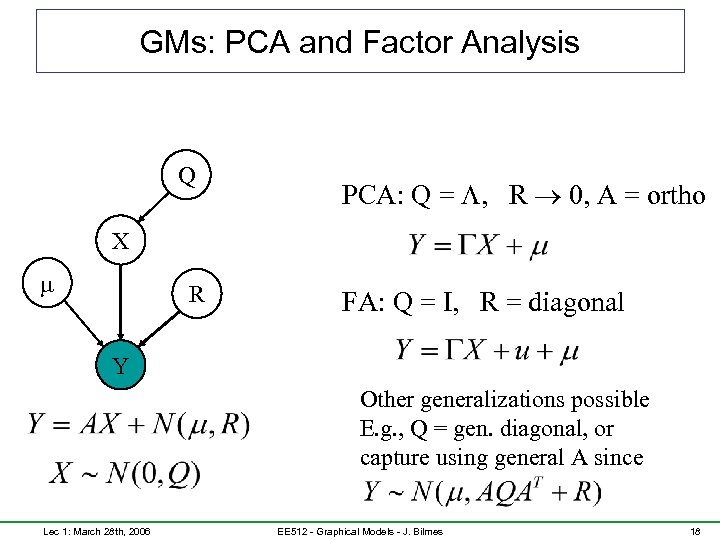 GMs: PCA and Factor Analysis Q PCA: Q = , R 0, A = ortho X R FA: Q = I, R = diagonal Y Other generalizations possible E. g. , Q = gen. diagonal, or capture using general A since Lec 1: March 28 th, 2006 EE 512 - Graphical Models - J. Bilmes 18
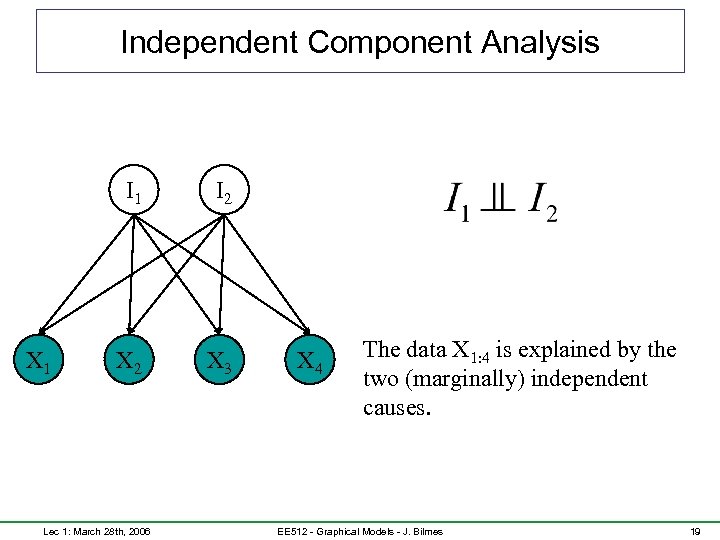 Independent Component Analysis I 1 X 1 I 2 X 3 Lec 1: March 28 th, 2006 X 4 The data X 1: 4 is explained by the two (marginally) independent causes. EE 512 - Graphical Models - J. Bilmes 19
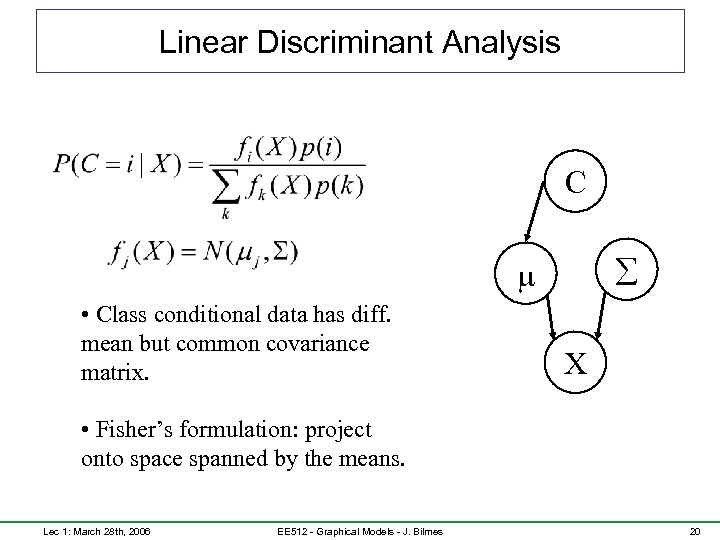 Linear Discriminant Analysis C • Class conditional data has diff. mean but common covariance matrix. X • Fisher’s formulation: project onto space spanned by the means. Lec 1: March 28 th, 2006 EE 512 - Graphical Models - J. Bilmes 20
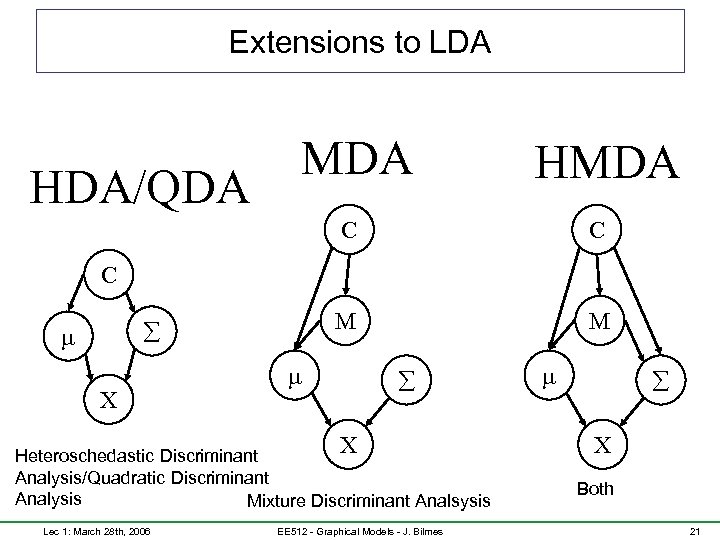 Extensions to LDA HDA/QDA MDA HMDA C C M M C X X Heteroschedastic Discriminant Analysis/Quadratic Discriminant Analysis Mixture Discriminant Analsysis Lec 1: March 28 th, 2006 EE 512 - Graphical Models - J. Bilmes X Both 21
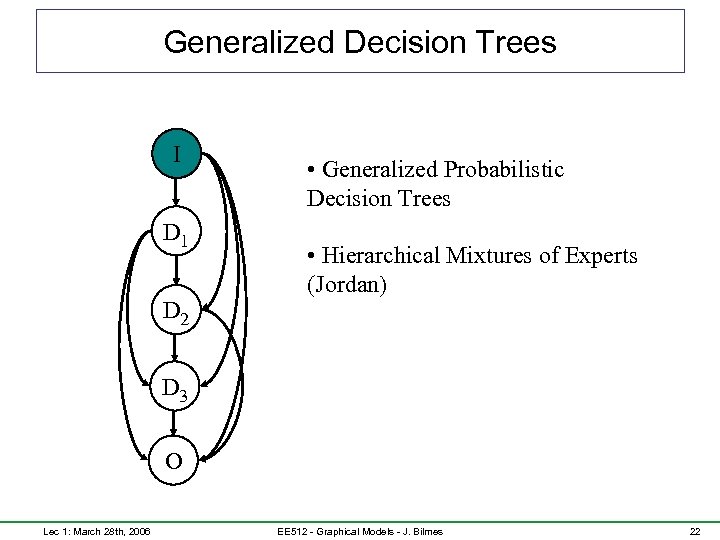 Generalized Decision Trees I D 1 D 2 • Generalized Probabilistic Decision Trees • Hierarchical Mixtures of Experts (Jordan) D 3 O Lec 1: March 28 th, 2006 EE 512 - Graphical Models - J. Bilmes 22
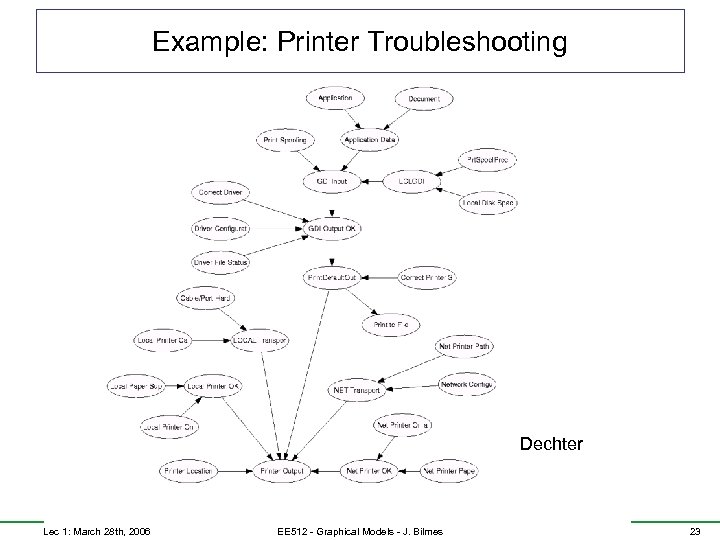 Example: Printer Troubleshooting Dechter Lec 1: March 28 th, 2006 EE 512 - Graphical Models - J. Bilmes 23
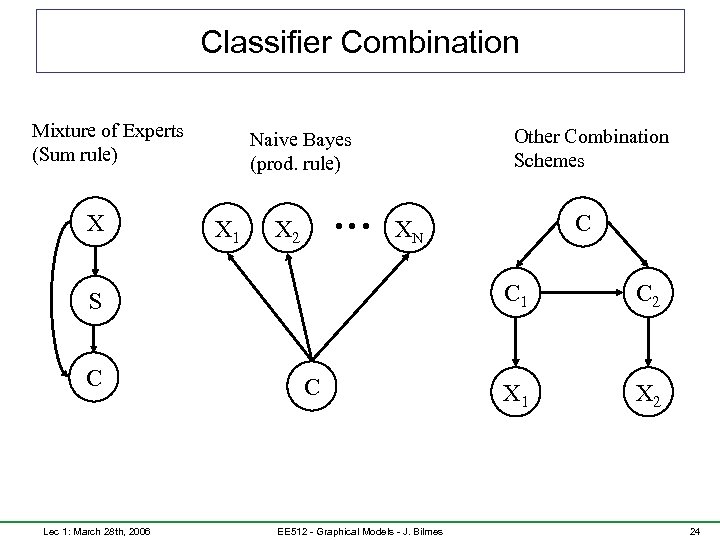 Classifier Combination Mixture of Experts (Sum rule) X Other Combination Schemes Naive Bayes (prod. rule) X 1 . . . X 2 C 1 S C Lec 1: March 28 th, 2006 C XN C EE 512 - Graphical Models - J. Bilmes C 2 X 1 X 2 24
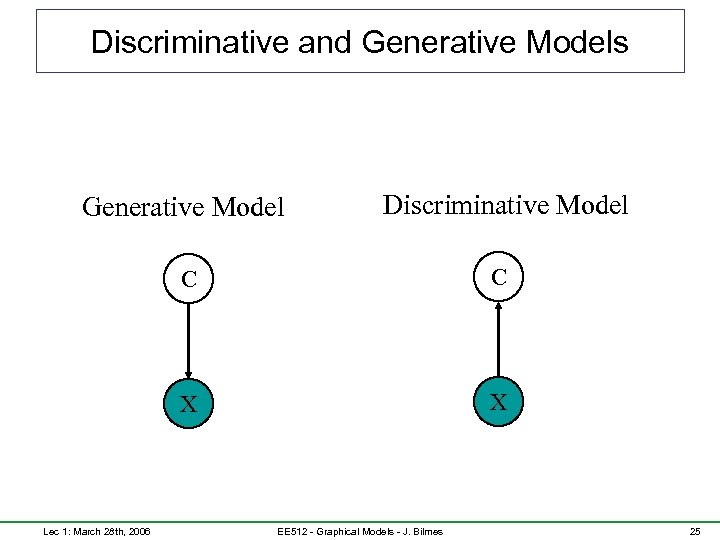 Discriminative and Generative Models Generative Model Discriminative Model C X Lec 1: March 28 th, 2006 C X EE 512 - Graphical Models - J. Bilmes 25
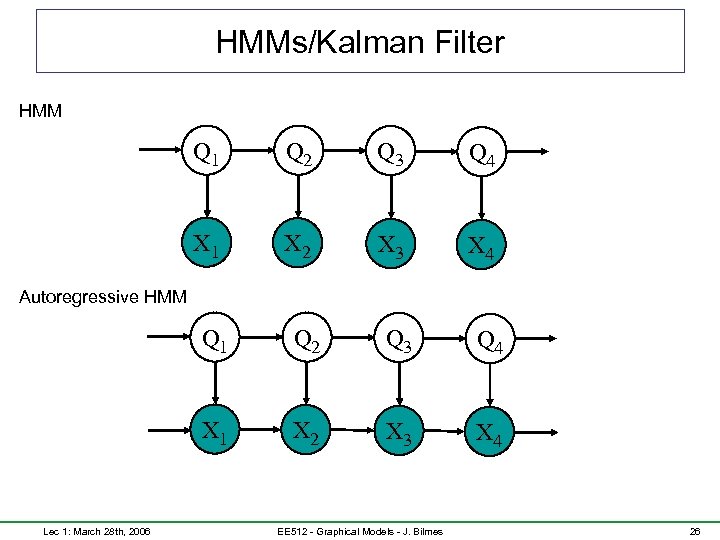 HMMs/Kalman Filter HMM Q 1 Q 2 Q 3 Q 4 X 1 X 2 X 3 X 4 Autoregressive HMM Q 1 Q 3 Q 4 X 1 Lec 1: March 28 th, 2006 Q 2 X 3 X 4 EE 512 - Graphical Models - J. Bilmes 26
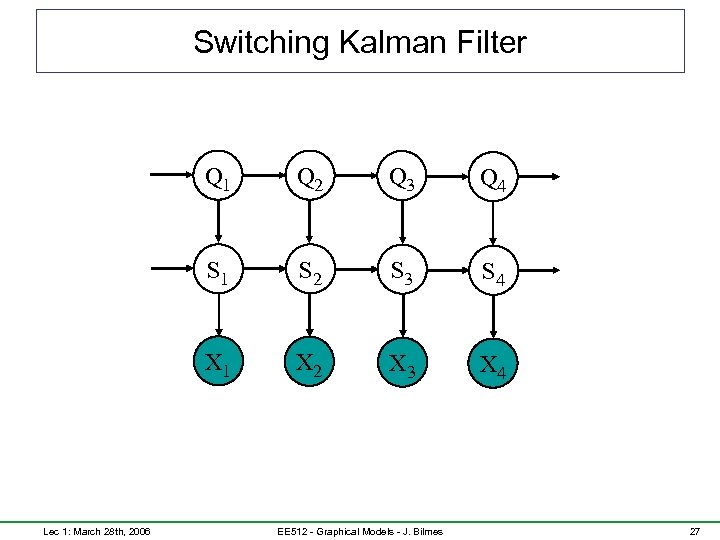 Switching Kalman Filter Q 1 Q 3 Q 4 S 1 S 2 S 3 S 4 X 1 Lec 1: March 28 th, 2006 Q 2 X 3 X 4 EE 512 - Graphical Models - J. Bilmes 27
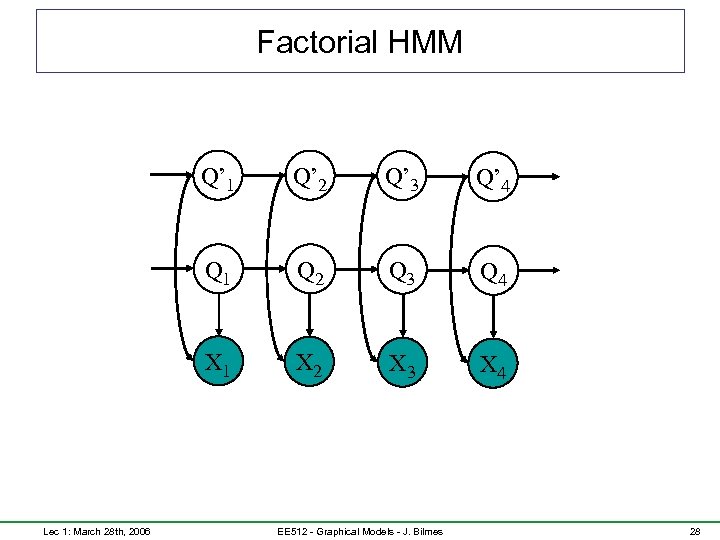 Factorial HMM Q’ 1 Q’ 3 Q’ 4 Q 1 Q 2 Q 3 Q 4 X 1 Lec 1: March 28 th, 2006 Q’ 2 X 3 X 4 EE 512 - Graphical Models - J. Bilmes 28
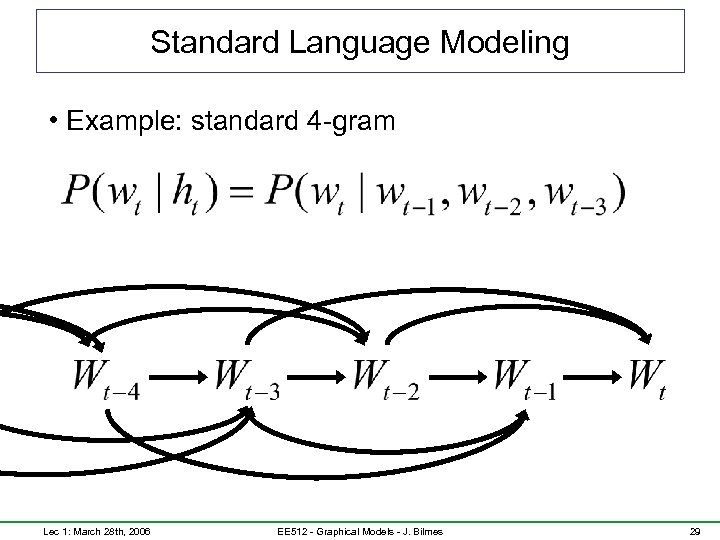 Standard Language Modeling • Example: standard 4 -gram Lec 1: March 28 th, 2006 EE 512 - Graphical Models - J. Bilmes 29
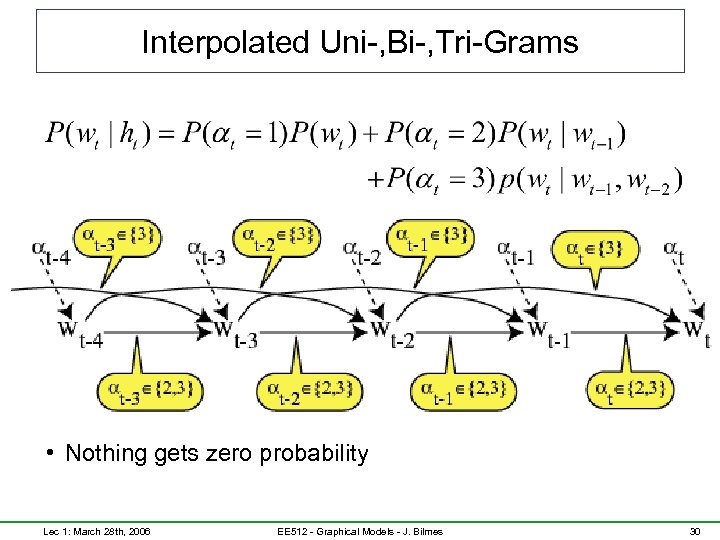 Interpolated Uni-, Bi-, Tri-Grams • Nothing gets zero probability Lec 1: March 28 th, 2006 EE 512 - Graphical Models - J. Bilmes 30
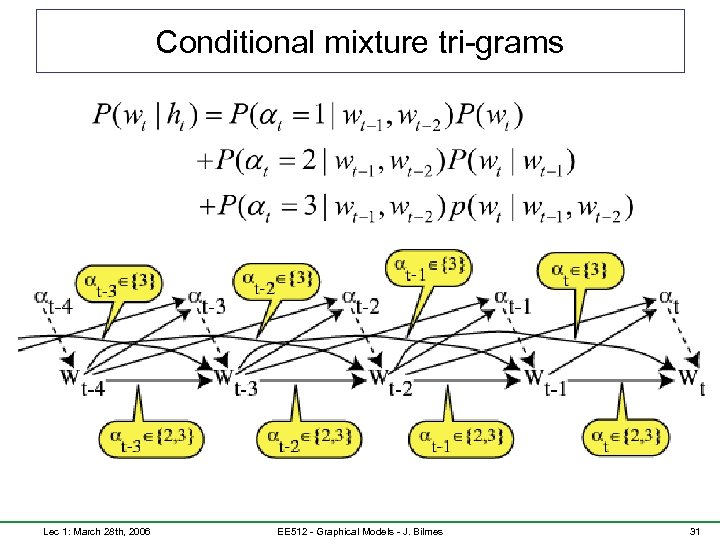 Conditional mixture tri-grams Lec 1: March 28 th, 2006 EE 512 - Graphical Models - J. Bilmes 31
 Bayesian Networks • … and so on • We need to be more formal about what BNs mean. • In the rest of this, and in the next, lecture, we start with basic semantics of BNs, move on to undirected models, and then come back to BNs again to clean up … Lec 1: March 28 th, 2006 EE 512 - Graphical Models - J. Bilmes 32
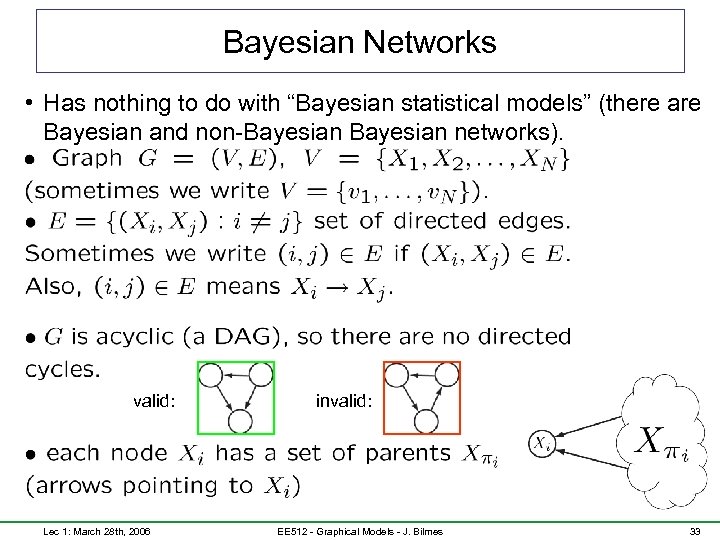 Bayesian Networks • Has nothing to do with “Bayesian statistical models” (there are Bayesian and non-Bayesian networks). valid: Lec 1: March 28 th, 2006 invalid: EE 512 - Graphical Models - J. Bilmes 33
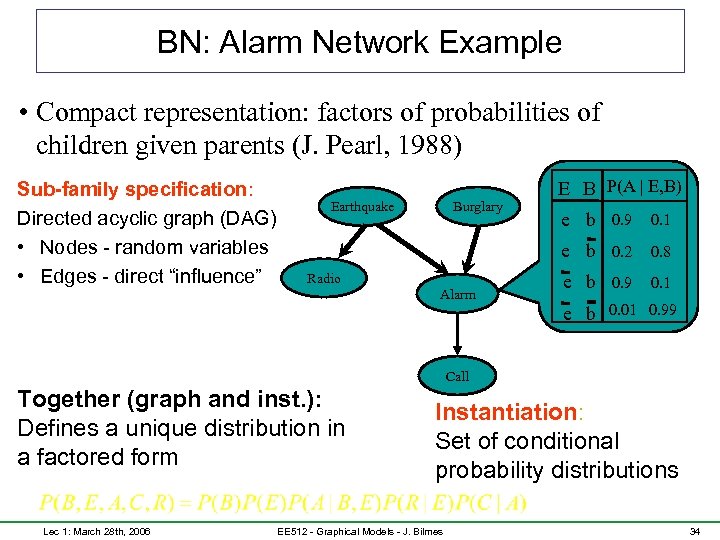 BN: Alarm Network Example • Compact representation: factors of probabilities of children given parents (J. Pearl, 1988) Sub-family specification: Directed acyclic graph (DAG) • Nodes - random variables • Edges - direct “influence” E B P(A | E, B) Burglary Earthquake 0. 1 0. 2 0. 8 e b 0. 9 0. 1 e b Alarm 0. 9 e b Radio e b 0. 01 0. 99 Call Together (graph and inst. ): Defines a unique distribution in a factored form Lec 1: March 28 th, 2006 Instantiation: Set of conditional probability distributions EE 512 - Graphical Models - J. Bilmes 34
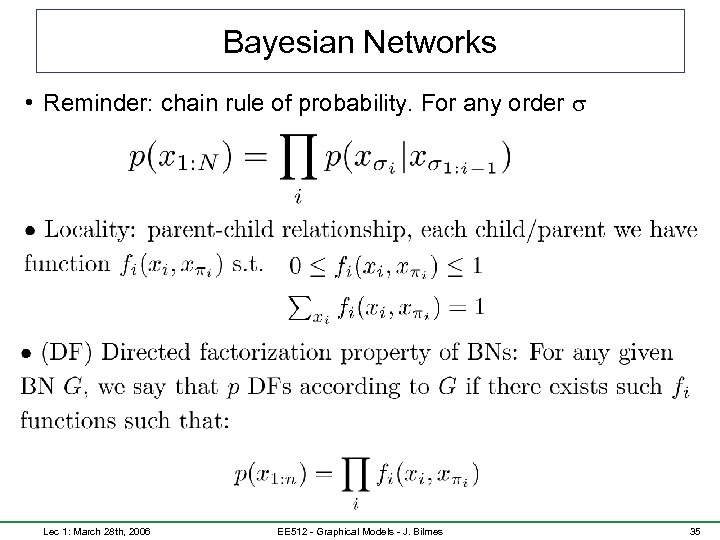 Bayesian Networks • Reminder: chain rule of probability. For any order Lec 1: March 28 th, 2006 EE 512 - Graphical Models - J. Bilmes 35
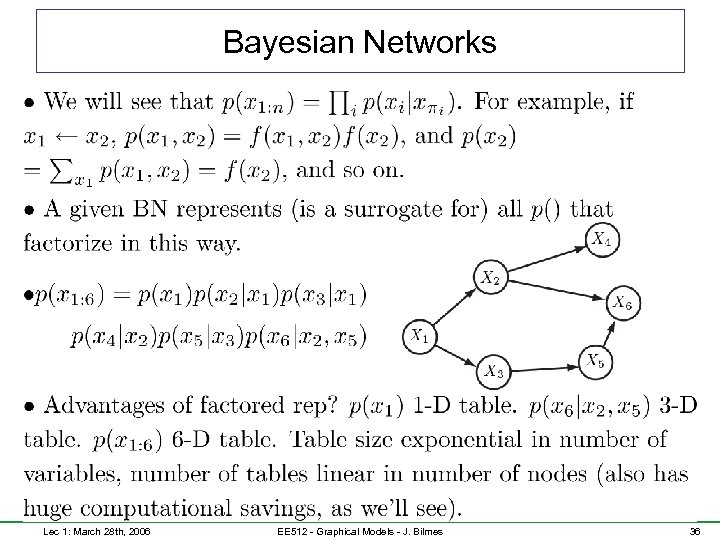 Bayesian Networks Lec 1: March 28 th, 2006 EE 512 - Graphical Models - J. Bilmes 36
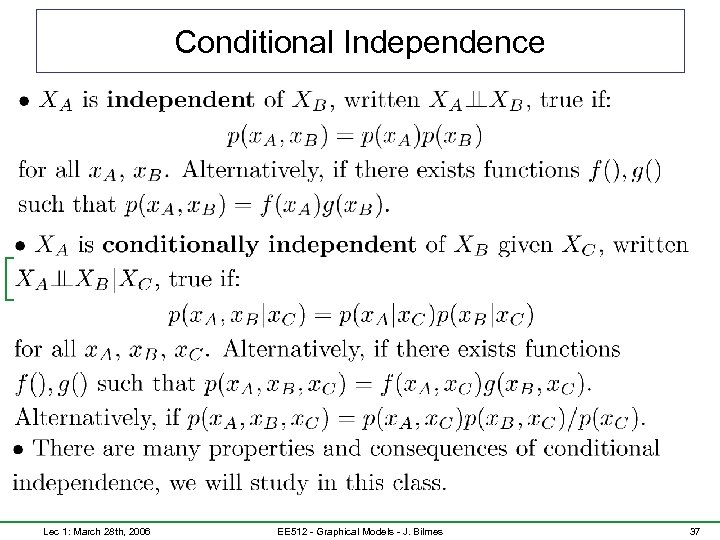 Conditional Independence Lec 1: March 28 th, 2006 EE 512 - Graphical Models - J. Bilmes 37
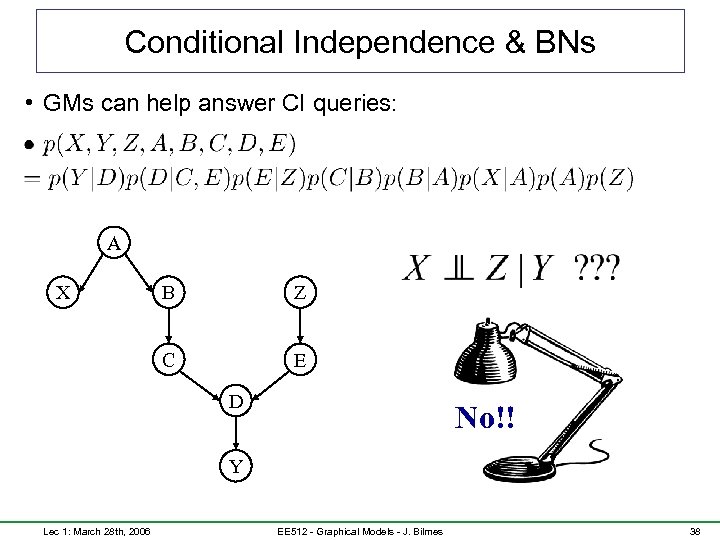 Conditional Independence & BNs • GMs can help answer CI queries: A X B Z C E D No!! Y Lec 1: March 28 th, 2006 EE 512 - Graphical Models - J. Bilmes 38
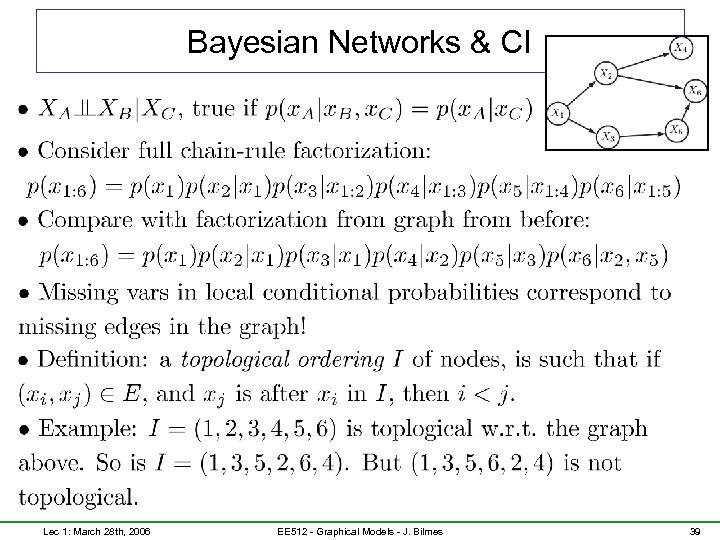 Bayesian Networks & CI Lec 1: March 28 th, 2006 EE 512 - Graphical Models - J. Bilmes 39
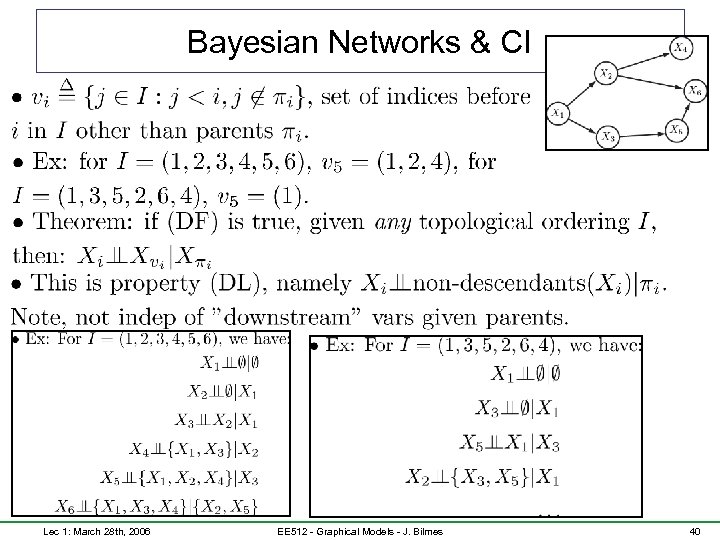 Bayesian Networks & CI Lec 1: March 28 th, 2006 EE 512 - Graphical Models - J. Bilmes 40
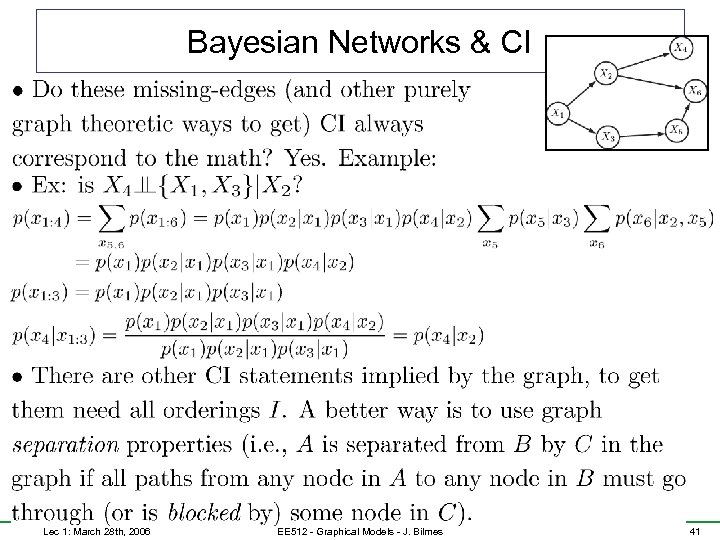 Bayesian Networks & CI Lec 1: March 28 th, 2006 EE 512 - Graphical Models - J. Bilmes 41
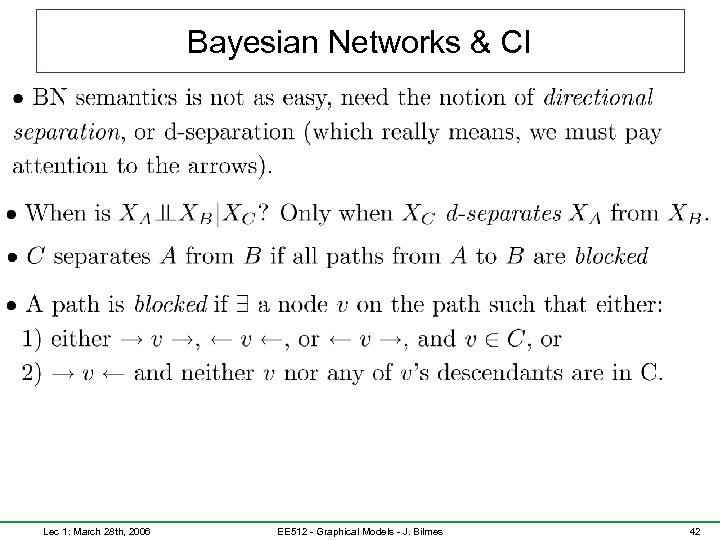 Bayesian Networks & CI Lec 1: March 28 th, 2006 EE 512 - Graphical Models - J. Bilmes 42
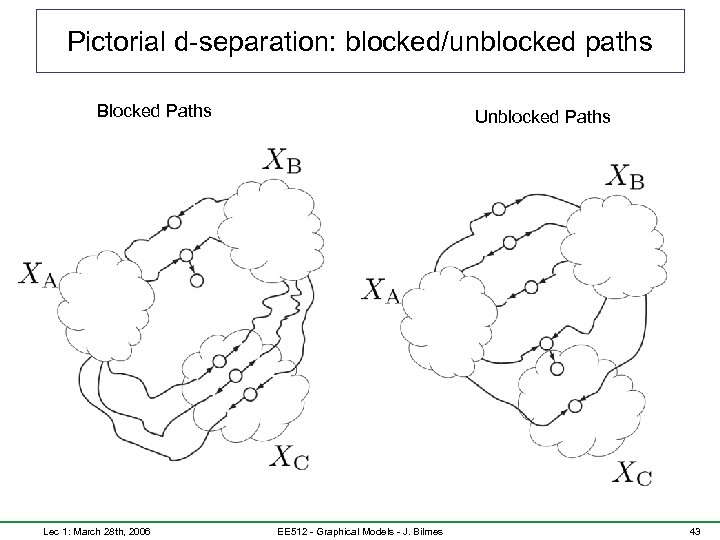 Pictorial d-separation: blocked/unblocked paths Blocked Paths Lec 1: March 28 th, 2006 Unblocked Paths EE 512 - Graphical Models - J. Bilmes 43
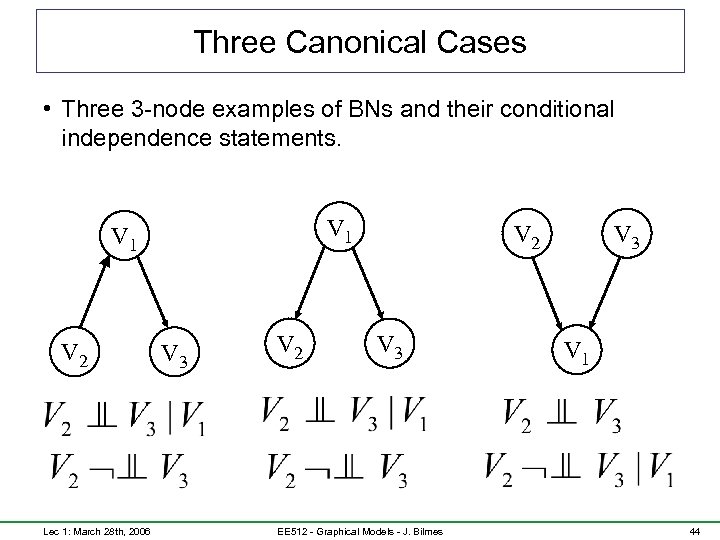 Three Canonical Cases • Three 3 -node examples of BNs and their conditional independence statements. V 1 V 2 Lec 1: March 28 th, 2006 V 3 V 2 V 3 EE 512 - Graphical Models - J. Bilmes V 1 44
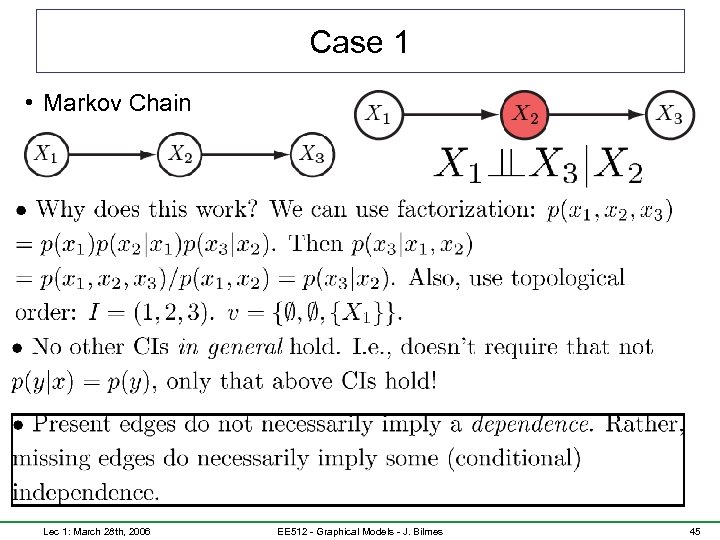 Case 1 • Markov Chain Lec 1: March 28 th, 2006 EE 512 - Graphical Models - J. Bilmes 45
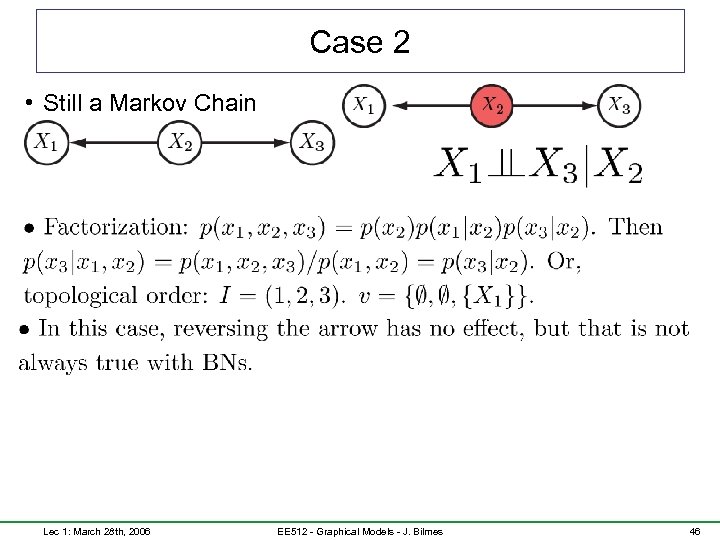 Case 2 • Still a Markov Chain Lec 1: March 28 th, 2006 EE 512 - Graphical Models - J. Bilmes 46
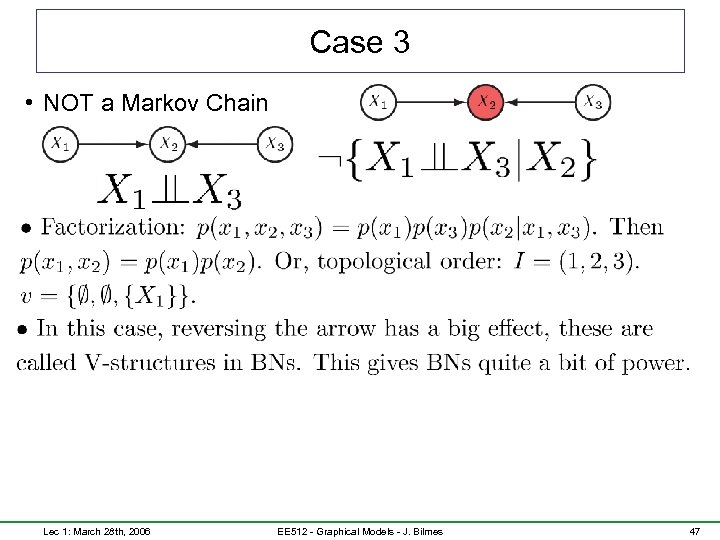 Case 3 • NOT a Markov Chain Lec 1: March 28 th, 2006 EE 512 - Graphical Models - J. Bilmes 47
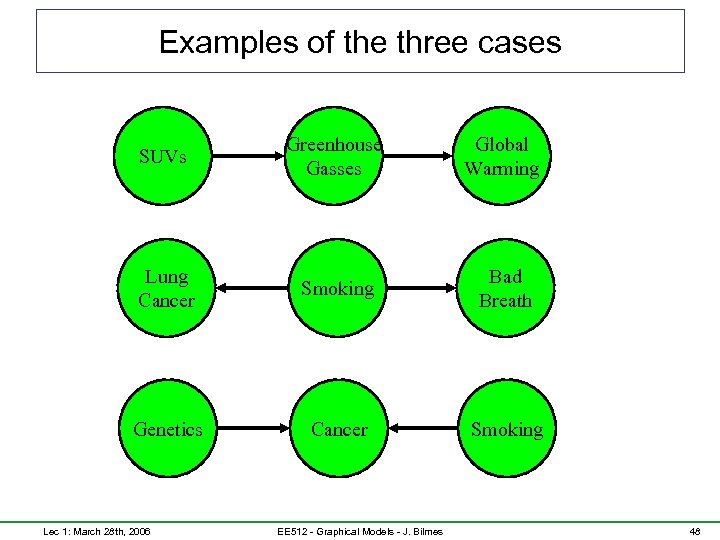 Examples of the three cases SUVs Greenhouse Gasses Global Warming Lung Cancer Smoking Bad Breath Genetics Cancer Smoking Lec 1: March 28 th, 2006 EE 512 - Graphical Models - J. Bilmes 48
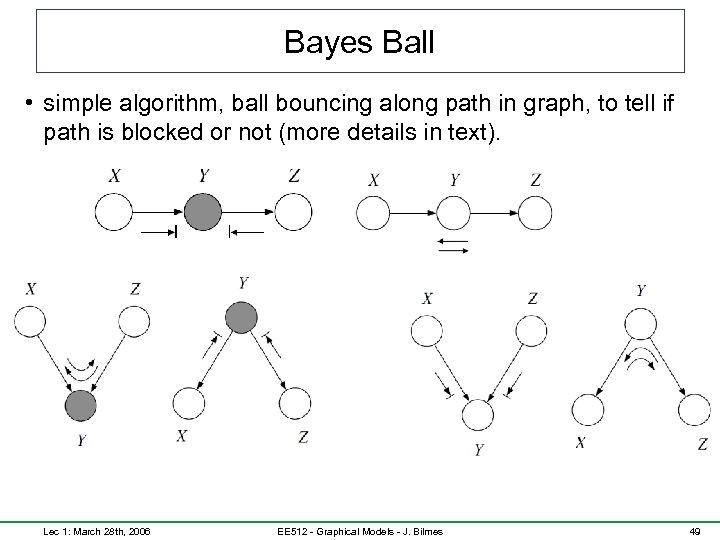 Bayes Ball • simple algorithm, ball bouncing along path in graph, to tell if path is blocked or not (more details in text). Lec 1: March 28 th, 2006 EE 512 - Graphical Models - J. Bilmes 49
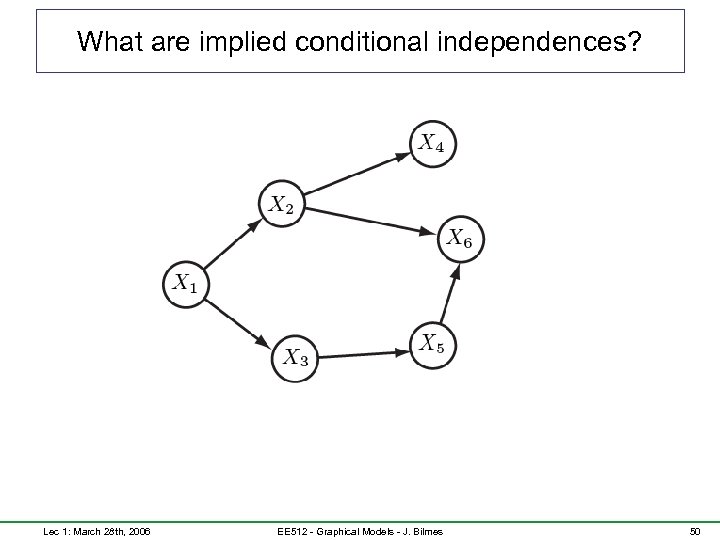 What are implied conditional independences? Lec 1: March 28 th, 2006 EE 512 - Graphical Models - J. Bilmes 50
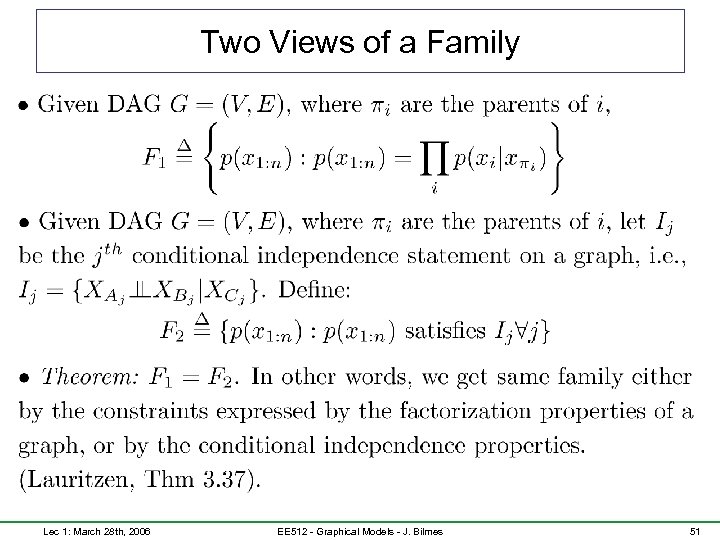 Two Views of a Family Lec 1: March 28 th, 2006 EE 512 - Graphical Models - J. Bilmes 51