


 Скачать презентацию University of Toronto Department of Computer Science Lecture
2972b19b5f61e8389d8f62c8acb7f4fb.ppt
- Количество слайдов: 15
 University of Toronto Department of Computer Science Lecture 17: Formal Modeling Methods Formal Modeling Techniques Definition of FM Why use FM? Program Specification vs. Requirements Modeling Example Formal Methods: RSML SCR RML Telos Albert II Tips on formal modeling © 2001, Steve Easterbrook CSC 444 Lec 17 1
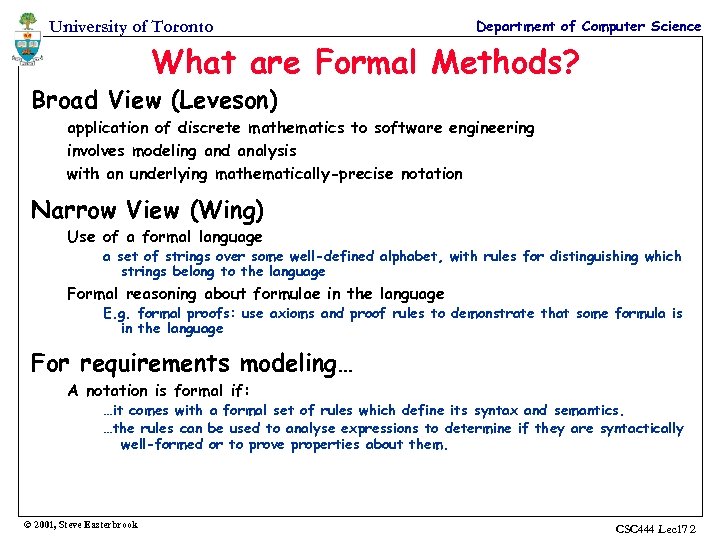 University of Toronto Department of Computer Science What are Formal Methods? Broad View (Leveson) application of discrete mathematics to software engineering involves modeling and analysis with an underlying mathematically-precise notation Narrow View (Wing) Use of a formal language a set of strings over some well-defined alphabet, with rules for distinguishing which strings belong to the language Formal reasoning about formulae in the language E. g. formal proofs: use axioms and proof rules to demonstrate that some formula is in the language For requirements modeling… A notation is formal if: …it comes with a formal set of rules which define its syntax and semantics. …the rules can be used to analyse expressions to determine if they are syntactically well-formed or to prove properties about them. © 2001, Steve Easterbrook CSC 444 Lec 17 2
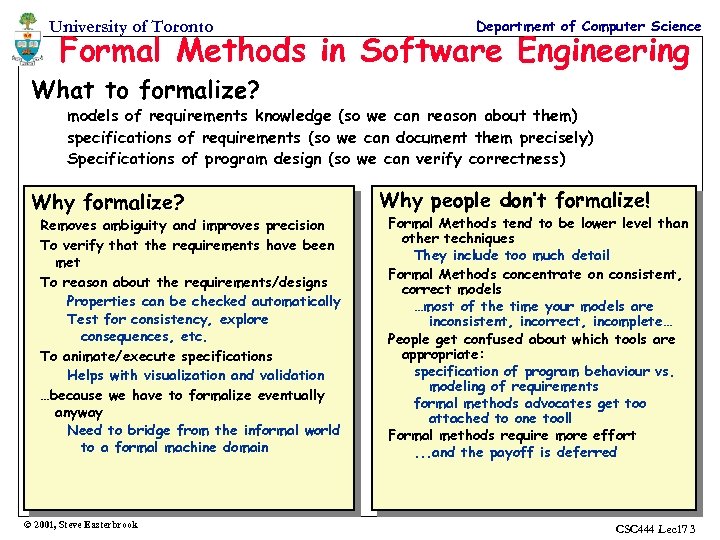 University of Toronto Department of Computer Science Formal Methods in Software Engineering What to formalize? models of requirements knowledge (so we can reason about them) specifications of requirements (so we can document them precisely) Specifications of program design (so we can verify correctness) Why formalize? Removes ambiguity and improves precision To verify that the requirements have been met To reason about the requirements/designs Properties can be checked automatically Test for consistency, explore consequences, etc. To animate/execute specifications Helps with visualization and validation …because we have to formalize eventually anyway Need to bridge from the informal world to a formal machine domain © 2001, Steve Easterbrook Why people don’t formalize! Formal Methods tend to be lower level than other techniques They include too much detail Formal Methods concentrate on consistent, correct models …most of the time your models are inconsistent, incorrect, incomplete… People get confused about which tools are appropriate: specification of program behaviour vs. modeling of requirements formal methods advocates get too attached to one tool! Formal methods require more effort. . . and the payoff is deferred CSC 444 Lec 17 3
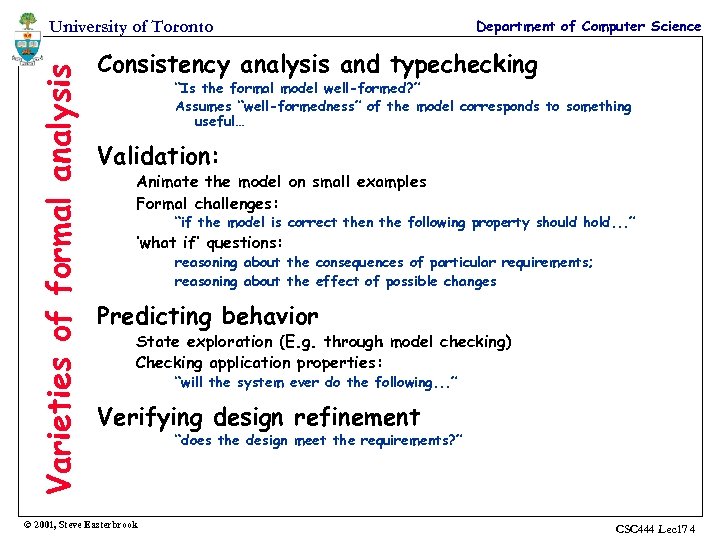 Varieties of formal analysis University of Toronto Department of Computer Science Consistency analysis and typechecking “Is the formal model well-formed? ” Assumes “well-formedness” of the model corresponds to something useful… Validation: Animate the model on small examples Formal challenges: “if the model is correct then the following property should hold. . . ” ‘what if’ questions: reasoning about the consequences of particular requirements; reasoning about the effect of possible changes Predicting behavior State exploration (E. g. through model checking) Checking application properties: “will the system ever do the following. . . ” Verifying design refinement © 2001, Steve Easterbrook “does the design meet the requirements? ” CSC 444 Lec 17 4
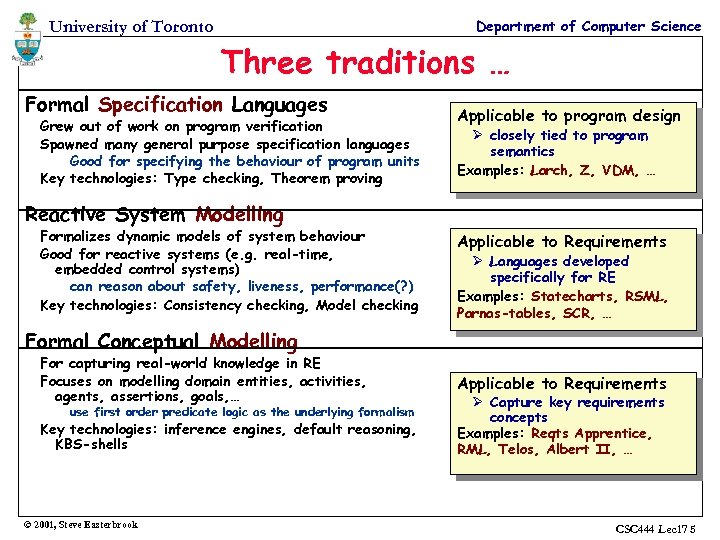 Department of Computer Science University of Toronto Three traditions … Formal Specification Languages Grew out of work on program verification Spawned many general purpose specification languages Good for specifying the behaviour of program units Key technologies: Type checking, Theorem proving Applicable to program design Ø closely tied to program semantics Examples: Larch, Z, VDM, … Reactive System Modelling Formalizes dynamic models of system behaviour Good for reactive systems (e. g. real-time, embedded control systems) can reason about safety, liveness, performance(? ) Key technologies: Consistency checking, Model checking Applicable to Requirements Ø Languages developed specifically for RE Examples: Statecharts, RSML, Parnas-tables, SCR, … Formal Conceptual Modelling For capturing real-world knowledge in RE Focuses on modelling domain entities, activities, agents, assertions, goals, … use first order predicate logic as the underlying formalism Key technologies: inference engines, default reasoning, KBS-shells © 2001, Steve Easterbrook Applicable to Requirements Ø Capture key requirements concepts Examples: Reqts Apprentice, RML, Telos, Albert II, … CSC 444 Lec 17 5
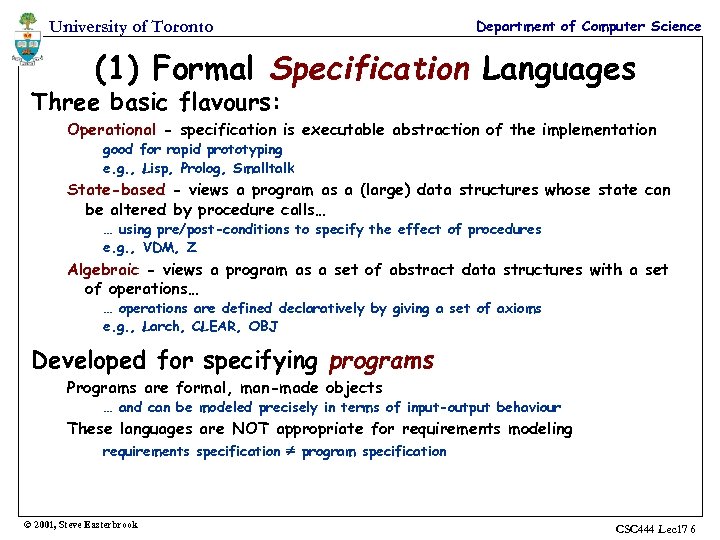 University of Toronto Department of Computer Science (1) Formal Specification Languages Three basic flavours: Operational - specification is executable abstraction of the implementation good for rapid prototyping e. g. , Lisp, Prolog, Smalltalk State-based - views a program as a (large) data structures whose state can be altered by procedure calls… … using pre/post-conditions to specify the effect of procedures e. g. , VDM, Z Algebraic - views a program as a set of abstract data structures with a set of operations… … operations are defined declaratively by giving a set of axioms e. g. , Larch, CLEAR, OBJ Developed for specifying programs Programs are formal, man-made objects … and can be modeled precisely in terms of input-output behaviour These languages are NOT appropriate for requirements modeling requirements specification program specification © 2001, Steve Easterbrook CSC 444 Lec 17 6
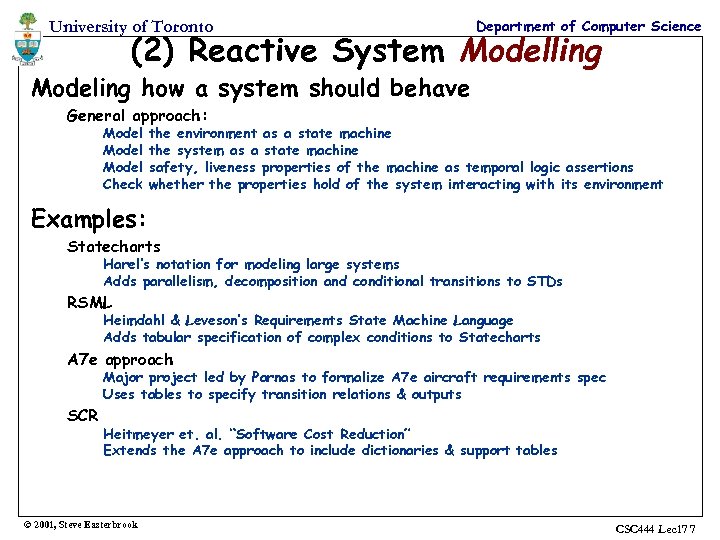 University of Toronto Department of Computer Science (2) Reactive System Modelling Modeling how a system should behave General approach: Model Check the environment as a state machine the system as a state machine safety, liveness properties of the machine as temporal logic assertions whether the properties hold of the system interacting with its environment Examples: Statecharts Harel’s notation for modeling large systems Adds parallelism, decomposition and conditional transitions to STDs RSML Heimdahl & Leveson’s Requirements State Machine Language Adds tabular specification of complex conditions to Statecharts A 7 e approach Major project led by Parnas to formalize A 7 e aircraft requirements spec Uses tables to specify transition relations & outputs SCR Heitmeyer et. al. “Software Cost Reduction” Extends the A 7 e approach to include dictionaries & support tables © 2001, Steve Easterbrook CSC 444 Lec 17 7
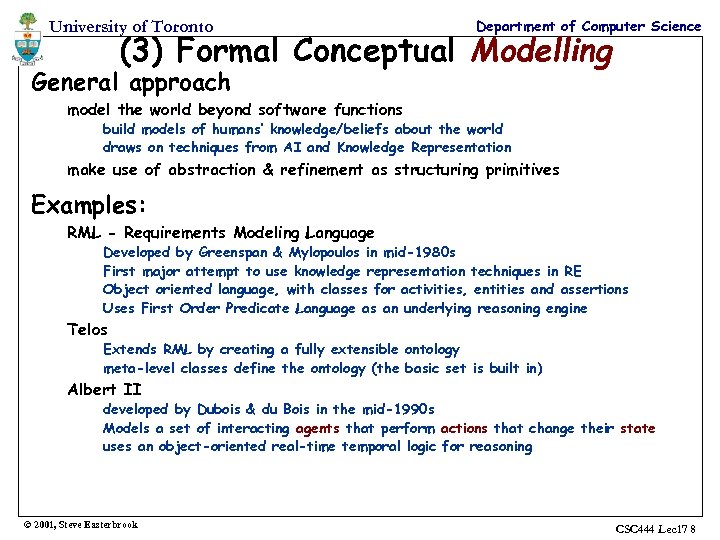 University of Toronto Department of Computer Science (3) Formal Conceptual Modelling General approach model the world beyond software functions build models of humans’ knowledge/beliefs about the world draws on techniques from AI and Knowledge Representation make use of abstraction & refinement as structuring primitives Examples: RML - Requirements Modeling Language Developed by Greenspan & Mylopoulos in mid-1980 s First major attempt to use knowledge representation techniques in RE Object oriented language, with classes for activities, entities and assertions Uses First Order Predicate Language as an underlying reasoning engine Telos Extends RML by creating a fully extensible ontology meta-level classes define the ontology (the basic set is built in) Albert II developed by Dubois & du Bois in the mid-1990 s Models a set of interacting agents that perform actions that change their state uses an object-oriented real-time temporal logic for reasoning © 2001, Steve Easterbrook CSC 444 Lec 17 8
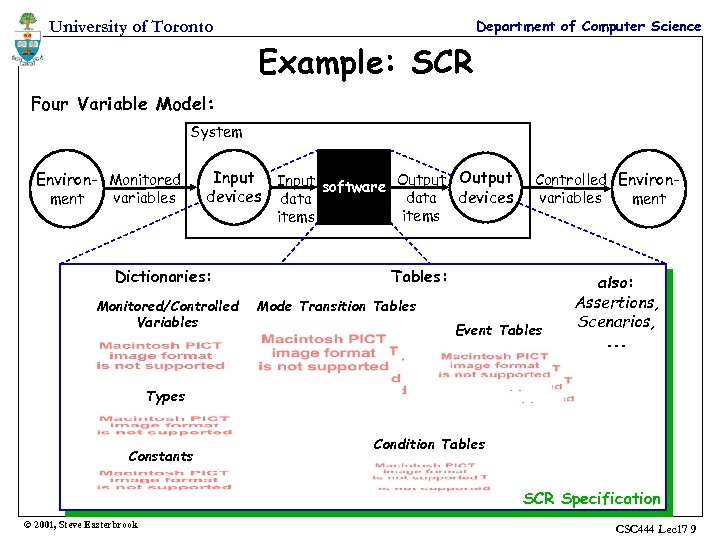 Department of Computer Science University of Toronto Example: SCR Four Variable Model: System Environ- Monitored ment variables Input Output software Output devices data devices Dictionaries: Monitored/Controlled Variables items Controlled Environvariables ment Tables: Mode Transition Tables Event Tables also: Assertions, Scenarios, . . . Types Constants Condition Tables SCR Specification © 2001, Steve Easterbrook CSC 444 Lec 17 9
 University of Toronto SCR basics Department of Computer Science Source: Adapted from Heitmeyer et. al. 1996. Modes and Mode classes A mode class is a finite state machine, with states called system modes Transitions in each mode class are triggered by events Complex systems are described using a number of mode classes operating in parallel System State A (system) state is defined as: the system is in exactly one mode from each mode class… …and each variable has a unique value Events An event occurs when any system entity changes value An input event occurs when an input variable changes value Single input assumption - only one input event can occur at once Notation: @T(c) means “c changed from false to true” A conditioned event is an event with a predicate @T(c) WHEN d means: “c became true when c was false and d was true” © 2001, Steve Easterbrook CSC 444 Lec 17 10
 Department of Computer Science University of Toronto SCR Tables Mode Class Tables Source: Adapted from Heitmeyer et. al. 1996. Define the set of modes (states) that the software can be in. A complex system will have many different modes classes Each mode class has a mode table showing the conditions that cause transitions between modes A mode table defines a partial function from modes and events to modes Event Tables An event table defines how a term or controlled variable changes in response to input events Defines a partial function from modes and events to variable values Condition Tables A condition table defines the value of a term or controlled variable under every possible condition Defines a total function from modes and conditions to variable values © 2001, Steve Easterbrook CSC 444 Lec 17 11
 Department of Computer Science University of Toronto Example: Temp Control System Source: Adapted from Heitmeyer et. al. 1996. Mode transition table: © 2001, Steve Easterbrook CSC 444 Lec 17 12
 Department of Computer Science University of Toronto Failure modes Source: Adapted from Heitmeyer et. al. 1996. Mode transition table: Event table: © 2001, Steve Easterbrook CSC 444 Lec 17 13
 University of Toronto Department of Computer Science Using Formal Methods Selective use of Formal Methods Amount of formality can vary Need not build complete formal models Apply to the most critical pieces Apply where existing analysis techniques are weak Need not formally analyze every system property E. g. check safety properties only Need not apply FM in every phase of development E. g. use for modeling requirements, but don’t formalize the system design Can choose what level of abstraction (amount of detail) to model Lightweight Formal Methods Have become popular as a means of getting the technology transferred Two approaches Lightweight use of FMs - selectively apply FMs for partial modeling Lightweight FMs - new methods that allow unevaluated predicates © 2001, Steve Easterbrook CSC 444 Lec 17 14
 Department of Computer Science University of Toronto References van Vliet, H. “Software Engineering: Principles and Practice (2 nd Edition)” Wiley, 1999. van Vliet gives a good introduction to formal methods in chapter 15. In particular, sections 15. 1 and 15. 5 are worth reading, to give a feel for the current state of the art, and the problems that hinder the use of formal methods in practice. van Vliet describes a completely different set of formal modeling techniques from those covered in this lecture – he concentrates on methods that can be used for program design models, rather than requirements models. Heitmeyer, C. L. , Jeffords, R. D. , & Labaw, B. G. (1996). Automated Consistency Checking of Requirements Specifications. ACM Transactions on Software Engineering and Methodology, 5(3), 231 -261. Describes SCR in detail. © 2001, Steve Easterbrook CSC 444 Lec 17 15