


 Скачать презентацию University of the German Armed Forces Munich Faculty
5ff1b5e84cb333315fc52134019adea9.ppt
- Количество слайдов: 35
 University of the German Armed Forces Munich Faculty of Civil and Environmental Engineering Institute of Engineering Mechanics and Structural Mechanics Laboratory of Engineering Informatics Univ. -Prof. Dr. -Ing. habil. N. Gebbeken A method for the development and control of stiffness matrices for the calculation of beam and shell structures using the symbolic programming language MAPLE N. Gebbeken, E. Pfeiffer, I. Videkhina
 Relevance of the topic In structural engineering the design and calculation of beam and shell structures is a daily practice. Beam and shell elements can also be combined in spatial structures like bridges, multi-story buildings, tunnels, impressive architectural buildings etc. Truss structure, Railway bridge Firth of Forth (Scotland) Folded plate structure, Church in Las Vegas University of the German Armed Forces Munich Faculty of Civil and Environmental Engineering Institute of Engineering Mechanics and Structural Mechanics / Laboratory of Engineering Informatics Univ. -Prof. Dr. -Ing. habil. N. Gebbeken
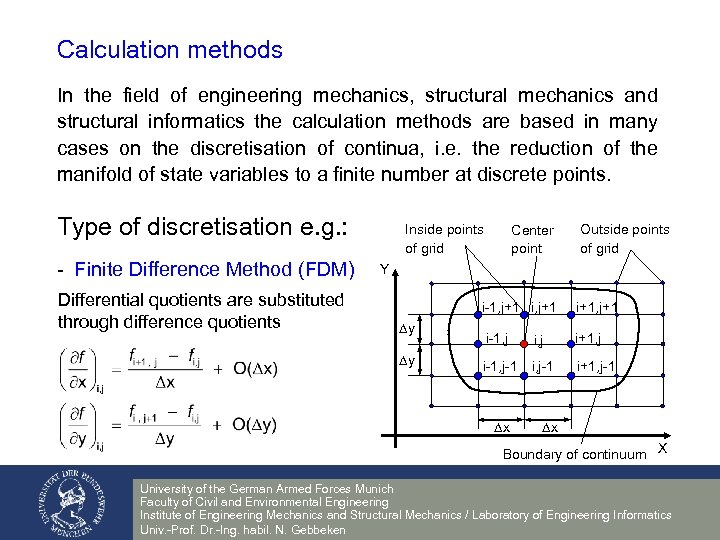 Calculation methods In the field of engineering mechanics, structural mechanics and structural informatics the calculation methods are based in many cases on the discretisation of continua, i. e. the reduction of the manifold of state variables to a finite number at discrete points. Type of discretisation e. g. : - Finite Difference Method (FDM) Differential quotients are substituted through difference quotients Inside points of grid Center point Outside points of grid Y i-1, j+1 i, j+1 y y i+1, j+1 i-1, j i+1, j i-1, j-1 i, j-1 x i+1, j-1 x Boundary of continuum X University of the German Armed Forces Munich Faculty of Civil and Environmental Engineering Institute of Engineering Mechanics and Structural Mechanics / Laboratory of Engineering Informatics Univ. -Prof. Dr. -Ing. habil. N. Gebbeken
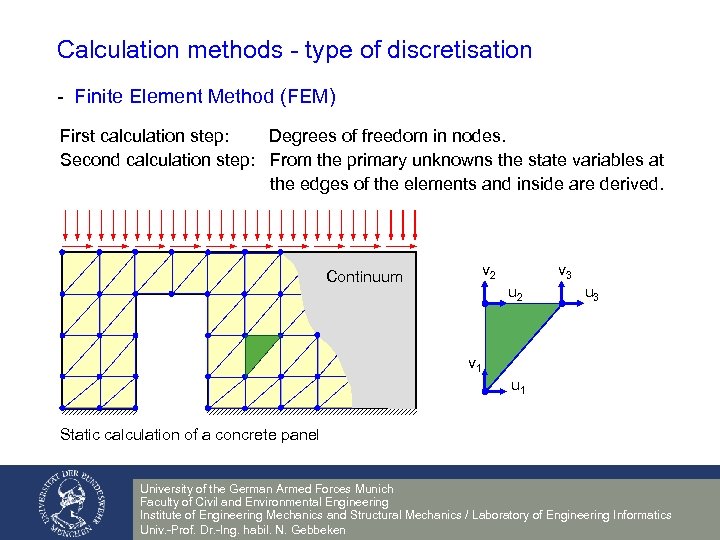 Calculation methods - type of discretisation - Finite Element Method (FEM) First calculation step: Degrees of freedom in nodes. Second calculation step: From the primary unknowns the state variables at the edges of the elements and inside are derived. v 2 Continuum v 3 u 2 u 3 v 1 u 1 Static calculation of a concrete panel University of the German Armed Forces Munich Faculty of Civil and Environmental Engineering Institute of Engineering Mechanics and Structural Mechanics / Laboratory of Engineering Informatics Univ. -Prof. Dr. -Ing. habil. N. Gebbeken
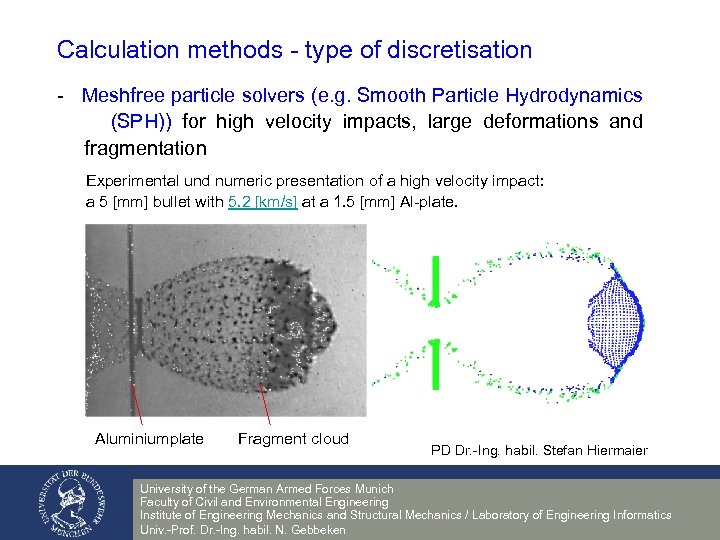 Calculation methods - type of discretisation - Meshfree particle solvers (e. g. Smooth Particle Hydrodynamics (SPH)) for high velocity impacts, large deformations and fragmentation Experimental und numeric presentation of a high velocity impact: a 5 [mm] bullet with 5. 2 [km/s] at a 1. 5 [mm] Al-plate. Aluminiumplate Fragment cloud PD Dr. -Ing. habil. Stefan Hiermaier University of the German Armed Forces Munich Faculty of Civil and Environmental Engineering Institute of Engineering Mechanics and Structural Mechanics / Laboratory of Engineering Informatics Univ. -Prof. Dr. -Ing. habil. N. Gebbeken
 FEM-Advantages: + Continua can easily be approximated with different element geometries (e. g. triangles, rectangles, tetrahedrons, cuboids) + The strict formalisation of the method enables a simplementation of new elements in an existing calculus + The convergence of the discretised model to the real system behaviour can be influenced with well-known strategies, e. g. refinement of the mesh, higher degrees of element formulations, automated mesh adaptivity depending on stress gradients or local errors University of the German Armed Forces Munich Faculty of Civil and Environmental Engineering Institute of Engineering Mechanics and Structural Mechanics / Laboratory of Engineering Informatics Univ. -Prof. Dr. -Ing. habil. N. Gebbeken
 Aspects about FEM - Extensive fundamentals in mathematics (infinitesimal calculus, calculus of variations, numerical integration, error estimation, error propagation etc. ) and mechanics (e. g. nonlinearities of material and the geometry) are needed. Unexperienced users tend to use FEM-programmes as a „black box“. - Teaching the FEM-theory is much more time consuming as other numerical methods, e. g. FDM At this point it is helpful to use the symbolic programming language MAPLE as an e. Learning tool: the mathematical background is imparted without undue effort and effects of modified calculation steps or extensions of the FEM-theory can be studied easier! University of the German Armed Forces Munich Faculty of Civil and Environmental Engineering Institute of Engineering Mechanics and Structural Mechanics / Laboratory of Engineering Informatics Univ. -Prof. Dr. -Ing. habil. N. Gebbeken
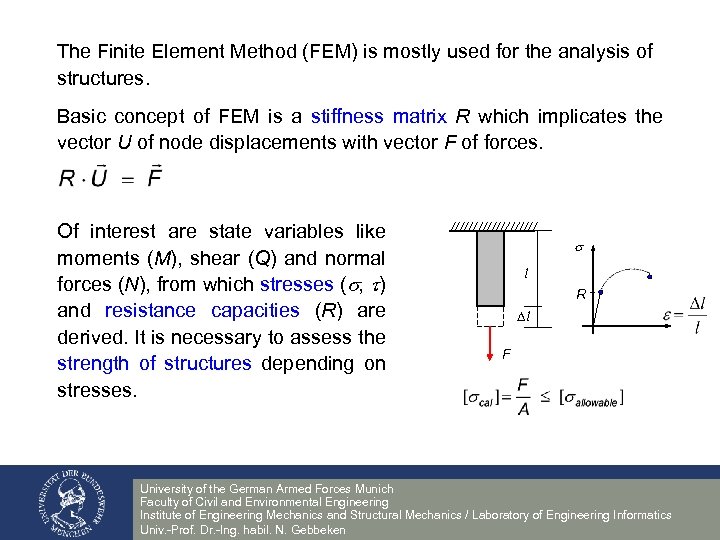 The Finite Element Method (FEM) is mostly used for the analysis of structures. Basic concept of FEM is a stiffness matrix R which implicates the vector U of node displacements with vector F of forces. Of interest are state variables like moments (M), shear (Q) and normal forces (N), from which stresses ( , ) and resistance capacities (R) are derived. It is necessary to assess the strength of structures depending on stresses. l R l F University of the German Armed Forces Munich Faculty of Civil and Environmental Engineering Institute of Engineering Mechanics and Structural Mechanics / Laboratory of Engineering Informatics Univ. -Prof. Dr. -Ing. habil. N. Gebbeken
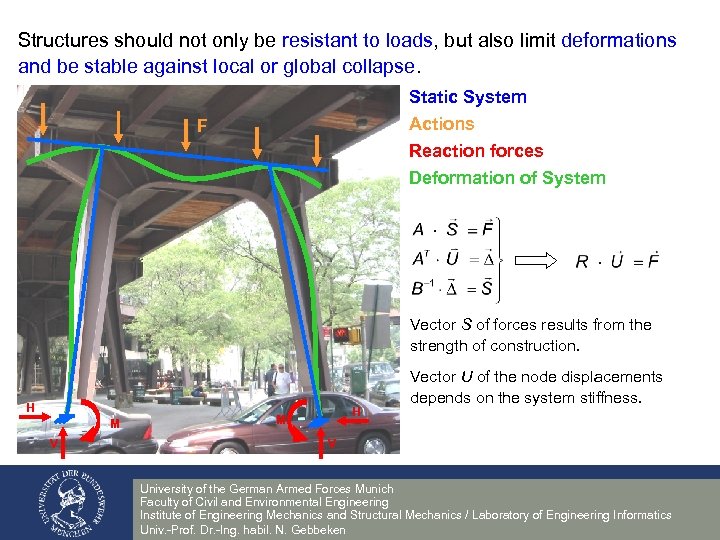 Structures should not only be resistant to loads, but also limit deformations and be stable against local or global collapse. Static System Actions Reaction forces F Deformation of System Vector S of forces results from the strength of construction. H M Vector U of the node displacements depends on the system stiffness. V University of the German Armed Forces Munich Faculty of Civil and Environmental Engineering Institute of Engineering Mechanics and Structural Mechanics / Laboratory of Engineering Informatics Univ. -Prof. Dr. -Ing. habil. N. Gebbeken
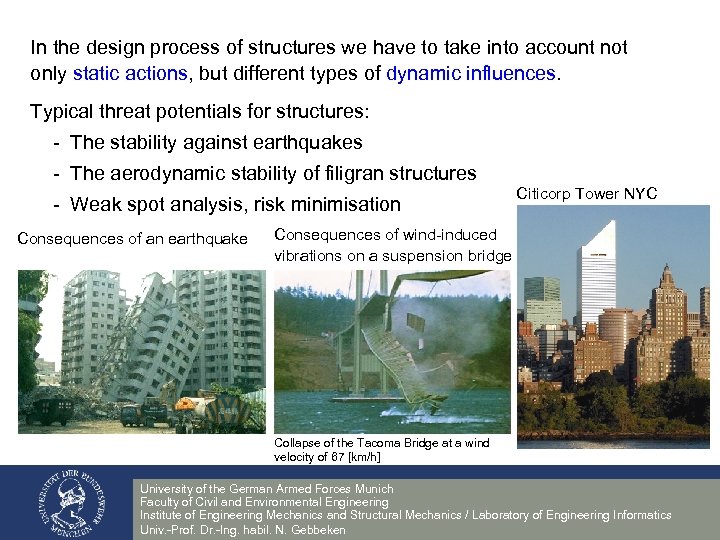 In the design process of structures we have to take into account not only static actions, but different types of dynamic influences. Typical threat potentials for structures: - The stability against earthquakes - The aerodynamic stability of filigran structures - Weak spot analysis, risk minimisation Consequences of an earthquake Citicorp Tower NYC Consequences of wind-induced vibrations on a suspension bridge Collapse of the Tacoma Bridge at a wind velocity of 67 [km/h] University of the German Armed Forces Munich Faculty of Civil and Environmental Engineering Institute of Engineering Mechanics and Structural Mechanics / Laboratory of Engineering Informatics Univ. -Prof. Dr. -Ing. habil. N. Gebbeken
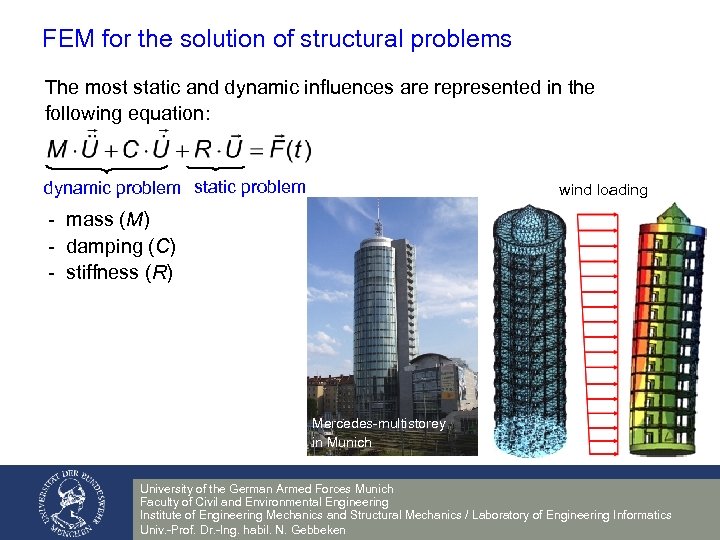 FEM for the solution of structural problems The most static and dynamic influences are represented in the following equation: dynamic problem static problem wind loading - mass (M) - damping (C) - stiffness (R) Mercedes-multistorey in Munich University of the German Armed Forces Munich Faculty of Civil and Environmental Engineering Institute of Engineering Mechanics and Structural Mechanics / Laboratory of Engineering Informatics Univ. -Prof. Dr. -Ing. habil. N. Gebbeken
 Research goals: 1. The basic purpose of this work is the creation of an universal method for the development of stiffness matrices which are necessary for the calculation of engineering constructions using the symbolic programming language MAPLE. 2. Assessment of correctness of the obtained stiffness matrices. University of the German Armed Forces Munich Faculty of Civil and Environmental Engineering Institute of Engineering Mechanics and Structural Mechanics / Laboratory of Engineering Informatics Univ. -Prof. Dr. -Ing. habil. N. Gebbeken
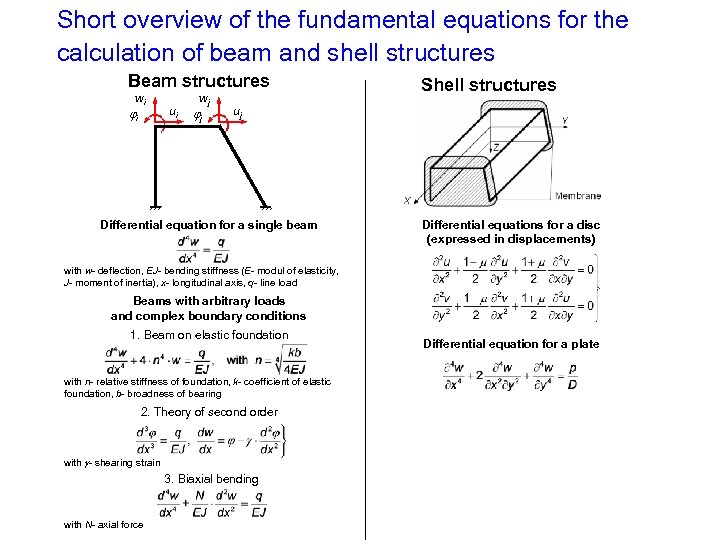 Short overview of the fundamental equations for the calculation of beam and shell structures Beam structures wi i ui wj j Shell structures uj Differential equation for a single beam Differential equations for a disc (expressed in displacements) with w- deflection, EJ- bending stiffness (E- modul of elasticity, J- moment of inertia), x- longitudinal axis, q- line load Beams with arbitrary loads and complex boundary conditions 1. Beam on elastic foundation with n- relative stiffness of foundation, k- coefficient of elastic foundation, b- broadness of bearing 2. Theory of second order with - shearing strain 3. Biaxial bending with N- axial force Differential equation for a plate
 Calculation of beam structures For the elaboration of the stiffness matrix for beams the following approach will be suggested: 1. Based on the differential equation for a beam the stiffness matrix is developed in a local coordinate system. 2. Consideration of the stiff or hinge connection in the nodes at the end of the beam. 3. Extension of element matrix formulations for beams with different characteristics, e. g. tension/ compression. 4. Transforming the expressions from the local coordinate system into the global coordinate system. 5. The element matrices are assembled in the global stiffness matrix. University of the German Armed Forces Munich Faculty of Civil and Environmental Engineering Institute of Engineering Mechanics and Structural Mechanics / Laboratory of Engineering Informatics Univ. -Prof. Dr. -Ing. habil. N. Gebbeken
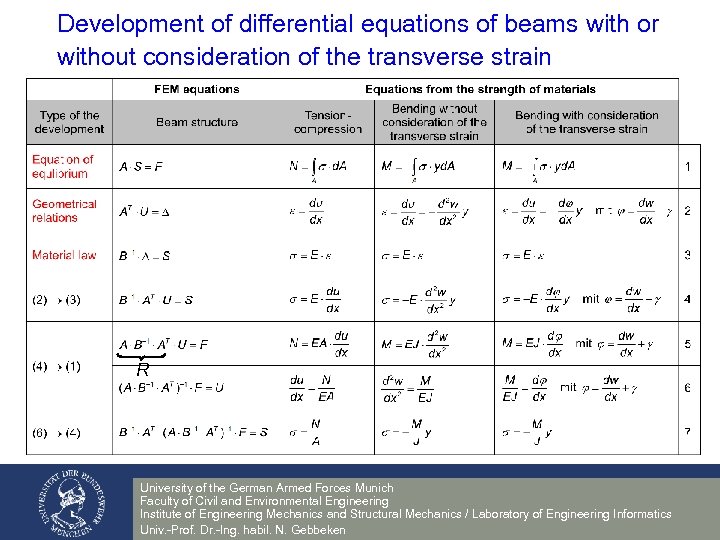 Development of differential equations of beams with or without consideration of the transverse strain R University of the German Armed Forces Munich Faculty of Civil and Environmental Engineering Institute of Engineering Mechanics and Structural Mechanics / Laboratory of Engineering Informatics Univ. -Prof. Dr. -Ing. habil. N. Gebbeken
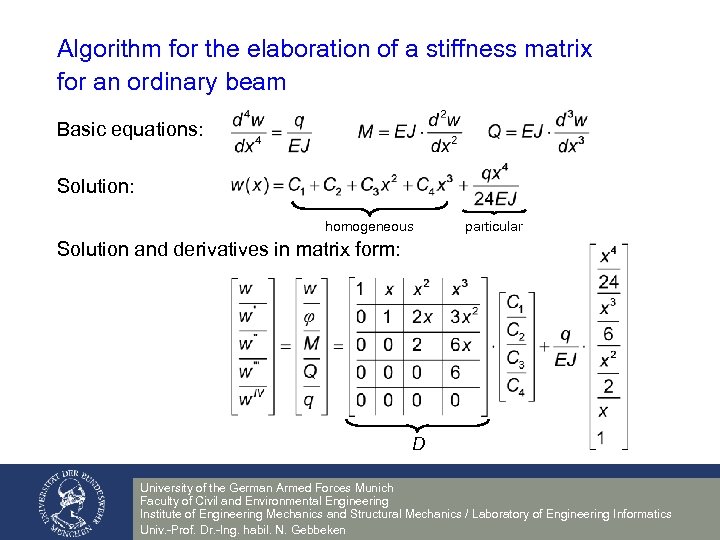 Algorithm for the elaboration of a stiffness matrix for an ordinary beam Basic equations: Solution: homogeneous particular Solution and derivatives in matrix form: D University of the German Armed Forces Munich Faculty of Civil and Environmental Engineering Institute of Engineering Mechanics and Structural Mechanics / Laboratory of Engineering Informatics Univ. -Prof. Dr. -Ing. habil. N. Gebbeken
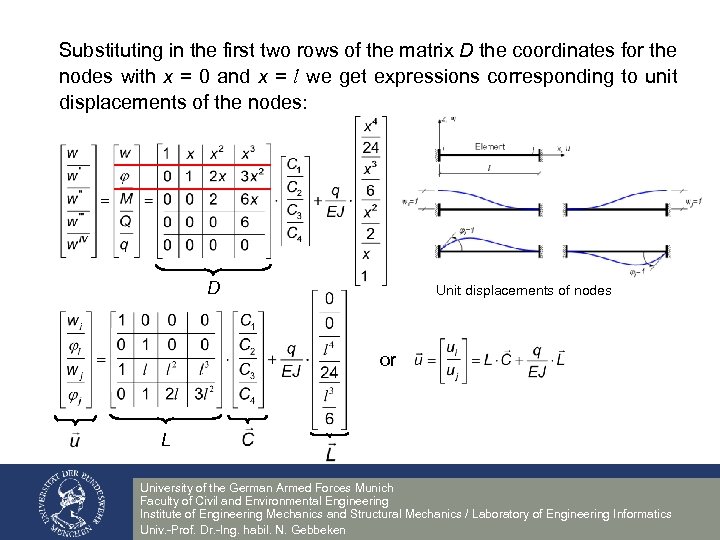 Substituting in the first two rows of the matrix D the coordinates for the nodes with x = 0 and x = l we get expressions corresponding to unit displacements of the nodes: D Unit displacements of nodes or L University of the German Armed Forces Munich Faculty of Civil and Environmental Engineering Institute of Engineering Mechanics and Structural Mechanics / Laboratory of Engineering Informatics Univ. -Prof. Dr. -Ing. habil. N. Gebbeken
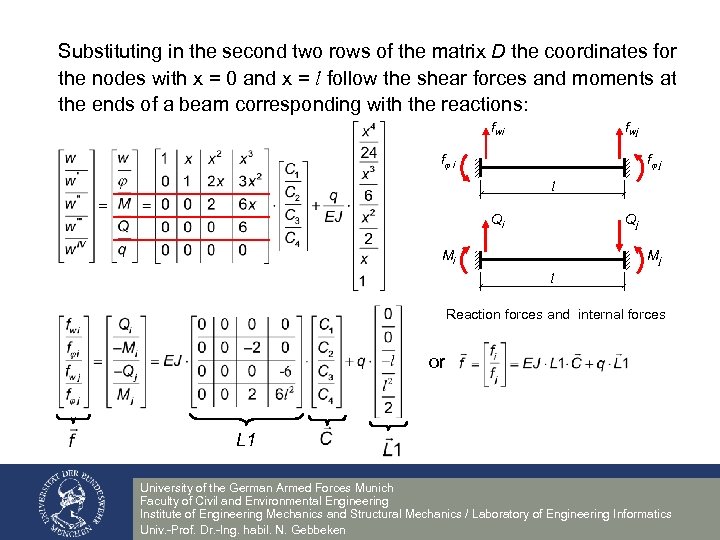 Substituting in the second two rows of the matrix D the coordinates for the nodes with x = 0 and x = l follow the shear forces and moments at the ends of a beam corresponding with the reactions: fwi fwj f i f j l Qi Qj Mi Mj l Reaction forces and internal forces or L 1 University of the German Armed Forces Munich Faculty of Civil and Environmental Engineering Institute of Engineering Mechanics and Structural Mechanics / Laboratory of Engineering Informatics Univ. -Prof. Dr. -Ing. habil. N. Gebbeken
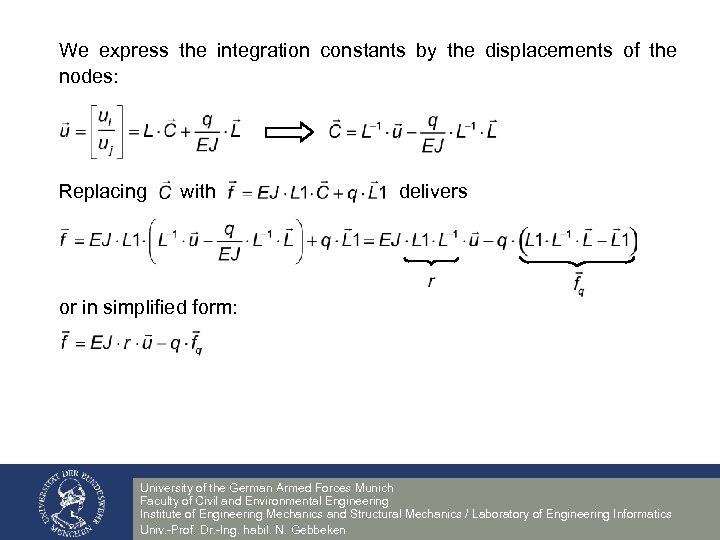 We express the integration constants by the displacements of the nodes: Replacing with delivers or in simplified form: University of the German Armed Forces Munich Faculty of Civil and Environmental Engineering Institute of Engineering Mechanics and Structural Mechanics / Laboratory of Engineering Informatics Univ. -Prof. Dr. -Ing. habil. N. Gebbeken
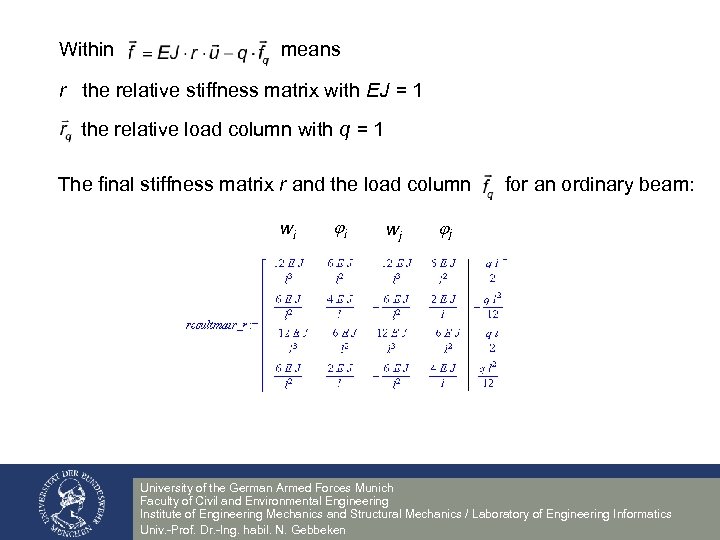 Within means r the relative stiffness matrix with EJ = 1 the relative load column with q = 1 The final stiffness matrix r and the load column wi i wj for an ordinary beam: j University of the German Armed Forces Munich Faculty of Civil and Environmental Engineering Institute of Engineering Mechanics and Structural Mechanics / Laboratory of Engineering Informatics Univ. -Prof. Dr. -Ing. habil. N. Gebbeken
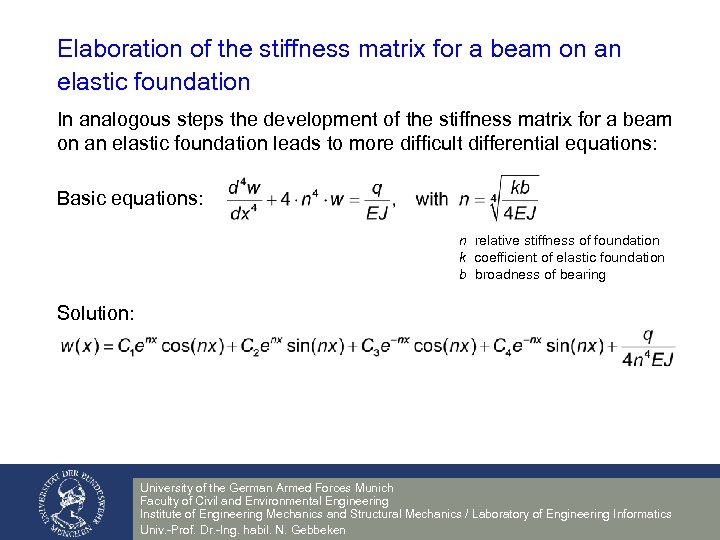 Elaboration of the stiffness matrix for a beam on an elastic foundation In analogous steps the development of the stiffness matrix for a beam on an elastic foundation leads to more difficult differential equations: Basic equations: n relative stiffness of foundation k coefficient of elastic foundation b broadness of bearing Solution: University of the German Armed Forces Munich Faculty of Civil and Environmental Engineering Institute of Engineering Mechanics and Structural Mechanics / Laboratory of Engineering Informatics Univ. -Prof. Dr. -Ing. habil. N. Gebbeken
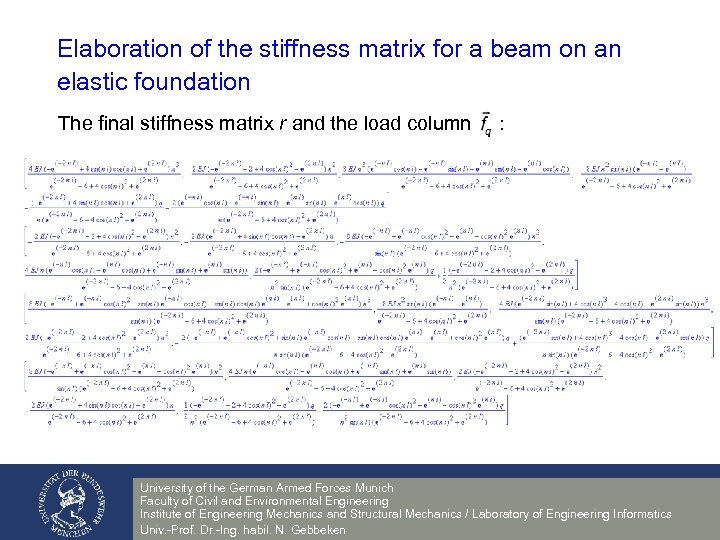 Elaboration of the stiffness matrix for a beam on an elastic foundation The final stiffness matrix r and the load column : University of the German Armed Forces Munich Faculty of Civil and Environmental Engineering Institute of Engineering Mechanics and Structural Mechanics / Laboratory of Engineering Informatics Univ. -Prof. Dr. -Ing. habil. N. Gebbeken
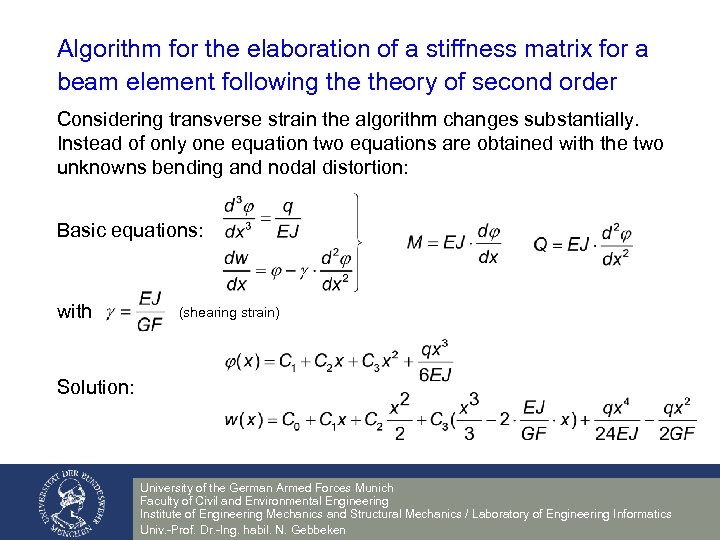 Algorithm for the elaboration of a stiffness matrix for a beam element following theory of second order Considering transverse strain the algorithm changes substantially. Instead of only one equation two equations are obtained with the two unknowns bending and nodal distortion: Basic equations: with (shearing strain) Solution: University of the German Armed Forces Munich Faculty of Civil and Environmental Engineering Institute of Engineering Mechanics and Structural Mechanics / Laboratory of Engineering Informatics Univ. -Prof. Dr. -Ing. habil. N. Gebbeken
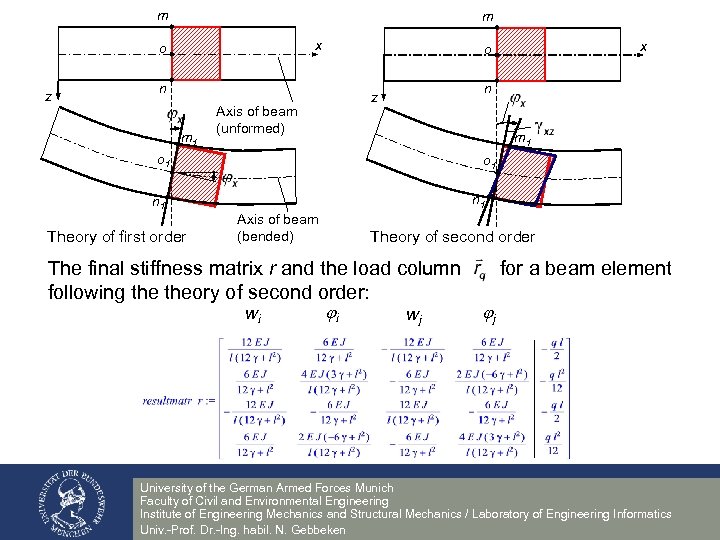 m m x o z n m 1 Axis of beam (unformed) z n m 1 o 1 n 1 Theory of first order x o Axis of beam (bended) Theory of second order The final stiffness matrix r and the load column following theory of second order: i wi wj for a beam element j University of the German Armed Forces Munich Faculty of Civil and Environmental Engineering Institute of Engineering Mechanics and Structural Mechanics / Laboratory of Engineering Informatics Univ. -Prof. Dr. -Ing. habil. N. Gebbeken
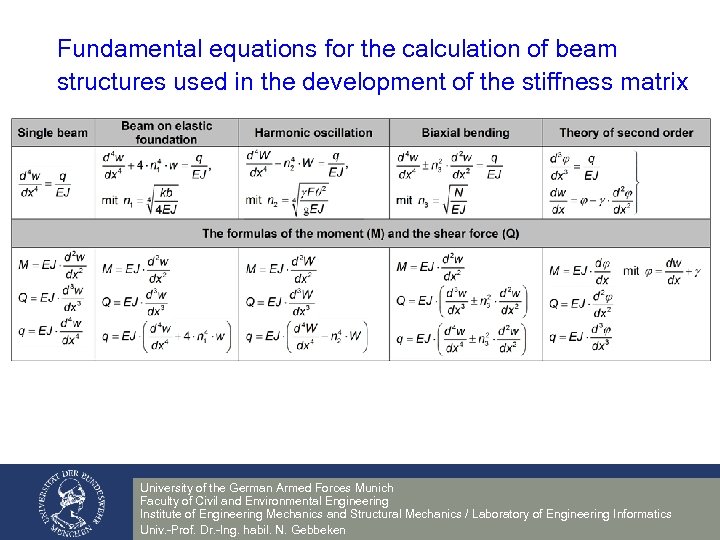 Fundamental equations for the calculation of beam structures used in the development of the stiffness matrix University of the German Armed Forces Munich Faculty of Civil and Environmental Engineering Institute of Engineering Mechanics and Structural Mechanics / Laboratory of Engineering Informatics Univ. -Prof. Dr. -Ing. habil. N. Gebbeken
 Assessment of correctness of the stiffness matrices Derivations of stiffness matrices are sometimes extensive and sophisticated in mathematics. Therefore, the test of the correctness of the mathematical calculus for this object is an important step in the development process of numerical methods. There are two types of assessment: 1. Compatibility condition 2. Duplication of the length of the element University of the German Armed Forces Munich Faculty of Civil and Environmental Engineering Institute of Engineering Mechanics and Structural Mechanics / Laboratory of Engineering Informatics Univ. -Prof. Dr. -Ing. habil. N. Gebbeken
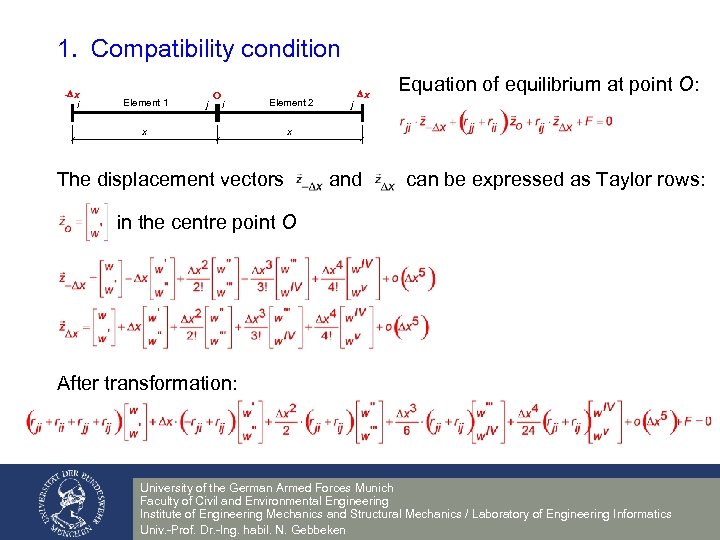 1. Compatibility condition - x i Element 1 j O i Element 2 x j x Equation of equilibrium at point О: x The displacement vectors and can be expressed as Taylor rows: in the centre point O After transformation: University of the German Armed Forces Munich Faculty of Civil and Environmental Engineering Institute of Engineering Mechanics and Structural Mechanics / Laboratory of Engineering Informatics Univ. -Prof. Dr. -Ing. habil. N. Gebbeken
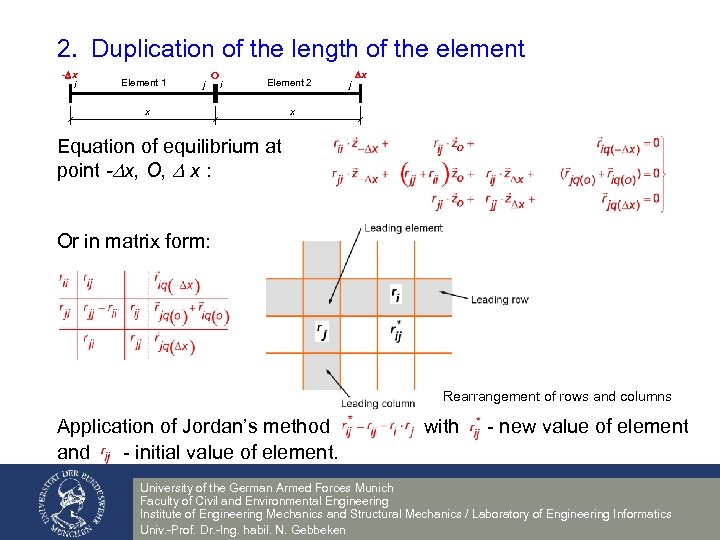 2. Duplication of the length of the element - x i Element 1 j O i Element 2 x j x x Equation of equilibrium at point - x, О, x : Or in matrix form: Rearrangement of rows and columns Application of Jordan’s method and - initial value of element. with - new value of element University of the German Armed Forces Munich Faculty of Civil and Environmental Engineering Institute of Engineering Mechanics and Structural Mechanics / Laboratory of Engineering Informatics Univ. -Prof. Dr. -Ing. habil. N. Gebbeken
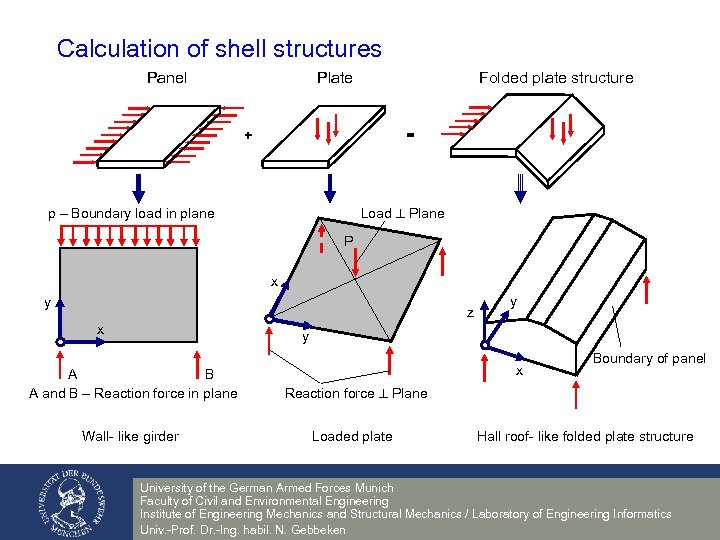 Calculation of shell structures Panel Plate Folded plate structure + = Load Plane p – Boundary load in plane P x y z x y y x A B A and B – Reaction force in plane Reaction force Plane Wall- like girder Loaded plate Boundary of panel Hall roof- like folded plate structure University of the German Armed Forces Munich Faculty of Civil and Environmental Engineering Institute of Engineering Mechanics and Structural Mechanics / Laboratory of Engineering Informatics Univ. -Prof. Dr. -Ing. habil. N. Gebbeken
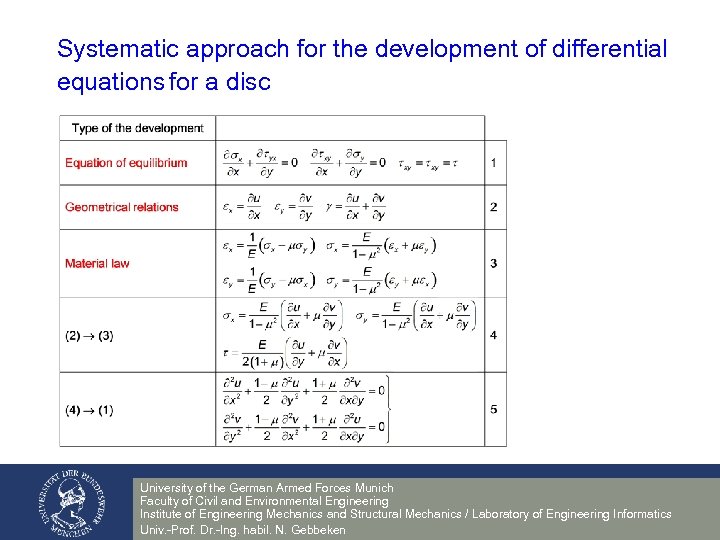 Systematic approach for the development of differential equations for a disc University of the German Armed Forces Munich Faculty of Civil and Environmental Engineering Institute of Engineering Mechanics and Structural Mechanics / Laboratory of Engineering Informatics Univ. -Prof. Dr. -Ing. habil. N. Gebbeken
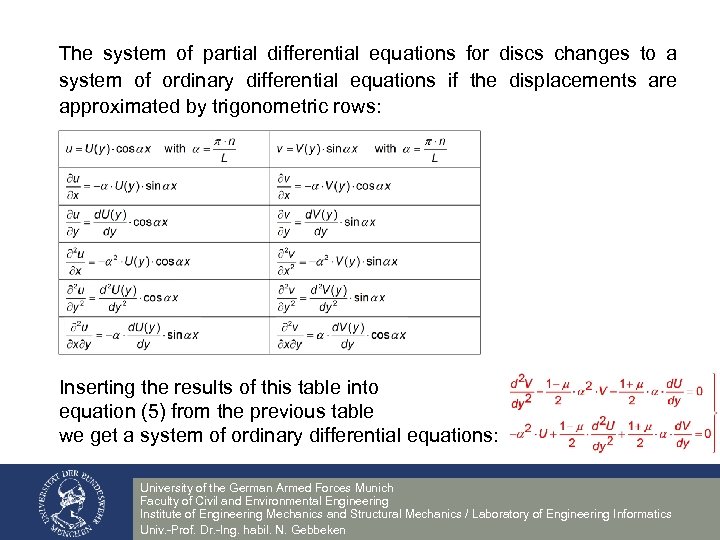 The system of partial differential equations for discs changes to a system of ordinary differential equations if the displacements are approximated by trigonometric rows: Inserting the results of this table into equation (5) from the previous table we get a system of ordinary differential equations: University of the German Armed Forces Munich Faculty of Civil and Environmental Engineering Institute of Engineering Mechanics and Structural Mechanics / Laboratory of Engineering Informatics Univ. -Prof. Dr. -Ing. habil. N. Gebbeken
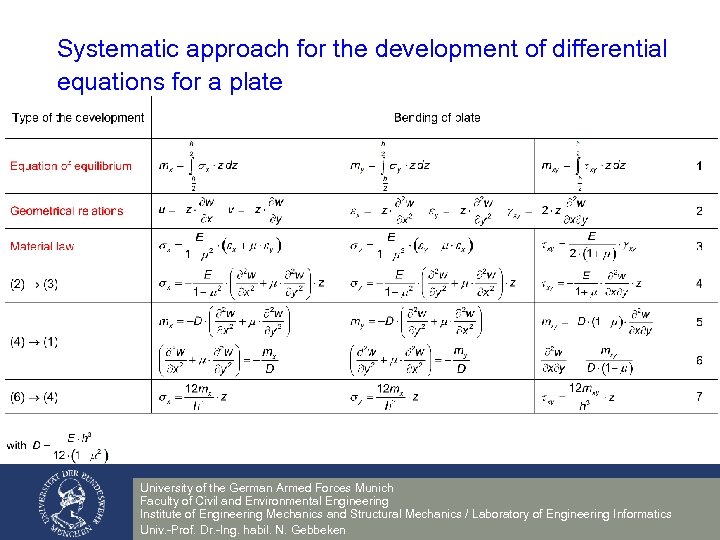 Systematic approach for the development of differential equations for a plate University of the German Armed Forces Munich Faculty of Civil and Environmental Engineering Institute of Engineering Mechanics and Structural Mechanics / Laboratory of Engineering Informatics Univ. -Prof. Dr. -Ing. habil. N. Gebbeken
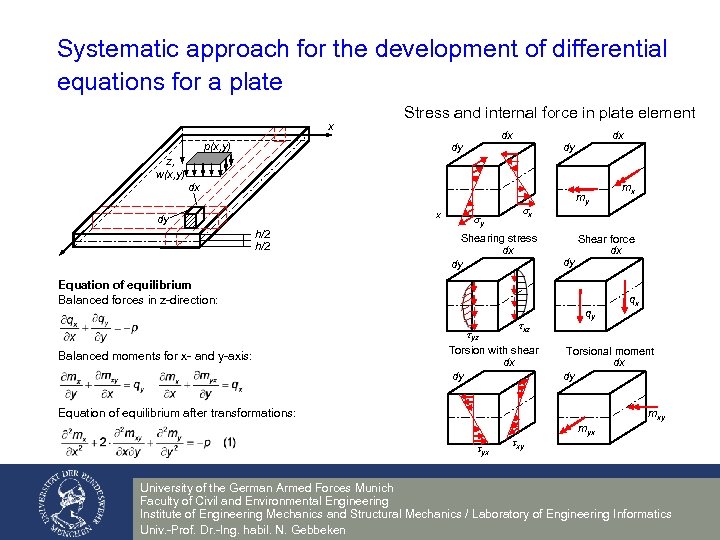 Systematic approach for the development of differential equations for a plate x Stress and internal force in plate element p(x, y) dx dy z, w(x, y) dx x dy h/2 y my x Shearing stress dx dy dy Shear force dx Equation of equilibrium Balanced forces in z-direction: yz Balanced moments for x- and y-axis: xz Torsion with shear dx dy mx qy qx Torsional moment dx dy Equation of equilibrium after transformations: mxy yx xy myx University of the German Armed Forces Munich Faculty of Civil and Environmental Engineering Institute of Engineering Mechanics and Structural Mechanics / Laboratory of Engineering Informatics Univ. -Prof. Dr. -Ing. habil. N. Gebbeken
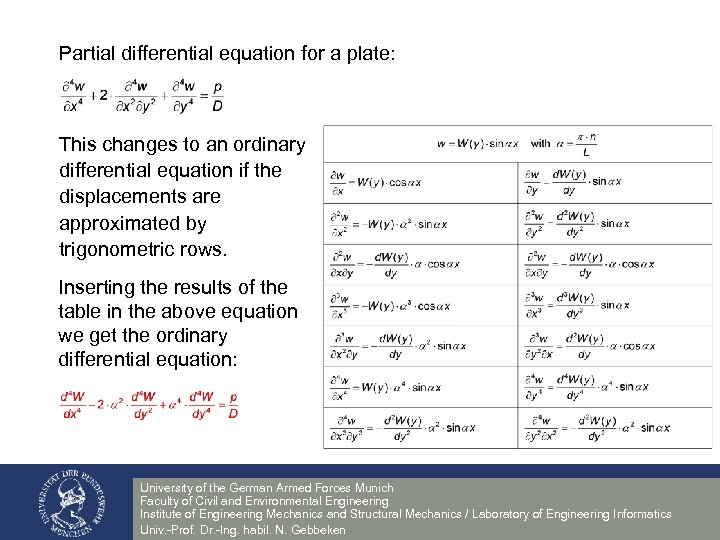 Partial differential equation for a plate: This changes to an ordinary differential equation if the displacements are approximated by trigonometric rows. Inserting the results of the table in the above equation we get the ordinary differential equation: University of the German Armed Forces Munich Faculty of Civil and Environmental Engineering Institute of Engineering Mechanics and Structural Mechanics / Laboratory of Engineering Informatics Univ. -Prof. Dr. -Ing. habil. N. Gebbeken
 Conclusion: - MAPLE permits a fast calculation of stiffness matrices for different element types in symbolic form - Elaboration of stiffness matrices can be automated - Export of the results in other computer languages (C, C++, VB, Fortran) can help to implement stiffness matrices in different environments - For students‘ education an understanding of algorithms is essential to test different FE-formulations - Students can develop their own programmes for the FEM University of the German Armed Forces Munich Faculty of Civil and Environmental Engineering Institute of Engineering Mechanics and Structural Mechanics / Laboratory of Engineering Informatics Univ. -Prof. Dr. -Ing. habil. N. Gebbeken