


 Скачать презентацию University of Texas at Dallas Coinductive Logic Programming
8ad7fd8a93a9c80dd0e512fcd3bb01e1.ppt
- Количество слайдов: 49
 University of Texas at Dallas Coinductive Logic Programming and its Applications Gopal Gupta Luke Simon, Ajay Bansal, Ajay Mallya, Richard Min. Applied Logic, Programming-Languages and Systems (ALPS) Lab The University of Texas at Dallas, Richardson, Texas, USA Applied Logic, Programming-Languages and Systems (ALPS) Lab @ UTD Slide- 1
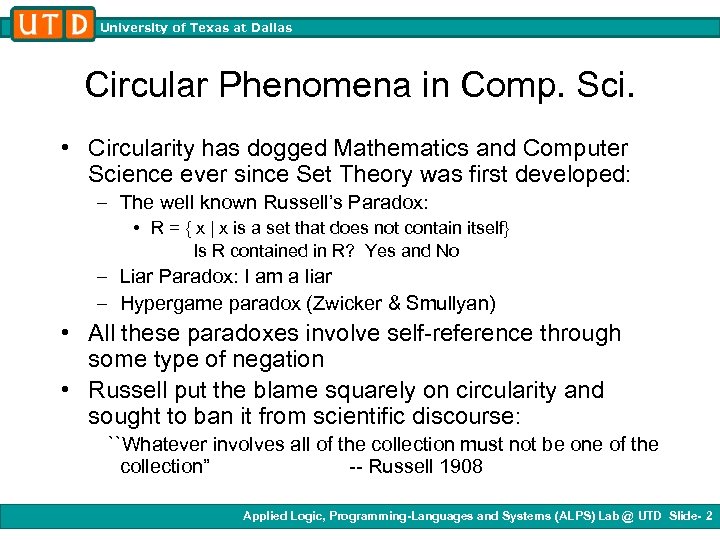 University of Texas at Dallas Circular Phenomena in Comp. Sci. • Circularity has dogged Mathematics and Computer Science ever since Set Theory was first developed: – The well known Russell’s Paradox: • R = { x | x is a set that does not contain itself} Is R contained in R? Yes and No – Liar Paradox: I am a liar – Hypergame paradox (Zwicker & Smullyan) • All these paradoxes involve self-reference through some type of negation • Russell put the blame squarely on circularity and sought to ban it from scientific discourse: ``Whatever involves all of the collection must not be one of the collection” -- Russell 1908 Applied Logic, Programming-Languages and Systems (ALPS) Lab @ UTD Slide- 2
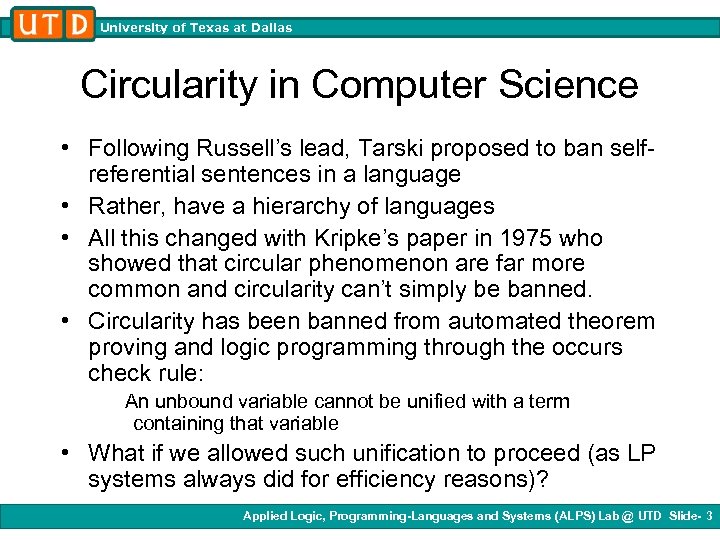 University of Texas at Dallas Circularity in Computer Science • Following Russell’s lead, Tarski proposed to ban selfreferential sentences in a language • Rather, have a hierarchy of languages • All this changed with Kripke’s paper in 1975 who showed that circular phenomenon are far more common and circularity can’t simply be banned. • Circularity has been banned from automated theorem proving and logic programming through the occurs check rule: An unbound variable cannot be unified with a term containing that variable • What if we allowed such unification to proceed (as LP systems always did for efficiency reasons)? Applied Logic, Programming-Languages and Systems (ALPS) Lab @ UTD Slide- 3
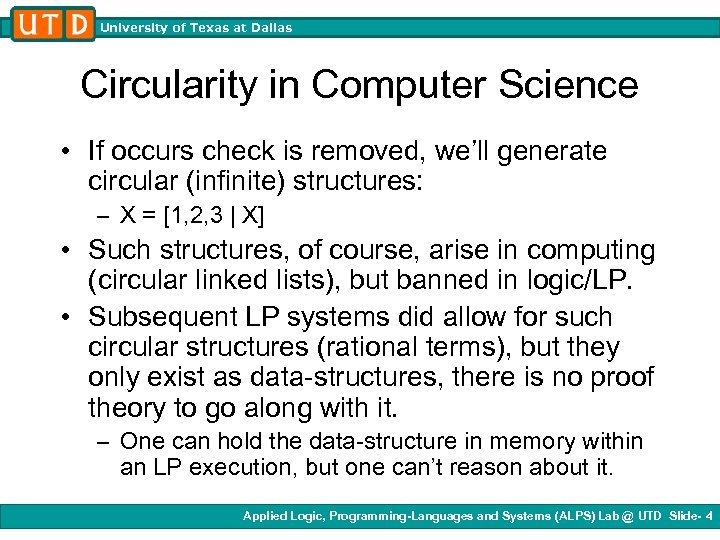 University of Texas at Dallas Circularity in Computer Science • If occurs check is removed, we’ll generate circular (infinite) structures: – X = [1, 2, 3 | X] • Such structures, of course, arise in computing (circular linked lists), but banned in logic/LP. • Subsequent LP systems did allow for such circular structures (rational terms), but they only exist as data-structures, there is no proof theory to go along with it. – One can hold the data-structure in memory within an LP execution, but one can’t reason about it. Applied Logic, Programming-Languages and Systems (ALPS) Lab @ UTD Slide- 4
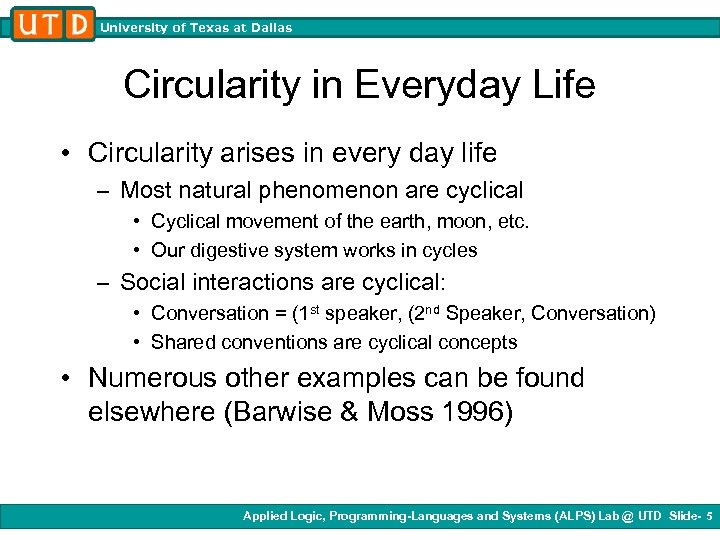 University of Texas at Dallas Circularity in Everyday Life • Circularity arises in every day life – Most natural phenomenon are cyclical • Cyclical movement of the earth, moon, etc. • Our digestive system works in cycles – Social interactions are cyclical: • Conversation = (1 st speaker, (2 nd Speaker, Conversation) • Shared conventions are cyclical concepts • Numerous other examples can be found elsewhere (Barwise & Moss 1996) Applied Logic, Programming-Languages and Systems (ALPS) Lab @ UTD Slide- 5
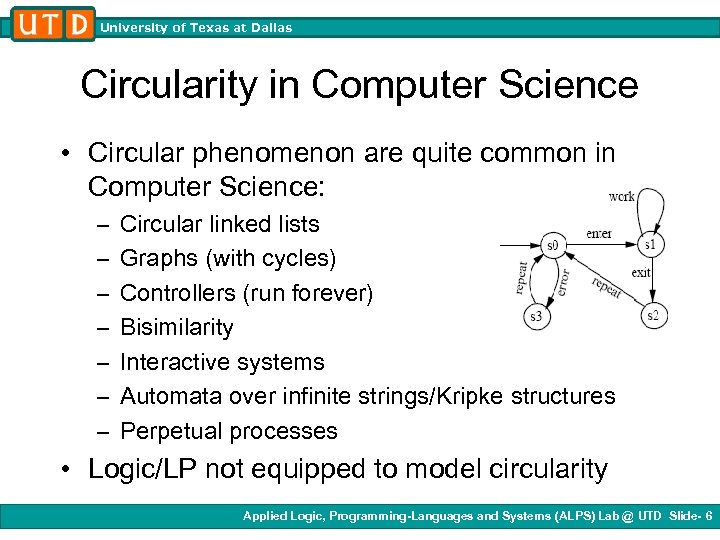 University of Texas at Dallas Circularity in Computer Science • Circular phenomenon are quite common in Computer Science: – – – – Circular linked lists Graphs (with cycles) Controllers (run forever) Bisimilarity Interactive systems Automata over infinite strings/Kripke structures Perpetual processes • Logic/LP not equipped to model circularity Applied Logic, Programming-Languages and Systems (ALPS) Lab @ UTD Slide- 6
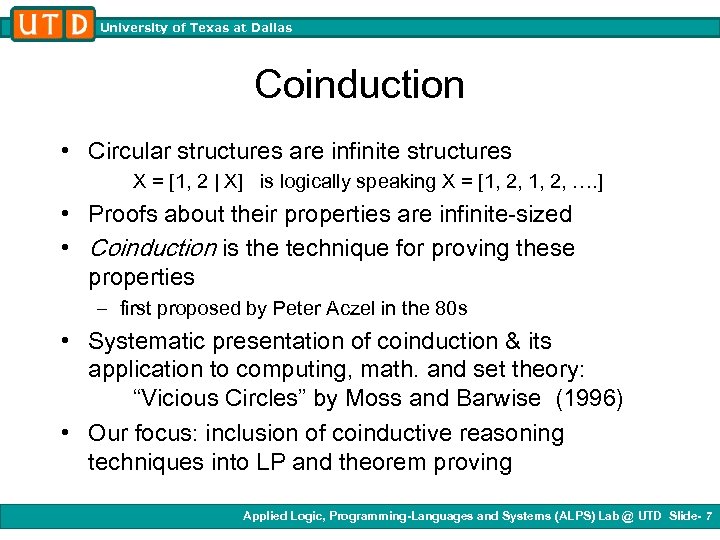 University of Texas at Dallas Coinduction • Circular structures are infinite structures X = [1, 2 | X] is logically speaking X = [1, 2, …. ] • Proofs about their properties are infinite-sized • Coinduction is the technique for proving these properties – first proposed by Peter Aczel in the 80 s • Systematic presentation of coinduction & its application to computing, math. and set theory: “Vicious Circles” by Moss and Barwise (1996) • Our focus: inclusion of coinductive reasoning techniques into LP and theorem proving Applied Logic, Programming-Languages and Systems (ALPS) Lab @ UTD Slide- 7
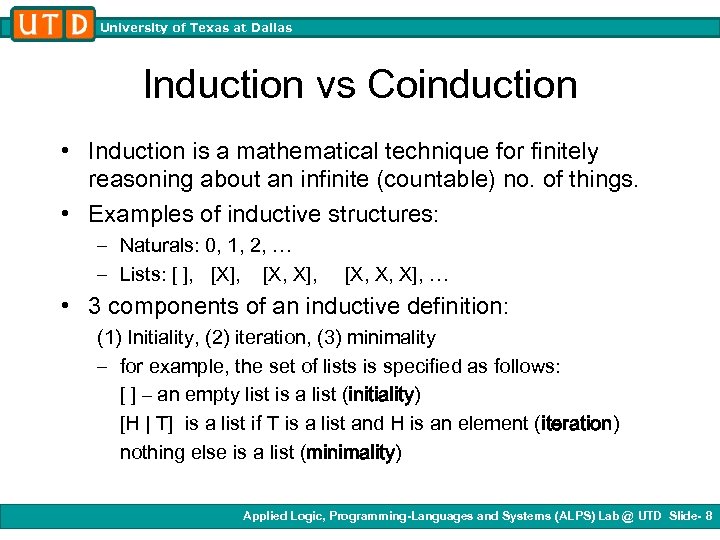 University of Texas at Dallas Induction vs Coinduction • Induction is a mathematical technique for finitely reasoning about an infinite (countable) no. of things. • Examples of inductive structures: – Naturals: 0, 1, 2, … – Lists: [ ], [X, X], [X, X, X], … • 3 components of an inductive definition: (1) Initiality, (2) iteration, (3) minimality – for example, the set of lists is specified as follows: [ ] – an empty list is a list (initiality) [H | T] is a list if T is a list and H is an element (iteration) nothing else is a list (minimality) Applied Logic, Programming-Languages and Systems (ALPS) Lab @ UTD Slide- 8
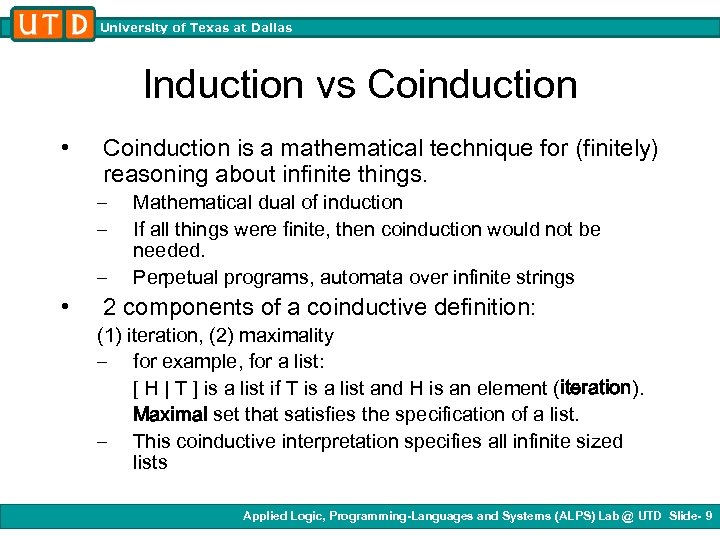 University of Texas at Dallas Induction vs Coinduction • Coinduction is a mathematical technique for (finitely) reasoning about infinite things. – – • – Mathematical dual of induction If all things were finite, then coinduction would not be needed. Perpetual programs, automata over infinite strings 2 components of a coinductive definition: (1) iteration, (2) maximality – for example, for a list: [ H | T ] is a list if T is a list and H is an element (iteration). Maximal set that satisfies the specification of a list. – This coinductive interpretation specifies all infinite sized lists Applied Logic, Programming-Languages and Systems (ALPS) Lab @ UTD Slide- 9
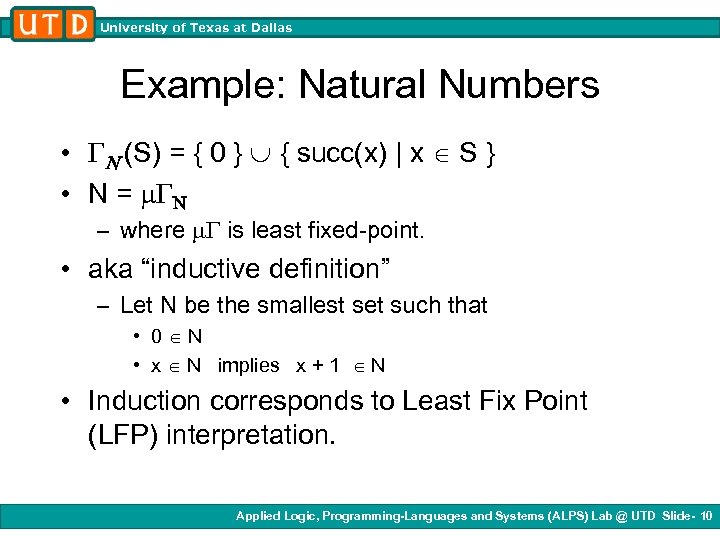 University of Texas at Dallas Example: Natural Numbers • (S) = { 0 } { succ(x) | x S } • N = – where is least fixed-point. • aka “inductive definition” – Let N be the smallest set such that • 0 N • x N implies x + 1 N • Induction corresponds to Least Fix Point (LFP) interpretation. Applied Logic, Programming-Languages and Systems (ALPS) Lab @ UTD Slide- 10
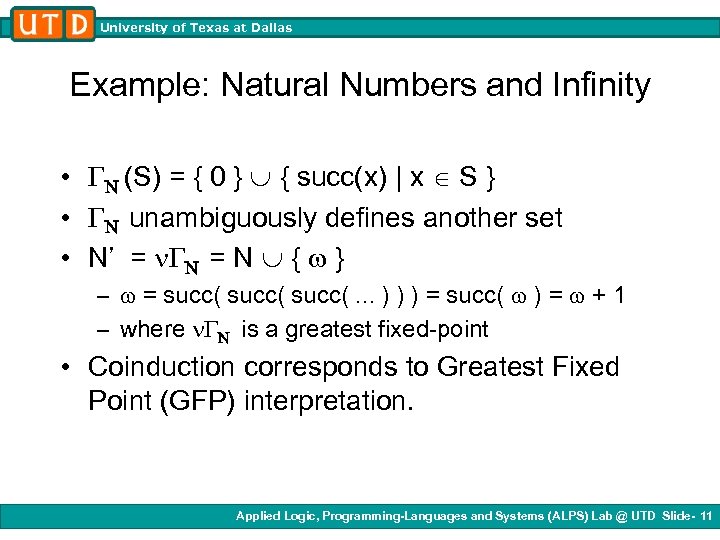 University of Texas at Dallas Example: Natural Numbers and Infinity • (S) = { 0 } { succ(x) | x S } • unambiguously defines another set • N’ = = N { } – = succ(. . . ) ) ) = succ( ) = + 1 – where is a greatest fixed-point • Coinduction corresponds to Greatest Fixed Point (GFP) interpretation. Applied Logic, Programming-Languages and Systems (ALPS) Lab @ UTD Slide- 11
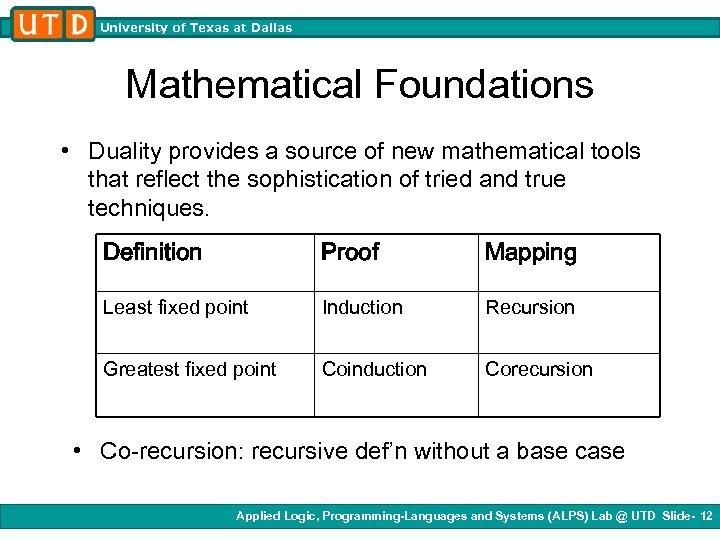 University of Texas at Dallas Mathematical Foundations • Duality provides a source of new mathematical tools that reflect the sophistication of tried and true techniques. Definition Proof Mapping Least fixed point Induction Recursion Greatest fixed point Coinduction Corecursion • Co-recursion: recursive def’n without a base case Applied Logic, Programming-Languages and Systems (ALPS) Lab @ UTD Slide- 12
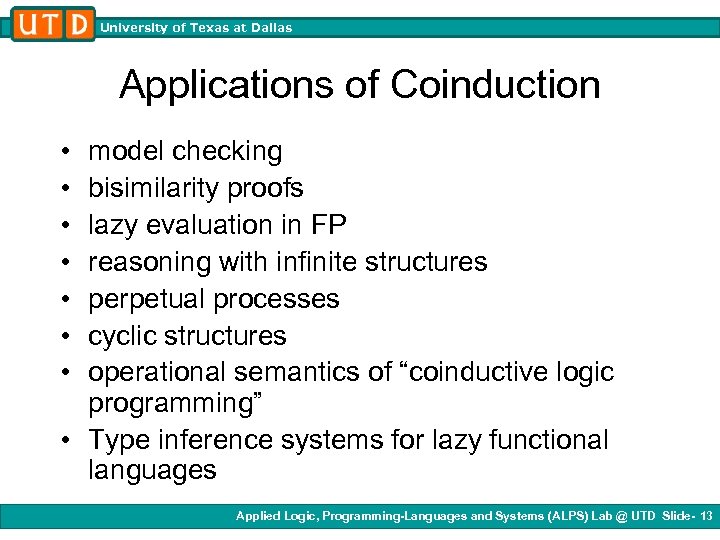 University of Texas at Dallas Applications of Coinduction • • model checking bisimilarity proofs lazy evaluation in FP reasoning with infinite structures perpetual processes cyclic structures operational semantics of “coinductive logic programming” • Type inference systems for lazy functional languages Applied Logic, Programming-Languages and Systems (ALPS) Lab @ UTD Slide- 13
 University of Texas at Dallas Inductive Logic Programming • Logic Programming – is actually inductive logic programming. – has inductive definition. – useful for writing programs for reasoning about finite things: - data structures - properties Applied Logic, Programming-Languages and Systems (ALPS) Lab @ UTD Slide- 14
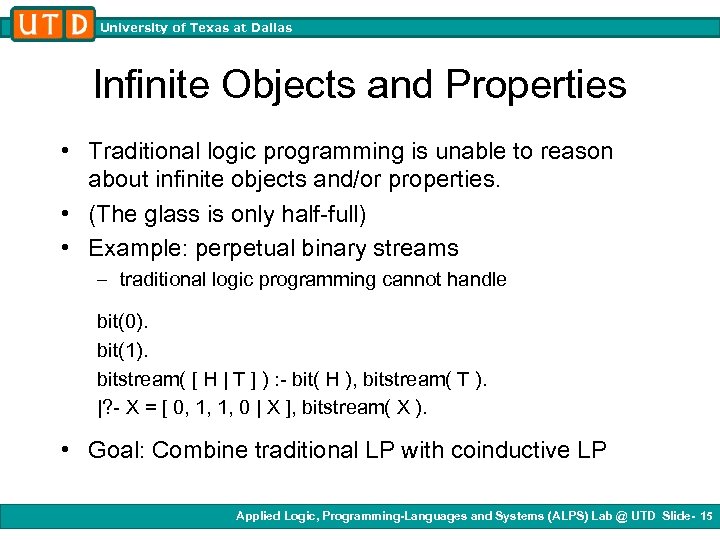 University of Texas at Dallas Infinite Objects and Properties • Traditional logic programming is unable to reason about infinite objects and/or properties. • (The glass is only half-full) • Example: perpetual binary streams – traditional logic programming cannot handle bit(0). bit(1). bitstream( [ H | T ] ) : - bit( H ), bitstream( T ). |? - X = [ 0, 1, 1, 0 | X ], bitstream( X ). • Goal: Combine traditional LP with coinductive LP Applied Logic, Programming-Languages and Systems (ALPS) Lab @ UTD Slide- 15
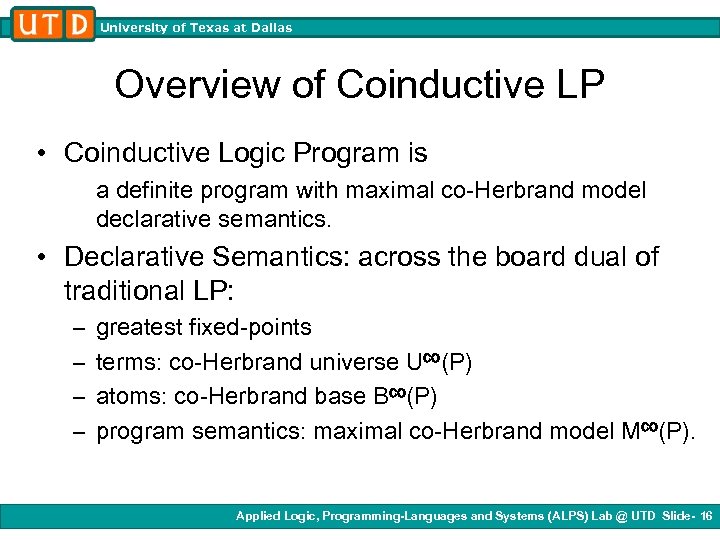 University of Texas at Dallas Overview of Coinductive LP • Coinductive Logic Program is a definite program with maximal co-Herbrand model declarative semantics. • Declarative Semantics: across the board dual of traditional LP: – – greatest fixed-points terms: co-Herbrand universe Uco(P) atoms: co-Herbrand base Bco(P) program semantics: maximal co-Herbrand model Mco(P). Applied Logic, Programming-Languages and Systems (ALPS) Lab @ UTD Slide- 16
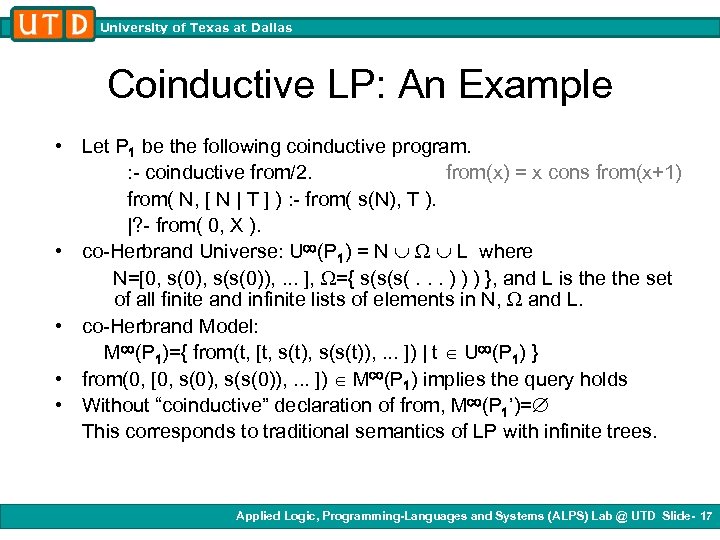 University of Texas at Dallas Coinductive LP: An Example • Let P 1 be the following coinductive program. : - coinductive from/2. from(x) = x cons from(x+1) from( N, [ N | T ] ) : - from( s(N), T ). |? - from( 0, X ). • co-Herbrand Universe: Uco(P 1) = N L where N=[0, s(0), s(s(0)), . . . ], ={ s(s(s(. . . ) ) ) }, and L is the set of all finite and infinite lists of elements in N, and L. • co-Herbrand Model: Mco(P 1)={ from(t, [t, s(t), s(s(t)), . . . ]) | t Uco(P 1) } • from(0, [0, s(0), s(s(0)), . . . ]) Mco(P 1) implies the query holds • Without “coinductive” declaration of from, Mco(P 1’)= This corresponds to traditional semantics of LP with infinite trees. Applied Logic, Programming-Languages and Systems (ALPS) Lab @ UTD Slide- 17
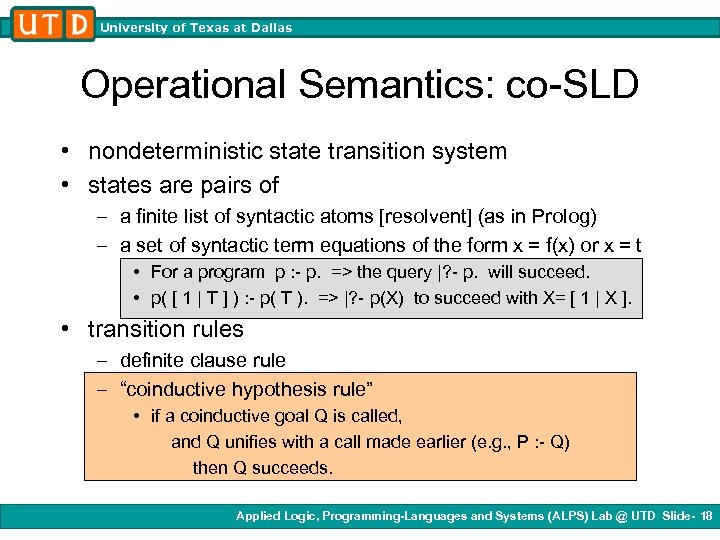 University of Texas at Dallas Operational Semantics: co-SLD • nondeterministic state transition system • states are pairs of – a finite list of syntactic atoms [resolvent] (as in Prolog) – a set of syntactic term equations of the form x = f(x) or x = t • For a program p : - p. => the query |? - p. will succeed. • p( [ 1 | T ] ) : - p( T ). => |? - p(X) to succeed with X= [ 1 | X ]. • transition rules – definite clause rule – “coinductive hypothesis rule” • if a coinductive goal Q is called, and Q unifies with a call made earlier (e. g. , P : - Q) then Q succeeds. Applied Logic, Programming-Languages and Systems (ALPS) Lab @ UTD Slide- 18
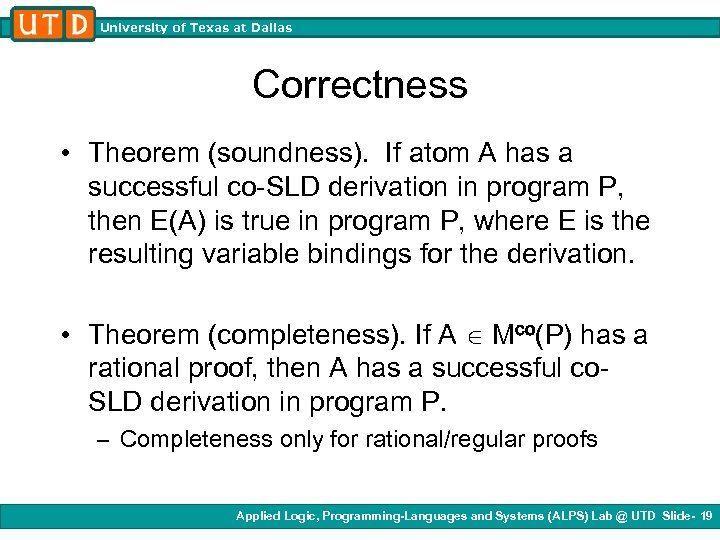 University of Texas at Dallas Correctness • Theorem (soundness). If atom A has a successful co-SLD derivation in program P, then E(A) is true in program P, where E is the resulting variable bindings for the derivation. • Theorem (completeness). If A Mco(P) has a rational proof, then A has a successful co. SLD derivation in program P. – Completeness only for rational/regular proofs Applied Logic, Programming-Languages and Systems (ALPS) Lab @ UTD Slide- 19
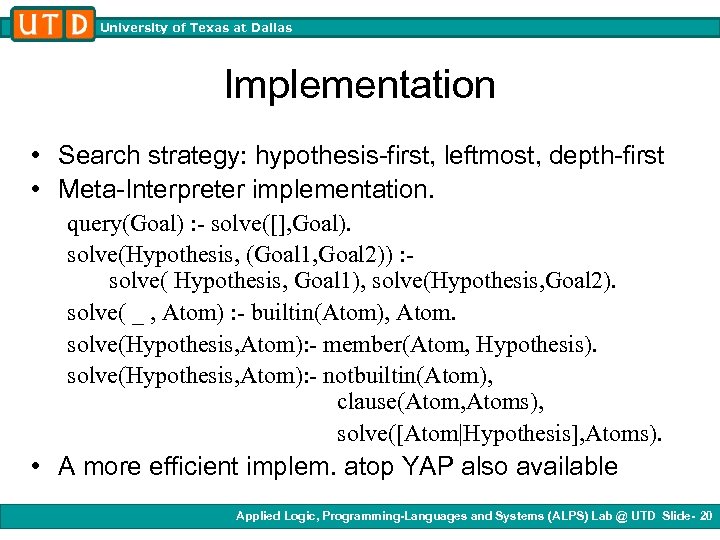 University of Texas at Dallas Implementation • Search strategy: hypothesis-first, leftmost, depth-first • Meta-Interpreter implementation. query(Goal) : - solve([], Goal). solve(Hypothesis, (Goal 1, Goal 2)) : solve( Hypothesis, Goal 1), solve(Hypothesis, Goal 2). solve( _ , Atom) : - builtin(Atom), Atom. solve(Hypothesis, Atom): - member(Atom, Hypothesis). solve(Hypothesis, Atom): - notbuiltin(Atom), clause(Atom, Atoms), solve([Atom|Hypothesis], Atoms). • A more efficient implem. atop YAP also available Applied Logic, Programming-Languages and Systems (ALPS) Lab @ UTD Slide- 20
 University of Texas at Dallas Example: Number Stream : - coinductive stream/1. stream( [ H | T ] ) : - num( H ), stream( T ). num( 0 ). num( s( N ) ) : - num( N ). |? - stream( [ 0, s( 0 ), s( s ( 0 ) ) | T ] ). 1. MEMO: stream( [ 0, s( 0 ), s( s ( 0 ) ) | T ] ) 2. MEMO: stream( [ s( 0 ), s( s ( 0 ) ) | T ] ) 3. MEMO: stream( [ s( s ( 0 ) ) | T ] ) Answers: T = [ 0, s(0), s(s(0)) | T ] T = [ 0, s(0), s(s(0)) | T ]. . . T = [ 0, s(0), s(s(0)) | X ] (where X is any rational list of numbers. ) Applied Logic, Programming-Languages and Systems (ALPS) Lab @ UTD Slide- 21
![University of Texas at Dallas Example: Append : - coinductive append/3. append( [ ],](https://present5.com/presentation/8ad7fd8a93a9c80dd0e512fcd3bb01e1/image-22.jpg "University of Texas at Dallas Example: Append : - coinductive append/3. append( [ ],") University of Texas at Dallas Example: Append : - coinductive append/3. append( [ ], X, X ). append( [ H | T ], Y, [ H | Z ] ) : - append( T, Y, Z ). |? - Y = [ 4, 5, 6 | Y ], append( [ 1, 2, 3 ], Y, Z). Answer: Z = [ 1, 2, 3 | Y ], Y=[ 4, 5, 6 | Y] |? - X = [ 1, 2, 3 | X ], Y = [ 3, 4 | Y ], append( X, Y, Z). Answer: Z = [ 1, 2, 3 | Z ]. |? - Z = [ 1, 2 | Z ], append( X, Y, Z ). Answer: X = [ ], Y = [ 1, 2 | Z ] ; X = [1, 2 | X], Y = _ X = [ 1 ], Y = [ 2 | Z ] ; X = [ 1, 2 ], Y = Z; …. ad infinitum Applied Logic, Programming-Languages and Systems (ALPS) Lab @ UTD Slide- 22
University of Texas at Dallas Example: Append : - coinductive append/3. append( [ ], X, X ). append( [ H | T ], Y, [ H | Z ] ) : - append( T, Y, Z ). |? - Y = [ 4, 5, 6 | Y ], append( [ 1, 2, 3 ], Y, Z). Answer: Z = [ 1, 2, 3 | Y ], Y=[ 4, 5, 6 | Y] |? - X = [ 1, 2, 3 | X ], Y = [ 3, 4 | Y ], append( X, Y, Z). Answer: Z = [ 1, 2, 3 | Z ]. |? - Z = [ 1, 2 | Z ], append( X, Y, Z ). Answer: X = [ ], Y = [ 1, 2 | Z ] ; X = [1, 2 | X], Y = _ X = [ 1 ], Y = [ 2 | Z ] ; X = [ 1, 2 ], Y = Z; …. ad infinitum Applied Logic, Programming-Languages and Systems (ALPS) Lab @ UTD Slide- 22
![University of Texas at Dallas Example: Comember(H, [ H | T ]). member(H, [](https://present5.com/presentation/8ad7fd8a93a9c80dd0e512fcd3bb01e1/image-23.jpg "University of Texas at Dallas Example: Comember(H, [ H | T ]). member(H, [") University of Texas at Dallas Example: Comember(H, [ H | T ]). member(H, [ X | T ]) : - member(H, T). ? - L = [1, 2 | L], member(3, L) succeeds. Instead: : - coinductive comember/2. %drop/3 is inductive comember(X, L) : - drop(X, L, R), comember(X, R). drop(H, [ H | T ], T). drop(H, [ X | T ], T 1) : - drop(H, T, T 1). ? - X=[ 1, 2, 3 | X ], comember(2, X). Answer: yes. ? - X=[ 1, 2, 3, 1, 2, 3], comember(2, X). Answer: no. ? - X=[1, 2, 3 | X], comember(Y, X). Answer: Y = 1; Y = 2; Y = 3; ? - X = [1, 2 | X], comember(3, X). Answer: no Applied Logic, Programming-Languages and Systems (ALPS) Lab @ UTD Slide- 23
University of Texas at Dallas Example: Comember(H, [ H | T ]). member(H, [ X | T ]) : - member(H, T). ? - L = [1, 2 | L], member(3, L) succeeds. Instead: : - coinductive comember/2. %drop/3 is inductive comember(X, L) : - drop(X, L, R), comember(X, R). drop(H, [ H | T ], T). drop(H, [ X | T ], T 1) : - drop(H, T, T 1). ? - X=[ 1, 2, 3 | X ], comember(2, X). Answer: yes. ? - X=[ 1, 2, 3, 1, 2, 3], comember(2, X). Answer: no. ? - X=[1, 2, 3 | X], comember(Y, X). Answer: Y = 1; Y = 2; Y = 3; ? - X = [1, 2 | X], comember(3, X). Answer: no Applied Logic, Programming-Languages and Systems (ALPS) Lab @ UTD Slide- 23
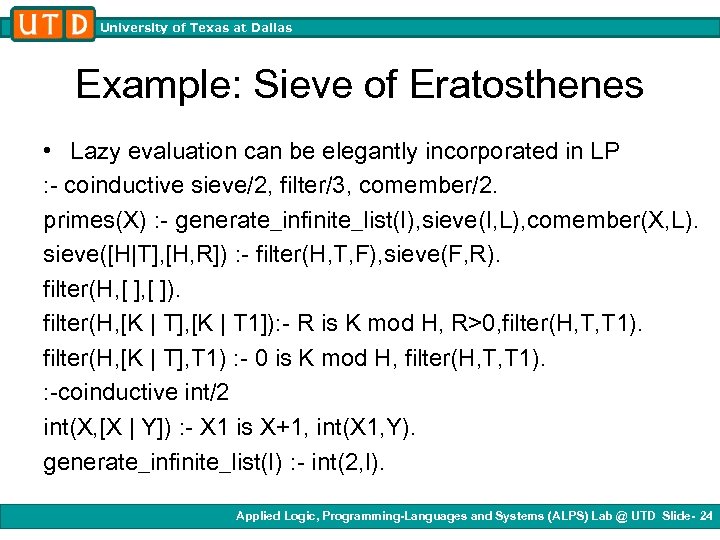 University of Texas at Dallas Example: Sieve of Eratosthenes • Lazy evaluation can be elegantly incorporated in LP : - coinductive sieve/2, filter/3, comember/2. primes(X) : - generate_infinite_list(I), sieve(I, L), comember(X, L). sieve([H|T], [H, R]) : - filter(H, T, F), sieve(F, R). filter(H, [ ]). filter(H, [K | T], [K | T 1]): - R is K mod H, R>0, filter(H, T, T 1). filter(H, [K | T], T 1) : - 0 is K mod H, filter(H, T, T 1). : -coinductive int/2 int(X, [X | Y]) : - X 1 is X+1, int(X 1, Y). generate_infinite_list(I) : - int(2, I). Applied Logic, Programming-Languages and Systems (ALPS) Lab @ UTD Slide- 24
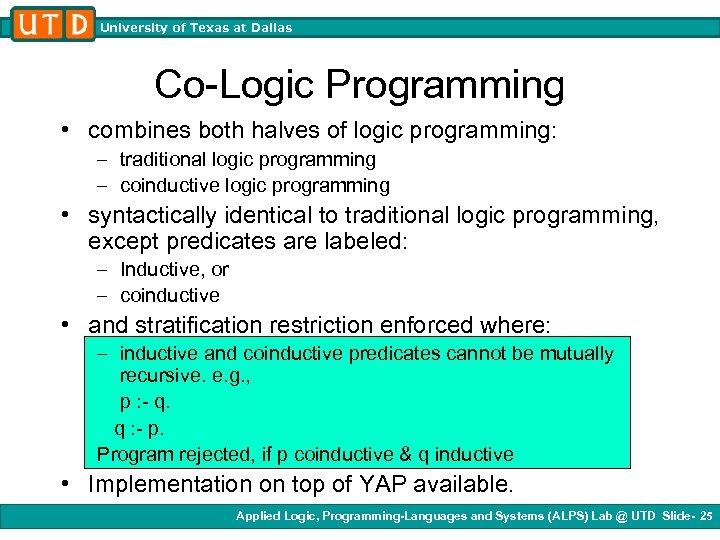 University of Texas at Dallas Co-Logic Programming • combines both halves of logic programming: – traditional logic programming – coinductive logic programming • syntactically identical to traditional logic programming, except predicates are labeled: – Inductive, or – coinductive • and stratification restriction enforced where: – inductive and coinductive predicates cannot be mutually recursive. e. g. , p : - q. q : - p. Program rejected, if p coinductive & q inductive • Implementation on top of YAP available. Applied Logic, Programming-Languages and Systems (ALPS) Lab @ UTD Slide- 25
 University of Texas at Dallas Application: Model Checking • automated verification of hardware and software systems • -automata – accept infinite strings – accepting state must be traversed infinitely often • requires computation of lfp and gfp • co-logic programming provides an elegant framework for model checking • traditional LP works for safety property (that is based on lfp) in an elegant manner, but not for liveness. Applied Logic, Programming-Languages and Systems (ALPS) Lab @ UTD Slide- 26
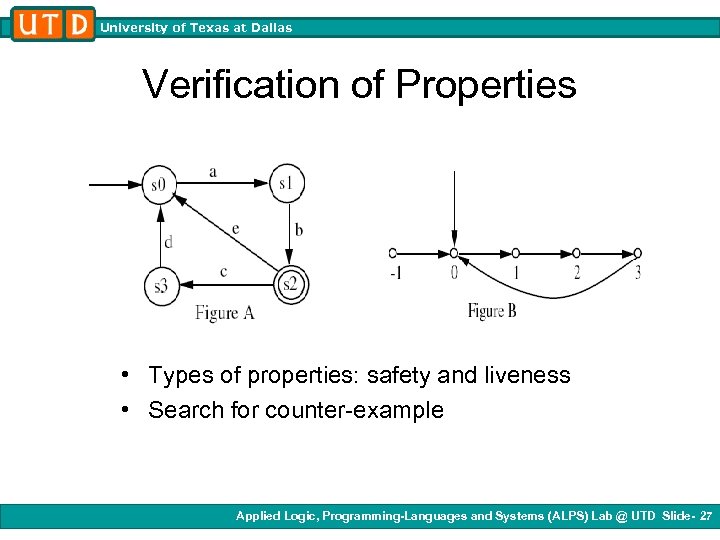 University of Texas at Dallas Verification of Properties • Types of properties: safety and liveness • Search for counter-example Applied Logic, Programming-Languages and Systems (ALPS) Lab @ UTD Slide- 27
 University of Texas at Dallas Safety versus Liveness • Safety – “nothing bad will happen” – naturally described inductively – straightforward encoding in traditional LP • liveness – – “something good will eventually happen” dual of safety naturally described coinductively straightforward encoding in coinductive LP Applied Logic, Programming-Languages and Systems (ALPS) Lab @ UTD Slide- 28
![University of Texas at Dallas Finite Automata automata([X|T], St): - trans(St, X, New. St),](https://present5.com/presentation/8ad7fd8a93a9c80dd0e512fcd3bb01e1/image-29.jpg "University of Texas at Dallas Finite Automata automata([X|T], St): - trans(St, X, New. St),") University of Texas at Dallas Finite Automata automata([X|T], St): - trans(St, X, New. St), automata(T, New. St). automata([ ], St) : - final(St). trans(s 0, a, s 1). trans(s 3, d, s 0). trans(s 1, b, s 2). trans(s 2, 3, s 0). trans(s 2, c, s 3). final(s 2). ? - automata(X, s 0). X=[ a, b]; X=[ a, b, e, a, b]; …… …… …… Applied Logic, Programming-Languages and Systems (ALPS) Lab @ UTD Slide- 29
University of Texas at Dallas Finite Automata automata([X|T], St): - trans(St, X, New. St), automata(T, New. St). automata([ ], St) : - final(St). trans(s 0, a, s 1). trans(s 3, d, s 0). trans(s 1, b, s 2). trans(s 2, 3, s 0). trans(s 2, c, s 3). final(s 2). ? - automata(X, s 0). X=[ a, b]; X=[ a, b, e, a, b]; …… …… …… Applied Logic, Programming-Languages and Systems (ALPS) Lab @ UTD Slide- 29
![University of Texas at Dallas Infinite Automata automata([X|T], St): - trans(St, X, New. St),](https://present5.com/presentation/8ad7fd8a93a9c80dd0e512fcd3bb01e1/image-30.jpg "University of Texas at Dallas Infinite Automata automata([X|T], St): - trans(St, X, New. St),") University of Texas at Dallas Infinite Automata automata([X|T], St): - trans(St, X, New. St), automata(T, New. St). trans(s 0, a, s 1). trans(s 3, d, s 0). trans(s 1, b, s 2). trans(s 2, 3, s 0). trans(s 2, c, s 3). final(s 2). ? - automata(X, s 0). X=[ a, b, c, d | X ]; X=[ a, b, e | X ]; Applied Logic, Programming-Languages and Systems (ALPS) Lab @ UTD Slide- 30
University of Texas at Dallas Infinite Automata automata([X|T], St): - trans(St, X, New. St), automata(T, New. St). trans(s 0, a, s 1). trans(s 3, d, s 0). trans(s 1, b, s 2). trans(s 2, 3, s 0). trans(s 2, c, s 3). final(s 2). ? - automata(X, s 0). X=[ a, b, c, d | X ]; X=[ a, b, e | X ]; Applied Logic, Programming-Languages and Systems (ALPS) Lab @ UTD Slide- 30
 University of Texas at Dallas Verifying Liveness Properties • Verifying safety properties in LP is relatively easy: safety modeled by reachability • Accomplished via tabled logic programming • Verifying liveness is much harder: a counterexample to liveness is an infinite trace • Verifying liveness is transformed into a safety check via use of negations in model checking and tabled LP – Considerable overhead incurred • Co-LP solves the problem more elegantly: – Infinite traces that serve as counter-examples are easily produced as answers Applied Logic, Programming-Languages and Systems (ALPS) Lab @ UTD Slide- 31
 University of Texas at Dallas Verifying Liveness Properties • Consider Safety: – Question: Is an unsafe state, Su, reachable (safe)? – If answer is yes, the path to Su is the counter-ex. • Consider Liveness, then dually – Question: Is a state, D, that should be dead, live? – If answer is yes, the infinite path containing D is the counter example • Co-LP will produce this infinite path as the answer • Checking for liveness is just as easy as checking for safety Applied Logic, Programming-Languages and Systems (ALPS) Lab @ UTD Slide- 32
![University of Texas at Dallas Counter sm 1(N, [sm 1|T]) : - N 1](https://present5.com/presentation/8ad7fd8a93a9c80dd0e512fcd3bb01e1/image-33.jpg "University of Texas at Dallas Counter sm 1(N, [sm 1|T]) : - N 1") University of Texas at Dallas Counter sm 1(N, [sm 1|T]) : - N 1 is N+1 mod 4, s 0(N 1, T), N 1>=0. s 0(N, [s 0|T]) : - N 1 is N+1 mod 4, s 1(N 1, T), N 1>=0. s 1(N, [s 1|T]) : - N 1 is N+1 mod 4, s 2(N 1, T), N 1>=0. s 2(N, [s 2|T]) : - N 1 is N+1 mod 4, s 3(N 1, T), N 1>=0. s 3(N, [s 3|T]) : - N 1 is N+1 mod 4, s 0(N 1, T), N 1>=0. ? - sm 1(-1, X), comember(sm 1, X). No. (because sm 1 does not occur in X infinitely often). Applied Logic, Programming-Languages and Systems (ALPS) Lab @ UTD Slide- 33
University of Texas at Dallas Counter sm 1(N, [sm 1|T]) : - N 1 is N+1 mod 4, s 0(N 1, T), N 1>=0. s 0(N, [s 0|T]) : - N 1 is N+1 mod 4, s 1(N 1, T), N 1>=0. s 1(N, [s 1|T]) : - N 1 is N+1 mod 4, s 2(N 1, T), N 1>=0. s 2(N, [s 2|T]) : - N 1 is N+1 mod 4, s 3(N 1, T), N 1>=0. s 3(N, [s 3|T]) : - N 1 is N+1 mod 4, s 0(N 1, T), N 1>=0. ? - sm 1(-1, X), comember(sm 1, X). No. (because sm 1 does not occur in X infinitely often). Applied Logic, Programming-Languages and Systems (ALPS) Lab @ UTD Slide- 33
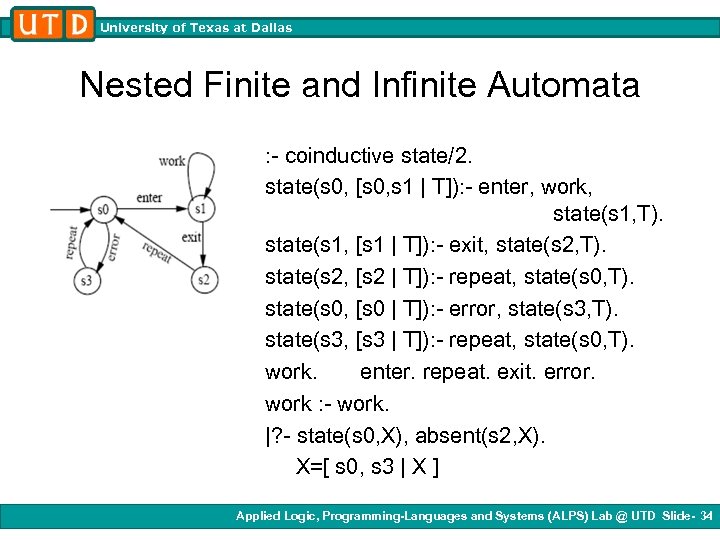 University of Texas at Dallas Nested Finite and Infinite Automata : - coinductive state/2. state(s 0, [s 0, s 1 | T]): - enter, work, state(s 1, T). state(s 1, [s 1 | T]): - exit, state(s 2, T). state(s 2, [s 2 | T]): - repeat, state(s 0, T). state(s 0, [s 0 | T]): - error, state(s 3, T). state(s 3, [s 3 | T]): - repeat, state(s 0, T). work. enter. repeat. exit. error. work : - work. |? - state(s 0, X), absent(s 2, X). X=[ s 0, s 3 | X ] Applied Logic, Programming-Languages and Systems (ALPS) Lab @ UTD Slide- 34
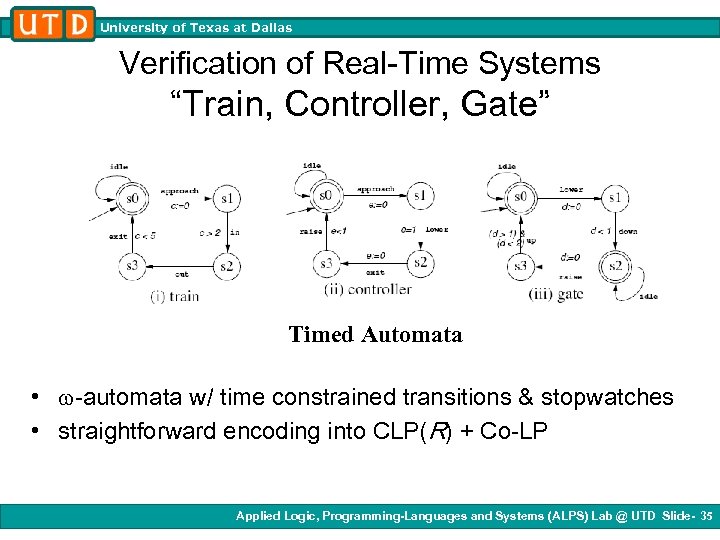 University of Texas at Dallas Verification of Real-Time Systems “Train, Controller, Gate” Timed Automata • -automata w/ time constrained transitions & stopwatches • straightforward encoding into CLP(R) + Co-LP Applied Logic, Programming-Languages and Systems (ALPS) Lab @ UTD Slide- 35
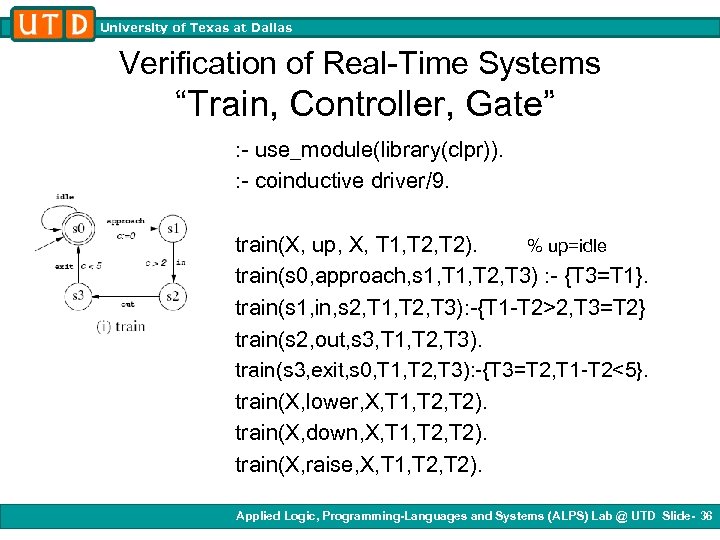 University of Texas at Dallas Verification of Real-Time Systems “Train, Controller, Gate” : - use_module(library(clpr)). : - coinductive driver/9. train(X, up, X, T 1, T 2). % up=idle train(s 0, approach, s 1, T 2, T 3) : - {T 3=T 1}. train(s 1, in, s 2, T 1, T 2, T 3): -{T 1 -T 2>2, T 3=T 2} train(s 2, out, s 3, T 1, T 2, T 3). train(s 3, exit, s 0, T 1, T 2, T 3): -{T 3=T 2, T 1 -T 2<5}. train(X, lower, X, T 1, T 2). train(X, down, X, T 1, T 2). train(X, raise, X, T 1, T 2). Applied Logic, Programming-Languages and Systems (ALPS) Lab @ UTD Slide- 36
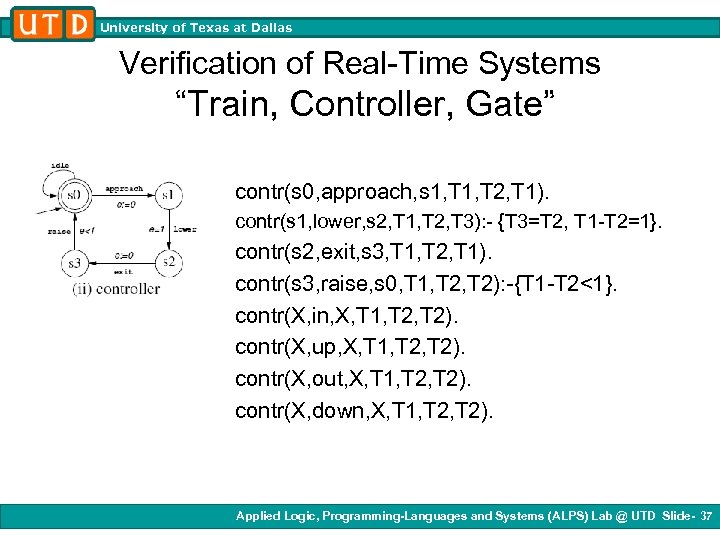 University of Texas at Dallas Verification of Real-Time Systems “Train, Controller, Gate” contr(s 0, approach, s 1, T 2, T 1). contr(s 1, lower, s 2, T 1, T 2, T 3): - {T 3=T 2, T 1 -T 2=1}. contr(s 2, exit, s 3, T 1, T 2, T 1). contr(s 3, raise, s 0, T 1, T 2): -{T 1 -T 2<1}. contr(X, in, X, T 1, T 2). contr(X, up, X, T 1, T 2). contr(X, out, X, T 1, T 2). contr(X, down, X, T 1, T 2). Applied Logic, Programming-Languages and Systems (ALPS) Lab @ UTD Slide- 37
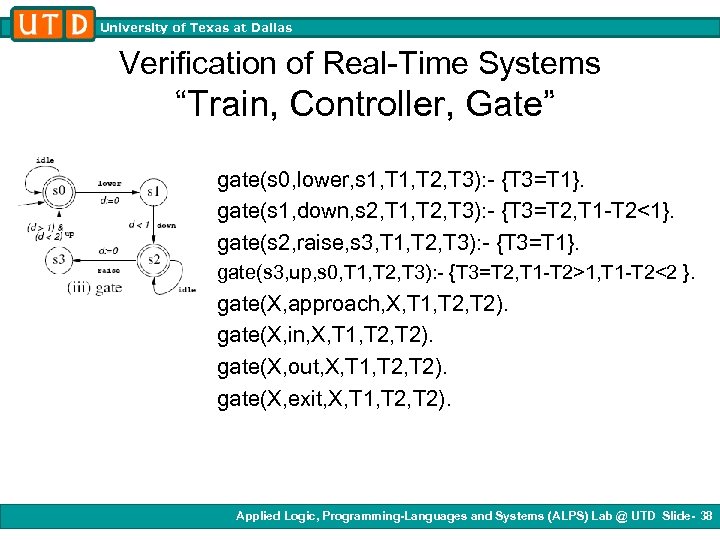 University of Texas at Dallas Verification of Real-Time Systems “Train, Controller, Gate” gate(s 0, lower, s 1, T 2, T 3): - {T 3=T 1}. gate(s 1, down, s 2, T 1, T 2, T 3): - {T 3=T 2, T 1 -T 2<1}. gate(s 2, raise, s 3, T 1, T 2, T 3): - {T 3=T 1}. gate(s 3, up, s 0, T 1, T 2, T 3): - {T 3=T 2, T 1 -T 2>1, T 1 -T 2<2 }. gate(X, approach, X, T 1, T 2). gate(X, in, X, T 1, T 2). gate(X, out, X, T 1, T 2). gate(X, exit, X, T 1, T 2). Applied Logic, Programming-Languages and Systems (ALPS) Lab @ UTD Slide- 38
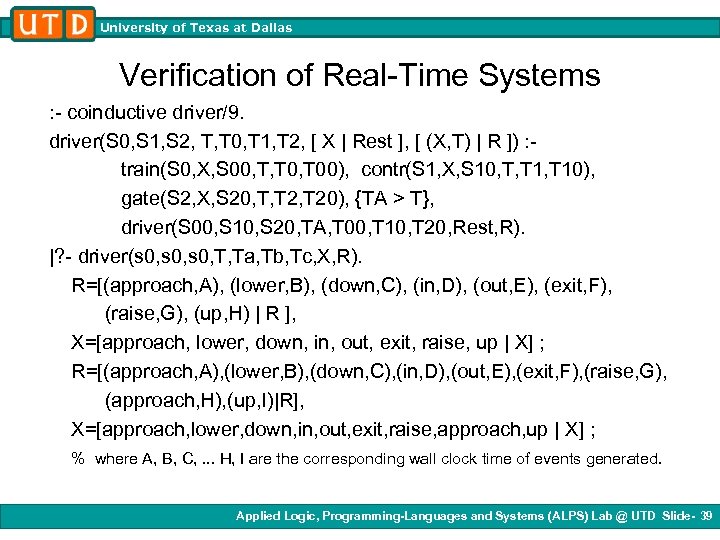 University of Texas at Dallas Verification of Real-Time Systems : - coinductive driver/9. driver(S 0, S 1, S 2, T, T 0, T 1, T 2, [ X | Rest ], [ (X, T) | R ]) : train(S 0, X, S 00, T, T 00), contr(S 1, X, S 10, T, T 10), gate(S 2, X, S 20, T, T 20), {TA > T}, driver(S 00, S 10, S 20, TA, T 00, T 10, T 20, Rest, R). |? - driver(s 0, T, Ta, Tb, Tc, X, R). R=[(approach, A), (lower, B), (down, C), (in, D), (out, E), (exit, F), (raise, G), (up, H) | R ], X=[approach, lower, down, in, out, exit, raise, up | X] ; R=[(approach, A), (lower, B), (down, C), (in, D), (out, E), (exit, F), (raise, G), (approach, H), (up, I)|R], X=[approach, lower, down, in, out, exit, raise, approach, up | X] ; % where A, B, C, . . . H, I are the corresponding wall clock time of events generated. Applied Logic, Programming-Languages and Systems (ALPS) Lab @ UTD Slide- 39
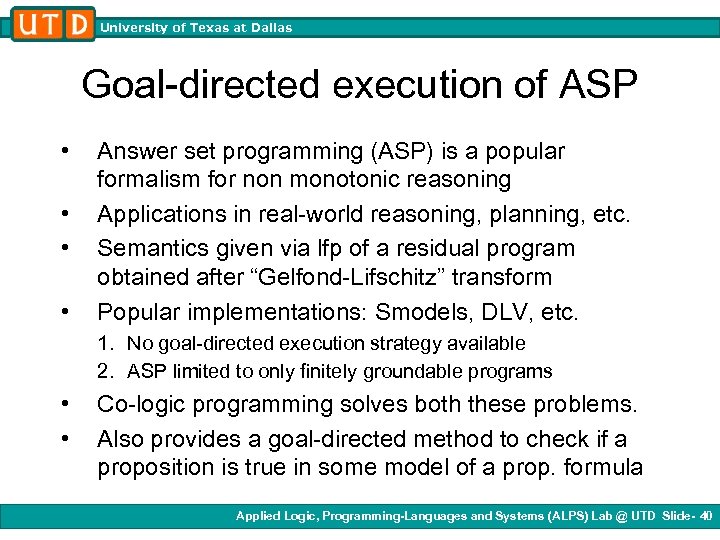 University of Texas at Dallas Goal-directed execution of ASP • • Answer set programming (ASP) is a popular formalism for non monotonic reasoning Applications in real-world reasoning, planning, etc. Semantics given via lfp of a residual program obtained after “Gelfond-Lifschitz” transform Popular implementations: Smodels, DLV, etc. 1. No goal-directed execution strategy available 2. ASP limited to only finitely groundable programs • • Co-logic programming solves both these problems. Also provides a goal-directed method to check if a proposition is true in some model of a prop. formula Applied Logic, Programming-Languages and Systems (ALPS) Lab @ UTD Slide- 40
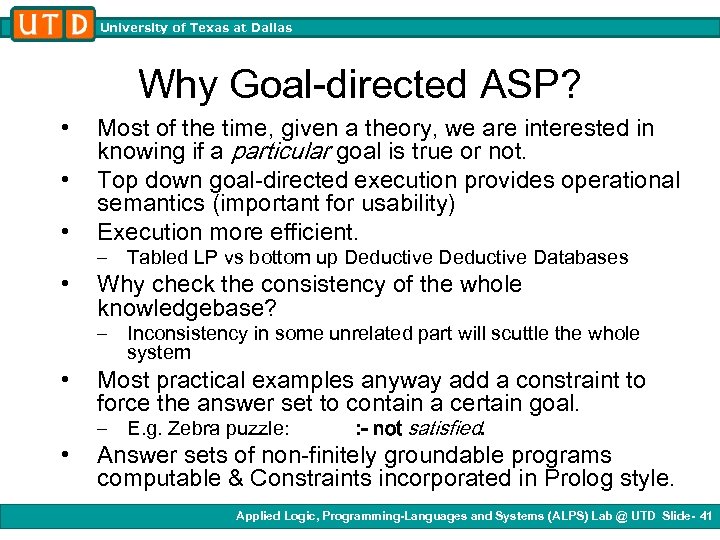 University of Texas at Dallas Why Goal-directed ASP? • • • Most of the time, given a theory, we are interested in knowing if a particular goal is true or not. Top down goal-directed execution provides operational semantics (important for usability) Execution more efficient. – Tabled LP vs bottom up Deductive Databases Why check the consistency of the whole knowledgebase? – Inconsistency in some unrelated part will scuttle the whole system Most practical examples anyway add a constraint to force the answer set to contain a certain goal. – E. g. Zebra puzzle: : - not satisfied. Answer sets of non-finitely groundable programs computable & Constraints incorporated in Prolog style. Applied Logic, Programming-Languages and Systems (ALPS) Lab @ UTD Slide- 41
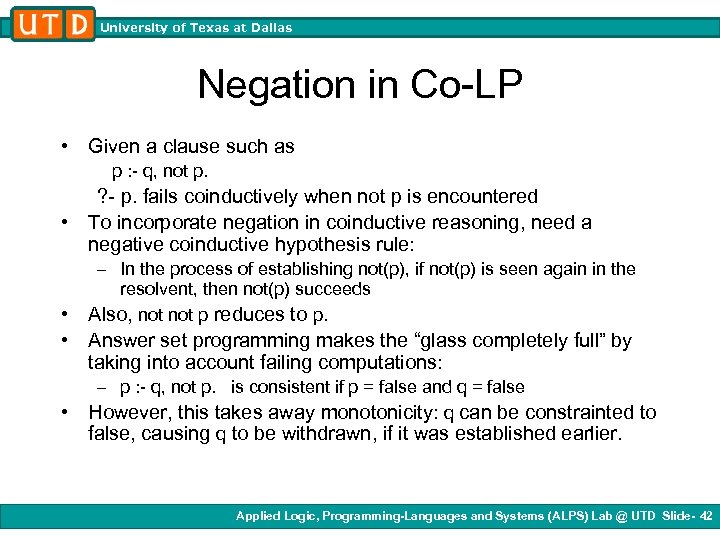 University of Texas at Dallas Negation in Co-LP • Given a clause such as p : - q, not p. ? - p. fails coinductively when not p is encountered • To incorporate negation in coinductive reasoning, need a negative coinductive hypothesis rule: – In the process of establishing not(p), if not(p) is seen again in the resolvent, then not(p) succeeds Also, not p reduces to p. • • Answer set programming makes the “glass completely full” by taking into account failing computations: • – p : - q, not p. is consistent if p = false and q = false However, this takes away monotonicity: q can be constrainted to false, causing q to be withdrawn, if it was established earlier. Applied Logic, Programming-Languages and Systems (ALPS) Lab @ UTD Slide- 42
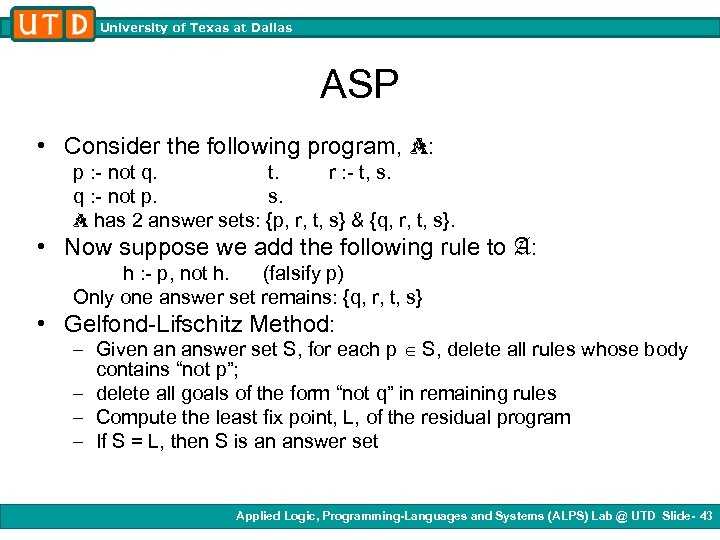 University of Texas at Dallas ASP • Consider the following program, A: p : - not q. t. r : - t, s. q : - not p. s. A has 2 answer sets: {p, r, t, s} & {q, r, t, s}. • Now suppose we add the following rule to A: h : - p, not h. (falsify p) Only one answer set remains: {q, r, t, s} • Gelfond-Lifschitz Method: – Given an answer set S, for each p S, delete all rules whose body contains “not p”; – delete all goals of the form “not q” in remaining rules – Compute the least fix point, L, of the residual program – If S = L, then S is an answer set Applied Logic, Programming-Languages and Systems (ALPS) Lab @ UTD Slide- 43
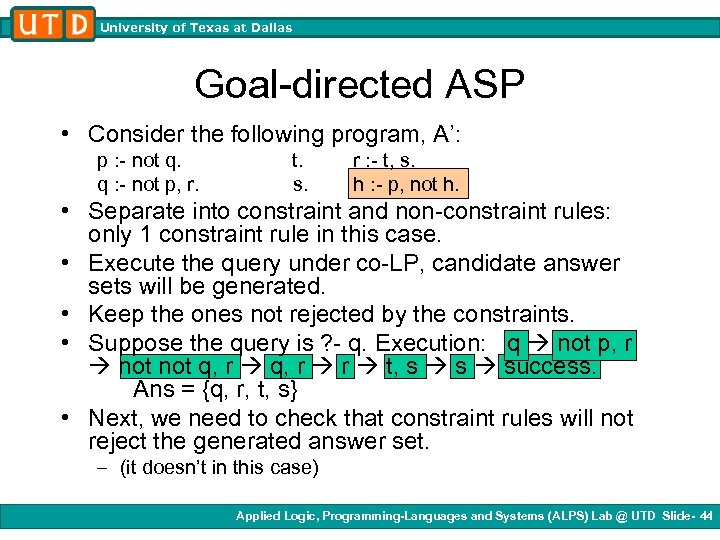 University of Texas at Dallas Goal-directed ASP • Consider the following program, A’: p : - not q. q : - not p, r. t. s. r : - t, s. h : - p, not h. • Separate into constraint and non-constraint rules: only 1 constraint rule in this case. • Execute the query under co-LP, candidate answer sets will be generated. • Keep the ones not rejected by the constraints. • Suppose the query is ? - q. Execution: q not p, r not q, r r t, s s success. Ans = {q, r, t, s} • Next, we need to check that constraint rules will not reject the generated answer set. – (it doesn’t in this case) Applied Logic, Programming-Languages and Systems (ALPS) Lab @ UTD Slide- 44
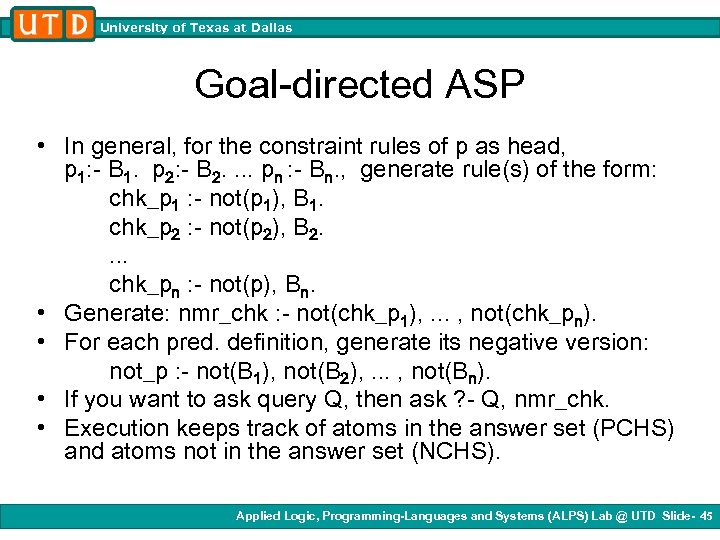 University of Texas at Dallas Goal-directed ASP • In general, for the constraint rules of p as head, p 1: - B 1. p 2: - B 2. . pn : - Bn. , generate rule(s) of the form: chk_p 1 : - not(p 1), B 1. chk_p 2 : - not(p 2), B 2. . chk_pn : - not(p), Bn. • Generate: nmr_chk : - not(chk_p 1), . . . , not(chk_pn). • For each pred. definition, generate its negative version: not_p : - not(B 1), not(B 2), . . . , not(Bn). • If you want to ask query Q, then ask ? - Q, nmr_chk. • Execution keeps track of atoms in the answer set (PCHS) and atoms not in the answer set (NCHS). Applied Logic, Programming-Languages and Systems (ALPS) Lab @ UTD Slide- 45
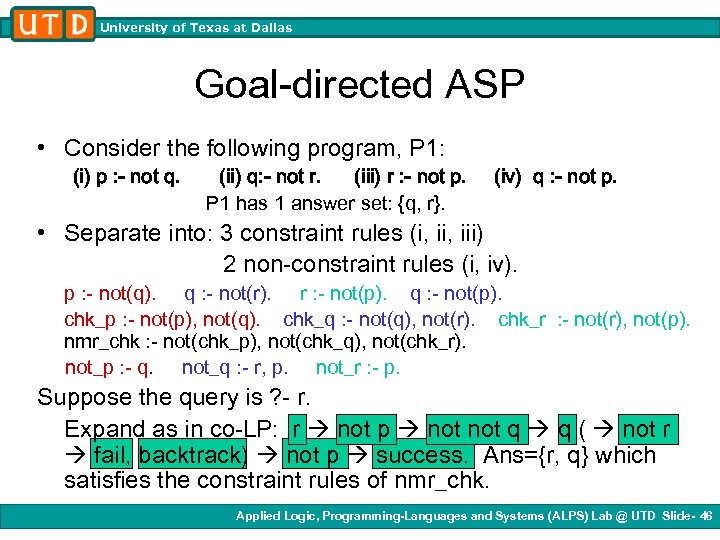 University of Texas at Dallas Goal-directed ASP • Consider the following program, P 1: (i) p : - not q. (ii) q: - not r. (iii) r : - not p. P 1 has 1 answer set: {q, r}. (iv) q : - not p. • Separate into: 3 constraint rules (i, iii) 2 non-constraint rules (i, iv). p : - not(q). q : - not(r). r : - not(p). q : - not(p). chk_p : - not(p), not(q). chk_q : - not(q), not(r). chk_r : - not(r), not(p). nmr_chk : - not(chk_p), not(chk_q), not(chk_r). not_p : - q. not_q : - r, p. not_r : - p. Suppose the query is ? - r. Expand as in co-LP: r not p not q q ( not r fail, backtrack) not p success. Ans={r, q} which satisfies the constraint rules of nmr_chk. Applied Logic, Programming-Languages and Systems (ALPS) Lab @ UTD Slide- 46
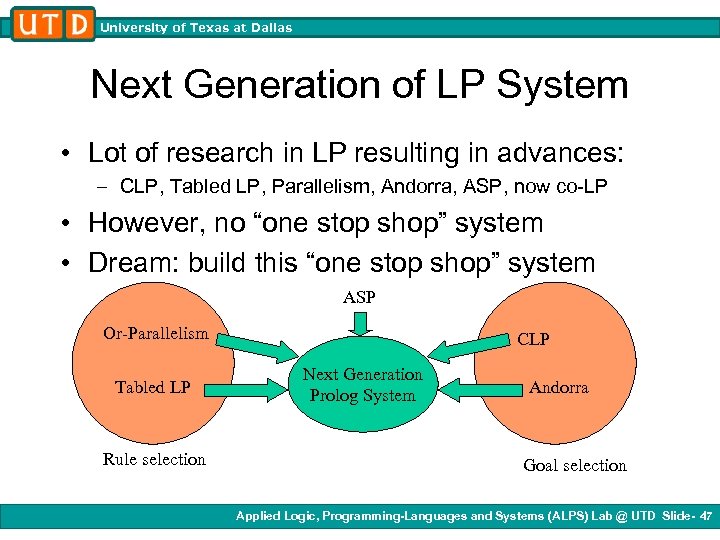 University of Texas at Dallas Next Generation of LP System • Lot of research in LP resulting in advances: – CLP, Tabled LP, Parallelism, Andorra, ASP, now co-LP • However, no “one stop shop” system • Dream: build this “one stop shop” system ASP Or-Parallelism Tabled LP Rule selection CLP Next Generation Prolog System Andorra Goal selection Applied Logic, Programming-Languages and Systems (ALPS) Lab @ UTD Slide- 47
 University of Texas at Dallas Related Publications 1. L. Simon, A. Mallya, A. Bansal, and G. Gupta. Coinductive logic programming. In ICLP’ 06. 2. L. Simon, A. Bansal, A. Mallya, and G. Gupta. Co. Logic programming: Extending logic programming with coinduction. In ICALP’ 07. 3. ICLP’ 07 Proceedings (this tutorial) 4. A. Bansal, R. Min, G. Gupta. Goal-directed Execution of ASP. Internal Report, UT Dallas 5. R. Min, A. Bansal, G. Gupta. Goal-directed Execution of ASP with General Predicates. Forthcoming. 6. A. Bansal, R. Min, G. Gupta. Resolution Theorem Proving with Coinduction. Internal Report, UT Dallas Applied Logic, Programming-Languages and Systems (ALPS) Lab @ UTD Slide- 48
 University of Texas at Dallas Conclusion • Circularity is a common concept in everyday life and computer science: • Logic/LP is unable to cope with circularity • Solution: introduce coinduction in Logic/LP – dual of traditional logic programming – operational semantics for coinduction – combining both halves of logic programming • applications to verification, non monotonic reasoning, negation in LP, web services, theorem proving, propositional satisfiability. • Acknowledgemt. : V. Santos Costa, R. Rocha, F. Silva (for help with implementation of co-LP) Applied Logic, Programming-Languages and Systems (ALPS) Lab @ UTD Slide- 49