


 Скачать презентацию University of Sheffield NLP Machine Learning in GATE
3202953d1358407e61923595acada080.ppt
- Количество слайдов: 48
 University of Sheffield NLP Machine Learning in GATE Angus Roberts, Horacio Saggion, Genevieve Gorrell
 University of Sheffield NLP Recap • Previous two days looked at knowledge engineered IE • This session looks at machine learned IE • Supervised learning • Effort is shifted from language engineers to annotators
 University of Sheffield NLP Outline • • • Machine Learning and IE Support Vector Machines GATE's learning API and PR Learning entities – hands on Learning relations – demo (classifying sentences and documents)
 University of Sheffield NLP Machine learning for information extraction
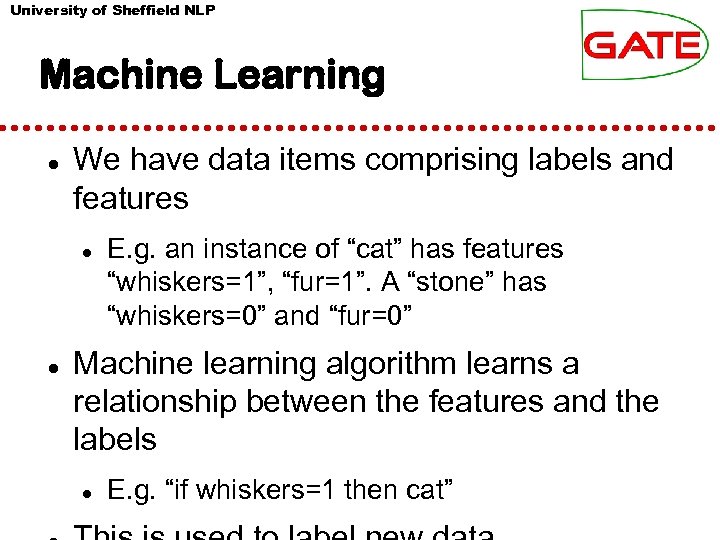 University of Sheffield NLP Machine Learning We have data items comprising labels and features E. g. an instance of “cat” has features “whiskers=1”, “fur=1”. A “stone” has “whiskers=0” and “fur=0” Machine learning algorithm learns a relationship between the features and the labels E. g. “if whiskers=1 then cat”
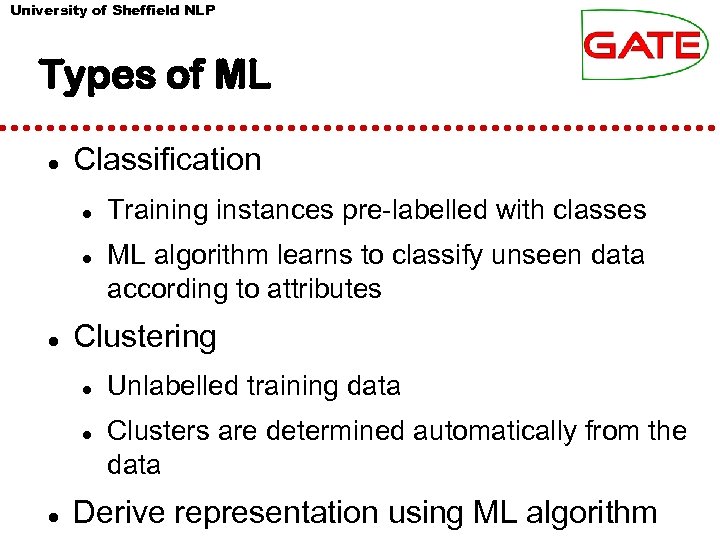 University of Sheffield NLP Types of ML Classification ML algorithm learns to classify unseen data according to attributes Clustering Training instances pre-labelled with classes Unlabelled training data Clusters are determined automatically from the data Derive representation using ML algorithm
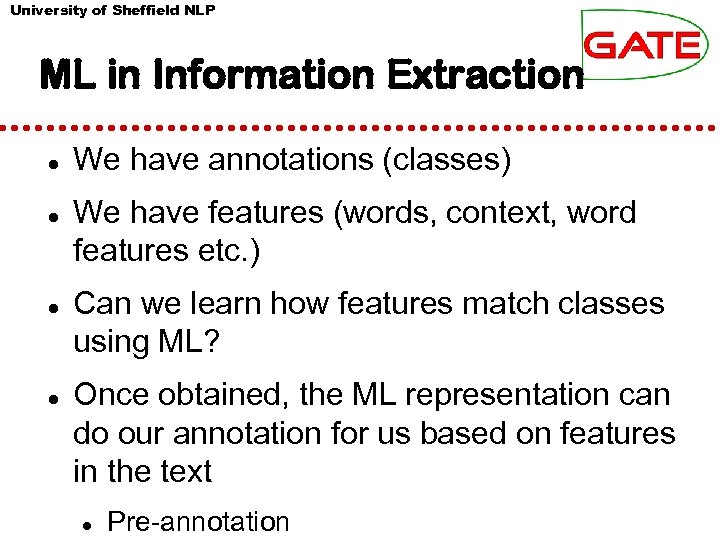 University of Sheffield NLP ML in Information Extraction We have annotations (classes) We have features (words, context, word features etc. ) Can we learn how features match classes using ML? Once obtained, the ML representation can do our annotation for us based on features in the text Pre-annotation
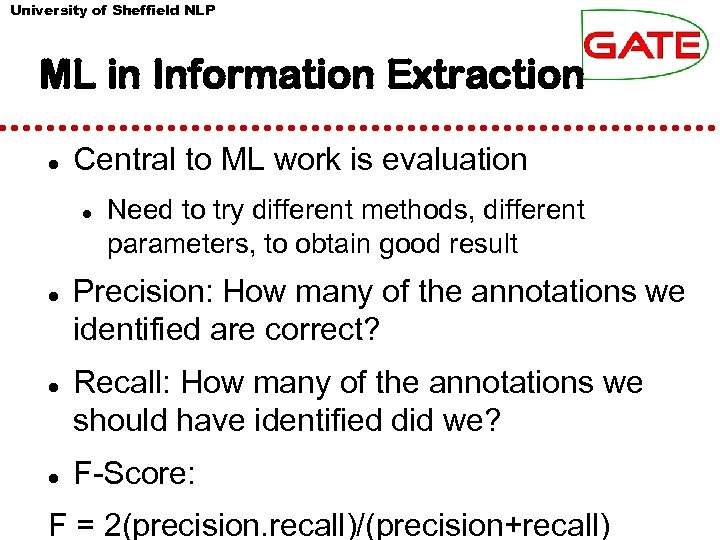 University of Sheffield NLP ML in Information Extraction Central to ML work is evaluation Need to try different methods, different parameters, to obtain good result Precision: How many of the annotations we identified are correct? Recall: How many of the annotations we should have identified did we? F-Score: F = 2(precision. recall)/(precision+recall)
 University of Sheffield NLP ML Algorithms Vector space models Data have attributes (word features, context etc. ) Each attribute is a dimension Data positioned in space Methods involve splitting the space Having learned the split, apply to new data Support vector machines, K-Nearest Neighbours etc.
 University of Sheffield NLP Support vector machines
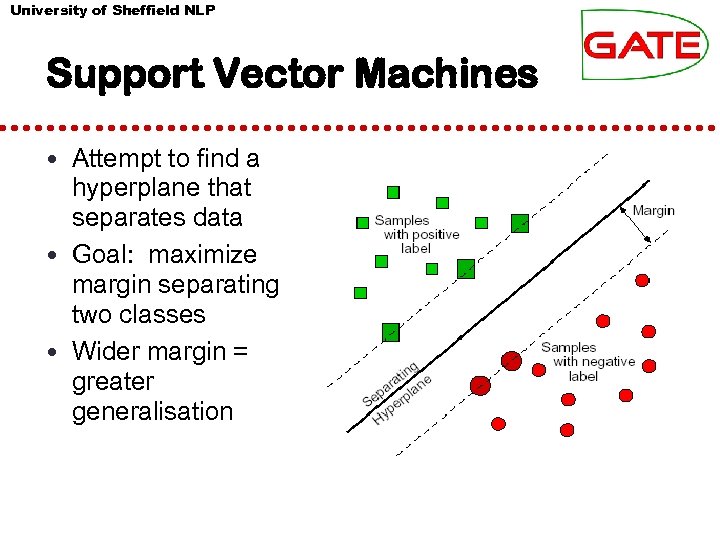 University of Sheffield NLP Support Vector Machines • Attempt to find a hyperplane that separates data • Goal: maximize margin separating two classes • Wider margin = greater generalisation
 University of Sheffield NLP Support Vector Machines • Points near decision boundary: support vectors (removing them would change boundary) • Points far from boundary not important for decision • What if data doesn't split? – – Soft boundary methods exist for imperfect solutions However linear separator may be
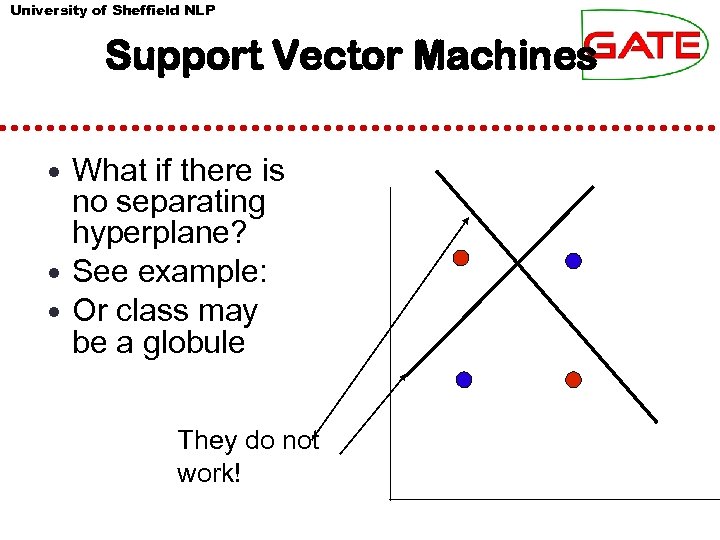 University of Sheffield NLP Support Vector Machines • What if there is no separating hyperplane? • See example: • Or class may be a globule They do not work!
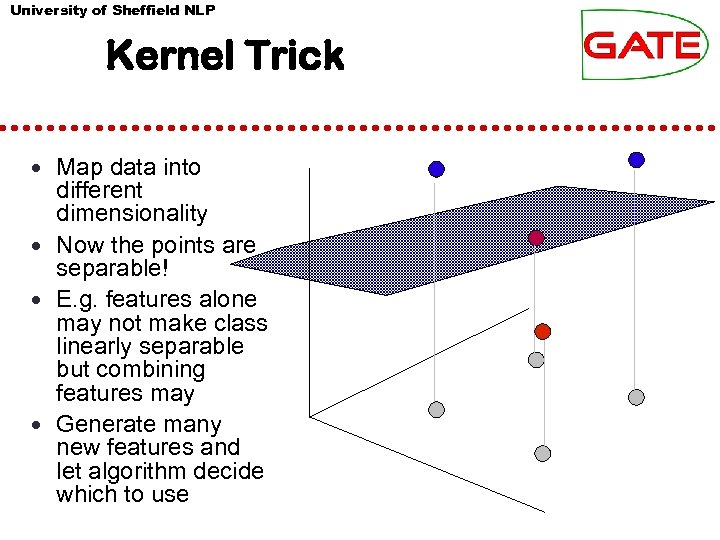 University of Sheffield NLP Kernel Trick • Map data into different dimensionality • Now the points are separable! • E. g. features alone may not make class linearly separable but combining features may • Generate many new features and let algorithm decide which to use
 University of Sheffield NLP Support Vector Machines SVMs combined with kernel trick provide a powerful technique Multiclass methods simple extention to two class technique (one vs. another, one vs. others) Widely used with great success across a range of linguistic tasks
 University of Sheffield NLP GATE's learning API and PR
 University of Sheffield NLP API and PRs • User Guide 9. 24 Machine Learning PR • Chapter 11 Machine Learning API • Support for 3 types of learning • Produce features from annotations • Abstracts away from ML algorithms Batch Learning PR • A GATE language analyser
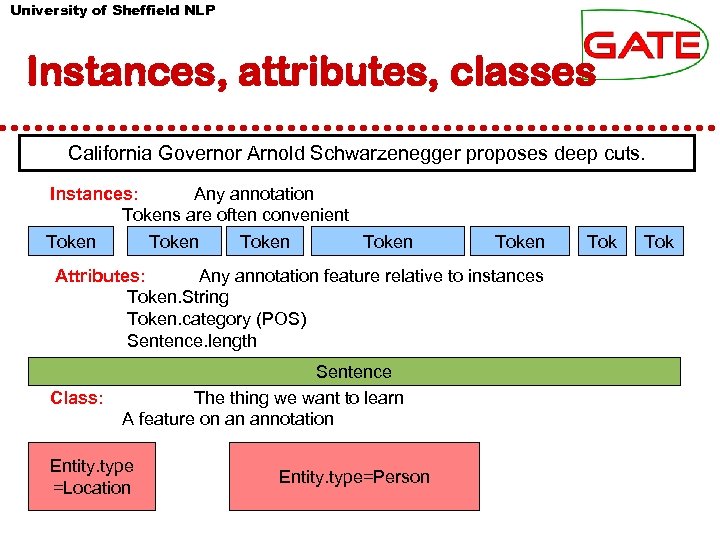 University of Sheffield NLP Instances, attributes, classes California Governor Arnold Schwarzenegger proposes deep cuts. Instances: Any annotation Tokens are often convenient Token Token Attributes: Any annotation feature relative to instances Token. String Token. category (POS) Sentence. length Class: Sentence The thing we want to learn A feature on an annotation Entity. type =Location Entity. type=Person Tok
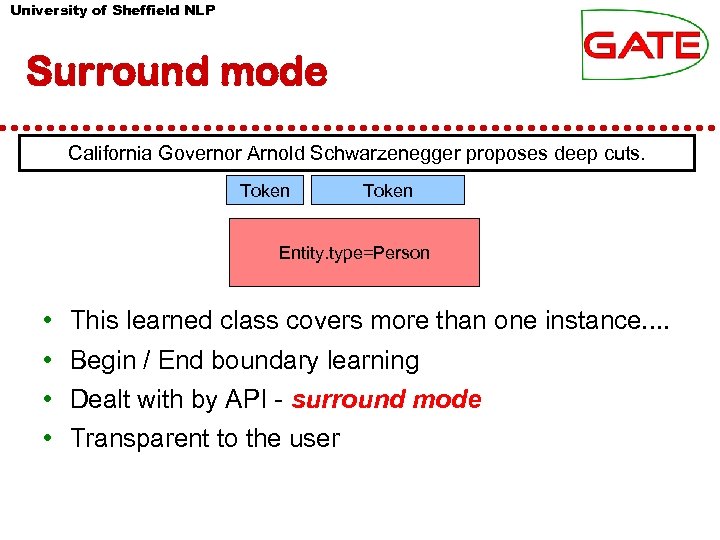 University of Sheffield NLP Surround mode California Governor Arnold Schwarzenegger proposes deep cuts. Token Entity. type=Person • • This learned class covers more than one instance. . Begin / End boundary learning Dealt with by API - surround mode Transparent to the user
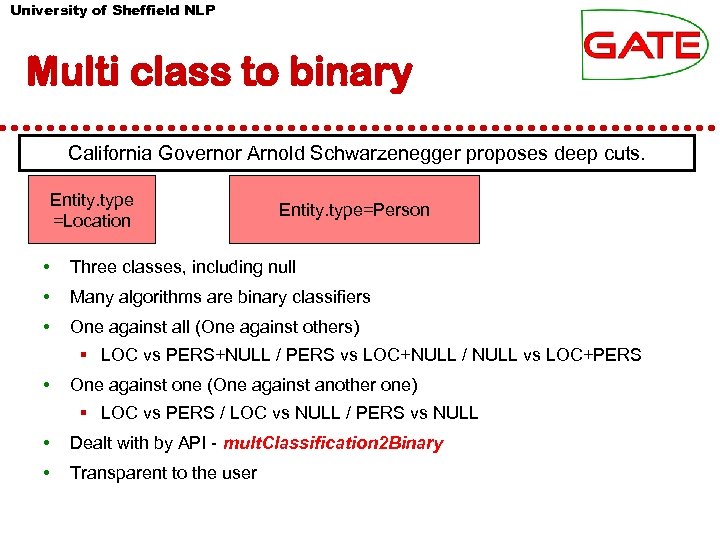 University of Sheffield NLP Multi class to binary California Governor Arnold Schwarzenegger proposes deep cuts. Entity. type =Location Entity. type=Person • Three classes, including null • Many algorithms are binary classifiers • One against all (One against others) LOC vs PERS+NULL / PERS vs LOC+NULL / NULL vs LOC+PERS • One against one (One against another one) LOC vs PERS / LOC vs NULL / PERS vs NULL • Dealt with by API - mult. Classification 2 Binary • Transparent to the user
 University of Sheffield NLP ML applications in GATE • Batch Learning PR Evaluation Training Application • Runs after all other PRs – must be last PR • Configured via xml file • A single directory holds generated features, models, and config file
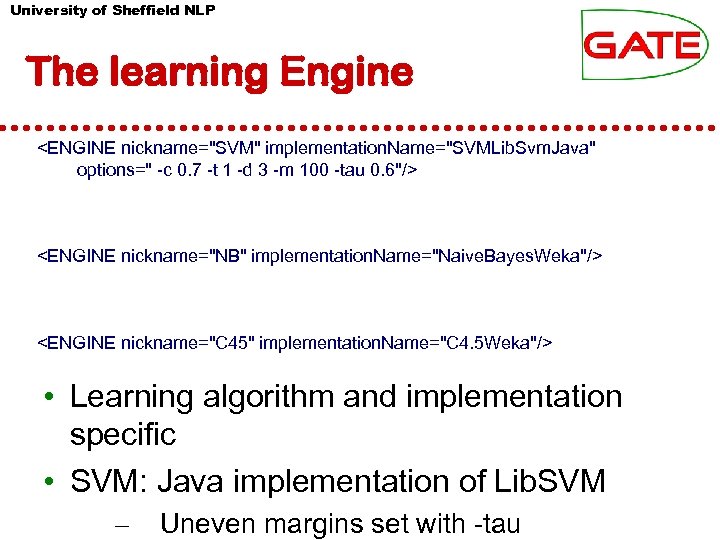 University of Sheffield NLP The learning Engine
 University of Sheffield NLP The dataset
 University of Sheffield NLP Learning entities Hands on
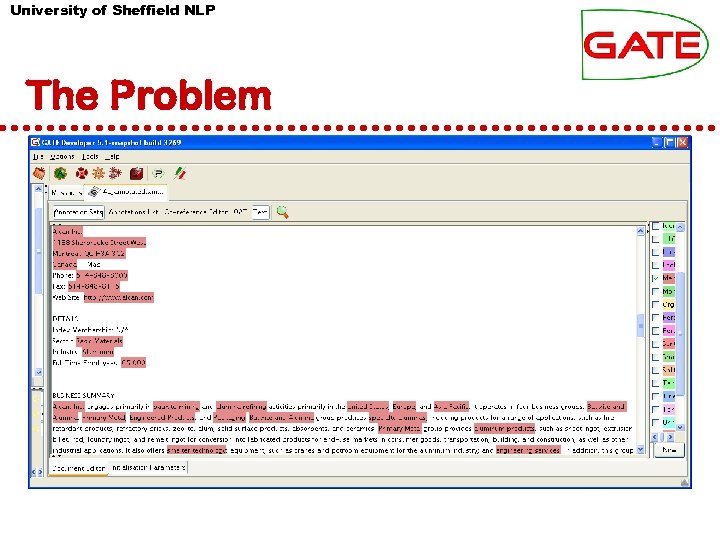
 University of Sheffield NLP The Problem • Information extraction consists on the identification of pre-specified facts in running texts • One important component of any information extraction system is a named entity identification component • Two main approaches exist for the identification of entities in text: • Hand-crafted rules: you’ve seen the ANNIE system • Machine learning approaches: we will explore one possibility in this session using a classification system • Manually developed rules use different source of information: identity of tokens, parts of speech, orthography of the tokens, dictionary information (e. g. Lookup process), etc. • ML components also rely on those sources of information and features have to be carefully selected by the ML developer
 University of Sheffield NLP The Problem
 University of Sheffield NLP Features for learning
 University of Sheffield NLP Features for learning • Consider the string “Alcan, Inc. ” in the text what we want the ML component to do is to annotate this whole string as a company name. Note that the ML component will treat this problem as classification: it will transform this into the problem of classifying individual tokens in text (e. g. “Alcan” is the beginning of a company name and “. ” (after Inc) is the end of the company name • There are several “features” one could use to recognize the string as the name of a company: the first token is a NNP (proper noun), the last token is a company designator, the first token after the string is the verb “to engage”, etc. • We are going to consider features which can be extracted from the linguistic and semantic analysis of the text: tokenisation, parts of speech tagging, morphological analysis, gazetteer lookup, and entity recognition • Additionally one may use information computed by a parser, dependency relations, or syntactic information • In some cases extra processes will be required in order to transform the result of the analysis into features the ML component can use
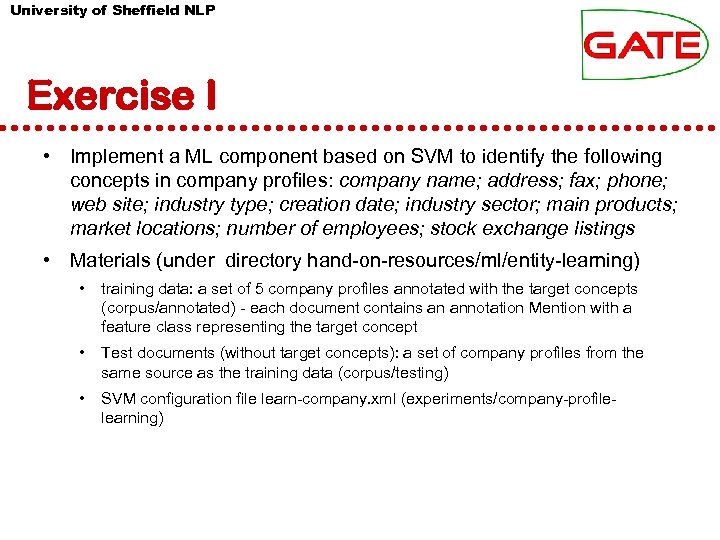 University of Sheffield NLP Exercise I • Implement a ML component based on SVM to identify the following concepts in company profiles: company name; address; fax; phone; web site; industry type; creation date; industry sector; main products; market locations; number of employees; stock exchange listings • Materials (under directory hand-on-resources/ml/entity-learning) • training data: a set of 5 company profiles annotated with the target concepts (corpus/annotated) - each document contains an annotation Mention with a feature class representing the target concept • Test documents (without target concepts): a set of company profiles from the same source as the training data (corpus/testing) • SVM configuration file learn-company. xml (experiments/company-profilelearning)
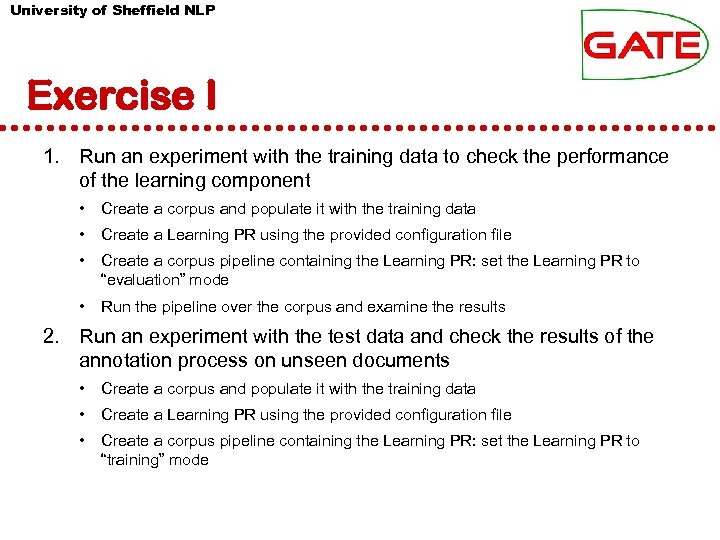 University of Sheffield NLP Exercise I 1. Run an experiment with the training data to check the performance of the learning component • Create a corpus and populate it with the training data • Create a Learning PR using the provided configuration file • Create a corpus pipeline containing the Learning PR: set the Learning PR to “evaluation” mode • Run the pipeline over the corpus and examine the results 2. Run an experiment with the test data and check the results of the annotation process on unseen documents • Create a corpus and populate it with the training data • Create a Learning PR using the provided configuration file • Create a corpus pipeline containing the Learning PR: set the Learning PR to “training” mode
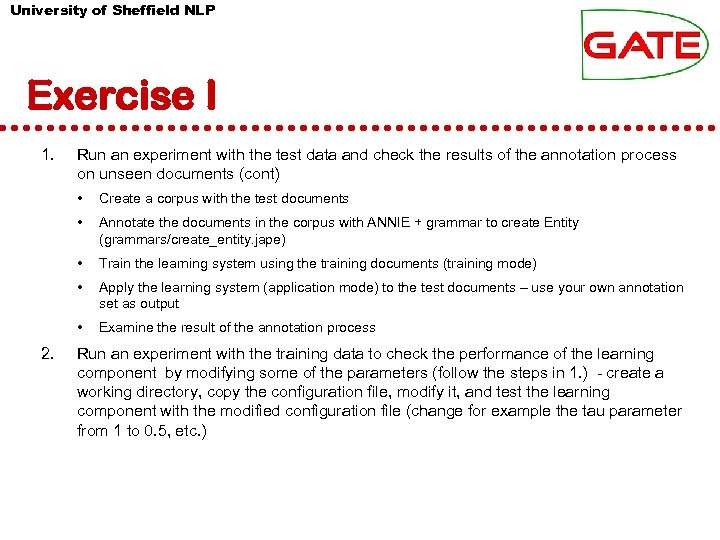 University of Sheffield NLP Exercise I 1. Run an experiment with the test data and check the results of the annotation process on unseen documents (cont) • • Annotate the documents in the corpus with ANNIE + grammar to create Entity (grammars/create_entity. jape) • Train the learning system using the training documents (training mode) • Apply the learning system (application mode) to the test documents – use your own annotation set as output • 2. Create a corpus with the test documents Examine the result of the annotation process Run an experiment with the training data to check the performance of the learning component by modifying some of the parameters (follow the steps in 1. ) - create a working directory, copy the configuration file, modify it, and test the learning component with the modified configuration file (change for example the tau parameter from 1 to 0. 5, etc. )
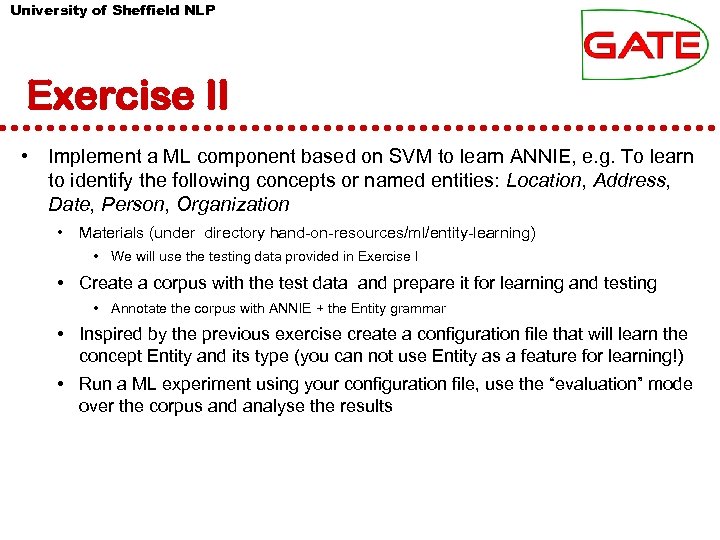 University of Sheffield NLP Exercise II • Implement a ML component based on SVM to learn ANNIE, e. g. To learn to identify the following concepts or named entities: Location, Address, Date, Person, Organization • Materials (under directory hand-on-resources/ml/entity-learning) • We will use the testing data provided in Exercise I • Create a corpus with the test data and prepare it for learning and testing • Annotate the corpus with ANNIE + the Entity grammar • Inspired by the previous exercise create a configuration file that will learn the concept Entity and its type (you can not use Entity as a feature for learning!) • Run a ML experiment using your configuration file, use the “evaluation” mode over the corpus and analyse the results
 University of Sheffield NLP Exercise II • As a variation, separate a few documents for testing, train the learner without the separated documents, and run it in application mode over the test documents • You may want to use the annotation. Diff tool verify in each document how the learner performed
 University of Sheffield NLP Learning relations Demonstration
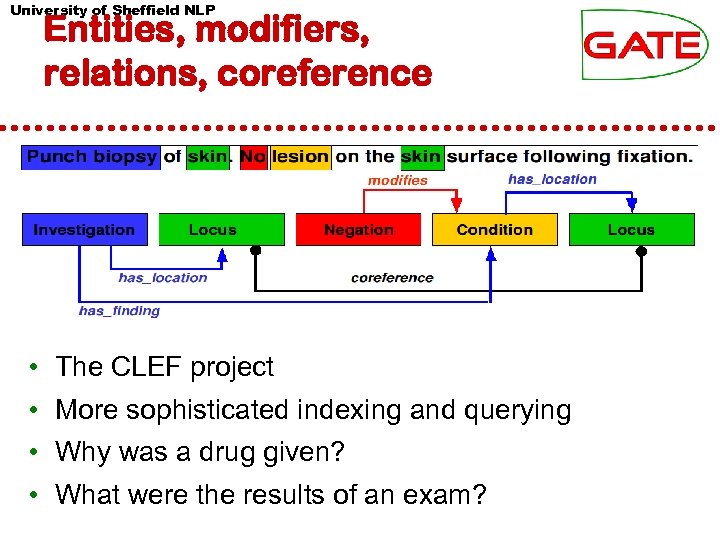 University of Sheffield NLP Entities, modifiers, relations, coreference • The CLEF project • More sophisticated indexing and querying • Why was a drug given? • What were the results of an exam?
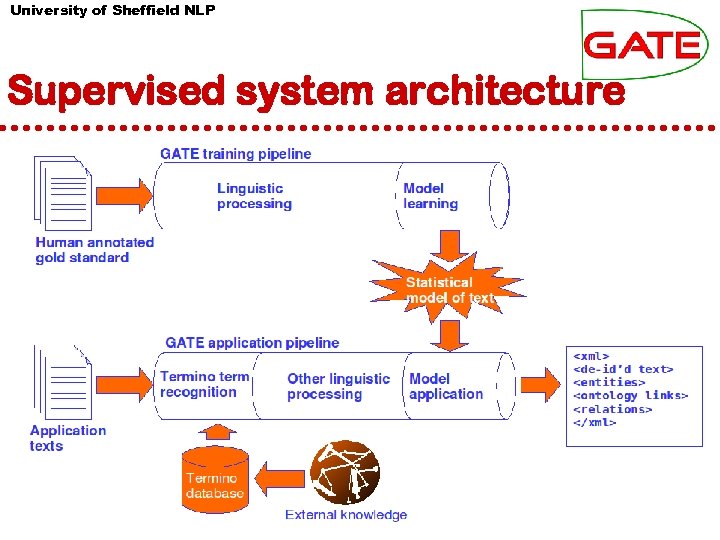 University of Sheffield NLP Supervised system architecture
 University of Sheffield NLP Previous work • Clinical relations have usually been extracted as part of a larger clinical IE system • Extraction has usually involved syntactic parses, domain-specific grammars and knowledge bases, often hand crafted • In other areas of biomedicine, statistical machine learning has come to predominate • We apply statistical techniques to clinical relations
 University of Sheffield NLP Entity types
 University of Sheffield NLP Relation types
 University of Sheffield NLP System architecture GATE pipeline Preprocess Training and test texts Pair entities Generate Relation model features learning and application Relation annotations
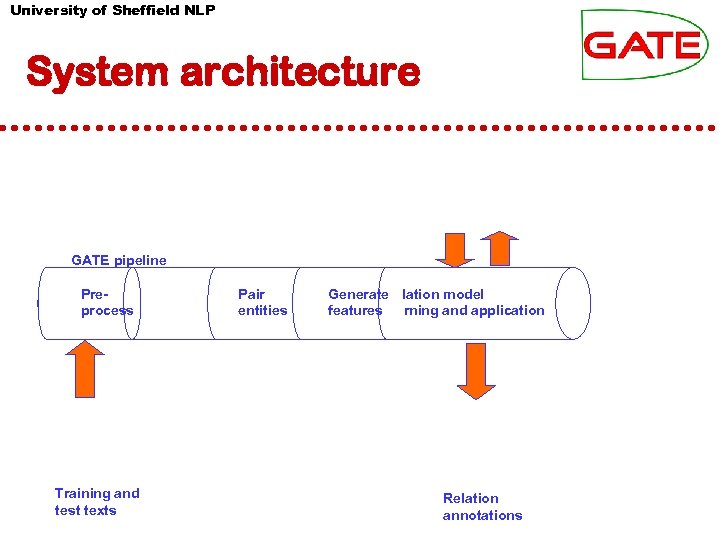
 University of Sheffield NLP Learning relations • Learn relations between pairs of entities • Create all possible pairings of entities across n sentences in the gold standard, constrained by legal entity types n: e. g. the same, or adjacent • Generate features describing the characteristics of these pairs • Build SVM models from these features
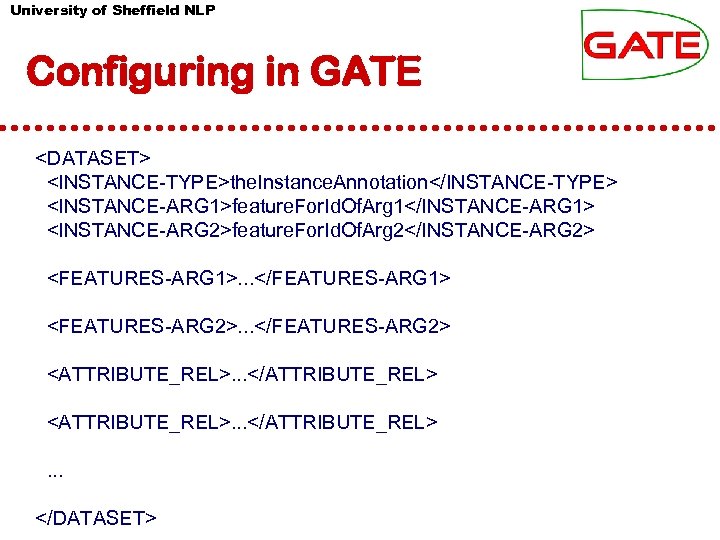 University of Sheffield NLP Configuring in GATE
 University of Sheffield NLP Creating entity pairings • Entity pairings provide instances • They will therefore provide features • A “pairing and features” PR or JAPE needs to be run before the Learning • Entities and features are problem specific • We do not have a generic “pairing and features” PR • You currently need to write your own
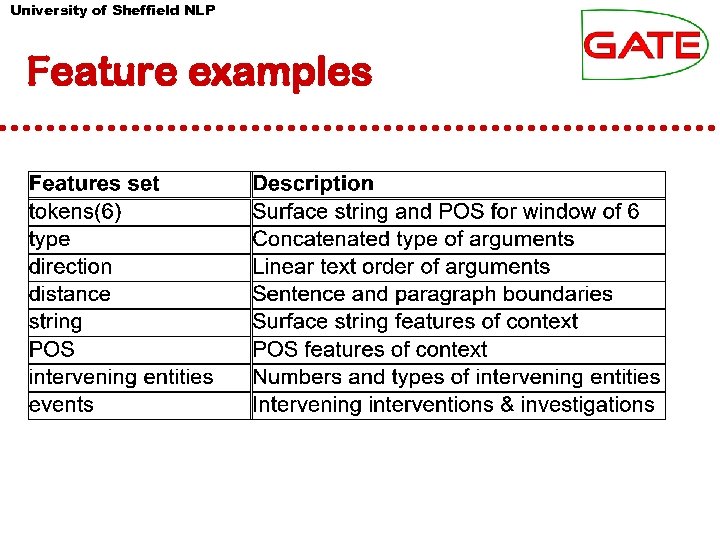 University of Sheffield NLP Feature examples
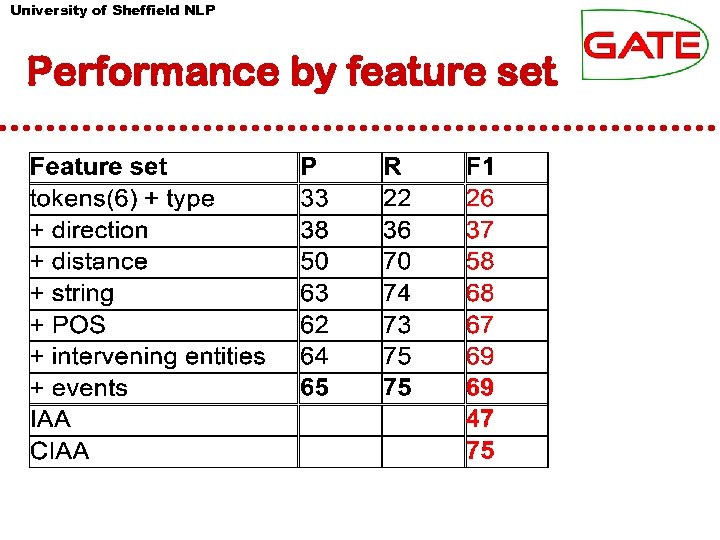 University of Sheffield NLP Performance by feature set