 Скачать презентацию University of Pitesti and Dolnośląska Wyższa Szkoła Przedsiębiorczości
6a608b6430525cf5514bc10262f9c024.ppt
- Количество слайдов: 25



University of Pitesti and Dolnośląska Wyższa Szkoła Przedsiębiorczości i Techniki w Polkowicach Basics of data acquisition systems -presentation- STUDENT: CONSTANTIN IONUT DR INZ. ZDZISŁAW PÓLKOWSKI Polkowice-2015 1
TOPICS MENU • • • • • PC-based Data Acquisition System Overview Data Acquisition System Introduction II Data Acquisition System Block Diagram Transducers and Actuators Signal Conditioning Data Acquisition Analog Inputs (A/D) Analog to Digital (A/D) Converter A/D Converter: Sampling Rate A/D Converter: Throughput A/D Converter: Range A/D Converter: Resolution Analog Outputs (D/A) Data Acquisition Software Programmable Software Data Acquisition Software
PC-based Data Acquisition System Overview In the last few years, industrial PC I/O interface products have become increasingly reliable, ccurate and affordable. PC-based data acquisition and control systems are widely used in industrial and laboratory applications like monitoring, control, data acquisition and automated testing. Selecting and building a DA&C (Data Acquisition and Control) system that actually does what you want it to do requires some knowledge of electrical and computer engineering. • Transducers and actuators • Signal conditioning • Data acquisition and control hardware • Computer systems software http: //home. deec. uc. pt/~jlobo/tc/daq_guid. pdf
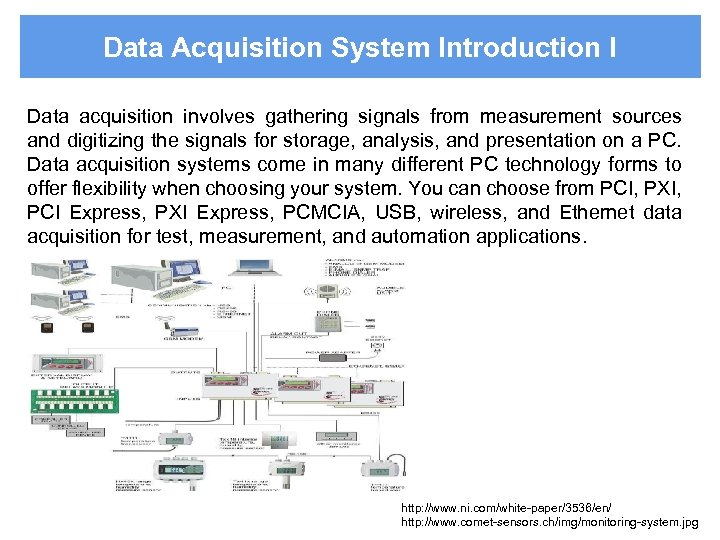
Data Acquisition System Introduction I Data acquisition involves gathering signals from measurement sources and digitizing the signals for storage, analysis, and presentation on a PC. Data acquisition systems come in many different PC technology forms to offer flexibility when choosing your system. You can choose from PCI, PXI, PCI Express, PXI Express, PCMCIA, USB, wireless, and Ethernet data acquisition for test, measurement, and automation applications. http: //www. ni. com/white-paper/3536/en/ http: //www. comet-sensors. ch/img/monitoring-system. jpg
Data Acquisition System Introduction II All industrial processing systems, factories, machinery, test facilities, and vehicles consist of hardware components and computer software whose behavior follow the laws of physics as we understand them. These systems contain thousands of mechanical and electrical phenomena that are continuously changing; they are not steady state. The measurable quantities that represent the characteristics of all systems are called variables. The proper functioning of a particular system depends on certain events in time and the parameters of these variables. Often, we are interested in the location, magnitude, and speed of the variables, and we use instruments to measure them. We assign the variables units of measure such as volts, pounds, and miles per hour, to name a few. http: //www. mccdaq. com/handbook/chapt_1. aspx
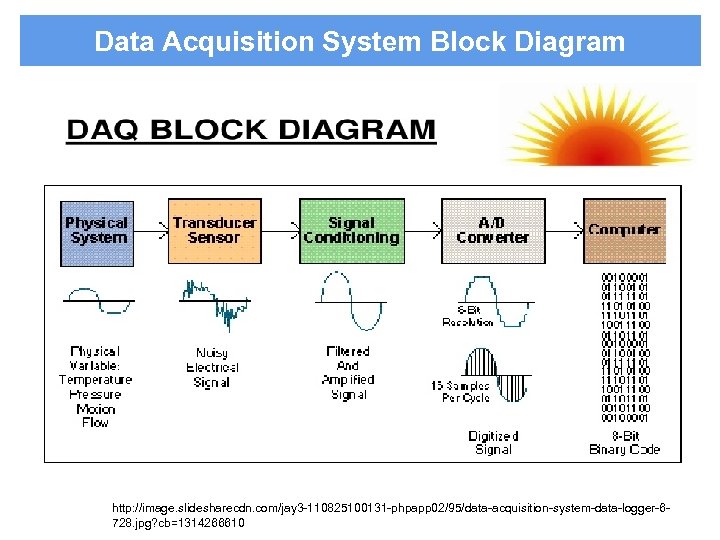
Data Acquisition System Block Diagram http: //image. slidesharecdn. com/jay 3 -110825100131 -phpapp 02/95/data-acquisition-system-data-logger-6728. jpg? cb=1314266610
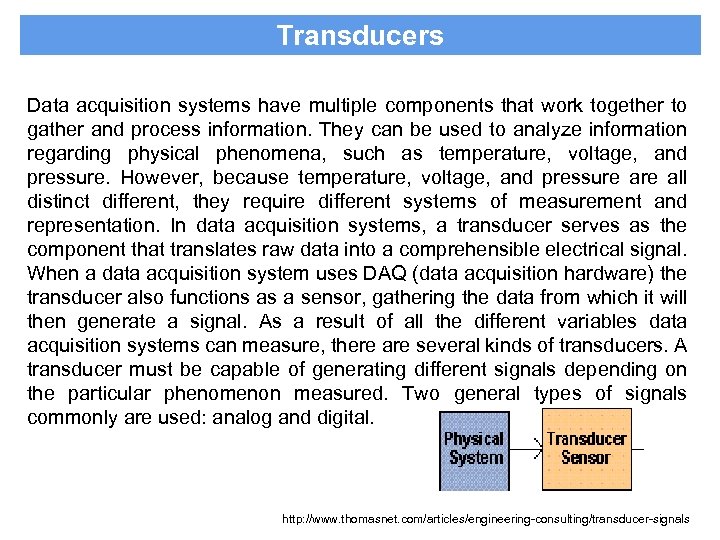
Transducers Data acquisition systems have multiple components that work together to gather and process information. They can be used to analyze information regarding physical phenomena, such as temperature, voltage, and pressure. However, because temperature, voltage, and pressure all distinct different, they require different systems of measurement and representation. In data acquisition systems, a transducer serves as the component that translates raw data into a comprehensible electrical signal. When a data acquisition system uses DAQ (data acquisition hardware) the transducer also functions as a sensor, gathering the data from which it will then generate a signal. As a result of all the different variables data acquisition systems can measure, there are several kinds of transducers. A transducer must be capable of generating different signals depending on the particular phenomenon measured. Two general types of signals commonly are used: analog and digital. http: //www. thomasnet. com/articles/engineering-consulting/transducer-signals
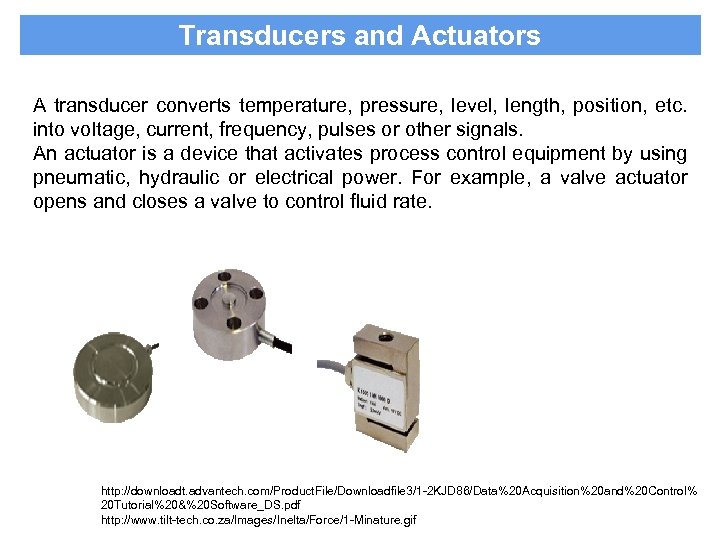
Transducers and Actuators A transducer converts temperature, pressure, level, length, position, etc. into voltage, current, frequency, pulses or other signals. An actuator is a device that activates process control equipment by using pneumatic, hydraulic or electrical power. For example, a valve actuator opens and closes a valve to control fluid rate. http: //downloadt. advantech. com/Product. File/Downloadfile 3/1 -2 KJD 86/Data%20 Acquisition%20 and%20 Control% 20 Tutorial%20&%20 Software_DS. pdf http: //www. tilt-tech. co. za/Images/Inelta/Force/1 -Minature. gif
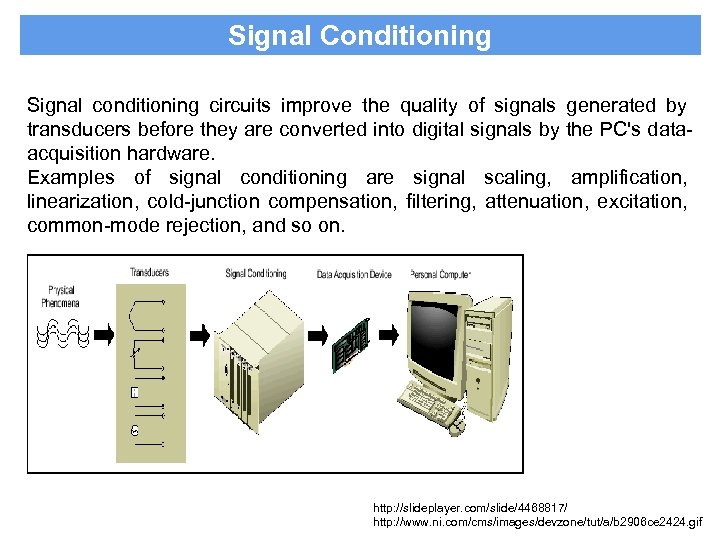
Signal Conditioning Signal conditioning circuits improve the quality of signals generated by transducers before they are converted into digital signals by the PC's dataacquisition hardware. Examples of signal conditioning are signal scaling, amplification, linearization, cold-junction compensation, filtering, attenuation, excitation, common-mode rejection, and so on. http: //slideplayer. com/slide/4468817/ http: //www. ni. com/cms/images/devzone/tut/a/b 2906 ce 2424. gif
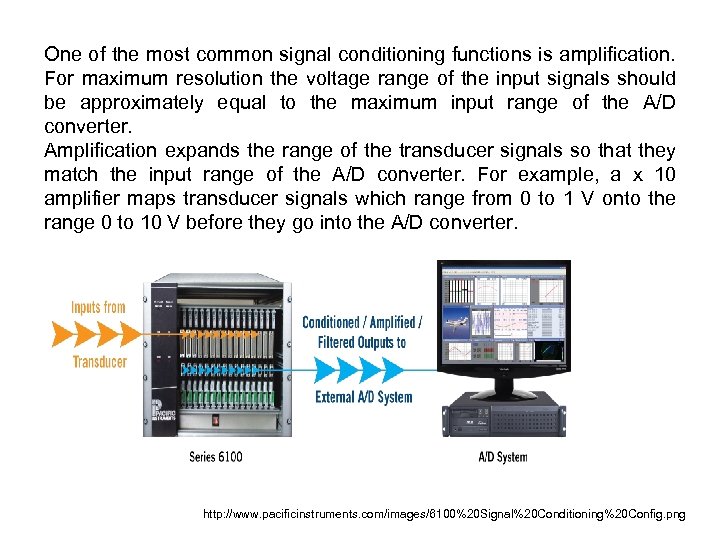
One of the most common signal conditioning functions is amplification. For maximum resolution the voltage range of the input signals should be approximately equal to the maximum input range of the A/D converter. Amplification expands the range of the transducer signals so that they match the input range of the A/D converter. For example, a x 10 amplifier maps transducer signals which range from 0 to 1 V onto the range 0 to 10 V before they go into the A/D converter. http: //www. pacificinstruments. com/images/6100%20 Signal%20 Conditioning%20 Config. png
Signal Conditioning Electrical signals are conditioned so they can be used by an analog input board. The following features may be available: Amplification n Isolation n Filtering n. Linearization n http: //docslide. us/documents/tutorial-daq. html
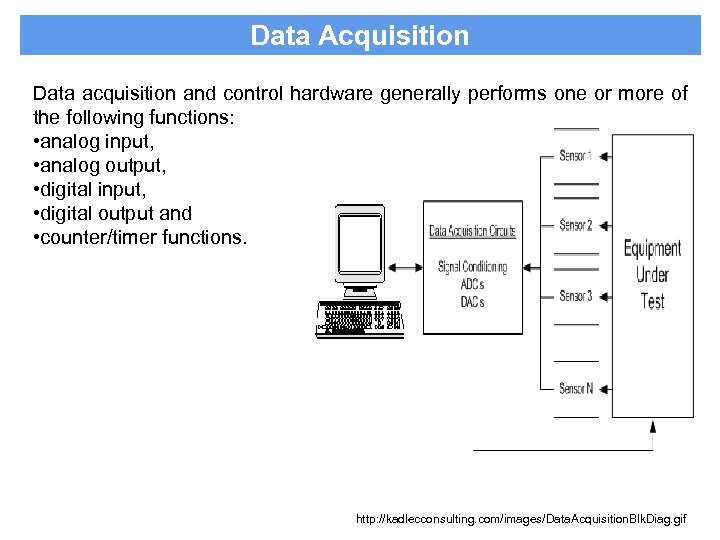
Data Acquisition Data acquisition and control hardware generally performs one or more of the following functions: • analog input, • analog output, • digital input, • digital output and • counter/timer functions. http: //kadlecconsulting. com/images/Data. Acquisition. Blk. Diag. gif
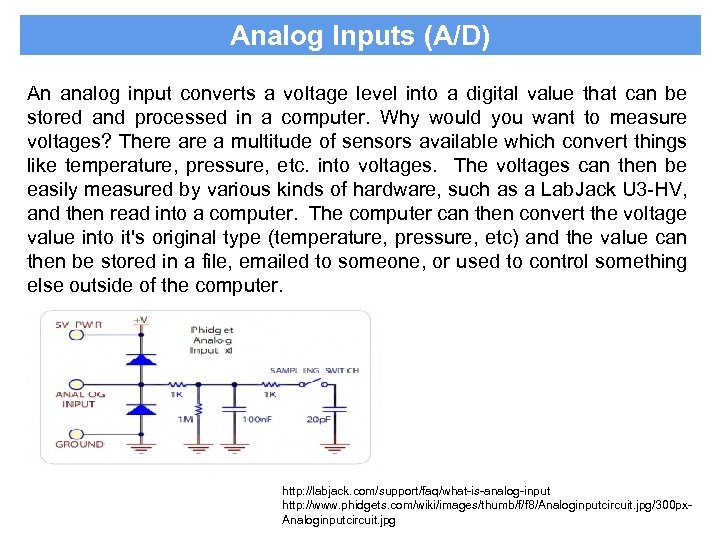
Analog Inputs (A/D) An analog input converts a voltage level into a digital value that can be stored and processed in a computer. Why would you want to measure voltages? There a multitude of sensors available which convert things like temperature, pressure, etc. into voltages. The voltages can then be easily measured by various kinds of hardware, such as a Lab. Jack U 3 -HV, and then read into a computer. The computer can then convert the voltage value into it's original type (temperature, pressure, etc) and the value can then be stored in a file, emailed to someone, or used to control something else outside of the computer. http: //labjack. com/support/faq/what-is-analog-input http: //www. phidgets. com/wiki/images/thumb/f/f 8/Analoginputcircuit. jpg/300 px. Analoginputcircuit. jpg
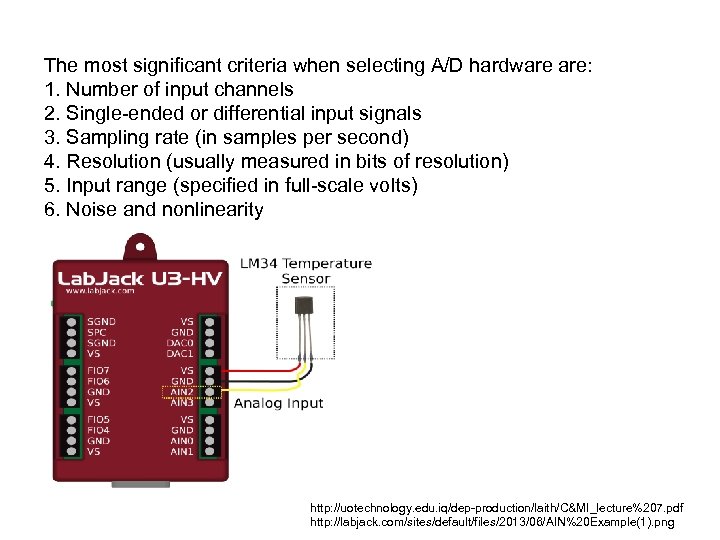
The most significant criteria when selecting A/D hardware are: 1. Number of input channels 2. Single-ended or differential input signals 3. Sampling rate (in samples per second) 4. Resolution (usually measured in bits of resolution) 5. Input range (specified in full-scale volts) 6. Noise and nonlinearity http: //uotechnology. edu. iq/dep-production/laith/C&MI_lecture%207. pdf http: //labjack. com/sites/default/files/2013/06/AIN%20 Example(1). png
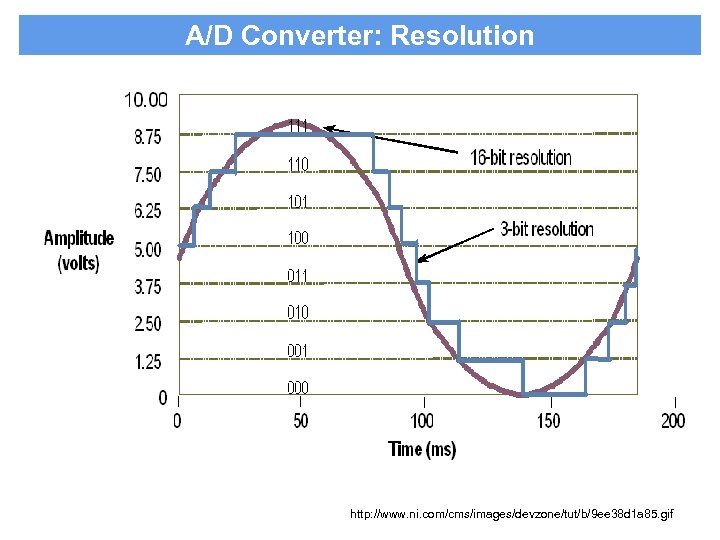
Analog to Digital (A/D) Converter An Analog to Digital Converter (ADC) is a very useful feature that converts an analog voltage on a pin to a digital number. By converting from the analog world to the digital world, we can begin to use electronics to interface to the analog world around us. Not every pin on a microcontroller has the ability to do analog to digital conversions. On the Arduino board, these pins have an ‘A’ in front of their label (A 0 through A 5) to indicate these pins can read analog voltages. ADCs can vary greatly between microcontroller. The ADC on the Arduino is a 10 -bit ADC meaning it has the ability to detect 1, 024 (210) discrete analog levels. Some microcontrollers have 8 -bit ADCs (28 = 256 discrete levels) and some have 16 -bit ADCs (216 = 65, 535 discrete levels). https: //learn. sparkfun. com/tutorials/analog-to-digital-conversion
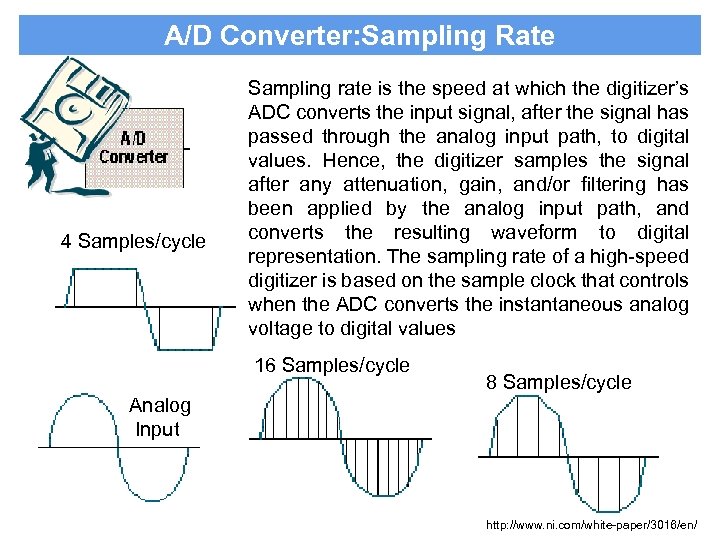
A/D Converter: Sampling Rate 4 Samples/cycle Sampling rate is the speed at which the digitizer’s ADC converts the input signal, after the signal has passed through the analog input path, to digital values. Hence, the digitizer samples the signal after any attenuation, gain, and/or filtering has been applied by the analog input path, and converts the resulting waveform to digital representation. The sampling rate of a high-speed digitizer is based on the sample clock that controls when the ADC converts the instantaneous analog voltage to digital values 16 Samples/cycle 8 Samples/cycle Analog Input http: //www. ni. com/white-paper/3016/en/
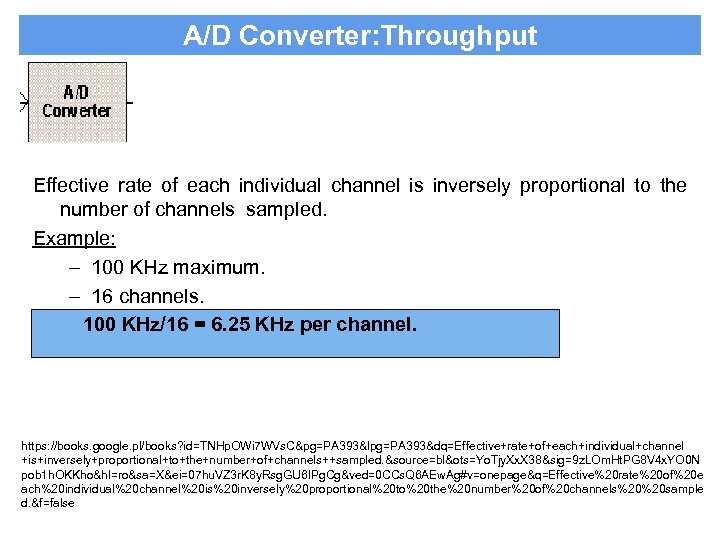
A/D Converter: Throughput Effective rate of each individual channel is inversely proportional to the number of channels sampled. Example: – 100 KHz maximum. – 16 channels. 100 KHz/16 = 6. 25 KHz per channel. https: //books. google. pl/books? id=TNHp. OWi 7 WVs. C&pg=PA 393&lpg=PA 393&dq=Effective+rate+of+each+individual+channel +is+inversely+proportional+to+the+number+of+channels++sampled. &source=bl&ots=Yo. Tjy. Xx. X 38&sig=9 z. LOm. Ht. PG 8 V 4 x. YO 0 N pob 1 h. OKKho&hl=ro&sa=X&ei=07 hu. VZ 3 r. K 8 y. Rsg. GU 6 IPg. Cg&ved=0 CCs. Q 6 AEw. Ag#v=onepage&q=Effective%20 rate%20 of%20 e ach%20 individual%20 channel%20 is%20 inversely%20 proportional%20 to%20 the%20 number%20 of%20 channels%20%20 sample d. &f=false
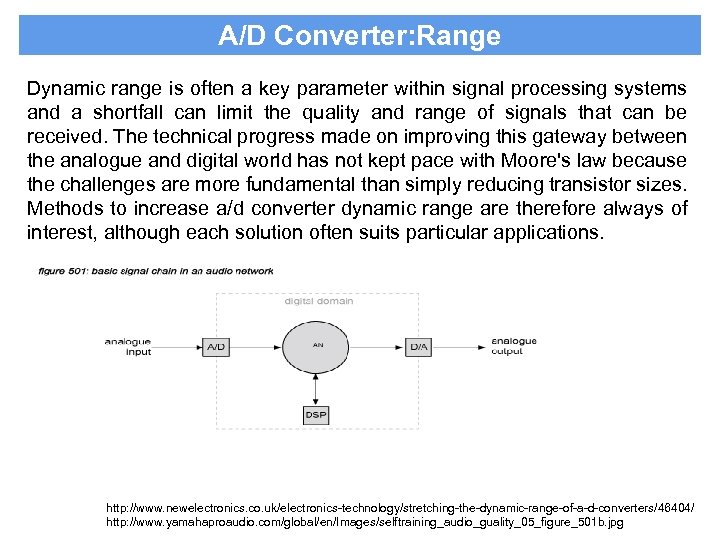
A/D Converter: Range Dynamic range is often a key parameter within signal processing systems and a shortfall can limit the quality and range of signals that can be received. The technical progress made on improving this gateway between the analogue and digital world has not kept pace with Moore's law because the challenges are more fundamental than simply reducing transistor sizes. Methods to increase a/d converter dynamic range are therefore always of interest, although each solution often suits particular applications. http: //www. newelectronics. co. uk/electronics-technology/stretching-the-dynamic-range-of-a-d-converters/46404/ http: //www. yamahaproaudio. com/global/en/Images/selftraining_audio_guality_05_figure_501 b. jpg
A/D Converter: Resolution http: //www. ni. com/cms/images/devzone/tut/b/9 ee 38 d 1 a 85. gif
Analog Outputs (D/A) An analog output is a measurable electrical signal with a defined range that is generated by a controller and sent to a controlled device, such as a variable speed drive or actuator. Changes in the analog output cause changes in the controlled device that result in changes in the controlled process. Controller output digital to analog circuitry is typically limited to a single range of voltage or current, such that output transducers are required to provide an output signal that is compatible with controlled devices using something other than the controller's standard signal. Common Types: There are four common types of analog outputs; voltage, current, resistance and pneumatic. http: //www. ddc-online. org/Input-Output-Tutorial/Analog-Outputs. html
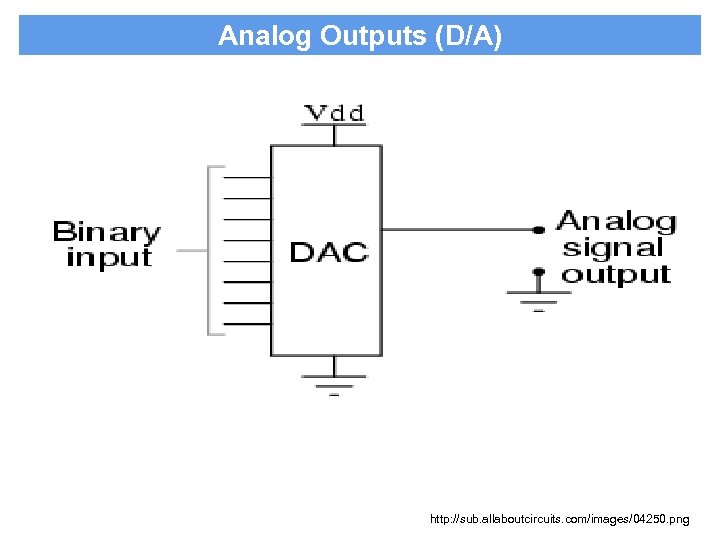
Analog Outputs (D/A) http: //sub. allaboutcircuits. com/images/04250. png
Data Acquisition Software • It can be the most critical factor in obtaining reliable, high performance operation. • Transforms the PC and DAQ hardware into a complete DAQ, analysis, and display system. • Different alternatives: – Programmable software. – Data acquisition software packages. http: //www. slideshare. net/priyanka 1194/daq-47202346
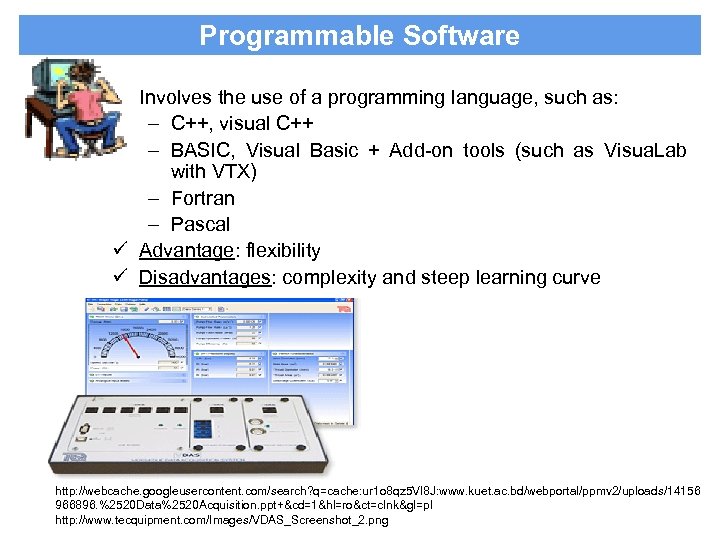
Programmable Software • Involves the use of a programming language, such as: – C++, visual C++ – BASIC, Visual Basic + Add-on tools (such as Visua. Lab with VTX) – Fortran – Pascal ü Advantage: flexibility ü Disadvantages: complexity and steep learning curve http: //webcache. googleusercontent. com/search? q=cache: ur 1 o 8 qz 5 Vl 8 J: www. kuet. ac. bd/webportal/ppmv 2/uploads/14156 966896. %2520 Data%2520 Acquisition. ppt+&cd=1&hl=ro&ct=clnk&gl=pl http: //www. tecquipment. com/Images/VDAS_Screenshot_2. png
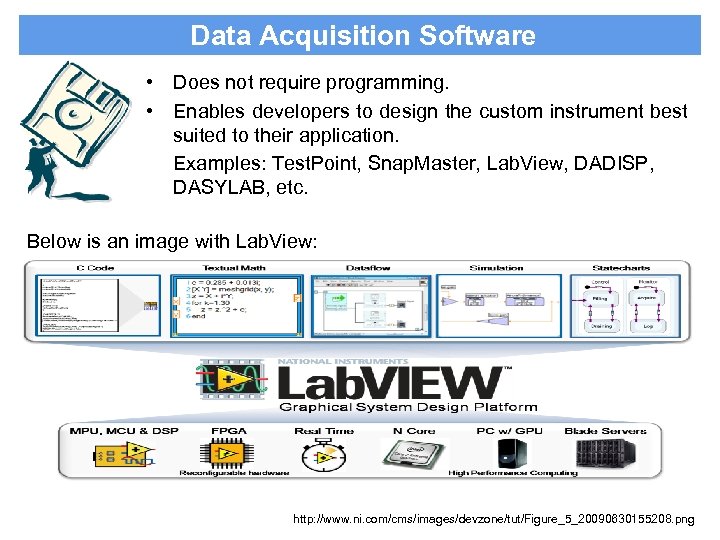
Data Acquisition Software • Does not require programming. • Enables developers to design the custom instrument best suited to their application. Examples: Test. Point, Snap. Master, Lab. View, DADISP, DASYLAB, etc. Below is an image with Lab. View: http: //www. ni. com/cms/images/devzone/tut/Figure_5_20090630155208. png

for watching
Скачать презентацию University of Pitesti and Dolnośląska Wyższa Szkoła Przedsiębiorczości
6a608b6430525cf5514bc10262f9c024.ppt