


 Скачать презентацию University of Minnesota Digital Technology Center Intelligent Storage
43a3cec906e029eb8e947a9978bdc5a0.ppt
- Количество слайдов: 47
 University of Minnesota Digital Technology Center Intelligent Storage Consortium David H. C. Du du@cs. umn. edu For more information on Intelligent Storage Consortium, please check http: //www. dtc. umn. edu/programs/DISC. htm
 Overall Focus Emphasize the application of Advanced Storage Technologies A Balanced approach to research that includes: l Applications that need/use storage l Advanced and Emerging Storage Architectures l Advanced and Emerging Storage Technologies both software and hardware l Business Cases and aspects of the Storage industry l Market Trends l Product Directions l Effects of these disruptive technologies l Adoption rates Provide consortium members with not just technology research but a more complete and significant outcome
 Initial Specific Focus Applied Object-based Storage Device (OSD) Active Storage (Datanomic Concept) l The Application of OSD and Active Storage Devices to different real-world problems (MPEG-21, data mirroring, i. SCSI based data sharing and file systems) l Demonstrate the feasibility and advantages of OSD and Active Storage (modifying Lustre code) l Develop an understanding of the limitations of OSD and Active Storage from a theoretical and practical standpoint (many research issues) How OSD Active Storage addresses real-world problems facing the storage industry today and tomorrow Must make this a Win-Win value proposition for the University and Industry
 University Participation The Digital Technology Center l Jim Licari and Tom Ruwart Cross-disciplinary University participants l Computer Science – Software Technology focus l David Du – Active disk, OSD, and Networking l Jon Weissman – Software systems, grid computing l Yongdae Kim- Computer and Network Security l Zhili Zhang – Networking and Internet Engineering l Electrical Engineering – Hardware Technology focus l Ahmed Tewfik – Signal processing, wireless network l David Lilja – Computer Architecture, Distributed systems l Carlson School of Business – Business focus l Bob Kauffman, Information and Decision Sciences l Alok Gupta l Gediminas Adomavicius
 Potential Industrial Participation EMC, Storage. Tek– Storage Systems Seagate, Qlogic, – Storage components l Development and demonstration of OSD Active Storage Veritas – Storage Software Microsoft, Intel, IBM, Sun Micro – I/O Subsystem, Network Storage System and Applications Cisco- Network Storage System Storage Networking Industry Association (SNIA) l Involvement with Technical Working Groups l Contact with leading-edge storage and networking companies l Help and guidance for useful projects
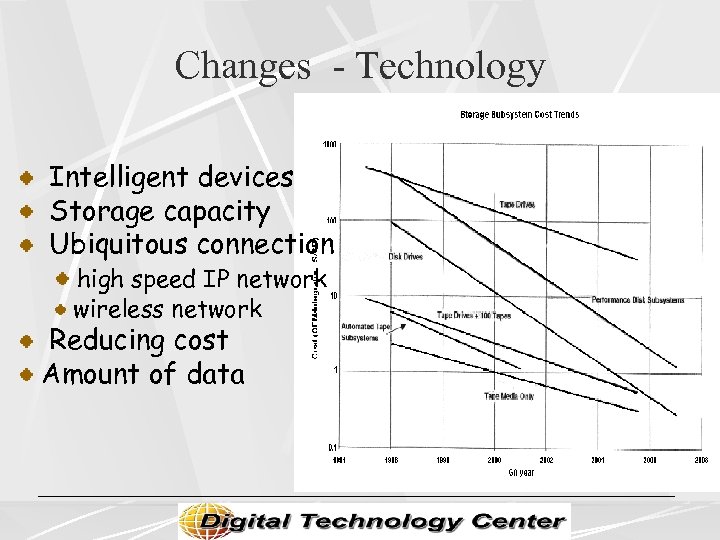 Changes - Technology Intelligent devices Storage capacity Ubiquitous connection high speed IP network wireless network Reducing cost Amount of data
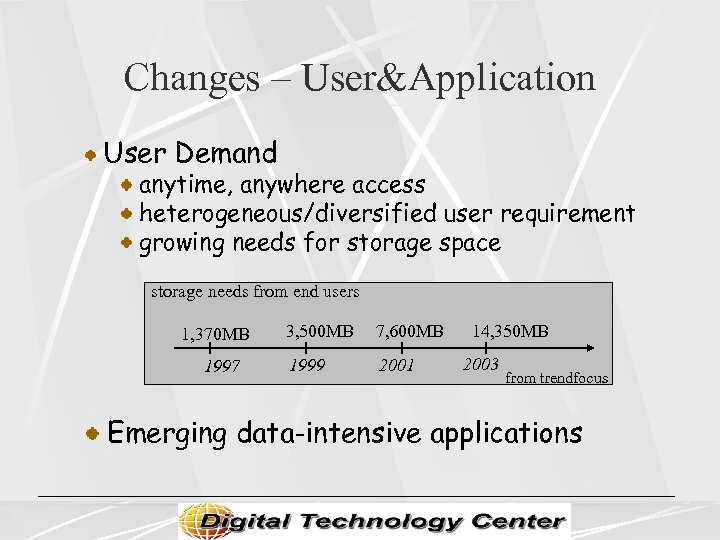 Changes – User&Application User Demand anytime, anywhere access heterogeneous/diversified user requirement growing needs for storage space storage needs from end users 1, 370 MB 1997 3, 500 MB 7, 600 MB 1999 2001 14, 350 MB 2003 from trendfocus Emerging data-intensive applications
 What is Datanomic? In an autonomic system, processes are performed automatically in response to internal causes and influences. Our proposed approach is to take a datacentric view of the system in which actions performed by, or on behalf of, a data object are taken at the direction of the data object itself. Therefore, such a system is called datanomic system.
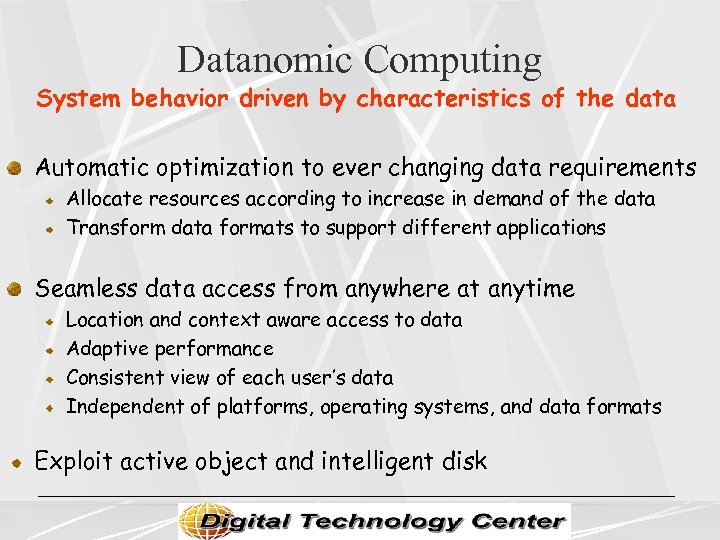 Datanomic Computing System behavior driven by characteristics of the data Automatic optimization to ever changing data requirements Allocate resources according to increase in demand of the data Transform data formats to support different applications Seamless data access from anywhere at anytime Location and context aware access to data Adaptive performance Consistent view of each user’s data Independent of platforms, operating systems, and data formats Exploit active object and intelligent disk
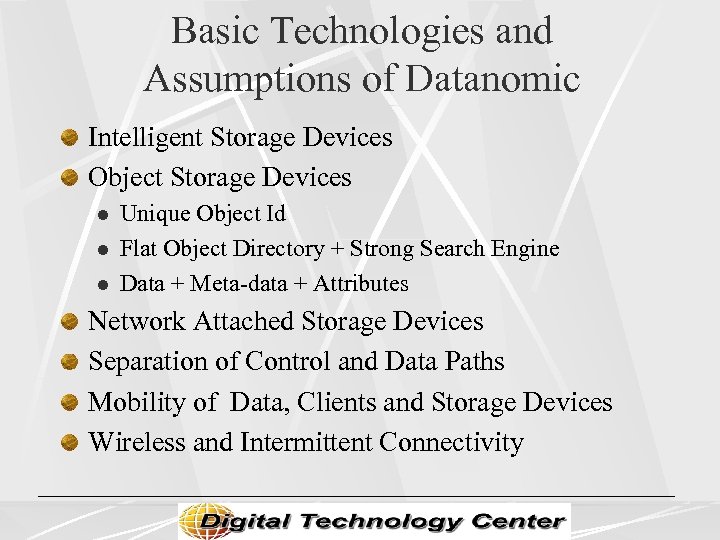 Basic Technologies and Assumptions of Datanomic Intelligent Storage Devices Object Storage Devices l l l Unique Object Id Flat Object Directory + Strong Search Engine Data + Meta-data + Attributes Network Attached Storage Devices Separation of Control and Data Paths Mobility of Data, Clients and Storage Devices Wireless and Intermittent Connectivity
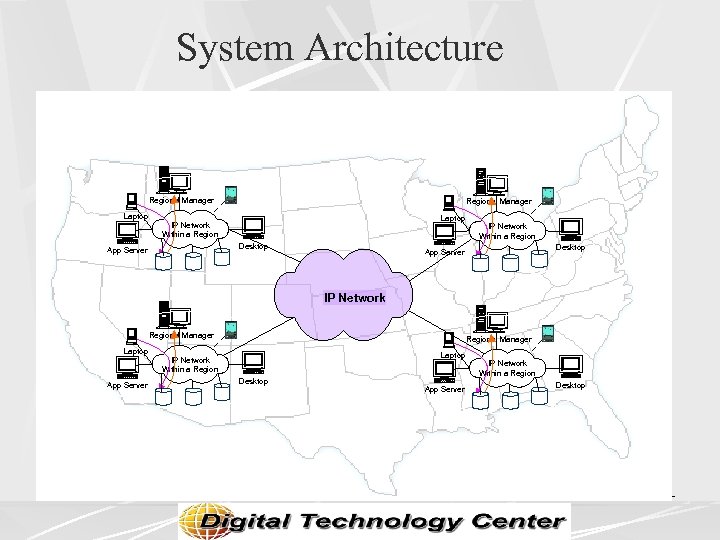 System Architecture Regional Manager Laptop IP Network Within a Region Desktop App Server IP Network Regional Manager Laptop App Server Regional Manager Laptop IP Network Within a Region Desktop App Server IP Network Within a Region Desktop
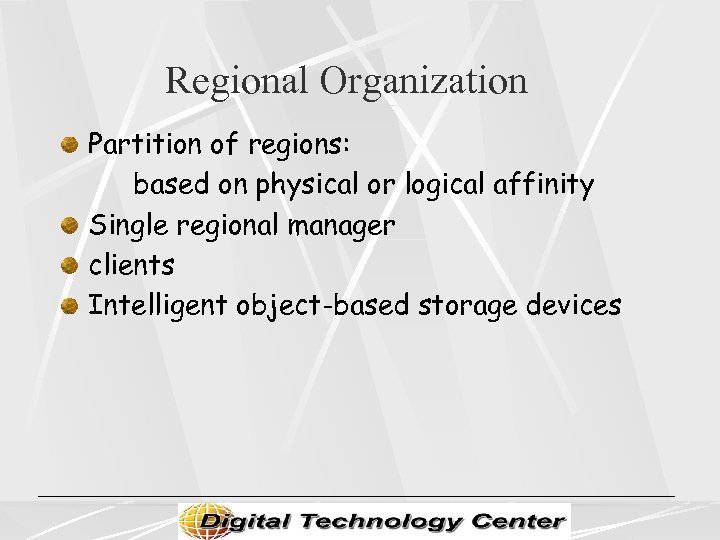 Regional Organization Partition of regions: based on physical or logical affinity Single regional manager clients Intelligent object-based storage devices
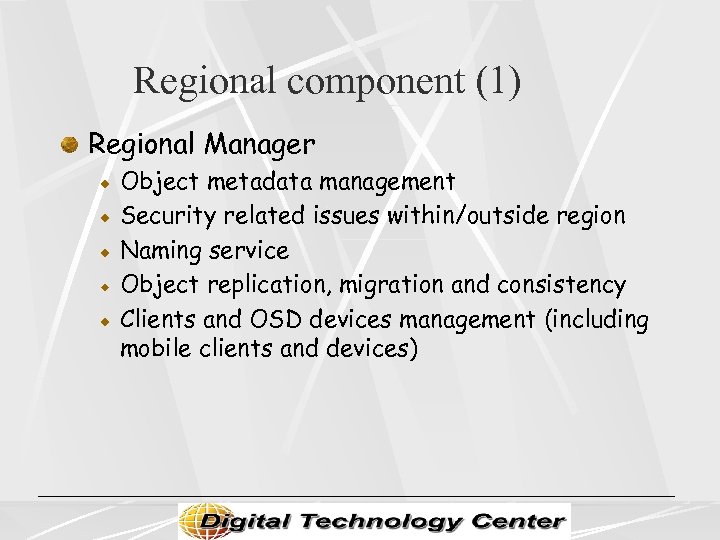 Regional component (1) Regional Manager Object metadata management Security related issues within/outside region Naming service Object replication, migration and consistency Clients and OSD devices management (including mobile clients and devices)
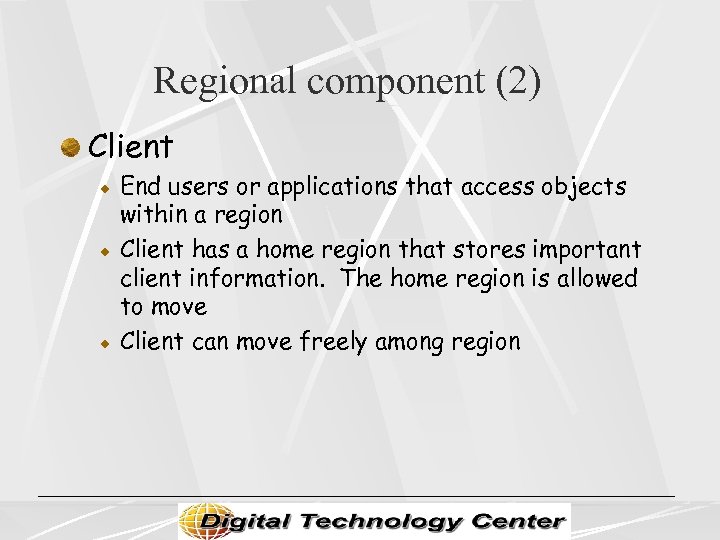 Regional component (2) Client End users or applications that access objects within a region Client has a home region that stores important client information. The home region is allowed to move Client can move freely among region
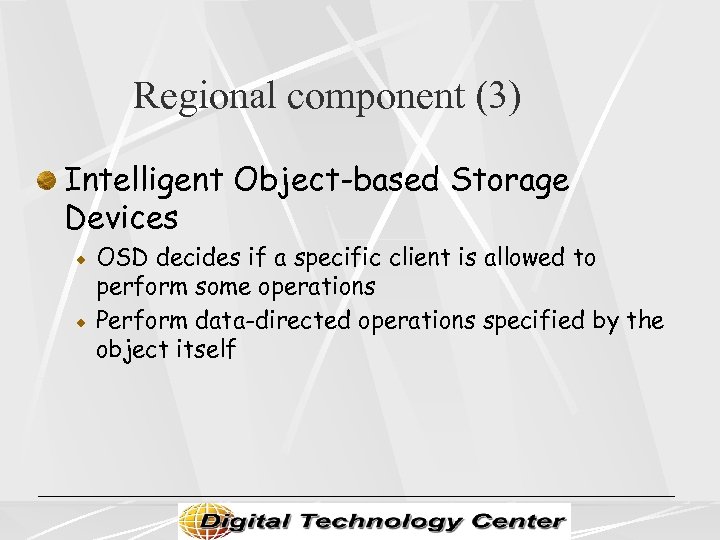 Regional component (3) Intelligent Object-based Storage Devices OSD decides if a specific client is allowed to perform some operations Perform data-directed operations specified by the object itself
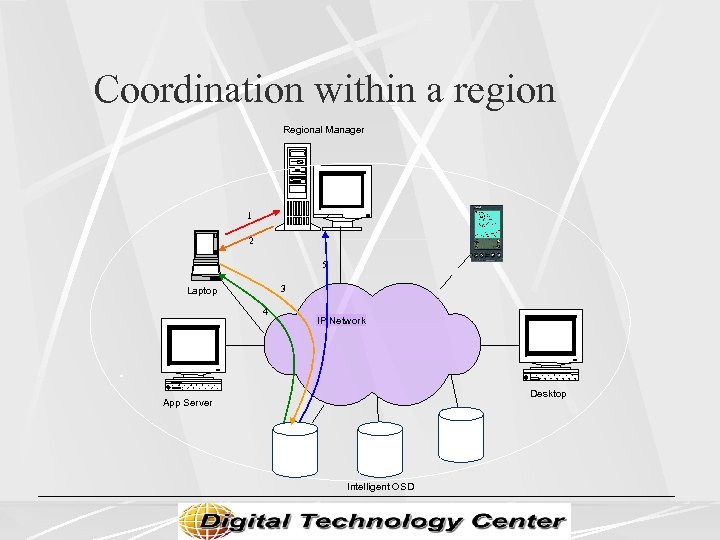 Coordination within a region Regional Manager 1 2 5 3 Laptop 4 IP Network Desktop App Server Intelligent OSD
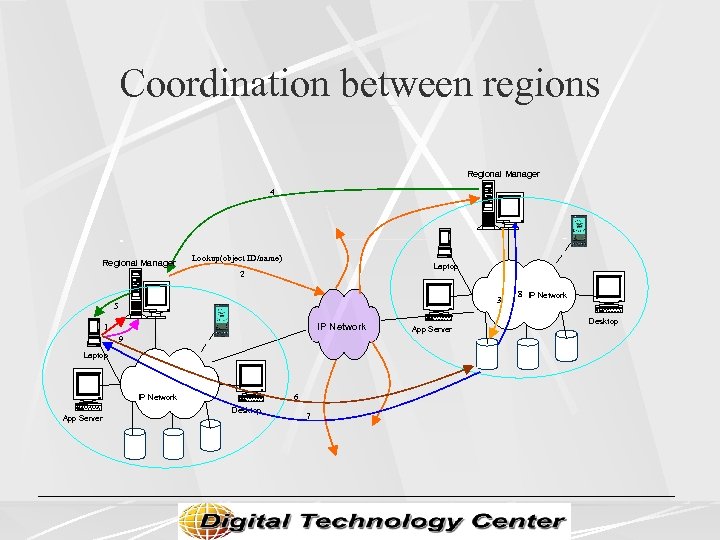 Coordination between regions Regional Manager 4 Regional Manager Lookup(object ID/name) Laptop 2 3 5 IP Network 1 9 Laptop 6 IP Network App Server Desktop 7 App Server 8 IP Network Desktop
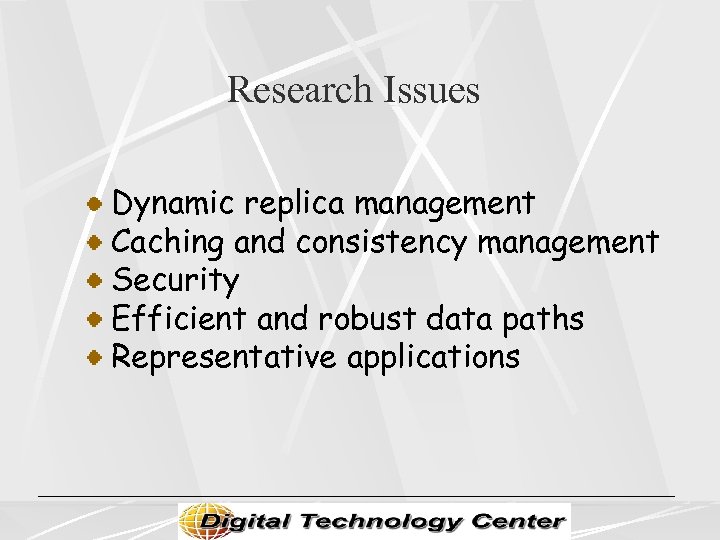 Research Issues Dynamic replica management Caching and consistency management Security Efficient and robust data paths Representative applications
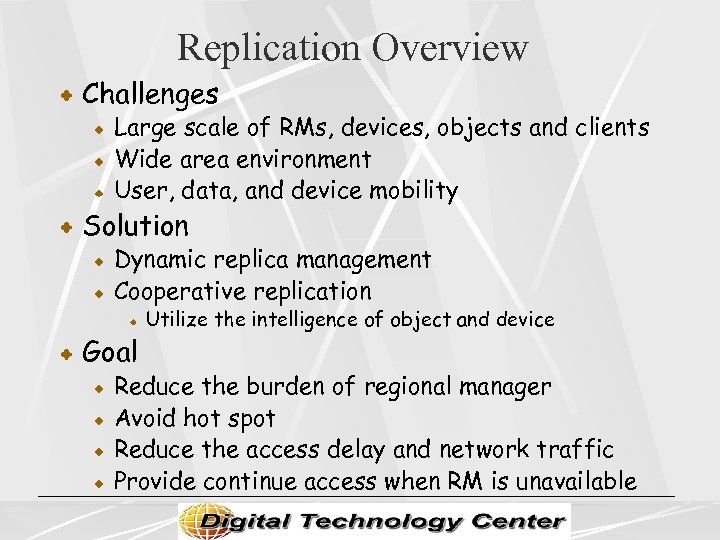 Replication Overview Challenges Large scale of RMs, devices, objects and clients Wide area environment User, data, and device mobility Solution Dynamic replica management Cooperative replication Goal Utilize the intelligence of object and device Reduce the burden of regional manager Avoid hot spot Reduce the access delay and network traffic Provide continue access when RM is unavailable
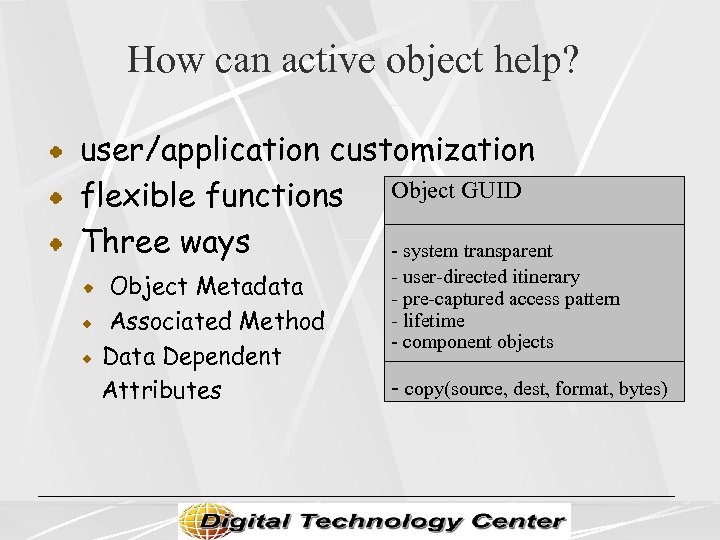 How can active object help? user/application customization flexible functions Object GUID Three ways - system transparent Object Metadata Associated Method Data Dependent Attributes - user-directed itinerary - pre-captured access pattern - lifetime - component objects - copy(source, dest, format, bytes)
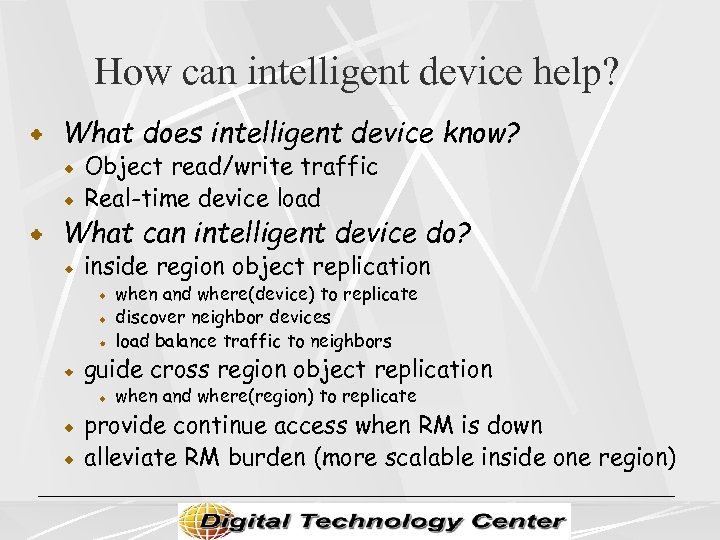 How can intelligent device help? What does intelligent device know? Object read/write traffic Real-time device load What can intelligent device do? inside region object replication when and where(device) to replicate discover neighbor devices load balance traffic to neighbors guide cross region object replication when and where(region) to replicate provide continue access when RM is down alleviate RM burden (more scalable inside one region)
 Role of RM - Speculative replication based on - “open” request Cross region replication Backup or mirroring Distributed location service Quota Control
 Consistency Management Overview Recognize replicas as the same object Allow automatic duplication, deletion, or migration of objects Support concurrent access of the same logical object from nearby replicas Allow caching of objects at multiple levels Overcome intermittent connections
 Levels of Consistency Objects indicate desired consistency level Strong consistency l l global consistency at any moment using server locking Weak consistency l l allow temporary inconsistency using optimistic concurrency control Balancing in-between l Could allow one object to split into two versions
 Partition of Consistency Management Functions Regional Managers + Intelligent Storage Devices Goals: reducing overheads l enhancing concurrency l Approaches: fine granularity smaller than data objects l hierarchical management over RM/ISD hierarchy l
 Differential Updates of Objects Optimistic concurrency control generates coexisting multiple versions of objects Update history has to be maintained until final reconciliation Full copy of individual versions consume too much storage Exploiting incremental/differential updates l l Existing scheme for text file and database app. Seeking more general support for various objects
 Distributed Committing Updates of compound object may involve several referenced objects Such updates have to be performed in a transaction way Such updates also have to support versions such that rollback is possible Determine global serializability of distributed updates
 Consistency Management under Mobility Mobile Entities: l l l Users w/ high mobility Active objects w/ less mobility Intelligent storage devices w/ less mobility Different requirements l l Users require quick hand-off when moving across adjacent regions Active objects & Intelligent storage devices requires least interruption of other services during the moving
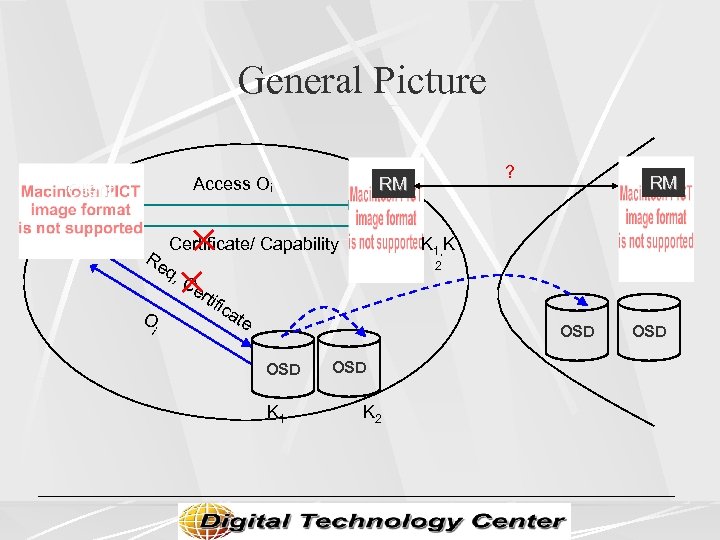 General Picture Client K 1 RM K 1, K Certificate/ Capability Re q, Ce rtif ica O te i OSD ? RM Access Oi 2 OSD K 2 OSD
 Security Issues Typically file managers are involved in all security -related functions l l Issuing capability, access control, revocation Excessive load on the file managers Central point of failure Attractive target of Do. S attacks Devices are directly attached to the network l l Exposed to various potential attacks Do. S, masquerading, replaying, other active/passive attacks
 Security Issues Direct interaction between client and devices l l Client needs a capability or credential from the RM Object Mobility Compound objects Devices need to perform additional functions l Authentication, access control Traffic analysis l Traffic trends or identity of the communicating party can reveal some sensitive information l l Merger of two companies, business trends of ISP Providing anonymity of traffic is important
 Authentication General authentication l Client – RM, client- device, device – RM, RM – RM Message authentication l l Messages sent from and between RMs Responses from devices Non-repudiation l Preventing RM, device, client from denying their operations or commands
 Access Control Credential based l l l ACL on the RM RM issues a credential which contains the access rights for the client This credential by the client to probe to the device his access rights Credential usually short lived, frequent requests to RM RM has to be online for the entire system to work Identity based l l ACL associated with the object Client receives an identity certificate from the RM Preferred if the object is mobile Revocation difficult, changes in client’s rights results in large number of updates
 Access Control Compound objects The component objects could be independent objects with different access rights than the main object l Could be located on different device or region l
 Confidentiality and Integrity Insecure Internet communication l Encryption on link necessary Person getting physical access to the device can read and modify the objects l l System administrator, device thefts End to End object level encryption may be required (optional) Ensuring integrity of the traffic on the link, cache etc. is important Compound objects l l How to encrypt? Accessing one object might require more than one keys
 Key Management and Keyword Search Key management l l l Merging different groups Revocation of the user Encrypted objects can reside on the device for a long time Some parts of meta-data will be encrypted l l How to support search operations using this meta-data Decrypting every time will be expensive If client wants to retrieve objects that contain certain keywords l l l RM will have to decrypt all of the relevant objects However, RM cannot always be trusted (E 2 E) Decryption of the objects will be expensive and unnecessary
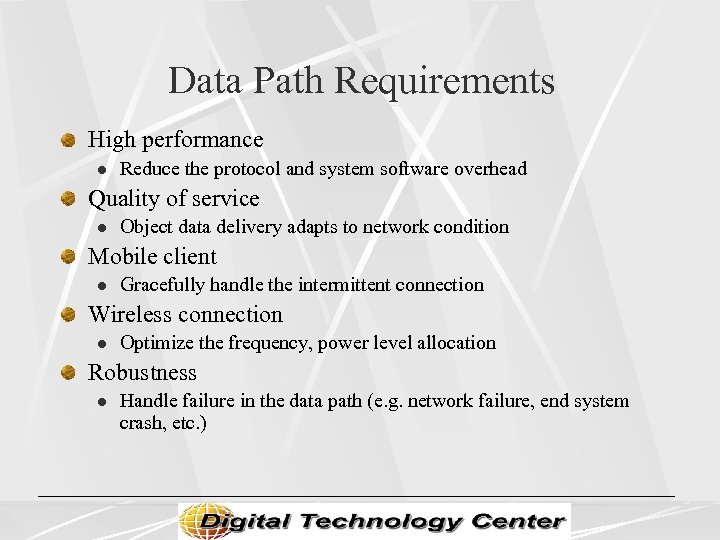 Data Path Requirements High performance l Reduce the protocol and system software overhead Quality of service l Object data delivery adapts to network condition Mobile client l Gracefully handle the intermittent connection Wireless connection l Optimize the frequency, power level allocation Robustness l Handle failure in the data path (e. g. network failure, end system crash, etc. )
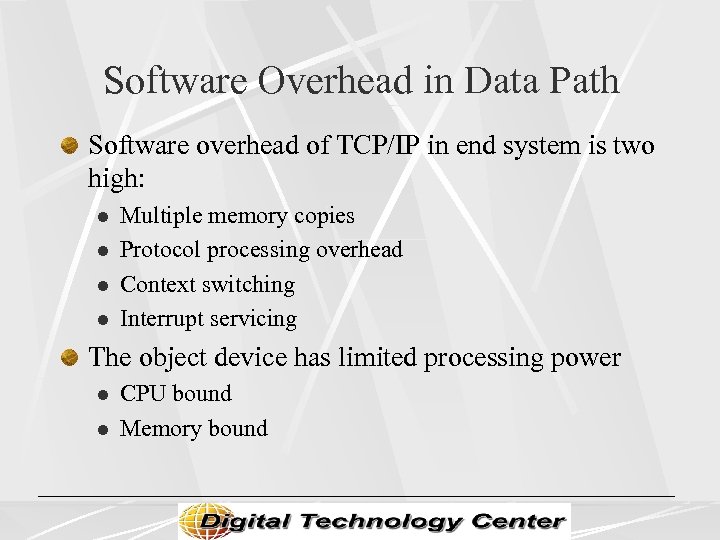 Software Overhead in Data Path Software overhead of TCP/IP in end system is two high: l l Multiple memory copies Protocol processing overhead Context switching Interrupt servicing The object device has limited processing power l l CPU bound Memory bound
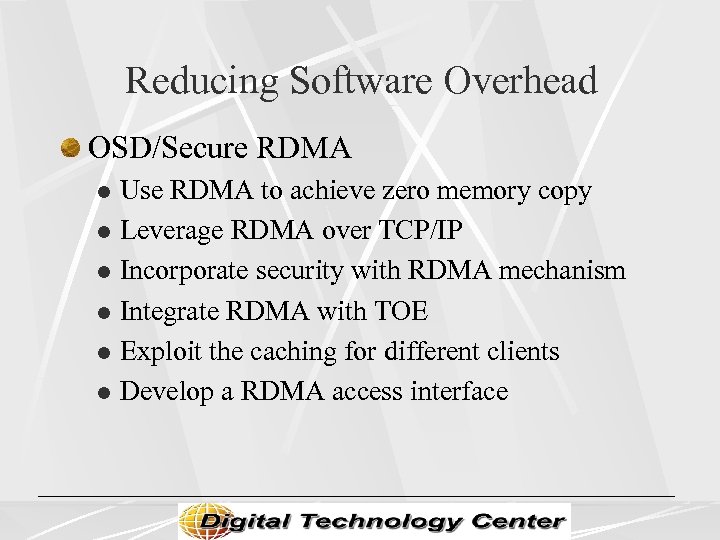 Reducing Software Overhead OSD/Secure RDMA Use RDMA to achieve zero memory copy l Leverage RDMA over TCP/IP l Incorporate security with RDMA mechanism l Integrate RDMA with TOE l Exploit the caching for different clients l Develop a RDMA access interface l
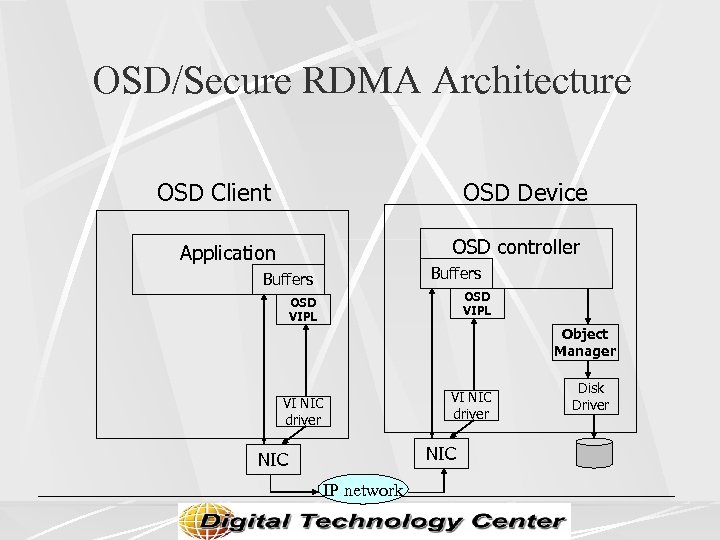 OSD/Secure RDMA Architecture OSD Client OSD Device OSD controller Application Buffers OSD VIPL Object Manager VI NIC driver NIC IP network Disk Driver
 Quality of Service Active object is a special application l may have its own Qo. S requirement l l Latency variance bandwidth Underlying network condition unpredictable l l l TCP is a best-effort protocol, no guarantee of BW Traffic can be bursty and varied Congestion may occur How to provide the Qo. S for object in datanomic? How to adapt the Qo. S smoothly when the network condition degrades? How to allot and schedule the BW in a OSD device?
 Adaptive Qo. S control Collect status info of substrate network Exchange Qo. S info between application and substrate network Exploit application “hint” Tailor the application level data transmission based on the underlying network behavior Network level transmission also adjusts to the above application requirements
 Mobility l l l Mobile clients (PDA, wireless and mobile users) Mobile objects Mobile storage devices Challenges l l l Connection can be intermittent An entity can dynamically join and leave a region A transition may happen in the process of data transmission or critical operation
 Wireless Connection Limited resource in wireless connection l Bandwidth, error rate, power consumption Effective resource management Optimize frequency allocation, power levels, and beamforming of access points l Adapt to changing traffic patterns and Qo. S requirements l Exploit multiple channels l
 Robustness Possible component failures in datanomic system l l Network failure Storage device failure Client failure Regional manager failure Maintain robustness in the face of failures l l l Data consistency Graceful degradation Roll-back mechanisms
 Representative Applications q MPEG-21 -compliant applications: q Meeting users’ heterogeneous capabilities, dynamic bandwidth changing, & display resolution by: Replication of objects and compound objects in different formats and resolution. q Layered Multimedia representations. q On-the-fly transcoding. q q Media personalization and Content-based search techniques.
 Representative Applications (continue) q Backup strategies ( special case of replication) that operate at multiple time scales. q Potential application in the field of the medical research and data mining: q Using the “methods” stored together with active data objects to generate requested statistics or discovering undefined correlations based on a large number of patient records without effecting the confidentiality of patient records.