


 Скачать презентацию University of Michigan Lecture Archiving and related activities
3b011430828f824e535ccebdeb857e8d.ppt
- Количество слайдов: 24
 University of Michigan Lecture Archiving and related activities of the U-M ATLAS Collaboratory Project Jeremy Herr University of Michigan CHEP 2007, Victoria, B. C. 5 September 2007 Jeremy Herr CHEP 2007, Victoria, BC 1
 • Goal: to study and advance the technologies and practices required for the organization and execution of modern, large-scale collaborative research experiments • specifically: using videoconferencing and web archiving to help the ATLAS experiment • Activities since 1999 – – – archiving of ATLAS meetings and software tutorials development of automated lecture archiving systems development and promotion of Lecture Object Qo. S bandwidth reservation testing design and implementation of group-to-group video conferencing facilities at CERN and Michigan 5 September 2007 Jeremy Herr CHEP 2007, Victoria, BC 2
 Some current ATLAS Collaboratory Project activities • Shaping Collaboration 2006 conference • Collaborative Tools Research Experience for Undergraduates (planned for summer 2008) – let bright CS undergrads work on our HEP collaborative tools problems • Fall 2007: pilot project to test remote teaching facility – this allows faculty to teach their classes remotely while visiting CERN during the semester 5 September 2007 Jeremy Herr CHEP 2007, Victoria, BC 3
 People • • • Homer A. Neal – PI, Director Steven Goldfarb – Research Scientist Shawn Mc. Kee – Advisor, Research Scientist Jeremy Herr – Project Manager Tushar Bhatnagar – Engineering Student (IR tracking) Robert Vogt – Electrical Engineer (ultrasound tracking) Mitch Mc. Lachlan – Media Specialist (recording processes) Curtis Hiller – Web development, programmer intern Alumni – – – Jim Irrer - engineer Cang Ye - engineer Giosue Vitaglione – software developer Eric Myers – software developer Kyle Wilamowski – media specialist 5 September 2007 Jeremy Herr CHEP 2007, Victoria, BC 4
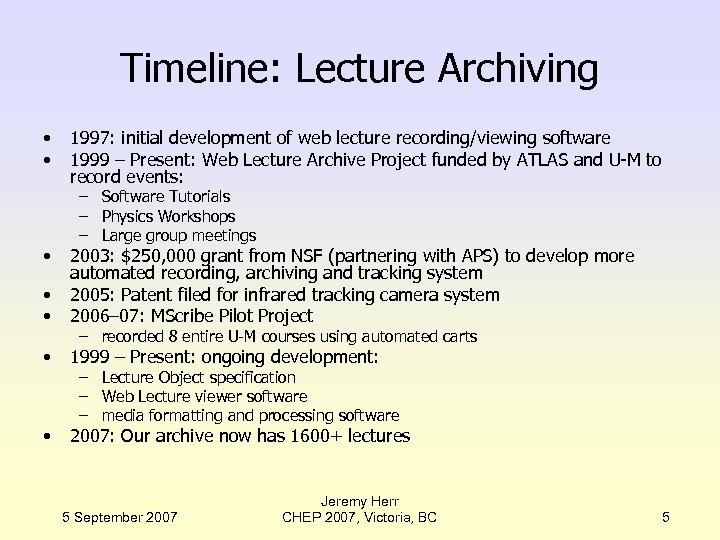 Timeline: Lecture Archiving • • • 1997: initial development of web lecture recording/viewing software 1999 – Present: Web Lecture Archive Project funded by ATLAS and U-M to record events: – Software Tutorials – Physics Workshops – Large group meetings • • 2003: $250, 000 grant from NSF (partnering with APS) to develop more automated recording, archiving and tracking system 2005: Patent filed for infrared tracking camera system 2006– 07: MScribe Pilot Project • 1999 – Present: ongoing development: • 2007: Our archive now has 1600+ lectures – recorded 8 entire U-M courses using automated carts – Lecture Object specification – Web Lecture viewer software – media formatting and processing software 5 September 2007 Jeremy Herr CHEP 2007, Victoria, BC 5
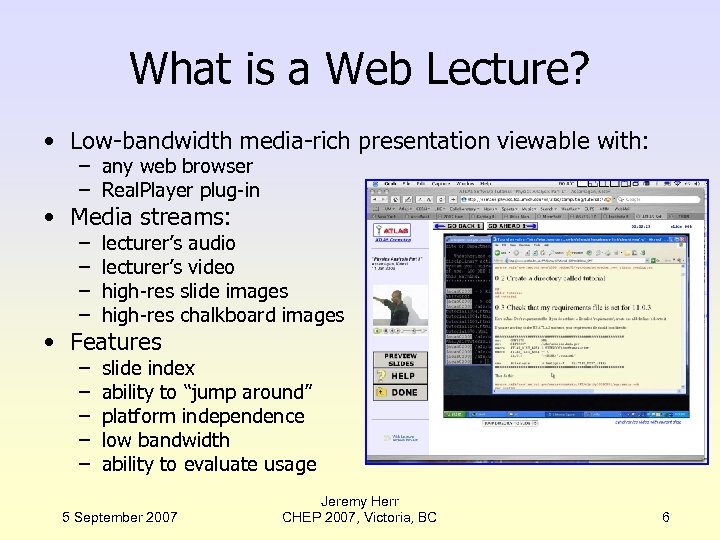 What is a Web Lecture? • Low-bandwidth media-rich presentation viewable with: – any web browser – Real. Player plug-in • Media streams: – – lecturer’s audio lecturer’s video high-res slide images high-res chalkboard images – – – slide index ability to “jump around” platform independence low bandwidth ability to evaluate usage • Features 5 September 2007 Jeremy Herr CHEP 2007, Victoria, BC 6
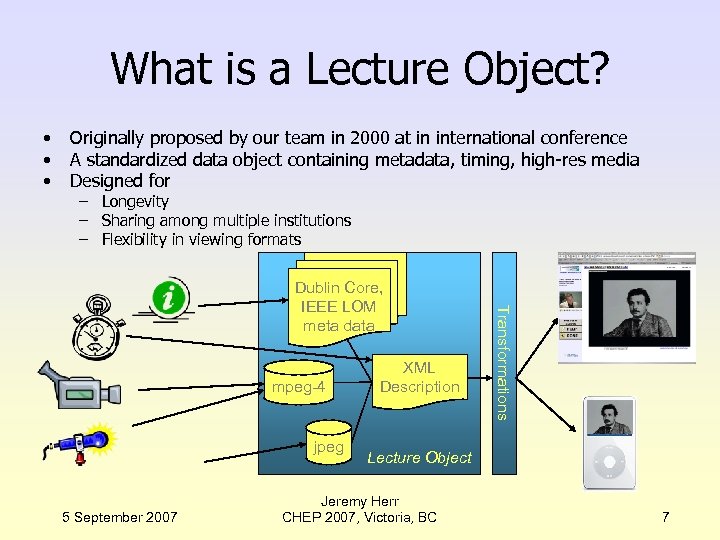 What is a Lecture Object? • • • Originally proposed by our team in 2000 at in international conference A standardized data object containing metadata, timing, high-res media Designed for – Longevity – Sharing among multiple institutions – Flexibility in viewing formats mpeg-4 jpeg 5 September 2007 XML Description Transformations Dublin Core, IEEE LOM meta data Lecture Object Jeremy Herr CHEP 2007, Victoria, BC 7
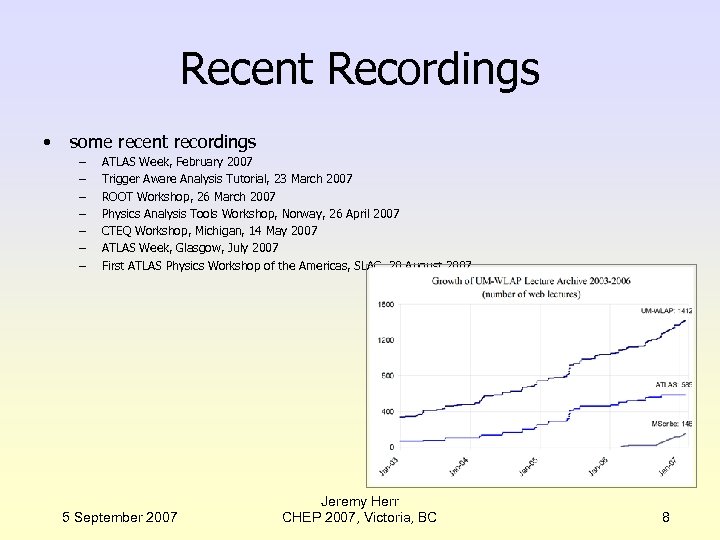 Recent Recordings • some recent recordings – – – – ATLAS Week, February 2007 Trigger Aware Analysis Tutorial, 23 March 2007 ROOT Workshop, 26 March 2007 Physics Analysis Tools Workshop, Norway, 26 April 2007 CTEQ Workshop, Michigan, 14 May 2007 ATLAS Week, Glasgow, July 2007 First ATLAS Physics Workshop of the Americas, SLAC, 20 August 2007 5 September 2007 Jeremy Herr CHEP 2007, Victoria, BC 8
 Contents of Lecture Archive • The ATLAS experiment – software tutorials – physics workshops – large meetings • • • Special CERN events and workshops Special University of Michigan events U-M Saturday Morning Physics (since 2001) American Physical Society (APS) meetings Int’l Conference on Systems Biology 2005 at Harvard MScribe classroom recordings (2006 -07) – American Culture, History of Art, Physics, Statistics, Psychology, Bioinformatics, School of Information 5 September 2007 Jeremy Herr CHEP 2007, Victoria, BC 9
 MScribe • MScribe is the next step toward large-scale automation of web lecture recording • Its new developments and technology are being used simultaneously to benefit ATLAS • Goals of MScribe Pilot Project (2006 -07): – Completely automate the recording of classroom lectures – Develop a robust tracking system to eliminate human camera operator – Study how students use recordings and the ramifications of the technology 5 September 2007 Jeremy Herr CHEP 2007, Victoria, BC 10
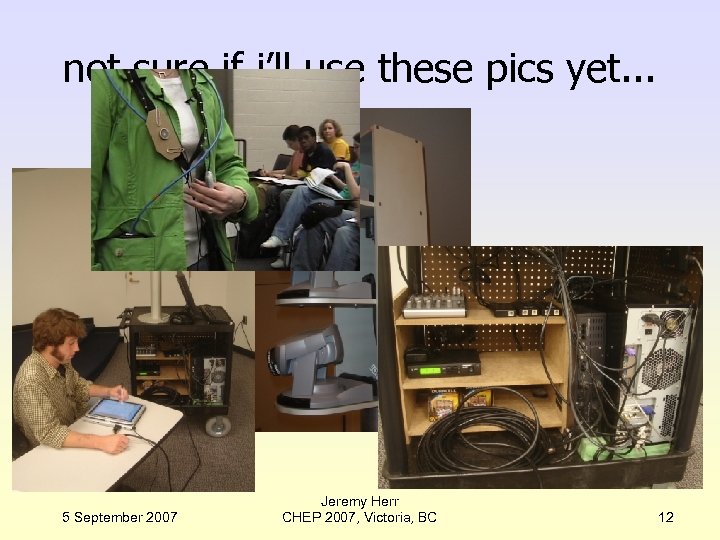
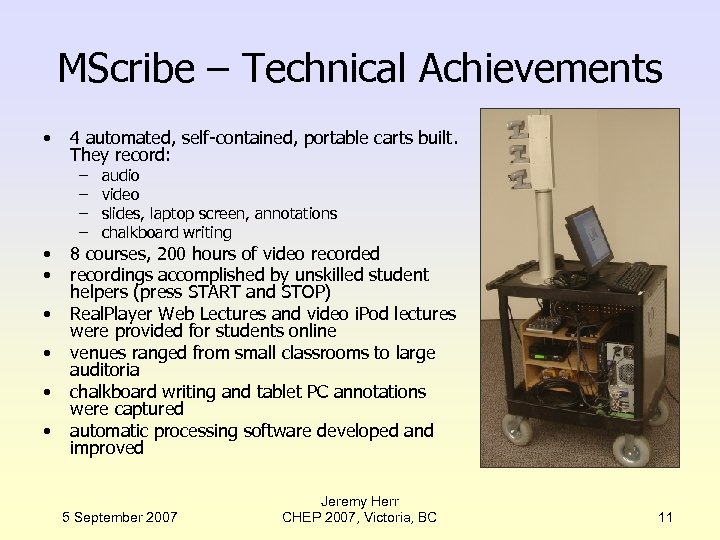 MScribe – Technical Achievements • • 4 automated, self-contained, portable carts built. They record: – – audio video slides, laptop screen, annotations chalkboard writing 8 courses, 200 hours of video recorded recordings accomplished by unskilled student helpers (press START and STOP) Real. Player Web Lectures and video i. Pod lectures were provided for students online venues ranged from small classrooms to large auditoria chalkboard writing and tablet PC annotations were captured automatic processing software developed and improved 5 September 2007 Jeremy Herr CHEP 2007, Victoria, BC 11
 not sure if i’ll use these pics yet. . . 5 September 2007 Jeremy Herr CHEP 2007, Victoria, BC 12
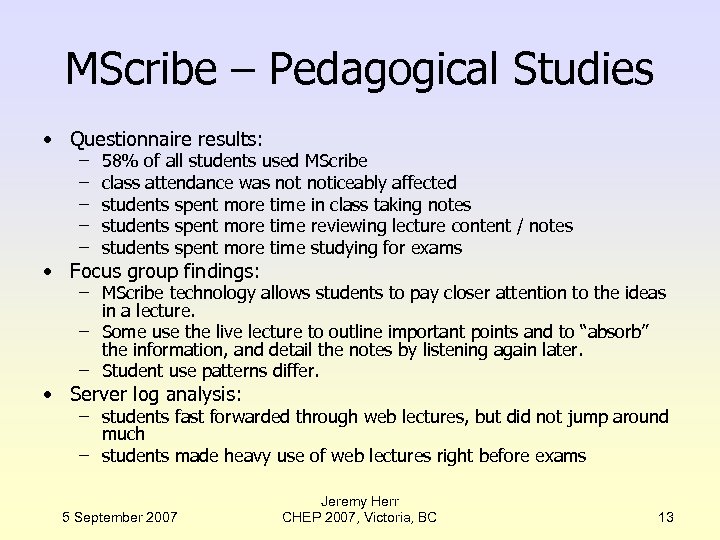 MScribe – Pedagogical Studies • Questionnaire results: – – – 58% of all students used MScribe class attendance was noticeably affected students spent more time in class taking notes students spent more time reviewing lecture content / notes students spent more time studying for exams • Focus group findings: – MScribe technology allows students to pay closer attention to the ideas in a lecture. – Some use the live lecture to outline important points and to “absorb” the information, and detail the notes by listening again later. – Student use patterns differ. • Server log analysis: – students fast forwarded through web lectures, but did not jump around much – students made heavy use of web lectures right before exams 5 September 2007 Jeremy Herr CHEP 2007, Victoria, BC 13
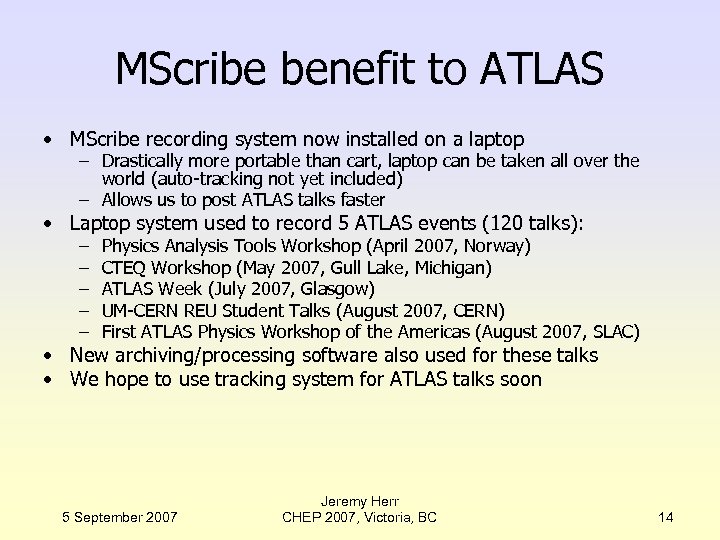 MScribe benefit to ATLAS • MScribe recording system now installed on a laptop – Drastically more portable than cart, laptop can be taken all over the world (auto-tracking not yet included) – Allows us to post ATLAS talks faster • Laptop system used to record 5 ATLAS events (120 talks): – – – Physics Analysis Tools Workshop (April 2007, Norway) CTEQ Workshop (May 2007, Gull Lake, Michigan) ATLAS Week (July 2007, Glasgow) UM-CERN REU Student Talks (August 2007, CERN) First ATLAS Physics Workshop of the Americas (August 2007, SLAC) • New archiving/processing software also used for these talks • We hope to use tracking system for ATLAS talks soon 5 September 2007 Jeremy Herr CHEP 2007, Victoria, BC 14
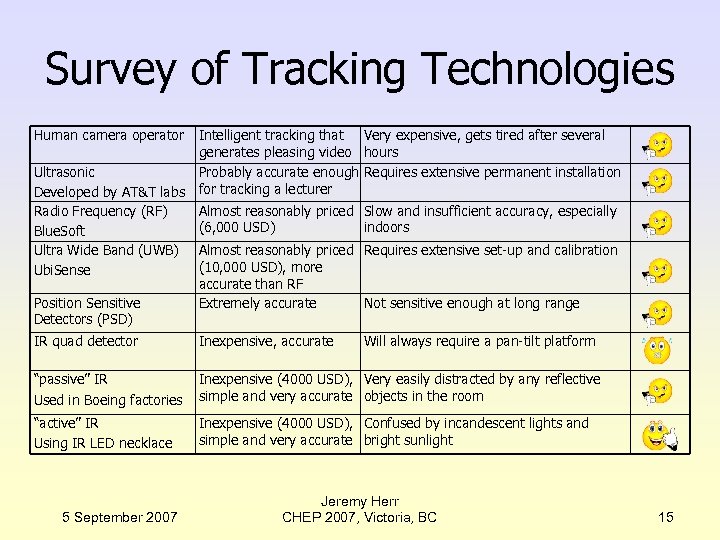 Survey of Tracking Technologies Human camera operator Intelligent tracking that Very expensive, gets tired after several generates pleasing video hours Ultrasonic Probably accurate enough Requires extensive permanent installation Developed by AT&T labs for tracking a lecturer Radio Frequency (RF) Almost reasonably priced Slow and insufficient accuracy, especially (6, 000 USD) indoors Blue. Soft Ultra Wide Band (UWB) Ubi. Sense Position Sensitive Detectors (PSD) Almost reasonably priced Requires extensive set-up and calibration (10, 000 USD), more accurate than RF Extremely accurate Not sensitive enough at long range IR quad detector Inexpensive, accurate “passive” IR Used in Boeing factories Inexpensive (4000 USD), Very easily distracted by any reflective simple and very accurate objects in the room “active” IR Using IR LED necklace Inexpensive (4000 USD), Confused by incandescent lights and simple and very accurate bright sunlight 5 September 2007 Will always require a pan-tilt platform Jeremy Herr CHEP 2007, Victoria, BC 15
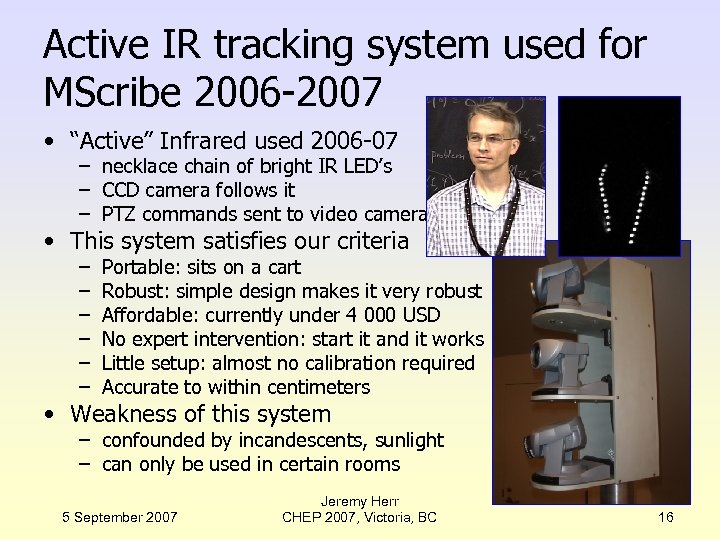 Active IR tracking system used for MScribe 2006 -2007 • “Active” Infrared used 2006 -07 – necklace chain of bright IR LED’s – CCD camera follows it – PTZ commands sent to video camera • This system satisfies our criteria – – – Portable: sits on a cart Robust: simple design makes it very robust Affordable: currently under 4 000 USD No expert intervention: start it and it works Little setup: almost no calibration required Accurate to within centimeters • Weakness of this system – confounded by incandescents, sunlight – can only be used in certain rooms 5 September 2007 Jeremy Herr CHEP 2007, Victoria, BC 16
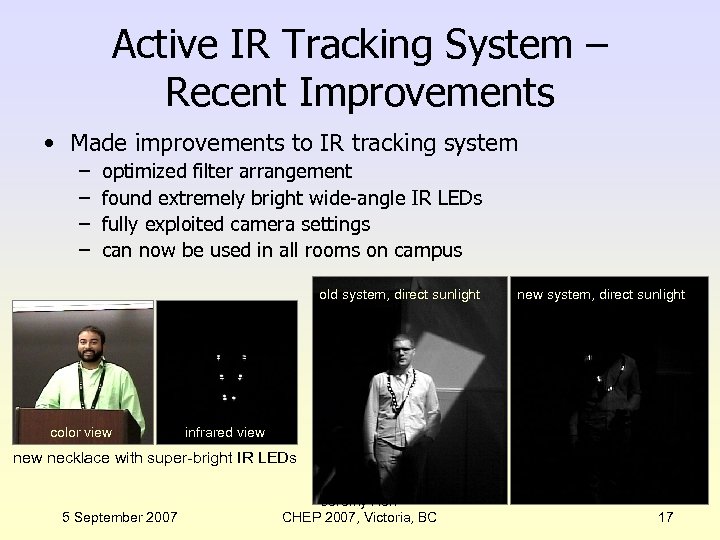 Active IR Tracking System – Recent Improvements • Made improvements to IR tracking system – – optimized filter arrangement found extremely bright wide-angle IR LEDs fully exploited camera settings can now be used in all rooms on campus old system, direct sunlight color view new system, direct sunlight infrared view necklace with super-bright IR LEDs 5 September 2007 Jeremy Herr CHEP 2007, Victoria, BC 17
 Tracking Camera Current Research • Necklace Design – testing fiber-optic options – parallel chain of wide-angle IR LEDs (120°, 8 m. W/sr) – super-bright wide-angle Malaysian LEDs (120°, 45 m. W/sr) with special high-current circuitry to drive them from battery pack • Flashing LED necklace under development – will further improve signal-to-noise ratio • Testing Tracking Algorithms – Modularizing current code – Generating database of position data – Trying to mimic human camera operator • Ultrasonic Phase-Difference array – currently developing this completely different tracking technology in parallel with improvements to IR system – see next page. . . 5 September 2007 Jeremy Herr CHEP 2007, Victoria, BC 18
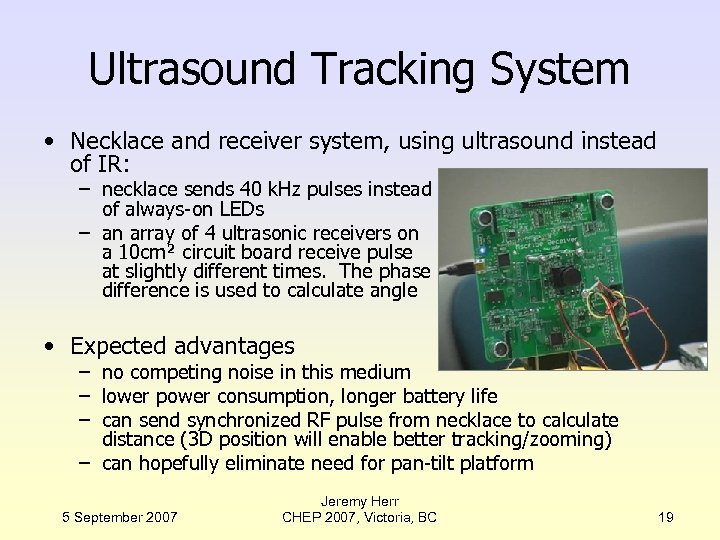 Ultrasound Tracking System • Necklace and receiver system, using ultrasound instead of IR: – necklace sends 40 k. Hz pulses instead of always-on LEDs – an array of 4 ultrasonic receivers on a 10 cm² circuit board receive pulse at slightly different times. The phase difference is used to calculate angle • Expected advantages – no competing noise in this medium – lower power consumption, longer battery life – can send synchronized RF pulse from necklace to calculate distance (3 D position will enable better tracking/zooming) – can hopefully eliminate need for pan-tilt platform 5 September 2007 Jeremy Herr CHEP 2007, Victoria, BC 19
 Lecture Object Development • MScribe technical advisory committee is working on refining the standard • We are collaborating with CERN in this development. Gregory Favre (CERN IT) is working to make SMAC support it. • Next versions of the Lecture Object will: – – support arbitrary numbers of streams support access control, authorization, copyright remain simple, minimal and easy to use be targeted to lectures, not generalized “learning objects” 5 September 2007 Jeremy Herr CHEP 2007, Victoria, BC 21
 Users of Lecture Object • Using a simple, open, well-defined global archival standard will: – preserve important material far into the future – encourage multiple institutions to share their archives – enable shoe-string operations as well-funded groups to easily produce compatible content • Archives using UM-WLAP technology and Lecture Object maintained by: – – University of Michigan CERN American Physical Society (APS) Fermilab 5 September 2007 Jeremy Herr CHEP 2007, Victoria, BC 22
 Advanced Indexing and Search using Blue. Stream • Blue. Stream is an online environment at the University of Michigan with powerful tools for working with digital video, audio, images, and documents. • The ATLAS Collaboratory Project, through WLAP and MScribe, has made hundreds of hours of video available online • Clearly, powerful search and indexing is needed. • Blue. Stream has tools that ingest video, images and metadata and – – transcode it to multiple formats convert speech to text to index the video stream perform OCR on the slide images provide search functions that take the user directly to a point in the video • We have begun working with this tool to provide advanced search capability for some classroom lectures 5 September 2007 Jeremy Herr CHEP 2007, Victoria, BC 23
 The Future • Totally automated room installations – record lectures at times specified in online agenda • ultra-portable recording carts – entire system including tracking can be checked on airplane • • desktop recording software make many display formats available (esp Flash) multiple-person (and audience) tracking integration with other lecture recording systems: – SMAC – Apple’s new lecture recording system (name? ) – EVO 5 September 2007 Jeremy Herr CHEP 2007, Victoria, BC 24
 Links • To view ATLAS talks: www. wlap. org/atlas • Web Lecture portal: – http: //www. wlap. org • ATLAS Collaboratory Project – http: //vesuvio. physics. lsa. umich. edu/acp 5 September 2007 Jeremy Herr CHEP 2007, Victoria, BC 25