


 Скачать презентацию UNIVERSITY OF MASSACHUSETTS Dept of Electrical Computer
bcf95bd9fdfb7b06723dc32749139f40.ppt
- Количество слайдов: 24
 UNIVERSITY OF MASSACHUSETTS Dept. of Electrical & Computer Engineering Digital Computer Arithmetic ECE 666 Part 9 a Evaluation of Elementary Functions - I Israel Koren ECE 666/Koren Part. 9 a. 1 Copyright 2010 Koren
 Efficient Algorithms for Evaluating Elementary Functions ¨Hardware algorithms which are accurate and fast compared to software algorithms ¨Useful for scientific hand-held calculators and numerical processors ¨Examples: e x , ln x, sin x, cos x ¨Straightforward method: look-up table ¨x, y of length n bits n ¨To evaluate y=F(x) - ROM of size 2 n ¨Prohibitive for n 20 - size 16 M ¨Second method: Taylor series expansion ECE 666/Koren Part. 9 a. 2 Copyright 2010 Koren
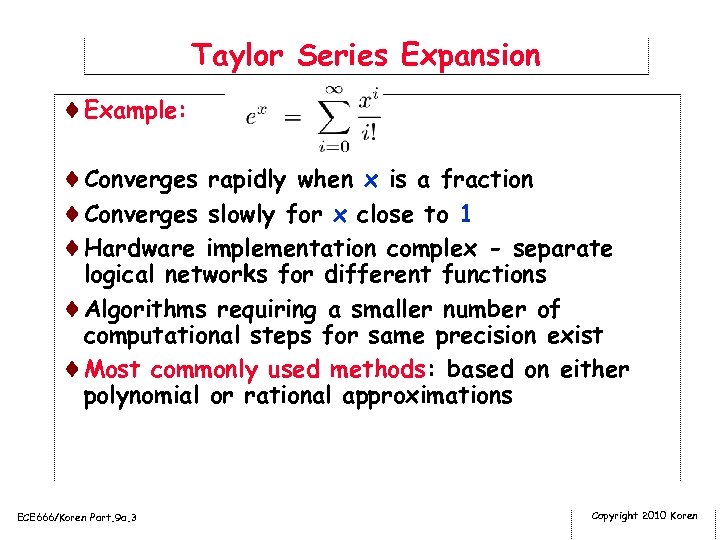 Taylor Series Expansion ¨Example: ¨Converges rapidly when x is a fraction ¨Converges slowly for x close to 1 ¨Hardware implementation complex - separate logical networks for different functions ¨Algorithms requiring a smaller number of computational steps for same precision exist ¨Most commonly used methods: based on either polynomial or rational approximations ECE 666/Koren Part. 9 a. 3 Copyright 2010 Koren
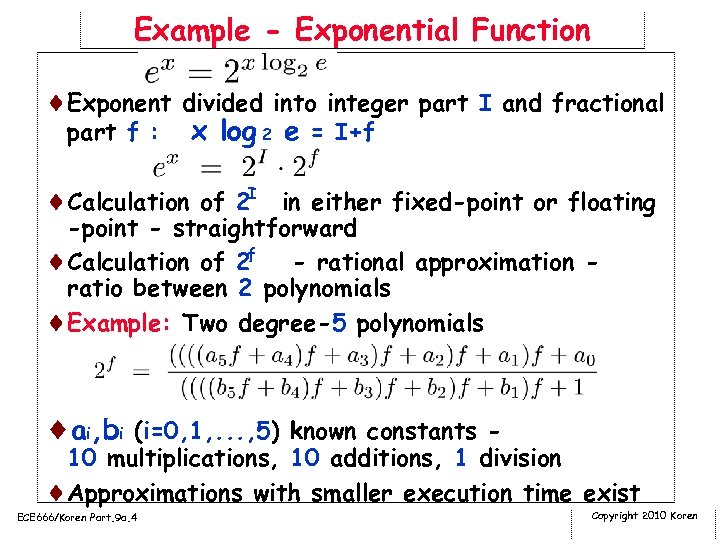 Example - Exponential Function ¨Exponent divided into integer part I and fractional part f : x log 2 e = I+f ¨Calculation of 2 I in either fixed-point or floating -point - straightforward ¨Calculation of 2 f - rational approximation ratio between 2 polynomials ¨Example: Two degree-5 polynomials ¨ai, bi (i=0, 1, . . . , 5) known constants 10 multiplications, 10 additions, 1 division ¨Approximations with smaller execution time exist ECE 666/Koren Part. 9 a. 4 Copyright 2010 Koren
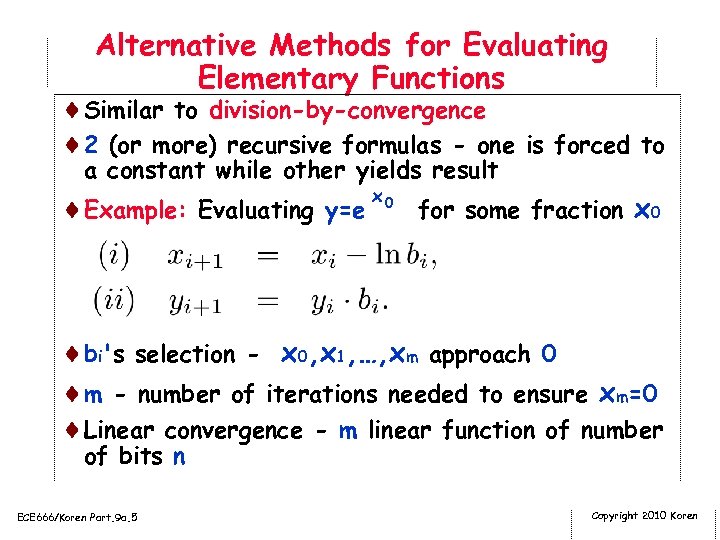 Alternative Methods for Evaluating Elementary Functions ¨Similar to division-by-convergence ¨ 2 (or more) recursive formulas - one is forced to a constant while other yields result ¨Example: Evaluating y=e x 0 for some fraction x 0 ¨bi's selection - x 0, x 1, …, xm approach 0 ¨m - number of iterations needed to ensure xm=0 ¨Linear convergence - m linear function of number of bits n ECE 666/Koren Part. 9 a. 5 Copyright 2010 Koren
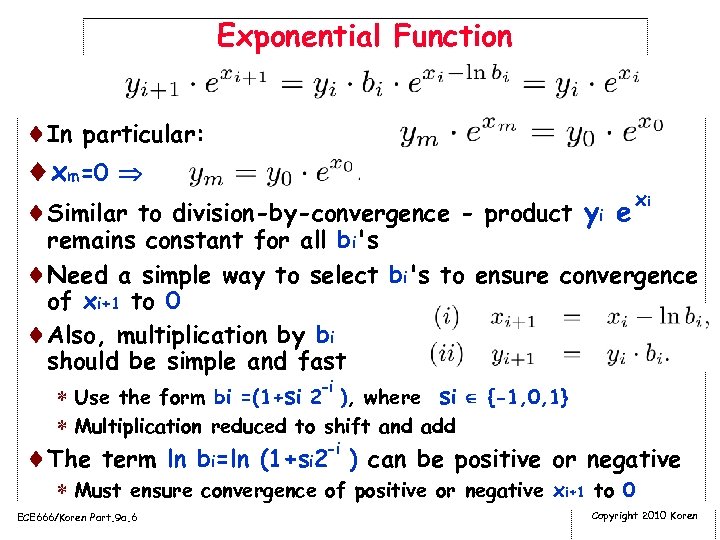 Exponential Function ¨In particular: ¨xm=0 xi ¨Similar to division-by-convergence - product yi e remains constant for all bi's ¨Need a simple way to select bi's to ensure convergence of xi+1 to 0 ¨Also, multiplication by bi should be simple and fast * Use the form bi =(1+si 2 -i ), where si {-1, 0, 1} * Multiplication reduced to shift and add ¨The term ln bi=ln (1+si 2 -i ) can be positive or negative * Must ensure convergence of positive or negative xi+1 to 0 ECE 666/Koren Part. 9 a. 6 Copyright 2010 Koren
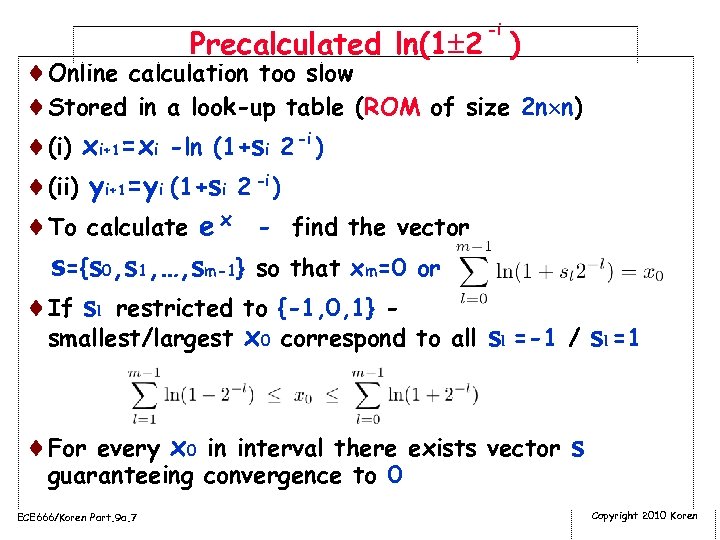 -i Precalculated ln(1 2 ) ¨Online calculation too slow ¨Stored in a look-up table (ROM of size 2 n n) ¨(i) xi+1=xi -ln (1+si 2 -i ) ¨(ii) yi+1=yi (1+si 2 -i ) ¨To calculate e x - find the vector ¨s={s 0, s 1, …, sm-1} so that xm=0 or ¨If sl restricted to {-1, 0, 1} smallest/largest x 0 correspond to all sl =-1 / sl =1 ¨For every x 0 in interval there exists vector s guaranteeing convergence to 0 ECE 666/Koren Part. 9 a. 7 Copyright 2010 Koren
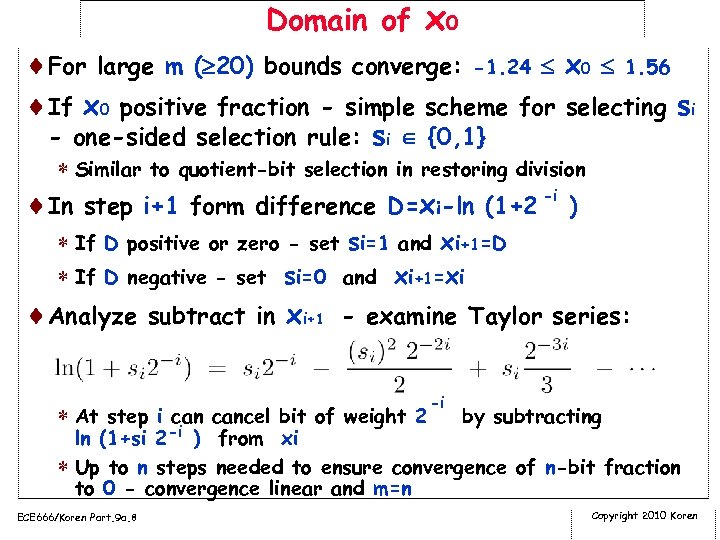 Domain of x 0 ¨For large m ( 20) bounds converge: -1. 24 x 0 1. 56 ¨If x 0 positive fraction - simple scheme for selecting si - one-sided selection rule: si {0, 1} * Similar to quotient-bit selection in restoring division ¨In step i+1 form difference D=xi-ln (1+2 -i ) * If D positive or zero - set si=1 and xi+1=D * If D negative - set si=0 and xi+1=xi ¨Analyze subtract in xi+1 - examine Taylor series: * At step i cancel bit of weight 2 -i by subtracting ln (1+si 2 -i ) from xi * Up to n steps needed to ensure convergence of n-bit fraction to 0 - convergence linear and m=n ECE 666/Koren Part. 9 a. 8 Copyright 2010 Koren
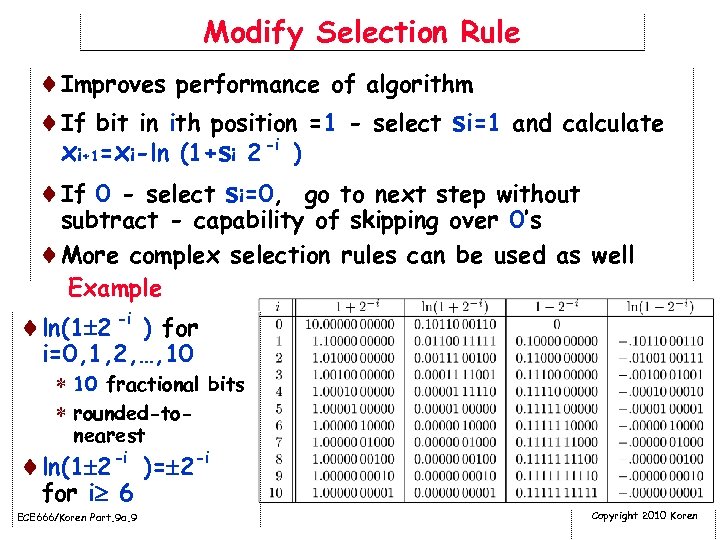 Modify Selection Rule ¨Improves performance of algorithm ¨If bit in ith position =1 - select si=1 and calculate xi+1=xi-ln (1+si 2 -i ) ¨If 0 - select si=0, go to next step without subtract - capability of skipping over 0’s ¨More complex selection rules can be used as well Example ¨ln(1 2 -i ) for i=0, 1, 2, …, 10 * 10 fractional bits * rounded-tonearest ¨ln(1 2 -i )= 2 -i for i 6 ECE 666/Koren Part. 9 a. 9 Copyright 2010 Koren
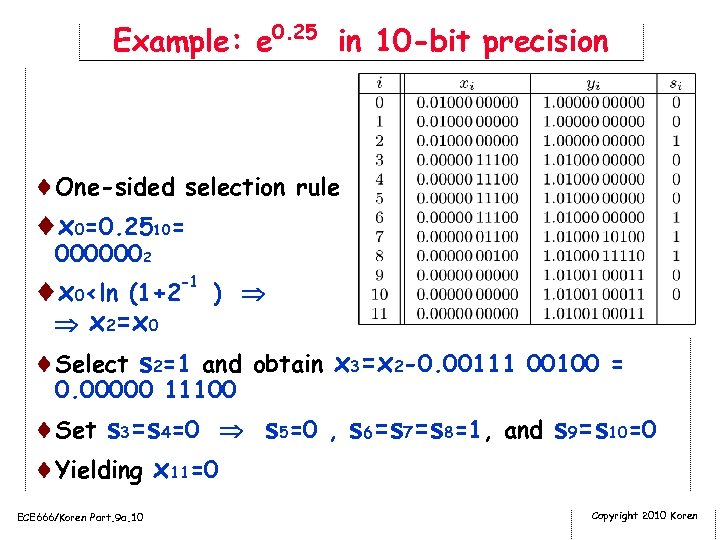 Example: e 0. 25 in 10 -bit precision ¨One-sided selection rule ¨x 0=0. 2510= 0000002 ¨x 0
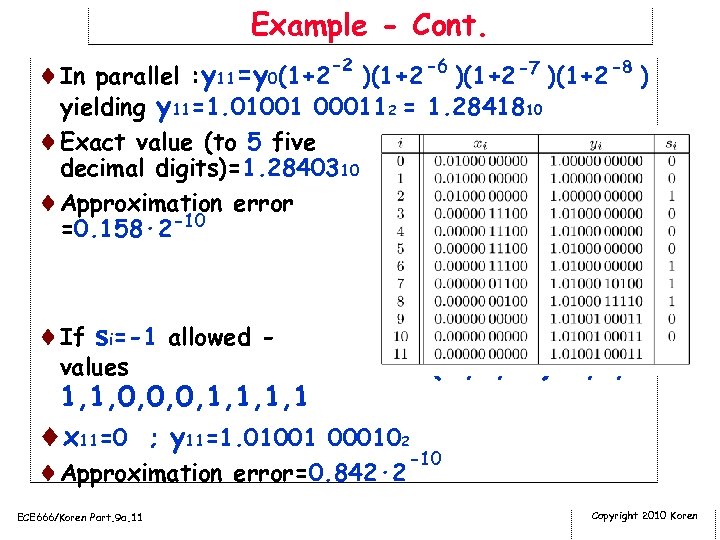 Example - Cont. -2 ¨In parallel : y 11=y 0(1+2 )(1+2 -6 )(1+2 -7 )(1+2 -8 ) yielding y 11=1. 01001 000112 = 1. 2841810 ¨Exact value (to 5 five decimal digits)=1. 2840310 ¨Approximation error =0. 158· 2 -10 ¨If si=-1 allowed values selected (s 0, …, s 10)=0, 1, - 1, 1, 0, 0, 0, 1, 1 ¨x 11=0 ; y 11=1. 01001 000102 -10 ¨Approximation error=0. 842· 2 ECE 666/Koren Part. 9 a. 11 Copyright 2010 Koren
 Extending Argument of Exponential Function ¨x = x log 2 e ln 2 ¨x log 2 e = I + f (I - integer ; 0 f < 1) ¨Calculate y=e x =e (I+f)ln 2 =e I ln 2+f ln 2 =2 I e f ln 2 ¨Set x 0=f ln 2 0 x 0 < ln 2 =0. 693 ¨ 2 I is easily dealt with * Incorporation into exponent part of floatingpoint number * Through a shift operation for fixed-point arithmetic ECE 666/Koren Part. 9 a. 12 Copyright 2010 Koren
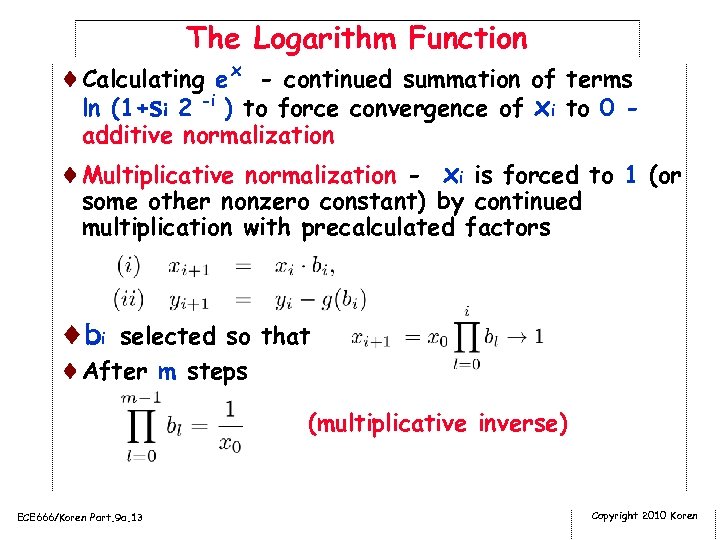 The Logarithm Function ¨Calculating e x - continued summation of terms ln (1+si 2 -i ) to force convergence of xi to 0 additive normalization ¨Multiplicative normalization - xi is forced to 1 (or some other nonzero constant) by continued multiplication with precalculated factors ¨ bi selected so that ¨After m steps (multiplicative inverse) ECE 666/Koren Part. 9 a. 13 Copyright 2010 Koren
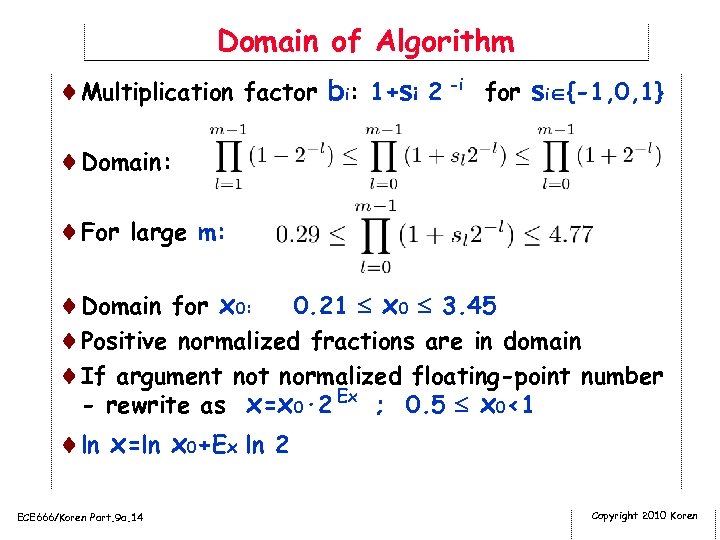 Domain of Algorithm ¨Multiplication factor bi: 1+si 2 -i for si {-1, 0, 1} ¨Domain: ¨For large m: ¨Domain for x 0: 0. 21 x 0 3. 45 ¨Positive normalized fractions are in domain ¨If argument normalized floating-point number - rewrite as x=x 0· 2 Ex ; 0. 5 x 0<1 ¨ln x=ln x 0+Ex ln 2 ECE 666/Koren Part. 9 a. 14 Copyright 2010 Koren
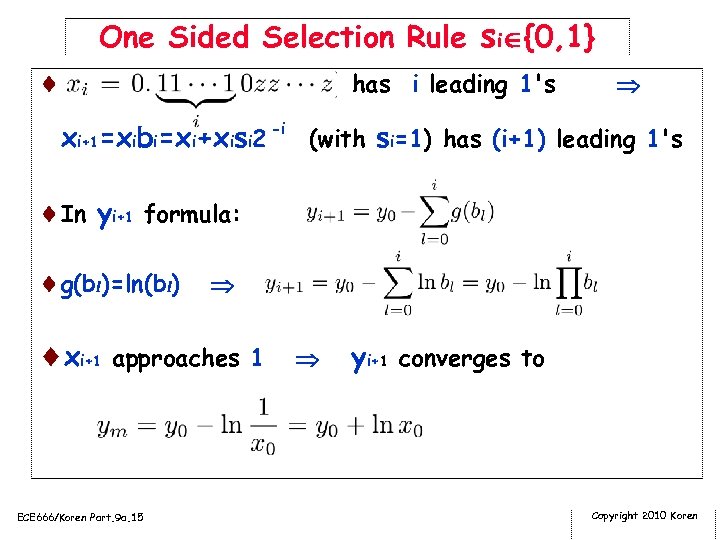 One Sided Selection Rule si {0, 1} ¨ has i leading 1's xi+1=xibi=xi+xisi 2 -i (with si=1) has (i+1) leading 1's ¨In yi+1 formula: ¨g(bl)=ln(bl) ¨xi+1 approaches 1 ECE 666/Koren Part. 9 a. 15 yi+1 converges to Copyright 2010 Koren
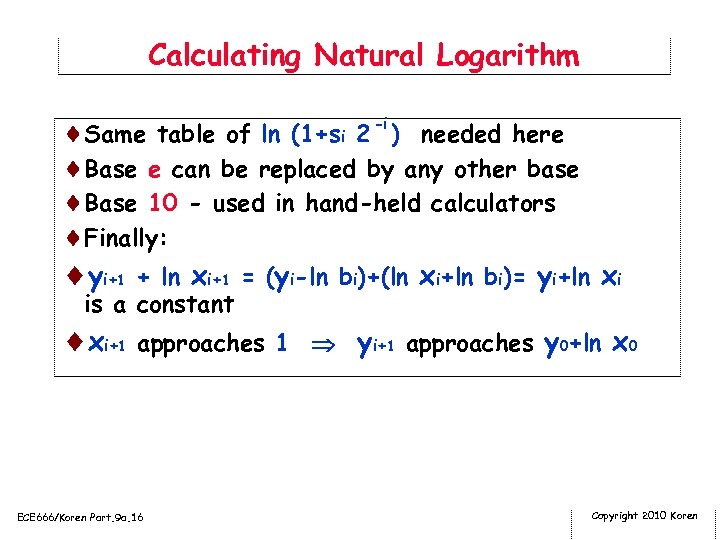 Calculating Natural Logarithm ¨Same table of ln (1+si 2 -i ) needed here ¨Base e can be replaced by any other base ¨Base 10 - used in hand-held calculators ¨Finally: ¨yi+1 + ln xi+1 = (yi-ln bi)+(ln xi+ln bi)= yi+ln xi is a constant ¨xi+1 approaches 1 yi+1 approaches y 0+ln x 0 ECE 666/Koren Part. 9 a. 16 Copyright 2010 Koren
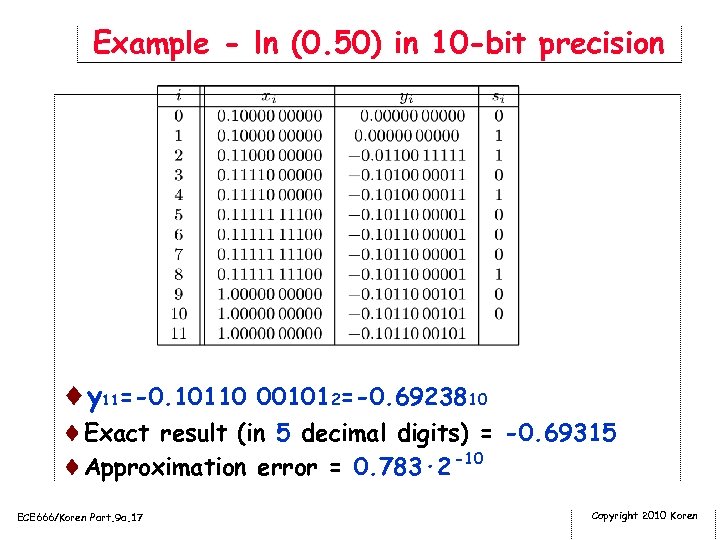 Example - ln (0. 50) in 10 -bit precision ¨y 11=-0. 10110 001012=-0. 6923810 ¨Exact result (in 5 decimal digits) = -0. 69315 ¨Approximation error = 0. 783· 2 -10 ECE 666/Koren Part. 9 a. 17 Copyright 2010 Koren
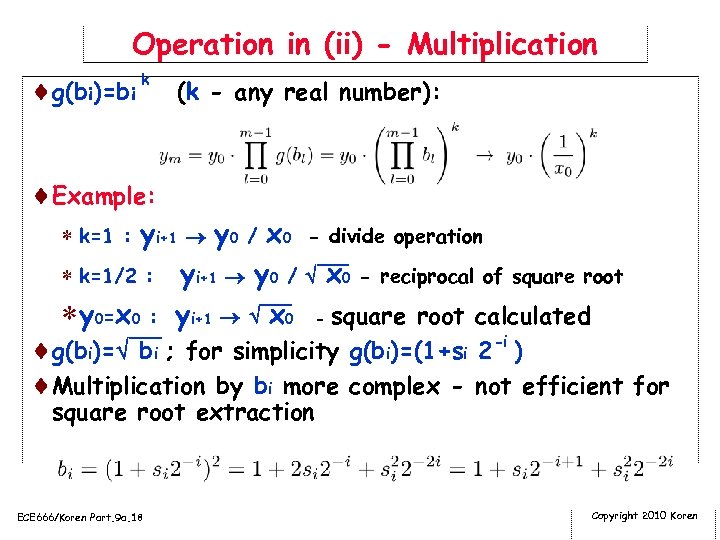 Operation in (ii) - Multiplication ¨g(bi)=bi k (k - any real number): ¨Example: * k=1 : yi+1 y 0 / x 0 - divide operation * k=1/2 : yi+1 y 0 / x 0 - reciprocal of square root *y 0=x 0 : yi+1 x 0 - square root calculated ¨g(bi)= bi ; for simplicity g(bi)=(1+si 2 -i ) ¨Multiplication by bi more complex - not efficient for square root extraction ECE 666/Koren Part. 9 a. 18 Copyright 2010 Koren
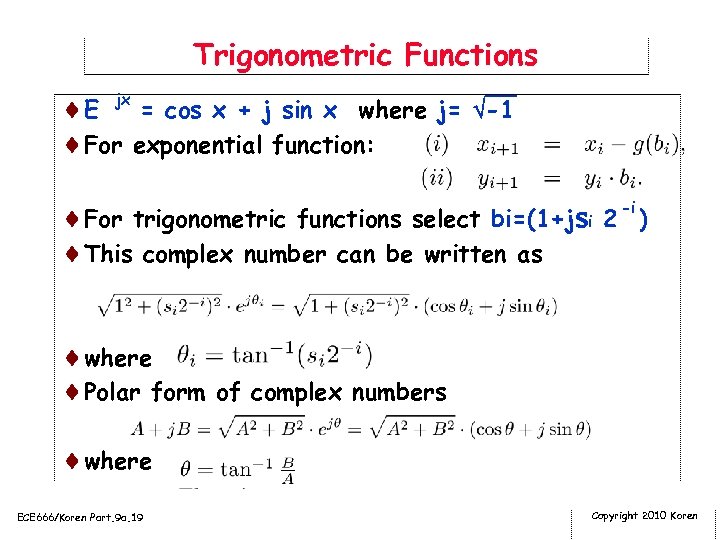 Trigonometric Functions ¨E jx = cos x + j sin x where j= -1 ¨For exponential function: ¨For trigonometric functions select bi=(1+jsi 2 -i ) ¨This complex number can be written as ¨where ¨Polar form of complex numbers ¨where ECE 666/Koren Part. 9 a. 19 Copyright 2010 Koren
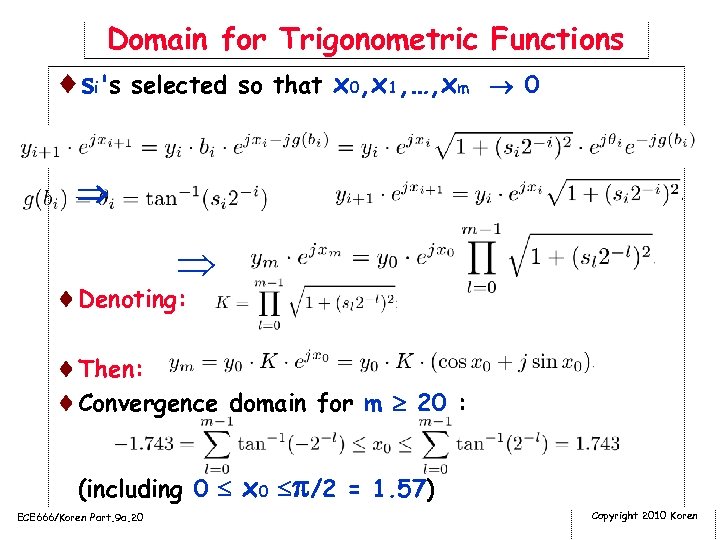 Domain for Trigonometric Functions ¨si's selected so that x 0, x 1, …, xm 0 ¨ ¨Denoting: ¨Then: ¨Convergence domain for m 20 : (including 0 x 0 /2 = 1. 57) ECE 666/Koren Part. 9 a. 20 Copyright 2010 Koren
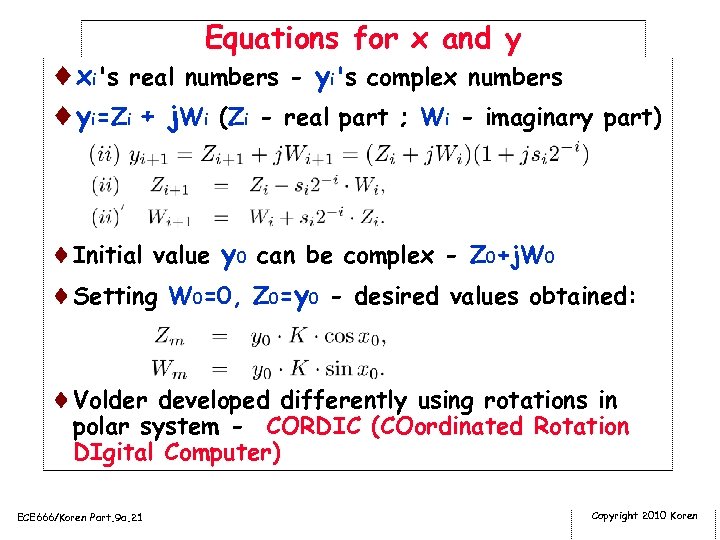 Equations for x and y ¨xi's real numbers - yi's complex numbers ¨yi=Zi + j. Wi (Zi - real part ; Wi - imaginary part) ¨Initial value y 0 can be complex - Z 0+j. W 0 ¨Setting W 0=0, Z 0=y 0 - desired values obtained: ¨Volder developed differently using rotations in polar system - CORDIC (COordinated Rotation DIgital Computer) ECE 666/Koren Part. 9 a. 21 Copyright 2010 Koren
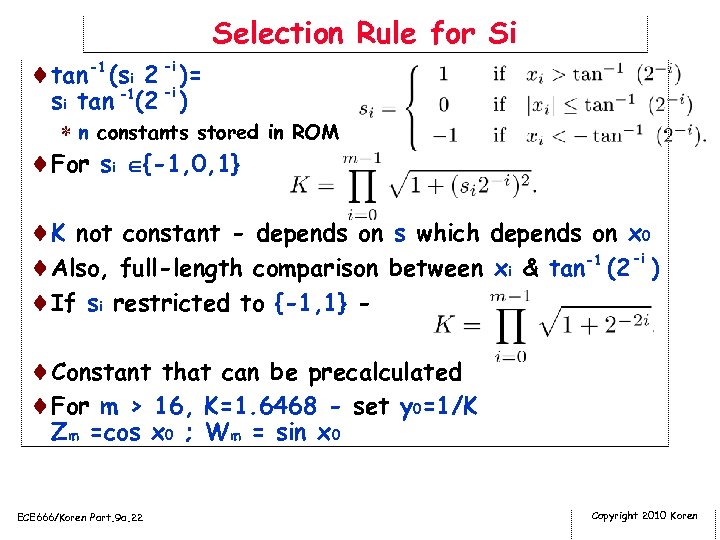 Selection Rule for Si ¨tan -1 (si 2 -i )= -i si tan -1(2 ) * n constants stored in ROM ¨For si {-1, 0, 1} ¨K not constant - depends on s which depends on x 0 ¨Also, full-length comparison between xi & tan-1 (2 -i ) ¨If si restricted to {-1, 1} ¨Constant that can be precalculated ¨For m > 16, K=1. 6468 - set y 0=1/K Zm =cos x 0 ; Wm = sin x 0 ECE 666/Koren Part. 9 a. 22 Copyright 2010 Koren
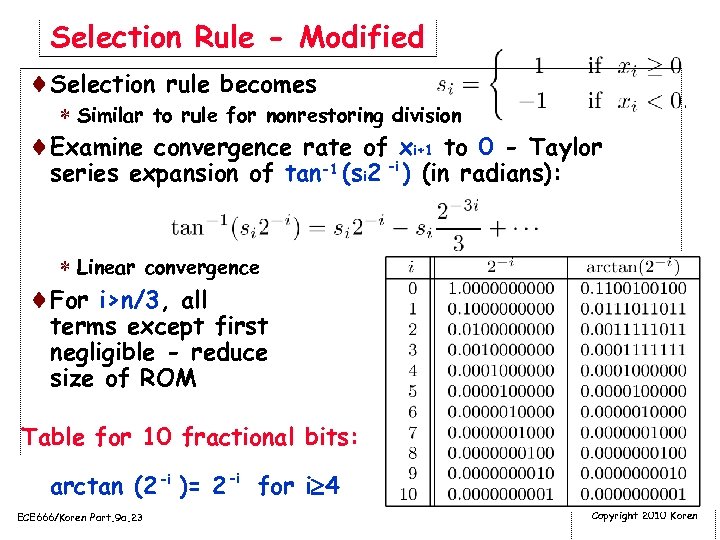 Selection Rule - Modified ¨Selection rule becomes * Similar to rule for nonrestoring division ¨Examine convergence rate of xi+1 to 0 - Taylor series expansion of tan-1 (si 2 -i ) (in radians): * Linear convergence ¨For i>n/3, all terms except first negligible - reduce size of ROM Table for 10 fractional bits: arctan (2 -i )= 2 -i for i 4 ECE 666/Koren Part. 9 a. 23 Copyright 2010 Koren
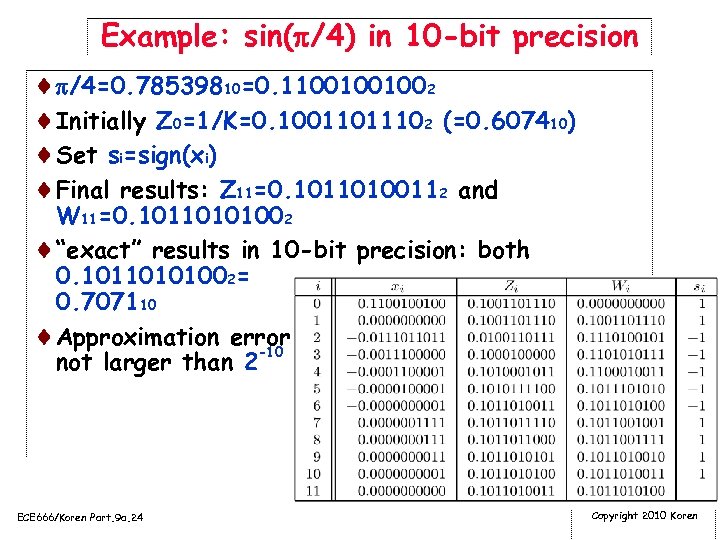 Example: sin( /4) in 10 -bit precision ¨ /4=0. 78539810=0. 11001001002 ¨Initially Z 0=1/K=0. 10011011102 (=0. 607410) ¨Set si=sign(xi) ¨Final results: Z 11=0. 10110100112 and W 11=0. 10110101002 ¨“exact” results in 10 -bit precision: both 0. 10110101002= 0. 707110 ¨Approximation error -10 not larger than 2 ECE 666/Koren Part. 9 a. 24 Copyright 2010 Koren