


 Скачать презентацию UNIVERSITY OF MASSACHUSETTS Dept of Electrical Computer
a3799b9b8db16f2bb172caa29023a8c8.ppt
- Количество слайдов: 36
 UNIVERSITY OF MASSACHUSETTS Dept. of Electrical & Computer Engineering Digital Computer Arithmetic ECE 666 Part 3 Sequential Algorithms for Multiplication and Division Israel Koren ECE 666/Koren Part. 3. 1 Copyright 2010 Koren
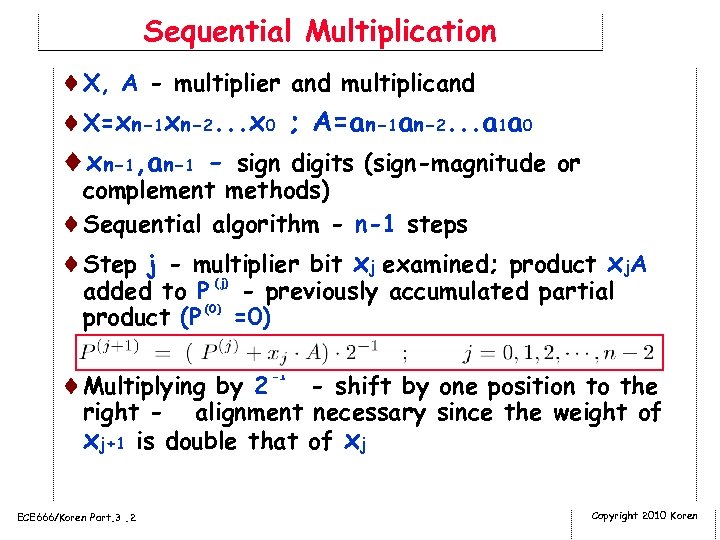 Sequential Multiplication ¨X, A - multiplier and multiplicand ¨X=xn-1 xn-2. . . x 0 ; A=an-1 an-2. . . a 1 a 0 ¨xn-1, an-1 - sign digits (sign-magnitude or complement methods) ¨Sequential algorithm - n-1 steps ¨Step j - multiplier bit xj examined; product xj. A added to P - previously accumulated partial product (P (0) =0) (j) ¨Multiplying by 2 -1 - shift by one position to the right - alignment necessary since the weight of xj+1 is double that of xj ECE 666/Koren Part. 3. 2 Copyright 2010 Koren
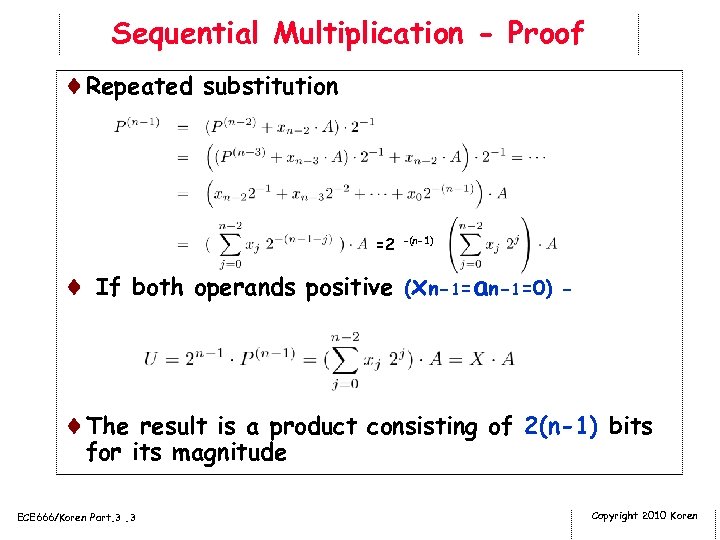 Sequential Multiplication - Proof ¨Repeated substitution =2 -(n-1) ¨ If both operands positive (xn-1=an-1=0) - ¨The result is a product consisting of 2(n-1) bits for its magnitude ECE 666/Koren Part. 3. 3 Copyright 2010 Koren
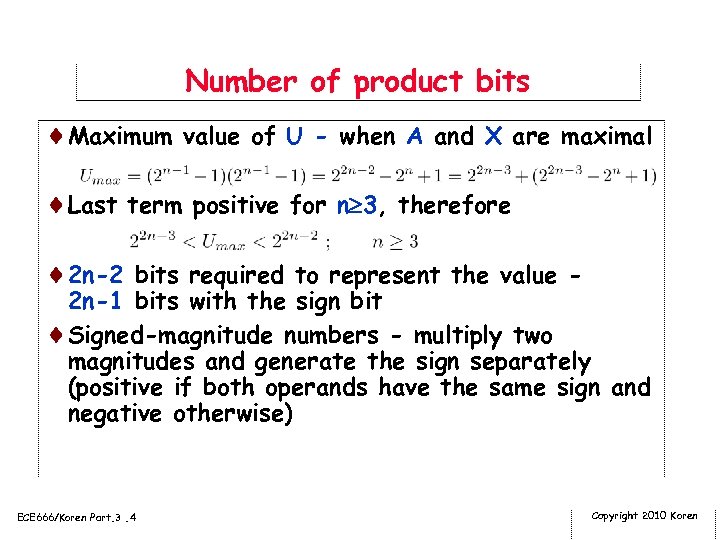 Number of product bits ¨Maximum value of U - when A and X are maximal ¨Last term positive for n 3, therefore ¨ 2 n-2 bits required to represent the value - 2 n-1 bits with the sign bit ¨Signed-magnitude numbers - multiply two magnitudes and generate the sign separately (positive if both operands have the same sign and negative otherwise) ECE 666/Koren Part. 3. 4 Copyright 2010 Koren
 Negative operands ¨For two's and one's complement - distinguish between multiplication with a negative multiplicand A and multiplication with a negative multiplier X ¨If only multiplicand is negative - no need to change the previous algorithm - only add some multiple of a negative number that is represented in either two's or one's complement ECE 666/Koren Part. 3. 5 Copyright 2010 Koren
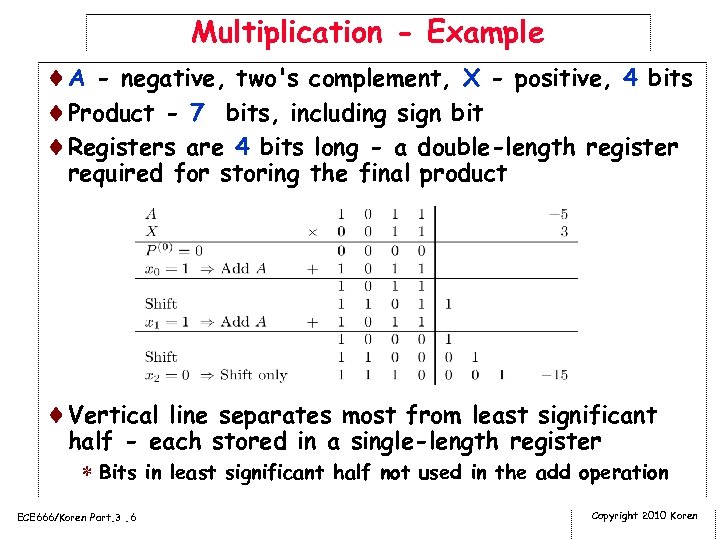 Multiplication - Example ¨A - negative, two's complement, X - positive, 4 bits ¨Product - 7 bits, including sign bit ¨Registers are 4 bits long - a double-length register required for storing the final product ¨Vertical line separates most from least significant half - each stored in a single-length register * Bits in least significant half not used in the add operation ECE 666/Koren Part. 3. 6 Copyright 2010 Koren
 Least significant half of product ¨Only 3 bit positions are utilized - least significant bit position unused - not necessarily final arrangement ¨The 3 bits can be stored in 3 rightmost positions ¨Sign bit of second register can be set in two ways * (1) Always set sign bit to 0, irrespective of sign of the product, since it is the least significant part of result * (2) Set sign bit equal to sign bit of first register ¨Another possible arrangement - * Use all four bit positions in second register for the four least significant bits of the product * Use the rightmost two bit positions in the first register * Insert two copies of sign bit into remaining bit positions ECE 666/Koren Part. 3. 7 Copyright 2010 Koren
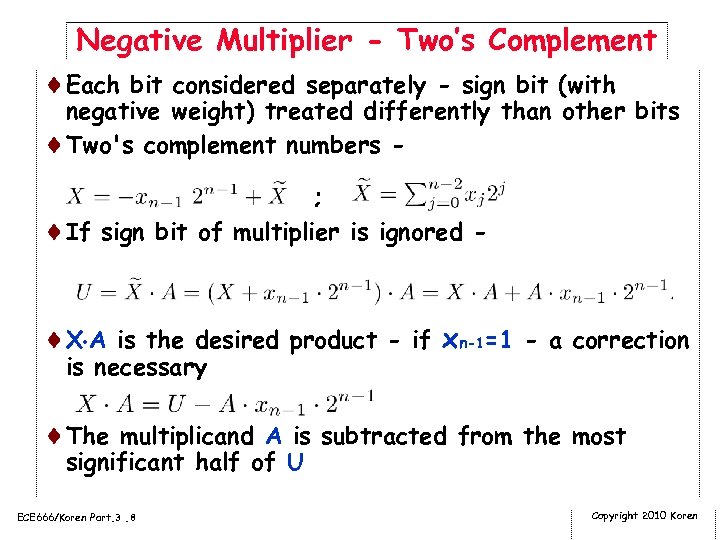 Negative Multiplier - Two’s Complement ¨Each bit considered separately - sign bit (with negative weight) treated differently than other bits ¨Two's complement numbers ; ¨If sign bit of multiplier is ignored - ¨X A is the desired product - if xn-1=1 - a correction is necessary ¨The multiplicand A is subtracted from the most significant half of U ECE 666/Koren Part. 3. 8 Copyright 2010 Koren
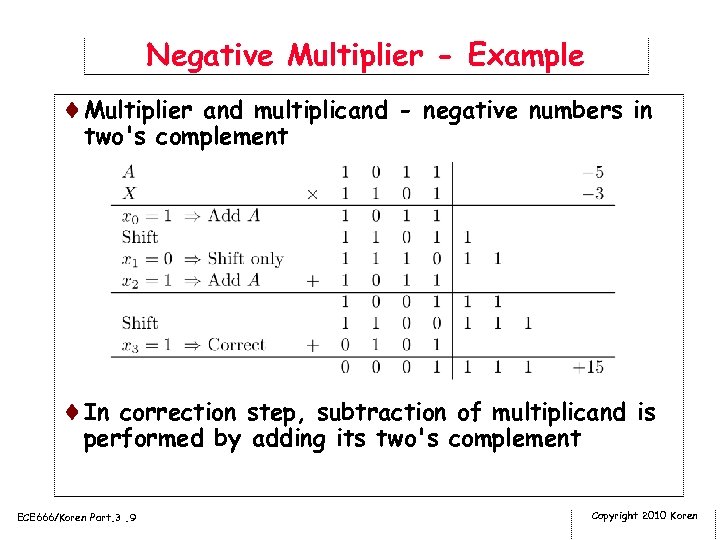 Negative Multiplier - Example ¨Multiplier and multiplicand - negative numbers in two's complement ¨In correction step, subtraction of multiplicand is performed by adding its two's complement ECE 666/Koren Part. 3. 9 Copyright 2010 Koren
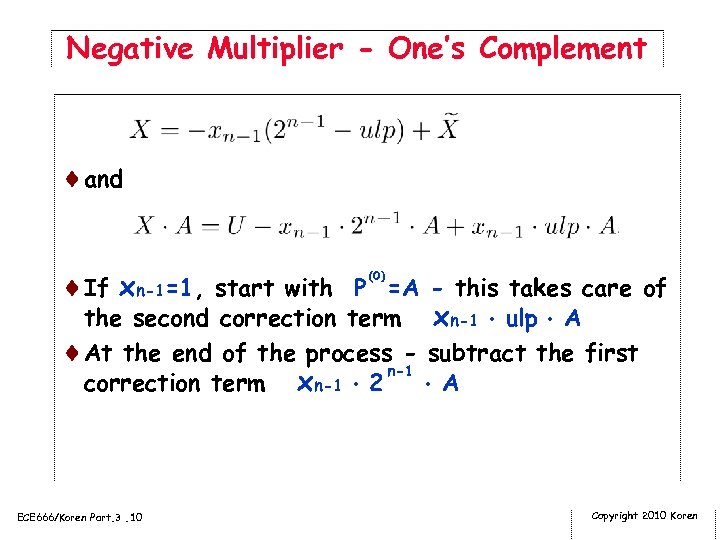 Negative Multiplier - One’s Complement ¨and ¨If xn-1=1, start with P =A - this takes care of the second correction term xn-1 ulp A ¨At the end of the process - subtract the first n-1 correction term xn-1 2 A (0) ECE 666/Koren Part. 3. 10 Copyright 2010 Koren
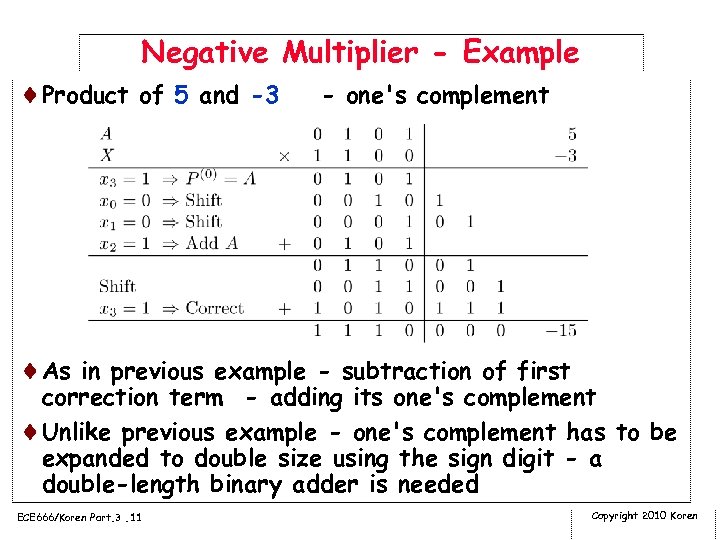 Negative Multiplier - Example ¨Product of 5 and -3 - one's complement ¨As in previous example - subtraction of first correction term - adding its one's complement ¨Unlike previous example - one's complement has to be expanded to double size using the sign digit - a double-length binary adder is needed ECE 666/Koren Part. 3. 11 Copyright 2010 Koren
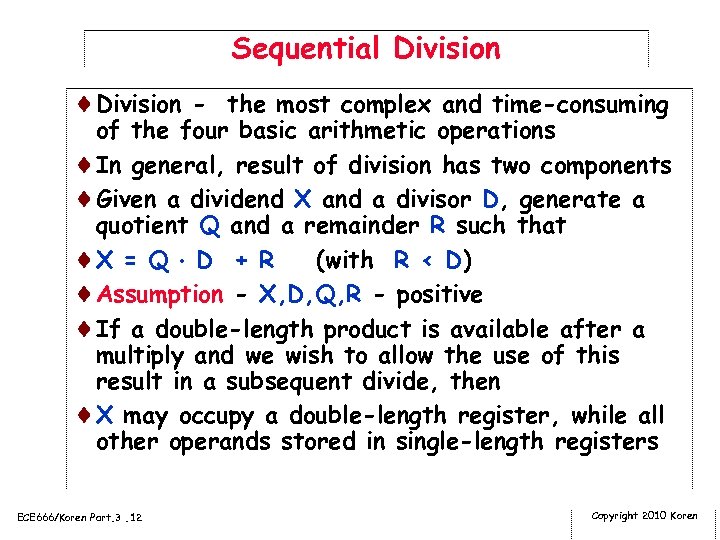 Sequential Division ¨Division - the most complex and time-consuming of the four basic arithmetic operations ¨In general, result of division has two components ¨Given a dividend X and a divisor D, generate a quotient Q and a remainder R such that ¨X = Q D + R (with R < D) ¨Assumption - X, D, Q, R - positive ¨If a double-length product is available after a multiply and we wish to allow the use of this result in a subsequent divide, then ¨X may occupy a double-length register, while all other operands stored in single-length registers ECE 666/Koren Part. 3. 12 Copyright 2010 Koren
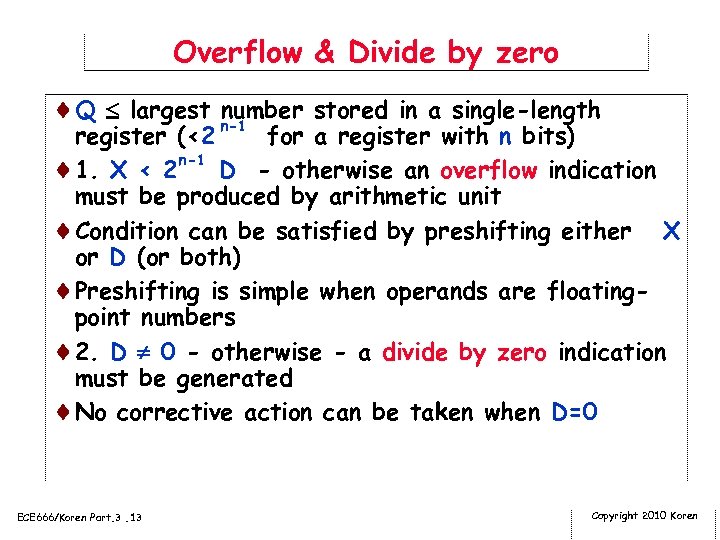 Overflow & Divide by zero ¨Q largest n-1 number stored in a single-length register (<2 for a register with n bits) ¨ 1. X < 2 n-1 D - otherwise an overflow indication must be produced by arithmetic unit ¨Condition can be satisfied by preshifting either X or D (or both) ¨Preshifting is simple when operands are floatingpoint numbers ¨ 2. D 0 - otherwise - a divide by zero indication must be generated ¨No corrective action can be taken when D=0 ECE 666/Koren Part. 3. 13 Copyright 2010 Koren
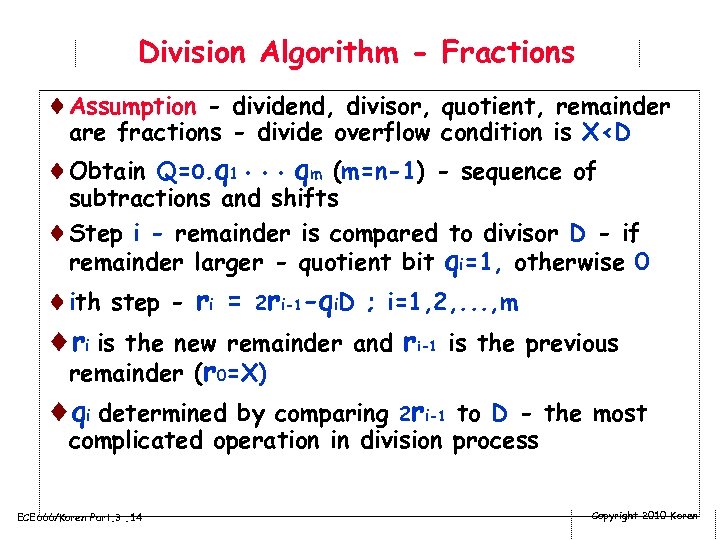 Division Algorithm - Fractions ¨Assumption - dividend, divisor, quotient, remainder are fractions - divide overflow condition is X
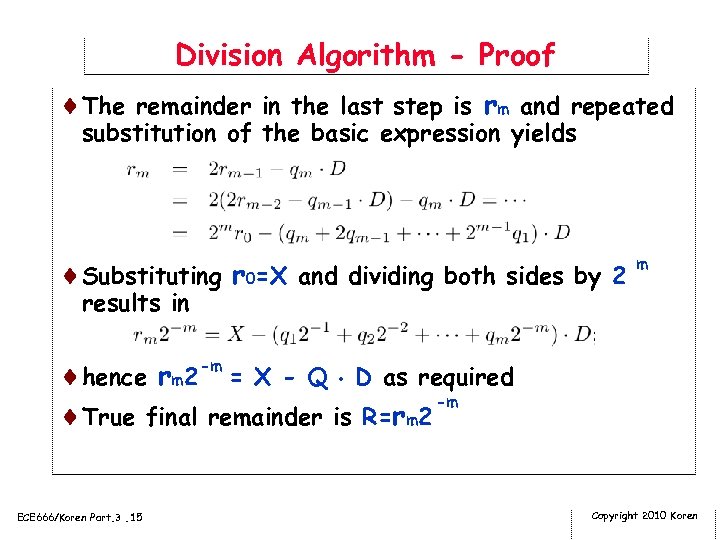 Division Algorithm - Proof ¨The remainder in the last step is rm and repeated substitution of the basic expression yields ¨Substituting r 0=X and dividing both sides by 2 m results in -m ¨hence rm 2 = X - Q D as required -m ¨True final remainder is R=rm 2 ECE 666/Koren Part. 3. 15 Copyright 2010 Koren
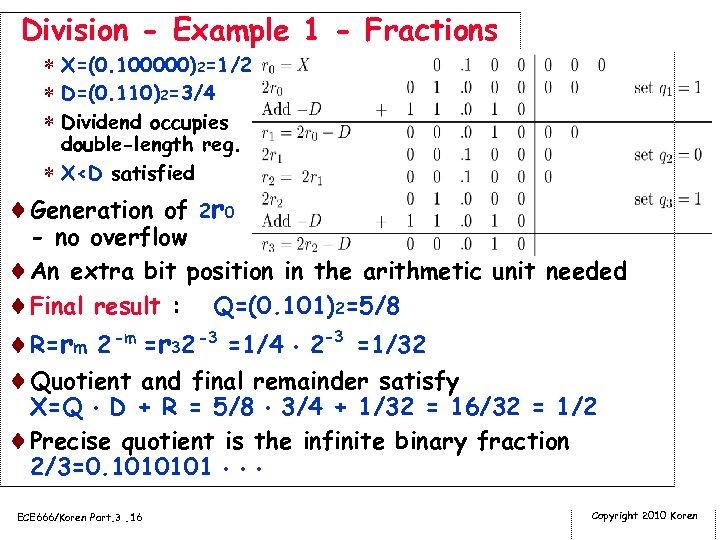 Division - Example 1 - Fractions * X=(0. 100000)2=1/2 * D=(0. 110)2=3/4 * Dividend occupies double-length reg. * X
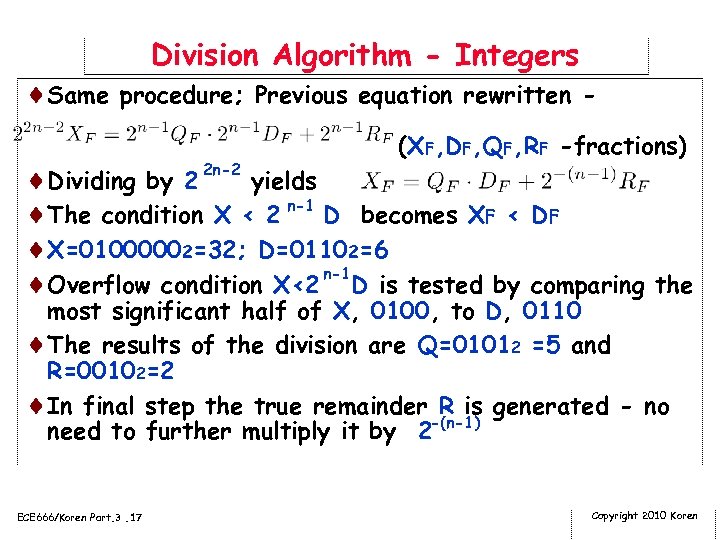 Division Algorithm - Integers ¨Same procedure; Previous equation rewritten 2 n-2 (XF, DF, QF, RF -fractions) ¨Dividing by 2 yields ¨The condition X < 2 n-1 D becomes XF < DF ¨X=01000002=32; D=01102=6 n-1 ¨Overflow condition X<2 D is tested by comparing the most significant half of X, 0100, to D, 0110 ¨The results of the division are Q=01012 =5 and R=00102=2 ¨In final step the true remainder -(n-1) generated - no R is need to further multiply it by 2 ECE 666/Koren Part. 3. 17 Copyright 2010 Koren
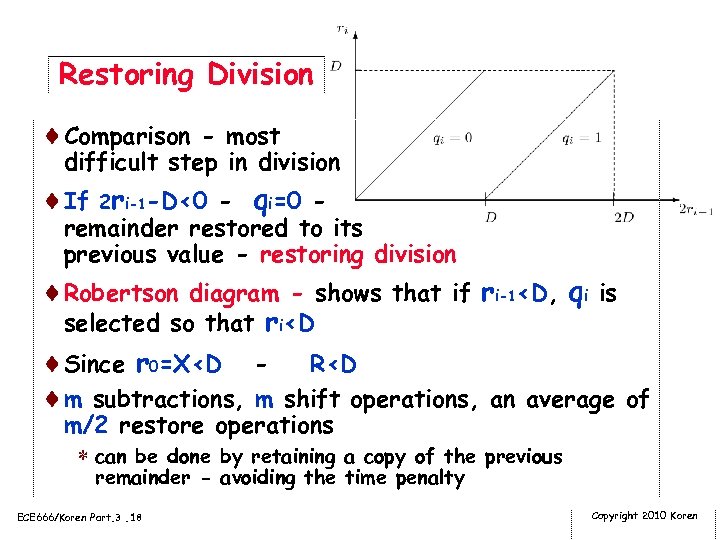 Restoring Division ¨Comparison - most difficult step in division ¨If 2 ri-1 -D<0 - qi=0 - remainder restored to its previous value - restoring division ¨Robertson diagram - shows that if ri-1
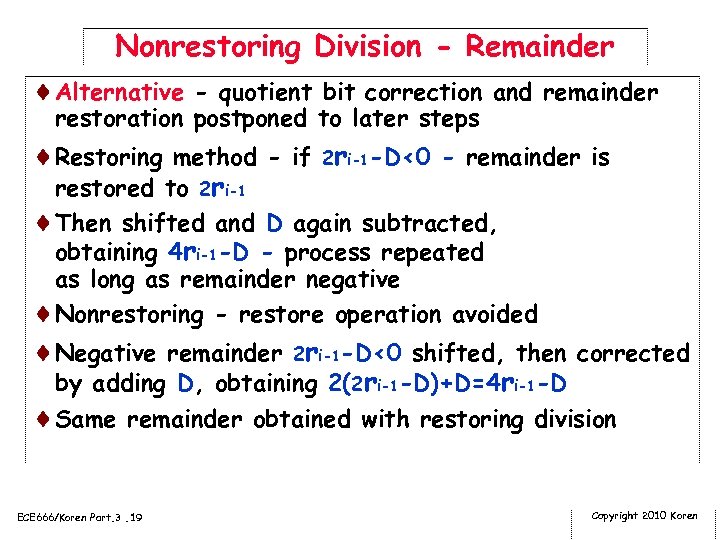 Nonrestoring Division - Remainder ¨Alternative - quotient bit correction and remainder restoration postponed to later steps ¨Restoring method - if 2 ri-1 -D<0 - remainder is restored to 2 ri-1 ¨Then shifted and D again subtracted, obtaining 4 ri-1 -D - process repeated as long as remainder negative ¨Nonrestoring - restore operation avoided ¨Negative remainder 2 ri-1 -D<0 shifted, then corrected by adding D, obtaining 2(2 ri-1 -D)+D=4 ri-1 -D ¨Same remainder obtained with restoring division ECE 666/Koren Part. 3. 19 Copyright 2010 Koren
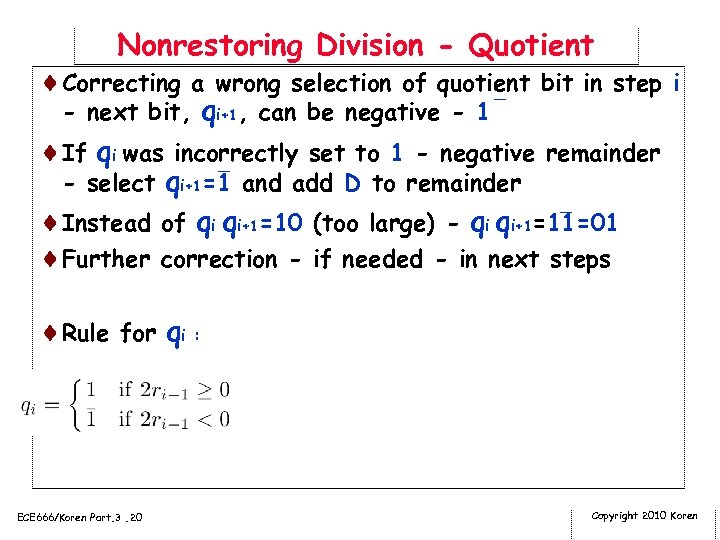 Nonrestoring Division - Quotient ¨Correcting a wrong selection of quotient bit in step i _ - next bit, qi+1, can be negative - 1 ¨If qi was incorrectly set to 1 - negative remainder _ - select qi+1=1 and add D to remainder _ ¨Instead of qi qi+1=10 (too large) - qi qi+1=11=01 ¨Further correction - if needed - in next steps ¨Rule for qi : ECE 666/Koren Part. 3. 20 Copyright 2010 Koren
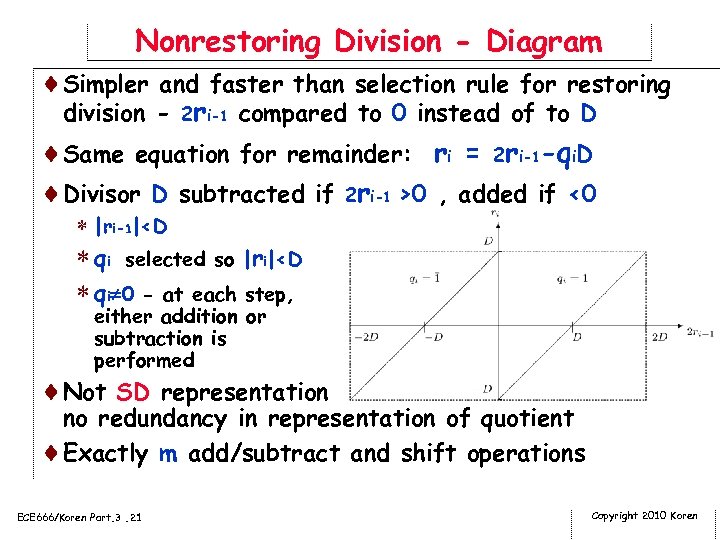 Nonrestoring Division - Diagram ¨Simpler and faster than selection rule for restoring division - 2 ri-1 compared to 0 instead of to D ¨Same equation for remainder: ri = 2 ri-1 -qi. D ¨Divisor D subtracted if 2 ri-1 >0 , added if <0 * |ri-1|
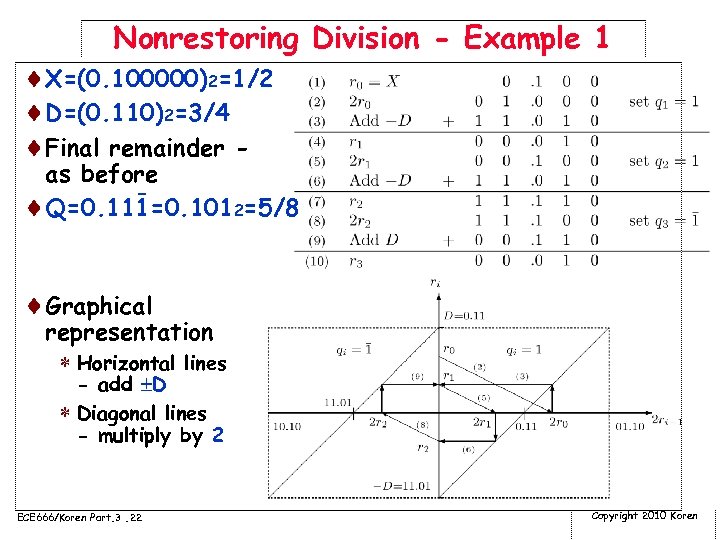 Nonrestoring Division - Example 1 ¨X=(0. 100000)2=1/2 ¨D=(0. 110)2=3/4 ¨Final remainder - as before ¨Q=0. 111=0. 1012=5/8 ¨Graphical representation * Horizontal lines - add D * Diagonal lines - multiply by 2 ECE 666/Koren Part. 3. 22 Copyright 2010 Koren
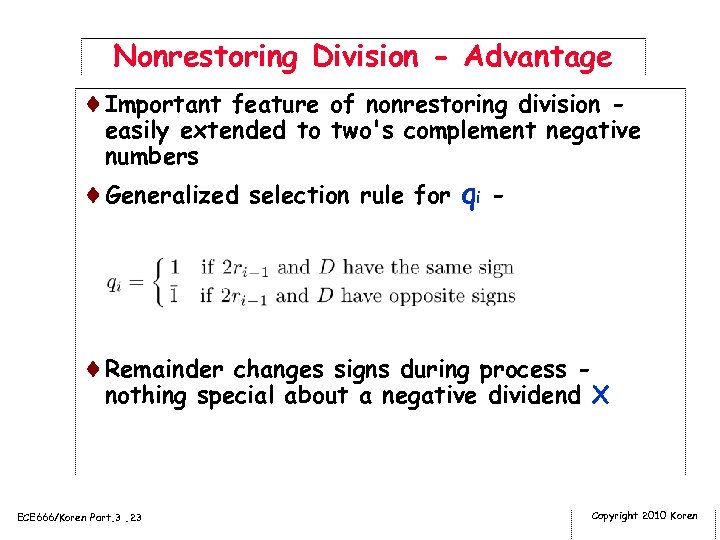 Nonrestoring Division - Advantage ¨Important feature of nonrestoring division - easily extended to two's complement negative numbers ¨Generalized selection rule for qi - ¨Remainder changes signs during process - nothing special about a negative dividend X ECE 666/Koren Part. 3. 23 Copyright 2010 Koren
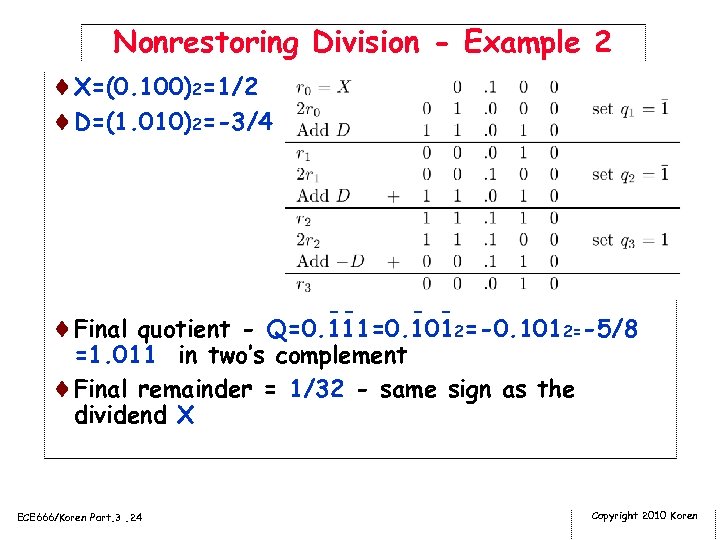 Nonrestoring Division - Example 2 ¨X=(0. 100)2=1/2 ¨D=(1. 010)2=-3/4 -- - - ¨Final quotient - Q=0. 111=0. 1012=-5/8 =1. 011 in two’s complement ¨Final remainder = 1/32 - same sign as the dividend X ECE 666/Koren Part. 3. 24 Copyright 2010 Koren
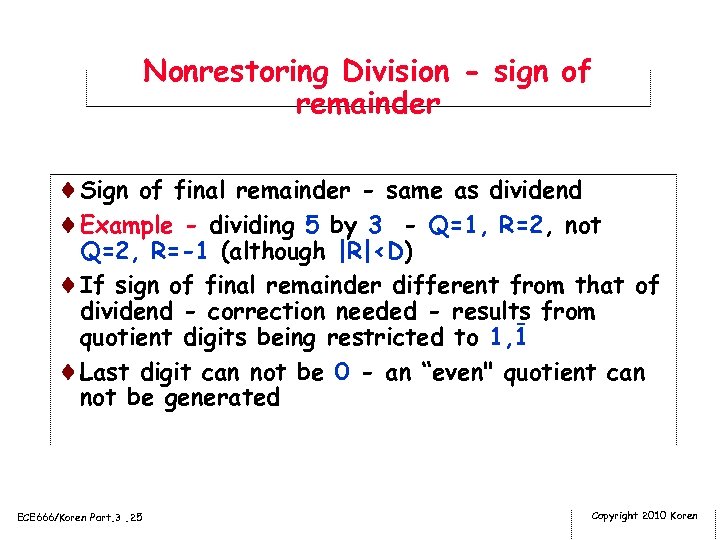 Nonrestoring Division - sign of remainder ¨Sign of final remainder - same as dividend ¨Example - dividing 5 by 3 - Q=1, R=2, not Q=2, R=-1 (although |R|
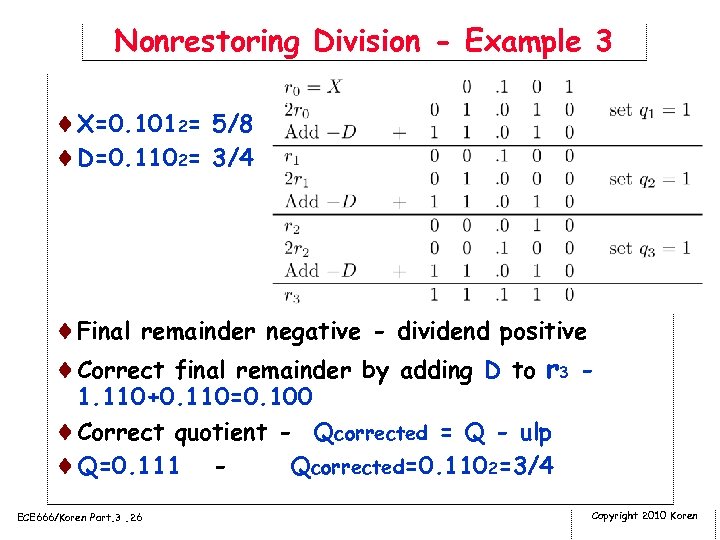 Nonrestoring Division - Example 3 ¨X=0. 1012= 5/8 ¨D=0. 1102= 3/4 ¨Final remainder negative - dividend positive ¨Correct final remainder by adding D to r 3 1. 110+0. 110=0. 100 ¨Correct quotient - Qcorrected = Q - ulp ¨Q=0. 111 Qcorrected=0. 1102=3/4 ECE 666/Koren Part. 3. 26 Copyright 2010 Koren
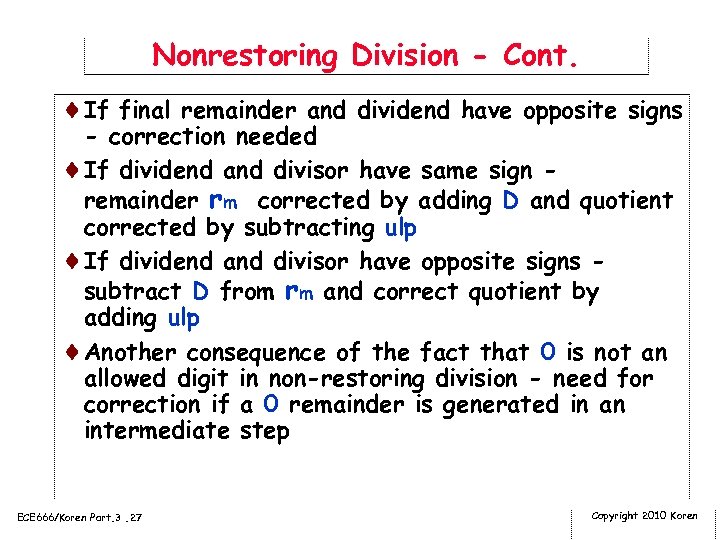 Nonrestoring Division - Cont. ¨If final remainder and dividend have opposite signs - correction needed ¨If dividend and divisor have same sign remainder rm corrected by adding D and quotient corrected by subtracting ulp ¨If dividend and divisor have opposite signs subtract D from rm and correct quotient by adding ulp ¨Another consequence of the fact that 0 is not an allowed digit in non-restoring division - need for correction if a 0 remainder is generated in an intermediate step ECE 666/Koren Part. 3. 27 Copyright 2010 Koren
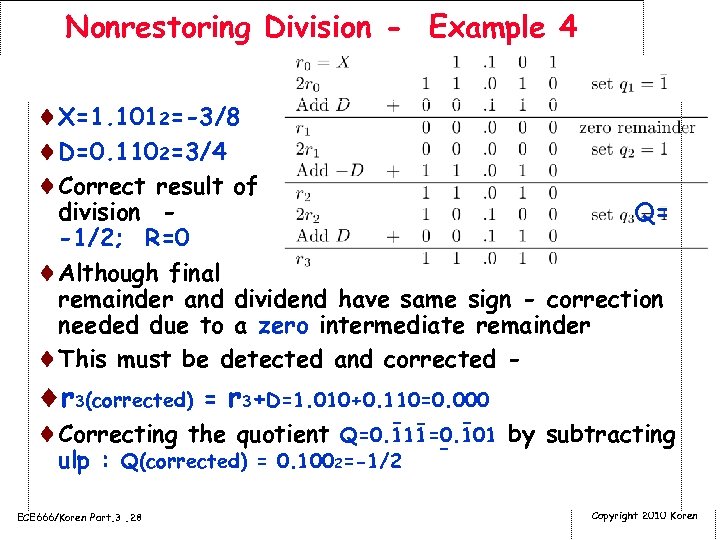 Nonrestoring Division - Example 4 ¨X=1. 1012=-3/8 ¨D=0. 1102=3/4 ¨Correct result of division Q= -1/2; R=0 ¨Although final remainder and dividend have same sign - correction needed due to a zero intermediate remainder ¨This must be detected and corrected - ¨r 3(corrected) = r 3+D=1. 010+0. 110=0. 000 - ¨Correcting the quotient Q=0. 111=0. 101 by subtracting ulp : Q(corrected) = 0. 1002=-1/2 ECE 666/Koren Part. 3. 28 Copyright 2010 Koren
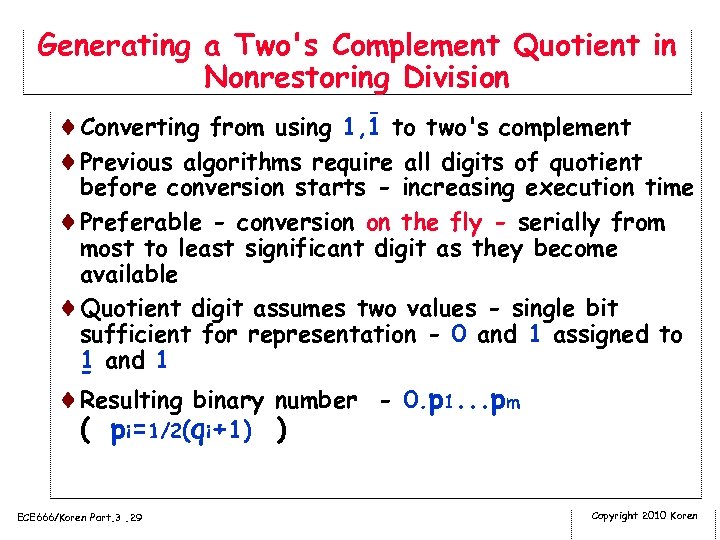 Generating a Two's Complement Quotient in Nonrestoring Division - ¨Converting from using 1, 1 to two's complement ¨Previous algorithms require all digits of quotient before conversion starts - increasing execution time ¨Preferable - conversion on the fly - serially from most to least significant digit as they become available ¨Quotient digit assumes two values - single bit sufficient for representation - 0 and 1 assigned to 1 - and 1 ¨Resulting binary number - 0. p 1. . . pm ( pi=1/2(qi+1) ) ECE 666/Koren Part. 3. 29 Copyright 2010 Koren
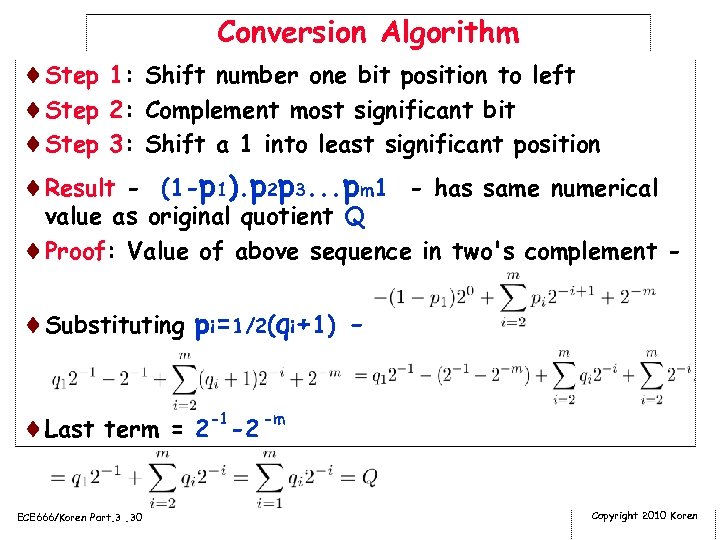 Conversion Algorithm ¨Step 1: Shift number one bit position to left ¨Step 2: Complement most significant bit ¨Step 3: Shift a 1 into least significant position ¨Result - (1 -p 1). p 2 p 3. . . pm 1 - has same numerical value as original quotient Q ¨Proof: Value of above sequence in two's complement - ¨Substituting pi=1/2(qi+1) -1 ¨Last term = 2 -2 ECE 666/Koren Part. 3. 30 -m Copyright 2010 Koren
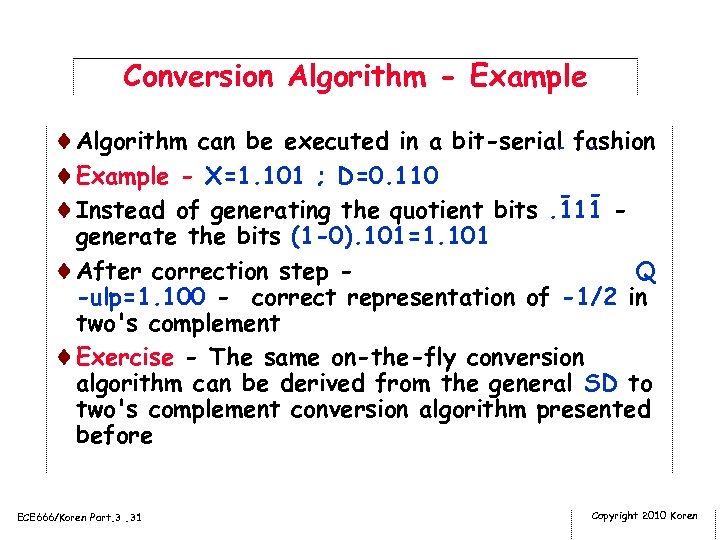 Conversion Algorithm - Example ¨Algorithm can be executed in a bit-serial fashion - ¨Example - X=1. 101 ; D=0. 110 - ¨Instead of generating the quotient bits. 111 generate the bits (1 -0). 101=1. 101 ¨After correction step Q -ulp=1. 100 - correct representation of -1/2 in two's complement ¨Exercise - The same on-the-fly conversion algorithm can be derived from the general SD to two's complement conversion algorithm presented before ECE 666/Koren Part. 3. 31 Copyright 2010 Koren
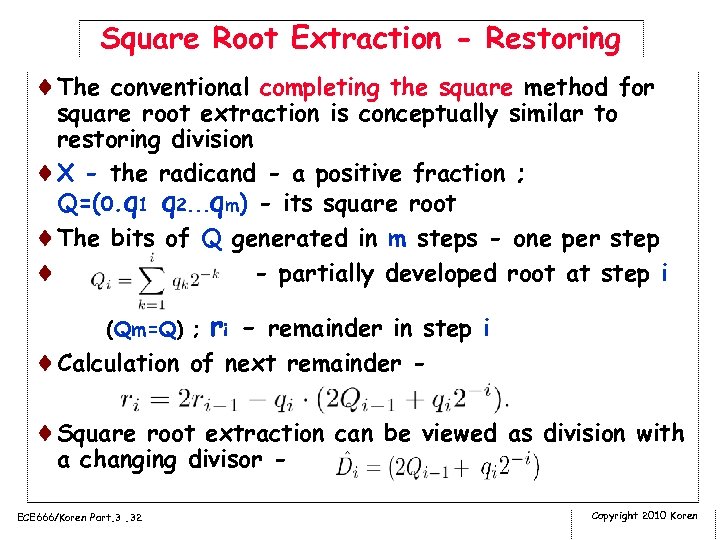 Square Root Extraction - Restoring ¨The conventional completing the square method for square root extraction is conceptually similar to restoring division ¨X - the radicand - a positive fraction ; Q=(0. q 1 q 2. . . qm) - its square root ¨The bits of Q generated in m steps - one per step ¨ - partially developed root at step i (Qm=Q) ; ri - remainder in step i ¨Calculation of next remainder - ¨Square root extraction can be viewed as division with a changing divisor - ECE 666/Koren Part. 3. 32 Copyright 2010 Koren
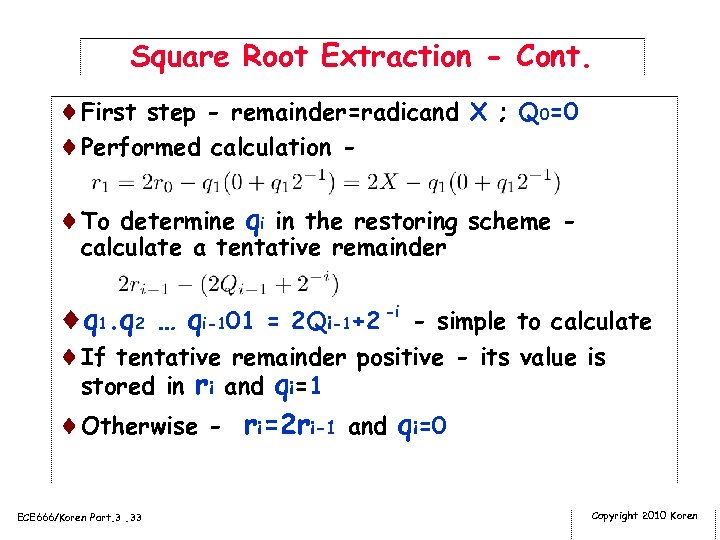 Square Root Extraction - Cont. ¨First step - remainder=radicand X ; Q 0=0 ¨Performed calculation ¨To determine qi in the restoring scheme calculate a tentative remainder ¨q 1. q 2 … qi-101 -i = 2 Qi-1+2 - simple to calculate ¨If tentative remainder positive - its value is stored in ri and qi=1 ¨Otherwise - ri=2 ri-1 and qi=0 ECE 666/Koren Part. 3. 33 Copyright 2010 Koren
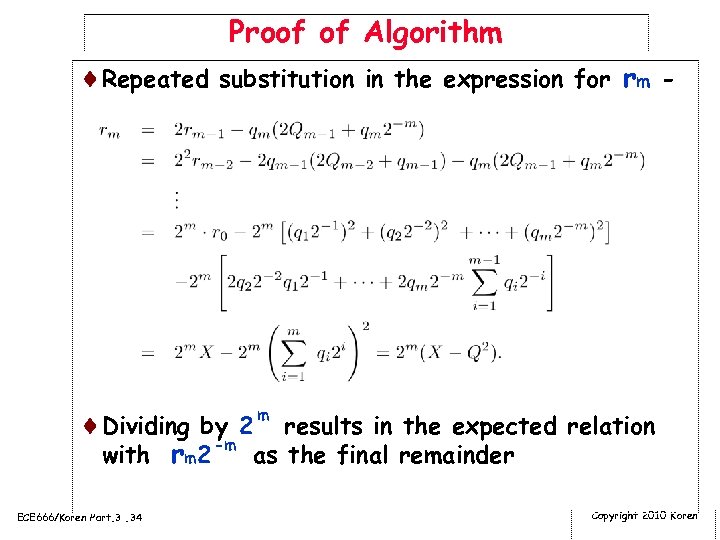 Proof of Algorithm ¨Repeated substitution in the expression for rm - m ¨Dividing by 2 results in the expected relation -m with rm 2 as the final remainder ECE 666/Koren Part. 3. 34 Copyright 2010 Koren
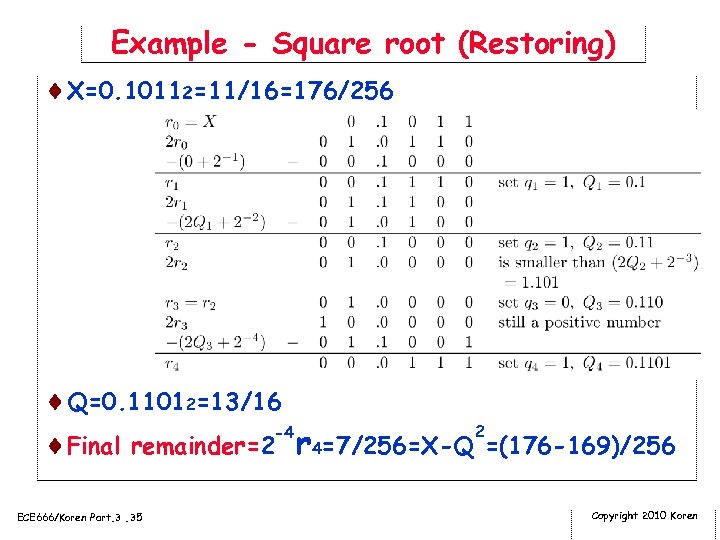 Example - Square root (Restoring) ¨X=0. 10112=11/16=176/256 ¨Q=0. 11012=13/16 ¨Final remainder=2 r 4=7/256=X-Q =(176 -169)/256 -4 ECE 666/Koren Part. 3. 35 2 Copyright 2010 Koren
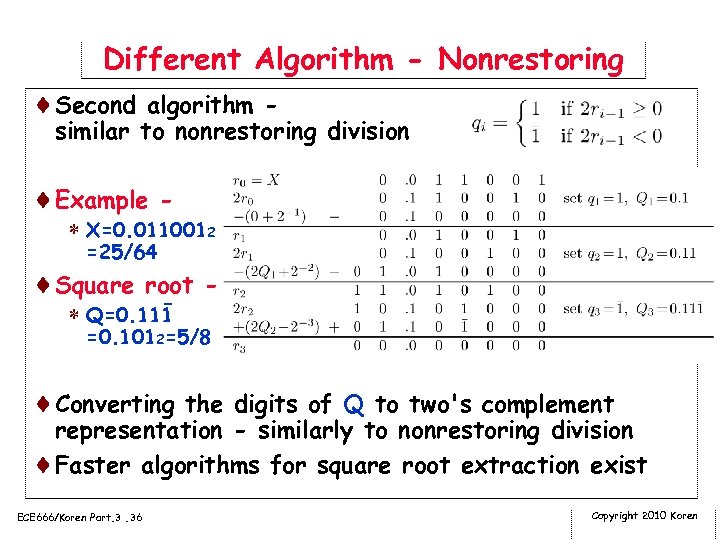 Different Algorithm - Nonrestoring ¨Second algorithm - similar to nonrestoring division ¨Example - * X=0. 0110012 =25/64 ¨Square root - * Q=0. 111 =0. 1012=5/8 ¨Converting the digits of Q to two's complement representation - similarly to nonrestoring division ¨Faster algorithms for square root extraction exist ECE 666/Koren Part. 3. 36 Copyright 2010 Koren