


 Скачать презентацию UNIVERSITY OF MASSACHUSETTS Dept of Electrical Computer
3a98c9993b6e2b95a780fdcda1c64d03.ppt
- Количество слайдов: 19
 UNIVERSITY OF MASSACHUSETTS Dept. of Electrical & Computer Engineering Digital Computer Arithmetic ECE 666 Part 7 b Fast Division - II Israel Koren Spring 2008 ECE 666/Koren Part. 7 b. 1 Copyright 2008 Koren
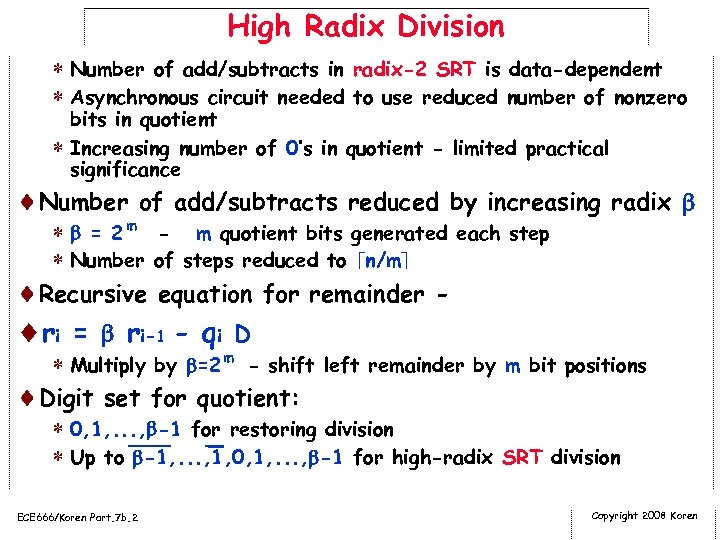 High Radix Division * Number of add/subtracts in radix-2 SRT is data-dependent * Asynchronous circuit needed to use reduced number of nonzero bits in quotient * Increasing number of 0’s in quotient - limited practical significance ¨Number of add/subtracts reduced by increasing radix * = 2 m - m quotient bits generated each step * Number of steps reduced to n/m ¨Recursive equation for remainder - ¨ ri = ri-1 - qi D * Multiply by =2 m - shift left remainder by m bit positions ¨Digit set for quotient: * 0, 1, . . . , -1 for restoring division * Up to -1, . . . , 1, 0, 1, . . . , -1 for high-radix SRT division ECE 666/Koren Part. 7 b. 2 Copyright 2008 Koren
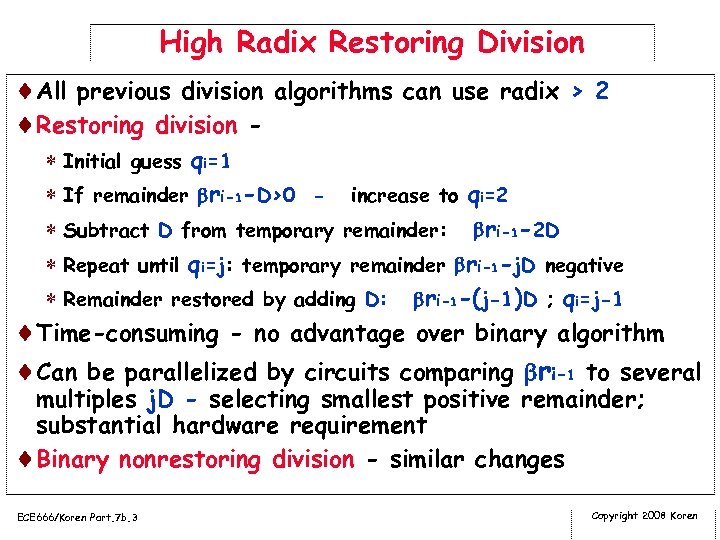 High Radix Restoring Division ¨All previous division algorithms can use radix > 2 ¨Restoring division * Initial guess qi=1 * If remainder ri-1 -D>0 - increase to qi=2 * Subtract D from temporary remainder: ri-1 -2 D * Repeat until qi=j: temporary remainder ri-1 -j. D negative * Remainder restored by adding D: ri-1 -(j-1)D ; qi=j-1 ¨Time-consuming - no advantage over binary algorithm ¨Can be parallelized by circuits comparing ri-1 to several multiples j. D - selecting smallest positive remainder; substantial hardware requirement ¨Binary nonrestoring division - similar changes ECE 666/Koren Part. 7 b. 3 Copyright 2008 Koren
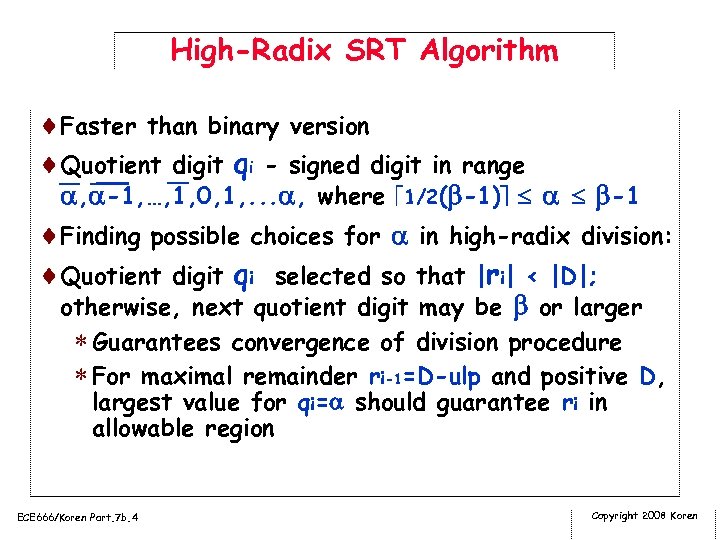 High-Radix SRT Algorithm ¨Faster than binary version ¨Quotient digit qi - signed digit in range , -1, …, 1, 0, 1, . . . , where 1/2( -1) -1 ¨Finding possible choices for in high-radix division: ¨Quotient digit qi selected so that |ri| < |D|; otherwise, next quotient digit may be or larger * Guarantees convergence of division procedure * For maximal remainder ri-1=D-ulp and positive D, largest value for qi= should guarantee ri in allowable region ECE 666/Koren Part. 7 b. 4 Copyright 2008 Koren
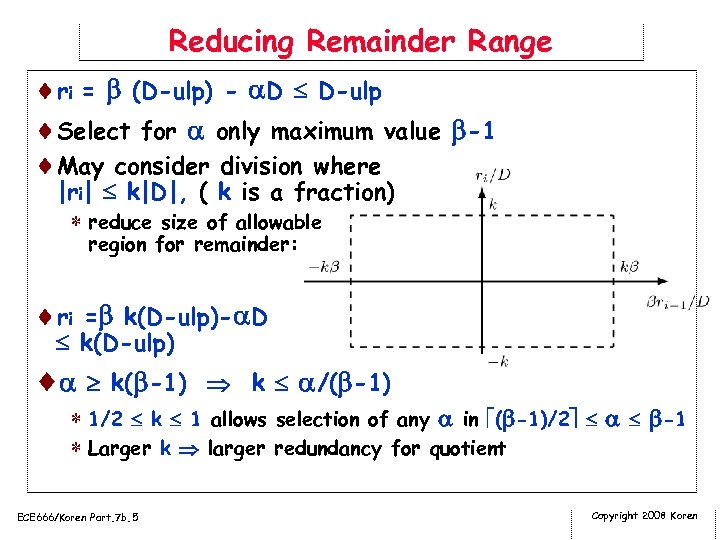 Reducing Remainder Range ¨ri = (D-ulp) - D D-ulp ¨Select for only maximum value -1 ¨May consider division where |ri| k|D|, ( k is a fraction) * reduce size of allowable region for remainder: ¨ri = k(D-ulp)- D k(D-ulp) ¨ k( -1) k /( -1) * 1/2 k 1 allows selection of any in ( -1)/2 -1 * Larger k larger redundancy for quotient ECE 666/Koren Part. 7 b. 5 Copyright 2008 Koren
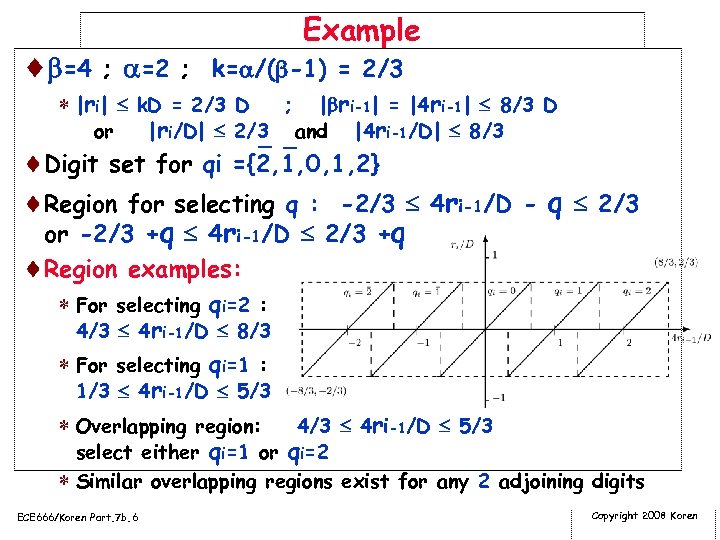 ¨ =4 ; =2 Example ; k= /( -1) = 2/3 * |ri| k. D = 2/3 D ; | ri-1| = |4 ri-1| 8/3 D or |ri/D| 2/3 _and |4 ri-1/D| 8/3 _ ¨Digit set for qi ={2, 1, 0, 1, 2} ¨Region for selecting q : -2/3 4 ri-1/D - q 2/3 or -2/3 +q 4 ri-1/D 2/3 +q ¨Region examples: * For selecting qi=2 : 4/3 4 ri-1/D 8/3 * For selecting qi=1 : 1/3 4 ri-1/D 5/3 * Overlapping region: 4/3 4 ri-1/D 5/3 select either qi=1 or qi=2 * Similar overlapping regions exist for any 2 adjoining digits ECE 666/Koren Part. 7 b. 6 Copyright 2008 Koren
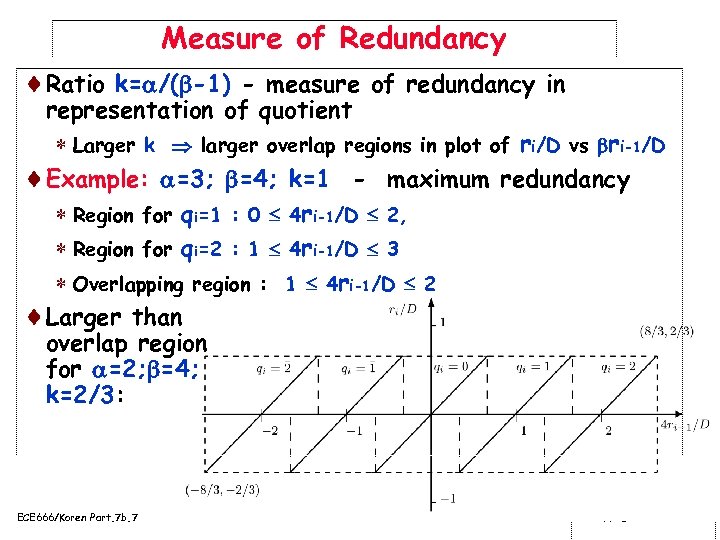 Measure of Redundancy ¨Ratio k= /( -1) - measure of redundancy in representation of quotient * Larger k larger overlap regions in plot of ri/D vs ri-1/D ¨Example: =3; =4; k=1 - maximum redundancy * Region for qi=1 : 0 4 ri-1/D 2, * Region for qi=2 : 1 4 ri-1/D 3 * Overlapping region : 1 4 ri-1/D 2 ¨Larger than overlap region for =2; =4; k=2/3: ECE 666/Koren Part. 7 b. 7 Copyright 2008 Koren
 Implication of Overlap Region ¨Provides choice of comparison constants for partial remainder and divisor * Can be selected to require as few digits as possible * Reducing execution time of comparison step when determining quotient digit ¨Larger larger overlap region larger choice fewer digits ¨On the other hand, larger more D multiples extra hardware and/or time required ¨For given - determining number of bits of partial remainder and divisor to be examined is the most difficult step when developing high-radix SRT * Can be done numerically, analytically, graphically, or by combination of techniques ECE 666/Koren Part. 7 b. 8 Copyright 2008 Koren
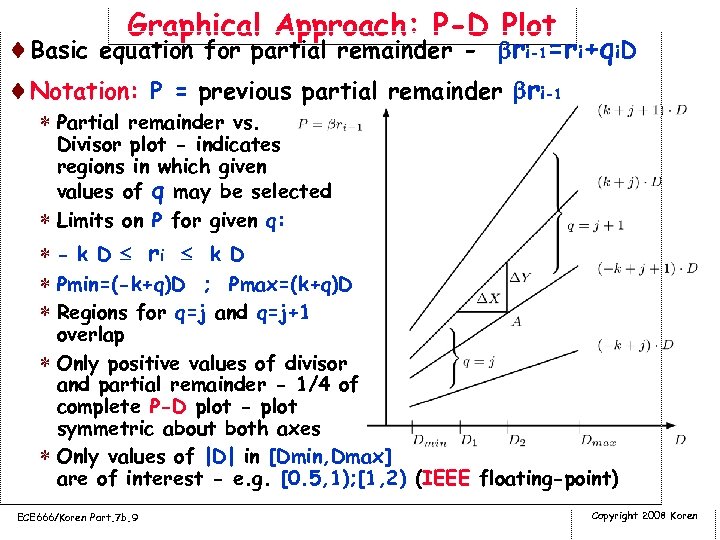 Graphical Approach: P-D Plot ¨Basic equation for partial remainder - ri-1=ri+qi. D ¨Notation: P = previous partial remainder ri-1 * Partial remainder vs. Divisor plot - indicates regions in which given values of q may be selected * Limits on P for given q: * - k D ri k D * Pmin=(-k+q)D ; Pmax=(k+q)D * Regions for q=j and q=j+1 overlap * Only positive values of divisor and partial remainder - 1/4 of complete P-D plot - plot symmetric about both axes * Only values of |D| in [Dmin, Dmax] are of interest - e. g. [0. 5, 1); [1, 2) (IEEE floating-point) ECE 666/Koren Part. 7 b. 9 Copyright 2008 Koren
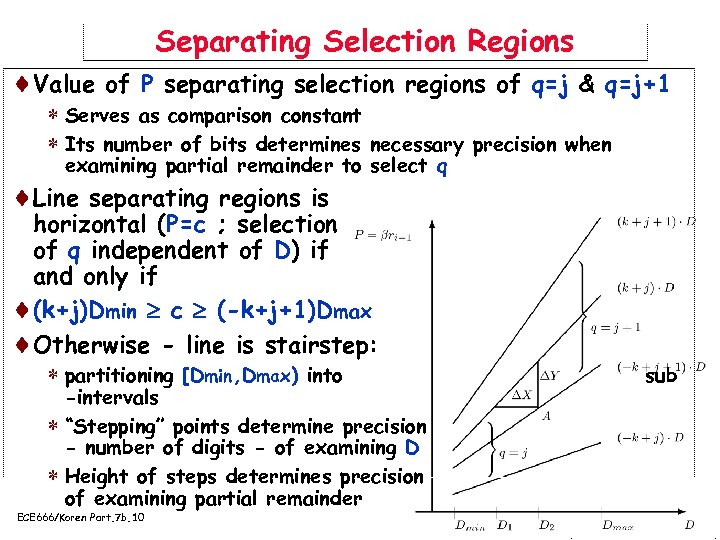 Separating Selection Regions ¨Value of P separating selection regions of q=j & q=j+1 * Serves as comparison constant * Its number of bits determines necessary precision when examining partial remainder to select q ¨Line separating regions is horizontal (P=c ; selection of q independent of D) if and only if ¨(k+j)Dmin c (-k+j+1)Dmax ¨Otherwise - line is stairstep: * partitioning [Dmin, Dmax) into -intervals * “Stepping” points determine precision - number of digits - of examining D * Height of steps determines precision of examining partial remainder ECE 666/Koren Part. 7 b. 10 sub Copyright 2008 Koren
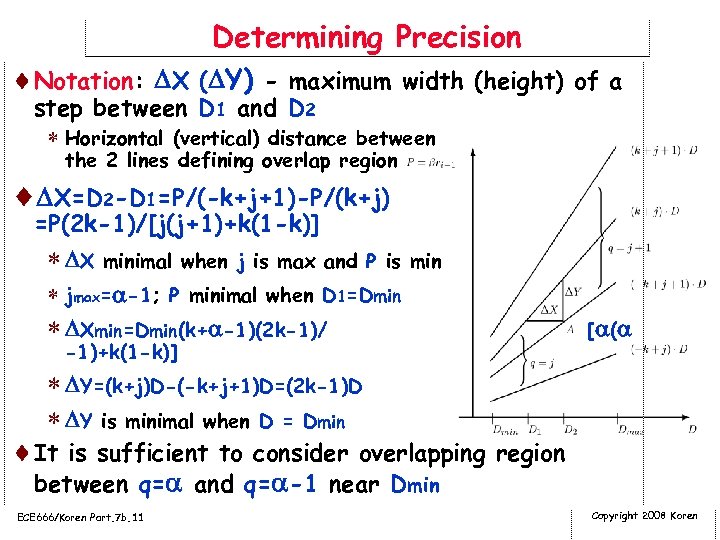 Determining Precision ¨Notation: X ( Y) - maximum width (height) of a step between D 1 and D 2 * Horizontal (vertical) distance between the 2 lines defining overlap region ¨ X=D 2 -D 1=P/(-k+j+1)-P/(k+j) =P(2 k-1)/[j(j+1)+k(1 -k)] * X minimal when j is max and P is min * jmax= -1; P minimal when D 1=Dmin * Xmin=Dmin(k+ -1)(2 k-1)/ -1)+k(1 -k)] [ ( * Y=(k+j)D-(-k+j+1)D=(2 k-1)D * Y is minimal when D = Dmin ¨It is sufficient to consider overlapping region between q= and q= -1 near Dmin ECE 666/Koren Part. 7 b. 11 Copyright 2008 Koren
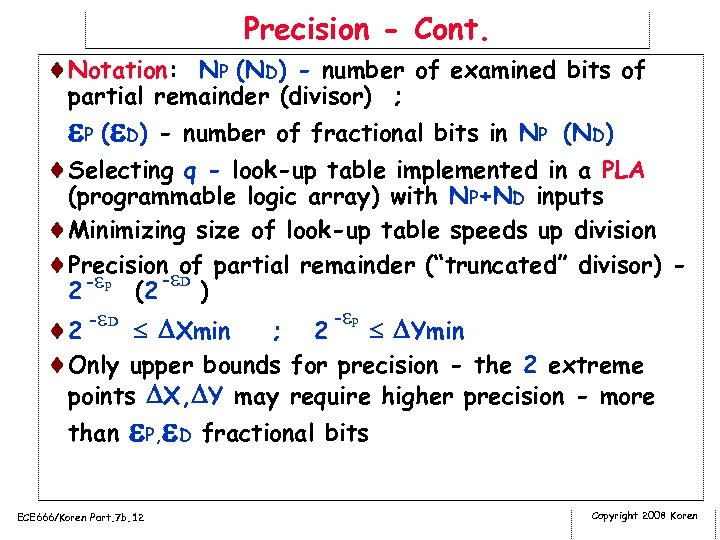 Precision - Cont. ¨Notation: NP (ND) - number of examined bits of partial remainder (divisor) ; P ( D) - number of fractional bits in NP (ND) ¨Selecting q - look-up table implemented in a PLA (programmable logic array) with NP+ND inputs ¨Minimizing size of look-up table speeds up division ¨Precision of partial remainder (“truncated” divisor) - D 2 - p (2 ) - p - D ¨ 2 Xmin ; 2 Ymin ¨Only upper bounds for precision - the 2 extreme points X, Y may require higher precision - more than P, D fractional bits ECE 666/Koren Part. 7 b. 12 Copyright 2008 Koren
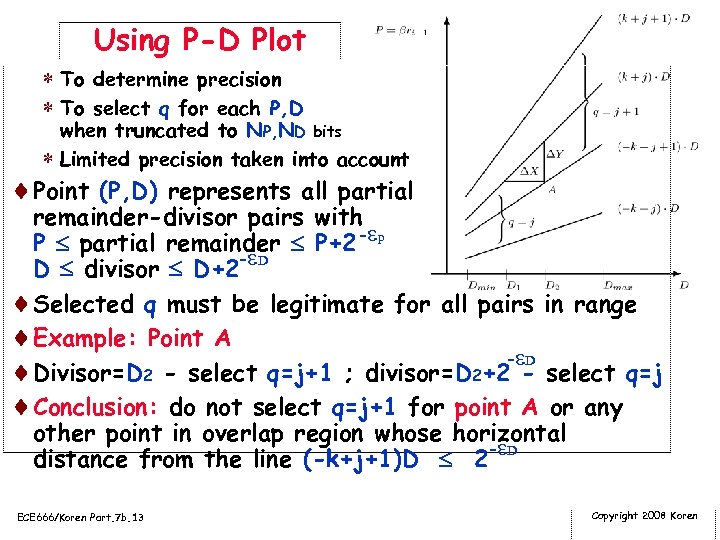 Using P-D Plot * To determine precision * To select q for each P, D when truncated to NP, ND bits * Limited precision taken into account ¨Point (P, D) represents all partial remainder-divisor pairs with P partial remainder P+2 - p D divisor D+2 - D ¨Selected q must be legitimate for all pairs in range ¨Example: Point A - D ¨Divisor=D 2 - select q=j+1 ; divisor=D 2+2 - select q=j ¨Conclusion: do not select q=j+1 for point A or any other point in overlap region whose horizontal distance from the line (-k+j+1)D 2 - D ECE 666/Koren Part. 7 b. 13 Copyright 2008 Koren
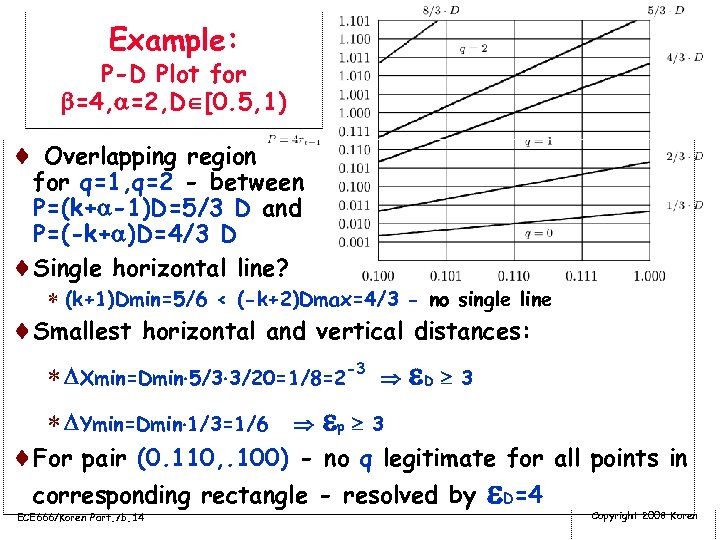 Example: P-D Plot for =4, =2, D [0. 5, 1) ¨ Overlapping region for q=1, q=2 - between P=(k+ -1)D=5/3 D and P=(-k+ )D=4/3 D ¨Single horizontal line? * (k+1)Dmin=5/6 < (-k+2)Dmax=4/3 - no single line ¨Smallest horizontal and vertical distances: * Xmin=Dmin 5/3 3/20=1/8=2 -3 * Ymin=Dmin 1/3=1/6 D 3 p 3 ¨For pair (0. 110, . 100) - no q legitimate for all points in corresponding rectangle - resolved by ECE 666/Koren Part. 7 b. 14 D=4 Copyright 2008 Koren
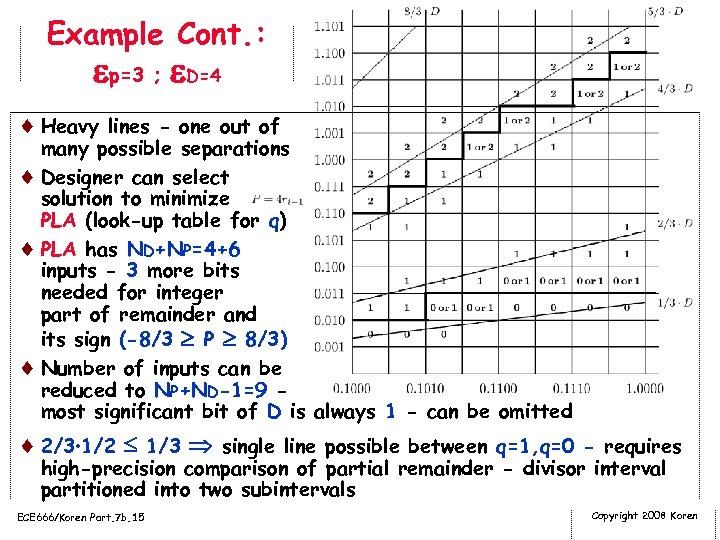 Example Cont. : p=3 ; D=4 ¨ Heavy lines - one out of many possible separations ¨ Designer can select solution to minimize PLA (look-up table for q) ¨ PLA has ND+NP=4+6 inputs - 3 more bits needed for integer part of remainder and its sign (-8/3 P 8/3) ¨ Number of inputs can be reduced to NP+ND-1=9 most significant bit of D is always 1 - can be omitted ¨ 2/3 1/2 1/3 single line possible between q=1, q=0 - requires high-precision comparison of partial remainder - divisor interval partitioned into two subintervals ECE 666/Koren Part. 7 b. 15 Copyright 2008 Koren
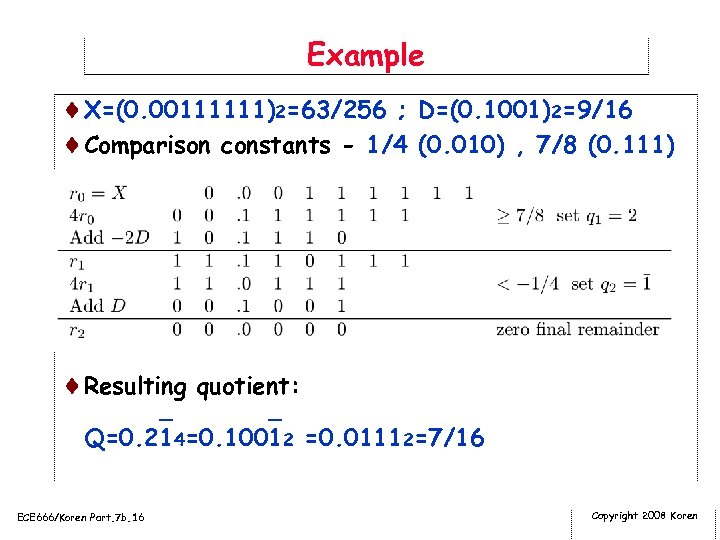 Example ¨X=(0. 00111111)2=63/256 ; D=(0. 1001)2=9/16 ¨Comparison constants - 1/4 (0. 010) , 7/8 (0. 111) ¨Resulting quotient: _ _ Q=0. 214=0. 10012 =0. 01112=7/16 ECE 666/Koren Part. 7 b. 16 Copyright 2008 Koren
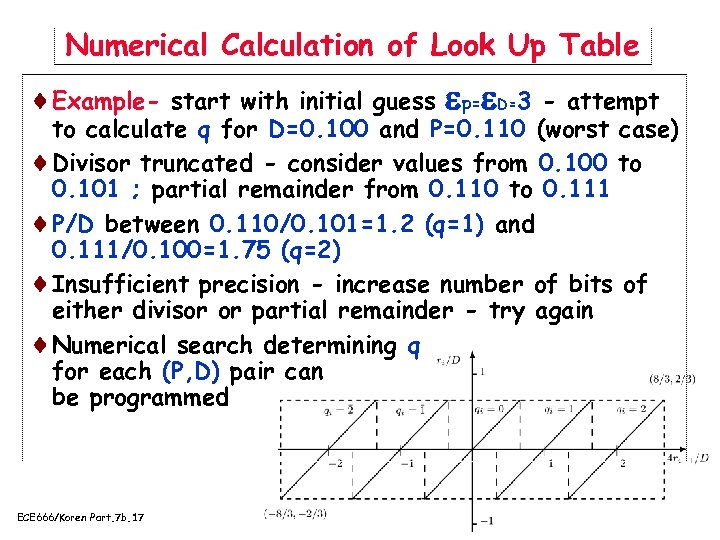 Numerical Calculation of Look Up Table ¨Example- start with initial guess p= D=3 - attempt to calculate q for D=0. 100 and P=0. 110 (worst case) ¨Divisor truncated - consider values from 0. 100 to 0. 101 ; partial remainder from 0. 110 to 0. 111 ¨P/D between 0. 110/0. 101=1. 2 (q=1) and 0. 111/0. 100=1. 75 (q=2) ¨Insufficient precision - increase number of bits of either divisor or partial remainder - try again ¨Numerical search determining q for each (P, D) pair can be programmed ECE 666/Koren Part. 7 b. 17 Copyright 2008 Koren
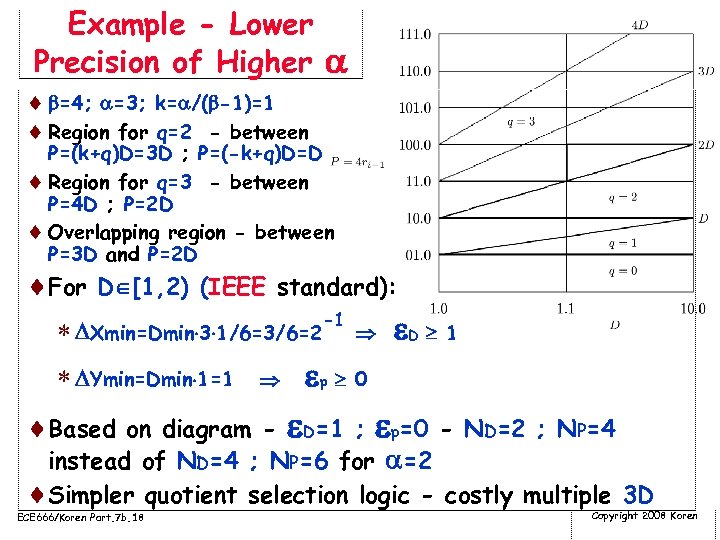 Example - Lower Precision of Higher ¨ =4; =3; k= /( -1)=1 ¨ Region for q=2 - between P=(k+q)D=3 D ; P=(-k+q)D=D ¨ Region for q=3 - between P=4 D ; P=2 D ¨ Overlapping region - between P=3 D and P=2 D ¨For D [1, 2) (IEEE standard): * Xmin=Dmin 3 1/6=3/6=2 -1 * Ymin=Dmin 1=1 ¨Based on diagram - D 1 p 0 D=1 ; p=0 - ND=2 ; NP=4 instead of ND=4 ; NP=6 for =2 ¨Simpler quotient selection logic - costly multiple 3 D ECE 666/Koren Part. 7 b. 18 Copyright 2008 Koren
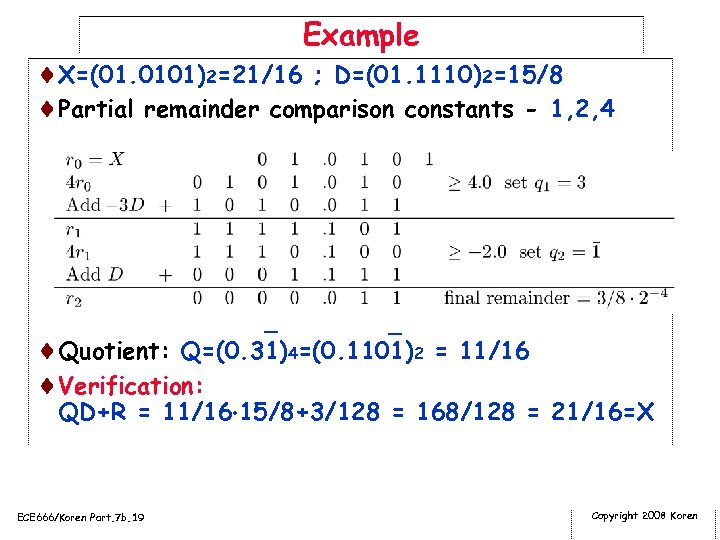 Example ¨X=(01. 0101)2=21/16 ; D=(01. 1110)2=15/8 ¨Partial remainder comparison constants - 1, 2, 4 _ _ ¨Quotient: Q=(0. 31)4=(0. 1101)2 = 11/16 ¨Verification: QD+R = 11/16 15/8+3/128 = 168/128 = 21/16=X ECE 666/Koren Part. 7 b. 19 Copyright 2008 Koren