


 Скачать презентацию UNIVERSITY OF MASSACHUSETTS Dept of Electrical Computer
a39f65afdaacd57753d3c52d5b012548.ppt
- Количество слайдов: 22
 UNIVERSITY OF MASSACHUSETTS Dept. of Electrical & Computer Engineering Digital Computer Arithmetic ECE 666 Part 2 Unconventional Number Systems Israel Koren ECE 666/Koren Part. 2. 1 Copyright 2010 Koren
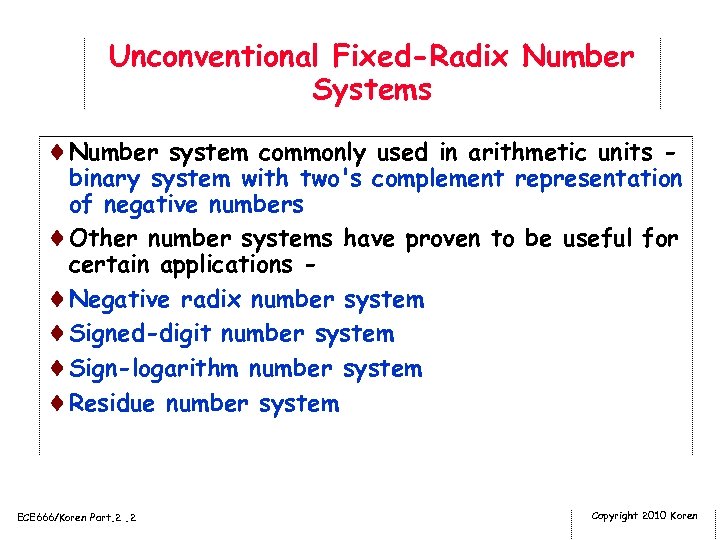 Unconventional Fixed-Radix Number Systems ¨Number system commonly used in arithmetic units - binary system with two's complement representation of negative numbers ¨Other number systems have proven to be useful for certain applications ¨Negative radix number system ¨Signed-digit number system ¨Sign-logarithm number system ¨Residue number system ECE 666/Koren Part. 2. 2 Copyright 2010 Koren
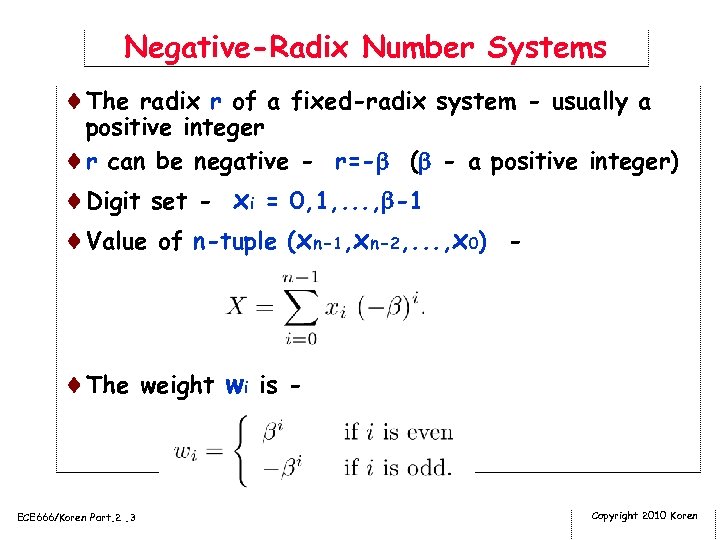 Negative-Radix Number Systems ¨The radix r of a fixed-radix system - usually a positive integer ¨r can be negative - r=- ( - a positive integer) ¨Digit set - xi = 0, 1, . . . , -1 ¨Value of n-tuple (xn-1, xn-2, . . . , x 0) - ¨The weight wi is - ECE 666/Koren Part. 2. 3 Copyright 2010 Koren
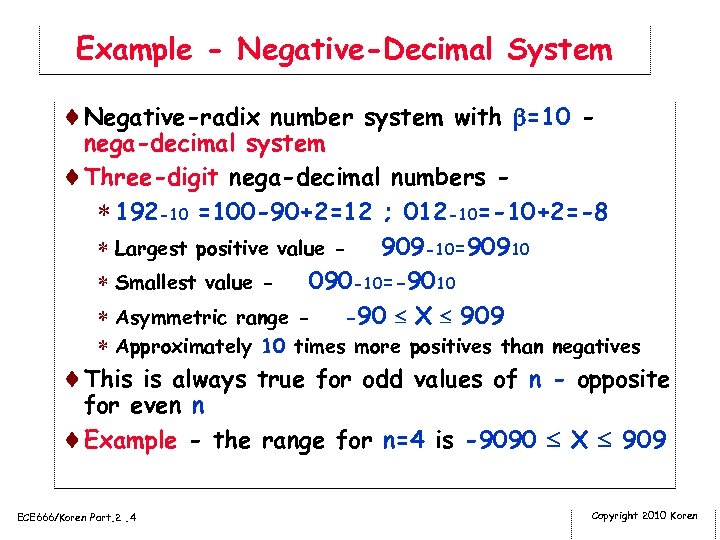 Example - Negative-Decimal System ¨Negative-radix number system with =10 - nega-decimal system ¨Three-digit nega-decimal numbers * 192 -10 =100 -90+2=12 ; 012 -10=-10+2=-8 * Largest positive value - 909 -10=90910 * Smallest value - 090 -10=-9010 * Asymmetric range - -90 X 909 * Approximately 10 times more positives than negatives ¨This is always true for odd values of n - opposite for even n ¨Example - the range for n=4 is -9090 X 909 ECE 666/Koren Part. 2. 4 Copyright 2010 Koren
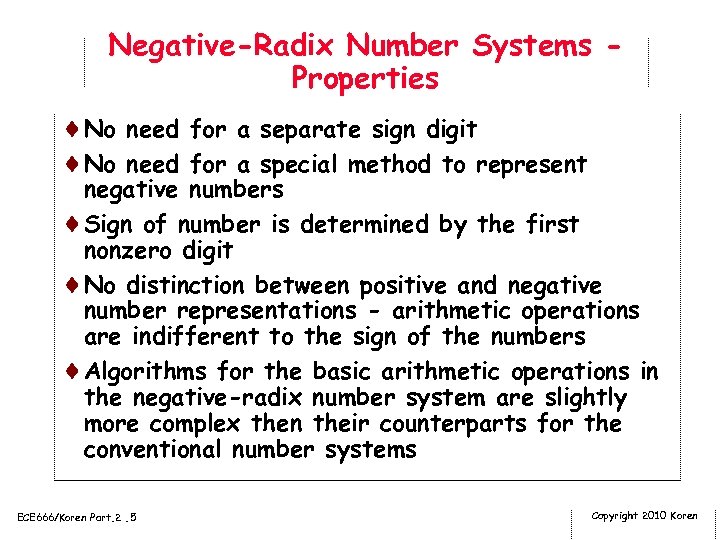 Negative-Radix Number Systems Properties ¨No need for a separate sign digit ¨No need for a special method to represent negative numbers ¨Sign of number is determined by the first nonzero digit ¨No distinction between positive and negative number representations - arithmetic operations are indifferent to the sign of the numbers ¨Algorithms for the basic arithmetic operations in the negative-radix number system are slightly more complex then their counterparts for the conventional number systems ECE 666/Koren Part. 2. 5 Copyright 2010 Koren
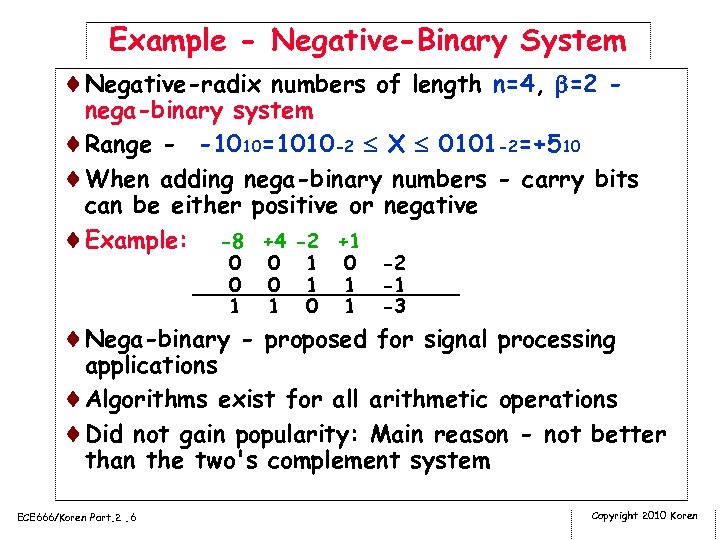 Example - Negative-Binary System ¨Negative-radix numbers of length n=4, =2 - nega-binary system ¨Range - -1010=1010 -2 X 0101 -2=+510 ¨When adding nega-binary numbers - carry bits can be either positive or negative ¨Example: -8 +4 -2 +1 0 0 1 1 -2 -1 -3 ¨Nega-binary - proposed for signal processing applications ¨Algorithms exist for all arithmetic operations ¨Did not gain popularity: Main reason - not better than the two's complement system ECE 666/Koren Part. 2. 6 Copyright 2010 Koren
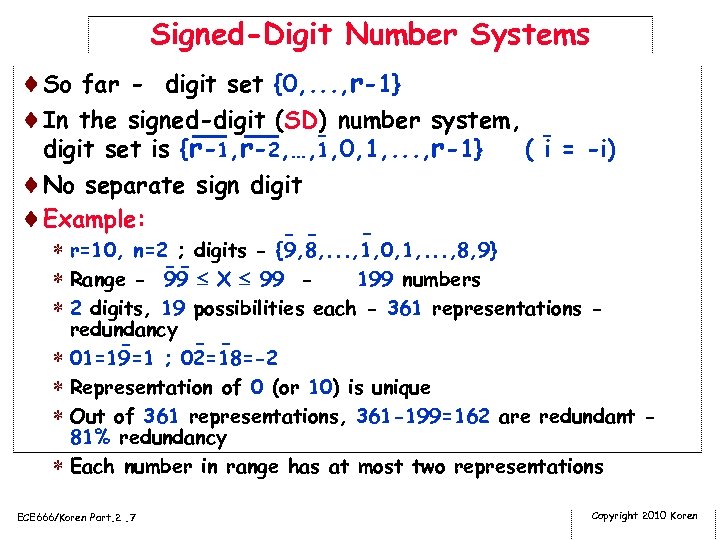 Signed-Digit Number Systems ¨So far - digit set {0, . . . , r-1} ¨In the signed-digit (SD) number system, __ __ digit set is {r-1, r-2, …, 1, 0, 1, . . . , r-1} ( i = -i) ¨No separate sign digit ¨Example: - * r=10, n=2 ; digits - {9, 8, . . . , 1, 0, 1, . . . , 8, 9} -* Range - 99 X 99 199 numbers * 2 digits, 19 possibilities each - 361 representations - redundancy - - ; 02=18=-2 * 01=19=1 * Representation of 0 (or 10) is unique * Out of 361 representations, 361 -199=162 are redundant 81% redundancy * Each number in range has at most two representations ECE 666/Koren Part. 2. 7 Copyright 2010 Koren
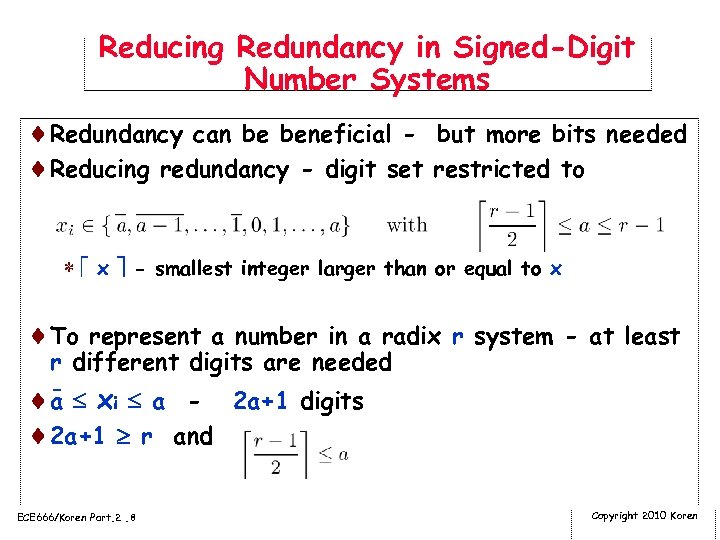 Reducing Redundancy in Signed-Digit Number Systems ¨Redundancy can be beneficial - but more bits needed ¨Reducing redundancy - digit set restricted to * x - smallest integer larger than or equal to x ¨To represent a number in a radix r system - at least r different digits are needed ¨a xi a - 2 a+1 digits ¨ 2 a+1 r and ECE 666/Koren Part. 2. 8 Copyright 2010 Koren
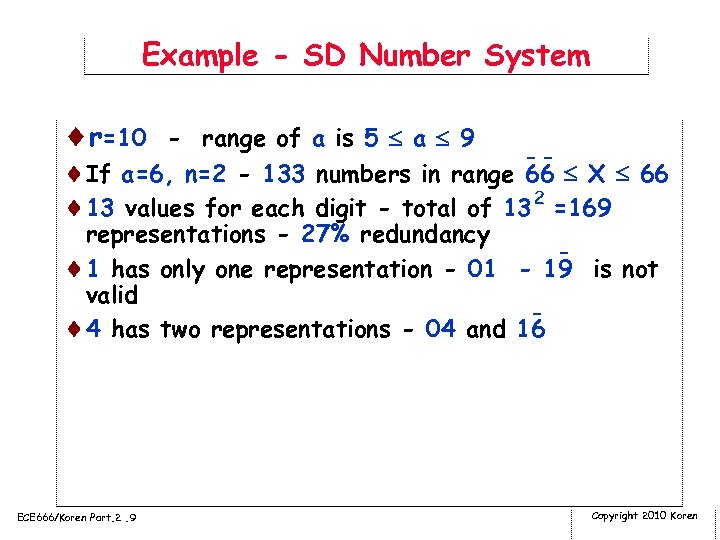 Example - SD Number System ¨r=10 - range of a is 5 a 9 -¨If a=6, n=2 - 133 numbers in range 66 X 66 2 ¨ 13 values for each digit - total of 13 =169 representations - 27% redundancy ¨ 1 has only one representation - 01 - 19 is not valid ¨ 4 has two representations - 04 and 16 ECE 666/Koren Part. 2. 9 Copyright 2010 Koren
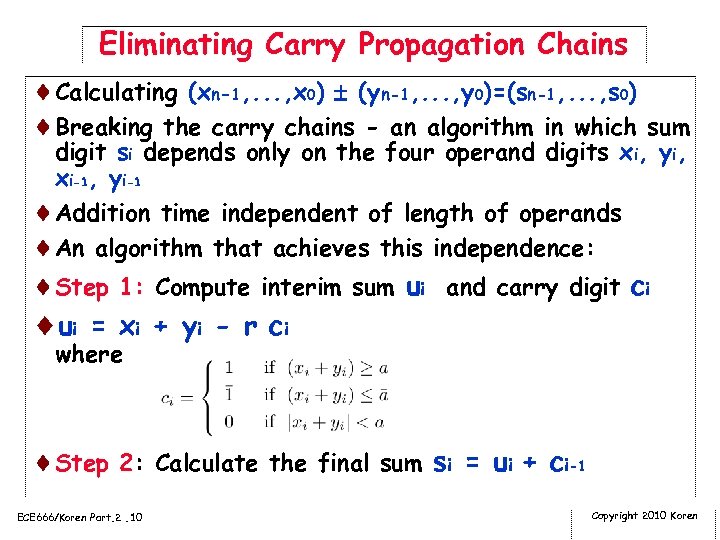 Eliminating Carry Propagation Chains ¨Calculating (xn-1, . . . , x 0) (yn-1, . . . , y 0)=(sn-1, . . . , s 0) ¨Breaking the carry chains - an algorithm in which sum digit si depends only on the four operand digits xi, yi, xi-1, yi-1 ¨Addition time independent of length of operands ¨An algorithm that achieves this independence: ¨Step 1: Compute interim sum ui and carry digit ci ¨ ui = x i + y i - r c i where ¨Step 2: Calculate the final sum si = ui + ci-1 ECE 666/Koren Part. 2. 10 Copyright 2010 Koren
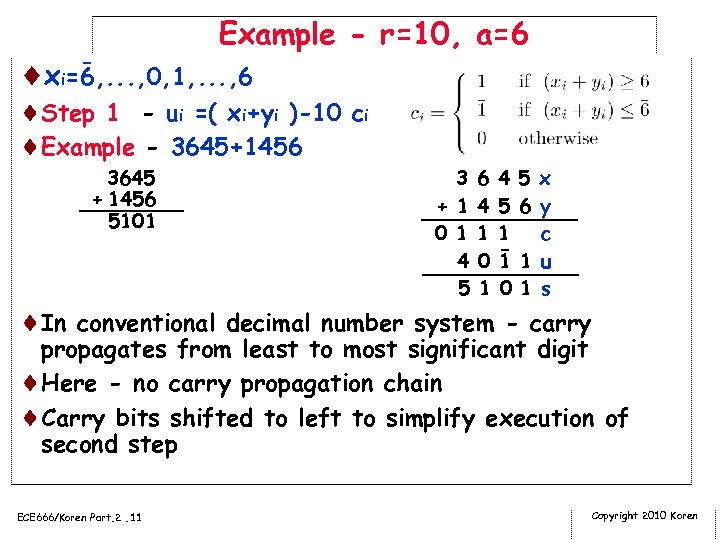 - Example - r=10, a=6 ¨xi=6, . . . , 0, 1, . . . , 6 ¨Step 1 - ui =( xi+yi )-10 ci ¨Example - 3645+1456 3645 + 1456 5101 3 + 1 0 1 4 5 6 4 1 0 1 4 5 1 1 0 5 6 1 1 x y c u s ¨In conventional decimal number system - carry propagates from least to most significant digit ¨Here - no carry propagation chain ¨Carry bits shifted to left to simplify execution of second step ECE 666/Koren Part. 2. 11 Copyright 2010 Koren
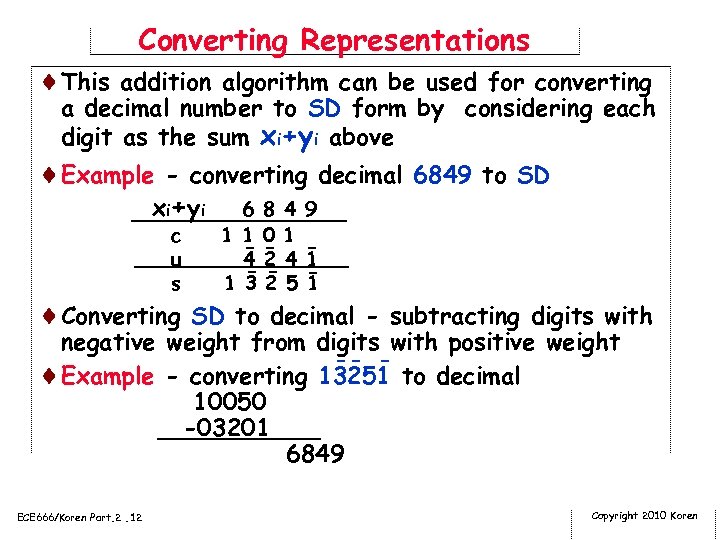 Converting Representations ¨This addition algorithm can be used for converting a decimal number to SD form by considering each digit as the sum xi+yi above ¨Example - converting decimal 6849 to SD xi+yi 6 8 4 9 c 1 1 0 1 -- u 4 2 4 1 -- s 1 3 2 5 1 ¨Converting SD to decimal - subtracting digits with negative weight from digits with positive weight -- ¨Example - converting 13251 to decimal 10050 -03201 6849 ECE 666/Koren Part. 2. 12 Copyright 2010 Koren
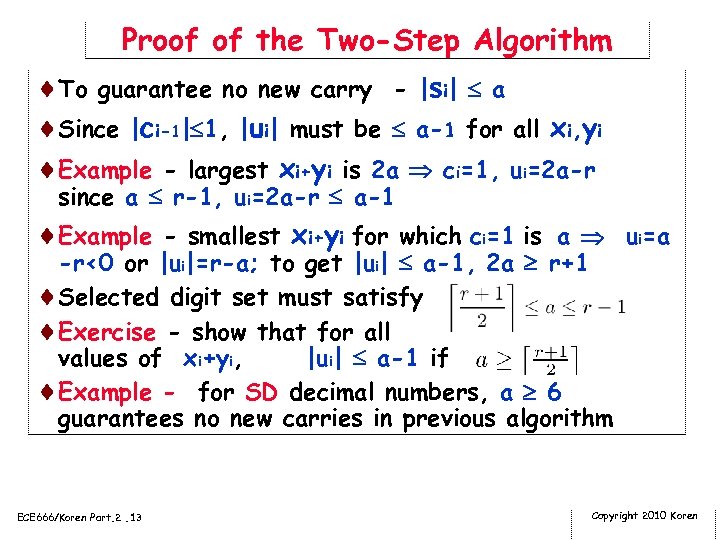 Proof of the Two-Step Algorithm ¨To guarantee no new carry - |si| a ¨Since |ci-1| 1, |ui| must be a-1 for all xi, yi ¨Example - largest xi+yi is 2 a ci=1, ui=2 a-r since a r-1, ui=2 a-r a-1 ¨Example - smallest xi+yi for which ci=1 is a ui=a -r<0 or |ui|=r-a; to get |ui| a-1, 2 a r+1 ¨Selected digit set must satisfy ¨Exercise - show that for all values of xi+yi, |ui| a-1 if ¨Example - for SD decimal numbers, a 6 guarantees no new carries in previous algorithm ECE 666/Koren Part. 2. 13 Copyright 2010 Koren
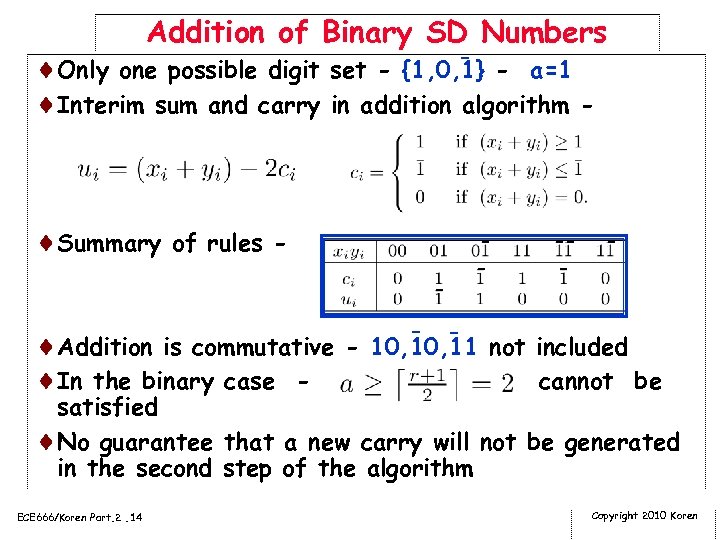 Addition of Binary SD Numbers ¨Only one possible digit set - {1, 0, 1} - a=1 ¨Interim sum and carry in addition algorithm - ¨Summary of rules - - - ¨Addition is commutative - 10, 11 not included ¨In the binary case cannot be satisfied ¨No guarantee that a new carry will not be generated in the second step of the algorithm ECE 666/Koren Part. 2. 14 Copyright 2010 Koren
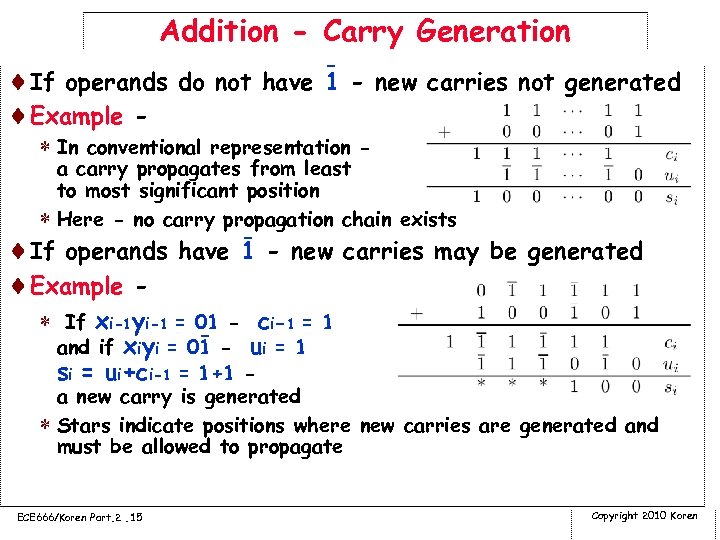 Addition - Carry Generation - ¨If operands do not have 1 - new carries not generated ¨Example * In conventional representation - a carry propagates from least to most significant position * Here - no carry propagation chain exists ¨If operands have 1 - new carries may be generated ¨Example * If xi-1 yi-1 = 01 - ci-1 = 1 and if xiyi = 01 - ui = 1 si = ui+ci-1 = 1+1 - a new carry is generated * Stars indicate positions where new carries are generated and must be allowed to propagate ECE 666/Koren Part. 2. 15 Copyright 2010 Koren
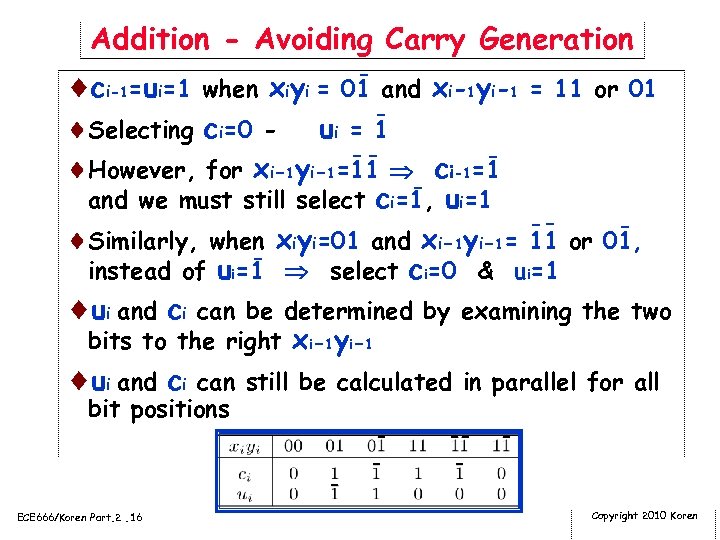 Addition - Avoiding Carry Generation ¨ci-1=ui=1 - when xiyi = 01 and xi-1 yi-1 = 11 or 01 ui = 1 -- ¨Selecting ci=0 ¨However, for xi-1 yi-1=11 ci-1=1 - ui=1 and we must still select ci=1, -¨Similarly, when xiyi=01 and xi-1 yi-1= 11 or 01, instead of ui=1 select ci=0 & ui=1 ¨ui and ci can be determined by examining the two bits to the right xi-1 yi-1 ¨ui and ci can still be calculated in parallel for all bit positions - ECE 666/Koren Part. 2. 16 -- - - Copyright 2010 Koren
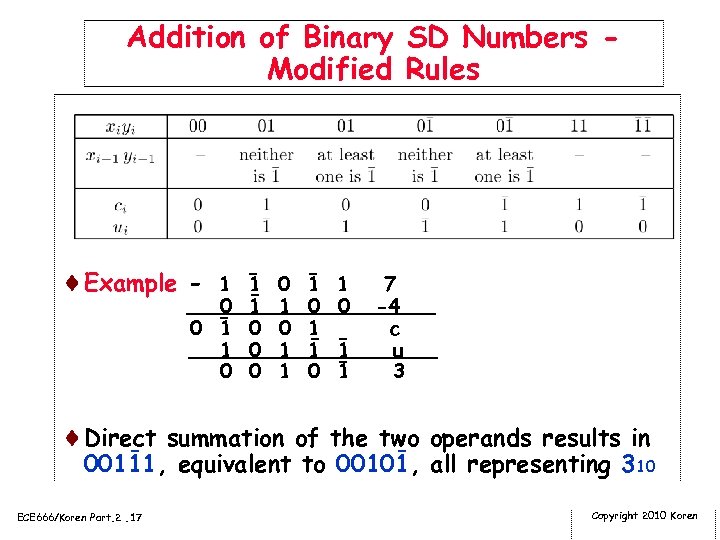 Addition of Binary SD Numbers Modified Rules ¨Example - 1 1 0 - 0 1 0 1 0 0 1 1 1 0 0 1 - 1 1 0 1 7 -4 c u 3 ¨Direct summation of the two operands results in - 00111, equivalent to 00101, all representing 310 ECE 666/Koren Part. 2. 17 Copyright 2010 Koren
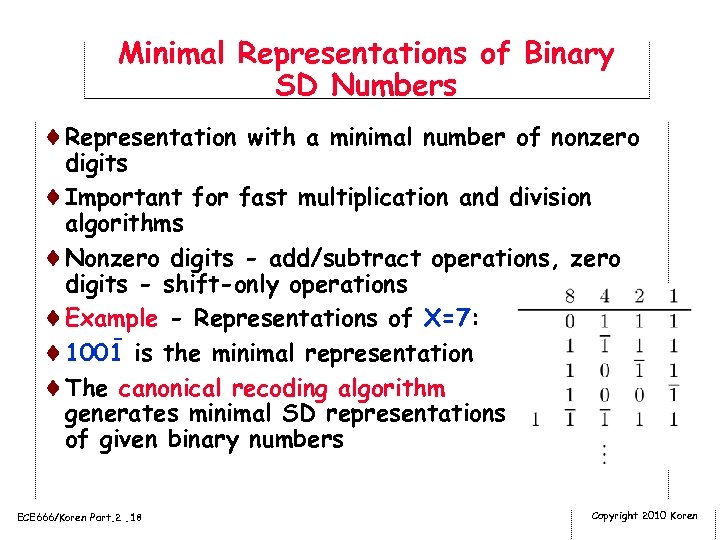 Minimal Representations of Binary SD Numbers ¨Representation with a minimal number of nonzero digits ¨Important for fast multiplication and division algorithms ¨Nonzero digits - add/subtract operations, zero digits - shift-only operations ¨Example - Representations of X=7: ¨ 1001 is the minimal representation ¨The canonical recoding algorithm generates minimal SD representations of given binary numbers ECE 666/Koren Part. 2. 18 Copyright 2010 Koren
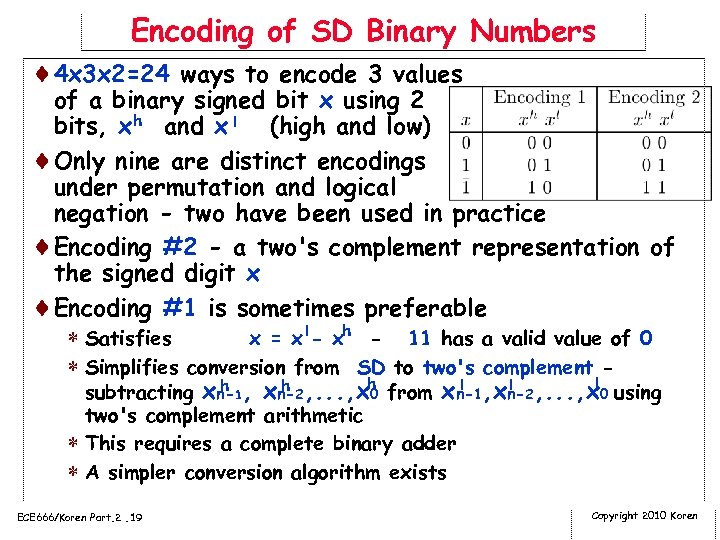 Encoding of SD Binary Numbers ¨ 4 x 3 x 2=24 ways to encode 3 values of a binary signed bit x using 2 bits, x h and x l (high and low) ¨Only nine are distinct encodings under permutation and logical negation - two have been used in practice ¨Encoding #2 - a two's complement representation of the signed digit x ¨Encoding #1 is sometimes preferable * Satisfies x = x l - xh - 11 has a valid value of 0 * Simplifies conversion from SD to two's complement l l l h h subtracting xn-1, xn-2, . . . , xh from xn-1, xn-2, . . . , x 0 using 0 two's complement arithmetic * This requires a complete binary adder * A simpler conversion algorithm exists ECE 666/Koren Part. 2. 19 Copyright 2010 Koren
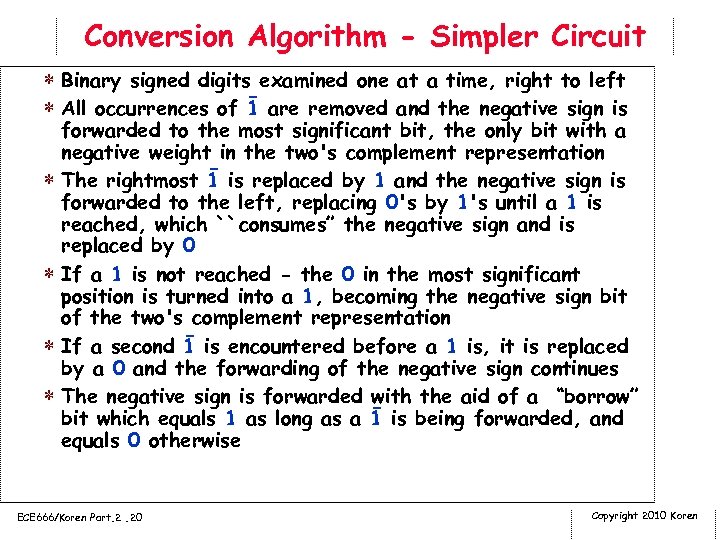 Conversion Algorithm - Simpler Circuit * Binary signed digits examined one at a time, right to left * All occurrences of - are removed and the negative sign is 1 forwarded to the most significant bit, the only bit with a negative weight in the two's complement representation * The rightmost 1 is replaced by 1 and the negative sign is forwarded to the left, replacing 0's by 1's until a 1 is reached, which ``consumes” the negative sign and is replaced by 0 * If a 1 is not reached - the 0 in the most significant position is turned into a 1, becoming the negative sign bit of the two's complement representation * If a second 1 is encountered before a 1 is, it is replaced by a 0 and the forwarding of the negative sign continues * The negative sign is forwarded with the aid of a “borrow” bit which equals 1 as long as a 1 is being forwarded, and equals 0 otherwise ECE 666/Koren Part. 2. 20 Copyright 2010 Koren
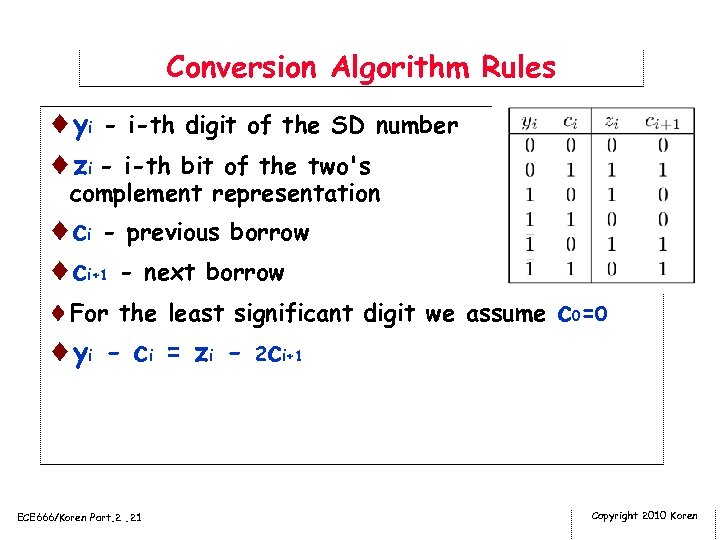 Conversion Algorithm Rules ¨yi - i-th digit of the SD number ¨zi - i-th bit of the two's complement representation ¨ci - previous borrow ¨ci+1 - next borrow ¨For the least significant digit we assume c 0=0 ¨yi - ci = zi - 2 ci+1 ECE 666/Koren Part. 2. 21 Copyright 2010 Koren
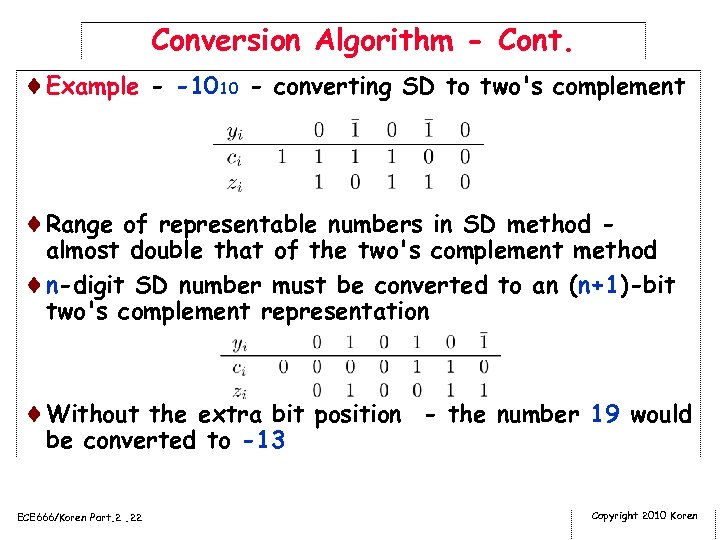 Conversion Algorithm - Cont. ¨Example - -1010 - converting SD to two's complement ¨Range of representable numbers in SD method - almost double that of the two's complement method ¨n-digit SD number must be converted to an (n+1)-bit two's complement representation ¨Without the extra bit position - the number 19 would be converted to -13 ECE 666/Koren Part. 2. 22 Copyright 2010 Koren