


 Скачать презентацию University of Kansas School of Engineering WIRELESS
b7a90ab23c3ba0340355e53cf7528d9a.ppt
- Количество слайдов: 29
 University of Kansas | School of Engineering WIRELESS USB: WIMEDIA® UWB Deepak Chellamani 2308366 cdeepak@ku. edu EECS 766 Technology Presentation 05/06/2008 Department of Electrical Engineering and Computer Science
 University of Kansas | School of Engineering ABSTRACT Wireless USB (WUSB) is a growing short range wireless mode of connectivity among devices in WPAN. WUSB is rapidly becoming the substitute for wired USB without cables. Certified WUSB promoter group Wi. Media® Alliance develop specifications to standardize the technology by providing Ultra Wideband radio platforms for WUSB implementations. This presentation provides a descriptive study of WUSB in context of its underlying physical and MAC layers, evolution, architecture, protocol stack and future prospects of the technology. Department of Electrical Engineering and Computer Science Wireless USB: Wi. Media® UWB 2
 University of Kansas | School of Engineering OUTLINE • • • Introduction Wi. Media® Alliance Ultra wideband Technology UWB Physical Layer MAC Layer Higher Layers WUSB Architecture WUSB Protocol Stack Recent Developments and Future prospects Conclusion Department of Electrical Engineering and Computer Science Wireless USB: Wi. Media® UWB 3
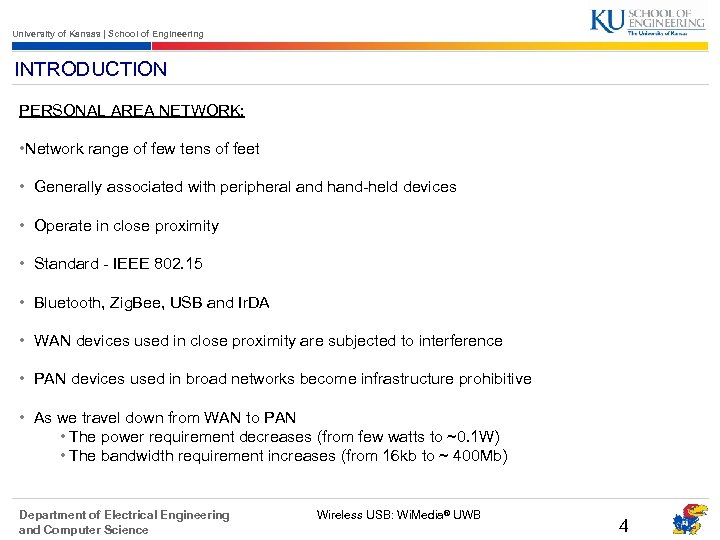 University of Kansas | School of Engineering INTRODUCTION PERSONAL AREA NETWORK: • Network range of few tens of feet • Generally associated with peripheral and hand-held devices • Operate in close proximity • Standard - IEEE 802. 15 • Bluetooth, Zig. Bee, USB and Ir. DA • WAN devices used in close proximity are subjected to interference • PAN devices used in broad networks become infrastructure prohibitive • As we travel down from WAN to PAN • The power requirement decreases (from few watts to ~0. 1 W) • The bandwidth requirement increases (from 16 kb to ~ 400 Mb) Department of Electrical Engineering and Computer Science Wireless USB: Wi. Media® UWB 4
 University of Kansas | School of Engineering WIMEDIA® ALLIANCE • An ISO-published radio platform standard for high-speed wireless transmission in UWB • Wi. Media® Alliance develop and maintain: • PHY and MAC Layers • Certifications test • Design pan radios and protocol stacks by toolkit approach • Sense and prevent collision with higher priority transmission is an important issue since these devices operate at extremely close proximities • While sensing Radar signal which has higher priority – Wi. Media device will switch off i. e. power level adjusted to -70 d. Bm • While sensing Wi. Max devices in following ranges • Power level adjusted to -80 d. Bm @ 36 cm • Power level adjusted to -70 d. Bm @ 22 m • Ignore if distance > 22 m Department of Electrical Engineering and Computer Science Wireless USB: Wi. Media® UWB 5
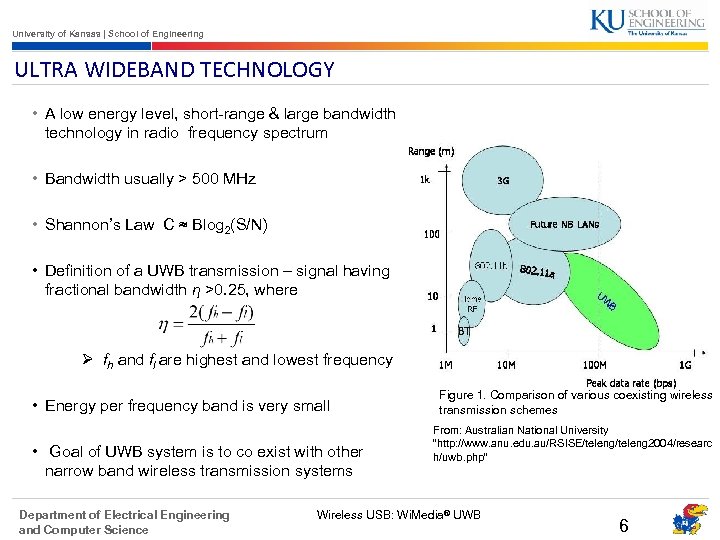 University of Kansas | School of Engineering ULTRA WIDEBAND TECHNOLOGY • A low energy level, short-range & large bandwidth technology in radio frequency spectrum • Bandwidth usually > 500 MHz • Shannon’s Law C ≈ Blog 2(S/N) • Definition of a UWB transmission – signal having fractional bandwidth η >0. 25, where Ø fh and fl are highest and lowest frequency • Energy per frequency band is very small • Goal of UWB system is to co exist with other narrow band wireless transmission systems Department of Electrical Engineering and Computer Science Figure 1. Comparison of various coexisting wireless transmission schemes From: Australian National University “http: //www. anu. edu. au/RSISE/teleng 2004/researc h/uwb. php” Wireless USB: Wi. Media® UWB 6
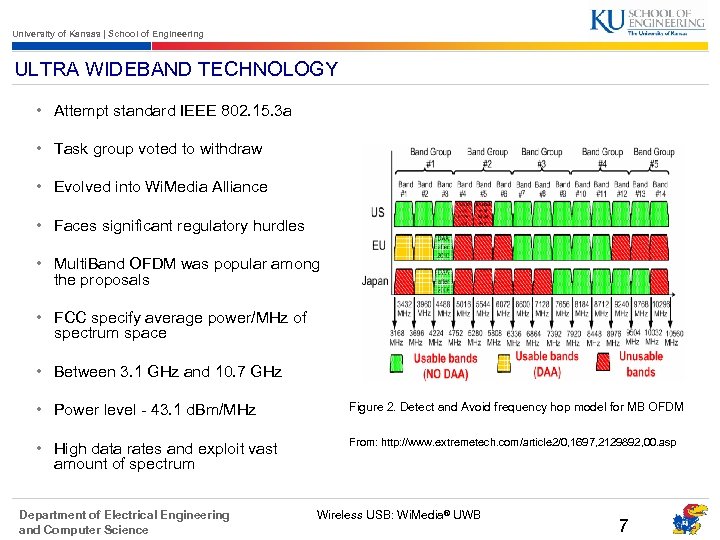 University of Kansas | School of Engineering ULTRA WIDEBAND TECHNOLOGY • Attempt standard IEEE 802. 15. 3 a • Task group voted to withdraw • Evolved into Wi. Media Alliance • Faces significant regulatory hurdles • Multi. Band OFDM was popular among the proposals • FCC specify average power/MHz of spectrum space • Between 3. 1 GHz and 10. 7 GHz • Power level - 43. 1 d. Bm/MHz Figure 2. Detect and Avoid frequency hop model for MB OFDM • High data rates and exploit vast amount of spectrum From: http: //www. extremetech. com/article 2/0, 1697, 2129892, 00. asp Department of Electrical Engineering and Computer Science Wireless USB: Wi. Media® UWB 7
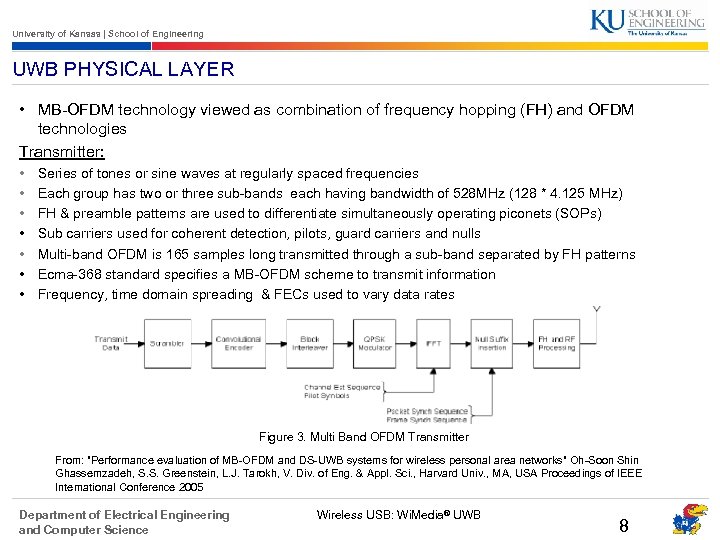 University of Kansas | School of Engineering UWB PHYSICAL LAYER • MB-OFDM technology viewed as combination of frequency hopping (FH) and OFDM technologies Transmitter: • • Series of tones or sine waves at regularly spaced frequencies Each group has two or three sub-bands each having bandwidth of 528 MHz (128 * 4. 125 MHz) FH & preamble patterns are used to differentiate simultaneously operating piconets (SOPs) Sub carriers used for coherent detection, pilots, guard carriers and nulls Multi-band OFDM is 165 samples long transmitted through a sub-band separated by FH patterns Ecma-368 standard specifies a MB-OFDM scheme to transmit information Frequency, time domain spreading & FECs used to vary data rates Figure 3. Multi Band OFDM Transmitter From: "Performance evaluation of MB-OFDM and DS-UWB systems for wireless personal area networks" Oh-Soon Shin Ghassemzadeh, S. S. Greenstein, L. J. Tarokh, V. Div. of Eng. & Appl. Sci. , Harvard Univ. , MA, USA Proceedings of IEEE International Conference 2005 Department of Electrical Engineering and Computer Science Wireless USB: Wi. Media® UWB 8
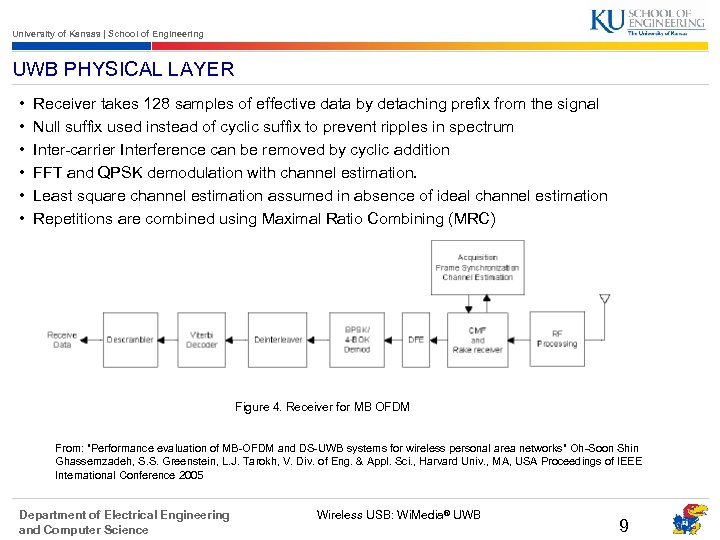 University of Kansas | School of Engineering UWB PHYSICAL LAYER • • • Receiver takes 128 samples of effective data by detaching prefix from the signal Null suffix used instead of cyclic suffix to prevent ripples in spectrum Inter-carrier Interference can be removed by cyclic addition FFT and QPSK demodulation with channel estimation. Least square channel estimation assumed in absence of ideal channel estimation Repetitions are combined using Maximal Ratio Combining (MRC) Figure 4. Receiver for MB OFDM From: "Performance evaluation of MB-OFDM and DS-UWB systems for wireless personal area networks" Oh-Soon Shin Ghassemzadeh, S. S. Greenstein, L. J. Tarokh, V. Div. of Eng. & Appl. Sci. , Harvard Univ. , MA, USA Proceedings of IEEE International Conference 2005 Department of Electrical Engineering and Computer Science Wireless USB: Wi. Media® UWB 9
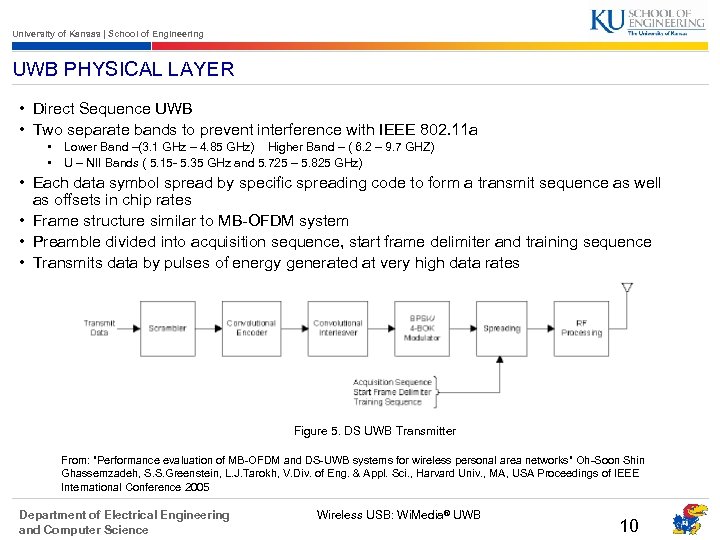 University of Kansas | School of Engineering UWB PHYSICAL LAYER • Direct Sequence UWB • Two separate bands to prevent interference with IEEE 802. 11 a • • Lower Band –(3. 1 GHz – 4. 85 GHz) Higher Band – ( 6. 2 – 9. 7 GHZ) U – NII Bands ( 5. 15 - 5. 35 GHz and 5. 725 – 5. 825 GHz) • Each data symbol spread by specific spreading code to form a transmit sequence as well as offsets in chip rates • Frame structure similar to MB-OFDM system • Preamble divided into acquisition sequence, start frame delimiter and training sequence • Transmits data by pulses of energy generated at very high data rates Figure 5. DS UWB Transmitter From: "Performance evaluation of MB-OFDM and DS-UWB systems for wireless personal area networks" Oh-Soon Shin Ghassemzadeh, S. S. Greenstein, L. J. Tarokh, V. Div. of Eng. & Appl. Sci. , Harvard Univ. , MA, USA Proceedings of IEEE International Conference 2005 Department of Electrical Engineering and Computer Science Wireless USB: Wi. Media® UWB 10
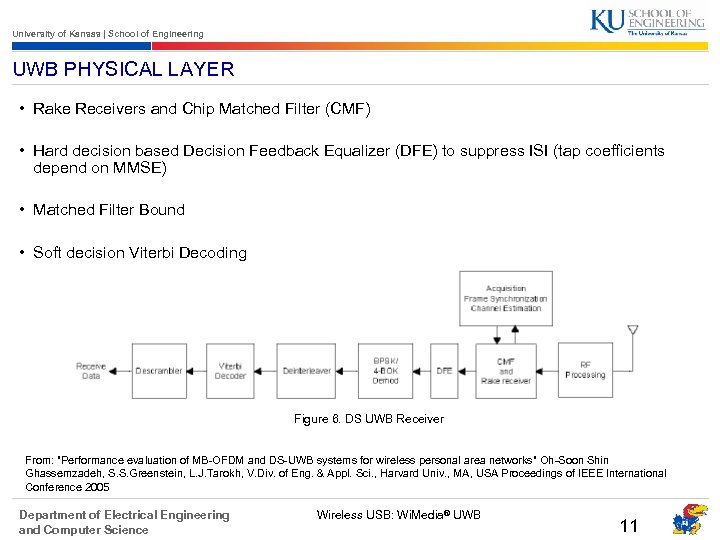 University of Kansas | School of Engineering UWB PHYSICAL LAYER • Rake Receivers and Chip Matched Filter (CMF) • Hard decision based Decision Feedback Equalizer (DFE) to suppress ISI (tap coefficients depend on MMSE) • Matched Filter Bound • Soft decision Viterbi Decoding Figure 6. DS UWB Receiver From: "Performance evaluation of MB-OFDM and DS-UWB systems for wireless personal area networks" Oh-Soon Shin Ghassemzadeh, S. S. Greenstein, L. J. Tarokh, V. Div. of Eng. & Appl. Sci. , Harvard Univ. , MA, USA Proceedings of IEEE International Conference 2005 Department of Electrical Engineering and Computer Science Wireless USB: Wi. Media® UWB 11
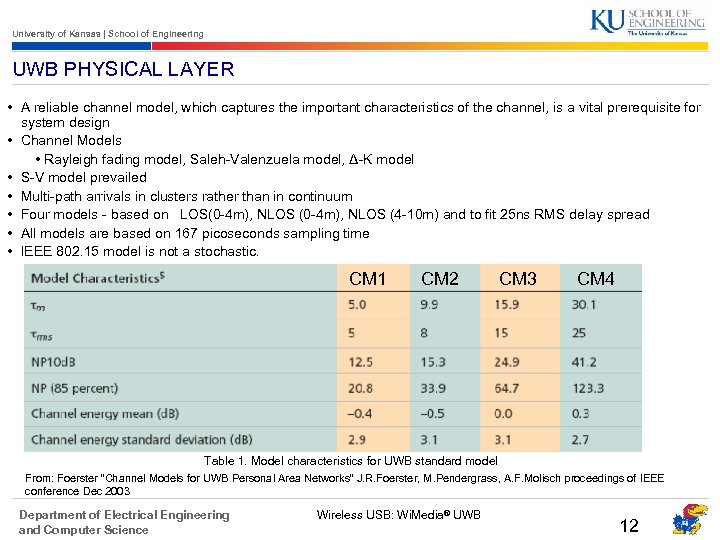 University of Kansas | School of Engineering UWB PHYSICAL LAYER • A reliable channel model, which captures the important characteristics of the channel, is a vital prerequisite for system design • Channel Models • Rayleigh fading model, Saleh-Valenzuela model, Δ-K model • S-V model prevailed • Multi-path arrivals in clusters rather than in continuum • Four models - based on LOS(0 -4 m), NLOS (4 -10 m) and to fit 25 ns RMS delay spread • All models are based on 167 picoseconds sampling time • IEEE 802. 15 model is not a stochastic. CM 1 CM 2 CM 3 CM 4 Table 1. Model characteristics for UWB standard model From: Foerster “Channel Models for UWB Personal Area Networks” J. R. Foerster, M. Pendergrass, A. F. Molisch proceedings of IEEE conference Dec 2003 Department of Electrical Engineering and Computer Science Wireless USB: Wi. Media® UWB 12
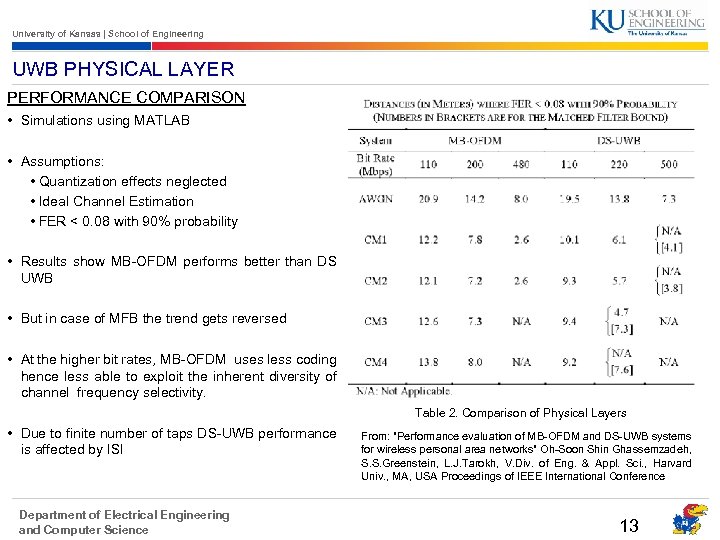 University of Kansas | School of Engineering UWB PHYSICAL LAYER PERFORMANCE COMPARISON • Simulations using MATLAB • Assumptions: • Quantization effects neglected • Ideal Channel Estimation • FER < 0. 08 with 90% probability • Results show MB-OFDM performs better than DS UWB • But in case of MFB the trend gets reversed • At the higher bit rates, MB-OFDM uses less coding hence less able to exploit the inherent diversity of channel frequency selectivity. Table 2. Comparison of Physical Layers • Due to finite number of taps DS-UWB performance is affected by ISI Department of Electrical Engineering and Computer Science From: "Performance evaluation of MB-OFDM and DS-UWB systems for wireless personal area networks" Oh-Soon Shin Ghassemzadeh, S. S. Greenstein, L. J. Tarokh, V. Div. of Eng. & Appl. Sci. , Harvard Univ. , MA, USA Proceedings of IEEE International Conference 13
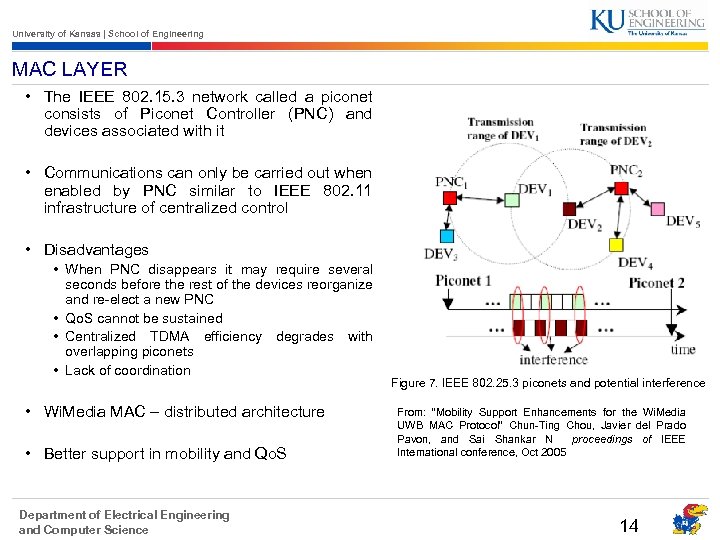 University of Kansas | School of Engineering MAC LAYER • The IEEE 802. 15. 3 network called a piconet consists of Piconet Controller (PNC) and devices associated with it • Communications can only be carried out when enabled by PNC similar to IEEE 802. 11 infrastructure of centralized control • Disadvantages • When PNC disappears it may require several seconds before the rest of the devices reorganize and re-elect a new PNC • Qo. S cannot be sustained • Centralized TDMA efficiency degrades with overlapping piconets • Lack of coordination • Wi. Media MAC – distributed architecture • Better support in mobility and Qo. S Department of Electrical Engineering and Computer Science Figure 7. IEEE 802. 25. 3 piconets and potential interference From: “Mobility Support Enhancements for the Wi. Media UWB MAC Protocol” Chun-Ting Chou, Javier del Prado Pavon, and Sai Shankar N proceedings of IEEE International conference, Oct 2005 14
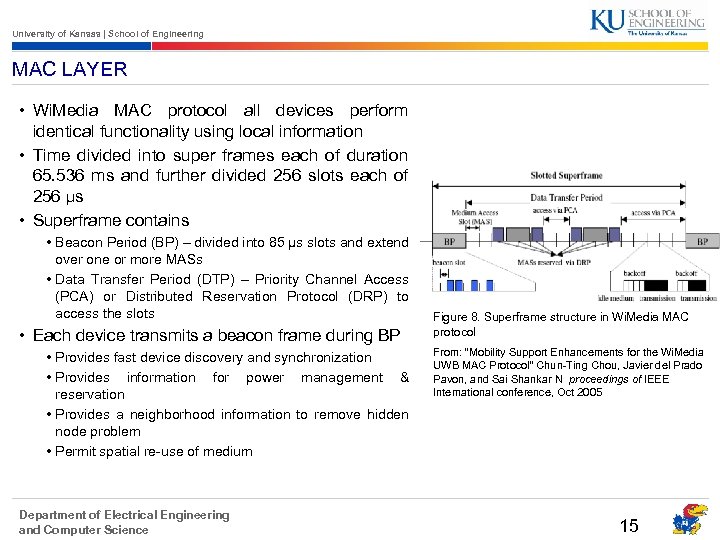 University of Kansas | School of Engineering MAC LAYER • Wi. Media MAC protocol all devices perform identical functionality using local information • Time divided into super frames each of duration 65. 536 ms and further divided 256 slots each of 256 µs • Superframe contains • Beacon Period (BP) – divided into 85 µs slots and extend over one or more MASs • Data Transfer Period (DTP) – Priority Channel Access (PCA) or Distributed Reservation Protocol (DRP) to access the slots • Each device transmits a beacon frame during BP • Provides fast device discovery and synchronization • Provides information for power management & reservation • Provides a neighborhood information to remove hidden node problem • Permit spatial re-use of medium Department of Electrical Engineering and Computer Science Figure 8. Superframe structure in Wi. Media MAC protocol From: “Mobility Support Enhancements for the Wi. Media UWB MAC Protocol” Chun-Ting Chou, Javier del Prado Pavon, and Sai Shankar N proceedings of IEEE International conference, Oct 2005 15
 University of Kansas | School of Engineering MAC LAYER • A device may create its own BP with own Beacon Period Starting Time (BPST) • Devices scan for one superframe to prevent overlapping between devices in proximity • If a beacon is received device sends its beacon in available slot • Otherwise creates its own BP • • • Information included in BPs are called Information Elements (IE) Beacon Period Occupancy IE (BPOIE) contains list of devices in device’s beacon group (BG) On reception device records the Device Address of transmitter and beacon slot number Neighborhood information used to detect collisions If own address is not found then conclude that collision occurred previous superframe On repetition the colliding device will change its beacon slot To minimize the collisions initial scan determines the beacon slots for its transmission Devices transmit only in that slots till collision occurs Devices with two hops may use different beacon slots to avoid collisions In case of more than two hops same beacon slots is used thus enabling spatial re-use of beacon slots Department of Electrical Engineering and Computer Science Wireless USB: Wi. Media® UWB 16
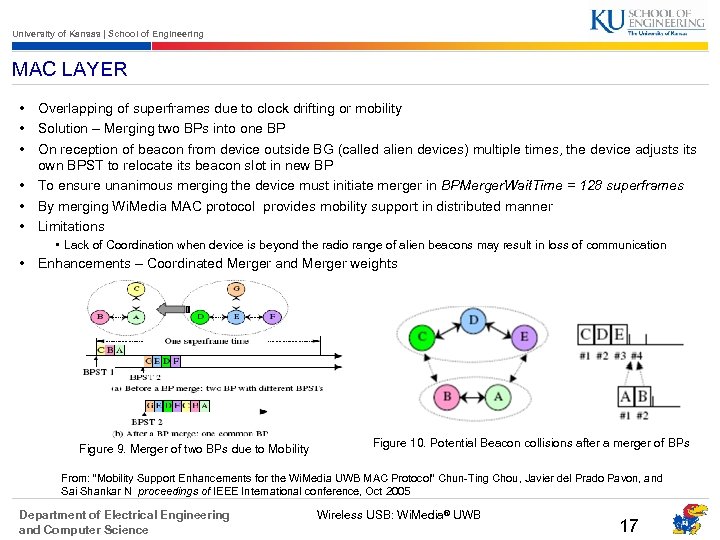 University of Kansas | School of Engineering MAC LAYER • Overlapping of superframes due to clock drifting or mobility • Solution – Merging two BPs into one BP • On reception of beacon from device outside BG (called alien devices) multiple times, the device adjusts its own BPST to relocate its beacon slot in new BP • To ensure unanimous merging the device must initiate merger in BPMerger. Wait. Time = 128 superframes • By merging Wi. Media MAC protocol provides mobility support in distributed manner • Limitations • Lack of Coordination when device is beyond the radio range of alien beacons may result in loss of communication • Enhancements – Coordinated Merger and Merger weights Figure 9. Merger of two BPs due to Mobility Figure 10. Potential Beacon collisions after a merger of BPs From: “Mobility Support Enhancements for the Wi. Media UWB MAC Protocol” Chun-Ting Chou, Javier del Prado Pavon, and Sai Shankar N proceedings of IEEE International conference, Oct 2005 Department of Electrical Engineering and Computer Science Wireless USB: Wi. Media® UWB 17
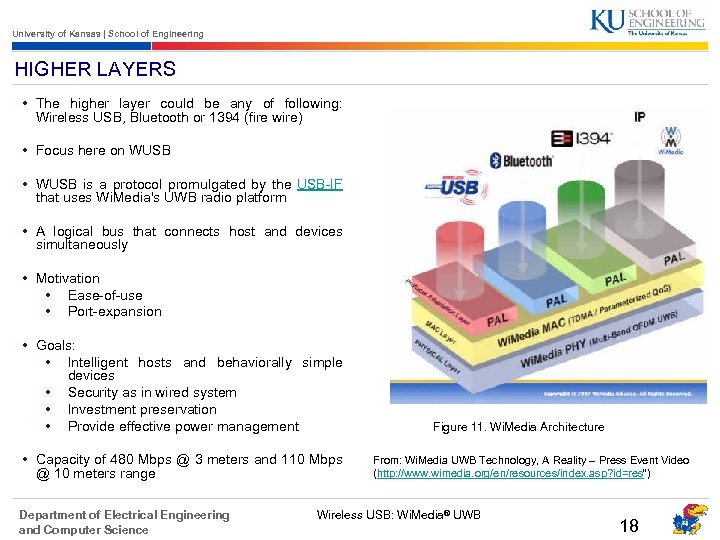 University of Kansas | School of Engineering HIGHER LAYERS • The higher layer could be any of following: Wireless USB, Bluetooth or 1394 (fire wire) • Focus here on WUSB • WUSB is a protocol promulgated by the USB-IF that uses Wi. Media's UWB radio platform • A logical bus that connects host and devices simultaneously • Motivation • Ease-of-use • Port-expansion • Goals: • Intelligent hosts and behaviorally simple devices • Security as in wired system • Investment preservation • Provide effective power management • Capacity of 480 Mbps @ 3 meters and 110 Mbps @ 10 meters range Department of Electrical Engineering and Computer Science Figure 11. Wi. Media Architecture From: Wi. Media UWB Technology, A Reality – Press Event Video (http: //www. wimedia. org/en/resources/index. asp? id=res”) Wireless USB: Wi. Media® UWB 18
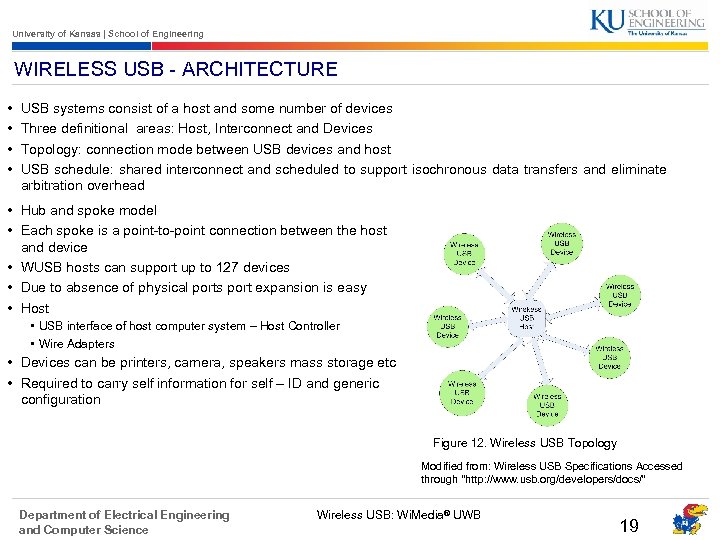 University of Kansas | School of Engineering WIRELESS USB - ARCHITECTURE • • USB systems consist of a host and some number of devices Three definitional areas: Host, Interconnect and Devices Topology: connection mode between USB devices and host USB schedule: shared interconnect and scheduled to support isochronous data transfers and eliminate arbitration overhead • Hub and spoke model • Each spoke is a point-to-point connection between the host and device • WUSB hosts can support up to 127 devices • Due to absence of physical ports port expansion is easy • Host • USB interface of host computer system – Host Controller • Wire Adapters • Devices can be printers, camera, speakers mass storage etc • Required to carry self information for self – ID and generic configuration Figure 12. Wireless USB Topology Modified from: Wireless USB Specifications Accessed through “http: //www. usb. org/developers/docs/” Department of Electrical Engineering and Computer Science Wireless USB: Wi. Media® UWB 19
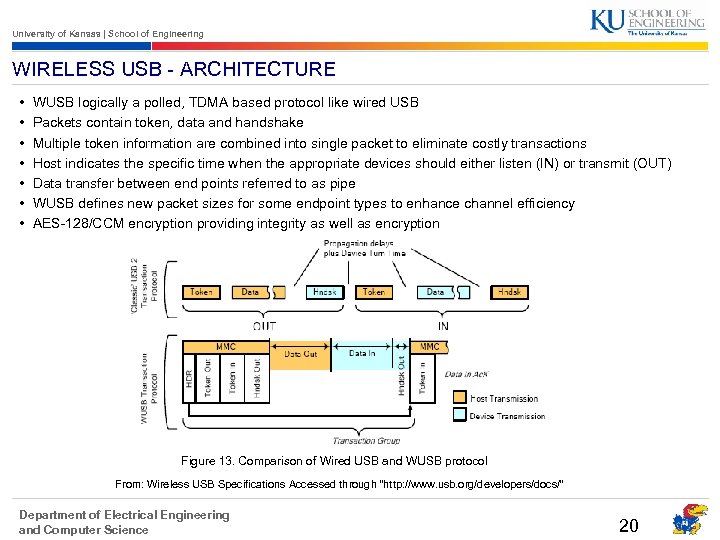 University of Kansas | School of Engineering WIRELESS USB - ARCHITECTURE • • WUSB logically a polled, TDMA based protocol like wired USB Packets contain token, data and handshake Multiple token information are combined into single packet to eliminate costly transactions Host indicates the specific time when the appropriate devices should either listen (IN) or transmit (OUT) Data transfer between end points referred to as pipe WUSB defines new packet sizes for some endpoint types to enhance channel efficiency AES-128/CCM encryption providing integrity as well as encryption Figure 13. Comparison of Wired USB and WUSB protocol From: Wireless USB Specifications Accessed through “http: //www. usb. org/developers/docs/” Department of Electrical Engineering and Computer Science 20
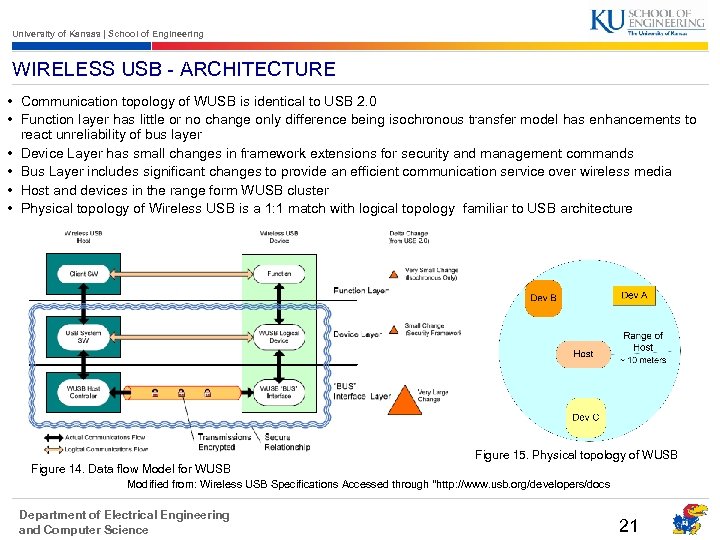 University of Kansas | School of Engineering WIRELESS USB - ARCHITECTURE • Communication topology of WUSB is identical to USB 2. 0 • Function layer has little or no change only difference being isochronous transfer model has enhancements to react unreliability of bus layer • Device Layer has small changes in framework extensions for security and management commands • Bus Layer includes significant changes to provide an efficient communication service over wireless media • Host and devices in the range form WUSB cluster • Physical topology of Wireless USB is a 1: 1 match with logical topology familiar to USB architecture Figure 15. Physical topology of WUSB Figure 14. Data flow Model for WUSB Modified from: Wireless USB Specifications Accessed through “http: //www. usb. org/developers/docs Department of Electrical Engineering and Computer Science 21
 University of Kansas | School of Engineering WIRELESS USB - ARCHITECTURE • WUSB preserves the device endpoint as the terminus of communication flow between host and device • All devices must implement at least the Default Control Pipe (Endpoint zero) which is a pipe used for device initialization and logical device management • WUSB information Exchange methods three functional buckets – host transmitted, asynchronous device transmitted and WUSB transaction protocol • WUSB device notification Time Slots • Broadcast control information • WUSB Transactions • Self Beaconing devices – implements full MAC layer protocol and manages synchronization • Device identifies host’s or a cluster member DRP IEs based on following keys • Reservation type field is Private • Stream index field – derived from MAC Header Delivery ID field • Dev. Addr field set to channel broadcast or host’s Cluster ID Department of Electrical Engineering and Computer Science 22
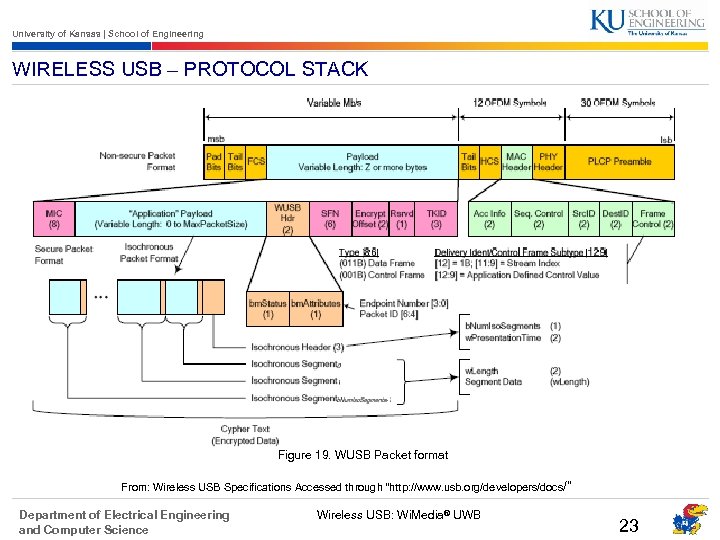 University of Kansas | School of Engineering WIRELESS USB – PROTOCOL STACK Figure 19. WUSB Packet format From: Wireless USB Specifications Accessed through “http: //www. usb. org/developers/docs/” Department of Electrical Engineering and Computer Science Wireless USB: Wi. Media® UWB 23
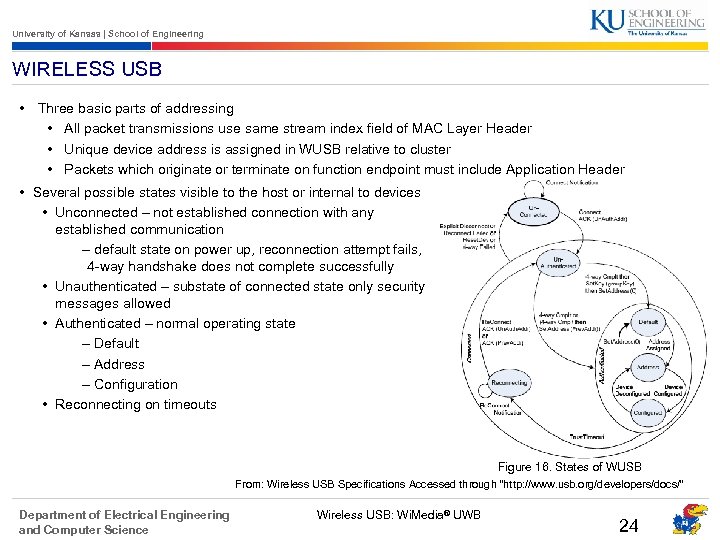 University of Kansas | School of Engineering WIRELESS USB • Three basic parts of addressing • All packet transmissions use same stream index field of MAC Layer Header • Unique device address is assigned in WUSB relative to cluster • Packets which originate or terminate on function endpoint must include Application Header • Several possible states visible to the host or internal to devices • Unconnected – not established connection with any established communication – default state on power up, reconnection attempt fails, 4 -way handshake does not complete successfully • Unauthenticated – substate of connected state only security messages allowed • Authenticated – normal operating state – Default – Address – Configuration • Reconnecting on timeouts Figure 16. States of WUSB From: Wireless USB Specifications Accessed through “http: //www. usb. org/developers/docs/” Department of Electrical Engineering and Computer Science Wireless USB: Wi. Media® UWB 24
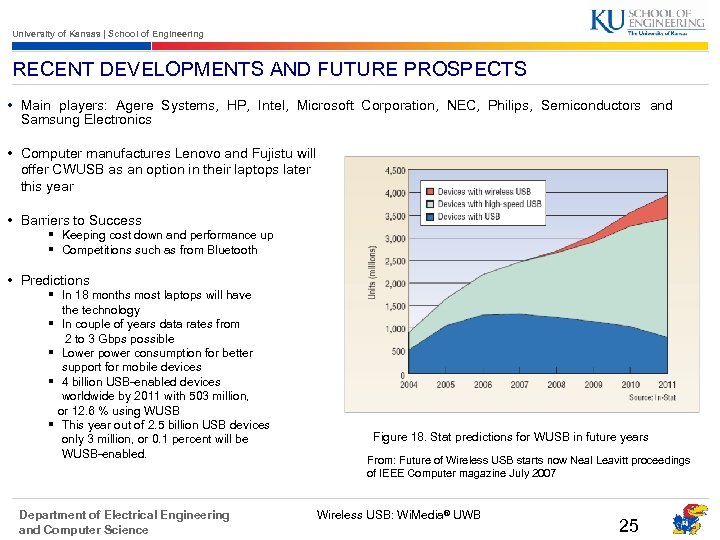 University of Kansas | School of Engineering RECENT DEVELOPMENTS AND FUTURE PROSPECTS • Main players: Agere Systems, HP, Intel, Microsoft Corporation, NEC, Philips, Semiconductors and Samsung Electronics • Computer manufactures Lenovo and Fujistu will offer CWUSB as an option in their laptops later this year • Barriers to Success § Keeping cost down and performance up § Competitions such as from Bluetooth • Predictions § In 18 months most laptops will have the technology § In couple of years data rates from 2 to 3 Gbps possible § Lower power consumption for better support for mobile devices § 4 billion USB-enabled devices worldwide by 2011 with 503 million, or 12. 6 % using WUSB § This year out of 2. 5 billion USB devices only 3 million, or 0. 1 percent will be WUSB-enabled. Department of Electrical Engineering and Computer Science Figure 18. Stat predictions for WUSB in future years From: Future of Wireless USB starts now Neal Leavitt proceedings of IEEE Computer magazine July 2007 Wireless USB: Wi. Media® UWB 25
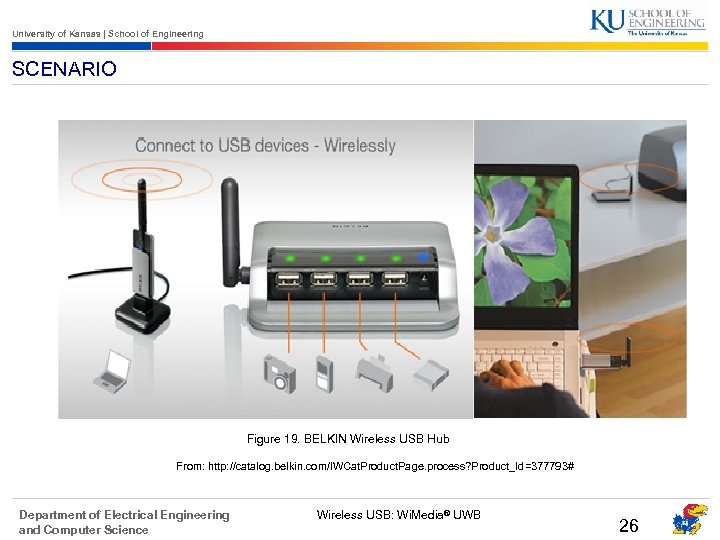 University of Kansas | School of Engineering SCENARIO Figure 19. BELKIN Wireless USB Hub From: http: //catalog. belkin. com/IWCat. Product. Page. process? Product_Id=377793# Department of Electrical Engineering and Computer Science Wireless USB: Wi. Media® UWB 26
 University of Kansas | School of Engineering CONCLUSION Wireless USB is a fast growing PAN technology, it’s the latest iteration of USB technology, will offer the same functionality as standard wired USB devices but without the cabling. In this presentation its underlying UWB technology along with its architecture were visited. As the new Wireless USB Promoter Group prepares to develop the specifications that will help standardize the technology, the industry is planning products that can take advantage of the convenience and mobility that this new device interconnect will offer. Department of Electrical Engineering and Computer Science 27
 University of Kansas | School of Engineering REFERENCES 1. Wireless USB Specifications Accessed through http: //www. usb. org/developers/docs/ 2. “Performance evaluation of MB-OFDM and DS-UWB systems for wireless personal area networks" Oh-Soon Shin Ghassemzadeh, S. S. Greenstein, L. J. Tarokh, V. Proceedings of IEEE International Conference Sep 2005 3. “Mobility Support Enhancements for the Wi. Media UWB MAC Protocol” Chun-Ting Chou, Javier del Prado Pavon, and Sai Shankar N proceedings of IEEE International conference, Oct 2005 4. Ultra Wideband Radio Technology Kazimierz Siwiak and Debra Mc. Keown John Wiley & Sons Ltd. Edition 2004 5. Wi. Media UWB Technology, A Reality – Press Event Video Accessed through http: //www. wimedia. org/en/resources/index. asp? id=res 6. Future of Wireless USB starts now Neal Leavitt proceedings of IEEE Computer magazine July 2007 accessed through http: //www. leavcom. com/pdf/Wireless. USB. pdf Department of Electrical Engineering and Computer Science Wireless USB: Wi. Media® UWB 28
 University of Kansas | School of Engineering REFERENCES 7. Channel Models for UWB Personal Area Networks J. R. Foerster, M. Pendergrass, A. F. Molisch proceedings of IEEE conference Dec 2003 8. Intel Corporation Wireless USB: The First High Speed Personal Wireless Interconnect White Paper Intel® Developer Forum March 14, 2004 http: //www. intel. com/technology/ultrawideband/downloads/wireless. USB. pdf 9. MAC Protocols for Ultra-Wide-Band (UWB) Wireless Networks: Impact of Channel Acquisition Time Jin Ding, Li Zhao, Sirisha R. Medidi and Krishna M. Sivalingam 10. http: //catalog. belkin. com/IWCat. Product. Page. process? Product_Id=377793# 11. http: //www. extremetech. com/article 2/0, 1697, 2129892, 00. asp 12. Wikipedia Article: “Ultra-wideband. ” http: //en. wikipedia. org/wiki/Ultra-wideband 13. http: //www. extremetech. com/article 2/0, 1697, 2129892, 00. asp 14. http: //www. anu. edu. au/RSISE/teleng 2004/research/uwb. php Department of Electrical Engineering and Computer Science Wireless USB: Wi. Media® UWB 29