 Скачать презентацию University of Hamburg Akdeniz Üniversitesi Antalya Jochen
48c85644d2b6688918b29511cfe98f85.ppt
- Количество слайдов: 94



University of Hamburg / Akdeniz Üniversitesi, Antalya Jochen Rehbein Pragmatics – in the sense of Functional Pragmatics. An animated PP introduction into its conceptual framework. 1 © Rehbein 2009 -2016
For an extended explanation of terms, concepts, notions and their relations which can only briefly be touched on in the following presentation, I refer to Angelika Redder’s (2008) article on „Functional Pragmatics“ (in: Gerd Antos / Eija Ventola (eds. ) Handbook of Interpersonal Communication. Series Handbooks of Applied Linguistics. Berlin: Mouton de Gruyter, 133 -178). Jochen Rehbein 2 © Rehbein 2009 -2016
In the following, I will try to inform about developments which have taken place in Western Germany during the last 35 years in the field of pragmatics due to the fact that the works of Austin, Searle, Bühler as well as Hegel, Marx, von Wright, Vygotsky and modern discourse analysis have been incorporated into the science(s) of language. The result is an action theory based and at the same time empirical approach to the study of the social functions of language. 3 © Rehbein 2009 -2016
It will be not possible to give more than a very general overview of several hundreds of works, studies, articles, books on many topics and themes. The common focus of these studies, bound together under the methodology of Functional Pragmatics, is that of an empirically based analysis of language and languages as an „instrument“ (“Geraet” in Bühler’s 1934 term) of social communication. © Rehbein 2009 -2016 4
![© Rehbein 2009 -2016 concepts of pragmatics Institutions of society [pragmem (Praxeogramme)] speaker-hearer-distinction understanding](https://present5.com/presentation/48c85644d2b6688918b29511cfe98f85/image-5.jpg "© Rehbein 2009 -2016 concepts of pragmatics Institutions of society [pragmem (Praxeogramme)] speaker-hearer-distinction understanding")
© Rehbein 2009 -2016 concepts of pragmatics Institutions of society [pragmem (Praxeogramme)] speaker-hearer-distinction understanding constellation discourse / text pattern of (speech)action speech action as process of action intercultural communication apparatuses [turn taking, speaker-hearersteering; mental apparatus; cultural apparatus] politeness acts linguistic procedures/ linguistic fields linguistic forms (morpho-syntax, prosody etc. ) knowledge structures 5
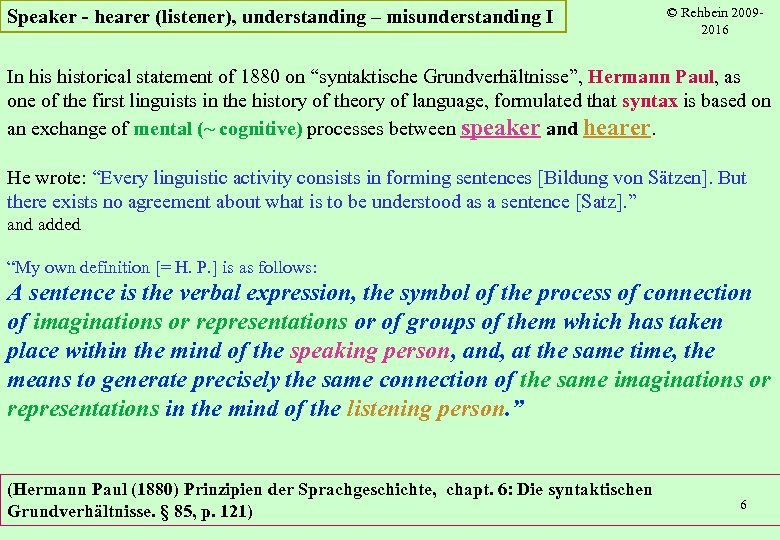
Speaker - hearer (listener), understanding – misunderstanding I © Rehbein 20092016 In historical statement of 1880 on “syntaktische Grundverhältnisse”, Hermann Paul, as one of the first linguists in the history of theory of language, formulated that syntax is based on an exchange of mental (~ cognitive) processes between speaker and hearer. He wrote: “Every linguistic activity consists in forming sentences [Bildung von Sätzen]. But there exists no agreement about what is to be understood as a sentence [Satz]. ” and added “My own definition [= H. P. ] is as follows: A sentence is the verbal expression, the symbol of the process of connection of imaginations or representations or of groups of them which has taken place within the mind of the speaking person, and, at the same time, the means to generate precisely the same connection of the same imaginations or representations in the mind of the listening person. ” (Hermann Paul (1880) Prinzipien der Sprachgeschichte, chapt. 6: Die syntaktischen Grundverhältnisse. § 85, p. 121) 6
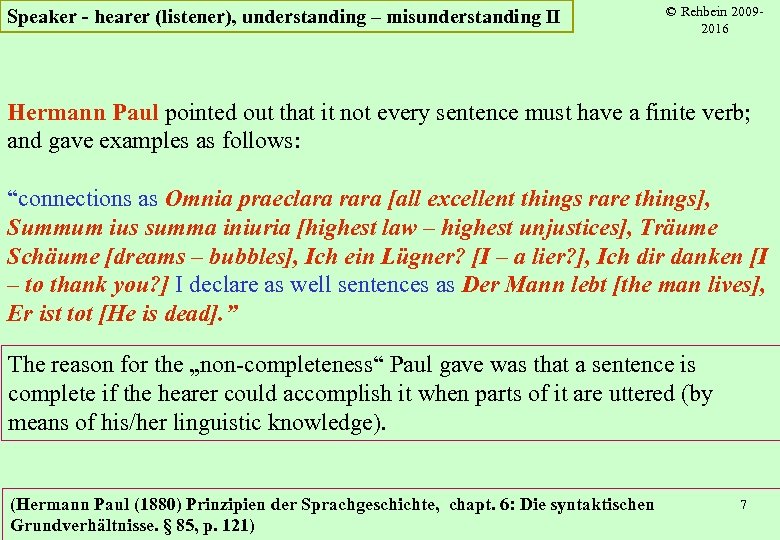
Speaker - hearer (listener), understanding – misunderstanding II © Rehbein 20092016 Hermann Paul pointed out that it not every sentence must have a finite verb; and gave examples as follows: “connections as Omnia praeclara rara [all excellent things rare things], Summum ius summa iniuria [highest law – highest unjustices], Träume Schäume [dreams – bubbles], Ich ein Lügner? [I – a lier? ], Ich dir danken [I – to thank you? ] I declare as well sentences as Der Mann lebt [the man lives], Er ist tot [He is dead]. ” The reason for the „non-completeness“ Paul gave was that a sentence is complete if the hearer could accomplish it when parts of it are uttered (by means of his/her linguistic knowledge). (Hermann Paul (1880) Prinzipien der Sprachgeschichte, chapt. 6: Die syntaktischen Grundverhältnisse. § 85, p. 121) 7
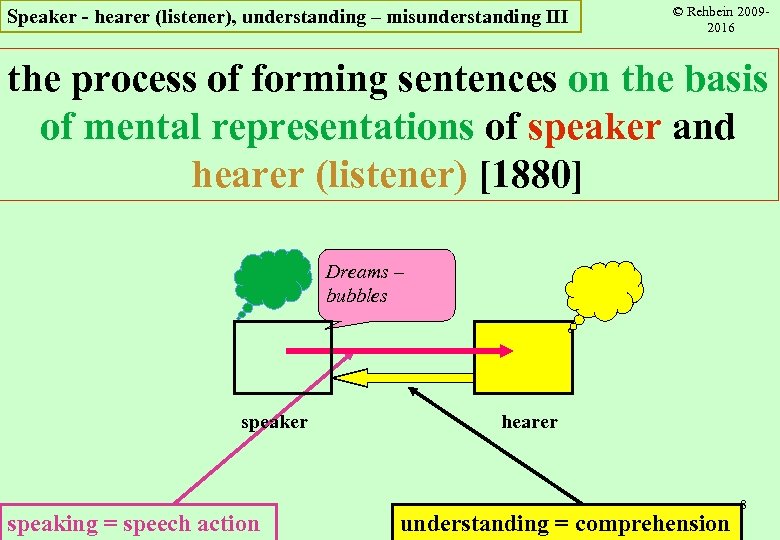
Speaker - hearer (listener), understanding – misunderstanding III © Rehbein 20092016 the process of forming sentences on the basis of mental representations of speaker and hearer (listener) [1880] Dreams – bubbles speaker speaking = speech action hearer understanding = comprehension 8
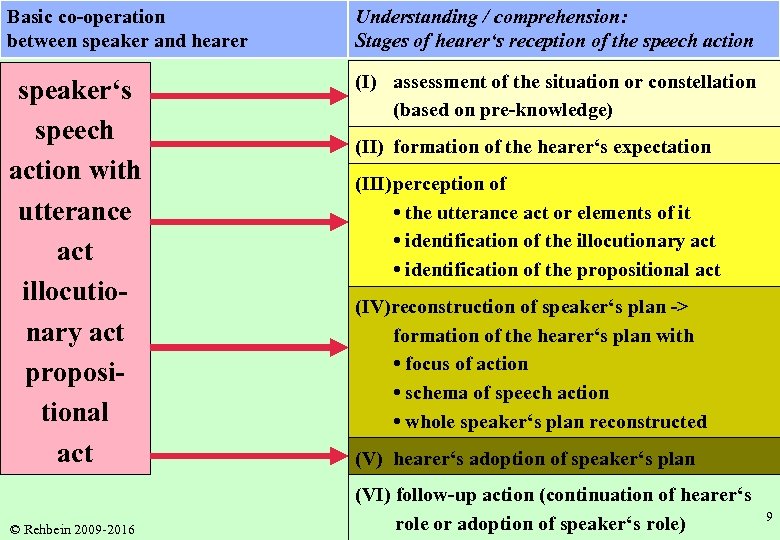
Basic co-operation between speaker and hearer Understanding / comprehension: Stages of hearer‘s reception of the speech action speaker‘s speech action with utterance act illocutionary act propositional act (I) assessment of the situation or constellation (based on pre-knowledge) © Rehbein 2009 -2016 (II) formation of the hearer‘s expectation (III)perception of • the utterance act or elements of it • identification of the illocutionary act • identification of the propositional act (IV)reconstruction of speaker‘s plan -> formation of the hearer‘s plan with • focus of action • schema of speech action • whole speaker‘s plan reconstructed (V) hearer‘s adoption of speaker‘s plan (VI) follow-up action (continuation of hearer‘s role or adoption of speaker‘s role) 9
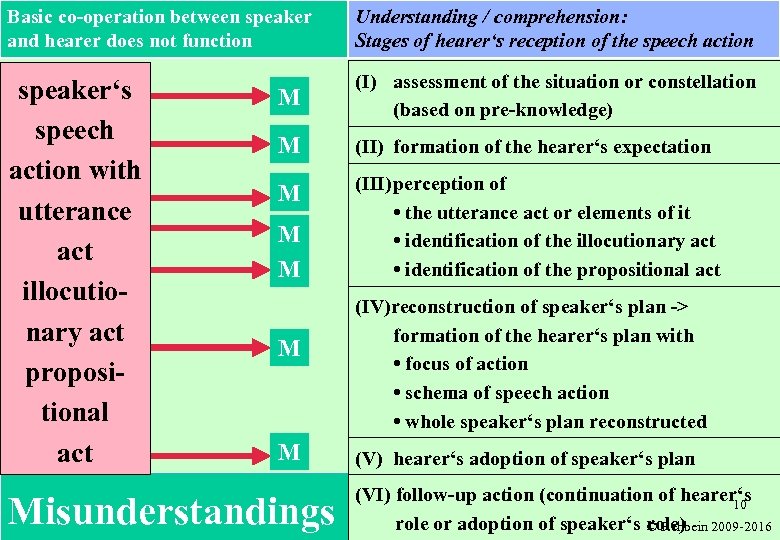
Basic co-operation between speaker and hearer does not function Understanding / comprehension: Stages of hearer‘s reception of the speech action speaker‘s speech action with utterance act illocutionary act propositional act M (I) assessment of the situation or constellation (based on pre-knowledge) M (II) formation of the hearer‘s expectation M (III)perception of • the utterance act or elements of it • identification of the illocutionary act • identification of the propositional act M M Misunderstandings (IV)reconstruction of speaker‘s plan -> formation of the hearer‘s plan with • focus of action • schema of speech action • whole speaker‘s plan reconstructed (V) hearer‘s adoption of speaker‘s plan (VI) follow-up action (continuation of hearer‘s 10 role or adoption of speaker‘s role) 2009 -2016 © Rehbein
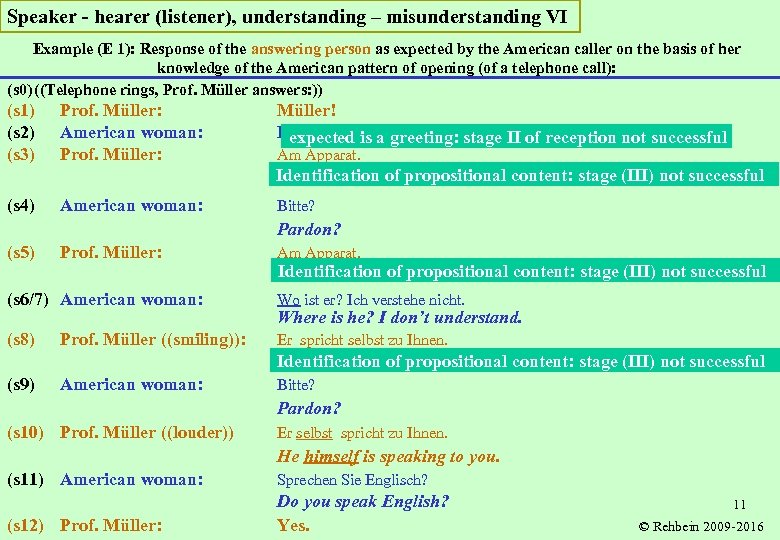
Speaker - hearer (listener), understanding – misunderstanding VI Example (E 1): Response of the answering person as expected by the American caller on the basis of her knowledge of the American pattern of opening (of a telephone call): (s 0) ((Telephone rings, Prof. Müller answers: )) (s 1) (s 2) (s 3) Prof. Müller: American woman: Prof. Müller: (s 4) American woman: Müller! Professor Müller? expected is a greeting: stage II of reception not successful Am Apparat. Speaking. [literally: at the apparatus] Identification of propositional content: stage (III) not successful Bitte? Pardon? (s 5) Prof. Müller: Am Apparat. Identification of propositional content: Speaking. [literally: at the apparatus] stage (III) not successful (s 6/7) American woman: Wo ist er? Ich verstehe nicht. (s 8) Er spricht selbst zu Ihnen. Prof. Müller ((smiling)): Where is he? I don’t understand. Identification of propositional content: stage (III) not successful He is speaking to you himself. (s 9) American woman: Bitte? Pardon? (s 10) Prof. Müller ((louder)) Er selbst spricht zu Ihnen. He himself is speaking to you. (s 11) American woman: Sprechen Sie Englisch? (s 12) Prof. Müller: Do you speak English? Yes. 11 © Rehbein 2009 -2016
![© Rehbein 20092016 Institutions of society [pragmem (Praxeogramme)] concepts of pragmatics speaker-hearer-distinction understanding constellation](https://present5.com/presentation/48c85644d2b6688918b29511cfe98f85/image-12.jpg "© Rehbein 20092016 Institutions of society [pragmem (Praxeogramme)] concepts of pragmatics speaker-hearer-distinction understanding constellation")
© Rehbein 20092016 Institutions of society [pragmem (Praxeogramme)] concepts of pragmatics speaker-hearer-distinction understanding constellation discourse / text pattern of (speech)action speech action as process of action apparatuses [turn taking, speaker-hearersteering; mental apparatus; cultural apparatus] acts linguistic procedures/ linguistic fields linguistic forms (morpho-syntax, prosody etc. ) knowledge structures 12
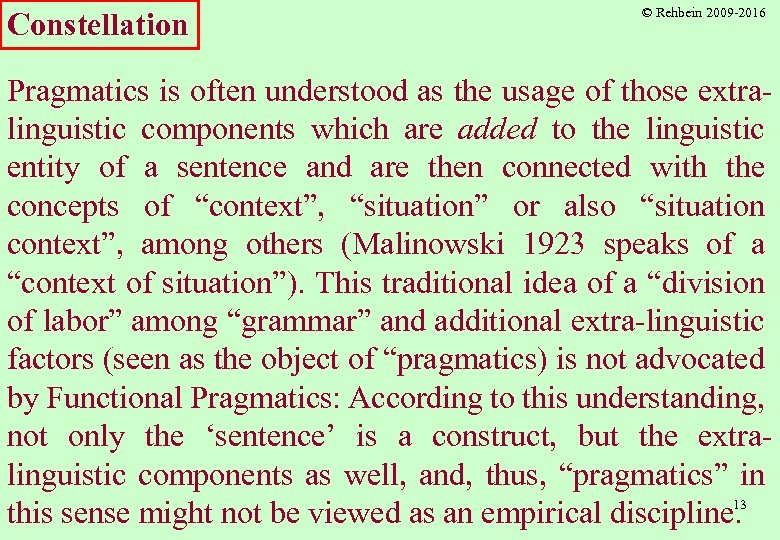
Constellation © Rehbein 2009 -2016 Pragmatics is often understood as the usage of those extralinguistic components which are added to the linguistic entity of a sentence and are then connected with the concepts of “context”, “situation” or also “situation context”, among others (Malinowski 1923 speaks of a “context of situation”). This traditional idea of a “division of labor” among “grammar” and additional extra-linguistic factors (seen as the object of “pragmatics) is not advocated by Functional Pragmatics: According to this understanding, not only the ‘sentence’ is a construct, but the extralinguistic components as well, and, thus, “pragmatics” in 13 this sense might not be viewed as an empirical discipline.
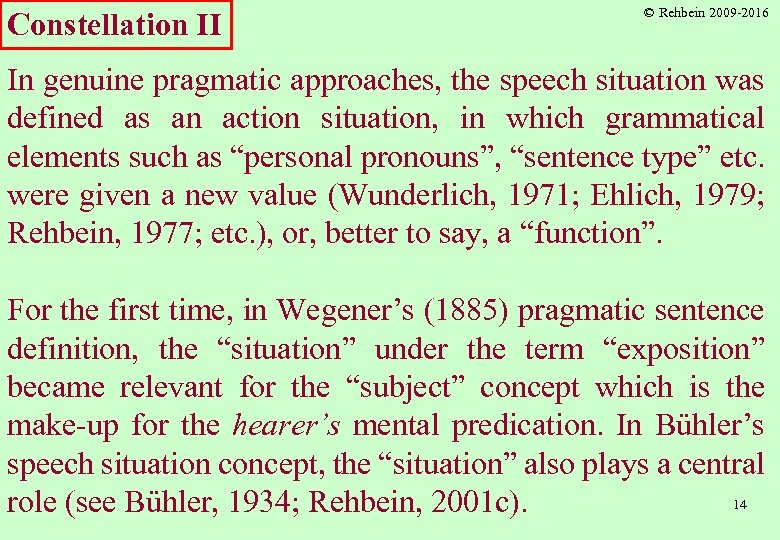
Constellation II © Rehbein 2009 -2016 In genuine pragmatic approaches, the speech situation was defined as an action situation, in which grammatical elements such as “personal pronouns”, “sentence type” etc. were given a new value (Wunderlich, 1971; Ehlich, 1979; Rehbein, 1977; etc. ), or, better to say, a “function”. For the first time, in Wegener’s (1885) pragmatic sentence definition, the “situation” under the term “exposition” became relevant for the “subject” concept which is the make-up for the hearer’s mental predication. In Bühler’s speech situation concept, the “situation” also plays a central 14 role (see Bühler, 1934; Rehbein, 2001 c).
Constellation III © Rehbein 2009 -2016 As I understood Manfred Kummer in his “Grundlagen einer kommunikativen Grammatik für das Thailändische” (1984), the concept of “speech situation” is one of the fundamentals of the Thai language because, in communication, common situational elements are presupposed by speakers and hearers in their common knowledge and need not explicitly be verbalized. 15
Constellation IV © Rehbein 2009 -2016 Theoretically speaking, actions process actional situations, i. e. constellations (of speech), in order to adjust actions to the needs and goals of actants and to change them accordingly in communicative deep structures such as patterns (of action). During their communicative realization, patterns of communication are, in turn, tested in the (continually changing) constellation. The constellation is thus viewed as systematically bound to patterns and, on the one hand, as a potential for the 16
Constellation V © Rehbein 2009 -2016 starting point of alternative patterns, on the other hand, as the result of the changes in social reality (brought about by the patterns), which are generated by the action process. Transitions between patterns are produced by changes in the constellation and are often realized by organizational elements (connecting elements) in speech. The constellation, in each case, has a certain structured course; what is central here is that the starting point of a speech action in a situation is established through the illocution (Rehbein, 1977: § 11). 17
Constellation VI © Rehbein 2009 -2016 The constellation is specified through the type of discourse, text, empractical interactional nexus, the institutional action etc. , but is not to be equated with these. The constellation plays a central role in the pragmatic analysis of the mode of speaking. In communication, modi apply the propositional content to a basic configuration with a specific hearer-sided processing; this movement is to be understood as “basic illocution”. 18
Constellation VII © Rehbein 2009 -2016 “Illocutionary basic acts” (Ehlich, 1974) such as questions, assertions and demands are not only systematic-theoretical ones, but also primarily onto- and phylogenetic. Thus, grammar organizes the respective constellation of the actants through the mental processes that are connected to the means of the modus (Rehbein, 1999 b). Thus, grammar organizes the respective constellations of the actants through the mental processes that are 19 connected to the means of the modus (Rehbein, 1999 b).
Discourse and text I © Rehbein 2009 -2016 In Functional Pragmatics, ‘discourse‘ is to be characterized as a speech situation in which the participants, speakers and hearers, are co-present, interact face-to-face with each other so that the speaker, in speaking, perceives the reception of his/her speech on the part of the hearer (with the consequence that he/she might change the plan of the speech action „on the spot“). Being co-present, the hearer controls, checks and steers the speaker‘s speech actions by „back channel cues“ which are verbal and/or non-verbal by definition. Most of these „signals of the hearer“ are interjections and exclamations, 20 and, in many languages, are linked to prosodic forms.
Discourse and text II © Rehbein 2009 -2016 Contrary to the co-presence of speaker and hearer in the mode of discourse, the speech situations of a text production and text reception are not the same. Normally, texts are produced by authors in one situation and received by readers in a temporally distinct, later situation. Therefore, Ehlich, in characterizing texts, spoke of dissociated spech situation and of the function of knowledge transfer performed by the language mode of 21 text. (Ehlich 1983, 1984 a).
Discourse and text III © Rehbein 2009 -2016 Whereas texts are stable structures so that they are reproducable on further and/or later occasions, i. e. in situations of reception, discourses are volatile and transient because they are bound to the spoken word which dissipates at the very moment when articulated. Therefore discourses, in order to become objects of linguistic research, have to be tape-recorded and fixed and, thus, made reproducable by being transcribed with the transcription system HIAT (semi interpretative working transcriptions; Ehlich & Rehbein 1976, 1979, Ehlich 1993) (s. statement on the transcription program below). 22
Discourse and text IV © Rehbein 2009 -2016 It is the discourse which, in the last 30 years, has become an eminently studied linguistic object in Functional Pragmatics. Orality and writing I The opposition of oral and written utterance forms is not identical with that of discourse and text. Functionally speaking, the written medium serves a surrogate of memory, orality a medium of immediate verbalisation on the basis of human and/or collective memory. In this sense, oral literature may be seen as a text reproduced by oral means. 23
Orality and writing II If a text is too complicated, as texts are in modern sciences for example or in international contracts, then the interactants take recourse to the written representation of texts. On the other hand, discourses are no longer of an oral constitution if they become tape-recorded and transcribed objects of linguistics; or if students write down lecture notes in an abbreviated style (which only themselves can read). Concerning the modes in which the forms of language appear we may draw a fourfold distinction as follows: © Rehbein 2009 -2016 24
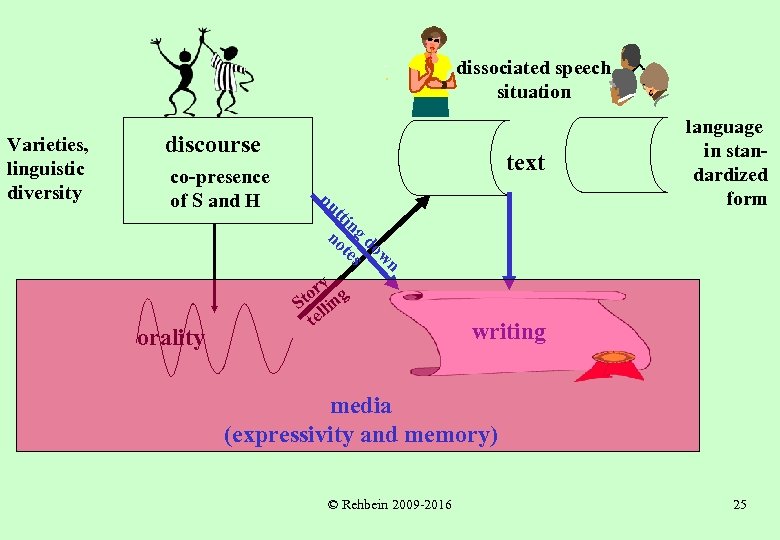
dissociated speech situation Varieties, linguistic diversity discourse co-presence of S and H orality text pu tti n no g d te ow s n ry to ing S ll te language in standardized form writing media (expressivity and memory) © Rehbein 2009 -2016 25
![© Rehbein 2009 -2016 concepts of pragmatics Institutions of society [pragmem (Praxeogramme)] constellation orality](https://present5.com/presentation/48c85644d2b6688918b29511cfe98f85/image-26.jpg "© Rehbein 2009 -2016 concepts of pragmatics Institutions of society [pragmem (Praxeogramme)] constellation orality")
© Rehbein 2009 -2016 concepts of pragmatics Institutions of society [pragmem (Praxeogramme)] constellation orality and writing speaker-hearer-distinction understanding discourse / text pattern of (speech)action speech action as process of action apparatuses [turn taking, speaker-hearersteering; mental apparatus; cultural apparatus] politeness acts linguistic procedures/ linguistic fields linguistic forms (morpho-syntax, prosody etc. ) knowledge structures 26
Knowledge I © Rehbein 2009 -2016 Knowledge, knowledge structures and knowledge systems represent collective mental processes and, at the same time, are determinants of social structures and social actions. Knowledge in this sense is non-homogeneous and non-uniform, or respectively, subjective and participant-oriented (as in ethno-methodology). Whereas knowledge or knowledge systems have also been modelled on the cognitive scientific concepts of “script”, “scheme” and “frame” (cf. overview in Mandl/Spada 1988; Scherner 2000; Strohner/Brose 2001), Functional Pragmatics has developed a language-based and language psychological concept of knowledge (cf. Ehlich/ Rehbein 1977). 27
Knowledge II © Rehbein 2009 -2016 The functional-pragmatic concept of knowledge, on the one hand, borrows from Marxist and Hegelian traditions (their functional and dynamic view) and, on the other hand, from French ethnological as well as from traditions of sociology of knowledge, Gestalt psychology and ethno-methodology. The main basis, however, is the psychology of language as initiated by Karl Bühler, and the action theory of language. In lieu thereof, knowledge structures “repetitively alike” (as ‘pattern’ and ‘apparatus’) are not locally negotiated in discourse; they are, for the most part, connected to social roles, classes and groups. Without knowledge structures, repetitive speech actions with different actants, in particular those in institutions, would 28 be unthinkable.
Knowledge III © Rehbein 2009 -2016 ‘Knowledge’ is organized in structural types and, especially, distributed to speaker and hearer alike. Also, one has to for the category of common discourse knowledge which is processed differently in different languages, better to say, there is problably a language-typological variability in the language-based processiability of common discourse knowledge. In Functional Pragmatics, knowledge is an integral part of the various speech actions and systematized as follows: 29
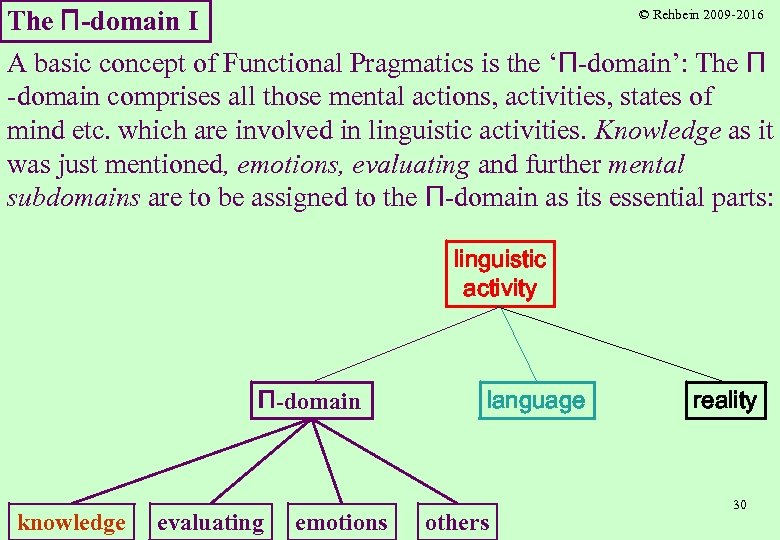
© Rehbein 2009 -2016 The Π-domain I A basic concept of Functional Pragmatics is the ‘Π-domain’: The Π -domain comprises all those mental actions, activities, states of mind etc. which are involved in linguistic activities. Knowledge as it was just mentioned, emotions, evaluating and further mental subdomains are to be assigned to the Π-domain as its essential parts: linguistic activity Π-domain knowledge evaluating emotions language others reality 30
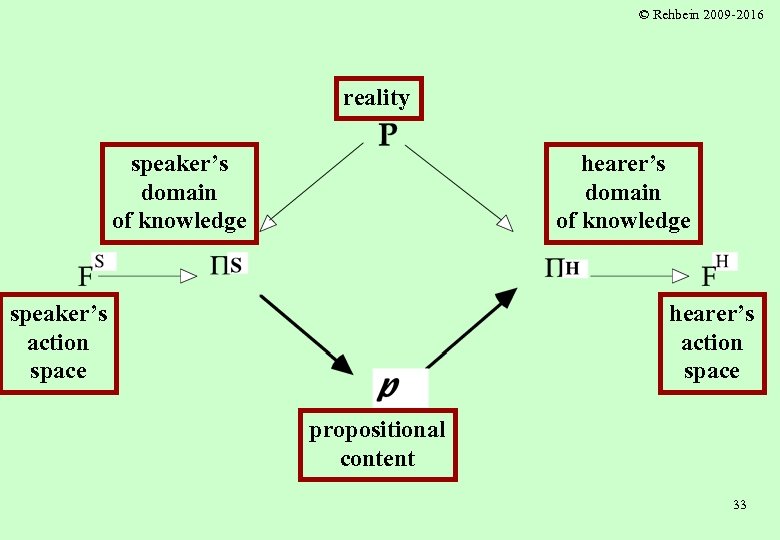
The Π-domain II © Rehbein 2009 -2016 ‘Reality’, ‘language’ and the Π-domain constitute three comprehensive components of linguistic activity in general as it is conceptualized by Functional Pragmatics. Generally speaking, the relationship between reality, Π-domain and language is as follows: The Π-domain is distributed differently among speaker (S) and hearer (H) (abbreviated as ‘ΠS’ for the speaker’s Π-domain and ‘ΠH’ for the hearer’s Π-domain). The Πdomains represent and process structures of reality (‘P’) generated via experience, perception, memory etc. 31
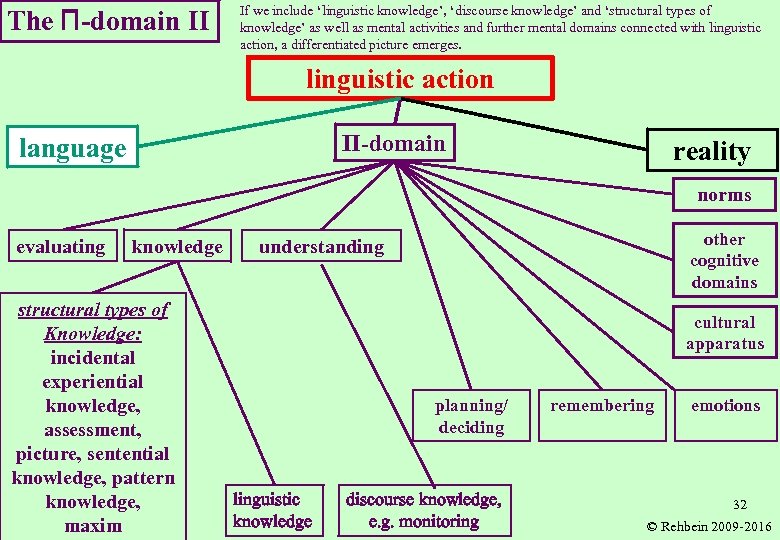
The Π-domain II If we include ‘linguistic knowledge’, ‘discourse knowledge’ and ‘structural types of knowledge’ as well as mental activities and further mental domains connected with linguistic action, a differentiated picture emerges. linguistic action Π-domain language reality norms evaluating knowledge structural types of Knowledge: incidental experiential knowledge, assessment, picture, sentential knowledge, pattern knowledge, maxim other cognitive domains understanding cultural apparatus planning/ deciding linguistic knowledge discourse knowledge, e. g. monitoring remembering emotions 32 © Rehbein 2009 -2016
© Rehbein 2009 -2016 reality speaker’s domain of knowledge hearer’s domain of knowledge speaker’s action space hearer’s action space propositional content 33
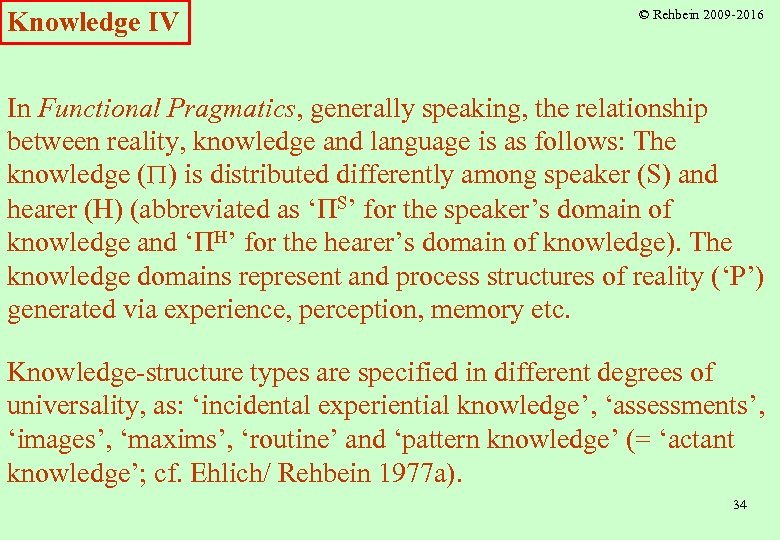
Knowledge IV © Rehbein 2009 -2016 In Functional Pragmatics, generally speaking, the relationship between reality, knowledge and language is as follows: The knowledge (Π) is distributed differently among speaker (S) and hearer (H) (abbreviated as ‘ΠS’ for the speaker’s domain of knowledge and ‘ΠH’ for the hearer’s domain of knowledge). The knowledge domains represent and process structures of reality (‘P’) generated via experience, perception, memory etc. Knowledge-structure types are specified in different degrees of universality, as: ‘incidental experiential knowledge’, ‘assessments’, ‘images’, ‘maxims’, ‘routine’ and ‘pattern knowledge’ (= ‘actant knowledge’; cf. Ehlich/ Rehbein 1977 a). 34
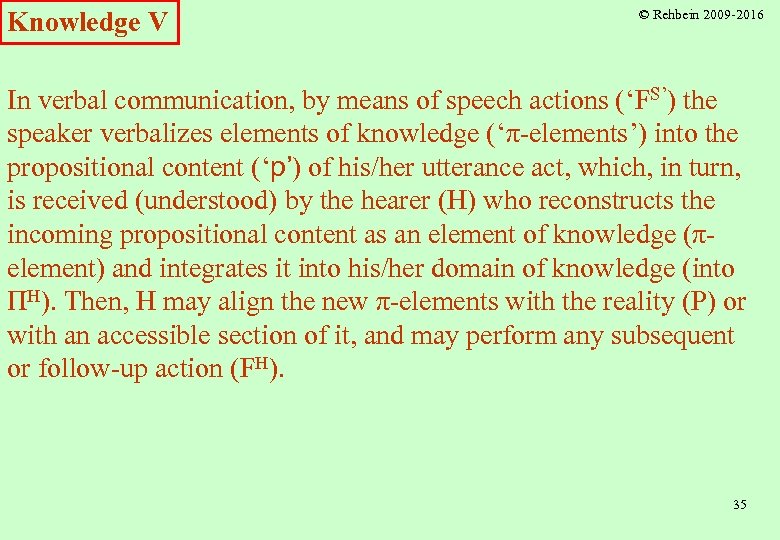
Knowledge V © Rehbein 2009 -2016 In verbal communication, by means of speech actions (‘FS’) the speaker verbalizes elements of knowledge (‘π-elements’) into the propositional content (‘p’) of his/her utterance act, which, in turn, is received (understood) by the hearer (H) who reconstructs the incoming propositional content as an element of knowledge (πelement) and integrates it into his/her domain of knowledge (into ΠH). Then, H may align the new π-elements with the reality (P) or with an accessible section of it, and may perform any subsequent or follow-up action (FH). 35
Basic speech actions as assertion and question I By means of assertions, certain elements of knowledge (π-elements) are verbally transferred from the speaker’s Π-domain to the hearer’s Π-domain because the hearer does not dispose of a specific knowledge. The following example is taken from a negotiation between a German publisher and an American authoress on royalties, i. e. from business communication (for details s. Rehbein 2002, 2006). The American authoress gives assertions to the German who is not quite familiar with the American market usages with respect to the royalties of scientific manuscripts (as this is not a usual practice in Germany): © Rehbein 2009 -2016 36
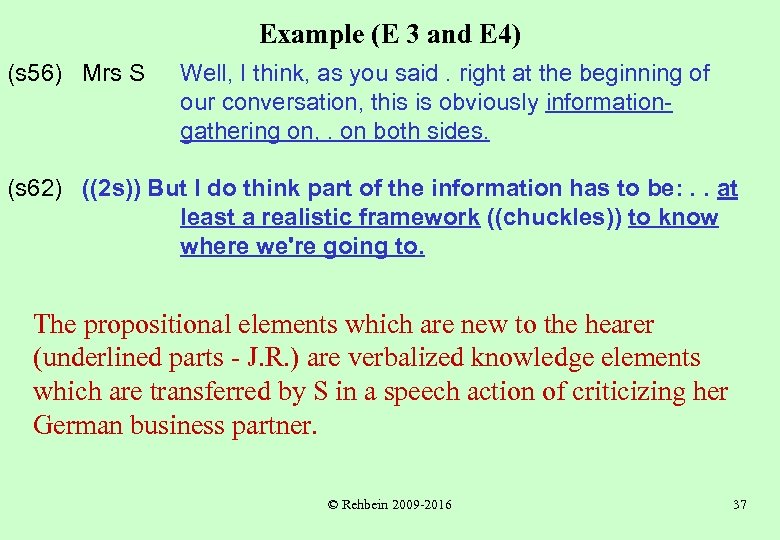
Example (E 3 and E 4) (s 56) Mrs S Well, I think, as you said. right at the beginning of our conversation, this is obviously informationgathering on, . on both sides. (s 62) ((2 s)) But I do think part of the information has to be: . . at least a realistic framework ((chuckles)) to know where we're going to. The propositional elements which are new to the hearer (underlined parts - J. R. ) are verbalized knowledge elements which are transferred by S in a speech action of criticizing her German business partner. © Rehbein 2009 -2016 37
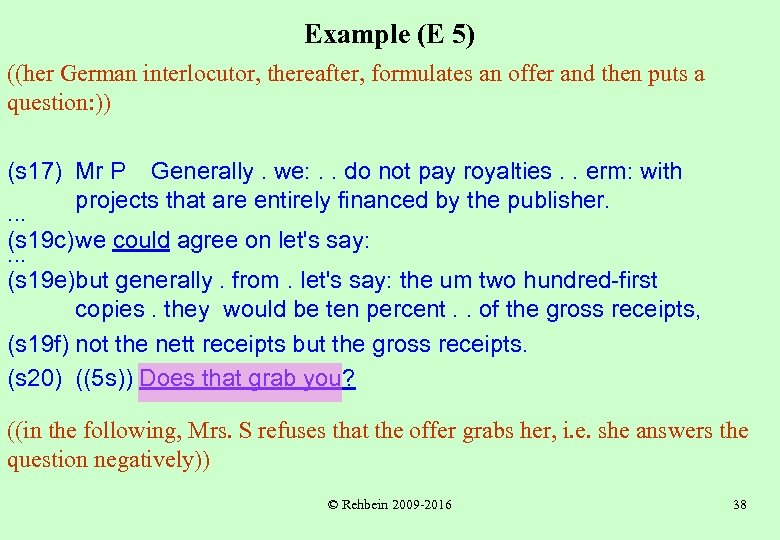
Example (E 5) ((her German interlocutor, thereafter, formulates an offer and then puts a question: )) (s 17) Mr P Generally. we: . . do not pay royalties. . erm: with projects that are entirely financed by the publisher. . (s 19 c)we could agree on let's say: . . . (s 19 e)but generally. from. let's say: the um two hundred-first copies. they would be ten percent. . of the gross receipts, (s 19 f) not the nett receipts but the gross receipts. (s 20) ((5 s)) Does that grab you? ((in the following, Mrs. S refuses that the offer grabs her, i. e. she answers the question negatively)) © Rehbein 2009 -2016 38
Basic speech actions as assertion and question II © Rehbein 2009 -2016 Viewing the sequence of the question – answer speech actions, we may state that Mr. P formulates with “that” a reference to what he knows (his offer) and in the predicate “does. . . grab you” a propositional element which transports a definite non-known element, his deficient knowledge. By means of the illocutionary act of his question he addresses the verbalization of his knowledge deficit to his interlocutor because he expects the fulfilment of his knowledge deficit by her answer. Her answer is in fact a fulfilment regarding the propositional content of the question but the illocution of the answer is a refutation. The example cannot be discussed any further here but it should suffice to demonstrate that the category of knowledge is of high 39 importance for the analysis of (institutional/professional) discourse.
Patterns of action I © Rehbein 2009 -2016 Linguistic and mental actions are discursively organized in sucessions of action which are to be specified as sequences as question – answer – reaction etc. , or concatenations, as narratives, reports, explanations, descriptions etc. In general, successions of linguistic and mental actions are socially configurated in patterns (Ehlich & Rehbein 1986). Bührig (2005) says: “Austin's idea that action should be understood as a process was confirmed by analyses of the linguistic actions of 'complaining‘ and 'justifying‘. . . in restaurants and of schools. These analyses demonstrated that actions such as 'ordering meals‘ or 'task setting / task fulfilment‘. . . are composed of single constitutive parts, which are not always of a linguistic nature, but may also include mental and actional (non-verbal) activities. ” 40
Patterns of action II © Rehbein 2009 -2016 Bührig (2005) continues: “The succession of these activities (called ‘pattern positions’) is organised according to the purpose of the linguistic action. Together they form a ‘communicative deep structure’ that is specific for a particular ‘action pattern’. . . This structure is the reason why linguistic actions have no individual nature. Even if linguistic actions are realised by an actor in actu, they do not have to be created anew every time. ‘Speech action patterns’ are in fact developed within the course of the history of a society as the necessity for such actions repeatedly emerges and is dealt with. . Knowledge about speech action patterns (‘pattern knowledge’), in particular, knowledge about their particular purpose, their constituents their deep structure), and the possibilities of their linguistic realisations (single linguistic means), is passed on through society. Actors, during an action process, can access this knowledge which they acquire throughout their linguistic socialisation. ” (Bührig, 2005, 147) 41
![© Rehbein 2009 -2016 Institutions of society [pragmem (Praxeogramme)] concepts of pragmatics speaker-hearer-distinction understanding](https://present5.com/presentation/48c85644d2b6688918b29511cfe98f85/image-42.jpg "© Rehbein 2009 -2016 Institutions of society [pragmem (Praxeogramme)] concepts of pragmatics speaker-hearer-distinction understanding")
© Rehbein 2009 -2016 Institutions of society [pragmem (Praxeogramme)] concepts of pragmatics speaker-hearer-distinction understanding constellation discourse / text pattern of (speech)action speech action as process of action apparatuses [turn taking, speaker-hearersteering; mental apparatus; cultural apparatus] politeness acts linguistic procedures/ linguistic fields linguistic forms (morpho-syntax, prosody etc. ) knowledge structures 42
Linguistic Procedures I © Rehbein 20092016 While non-empirical trends in linguistics cling to the concept of “speech act” as a “last analytical unit”, in Functional Pragmatics, the category ‘speech action’ has been further decomposed, not only into the traditional partial “acts” of illocution, proposition and utterance, but these very acts themselves are being analysed. Linguistic elements, then, which are assumed to be smaller than acts, “mediate” the formal linguistic surface and the communicative deep structure in detail, and are conceptualised as linguistic procedures. The category of linguistic procedure is based on theory of linguistic fields, which Ehlich (1979; 1986 c; 1999 b; 2007) formulated, borrowing from Bühler’s differentiation between deictic field and symbol field (Bühler, 1934). 43
Linguistic Procedures II As smallest units of action, linguistic procedures unfold the corresponding specific action dynamics of the respective field; they have a formal, an interactional and a mental side. These linguistic procedures, which also serve as connecting elements between S, H and far-reaching structural components, of which the linguistic functions (as reflected in the corresponding hearersided mental processes) can be formally defined. © Rehbein 2009 -2016 44
Linguistic Fields I A ‚Linguistic Field‘ comprises functionally similar linguistic procedures of a certain homogeneity which are used in similar characteristic constellations. In particular, a linguistic field is determined by the respective mental domain which is activated on the side of the hearer when a linguistic procedure is used. Linguistic Fields are systematically structured – in a non-de-Saussurean sense –, they have a certain architecture which is yet unknown, especially as far as ‚symbol field‘ and ‚operation field‘ are concerned. © Rehbein 2009 -2016 45
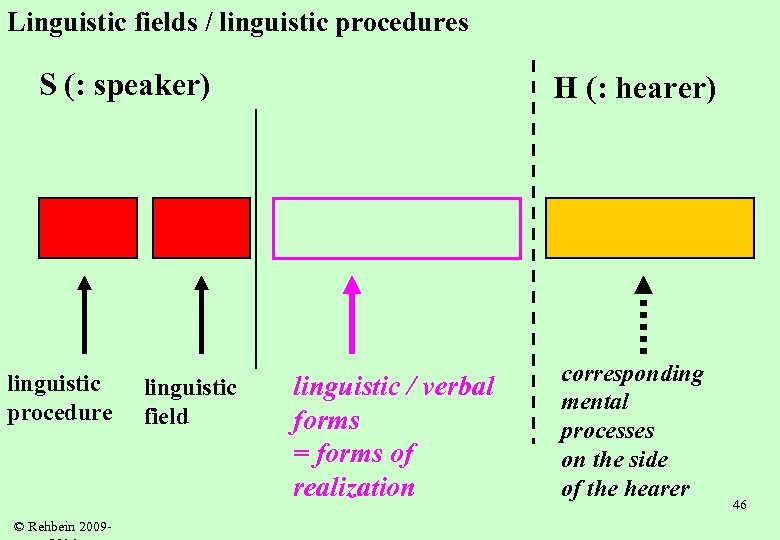
Linguistic fields / linguistic procedures S (: speaker) linguistic procedure © Rehbein 2009 - linguistic field H (: hearer) linguistic / verbal forms = forms of realization corresponding mental processes on the side of the hearer 46
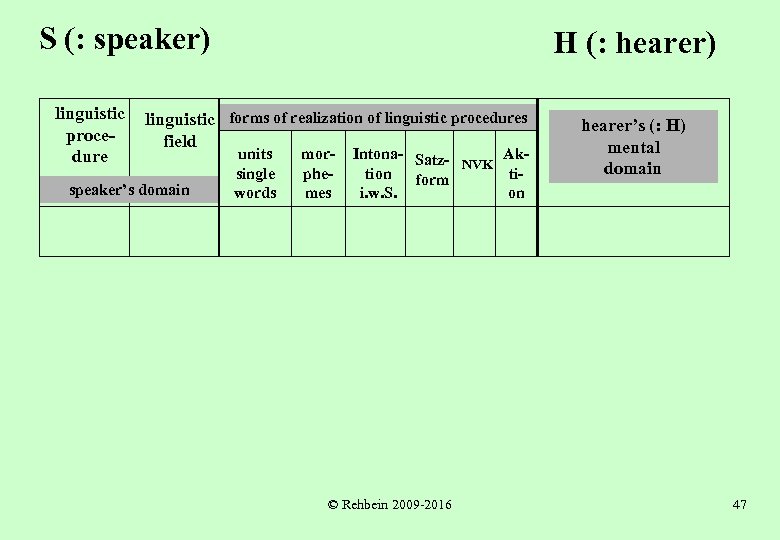
S (: speaker) linguistic procedure H (: hearer) linguistic forms of realization of linguistic procedures field speaker’s domain units single words morphemes Intona- Satz. Ak. NVK tion form tii. w. S. on © Rehbein 2009 -2016 hearer’s (: H) mental domain 47
tinge field Expressive procedures of the ‘tinge field’ are performed by imitations, expressive intonation (e. g. fairy tale prosody) etc. , which verbally create an atmosphere between the speaker and the hearer. © Rehbein 2009 -2016 48
incitement field Incitive procedures of the ‘incitement field’ such as interjections, the imperative morpheme and the vocative, directly encroach upon the different mental dimensions of H without building on propositional structures. Incitive procedures are, for instance, processed by hearer signals such as /uh/ in English. © Rehbein 2009 -2016 49
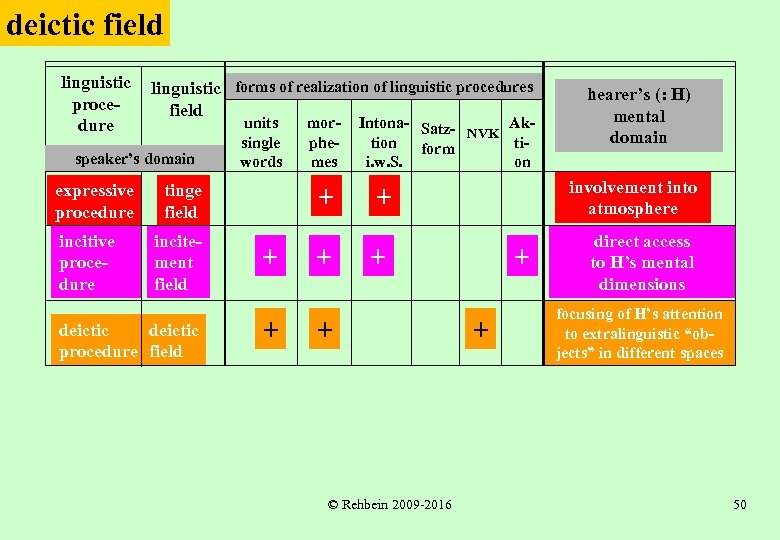
deictic field linguistic procedure linguistic forms of realization of linguistic procedures field speaker’s domain expressive procedure incitive procedure units single words tinge field incitement field deictic procedure field morphemes + + Intona- Satz. Ak. NVK tion form tii. w. S. on involvement into atmosphere + + + © Rehbein 2009 -2016 hearer’s (: H) mental domain + + direct access to H’s mental dimensions focusing of H’s attention to extralinguistic “objects” in different spaces 50
deictic field I ‘Deictics’ focus the attention of H on external linguistic objects, including speaker and hearer; they belong to the ‘deictic field’. ‘Deictic procedures’ such as there, now, then, over there, you and I etc. , are based on the origo of the speech situation. They do not “refer to linguistic units”, but rather focus the attention of the hearer/listener/reader on specific extra-linguistic objects in various mental spaces: in the spaces of perception (Wahrnehmungsraum), of imagination (Vorstellungsraum), of discourse (Rederaum) and of text (Textraum) (Bühler 1934; Ehlich 1979, 1987; Redder 2000 a). Subgroups of deictics are – personal deictics – temporal deictics – local deictics – aspect deictics (as Turkish böyle, şöyle; German so). © Rehbein 2009 -2016 51
deictic field II © Rehbein 2009 -2016 deictic procedures of the deictic field such as “there”, “now”, “then”, “over there”, “you” and “I” etc. , focus (based on the origo of the speech situation) focus the attention of H on certain extra-linguistic objects in different mental focusing spaces : • in the perception space • in the imagination space • in the discourse space [Rederaum] • in the text space. The process of focusing H’s attention on extraverbal objects is valid for objects in mental spaces, too: The deictic procedures do not refer, but they point an object out to the hearer. (Bühler 1934; Ehlich, 1979, 1987 b; Redder, 2000) contrary to deictic procedures, anaphoric procedures which are execu- ted by pronouns like ‘he’, ‘she’, ‘it’ carry out a relationship to a linguistic unit without mediation of H’s attention: They are operative procedures. The term ‘reference‘ current in most of the Anglophone literature levels the categorical difference between these two different procedures belonging to different linguistic fields. 52
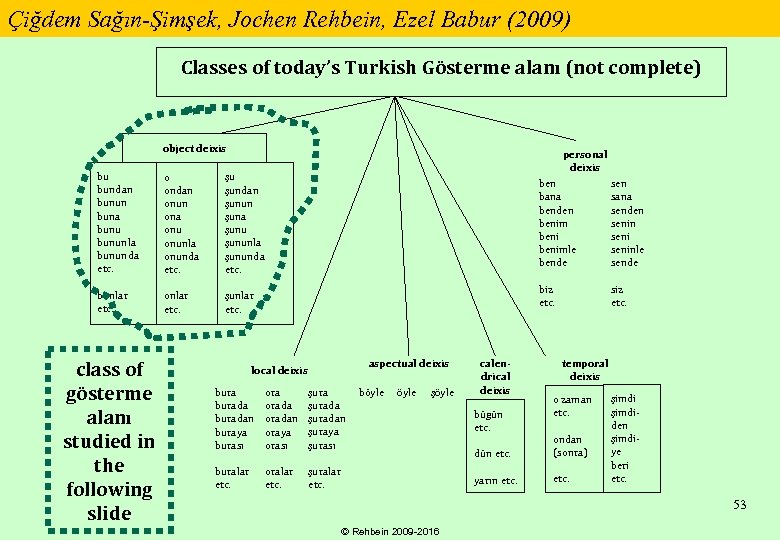
Çiğdem Sağın-Şimşek, Jochen Rehbein, Ezel Babur (2009) Classes of today’s Turkish Gösterme alanı (not complete) object deixis bu bundan bunun buna bununla bununda etc. o ondan onun ona onunla onunda etc. şu şundan şunun şuna şununla şununda etc. bunlar etc. onlar etc. personal deixis şunlar etc. class of gösterme alanı studied in the following slide ben bana benden benimle bende biz etc. aspectual deixis local deixis buradan buraya burası oradan oraya orası şuradan şuraya şurası buralar etc. oralar etc. böyle şuralar etc. öyle şöyle calendrical deixis bügün etc. sen sana senden seninle sende siz etc. temporal deixis o zaman etc. dün etc. ondan (sonra) yarın etc. şimdiden şimdiye beri etc. 53 © Rehbein 2009 -2016
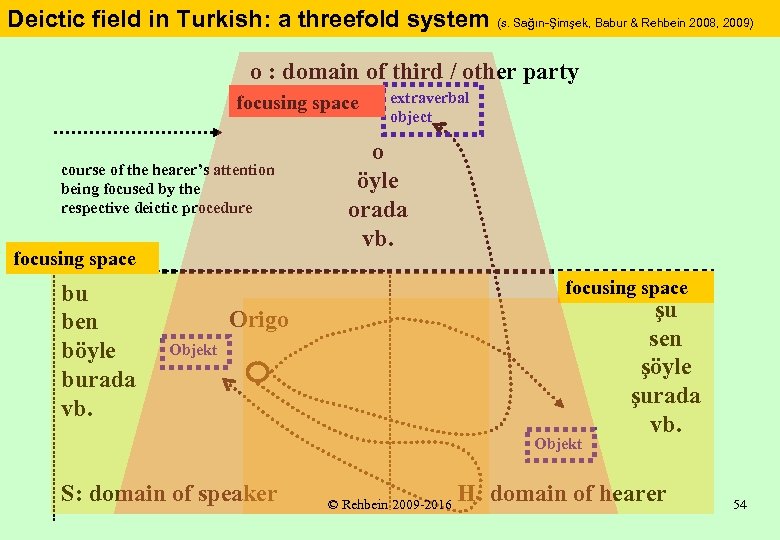
Deictic field in Turkish: a threefold system (s. Sağın-Şimşek, Babur & Rehbein 2008, 2009) o : domain of third / other party focusing space course of the hearer’s attention being focused by the respective deictic procedure focusing space bu ben böyle burada vb. extraverbal object o öyle orada vb. focusing space Origo Objekt S: domain of speaker © Rehbein 2009 -2016 şu sen şöyle şurada vb. H: domain of hearer 54
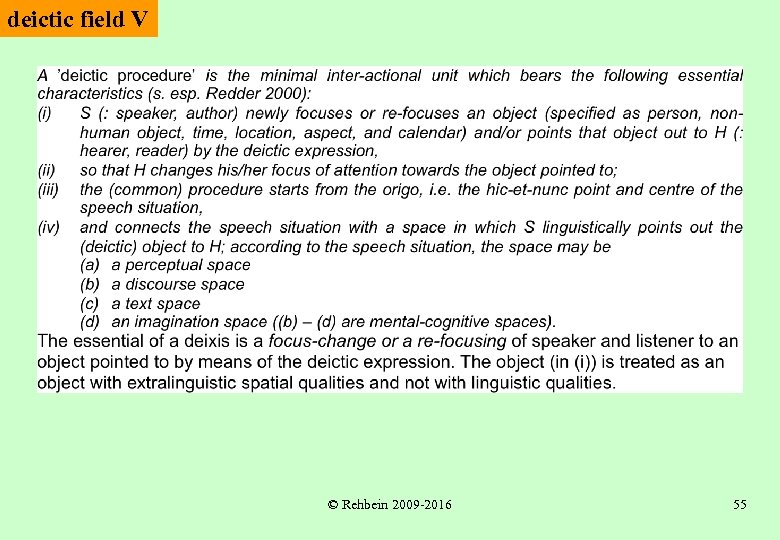
deictic field V © Rehbein 2009 -2016 55
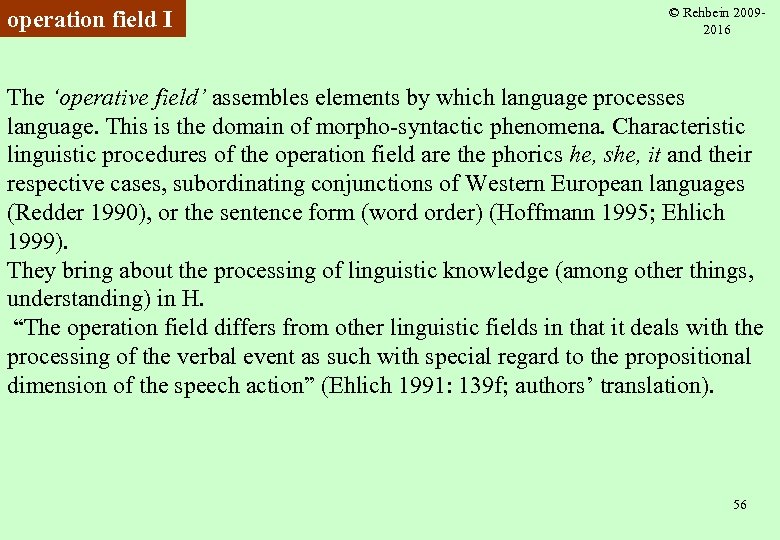
operation field I © Rehbein 20092016 The ‘operative field’ assembles elements by which language processes language. This is the domain of morpho-syntactic phenomena. Characteristic linguistic procedures of the operation field are the phorics he, she, it and their respective cases, subordinating conjunctions of Western European languages (Redder 1990), or the sentence form (word order) (Hoffmann 1995; Ehlich 1999). They bring about the processing of linguistic knowledge (among other things, understanding) in H. “The operation field differs from other linguistic fields in that it deals with the processing of the verbal event as such with special regard to the propositional dimension of the speech action” (Ehlich 1991: 139 f; authors’ translation). 56
operation field II © Rehbein 20092016 The operative procedure of the operation field such as the phoric procedures he, she, it and their cases or subordinate conjunctions (Redder, 1990), the sentence form (word order) (Hoffmann 1996; Ehlich 1999 a) brings about the processing of linguistic knowledge (among others, understanding) in H. Most of the particles in Western European languages (like engl. yet, still, even etc. , fr. encore, gm. noch, wohl, mal, eben etc. ) as well as coordinate conjunctions (equivalents of engl. but, and, or, also etc. ) can be categorized as operative procedures. » The operation field differs from other linguistic fields in that it deals with the processing of the verbal event as such with special regard of the propositional dimension of the speech action. Minimal requirements of interaction as mere cooperation by interjections and the like are not taken into consideration within the frame of the operation field. « (Ehlich 1991, 139/140) 57
operation field III © Rehbein 20092016 The propositional dimension may be inferred from two facts: • the segmentation of many utterances in many languages according to constituents, phrases etc. with a certain head-modifier-structure and other structural morphosyntactic and semantic characteristics is linked with the verbalisation of the propositional content; • together with this segmentation, the dimension of linguistic knowledge, based on linguistic procedures, forms a linguistically determined space of knowledge (s. Redder 1990, Rehbein 1977) especially in the hearer’s domain of knowledge. For example, gm. conjunction denn (because) which contains an operative procedure, contributes to the extension of the propositional knowledge (of the respective utterance) to a space of knowledge common to speaker and hearer. Particles and coordinative conjunctions do not constitute phrases, but are operating on phrases by taking them into their scope relating the “phrasal knowledge” to common space of knowledge. 58 Another example of operative procedures are wh-elements (s. b. ).
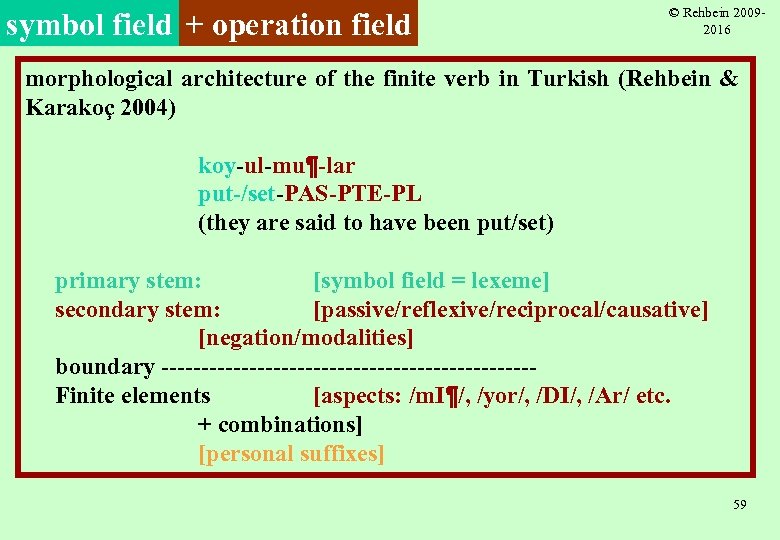
symbol field + operation field © Rehbein 20092016 morphological architecture of the finite verb in Turkish (Rehbein & Karakoç 2004) koy-ul-mu¶-lar put-/set-PAS-PTE-PL (they are said to have been put/set) primary stem: [symbol field = lexeme] secondary stem: [passive/reflexive/reciprocal/causative] [negation/modalities] boundary -----------------------Finite elements [aspects: /m. I¶/, /yor/, /DI/, /Ar/ etc. + combinations] [personal suffixes] 59
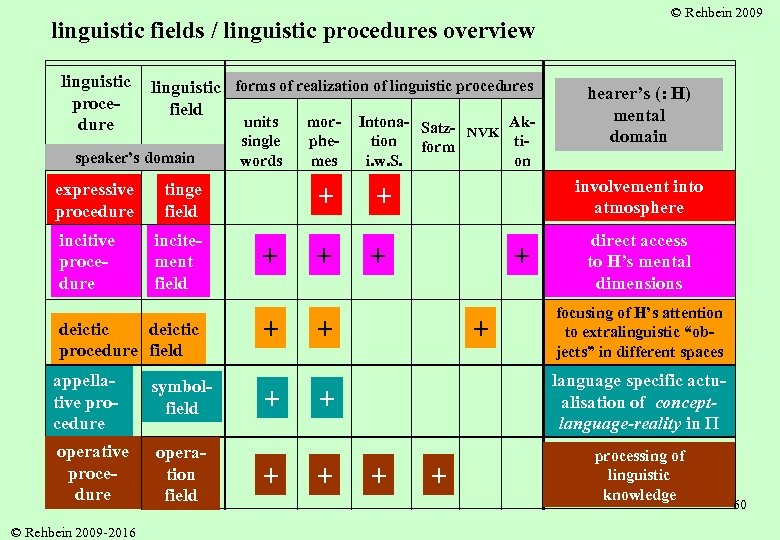
linguistic fields / linguistic procedures overview linguistic procedure linguistic forms of realization of linguistic procedures field speaker’s domain expressive procedure incitive procedure tinge field incitement field deictic procedure field appellative procedure symbolfield operative procedure operation field © Rehbein 2009 -2016 units single words morphemes + + + Intona- Satz. Ak. NVK tion form tii. w. S. on © Rehbein 2009 hearer’s (: H) mental domain involvement into atmosphere + + + direct access to H’s mental dimensions focusing of H’s attention to extralinguistic “objects” in different spaces + language specific actualisation of conceptlanguage-reality in P + processing of linguistic knowledge + + 60
symbol field © Rehbein 2009 -2016 The ‘symbol field’ with its symbolic, or appellative, procedures provides the linguistic potential for the verbalization and reception of knowledge. In discourse/text, i. e. in the synsemantic environment, the linguistic naming transfers reality into a category of knowledge (Rehbein 1998). ‘Prepositions’, which represent ontological relationships, along with ‘auxiliaries’, which in Indo-European languages represent abstract processes, belong to the ‘symbol field’. In general, the ‘symbol field’ with its appellative procedures covers the lexical components of nouns, verbs, adjectives, and adpositions as used in discourse and text. Moreover, language specific speech formulae form complex symbolic procedures. With the help of the appellative procedures of the symbol field, e. g. nouns, verbs, adjectives, adpositions (traditionally known as lexical constituents), an element of reality is given a linguistic form and, in this way, removed from its situational embeddedness and made identifiable to other actants, who have the respective nomenclature at their disposal. Thus, when S uses an appellative procedure, H is enabled, based on his knowledge, to find the 61 named element of reality.
Field transpositions © Rehbein 20092016 The fact of a field transposition of a linguistic element is indicated by the prefix ‘para’preposed to the name of the new linguistic field the linguistic element belongs to. Example: a) The originally operative procedure gm. pl. pronoun sie is para-deictic after having undergone the field transposition to the deictic field as polite address form Sie. b) Subordinative conjunction contain a historical development from the deictic field to the operation field (cf. gm. als, dass, indem engl. that etc. ): they are para-operative procedures. 62
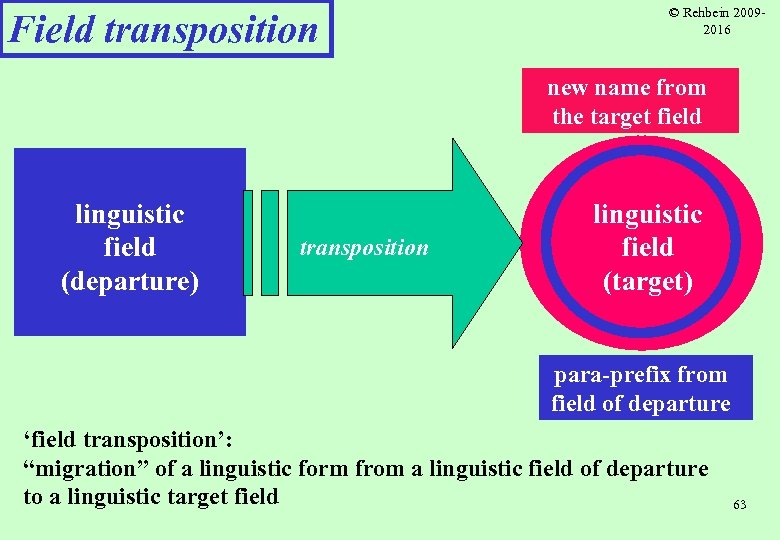
Field transposition © Rehbein 20092016 new name from the target field linguistic field (departure) transposition linguistic field (target) para-prefix from field of departure ‘field transposition’: “migration” of a linguistic form from a linguistic field of departure to a linguistic target field 63
Remarks on a theory of contact induced language change I argue that some existing theories on language contact should be supplemented by a functional explication of contact-induction. In this respect I resorted to theory of field transposition of Functional Pragmatics, according to which contact-induced language change can be understood as a form-function-oriented process from state/variety A of a language to state/variety A’, which is catalyzed (or mediated) by the inducing language which, in turn, is activated in multilingual communication. With a clear-cut distinction between forms/structures and functions of a language, we can observe, then, that forms/structures of a language very often seem to remain the same from A to A’, but gradually expand to adopt new functions. It is this functional domain of a language change which we describe by means of the concept of ‘linguistic procedure’. 64 © Rehbein 2009 -2016
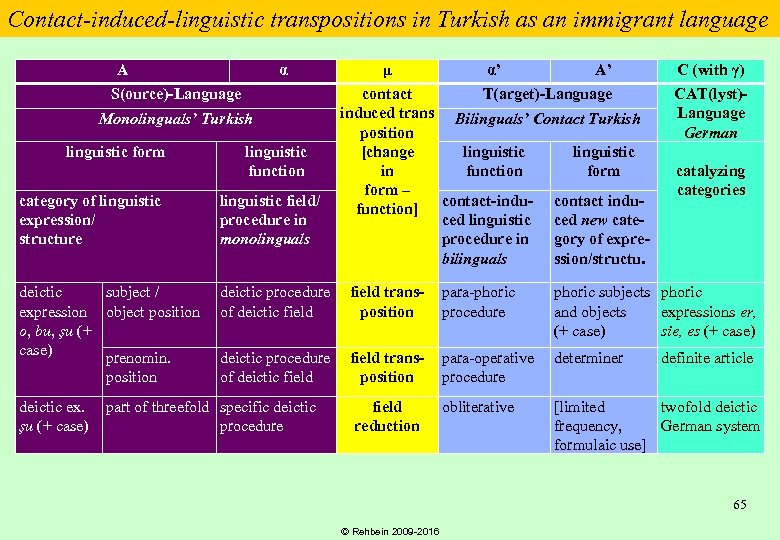
Contact-induced-linguistic transpositions in Turkish as an immigrant language A α S(ource)-Language Monolinguals’ Turkish linguistic form linguistic function μ α’ A’ contact T(arget)-Language induced trans Bilinguals’ Contact Turkish position [change linguistic in function form – contact-indu- contact indufunction] ced linguistic ced new cateprocedure in gory of exprebilinguals ssion/structu. C (with γ) CAT(lyst)Language German catalyzing categories category of linguistic expression/ structure linguistic field/ procedure in monolinguals deictic subject / expression object position o, bu, şu (+ case) prenomin. position deictic procedure of deictic field transposition para-phoric procedure phoric subjects phoric and objects expressions er, (+ case) sie, es (+ case) deictic procedure of deictic field transposition para-operative procedure determiner field reduction obliterative [limited twofold deictic frequency, German system formulaic use] deictic ex. şu (+ case) part of threefold specific deictic procedure definite article 65 © Rehbein 2009 -2016
Remarks on a theory of contact induced language change II To formulate it more abstractly: The inventory of linguistic procedures of a variety A will roughly be summed up as ‘α’, the one of C as ‘γ’. If we call A the monolingually based ‘source variety’ (here Turkish), A’ the bilingually based ‘target variety’ (here Contact Turkish), C the ‘catalyst language’ (here German), α and γ the inventories of linguistic procedures, then we formulate the function μ (α + γ) = α’, where μ is the projection of the linguistic procedural inventories (of A plus C) into the target variety A’ thus generating the linguistic procedural inventory α’ of A’ by means of field transpositions (see the following table); μ may be characterized as ‘contact induction’, and is carried through by bilingual speakers applying both language inventories, α and γ, and activating them within their communication process. ‘μ’ stands for anc. Greek μεταβολή or μεταλλαγή ‘change’. In functional-pragmatic theory, Greek terms generally refer to the 66 mental/cognitive domain of linguistic actions. © Rehbein 2009 -2016
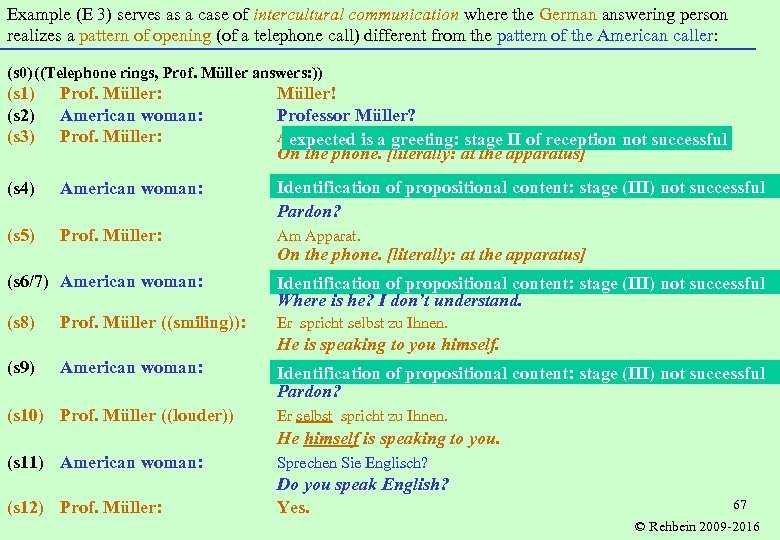
Example (E 3) serves as a case of intercultural communication where the German answering person realizes a pattern of opening (of a telephone call) different from the pattern of the American caller: (s 0) ((Telephone rings, Prof. Müller answers: )) (s 1) (s 2) (s 3) Prof. Müller: American woman: Prof. Müller: Müller! Professor Müller? Am Apparat. is a greeting: stage II of reception not successful expected On the phone. [literally: at the apparatus] (s 4) American woman: Identification of propositional content: stage (III) not successful Bitte? Pardon? (s 5) Prof. Müller: Am Apparat. On the phone. [literally: at the apparatus] (s 6/7) American woman: Wo ist er? Ich verstehe nicht. Identification of propositional content: stage (III) not successful Where is he? I don’t understand. (s 8) Er spricht selbst zu Ihnen. Prof. Müller ((smiling)): He is speaking to you himself. (s 9) American woman: (s 10) Prof. Müller ((louder)) Bitte? Identification of propositional content: stage (III) not successful Pardon? Er selbst spricht zu Ihnen. He himself is speaking to you. (s 11) American woman: Sprechen Sie Englisch? (s 12) Prof. Müller: Do you speak English? Yes. 67 © Rehbein 2009 -2016
Intercultural communication I © Rehbein 2009 -2016 In intercultural communication (or: multilingual communication), interactants from a different linguistic backgrounds and/or from different social classes / groups communicate with each other in making use of their respective discourse/text species, institutional knowledge, patterns of actions, diverse illocutionary, propositional and/or utterance acts, linguistic procedures and/or their apparatuses. All pragmatic dimensions are cross-linguistically specified according to their realization by means of the respective linguistic forms (morpho-syntax, prosody etc. ). Correspondingly, intercultural communication is systematically linked to all concepts of pragmatics (s. Rehbein 1985, 1994, 2002, 2006; House & Rehbein 2004). In intercultural communication, interactants very often synthesize new forms of discourses / texts, new patterns of actions and speech actions (s. Koole & ten Thije 1994, Ohama 1986) or, in generating language change via language contact, new variants of a language, as e. g. German Turkish (s. Rehbein 2001, 68 Herkenrath, Rehbein & Karakoç 2003, Rehbein, Herkenrath & Karakoç 2009).
Intercultural communication II © Rehbein 2009 -2016 In intercultural and in multilingual communication, the solution of misunderstandings, problem talk and the creating of new (pragmatic) structures are due to the application of an apparatus, called ‘cultural apparatus’ (s. Redder & Rehbein 1987, Rehbein 2006, 2008). The cultural apparatus initiates cultural action in a strict sense, if at least one of the participants submits the communication to reflection by opening his or her eyes on the tacit presuppositions made and so tries to reorganize (at least partially) mental structures and processes, like ‘action practices’, ‘thought patterns’, ‘conceptual forms’, ‘experience’, ‘pattern knowledge’ a. o. which underly communication. In the light of theory of cultural apparatus, prejudices are based on the repetitive usage of unquestioned systems of presuppositions which, paradoxically, stem from cultural action. 69
Intercultural communication III © Rehbein 2009 -2016 Action practices, thought patterns, conceptual forms, experiences, pattern knowledge a. o are altered into and fixated as prejudices (unreflected knowledge) by being repetitively used with everyday familiarity and custom, and intersperse intercultural communication as a “cultural filter” (as House 1997 states). In contrast to a “cultural filter”, however, a cultural apparatus reflects communicative structures in such a way that a falling back on a status quo ante is not at all possible. Breaking the “cultural filter” by applying the cultural apparatus to mental processes of the respective participants seems to be especially necessary in international confrontations against the shadow of unquestioned warfare action practices, as in the Near East. 70
![© Rehbein 2009 -2016 concepts of pragmatics Institutions of society [pragmem (Praxeogramme)] speaker-hearer-distinction understanding](https://present5.com/presentation/48c85644d2b6688918b29511cfe98f85/image-71.jpg "© Rehbein 2009 -2016 concepts of pragmatics Institutions of society [pragmem (Praxeogramme)] speaker-hearer-distinction understanding")
© Rehbein 2009 -2016 concepts of pragmatics Institutions of society [pragmem (Praxeogramme)] speaker-hearer-distinction understanding constellation Methodology of linguistic analysis discourse / text pattern of (speech)action speech action as process of action intercultural communication apparatuses [turn taking, speaker-hearersteering; mental apparatus; cultural apparatus] politeness acts linguistic procedures/ linguistic fields linguistic forms (morpho-syntax, © Rehbein 2009 -2016 prosody etc. ) knowledge 71 structures
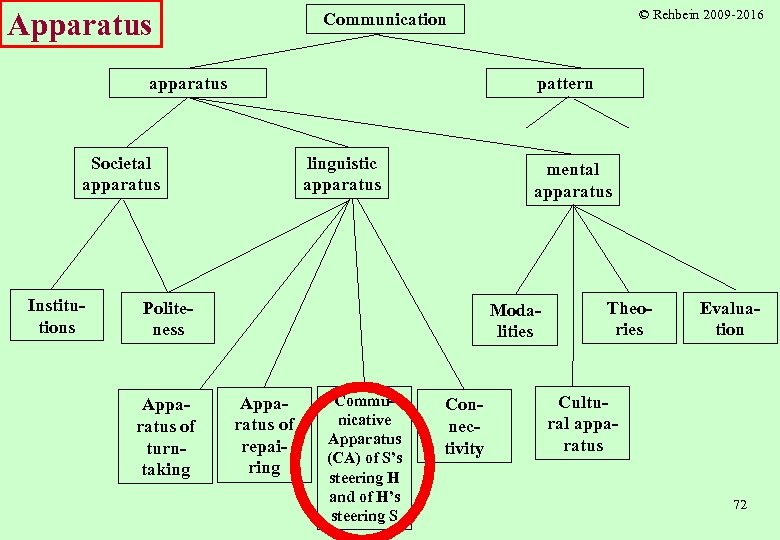
Apparatus apparatus pattern linguistic apparatus Societal apparatus Institutions mental apparatus Politeness Apparatus of turntaking © Rehbein 2009 -2016 Communication Modalities Apparatus of repairing Communicative Apparatus (CA) of S’s steering H and of H’s steering S Connectivity Theories Evaluation Cultural apparatus 72
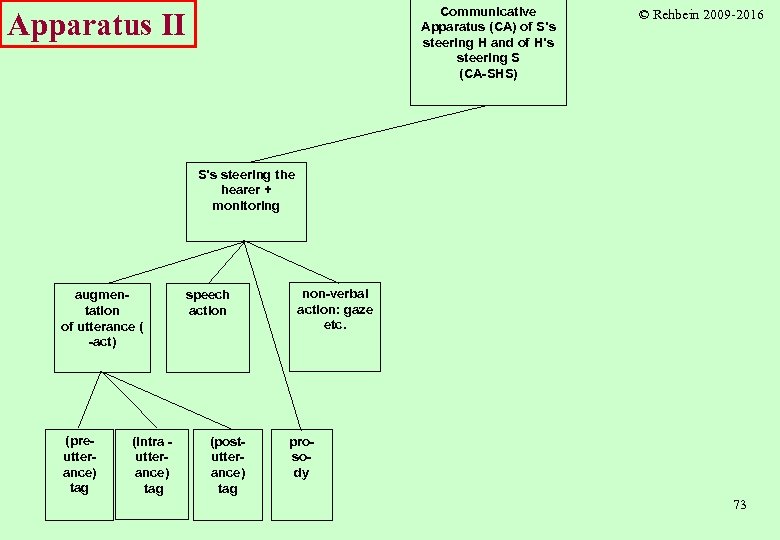
Communicative Apparatus (CA) of S’s steering H and of H’s steering S (CA-SHS) Apparatus II © Rehbein 2009 -2016 S’s steering the hearer + monitoring augmentation of utterance ( -act) (preutterance) tag (intra utterance) tag speech action (postutterance) tag non-verbal action: gaze etc. prosody 73
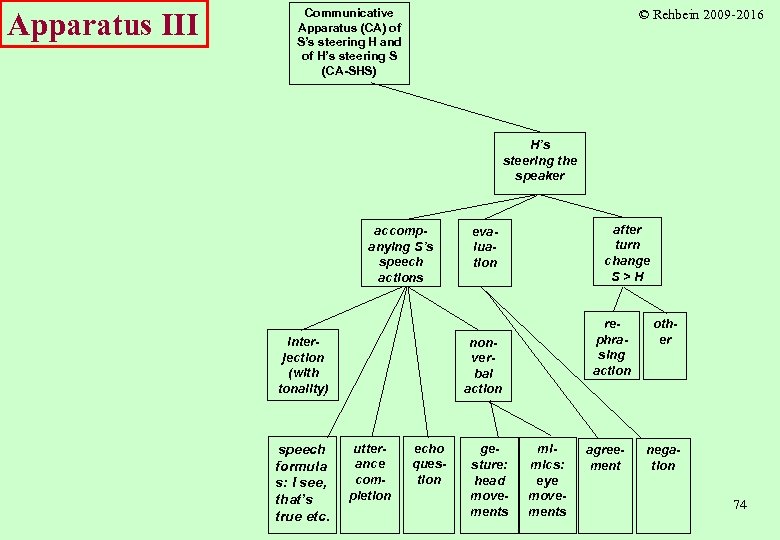
Apparatus III © Rehbein 2009 -2016 Communicative Apparatus (CA) of S’s steering H and of H’s steering S (CA-SHS) H’s steering the speaker accompanying S’s speech actions interjection (with tonality) speech formula s: I see, that’s true etc. after turn change S>H evaluation rephrasing action nonverbal action utterance completion echo question gesture: head movements mimics: eye movements agreement other negation 74
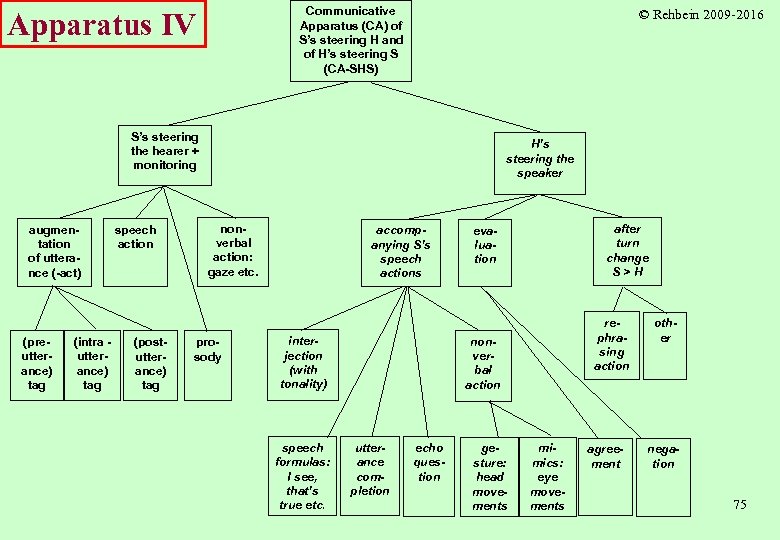
Communicative Apparatus (CA) of S’s steering H and of H’s steering S (CA-SHS) Apparatus IV © Rehbein 2009 -2016 S’s steering the hearer + monitoring H’s steering the speaker augmentation of utterance (-act) (preutterance) tag (intra utterance) tag speech action (postutterance) tag nonverbal action: gaze etc. prosody accompanying S’s speech actions interjection (with tonality) speech formulas: I see, that’s true etc. after turn change S>H evaluation rephrasing action nonverbal action utterance completion echo question gesture: head movements mimics: eye movements agreement other negation 75
![© Rehbein 2009 -2016 concepts of pragmatics Institutions of society [pragmem (Praxeogramme)] speaker-hearer-distinction understanding](https://present5.com/presentation/48c85644d2b6688918b29511cfe98f85/image-76.jpg "© Rehbein 2009 -2016 concepts of pragmatics Institutions of society [pragmem (Praxeogramme)] speaker-hearer-distinction understanding")
© Rehbein 2009 -2016 concepts of pragmatics Institutions of society [pragmem (Praxeogramme)] speaker-hearer-distinction understanding constellation discourse / text pattern of (speech)action speech action as process of action intercultural communication apparatuses [turn taking, speaker-hearersteering; mental apparatus; cultural apparatus] politeness acts linguistic procedures/ linguistic fields linguistic forms (morpho-syntax, © Rehbein 2009 -2016 prosody etc. ) knowledge structures 76
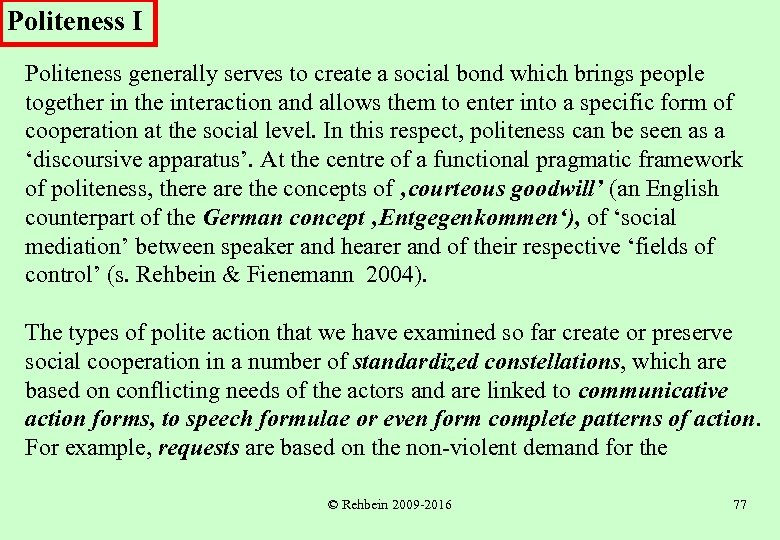
Politeness I Politeness generally serves to create a social bond which brings people together in the interaction and allows them to enter into a specific form of cooperation at the social level. In this respect, politeness can be seen as a ‘discoursive apparatus’. At the centre of a functional pragmatic framework of politeness, there are the concepts of ‚courteous goodwill’ (an English counterpart of the German concept ‚Entgegenkommen‘), of ‘social mediation’ between speaker and hearer and of their respective ‘fields of control’ (s. Rehbein & Fienemann 2004). The types of polite action that we have examined so far create or preserve social cooperation in a number of standardized constellations, which are based on conflicting needs of the actors and are linked to communicative action forms, to speech formulae or even form complete patterns of action. For example, requests are based on the non-violent demand for the © Rehbein 2009 -2016 77
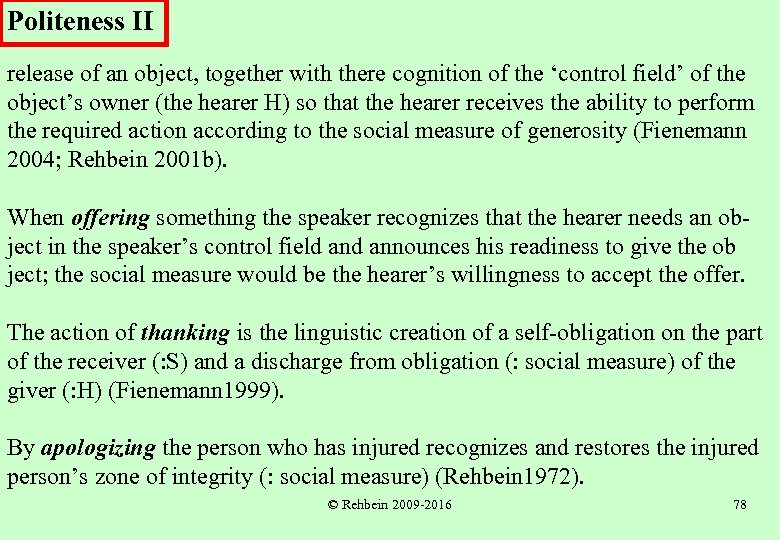
Politeness II release of an object, together with there cognition of the ‘control field’ of the object’s owner (the hearer H) so that the hearer receives the ability to perform the required action according to the social measure of generosity (Fienemann 2004; Rehbein 2001 b). When offering something the speaker recognizes that the hearer needs an object in the speaker’s control field announces his readiness to give the ob ject; the social measure would be the hearer’s willingness to accept the offer. The action of thanking is the linguistic creation of a self-obligation on the part of the receiver (: S) and a discharge from obligation (: social measure) of the giver (: H) (Fienemann 1999). By apologizing the person who has injured recognizes and restores the injured person’s zone of integrity (: social measure) (Rehbein 1972). © Rehbein 2009 -2016 78
Politeness III Verbal and non-verbal action forms, in and with which the actors, depending on their conflicting needs, accommodate each other in order to create, maintain or alter a social relationship, can be regarded as the results of sociohistorical developments (s. Ehlich 1992). Likewise, from a socio-historical perspective, these forms have become bound to corresponding socially standardized constellations. Seen from an actiontheoretical perspective, in using polite forms of speaking and acting, a speaker S shows courteous goodwill whereby s/he enables the hearer H to act according to social measures, so that the – potentially – incompatible control fields of S and H are “neutralized” and their respective‘ action fields’ are calibrated. It is essential that S, by means of polite action, should refrain from subjecting H to the natural state of her/his (i. e. S’s) needs and/or to her/his force and power and that S should put her/himself in charge of rights and duties first, instead of acting as an unreflecting individual. 79 © Rehbein 2009 -2016
Politeness IV © Rehbein 2009 -2016 Critical note The view taken by researchers continuing the work of Brown and Levinson (1987) has been that politeness is a ‘strategy’ to give the interaction partner a “face” (Goffman 1955) or avoid injury to face. Negative politeness strategies serve to defend the speaker’s own „territory“, positive strategies aim to preserve the positive face of the hearer, even to the extent of flattery, so that s/he does notice that the speaker is really pursuing her/his own, egoistic interests. To exaggerate a little: to Brown and Levinson polite action means to deceive the hearer so skilfully, that s/he does notice the deception. The model of a competitive society which underlies theory of Brown and Levinson is what leads to the notion that politeness is fundamentally a strategic instrument for the realization of one’s own interests. Our view is that polite action gives the interaction partner (i. e. the hearer) a social role, which is more than simply individual behaviour, rather it is to be seen as a position in the overall structures of society. Indeed a social role – in ist original Greek meaning of “mask, role, person” – 80 can also be termed a “face”.
![© Rehbein 2009 -2016 concepts of pragmatics Institutions of society [pragmem (Praxeogramme)] speaker-hearer-distinction understanding](https://present5.com/presentation/48c85644d2b6688918b29511cfe98f85/image-81.jpg "© Rehbein 2009 -2016 concepts of pragmatics Institutions of society [pragmem (Praxeogramme)] speaker-hearer-distinction understanding")
© Rehbein 2009 -2016 concepts of pragmatics Institutions of society [pragmem (Praxeogramme)] speaker-hearer-distinction understanding constellation discourse / text pattern of (speech)action speech action as process of action intercultural communication apparatuses [turn taking, speaker-hearersteering; mental apparatus; cultural apparatus] politeness acts linguistic procedures/ linguistic fields linguistic forms (morpho-syntax, © Rehbein 2009 -2016 prosody etc. ) knowledge 81 structures
Language and communication in institutions I One of the main areas of research of Functional Pragmatics has been and will be language and communication in diverse institutions of society and societies (in a comparatistic perspective). I only mention institutions here which have been objects of deeper study: • institutions of education (family, kindergarten, school etc. ) • language of science (universities, laboratories etc. ) • business, economics, tourism • diverse workplaces © Rehbein 2009 -2016 82
Language and communication in institutions II • medical institutions, health care, psychiatry • court and law • administration, state institutions • political institutions • media • (advice giving) institutes • communication in enterprise management Many other institutions and sub-institutions wait for being studied. Also, the processes of the change of institutions and the talk therein can be investigated and can be subject to a cross linguistic comparison. The following slide yields a rough overview. 83 © Rehbein 2009 -2016
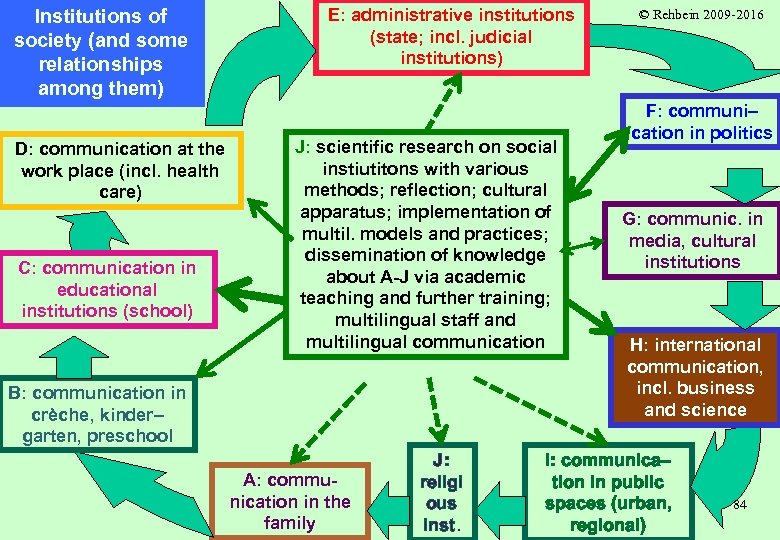
E: administrative institutions (state; incl. judicial institutions) Institutions of society (and some relationships among them) D: communication at the work place (incl. health care) C: communication in educational institutions (school) J: scientific research on social instiutitons with various methods; reflection; cultural apparatus; implementation of multil. models and practices; dissemination of knowledge about A-J via academic teaching and further training; multilingual staff and multilingual communication B: communication in crèche, kinder– garten, preschool A: communication in the family J: religi ous inst. © Rehbein 2009 -2016 F: communi– cation in politics G: communic. in media, cultural institutions H: international communication, incl. business and science I: communica– tion in public spaces (urban, regional) 84
![© Rehbein 20092016 concepts of pragmatics Institutions of society [pragmem (Praxeogramme)] speaker-hearer-distinction understanding constellation](https://present5.com/presentation/48c85644d2b6688918b29511cfe98f85/image-85.jpg "© Rehbein 20092016 concepts of pragmatics Institutions of society [pragmem (Praxeogramme)] speaker-hearer-distinction understanding constellation")
© Rehbein 20092016 concepts of pragmatics Institutions of society [pragmem (Praxeogramme)] speaker-hearer-distinction understanding constellation Methodology of linguistic analysis discourse / text pattern of (speech)action speech action as process of action intercultural communication apparatuses [turn taking, speaker-hearersteering; mental apparatus; cultural apparatus] politeness acts linguistic procedures/ linguistic fields linguistic forms (morpho-syntax, prosody etc. ) knowledge 85 structures
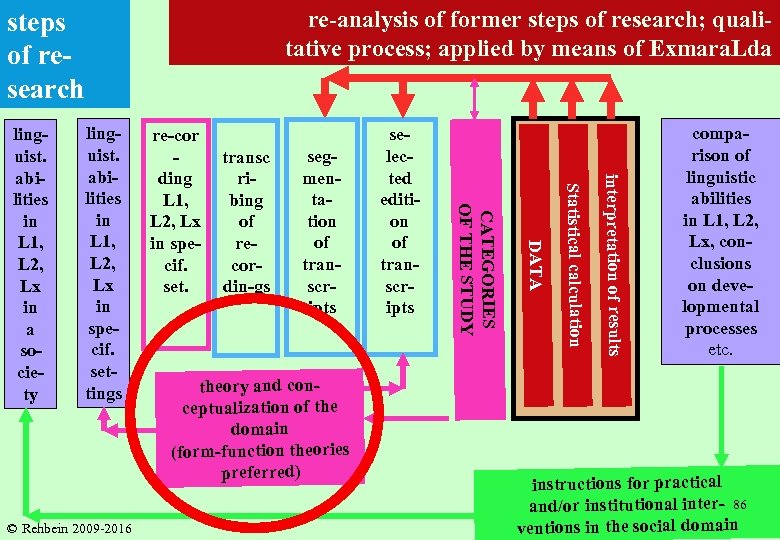
re-analysis of former steps of research; qualitative process; applied by means of Exmara. Lda steps of research segmentation of transcripts theory and conceptualization of the domain (form-function theories preferred) interpretation of results transc ribing of recordin-gs selected edition of transcripts Statistical calculation © Rehbein 2009 -2016 re-cor ding L 1, L 2, Lx in specif. set. DATA linguist. abilities in L 1, L 2, Lx in specif. settings CATEGORIES OF THE STUDY linguist. abilities in L 1, L 2, Lx in a society comparison of linguistic abilities in L 1, L 2, Lx, conclusions on developmental processes etc. instructions for practical and/or institutional inter- 86 ventions in the social domain
![© Rehbein 2009 -2016 concepts of pragmatics Institutions of society [pragmem (Praxeogramme)] speaker-hearer-distinction understanding](https://present5.com/presentation/48c85644d2b6688918b29511cfe98f85/image-87.jpg "© Rehbein 2009 -2016 concepts of pragmatics Institutions of society [pragmem (Praxeogramme)] speaker-hearer-distinction understanding")
© Rehbein 2009 -2016 concepts of pragmatics Institutions of society [pragmem (Praxeogramme)] speaker-hearer-distinction understanding constellation discourse / text pattern of (speech)action speech action as process of action intercultural communication apparatuses [turn taking, speaker-hearersteering; mental apparatus; cultural apparatus] politeness acts linguistic procedures/ linguistic fields linguistic forms (morpho-syntax, prosody etc. ) Methodology of linguistic analysis Exmara. Lda transcription program and database knowledge structures 87
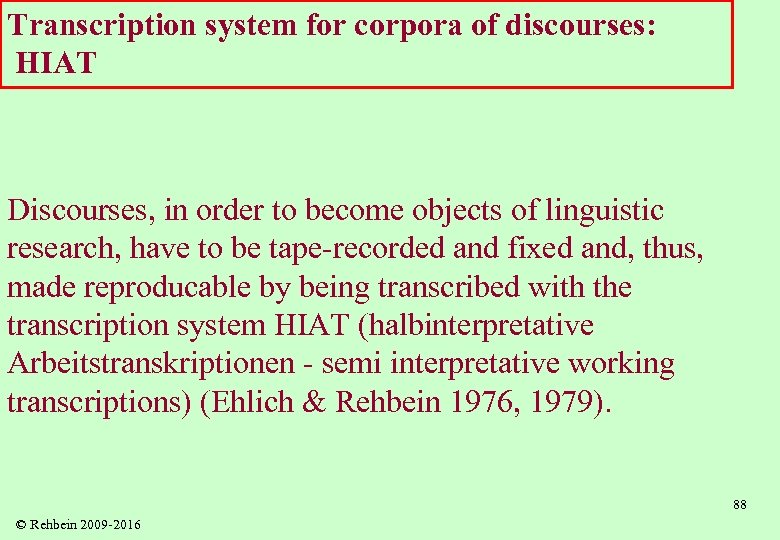
Transcription system for corpora of discourses: HIAT Discourses, in order to become objects of linguistic research, have to be tape-recorded and fixed and, thus, made reproducable by being transcribed with the transcription system HIAT (halbinterpretative Arbeitstranskriptionen - semi interpretative working transcriptions) (Ehlich & Rehbein 1976, 1979). 88 © Rehbein 2009 -2016
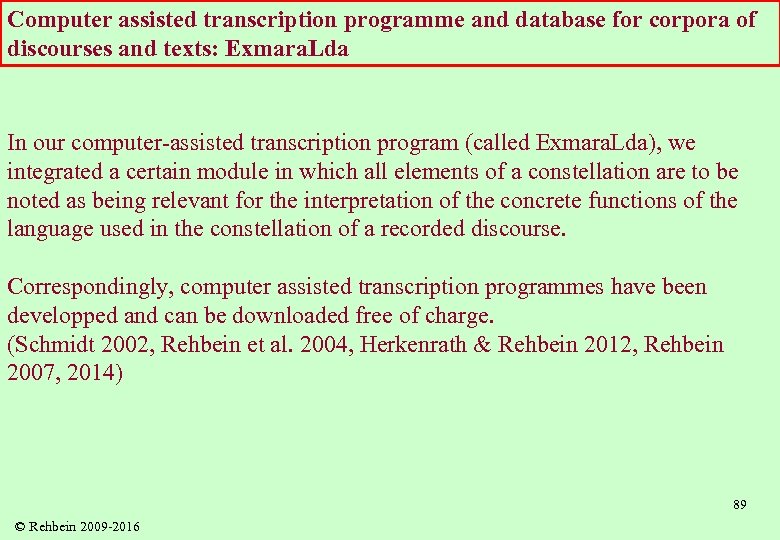
Computer assisted transcription programme and database for corpora of discourses and texts: Exmara. Lda In our computer-assisted transcription program (called Exmara. Lda), we integrated a certain module in which all elements of a constellation are to be noted as being relevant for the interpretation of the concrete functions of the language used in the constellation of a recorded discourse. Correspondingly, computer assisted transcription programmes have been developped and can be downloaded free of charge. (Schmidt 2002, Rehbein et al. 2004, Herkenrath & Rehbein 2012, Rehbein 2007, 2014) 89 © Rehbein 2009 -2016
References I Brown, P. / Levinson, S. C. (1987) Politeness: Some universals in language use. Cambridge: University Press Brünner, G. / Graefen, G. (eds. ) (1994) Texte und Diskurse. Methoden und Forschungsergebnisse der Funktionalen Pragmatik. Westdeutscher Verlag: Opladen Bühler, K. (1934) Sprachtheorie. Die Darstellungsfunktion der Sprache. Jena: Fischer (1978 Frankfurt/M. : Ullstein) (engl. Theory of Language. The Representational Function of Language. Translated by D. F. Goodwin (1990) Amsterdam, Philadelphia: John Benjamins) Bührig, K. (1996) Reformulierende Handlungen. Zur Analyse sprachlicher Adaptierungsprozesse in institutioneller Kommunikation. Tübingen: Narr - (2005) “Speech Action Patterns” and “Discourse Types”. In: Folia Linguistica XXXIX/1 -2, 143 -171 - (2007) Konnektivpartikel. In: Hoffmann, L. (Hg. ) Handbuch der deutschen Wortarten. Berlin, New York: Walter de Gruyter, 525 -546 - / Rehbein, J. (1996) Reproduzierendes Handeln. Übersetzen, simultanes und konsekutives Dolmetschen im diskursanalytischen Vergleich. In: Arbeiten zur Mehrsprachigkeit Working papers in Multilingualism. Series B, 6/2000. Universität Hamburg: Sonderforschungsbereich 538. - / Matras, Y. (1999) Einleitung. In: dies. (eds. ) Sprachtheorie und sprachliches Handeln. Tübingen: Stauffenburg, vii-xii - / ten Thije, J. D. (2004) Diskurspragmatische Beschreibung. Artikel 123 in: Ammon, U. ; Dittmar, N. ; Mattheier, K. J. / Trudgill, P. (eds. ) Handbook ''Sociolinguistics'' / Handbuch ''Soziolinguistik''. 2. , vollständig neu bearbeitete und erweiterte Auflage. Handbücher Sprache und Kommunikation (HSK). Vol. II. Berlin etc. : de. Gruyter (im Druck) - / - (eds. ) (2006) Beyond Misunderstanding. Linguistic analyses of intercultural communication. Amsterdam, Philadelphia: John Benjamins Clyne, M. (1994) Inter-cultural communication at work. Cultural values in discourse. Cambridge: University Press Ehlich, K. (1974) “Illocutionary Act” – A Useful Category for a Materialistic Analysis of Language. In: id. - (1979) Verwendungen der Deixis beim sprachlichen Handeln. Linguistisch-philologische Untersuchungen zum hebräischen deiktischen System. Frankfurt/M. : Lang - (1983) Text und sprachliches Handeln. Die Entstehung von Texten aus dem Bedürfnais nach Überlieferung, in: Assmann, A. , Assmann, J. , /Hardmeier, C. (eds. ) Schrift und Gedächtnis. Beiträge zur Archäologie der literarischen Kommunikation. München: Fink, 24 -43 - (1984 a) Zum Textbegriff. In: Rothkegel, A. /Sandig, B. (eds. ) Text - Textsorten - Semantik. Linguistische Modelle und maschinelle Verfahren. Hamburg: Buske, 9 -25 - (1984 b) Sprechhandlungsanalyse. In: Haft, H. / Kordes, H. (eds. ) Methoden der Erziehungs- und Bildungsforschung. Bd. 2. Stuttgart: Klett-Cotta, 526 -538 - (1986) Interjektionen. Tübingen: Niemeyer - (1987) so - Überlegungen zum Verhältnis sprachlicher Formen und sprachlichen Handelns, allgemein und an einem widerspenstigen Beispiel. In: Rosengren, Inger (ed. )(1987) Sprache und Pragmatik. Stockholm: Almquist & Wiksell, 279 -298 - (1992) Zum Satzbegriff. In: Hoffmann, L. (ed. ) Deutsche Syntax. Ansichten und Aussichten. Berlin: de Gryuter, 386 -395 - (1994) Funktionale Etymologie. In: Brünner, G. /Graefen, G. (eds. ), 68 -82 - (1991) Funktional-pragmatische Kommunikationsanalyse. In: Flader, D. (ed. ) Verbale Interaktion. Studien zur Empirie und Methodologie der Pragmatik. Stuttgart: Metzler, 127 -143 - (1992) On the historicity of politeness, in: Watts, R. ; Ide, S. , Ehlich, K. (eds. ) (1992) Politeness in language. Studies in its history, theories and practice. Berlin, New York: Mouton de Gruyter, 71 -107 - (1993) HIAT: A Transcription System for Discourse Data. In: Edwards , J. . A. / Lampert, M. D. , Talking Data. Transcription and Coding in Discourse Research. Hillsdale: Erlbaum, 123 -148 - (1997) Linguistisches Feld und poetischer Fall – Eichendorffs Lockung. In: ders. (ed. ) Eichendorffs Inkognito. Wiesbaden: Harrassowitz, 163 -194 - (1999 a) Der Satz. Beiträge zu einer pragmatischen Rekonstruktion. In: Redder, A. / Rehbein, J. ( eds. ), 51 -68 - (1999 b) Funktionale Pragmatik – Terme, Themen und Methoden. In: Deutschunterricht in Japan 4, 4 -24 - (2007) Sprache und sprachliches Handeln. Bd. 1: Pragmatik und Sprachtheorie. Bd. 2: Prozeduren dessprachlichen Handelns. Bd. 3: Diskurs – Narration – Text – Schrift. Berlin: de Gruyter © Rehbein 2009 -2016 90
References II Ehlich, K. / Rehbein, J. (1972 a) Einige Interrelationen von Modalverben. In: Wunderlich, D. (ed. )(1972) Linguistische Pragmatik. Frankfurt/M. : Athenäum, 318 -340 - / - (1972 b) Zur Konstitution pragmatischer Einheiten in einer Institution: Das Speiserestaurant. In: Wunderlich, D. (ed. )(1972) Linguistische Pragmatik. Frankfurt/M. : Athenäum, 209 -254 - / - (1973) On Pragmatic Units in an Institution: Restaurant. In: Verdoodt, A. (ed. ) Applied Sociolinguistics. Proceedings of the Third Congress of AILA in Copenhagen 1972. Vol. II. Heidelberg: Groos, 42 -70 - / - (1975) On effective reasoning. In: Candlin, C. (ed. ) Proceedings of the IVth AILA Congress of Applied Linguistics Stuttgart: Hochschul-Verlag, 313 -338 - / - (1976) Halbinterpretative Arbeitstranskriptionen (HIAT). In: Linguistische Berichte 45/1976, 21 -41 - / - (1977) Wissen, kommunikatives Handeln und die Schule, in: Goeppert, Herma C. , Hg. , (1977) Sprachverhalten im Unterricht. München: Fink, . 36 -113. / - (1979) Erweiterte halbinterpretative Arbeitstranskriptionen (HIAT II): Intonation. In: Linguistische Berichte 59/1979, 51 -75 - / - (1979 b) Sprachliche Handlungsmuster. In: Soeffner, H. -G. (ed. ) Interpretative Verfahren in den Text- und Sozialwissenschaften. Stuttgart: Metzler, 243 -274 - / - (1980) Sprache in Institutionen. In: Althaus, H. P. , Henne, H. , Wiegand, H. E. (ed. ) (1980) Lexikon für Germanistische Linguistik. Tübingen: Niemeyer: 338 -345 - / - (1982) Augenkommunikation. Methodenreflexion und Beispielanalyse. Amsterdam: Benjamins - / - (1986) Muster und Institution. Untersuchungen zur schulischen Kommunikation. Tübingen: Narr - / - (1994) Institutionsanalyse. Prolegomena zur Untersuchung von Kommunikation in Institutionen, In: Brünner, G. /Graefen, G. (eds. ), 287 -327 Ehlich, K. , Mackenzie, L. / Rehbein, J. , ten Thije, J. D. (2000) A German-English-Dutch Glossary for Functional Pragmatics. Edited by Jan D. ten Thije. (mimeo) Cardenes Melián, J. (1997) Aber, denn, doch, eben und ihre spanischen Entsprechungen. Eine funktional-pragmatische Studie zur Übersetzung deutscher Partikeln. Münster: Waxmann Eissenhauer, S. (1999) Relativsätze im Vergleich: Deutsch – Arabisch. Münster: Waxmann Fienemann, J. (2006) Erzählen in zwei Sprachen. Diskursanalytische Untersuchungen von Erzählungen auf Deutsch und Französisch. Mu nster etc. : Waxmann Graefen, G. (1997) Der Wissenschaftliche Artikel – Textart und Textorganisation. Frankfurt/M. : Lang Grießhaber, W. (1987) Authentisches und zitierendes Handeln. Band I. Einstellungsgespräche. Band II. Rollenspiele im Sprachunterricht. Tübingen: Narr - (1999) Die relationierende Prozedur. Zu Grammatik und Pragmatik lokaler Präpositionen und ihrer Verwendung durch türkische Deutschlerner. Münster: Waxmann -; Aksoy-Reiter, A. ; Kolcu-Zengin, S. , Rehbein, J. (1992)) Lehrbuch Deutsch fuer Tuerken. Eine praktische Grammatik in zwei Sprachen. Tuerler icin Almanca Ders Kitabı. Iki Dilli Uygulamalı Almanca + Çözümler / Lösungen. Hamburg: Signum-Verlag Herkenrath, A. , Karakoç, B. / Rehbein, J. (2003) Interrogative elements as subordinators in Turkish – Aspects of Turkish-German bilingual children’s language use. In: Mueller, Natascha (ed. ) (In)vulnerable domains in Multilingualism. Hamburg Studies on Multilingualism I. Amsterdam: Benjamins, 219 -267 Herkenrath, A. & Rehbein, J. (2012) Pragmatic Corpus Analysis, exemplified by Turkish-German bilingual and monolingual data. In: Thomas Schmidt & Kai Woerner (eds. ) Multilingual corpora and multilingual corpus analysis. Amsterdam, Philadelphia: Johns Benjamins, 123 -152 Hartog, J. (1996) Das genetische Beratungsgespräch. Institutionalisierte Kommunikation zwischen Experten und Nicht-Experten. Tübingen: Narr Hoffmann, L. (1996) Satz. In: Deutsche Sprache 3, 193 -223 - (1997) Thematische Organisation von Text und Diskurs. In: Zifonun, G. , Hoffmann, L. / Strecker, B. (eds. ) Grammatik der deutschen Sprache. Berlin: Walter de Gruyter, 507591 - (1999) Ellipse und Analepse. In: Redder, A. /Rehbein, J. ( eds. ) , 69 -90 - (2003) Funktionale Syntax: Prinzipien und Prozeduren. In: id. (ed. ) Funktionale Syntax. Berlin, New York: Walter de Gruyter - (ed. ) (2007) Handbuch der deutschen Wortarten. Berlin, New York: Walter de Gruyter Hohenstein, C. (2004) A comparative analysis of Japanese and German complement constructions with matrix verbs of thinking and believing: To omou and ich glaube. In: House, J. / Rehbein, J. (eds. ) Multilingual Communication. Hamburg Studies on Multilingualism 3. Amsterdam: Benjamins, 303 -341 - (2006 a) Erklärendes Handeln im Wissenschaftlichen Vortrag. München: Judicium 91 © Rehbein 2009 -2016
References III - (2006 b) Sind Handlungsmuster mehrsprachig? Erklären im wissenschaftlichen Vortrag deutsch/japanisch. In: Ehlich, K. / Hornung, A. (eds. ) Praxen der Mehrsprachigkeit. Muenster, New York: Waxmann, 155 -194 - / Rehbein, J. (2008) Rhetorisch-stilistische Eigenschaften der Sprache der Verwaltung. Artikel 139 in: Fix, U. ; Gardt, G. et al. (eds. ) Rhetorik und Stilistik (HSK). Berlin etc. : de Gruyter (in press) Koole, T. / ten Thije, J. D. (1994) The construction of intercultural discourse: Team discussions of educational advisers. Amsterdam. Atlanta: Rodopi House, J. / Rehbein, J. (2004) What is ‘multilingual communication’? In: ids. (eds. ) Multilingual Communication. Hamburg Studies on Multilingualism 3. Amsterdam: Benjamins, 1 -17 Kameyama, S. (2004) Verständnissicherndes Handeln. Zur reparativen Bearbeitung von Rezeptionsdefiziten in deutschen und japanischen Diskursen. Münster: Waxmann. - (2007) Persondeixis, Objektdeixis. In: Hoffmann, L. (ed. ) (2007) Handbuch der deutschen Wortarten. Berlin, New York: Walter de Gruyter, 577 -600 - / Meyer, B. (2006) (eds. ) Mehrsprachigkeit am Arbeitsplatz. Forum Angewandte Linguistik. Frankfurt/M. etc. : Lang Kraft, B. (1999) Aufforderungsausdrücke als Mittel kommunikativer Lenkung. Überlegungen zu einem Typ von Sprechhandlungsaugmenten. In: Bührig, K. /Matras, Y. (eds. ), 247 -263 Kummer, M. (1984) Grundlagen einer kommunikativen Grammatik fuer das Thailaendische. Liedke, M. (1994) Die Mikro-Organisation der Verständigung. Diskursuntersuchungen zu griechischen und deutschen Partikeln. Frankfurt/M. : Lang Malinowski, B. (1923) The problem of meaning in primitive languages, in: Ogden, C. K. /Richards, I. A. (1923) The meaning of meaning. London: Kegan, 296 -336 Mandl, Heinz / Spada, Hans (eds. )(1988) Wissenspsychologie. München, Weinheim: Psychologie Verlags Union. Matras, Y. (1994) Untersuchungen zu Grammatik und Diskurs des Romanes. Wiesbaden: Harrassowitz – (1995) Connective (VS) word order in Romani, in: Sprachtypologie und Universalienforschung 48/1/2, 189 -203 Marx, Karl (1857) Grundrisse der Kritik der politischen Ökonomie. (Rohentwurf 1857 -1858). Frankfurt/M. : Europäische Verlagsanstalt. Meng, K. / Schrabback, S. (1994) Interjektionen im Erwachsenen-Kind-Diskurs. In: Brünner, G. /Graefen, G. , 199 -217 Meyer, B. (2004) Dolmetschen im medizinischen Aufklärungsgespräch. Eine diskursanalytische Studie zur Wissensvermittlung im mehrsprachigen Krankenhaus. Muenster, New York: Waxmann Rasoloson, J. N. (1994) Interjektionen im Kontrast. Am Beispiel der deutschen, madagassischen, englischen undfranzösisichen Sprache. Frankfurt/M. : Lang Redder, A. (1990) Grammatiktheorie und sprachliches Handeln: ‘denn’ und ‘da’. Tübingen: Niemeyer - (1992) Funktional-grammatischer Aufbau des Verb-Systems im Deutschen. In: Hoffmann, L. (ed. ) Deutsche Syntax. Ansichten und Aussichten. Berlin: de Gryuter, 128 -154 - (1994) "Bergungsunternehmen" – Prozeduren des Malfelds beim Erzählen. In: Brünner, G. / Graefen, G. (eds. ), 238 -264 - (1999 a) ‘Werden’ – funktional-grammatische Bestimmungen. In: Redder, A. /Rehbein, J. (eds. ), 295 -336 - (1999 b) Mann, oh Mann! In: Bührig, K. /Matras, Y. (eds. ), 235 -245 - (2000) Textdeixis. Art. 30 in: Brinker, K. , Antos, G. , Heinemann, W. / Sager, S. F. (eds. )(2000) Text- und Gesprächslinguistik. 1. Halbband. HSK. Berlin: de Gruyter, 283 -294 - (2007) Konnektor. In: Hoffmann, L. (ed. ) Handbuch der deutschen Wortarten. Berlin, New York: Walter de Gruyter, 483 -524 - (2008) Functional Pragmatics. In: Antos, G. & Ventola, E. (eds. ) Handbook of Interpersonal Communication. Berlin, New York: Mouton de Gruyter, 133 -178 Redder, A. / Rehbein, A. (eds. ) Arbeiten zur interkulturellen Kommunikation. (Osnabruecker Beitraee zur Sprachtheorie Nr. 38 Themenband - / - (eds. ) (1999) Grammatik und mentale Prozesse. Tübingen: Stauffenburg © Rehbein 2009 -2016 92
References IV Rehbein, J. (1972) Entschuldigungen und Rechtfertigungen. Zur Sequenzierung von kommunikativen Handlungen. In: Wunderlich, D. (ed. ) Linguistische Pragmatik. Frankfurt/M: Athenaeum, 288 -317 - (1977) Komplexes Handeln. Element zur Handlungstheorie der Sprache. Stuttgart: Metzler - (1979) Sprechhandlungsaugmente. Zur Organisation der Hörersteuerung. In: Weydt, H. (ed. ) Die Partikeln der deutschen Sprache. Berlin. de Gruyter, 58 -74 - (1981) Announcing - On Formulating Plans. In: Coulmas, Florian (ed. ) Conversational Routine. The Hague: Mouton, 215 -258 - (1983) Zur pragmatischen Rolle des Stils. In: Sandig, B. (ed. ) Probleme der Stilistik. Hildesheim: Olms, 21 -48 - (1985) Medizinische Beratung türkischer Eltern. In: Rehbein, J. (ed. ) Interkulturelle Kommunikation. Tübingen: Narr, 349 -419 - (1992) Zur Wortstellung im komplexen deutschen Satz. In: Hoffmann, L. (ed. ) Deutsche Syntax. Ansichten und Aussichten. Berlin: de Gruyter, 523 -574 - (1994) Rejective Proposals. In: Multilingua - Journal of Cross-Cultural and Interlanguage Communication (Special Issue on Intercultural Communication in the Professions) 13 -1/2, 83 -130 - (1995 a) Über zusammengesetzte Verweiswörter und ihre Rolle in argumentierender Rede. In: Wohlrapp, H. (ed. )(1995) Wege der Argumentationsforschung. Stuttgart-Bad. Cannstatt: fromman-holzboog 166 -197 - (1995 b) Segmentieren. (Verbmobil Memo 64). Universität Hamburg, Institut für Germanistik - (1995 c) Grammatik kontrastiv – am Beispiel von Problemen mit der Stellung finiter Elemente. In: Jahrbuch Deutsch als Fremdsprache 21, 265 -292 - (1995 d) International sales talk. In: Ehlich, K. / Wagner, J. (eds. ) The Discourse of Business Negotiation. Berlin, New York: Mouton de Gruyter, 67 -102 - (1997 a) Sie? In: Gipser, D. , Schalabi, I. /Tichy, E. (eds. ) Das nahe Fremde und das entfremdete Eigene im Dialog zwischen den Kulturen. Hamburg/Kairo: edition zebra, 235256 - (1998 b) Austauschprozesse zwischen unterschiedlichen fachlichen Kommunikationsbereichen. In: Hoffmann, L. /Kalverkämper, H. / Wiegand, E. H. (eds. ) Fachsprachen. Ein internationales Handbuch zur Fachsprachenforschung und Terminologiewissenschaft. Vol. I. Berlin: de Gruyter Mouton, 689 -710 - (1999 a) Konnektivität im Kontrast. Zu Struktur und Funktion türkischer Konverbien und deutscher Konjunktionen, mit Blick auf ihre Verwendung durch monolinguale und bilinguale Kinder. In: Johanson, L. /Rehbein, J. (eds. ) Türkisch und Deutsch im Vergleich. Wiesbaden: Harrassowitz, 189 -243 - (1999 b) Zum Modus von Äußerungen. In: Redder, A. / J. Rehbein (Hrsg. ) Grammatik und mentale Prozesse. Tübingen: Stauffenburg, 91 -139 - (2001 a) De-Grammatikalisierung – Zum prozeduralen Wandel sprachlicher Ausdruecke am Beispiel von ‘danke!’, ‘bitte!’ und ‘Entschuldigung!’. Universitaet Hamburg, Institut fuer Germanistik I - (2001 b) Turkish in European Societies. In: Lingua e Stile XXXVI-2/2001, 317 -334 - (2002 a) Intercultural negotiation. In: Di Luzio, Aldo, Guenthner, Susanne / Orletti, Franca (eds. )(2001) Culture in Communication. Analyses of intercultural situations. Amsterdam: Benjamins, 173 -207 - (2002 b) Pragmatische Aspekte des Kontrastierens von Sprachen – Türkisch und Deutsch im Vergleich. In: Arbeiten zur Mehrsprachigkeit, Folge B (Nr. 40). Universität Hamburg: Sonderforschungsbereich Mehrsprachigkeit - (2006) The cultural apparatus. Thoughts on the relationship between language, culture and society In: Kristin Buehrig / Jan D. ten Thije (eds) Beyond misunderstanding, the. linguistic reconstruction of intercultural discourse. Amsterdam: Benjamins, 43 -96 - (2007) Matrix constructions. In: J. Rehbein, C. Hohenstein, L. Pietsch (eds), Connectivity in Grammar and Discourse. Hamburg Studies on Multilingualism 5. Amsterdam and Philadelphia: John Benjamins, 419 -447 - (2008 a) Vorurteile. In: Steinmann, Siegfried und Riedner, Ursula (Hrsg. ) Alexandrinische Gespraeche. Forschungsbeitraege aeyptischer und deutscher Germanist/inn/en. Muenchen: Judicium, 199 -238 - (2008 b) Transcribing spoken language in EXMARa. LDA / Partitur-Editor- Step by step instructions for practical use only. In: http: //www 1. unihamburg. de/exmaralda/files/Transcribing_spoken_language_2009. pdf - / Kameyama, S. (2004) Pragmatik. Artikel 69 in: Ammon, U. ; Dittmar, N. ; Mattheier, K. J. / Trudgill, P. (eds. ) Handbook ''Sociolinguistics'' / Handbuch ''Soziolinguistik''. 2. , vollständig neu bearbeitete und erweiterte Auflage. Handbücher Sprache und Kommunikation (HSK). Vol. I. Berlin etc. : de Gruyter, 556 -588 © Rehbein 2009 -2016 93
References IV - , Schmidt, T. , Meyer, B. , Watzke, F. , Herkenrath, A. (2004) Handbuch für das computergestützte Transkribieren nach HIAT. In: Arbeiten zur Mehrsprachigkeit, Folge B 56. University of Hamburg: Collaborative Research Institute (SFB 538) Multilingualism - / Fienemann, J. (2004) Introductions – Being polite in multilingual settings. In: House, J. / Rehbein, J. (eds. ) Multilingual Communication. Hamburg Studies on Multilingualism 3. Amsterdam: Benjamins, 223 -278 - / Hohenstein, C. , Pietsch, L. (2007) Connectivity as an object of linguistic research in multilingualism. In: Connectivity in Grammar and Discourse. Hamburg Studies on Multilingualism 5, J. ids. (eds), Amsterdam and Philadelphia: John Benjamins, 1 -18 - / Meng. K. (eds. )(2007) Kinderkommunikation – einsprachig und mehrsprachig. Mit einer erstmals auf Deutsch publizierten Arbeit von Lev S. Vygotskij, Zur Frage nach der Mehrsprachigkeit im kindlichen Alter. Münster: Waxmann - , Karakoç, B. Herkenrath, A. (2008) Turkish in Germany – On contact-induced language change of an immigrant language in the multilingual landscape of Europe (35 p. ) In: STUF – Sprachtypologie und Universalienforschung / Language Typology and Universals, Special Issue on "Multilingualism and Universal Principles of Linguistic Change“, Ferraresi, G. & E. Rinke (eds. ), Stuff 2008/1, 6 -43 - , Karakoç, B. Herkenrath, A. (2009 a) Rehbein-SKOBI (Sprachliche Konnektivitaet bei bilingual tuerkisch-deutsch aufwachsenden Kindern und Jugendlichen). Universitaet Hamburg, EXMARa. LDA: SFB 538 -Korpora: E 5. Download: http: //www. exmaralda. org/downloads. html Reisigl, M. (1999) Sekundäre Interjektionen. Frankfurt/M. : Lang Sağın-Şimşek, S. Ç. , Babur, E. , Rehbein, J. (2008) İşlevsel Edimbilim yöntemiyle dilsel araçların incelenmesi: bu, şu, o ve dilin gösterme alanı. In: Dilbilim Araştırmaları 2008, 111 -124 -, -, - (2009) İşlevsel Edimbilim yöntemiyle metin içinde gösterme alanının incelenmesi. In: Dilbilim Araştırmaları (in press) Scherner, M. (2000) Kognitionswissenschaftliche Methoden in der Textanalyse. Art. 20 in: Brinker, K. , Antos, G. , Heinemann, W. , Sager, S. F. (eds. ) Text- und Gesprächslinguistik. 1 (HSK). Berlin: de Gruyter, 186 -195 Schmidt, T. (2002) EXMARa. LDA – ein System zur Diskurstranskription auf dem Computer. Arbeiten zur Mehrsprachigkeit, Serie B, Nr. 34/2002. Universität Hamburg: SFB 538 - (2006) EXMARa. LDA. Partitur-Editor Handbuch. Version 1. 3. 2. University of Hamburg: Collaborative Research Institute (SFB 538) Multilingualism. http: //www 1. unihamburg. de/exmaralda/files/handbuch-aktuell. pdf Strohner, H. (2000) Kognitive Voraussetzungen: Wissenssysteme – Wissensstrukturen – Gedächtnis. Art. 28 in: Brinker, K. , Antos, G. , Heinemann, W. , Sager, S. F. (eds. ) Text- und Gesprächslinguistik. 1 (HSK). Berlin: de Gruyter, 261 -274 ten Thije, J. D. Wegener, P. (1885) Untersuchungen über die Grundfragen des Sprachlebens. Halle a. S. : Niemeyer (ND 1991, ed. von E. F. K. Koerner und mit einer Einleitung von C. Knobloch. Amsterdam: Benjamins) Wunderlich, D. (1971) Pragmatik, Sprechsituation, Deixis. In: Zeitschrift für Linguistik und Literaturwissenschaft 1/1971, 153 -190 - (ed. )(1972) Linguistische Pragmatik. Frankfurt/M. : Athenäum Internetlinks EXMARa. LDA. Research Center on Multilingualism (SFB 538), Computer assisted methods fort he creation and analysis of multilingual data. Hamburg: University of Hamburg. Free downloads: http: //www. exmaralda. org/downloads. html Peter Lang Verlagsgruppe, Series Arbeiten zur Sprachanalyse (Ehlich (ed. )): http: //www. peterlang. de/ Verlag Gunter Narr, Series Institution und Kommunikation (Ehlich / Rehbein (eds. )): http: //www. narr. de/ Verlag Stauffenburg, Publications by Redder, Rehbein, Ehlich, Bührig / Matras a. o. : http: //www. stauffenburg. de/ Waxmann Verlag, Series Mehrsprachigkeit / Multilingualism (Griesshaber / Rehbein (eds. )): http: //www. waxmann. de/index-e. html Working Papers on Multilingualism, Series B, Sonderforschungsbereich Mehrsprachigkeit, University of Hamburg: http: //www. uni-hamburg. de/sfb 538/azm_e. html 94 © Rehbein 2009 -2016
Скачать презентацию University of Hamburg Akdeniz Üniversitesi Antalya Jochen
48c85644d2b6688918b29511cfe98f85.ppt