


 Скачать презентацию University of Durham Centre for Advanced Instrumentation Rayleigh
126a49e495c16678a25b3e8d247db896.ppt
- Количество слайдов: 24
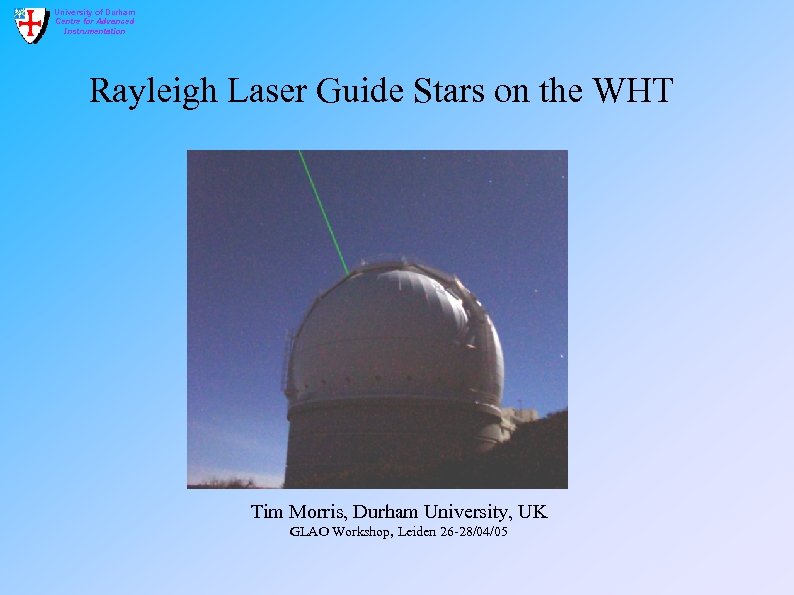 University of Durham Centre for Advanced Instrumentation Rayleigh Laser Guide Stars on the WHT Tim Morris, Durham University, UK GLAO Workshop, Leiden 26 -28/04/05
 University of Durham Centre for Advanced Instrumentation Talk Overview ● GLAO overview ● Durham GLAO System ● System Performance ● Ongoing Work
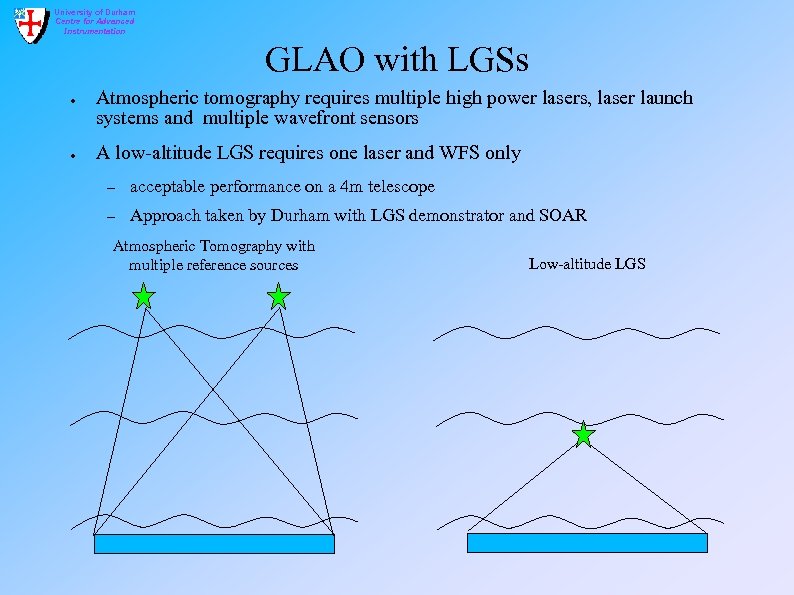 University of Durham Centre for Advanced Instrumentation GLAO with LGSs ● ● Atmospheric tomography requires multiple high power lasers, laser launch systems and multiple wavefront sensors A low-altitude LGS requires one laser and WFS only – acceptable performance on a 4 m telescope – Approach taken by Durham with LGS demonstrator and SOAR Atmospheric Tomography with multiple reference sources Low-altitude LGS
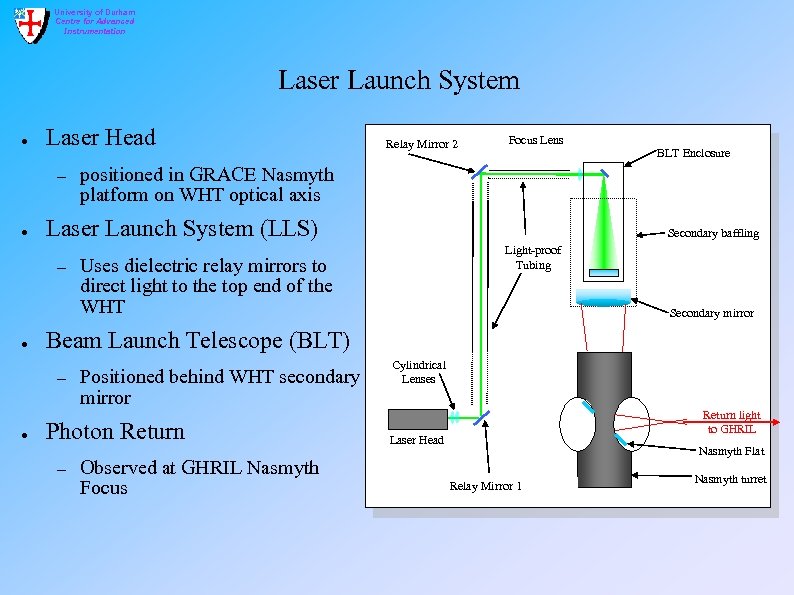 University of Durham Centre for Advanced Instrumentation Laser Launch System ● Laser Head – ● BLT Enclosure positioned in GRACE Nasmyth platform on WHT optical axis Secondary baffling Light-proof Tubing Uses dielectric relay mirrors to direct light to the top end of the WHT Secondary mirror Beam Launch Telescope (BLT) – ● Focus Lens Laser Launch System (LLS) – ● Relay Mirror 2 Positioned behind WHT secondary mirror Photon Return – Observed at GHRIL Nasmyth Focus Cylindrical Lenses Return light to GHRIL Laser Head Nasmyth Flat Relay Mirror 1 Nasmyth turret
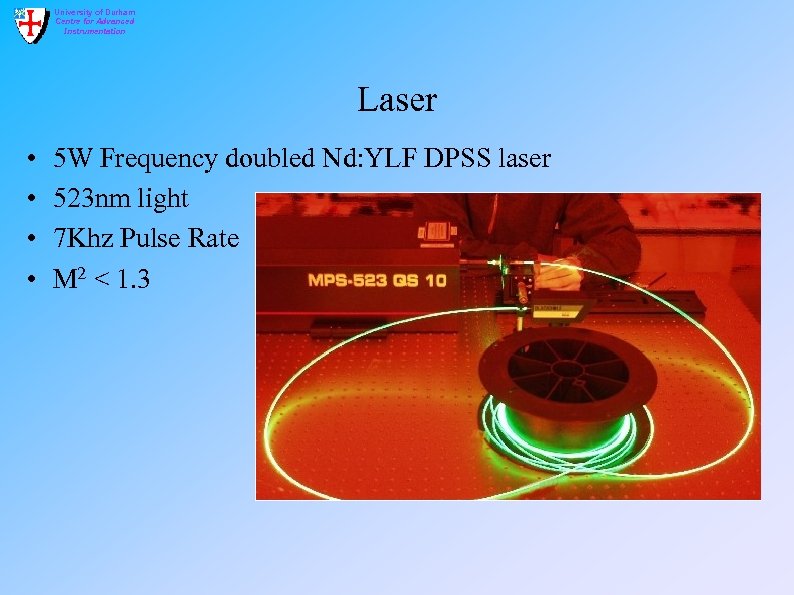 University of Durham Centre for Advanced Instrumentation Laser • • 5 W Frequency doubled Nd: YLF DPSS laser 523 nm light 7 Khz Pulse Rate M 2 < 1. 3
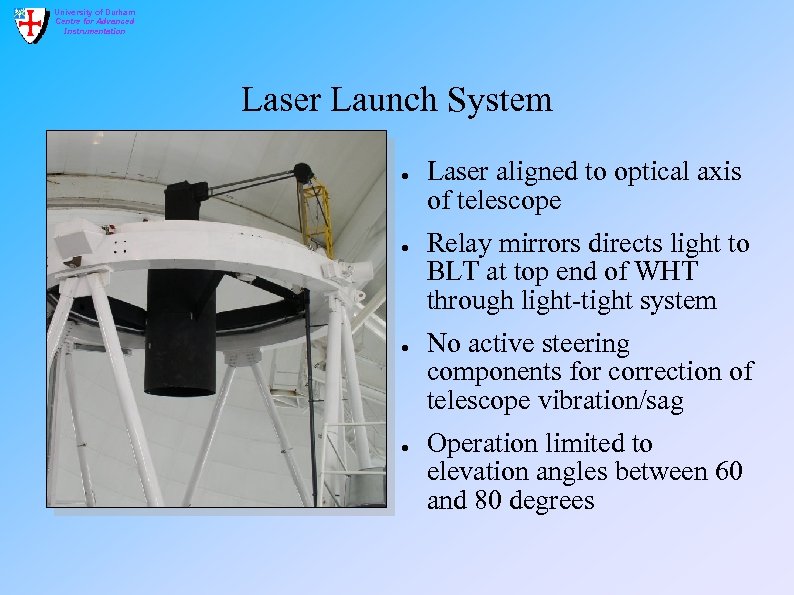 University of Durham Centre for Advanced Instrumentation Laser Launch System ● ● Laser aligned to optical axis of telescope Relay mirrors directs light to BLT at top end of WHT through light-tight system No active steering components for correction of telescope vibration/sag Operation limited to elevation angles between 60 and 80 degrees
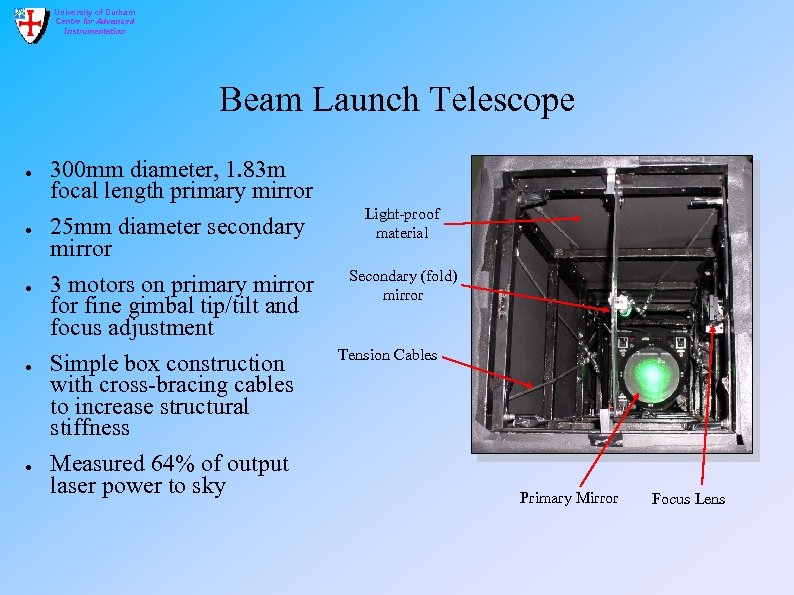 University of Durham Centre for Advanced Instrumentation Beam Launch Telescope ● ● ● 300 mm diameter, 1. 83 m focal length primary mirror 25 mm diameter secondary mirror 3 motors on primary mirror fine gimbal tip/tilt and focus adjustment Simple box construction with cross-bracing cables to increase structural stiffness Measured 64% of output laser power to sky Light-proof material Secondary (fold) mirror Tension Cables Primary Mirror Focus Lens
 University of Durham Centre for Advanced Instrumentation AO System ● ● 97 actuator continuous phase sheet DM (Xinetics) 37 actuator electrostatic DM for non-common path error removal ● 10 x 10 subaperture Shack-Hartmann WFS ● 8 x Parallel Texas Instruments C 40 DSP control system ● In-house built fast steering mirrors for tip/tilt correction
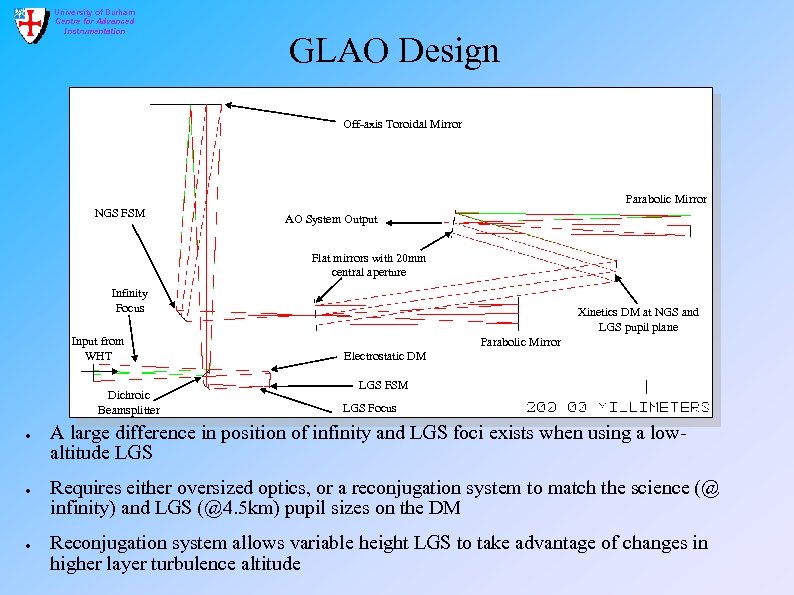 University of Durham Centre for Advanced Instrumentation GLAO Design Off-axis Toroidal Mirror Parabolic Mirror NGS FSM AO System Output Flat mirrors with 20 mm central aperture Infinity Focus Input from WHT Dichroic Beamsplitter ● ● ● Xinetics DM at NGS and LGS pupil plane Parabolic Mirror Electrostatic DM LGS FSM LGS Focus A large difference in position of infinity and LGS foci exists when using a lowaltitude LGS Requires either oversized optics, or a reconjugation system to match the science (@ infinity) and LGS (@4. 5 km) pupil sizes on the DM Reconjugation system allows variable height LGS to take advantage of changes in higher layer turbulence altitude
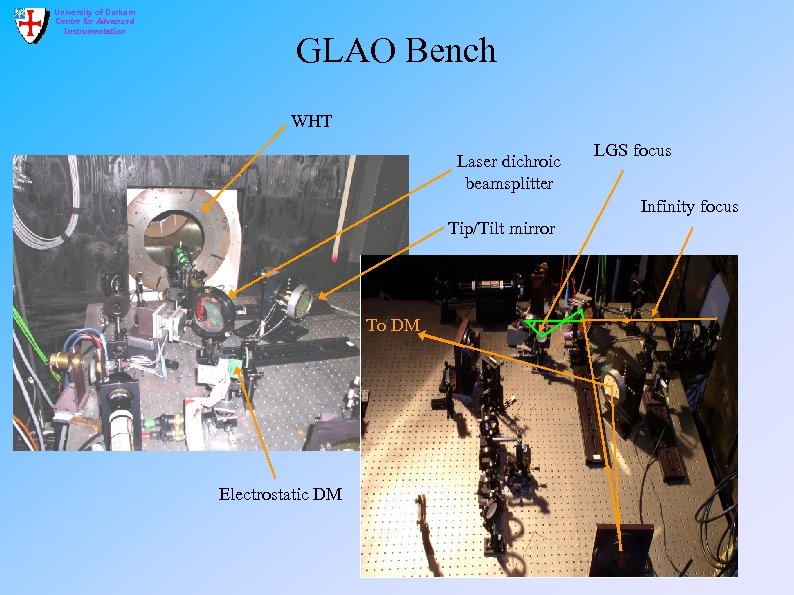 University of Durham Centre for Advanced Instrumentation GLAO Bench WHT Laser dichroic beamsplitter LGS focus Infinity focus Tip/Tilt mirror To DM Electrostatic DM
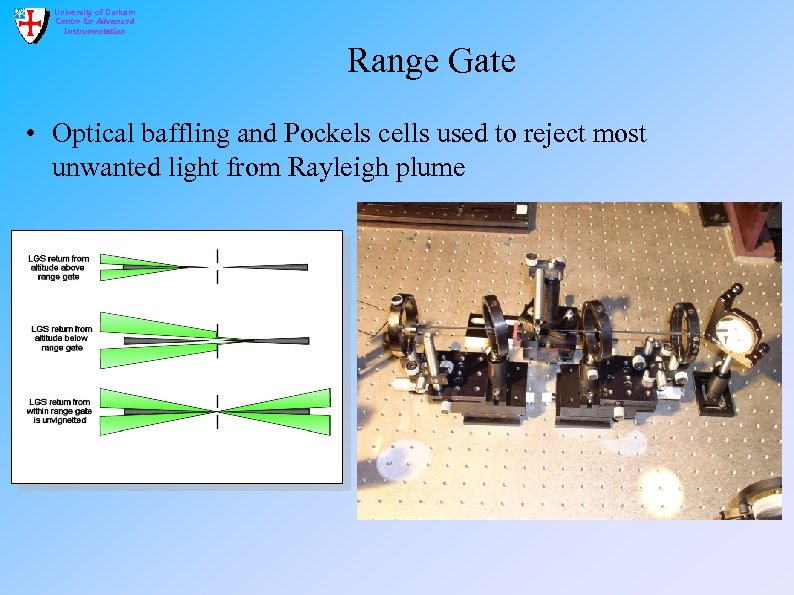 University of Durham Centre for Advanced Instrumentation Range Gate • Optical baffling and Pockels cells used to reject most unwanted light from Rayleigh plume
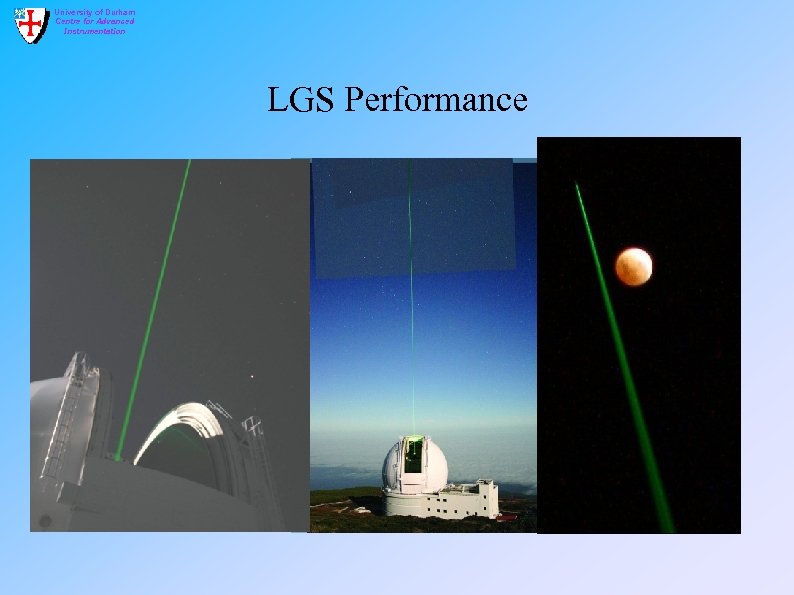 University of Durham Centre for Advanced Instrumentation LGS Performance
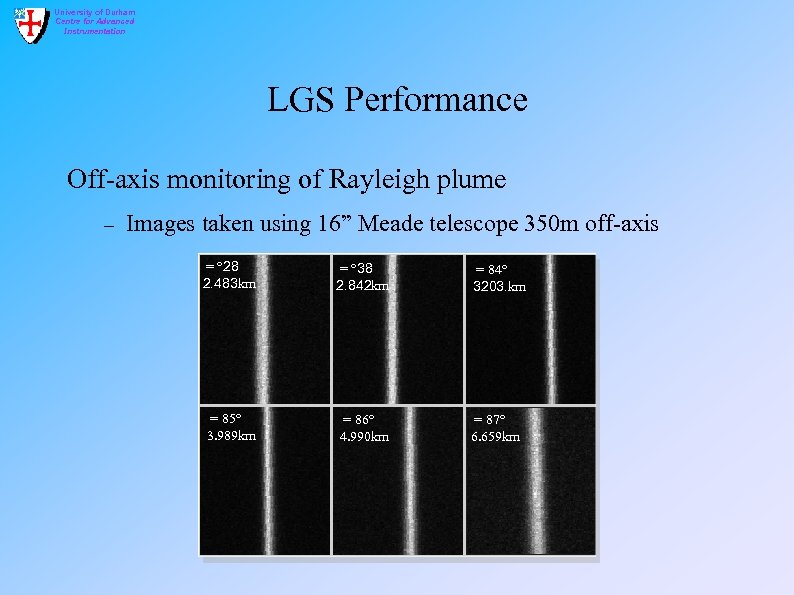 University of Durham Centre for Advanced Instrumentation LGS Performance Off-axis monitoring of Rayleigh plume – Images taken using 16” Meade telescope 350 m off-axis = ° 28 2. 483 km = ° 38 2. 842 km = 84° 3203. km = 85° 3. 989 km = 86° 4. 990 km = 87° 6. 659 km
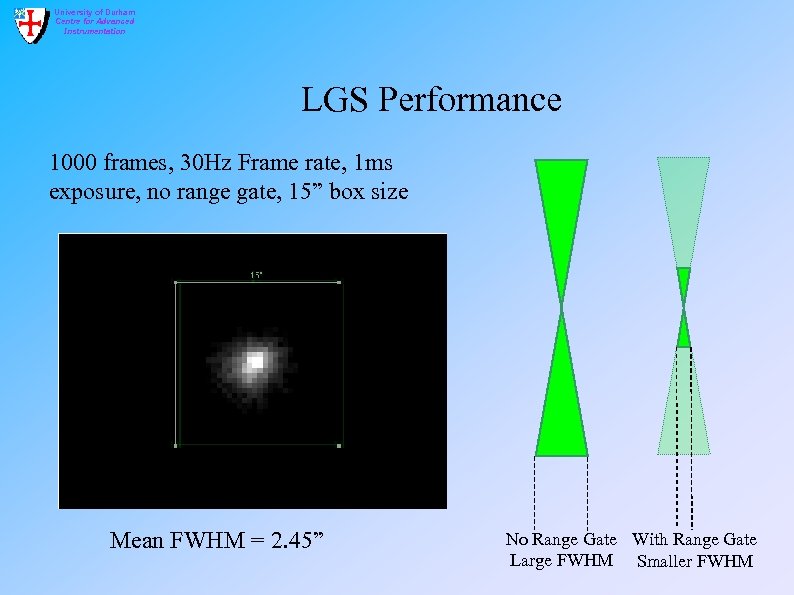 University of Durham Centre for Advanced Instrumentation LGS Performance 1000 frames, 30 Hz Frame rate, 1 ms exposure, no range gate, 15” box size Mean FWHM = 2. 45” No Range Gate With Range Gate Large FWHM Smaller FWHM
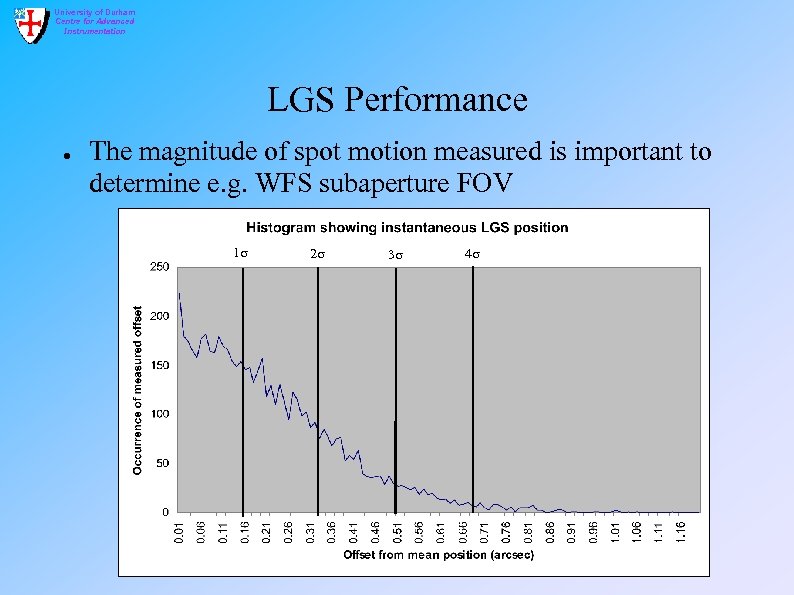 University of Durham Centre for Advanced Instrumentation LGS Performance ● The magnitude of spot motion measured is important to determine e. g. WFS subaperture FOV 1 2 3 4
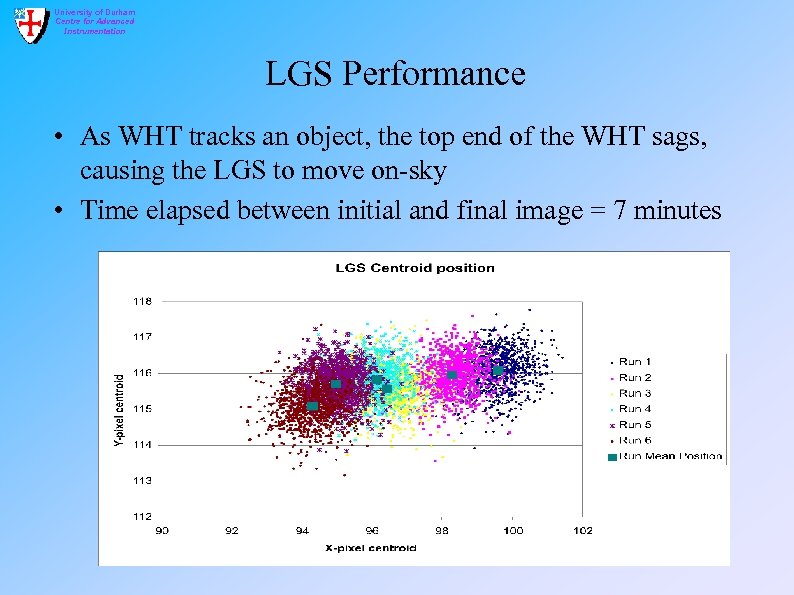 University of Durham Centre for Advanced Instrumentation LGS Performance • As WHT tracks an object, the top end of the WHT sags, causing the LGS to move on-sky • Time elapsed between initial and final image = 7 minutes
 University of Durham Centre for Advanced Instrumentation AO Performance ● ● A quadrant of the WFS failed whilst on the run. The effect of telescope sag caused more light to pass through the range gate system than was expected. This made WFSing difficult. AO loop was closed, but on a very poor WFS image. No correction observed Demonstrated a viable Rayleigh LGS can be created on the WHT – ● FWHM and spot motion acceptable LGS performance analysis gave valuable data for GLAS system modelling
 University of Durham Centre for Advanced Instrumentation Ongoing LGS Work ● GLAS – ● A Rayleigh LGS upgrade for WHT NGS AO System (NAOMI) LGS concept demostrators – P 4 – SPLASH – PIGS (collaboration with MPIA Heidelburg and INAF) – 4 LGS GLAO (Gemini and ESO geometry)
 University of Durham Centre for Advanced Instrumentation LGS Concept Demonstrators ● GLAS will provide a 30 W laser and launch system – – – ● ● capable of creating approx V=9 LGS @ 20 km LGS distance ranges from 5 km to infinity High laser beam quality gives sub-arcsecond 1/e 2 diameter LGS WHT has an empty Nasmyth focus for visiting instruments/experiments Part of the GLAS system requirements is that the laser can be removed from launch system – Allows possibility of launching the laser from the full aperture of the WHT (shared launch)
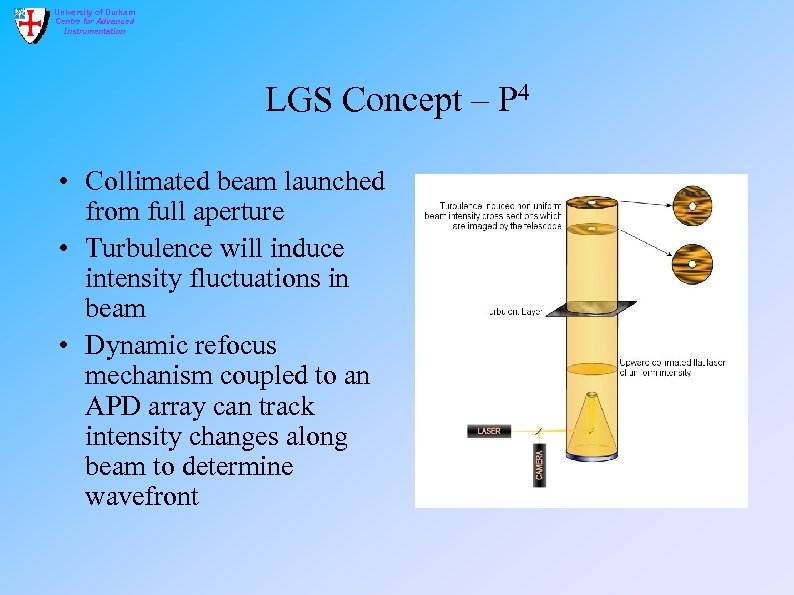 University of Durham Centre for Advanced Instrumentation LGS Concept – P 4 • Collimated beam launched from full aperture • Turbulence will induce intensity fluctuations in beam • Dynamic refocus mechanism coupled to an APD array can track intensity changes along beam to determine wavefront
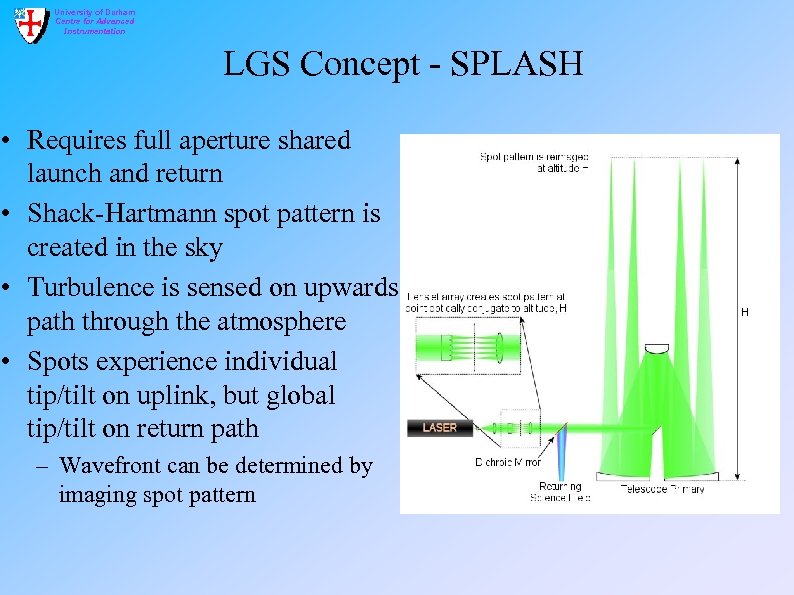 University of Durham Centre for Advanced Instrumentation LGS Concept - SPLASH • Requires full aperture shared launch and return • Shack-Hartmann spot pattern is created in the sky • Turbulence is sensed on upwards path through the atmosphere • Spots experience individual tip/tilt on uplink, but global tip/tilt on return path – Wavefront can be determined by imaging spot pattern
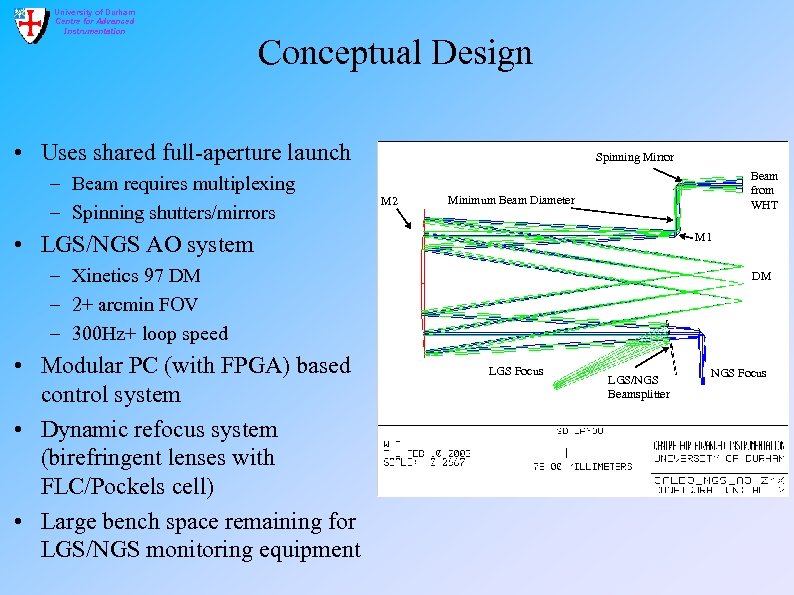 University of Durham Centre for Advanced Instrumentation Conceptual Design • Uses shared full-aperture launch – Beam requires multiplexing – Spinning shutters/mirrors Spinning Mirror M 2 Beam from WHT Minimum Beam Diameter • LGS/NGS AO system M 1 – Xinetics 97 DM – 2+ arcmin FOV – 300 Hz+ loop speed • Modular PC (with FPGA) based control system • Dynamic refocus system (birefringent lenses with FLC/Pockels cell) • Large bench space remaining for LGS/NGS monitoring equipment DM LGS Focus LGS/NGS Beamsplitter NGS Focus
 University of Durham Centre for Advanced Instrumentation Conclusion ● GLAO demonstrator – – Fully engineered laser launch system will greatly simplify system setup – ● An upgraded versatile AO system is being designed System provided valuable data and experience for GLAS design LGS Concept Demonstrator – Already had successful first on-sky test of PIGS WFS – Upgraded AO system is being designed to allow on-sky testing of (almost) every LGS concept/beacon geometry – ING Director is very, very nice and loves to see lasers being launched from the WHT
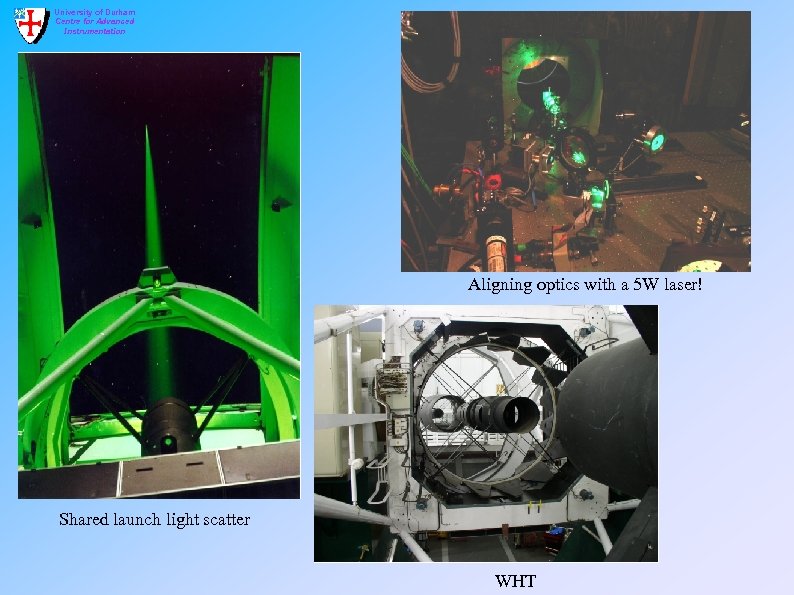 University of Durham Centre for Advanced Instrumentation Aligning optics with a 5 W laser! Shared launch light scatter WHT