


 Скачать презентацию University of California HIPAA Education Module Protected Health
7e135ba96d5ba8fb879c0549c0dbb599.ppt
- Количество слайдов: 73
 University of California HIPAA Education Module Protected Health Information (PHI) Management Module for PHI Data Stewards 3/31/2003: Final Copyright © University of California HIPAA-Data Steward Module
 Purpose n n This presentation has been prepared for all University workforce members who manage the use and disclosure of Protected Health Information (PHI). Your supervisor, HIPAA trainer or Privacy Officer should have also provided you with the PHI Management Reference Manual (Reference Manual). The University’s HIPAA Privacy Rule Education Modules and the Reference Manual should be used together to obtain information about HIPAA’s requirements for releasing, accessing, handling health information and responding to requests from University patients about the use and disclosure of their information. The other UC HIPAA modules are: the UC HIPAA Provider Module, Research Module, Institutional Advancement and Media Module HIPAA-Data Steward Module 2
 Data Steward for PHI Protected Health Information (PHI) n Your job title or job description identifies you as a PHI Data Steward who: n n Receives and reviews requests for PHI Provides access to or releases PHI as permitted or required by HIPAA and other state or federal laws Prevents access to or disclosure of PHI as permitted or required by HIPAA and other state or federal laws Serves as the University’s liaison to the patient, when the patient wants to exercise their Patient Rights provided by HIPAA or state law HIPAA-Data Steward Module 3
 Objectives n n n Increase knowledge and understanding of HIPAA requirements and your important role as the Data Steward Identify risk areas and new policies Identify how California law and HIPAA provide patient rights and privacy protections HIPAA-Data Steward Module 4
 When do HIPAA rules apply to PHI and the work you do? n Let me count the ways… n n n n When When you use it you disclose it you store or file it you see it on your computer it is lying on your desk you are talking about it face-to-face you are talking about it over the phone you transmit or store it electronically HIPAA-Data Steward Module 5
 HIPAA = Federal Law n n Establishes National Code Set Standards for electronic transactions and the transmittal of data electronically Provides for the privacy and security of an individual’s health information n Privacy Rule (April 14, 2003) protects access to, uses and disclosures of an individual’s protected health information (PHI) and requires security measures for that PHI. Security Rules (April 20, 2005) requires physical and technical safeguards to protect the confidentiality, integrity and availability of PHI in electronic form Potential civil and criminal penalties for non-compliance HIPAA-Data Steward Module 6
 Layers of Laws n n n California law and JCAHO standards regarding patient privacy and confidentiality have existed for many years. Federal HIPAA Privacy Rule provides a national “floor” for providing patient rights and protection of PHI. California law pre-empts HIPAA when it provides greater patient rights or stronger protections for PHI HIPAA-Data Steward Module 7
 HIPAA Privacy Rule: What information is protected? n What is protected health information (PHI)? n HIPAA-Data Steward Module 8
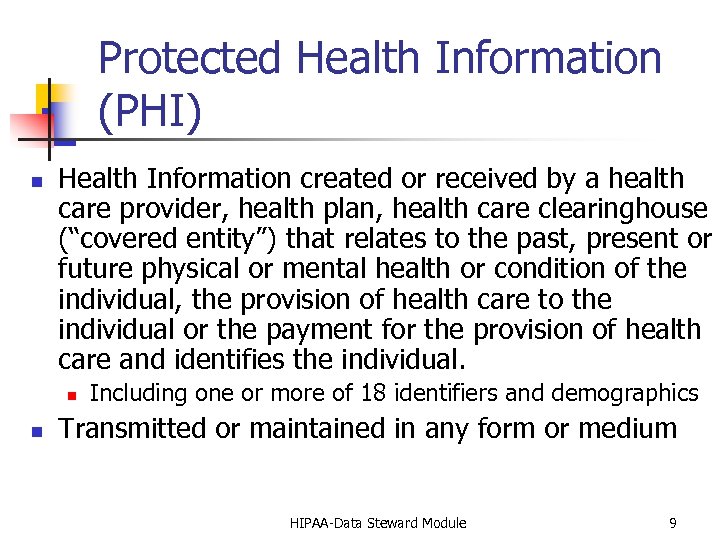 Protected Health Information (PHI) n Health Information created or received by a health care provider, health plan, health care clearinghouse (“covered entity”) that relates to the past, present or future physical or mental health or condition of the individual, the provision of health care to the individual or the payment for the provision of health care and identifies the individual. n n Including one or more of 18 identifiers and demographics Transmitted or maintained in any form or medium HIPAA-Data Steward Module 9
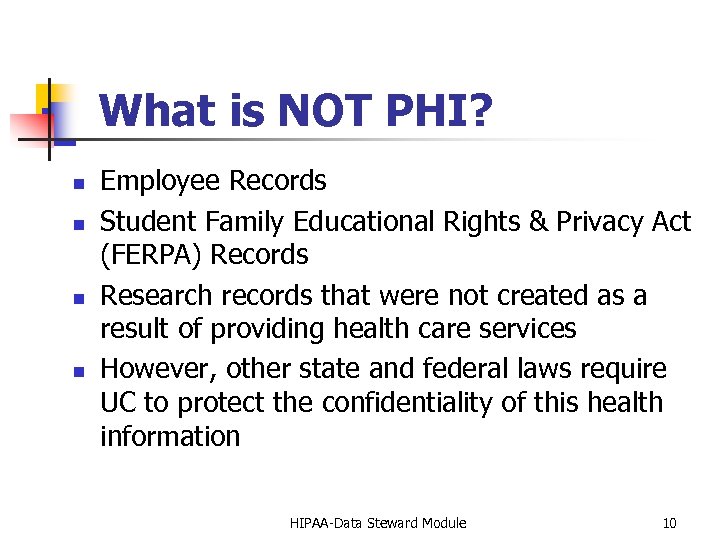 What is NOT PHI? n n Employee Records Student Family Educational Rights & Privacy Act (FERPA) Records Research records that were not created as a result of providing health care services However, other state and federal laws require UC to protect the confidentiality of this health information HIPAA-Data Steward Module 10
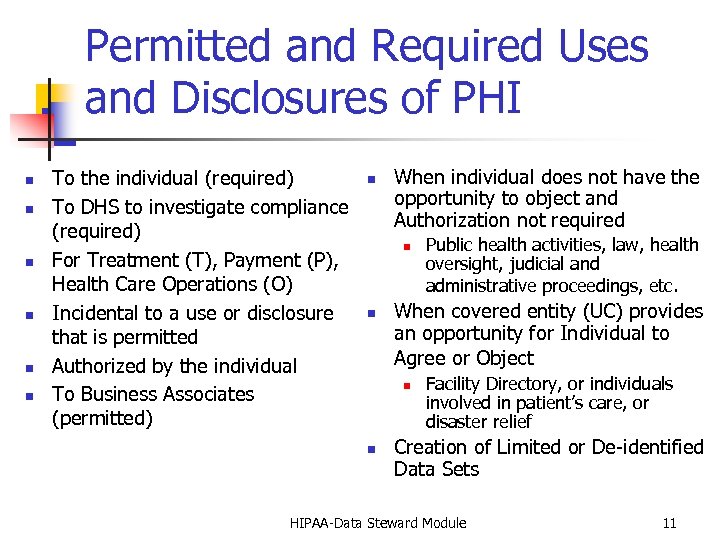 Permitted and Required Uses and Disclosures of PHI n n n To the individual (required) To DHS to investigate compliance (required) For Treatment (T), Payment (P), Health Care Operations (O) Incidental to a use or disclosure that is permitted Authorized by the individual To Business Associates (permitted) n When individual does not have the opportunity to object and Authorization not required n n When covered entity (UC) provides an opportunity for Individual to Agree or Object n n Public health activities, law, health oversight, judicial and administrative proceedings, etc. Facility Directory, or individuals involved in patient’s care, or disaster relief Creation of Limited or De-identified Data Sets HIPAA-Data Steward Module 11
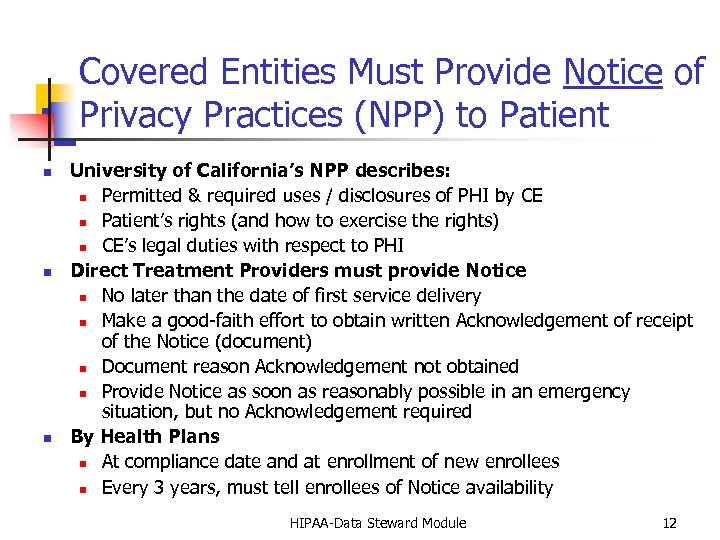 Covered Entities Must Provide Notice of Privacy Practices (NPP) to Patient n n n University of California’s NPP describes: n Permitted & required uses / disclosures of PHI by CE n Patient’s rights (and how to exercise the rights) n CE’s legal duties with respect to PHI Direct Treatment Providers must provide Notice n No later than the date of first service delivery n Make a good-faith effort to obtain written Acknowledgement of receipt of the Notice (document) n Document reason Acknowledgement not obtained n Provide Notice as soon as reasonably possible in an emergency situation, but no Acknowledgement required By Health Plans n At compliance date and at enrollment of new enrollees n Every 3 years, must tell enrollees of Notice availability HIPAA-Data Steward Module 12
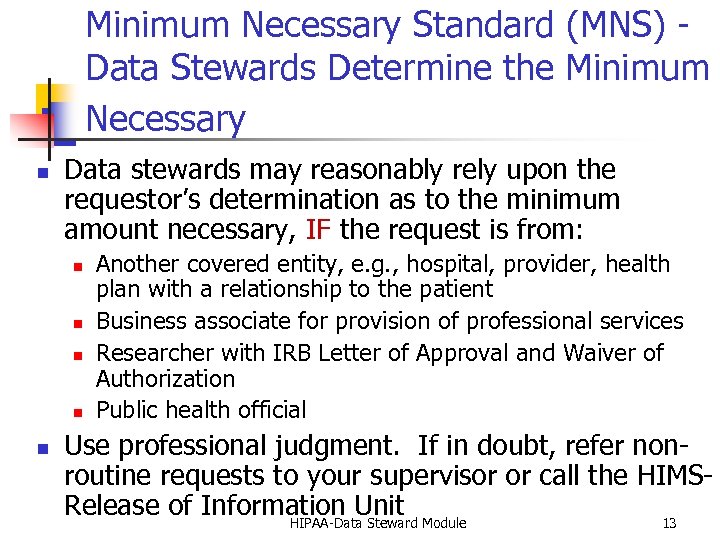 Minimum Necessary Standard (MNS) Data Stewards Determine the Minimum Necessary n Data stewards may reasonably rely upon the requestor’s determination as to the minimum amount necessary, IF the request is from: n n n Another covered entity, e. g. , hospital, provider, health plan with a relationship to the patient Business associate for provision of professional services Researcher with IRB Letter of Approval and Waiver of Authorization Public health official Use professional judgment. If in doubt, refer nonroutine requests to your supervisor or call the HIMSRelease of Information Unit Module HIPAA-Data Steward 13
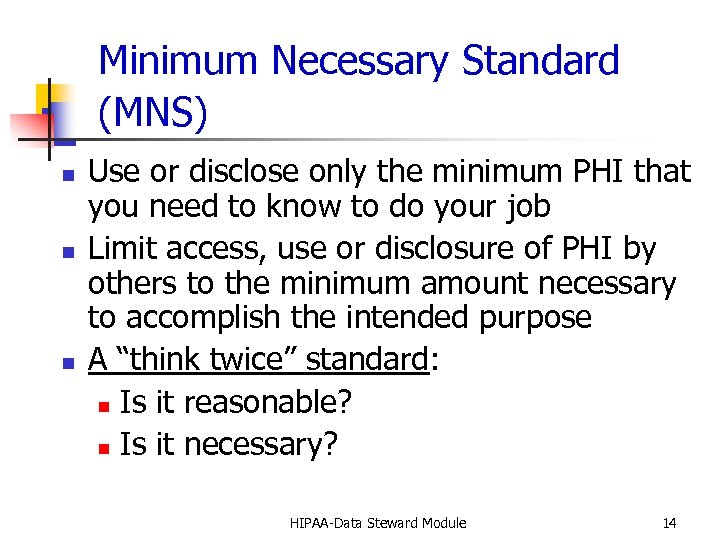 Minimum Necessary Standard (MNS) n n n Use or disclose only the minimum PHI that you need to know to do your job Limit access, use or disclosure of PHI by others to the minimum amount necessary to accomplish the intended purpose A “think twice” standard: n Is it reasonable? n Is it necessary? HIPAA-Data Steward Module 14
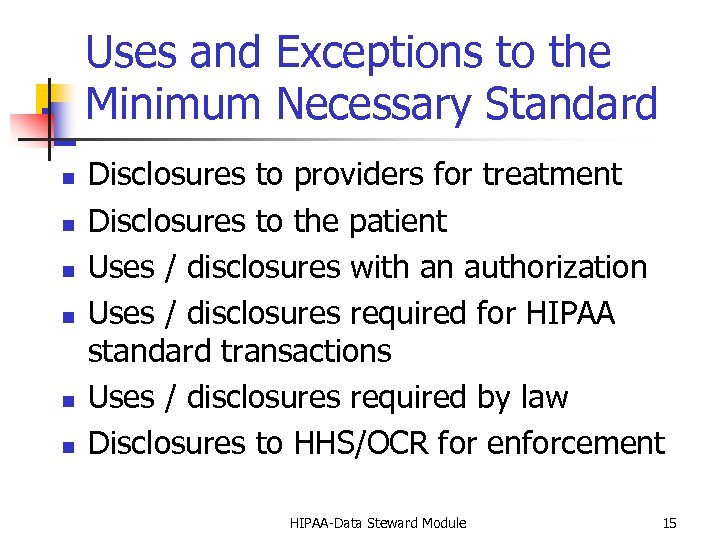 Uses and Exceptions to the Minimum Necessary Standard n n n Disclosures to providers for treatment Disclosures to the patient Uses / disclosures with an authorization Uses / disclosures required for HIPAA standard transactions Uses / disclosures required by law Disclosures to HHS/OCR for enforcement HIPAA-Data Steward Module 15
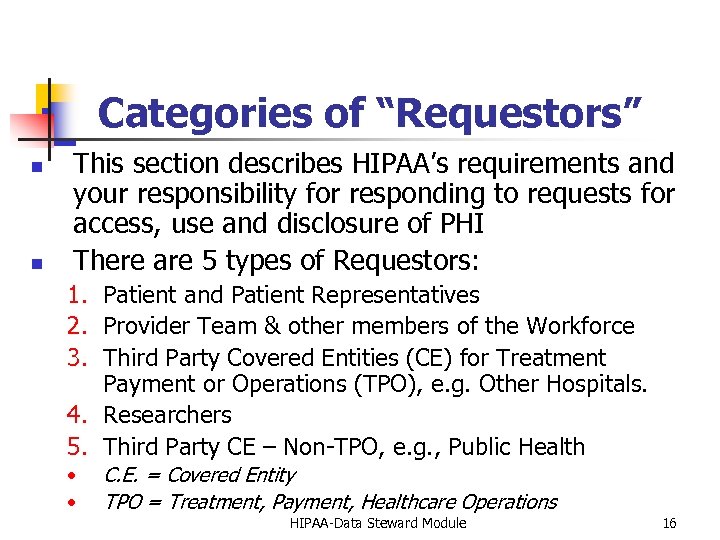 Categories of “Requestors” n n This section describes HIPAA’s requirements and your responsibility for responding to requests for access, use and disclosure of PHI There are 5 types of Requestors: 1. Patient and Patient Representatives 2. Provider Team & other members of the Workforce 3. Third Party Covered Entities (CE) for Treatment Payment or Operations (TPO), e. g. Other Hospitals. 4. Researchers 5. Third Party CE – Non-TPO, e. g. , Public Health • • C. E. = Covered Entity TPO = Treatment, Payment, Healthcare Operations HIPAA-Data Steward Module 16
 #1. Requests from Patients or Patient Representatives n n Patients or patients representatives may request information from their Designated Records Set (DRS) A Designated Records Set is a group of records maintained by or for a Covered Entity (CE) that is: n The medical and billing records about individuals; n The enrollment, payment and claims adjudication records and case or medical management record systems maintained by or for a health plan; or n Information used in whole or in part by or for the CE to make decisions about individuals. HIPAA-Data Steward Module 17
 Requests from Patients or Patient Representatives n n n All patient/patient representative requests should be in writing to the University Failure to follow HIPAA requirements for responding to patient/patient representative requests is a violation of HIPAA If you have questions, contact the Privacy Officer or a Supervisor HIPAA-Data Steward Module 18
 Personal Representatives of the Patient Ø The HIPAA definition of a “personal representative” is someone who is authorized to act on behalf of an individual who is an adult or emancipated minor in making healthcare decisions, including signing an authorization for disclosure of PHI. Ø The scope of access depends upon the authority granted to the personal representative by state law. • For purposes of inspecting and copying an individual’s PHI, a • representative may include: a guardian or conservator; an executor or beneficiary or next of kin for a decedent; a parent or legal guardian of a unemancipated minor (unless the minor has that right); a person authorized to make health care decisions under a patient’s advanced health care directive. Use professional judgment HIPAA-Data Steward Module 19
 Identifying the Personal Representative n Personal Rep – Minors n n Personal Rep – Deceased Patient n n Parent or guardian usually has the authority to make healthcare decisions about an unemancipated minor Executor, Administrator or other person with authority to act on behalf of a deceased patient Personal Rep – Adults and Emancipated Minors n Conservator, Agent with Health Care Power of Attorney, or other person who has the authority to make healthcare decisions for an emancipated minor or adult who is unable or unwilling to make decisions Ø Examples of Exceptions to authority to act: n n n When a minor is a possible victim of violence, abuse or neglect When a minor can consent to the healthcare, e. g. , reproductive and/or substance abuse counseling, sensitive services General power of attorney vs. Healthcare power of attorney: Scope of access varies! HIPAA-Data Steward Module 20
 What Can be Disclosed to a Personal Representative? n n n Use professional judgment and experience to determine what PHI should be disclosed A patient’s objections to disclosures should be honored Obtain a signed authorization for requests to access or obtain copies of PHI HIPAA-Data Steward Module 21
 Communication with Individuals Involved in the Patient’s Care n n Exercise professional judgment & discretion Minimum necessary for disclosures of PHI to individuals involved in the patient’s care Respect approved requests for confidentiality & restrictions Refer to the facility inpatient directory before releasing any inpatient information. There may be restrictions! HIPAA-Data Steward Module 22
 Considerations for Granting Access to PHI for Personal Representatives § Verify the identity of the requestor and the authority to have access to PHI § Use professional judgment: You may deny access / copies of PHI for suspected abuse, neglect and endangerment situations or where access to PHI is reasonably likely to cause harm • In this situation, the reason for denial will be determined by a healthcare provider or with consultation and approval from a HIMS Supervisor or Risk Management § Other exceptions may limit PHI disclosure to a specific care decision, e. g. , a limited health care power of attorney for life support decision. § This individual may not authorize PHI disclosures for unrelated purposes. HIPAA-Data Steward Module 23
 Billing Process n n Patients may request access to all payment / billing records “used to make a decision” regarding his/her benefit coverage, e. g. , patient accounting notes or individual healthcare claim status notes; health plan eligibility notes. Determination of what parts of the claim record are decision notes must be made. Data stewards can provide a summary of the “decision notes”, if this is acceptable to the patient. UC may charge a reasonable fee for copies / postage Tip: Only record relevant notes that are appropriate for viewing. Be aware: Time frame for response HIPAA-Data Steward Module 24
 #2. Requests for PHI from UC Workforce Members and UC Business Associates Who are Covered by the Privacy Rule Healthcare Provider Team, Faculty Physicians and Health Professional Trainees, UC Business Associates, Workforce members who provide Business, Financial, Legal Services to the CE Volunteers and others under the direct control of the University HIPAA-Data Steward Module 25
 HIPAA Permits Use and Disclosure of PHI for Treatment, Payment & Operations (TPO) n n n Treatment (T) – The provision, coordination, or management of healthcare by one or more health care providers, including consultations and referrals Payment (P) – Activities to obtain payment or be reimbursed for health care services; health plans to obtain premiums, fulfill coverage responsibilities, or provide reimbursement Health Care Operations (O) -- Administrative, financial, legal and quality improvement activities; business planning activities; training, teaching; accreditation, credentialing, licensing, competence, performance activities; fraud, abuse, compliance activities The University’s Notice of Privacy Practices describes the specific uses and disclosures of TPO HIPAA-Data Steward Module 26
 Disclosure of PHI for Payment Activities n PHI can be disclosed to workforce members and Business Associates involved in obtaining payment for UC healthcare services (Minimum Necessary Standard applies) n n Business Associates (outside contractors or vendors) must sign a Business Associate Agreement with UC in order to access, use or disclose PHI on UC’s behalf Coding and billing staff, utilization review, third party payers, financial transactions Transmit the data in a secure, confidential manner (see policy on e-mail transmission) Minimum Necessary Standard applies to access, use or disclosure for payment activities HIPAA-Data Steward Module 27
 Requests for Billing Data received by Phone n n For phone requests, when the caller is the financial guarantor or other third-party payer, you may disclose by phone the minimum billing PHI for the episode of care to facilitate payment. Considerations: n n n Use professional judgment and discretion Verify identity of caller, e. g. , what is the account #, or last 4 -digits of beneficiary’s SS#, or other identifier? Provide minimum necessary PHI for the specific episode of care in question; Document the release of PHI in the claim notes Be aware of any approved ‘alternative communications’, e. g. , alternate address or phone # HIPAA-Data Steward Module 28
 Requests for Written Documentation in Support of a Medical Claim / Billing n Requests from payers: Minimum Necessary Standard for the episode of care (e. g. , specific claim in question) n n n Transmit the material in a secure manner Use fax cover sheets (verify fax #/addresses) or Use sealed envelope with a cover letter Do not use unsecured E-mail Requests from patient or a guarantor for copies of PHI for the medical billing claim (medical records, claim records): n n n Patient (or legal representative) authorization is required for any release of information Use the UC_ Authorization Form Forward the request to the appropriate data steward, e. g. , HIMS HIPAA-Data Steward Module 29
 Use and Disclosure of PHI for Health Care Operations (O) n n Fundraising, Community and Media Relations Training of health care professionals is a part of operations (Minimum Necessary Standard applies) n n UC teaching activities within UC, with UC teaching affiliates and with other teaching institutions Training of health professionals from other CEs who are UC teaching affiliates Quality/Peer Review Activities Business Planning and Development For all operations, MNS applies. For some uses and disclosures, there are further restrictions. See PHI Reference Manual. HIPAA-Data Steward Module 30
 Uses and Disclosures of PHI for Fundraising by Staff and Faculty n UC may only use demographic information and dates of service to create fundraising lists, fundraising databases and send out fundraising materials to patients n n Faculty may provide the Development Office with a list of individuals and contact information for specific fundraising appeals n n n Disease, diagnosis or condition may not be used to develop a fundraising mailing list. An existing data base may not be used except with a patient’s Authorization that meets all HIPAA requirements for a valid Authorization For example, Development Office may request that all faculty provide a list of names for a fundraising event for the Cancer Center All fundraising material must provide the recipient with a way to opt out of receiving future fundraising materials All fundraising efforts must by coordinated with the UC_HS or campus Development Office. HIPAA-Data Steward Module 31
 Use & Disclosure of PHI to UC Faculty and Health Care Trainees n n Use and disclosure of PHI for the teaching of all UC health professions programs students are part of health care operations (Minimum Necessary Standard always applies & students must be HIPAA trained—see Provider Module) When non-UC health care trainees are participating in a UC training program (e. g. , students from affiliated teaching institutions that are also CEs), they are a part of the UC workforce and must be HIPAA-trained n n However, trainees from UC affiliated institutions must have a teaching relationship to the patient in order to use PHI for teaching purposes at the sponsoring affiliated institutions Trainees, who are also providing healthcare to the patient, may have access to the patient’s complete PHI, if necessary. HIPAA-Data Steward Module 32
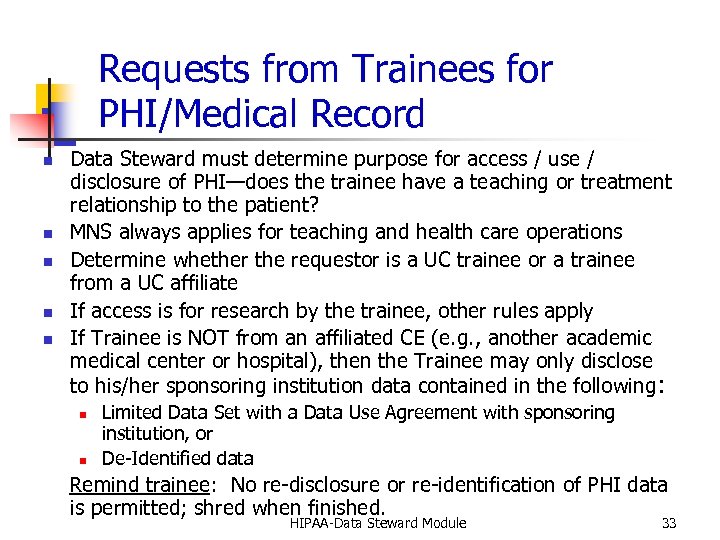 Requests from Trainees for PHI/Medical Record n n n Data Steward must determine purpose for access / use / disclosure of PHI—does the trainee have a teaching or treatment relationship to the patient? MNS always applies for teaching and health care operations Determine whether the requestor is a UC trainee or a trainee from a UC affiliate If access is for research by the trainee, other rules apply If Trainee is NOT from an affiliated CE (e. g. , another academic medical center or hospital), then the Trainee may only disclose to his/her sponsoring institution data contained in the following : n n Limited Data Set with a Data Use Agreement with sponsoring institution, or De-Identified data Remind trainee: No re-disclosure or re-identification of PHI data is permitted; shred when finished. HIPAA-Data Steward Module 33
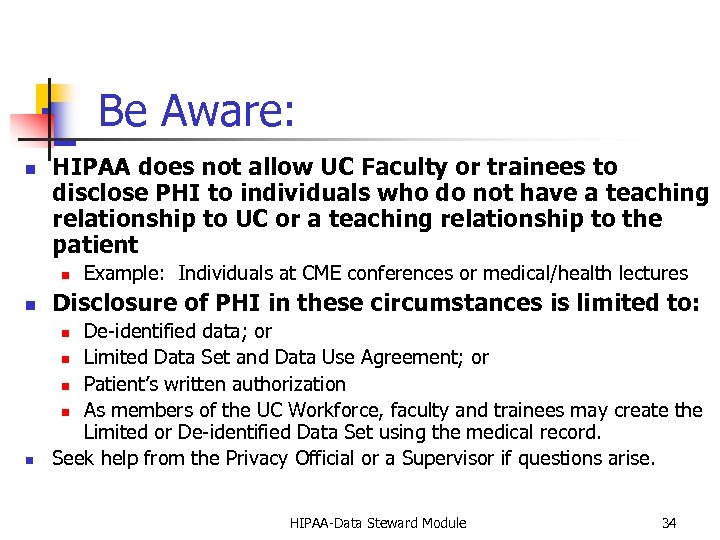 Be Aware: n HIPAA does not allow UC Faculty or trainees to disclose PHI to individuals who do not have a teaching relationship to UC or a teaching relationship to the patient n Example: Individuals at CME conferences or medical/health lectures n Disclosure of PHI in these circumstances is limited to: n De-identified data; or n Limited Data Set and Data Use Agreement; or n Patient’s written authorization n As members of the UC Workforce, faculty and trainees may create the Limited or De-identified Data Set using the medical record. Seek help from the Privacy Official or a Supervisor if questions arise. n HIPAA-Data Steward Module 34
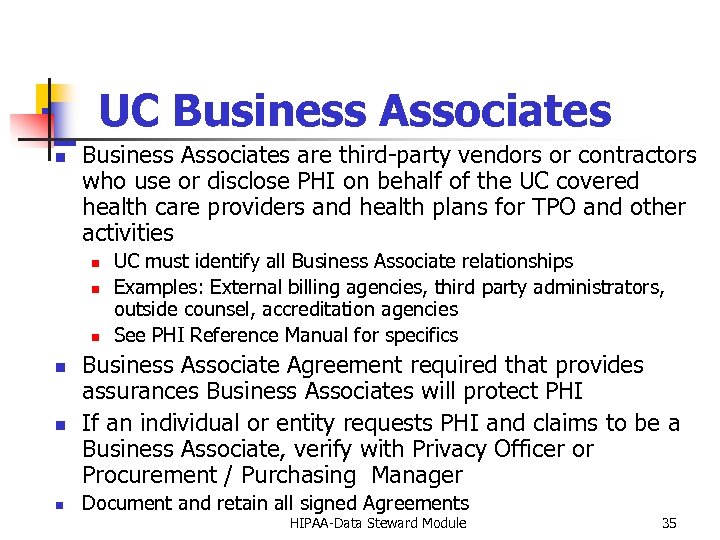 UC Business Associates n Business Associates are third-party vendors or contractors who use or disclose PHI on behalf of the UC covered health care providers and health plans for TPO and other activities n n n UC must identify all Business Associate relationships Examples: External billing agencies, third party administrators, outside counsel, accreditation agencies See PHI Reference Manual for specifics Business Associate Agreement required that provides assurances Business Associates will protect PHI If an individual or entity requests PHI and claims to be a Business Associate, verify with Privacy Officer or Procurement / Purchasing Manager Document and retain all signed Agreements HIPAA-Data Steward Module 35
 #3. Requests for PHI from Third Parties for TPO Other Covered Entities — for Treatment, Payment, Operations, including training of health care professionals HIPAA-Data Steward Module
 Disclosure of PHI to Other CEs n Treatment (T): The CE may provide PHI for ongoing treatment by another healthcare provider, health plan or non-covered healthcare provider or entity n n n No Business Associate agreement is required No MNS required For Payment (P): The CE may receive or disclose PHI for payment purposes of a covered or non-covered health care provider or covered health plan n No Business Associate Agreement is required n MNS applies and there must be a relationship to patient HIPAA-Data Steward Module 37
 Disclosure of PHI to Other CEs n For Operations (O): The CE may disclose PHI only to another CE or its Business Associates for the following: n n Quality assessment and improvement; population-based activities to improve health or reduce health care costs, case management, certification, accreditation, licensing, credentialing, conducting training, health care fraud and abuse detection and compliance MNS applies and there must be a relationship to the patient For all other O, CE must provide either a LDS with Data Use Agreement, DDS or obtain patient Authorization for disclosures of PHI For Research Purposes of another CE, Research is not O n UC Institutional Research Board (IRB) policy requires the participation of a UC investigator on any research conducted by an outside researcher with UC patients or patient records HIPAA-Data Steward Module 38
 Tracking Disclosures to Other Covered Entities (C. E. s) n The CE must track all disclosures to other CEs except those disclosures: n n n For TPO (Business Associate relationships to carry out TPO do not require tracking if a Business Associate Agreement is in place) Authorized by the Patient Provided with a LDS/Data Use Agreement or DDS See PHI Reference Manual for detailed list of required tracking of disclosures HIPAA-Data Steward Module 39
 #4. Use and Disclosure of PHI to University Researchers Research is not a covered function under the HIPAA Privacy Rule, but research confidentiality is protected under the Common Rule. Researchers want access to the CE’s PHI for research purposes. HIPAA requires the CE to be assured that PHI disclosed for research activities will be protected. This is the role of the UC Institutional Review Boards (IRBs). The IRBs review all protocols requiring PHI and provide assurance to the CE. HIPAA-Data Steward Module
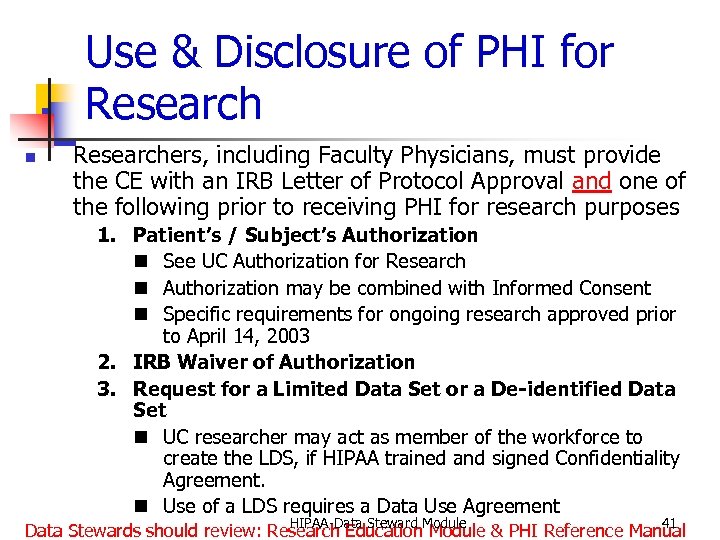 Use & Disclosure of PHI for Research n Researchers, including Faculty Physicians, must provide the CE with an IRB Letter of Protocol Approval and one of the following prior to receiving PHI for research purposes 1. Patient’s / Subject’s Authorization n See UC Authorization for Research n Authorization may be combined with Informed Consent n Specific requirements for ongoing research approved prior to April 14, 2003 2. IRB Waiver of Authorization 3. Request for a Limited Data Set or a De-identified Data Set n UC researcher may act as member of the workforce to create the LDS, if HIPAA trained and signed Confidentiality Agreement. n Use of a LDS requires a Data Use Agreement HIPAA-Data Steward Module 41 Data Stewards should review: Research Education Module & PHI Reference Manual
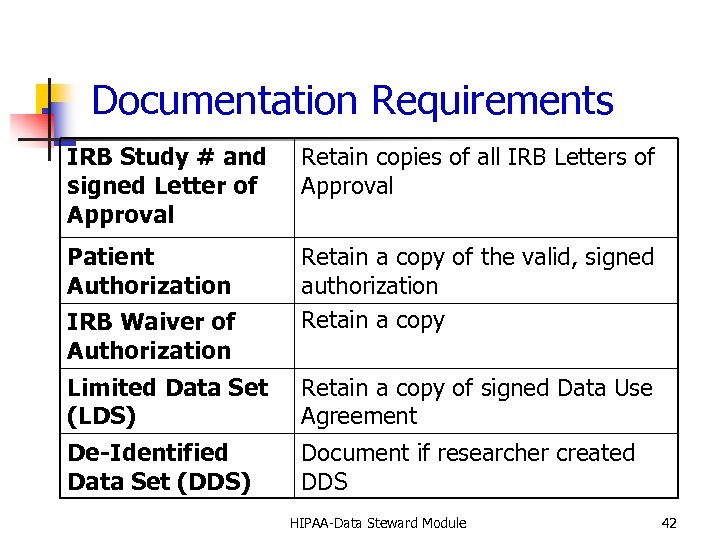 Documentation Requirements IRB Study # and signed Letter of Approval Retain copies of all IRB Letters of Approval Patient Authorization Retain a copy of the valid, signed authorization Retain a copy IRB Waiver of Authorization Limited Data Set (LDS) Retain a copy of signed Data Use Agreement De-Identified Data Set (DDS) Document if researcher created DDS HIPAA-Data Steward Module 42
 #5. Disclosures to Third Parties for non-TPO Activities Permitted or Required Reporting, such as. , Public Health Food & Drug Administration (FDA) Authorized Agency for Required Reporting Health Oversight Activities Others: Court Requests; Law Enforcement; Coroners… HIPAA-Data Steward Module
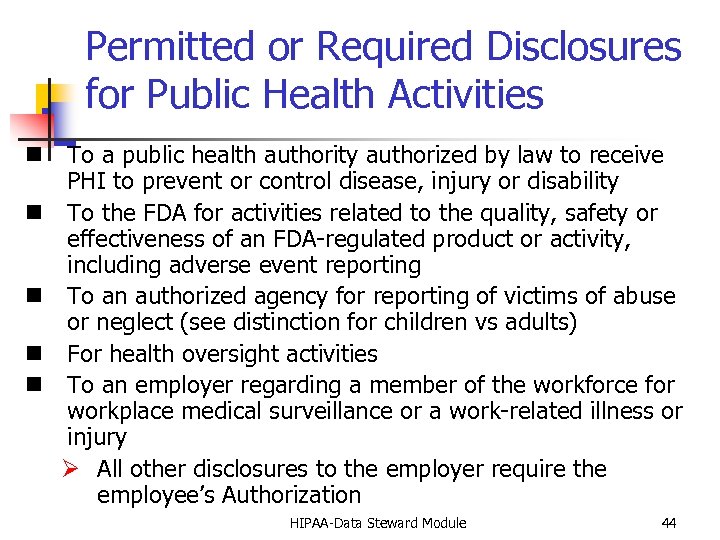 Permitted or Required Disclosures for Public Health Activities n To a public health authority authorized by law to receive PHI to prevent or control disease, injury or disability n To the FDA for activities related to the quality, safety or effectiveness of an FDA-regulated product or activity, including adverse event reporting n To an authorized agency for reporting of victims of abuse or neglect (see distinction for children vs adults) n For health oversight activities n To an employer regarding a member of the workforce for workplace medical surveillance or a work-related illness or injury Ø All other disclosures to the employer require the employee’s Authorization HIPAA-Data Steward Module 44
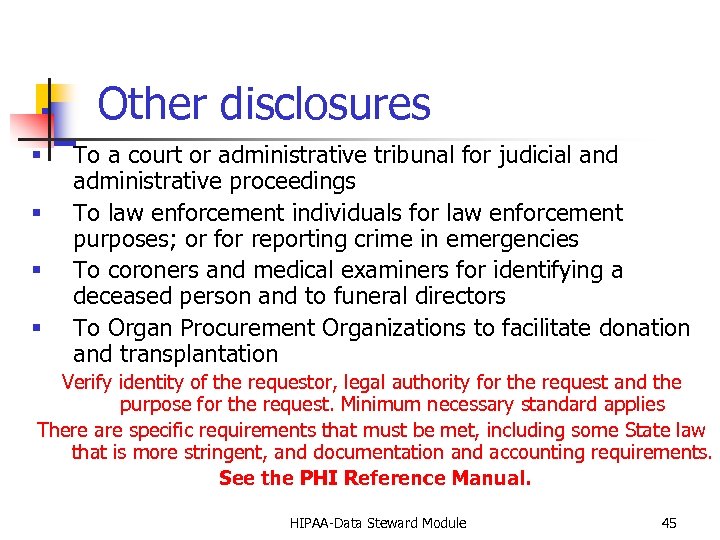 Other disclosures § § To a court or administrative tribunal for judicial and administrative proceedings To law enforcement individuals for law enforcement purposes; or for reporting crime in emergencies To coroners and medical examiners for identifying a deceased person and to funeral directors To Organ Procurement Organizations to facilitate donation and transplantation Verify identity of the requestor, legal authority for the request and the purpose for the request. Minimum necessary standard applies There are specific requirements that must be met, including some State law that is more stringent, and documentation and accounting requirements. See the PHI Reference Manual. HIPAA-Data Steward Module 45
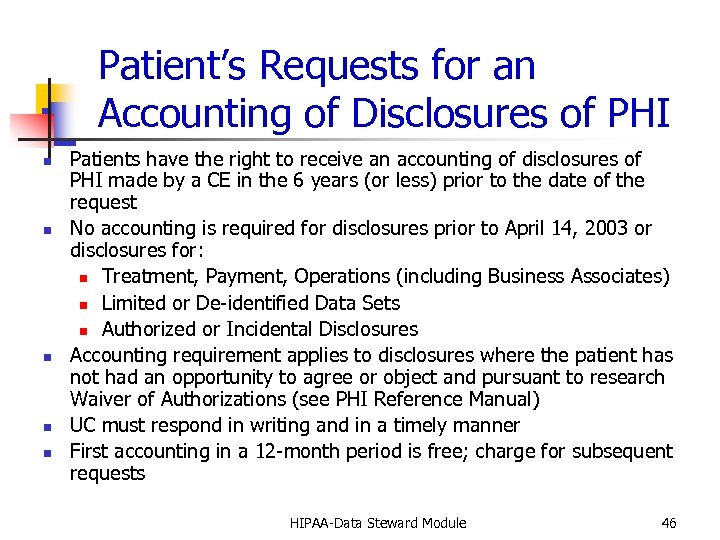 Patient’s Requests for an Accounting of Disclosures of PHI n n n Patients have the right to receive an accounting of disclosures of PHI made by a CE in the 6 years (or less) prior to the date of the request No accounting is required for disclosures prior to April 14, 2003 or disclosures for: n Treatment, Payment, Operations (including Business Associates) n Limited or De-identified Data Sets n Authorized or Incidental Disclosures Accounting requirement applies to disclosures where the patient has not had an opportunity to agree or object and pursuant to research Waiver of Authorizations (see PHI Reference Manual) UC must respond in writing and in a timely manner First accounting in a 12 -month period is free; charge for subsequent requests HIPAA-Data Steward Module 46
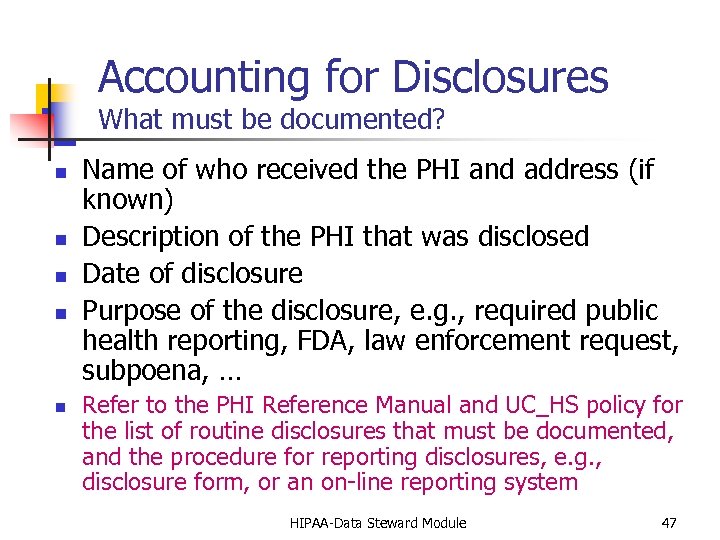 Accounting for Disclosures What must be documented? n n n Name of who received the PHI and address (if known) Description of the PHI that was disclosed Date of disclosure Purpose of the disclosure, e. g. , required public health reporting, FDA, law enforcement request, subpoena, … Refer to the PHI Reference Manual and UC_HS policy for the list of routine disclosures that must be documented, and the procedure for reporting disclosures, e. g. , disclosure form, or an on-line reporting system HIPAA-Data Steward Module 47
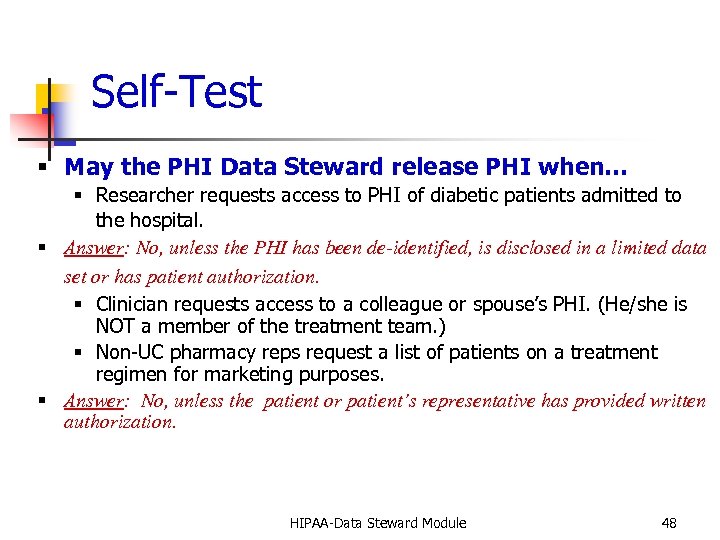 Self-Test § May the PHI Data Steward release PHI when… § Researcher requests access to PHI of diabetic patients admitted to the hospital. § Answer: No, unless the PHI has been de-identified, is disclosed in a limited data set or has patient authorization. § Clinician requests access to a colleague or spouse’s PHI. (He/she is NOT a member of the treatment team. ) § Non-UC pharmacy reps request a list of patients on a treatment regimen for marketing purposes. § Answer: No, unless the patient or patient’s representative has provided written authorization. HIPAA-Data Steward Module 48
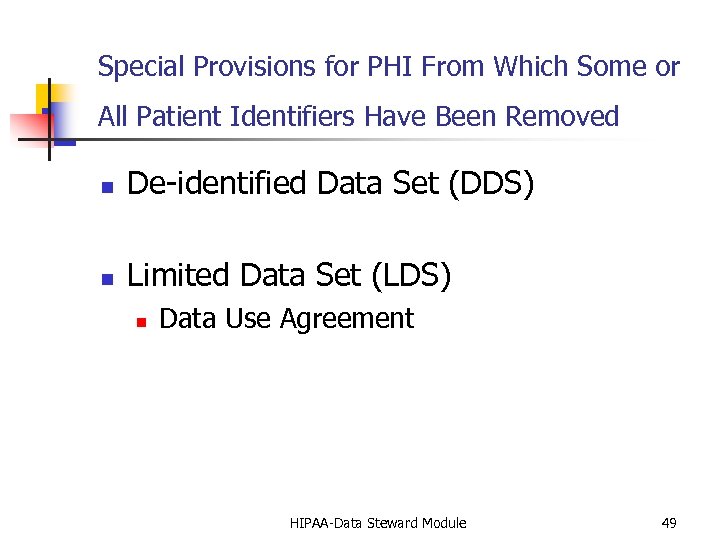 Special Provisions for PHI From Which Some or All Patient Identifiers Have Been Removed n De-identified Data Set (DDS) n Limited Data Set (LDS) n Data Use Agreement HIPAA-Data Steward Module 49
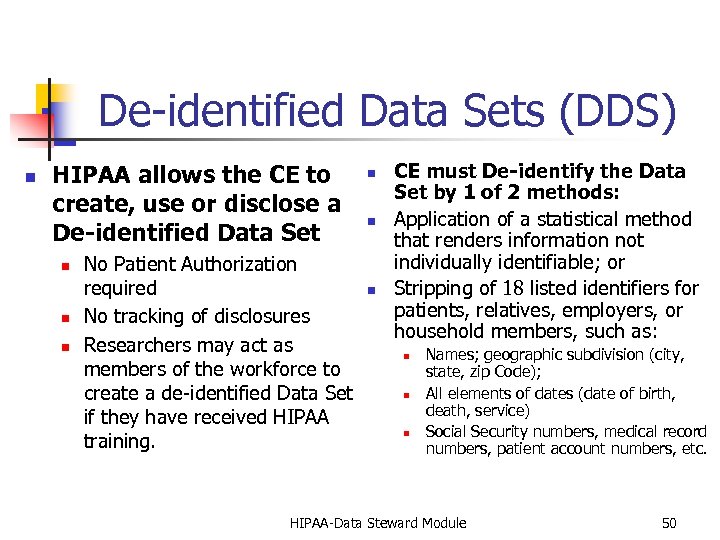 De-identified Data Sets (DDS) n HIPAA allows the CE to create, use or disclose a De-identified Data Set n n n No Patient Authorization required No tracking of disclosures Researchers may act as members of the workforce to create a de-identified Data Set if they have received HIPAA training. n n n CE must De-identify the Data Set by 1 of 2 methods: Application of a statistical method that renders information not individually identifiable; or Stripping of 18 listed identifiers for patients, relatives, employers, or household members, such as: n n n Names; geographic subdivision (city, state, zip Code); All elements of dates (date of birth, death, service) Social Security numbers, medical record numbers, patient account numbers, etc. HIPAA-Data Steward Module 50
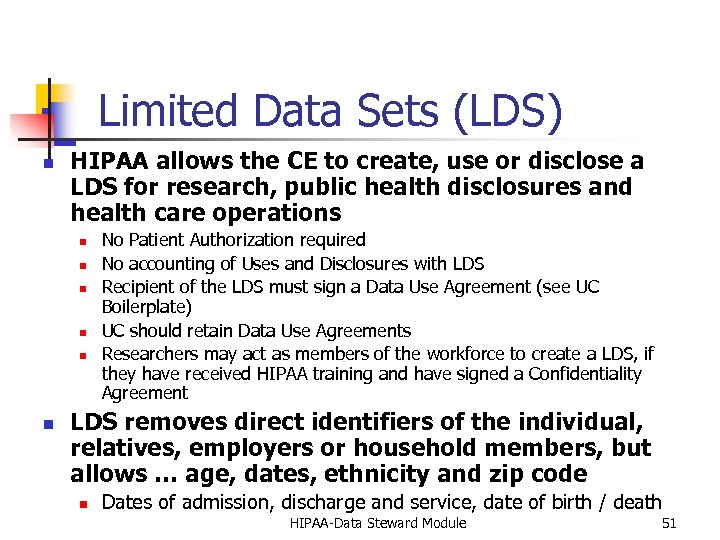 Limited Data Sets (LDS) n HIPAA allows the CE to create, use or disclose a LDS for research, public health disclosures and health care operations n n n No Patient Authorization required No accounting of Uses and Disclosures with LDS Recipient of the LDS must sign a Data Use Agreement (see UC Boilerplate) UC should retain Data Use Agreements Researchers may act as members of the workforce to create a LDS, if they have received HIPAA training and have signed a Confidentiality Agreement LDS removes direct identifiers of the individual, relatives, employers or household members, but allows … age, dates, ethnicity and zip code n Dates of admission, discharge and service, date of birth / death HIPAA-Data Steward Module 51
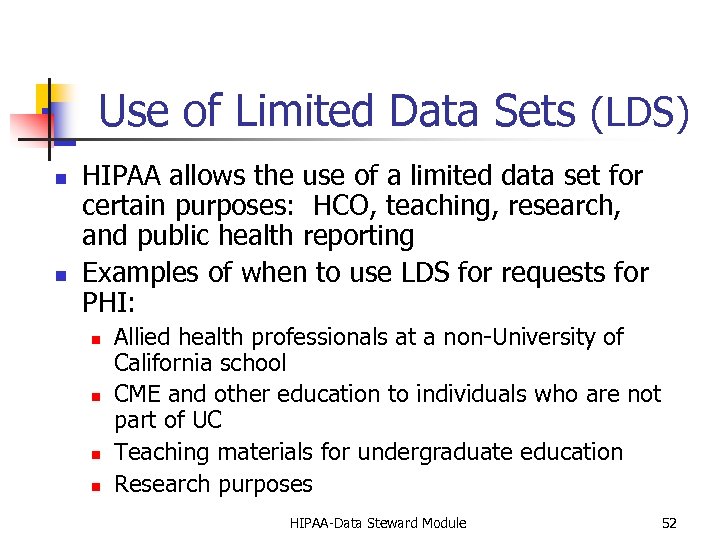 Use of Limited Data Sets (LDS) n n HIPAA allows the use of a limited data set for certain purposes: HCO, teaching, research, and public health reporting Examples of when to use LDS for requests for PHI: n n Allied health professionals at a non-University of California school CME and other education to individuals who are not part of UC Teaching materials for undergraduate education Research purposes HIPAA-Data Steward Module 52
 Authorizations for Access, Use/Disclosure of PHI HIPAA-Data Steward Module
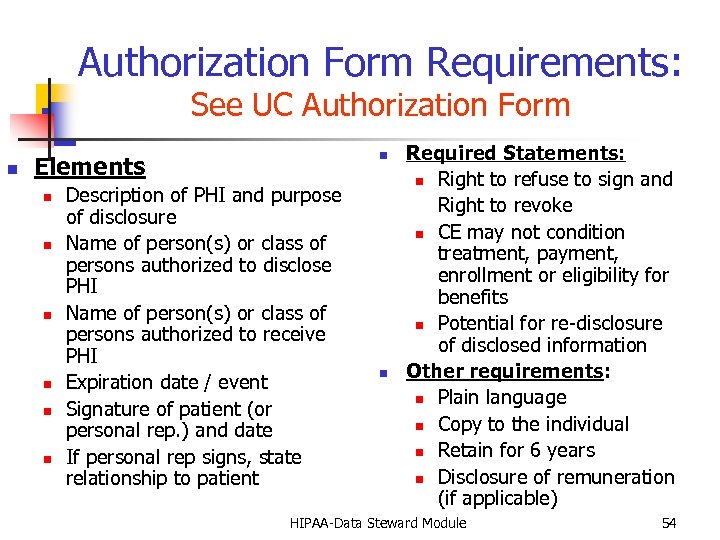 Authorization Form Requirements: See UC Authorization Form n n Elements n n n Description of PHI and purpose of disclosure Name of person(s) or class of persons authorized to disclose PHI Name of person(s) or class of persons authorized to receive PHI Expiration date / event Signature of patient (or personal rep. ) and date If personal rep signs, state relationship to patient n Required Statements: n Right to refuse to sign and Right to revoke n CE may not condition treatment, payment, enrollment or eligibility for benefits n Potential for re-disclosure of disclosed information Other requirements: n Plain language n Copy to the individual n Retain for 6 years n Disclosure of remuneration (if applicable) HIPAA-Data Steward Module 54
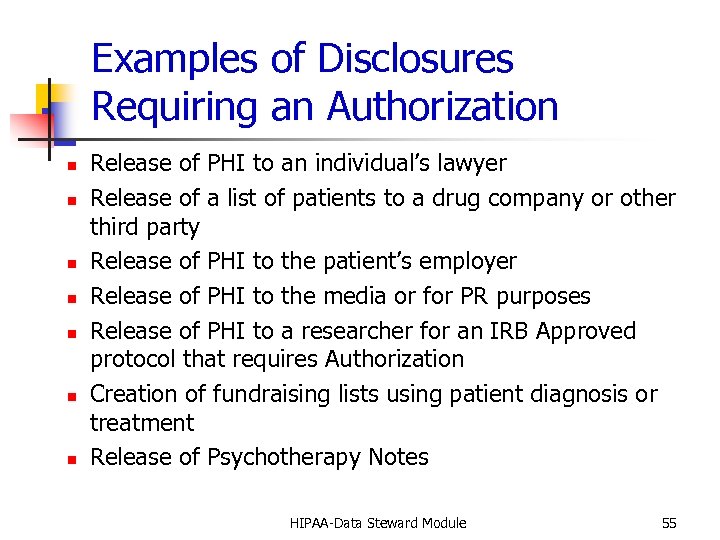 Examples of Disclosures Requiring an Authorization n n n Release of PHI to an individual’s lawyer Release of a list of patients to a drug company or other third party Release of PHI to the patient’s employer Release of PHI to the media or for PR purposes Release of PHI to a researcher for an IRB Approved protocol that requires Authorization Creation of fundraising lists using patient diagnosis or treatment Release of Psychotherapy Notes HIPAA-Data Steward Module 55
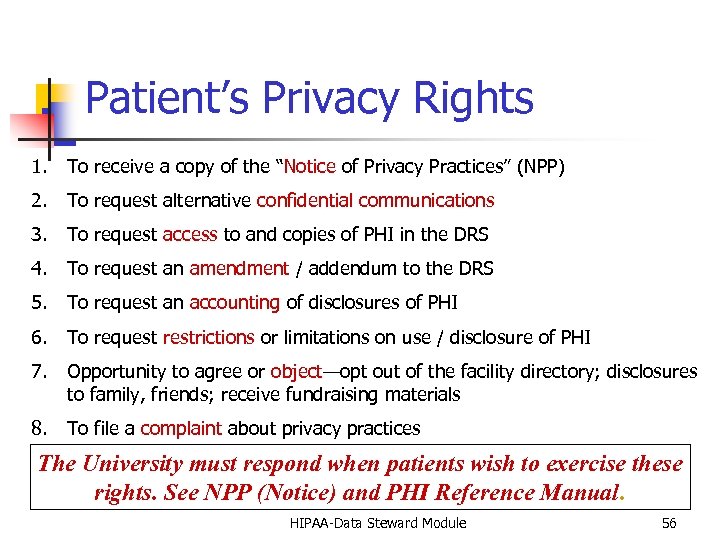 Patient’s Privacy Rights 1. To receive a copy of the “Notice of Privacy Practices” (NPP) 2. To request alternative confidential communications 3. To request access to and copies of PHI in the DRS 4. To request an amendment / addendum to the DRS 5. To request an accounting of disclosures of PHI 6. To request restrictions or limitations on use / disclosure of PHI 7. Opportunity to agree or object—opt out of the facility directory; disclosures to family, friends; receive fundraising materials 8. To file a complaint about privacy practices The University must respond when patients wish to exercise these rights. See NPP (Notice) and PHI Reference Manual. HIPAA-Data Steward Module 56
 Patients must have an Opportunity to: Ø Opt out of the Facility Directory (inpatient) Ø Object to uses and disclosures … n To family members or friends or patient advocate n In the Facility Directory Ø Request alternative forms of Confidential Communications Ø Request restrictions on uses and disclosures: n For Treatment, Payment and Operations n To individuals involved in patient’s care Ø Designate a personal representative Ø To opt out of fundraising and marketing Refer non-routine requests to the Privacy Official or Risk Manager for review. HIPAA-Data Steward Module 57
 Facility Directory (Inpatient) Patient information - What may be disclosed n n Facility Directory Information: name, location, general condition; and for clergy, the religious affiliation Facility Directory Information may be provided to persons who request the individual by name (including media), unless: n n n Patients restricts or prohibits use or disclosure, e. g. no phone calls, no visitors, no clergy, no disclosure In emergency, CE’s professional judgment to designate the admission as “no disclosure”, e. g. , patient safety Disclosures to clergy permitted, unless patient requested “no disclosure”: n n “No Disclosure“ means no disclosures may be made, e. g. , “I have no information on this patient. ” Patient request may be written or oral and may be made at any time. HIPAA-Data Steward Module 58
 Patient’s Request for Confidential Communications n n n Patients may request alternative means of receiving communications of their PHI All requests, denials of requests and approvals should be in writing All reasonable requests must be permitted and accommodated The requirement applies to disclosures by health plans if the individual clearly states disclosure could endanger individual UC data stewards will determine if the request is reasonable and will document all approved requests Examples of reasonable requests: n Send bills to a P. O. Box, rather than a home address. n Route follow-up calls to a cell-phone number, rather than home #. n E-Mail: Obtain patient’s authorization prior to sending, exercise caution HIPAA-Data Steward Module 59
 Patient’s Request for Access to and Copies of PHI in the DRS n n n Patient has a right to request access to inspect and/or obtain a copy of his/her PHI in a DRS for as long as the DRS is maintained All requests for access and any denials must be in writing Timely response is required UC may charge a reasonable cost-based fee for copying and mailing and for preparing an executive summary if patient requests a summary HIPAA provides specific requirements for denial of access in very limited circumstances and provides a right to an appeal of the denial Refer to the PHI Reference Manual and local campus policies for guidance HIPAA-Data Steward Module 60
 Patient’s Request to Amend the Designated Record Set n n n A patient has the right to request the CE to amend PHI in the DRS All requests should be in writing HIPAA provides specific criteria for denying a request and providing a timely, written response to the request UC providers may deny the request for an amendment Patient has right to disagree with the denial and provide a rebuttal California Law permits a patient to submit an addendum to the medical record (up to 250 words per incorrect item). UC cannot refuse the request to include an addendum. See the PHI Reference Manual for detailed instructions HIPAA-Data Steward Module 61
 Patient’s Requests for Restrictions n n n UC must permit an individual to request restrictions on the uses and disclosures of PHI for TPO purposes and for disclosures to persons involved in an individual’s care Requests should be in writing BUT …UC is not required to agree to such requests, nor provide review or appeal If UC agrees, then UC may not violate the restriction except in cases of emergency Consideration may be given for requests to restrict disclosures where there may be social stigma, celebrity status and/or risk of potential violence to the patient. Refer requests to the UC_HS Privacy Officer or Risk Manager. HIPAA-Data Steward Module 62
 Patient’s Right to File Complaints n n n Patients have the right to complain to UC about violations of their privacy / security and/or to the Department of Health & Human Services (DHHS) The NPP advises patients and others where they can file a complaint Respond to complaints and document any action taken The NPP is also posted on the UC_HS website at: www 2. ucsc. edu/healthcenter Action: Refer to PHI Reference Manual for policy / procedures for complaints. HIPAA-Data Steward Module 63
 Self-Test n n Do you know what to do when a patient requests those Rights provided under HIPAA? Do you know where to get help? Do you know when the Minimum Necessary Standard applies? Why is your role as PHI data steward and gatekeeper of the DRS so important? HIPAA-Data Steward Module 64
 HIPAA also requires Security HIPAA-Data Steward Module 65
 It’s Good to Know: Privacy & Security Go Hand-in-Hand n n Privacy focus is – “Who can access, use or disclose information? ” n “What is Private? ” is a key concept n Patient’s rights to know how information is used and disclosed n Patient’s right to control access to information Security focus is – “How do we keep it private? ” n Privacy Rule - protects security of information in all forms n Security Rule - protects electronic information HIPAA-Data Steward Module 66
 HIPAA – Security Tips n Security of electronic data: Your responsibility! n n n n Password security is key…NEVER SHARE PASSWORDS Password protect your PCs, PDAs, laptops, home computers; use automatic log-offs Secure access, transmission, storage and retention of e-data Don’t leave confidential information on your computer screen…or in the trash! Do not e-mail PHI outside the network unless you can encrypt it Use caution when sending faxes. Be aware of who may be viewing the information from both fax machines. Use fax cover sheets and verify fax #s. Report breaches to your UC privacy / security officer. Physical security of data: Your responsibility! n Use locked shredder bins; Key access to file rooms / cabinets HIPAA-Data Steward Module 67
 Self-Test: Security Question: For new hires & temporary personnel, when can I share my password to avoid delaying patient care and/or billing? Choices: (choose the 1 correct answer) A. I may share my password with new personnel for up to 10 days or until the person has their own password, as long as they have completed privacy training. B. I may post my password in a discreet area to limit access to my password. C. Only when temporary personnel are hired or students are visiting. D. Never! § Answer: “D” HIPAA-Data Steward Module 68
 Summary n n To build trust with our patients, the HIPAA Privacy Rules call on all of us to learn and implement the privacy and security rules regarding protected health information (PHI) …and abide by them! HIPAA-Data Steward Module 69
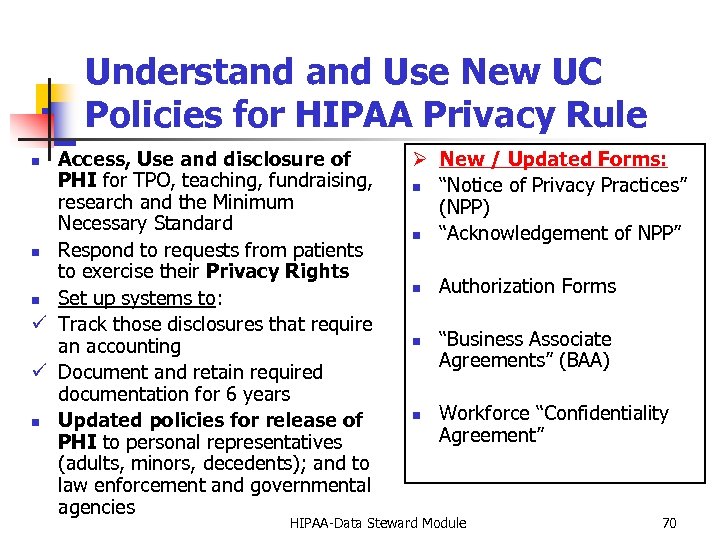 Understand Use New UC Policies for HIPAA Privacy Rule Access, Use and disclosure of PHI for TPO, teaching, fundraising, research and the Minimum Necessary Standard n Respond to requests from patients to exercise their Privacy Rights n Set up systems to: ü Track those disclosures that require an accounting ü Document and retain required documentation for 6 years n Updated policies for release of PHI to personal representatives (adults, minors, decedents); and to law enforcement and governmental agencies n Ø New / Updated Forms: n “Notice of Privacy Practices” (NPP) n “Acknowledgement of NPP” n n n Authorization Forms “Business Associate Agreements” (BAA) Workforce “Confidentiality Agreement” HIPAA-Data Steward Module 70
 HIPAA References and Resources n n n UC_HS “Notice of Privacy Practices” UC Privacy Officer and UC_HS Privacy Officer for your campus UCSC HIPAA web site: n www 2. ucsc. edu/healthcenter UC privacy / security / confidentiality policies HIPAA PHI Reference Manual is available at the Student Health Center to provide more detailed information on your local policies and procedures HHS Office of Civil Rights, HIPAA regulations n http: //www. hhs. gov/ocr/hipaa HIPAA-Data Steward Module 71
 Document your Training n If viewing this self-study module online, print out the training certificate form for your supervisor as proof of completing the module. HIPAA-Data Steward Module 72
 Training Certificate Congratulations! n n You have now completed the “HIPAA PHI Management Module for PHI Data Stewards”. Disclaimer: This module is intended to provide educational information and is not legal advice. If you have questions regarding the privacy / security laws and implementation procedures at your facility, please contact your supervisor or the healthcare privacy officer at your facility for more information. Print Name: _______Dept. : ______ Signature: ________Date: ______ HIPAA-Data Steward Module 73