 Скачать презентацию University of British Columbia CPSC 414 Computer Graphics
de7464b84580efb63bdd42fb455b8cd7.ppt
- Количество слайдов: 51



University of British Columbia CPSC 414 Computer Graphics Color Week 10, Wed 5 Nov 2003 © Tamara Munzner 1
Readings • Chapter 1. 4: color • plus supplemental reading: – A Survey of Color for Computer Graphics, Maureen Stone, SIGGRAPH Course Notes 2001 – pages 4 -24 required – http: //graphics. stanford. edu/courses/cs 448 b-02 -spring/04 cdrom. pdf Week 10, Wed 5 Nov 03 © Tamara Munzner 2
News • yet more extra office hours – Tue 11 -1 (AW xtra) – Wed 1 -2 (AW lab), 2 -3 (PZ lab) – Thu 11 -1 (AW, AG xtra) 12 -1 (AG lab) – Fri 10 -11 (AG lab), 11: 30 -1: 30 (AW, AG xtra) • I’m at a conference Fri pm – Mon pm – guest lecture Monday: Ahbijeet Ghosh – my personal mail response will be slow – use newsgroup or email to TAs • if can’t post remotely, try unsub/resub or port forward • homework 1 pickup again end of class Week 10, Wed 5 Nov 03 © Tamara Munzner 3
Picking Hints • use Open. GL picking to find correct face • plane: vectors from face verts, construct normal • 4 lines: glu. Un. Project – rect around pick xy point, z = 0 and z = 1 – visual debugging: try drawing line in scene – print out matrices, see if look right • make sure to grab them when they’re correct • confusing gl. Get. Doublev params: MODELVIEW_MATRIX • calculcate line/plane intersection – nudge outwards along normal Week 10, Wed 5 Nov 03 © Tamara Munzner 4
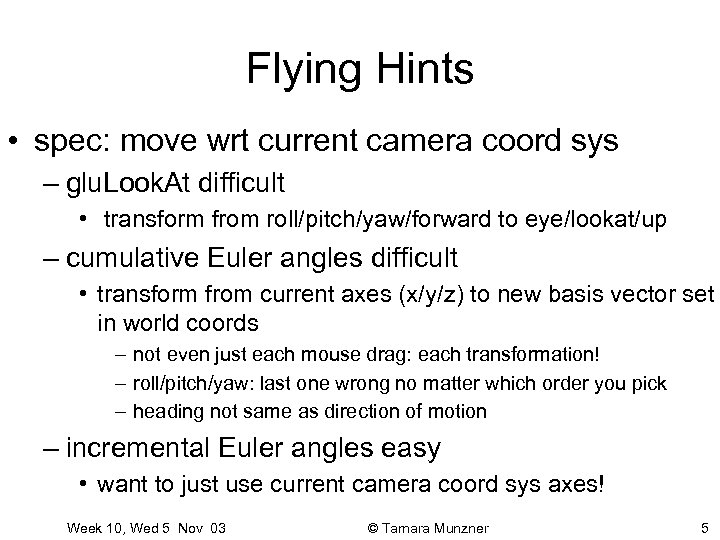
Flying Hints • spec: move wrt current camera coord sys – glu. Look. At difficult • transform from roll/pitch/yaw/forward to eye/lookat/up – cumulative Euler angles difficult • transform from current axes (x/y/z) to new basis vector set in world coords – not even just each mouse drag: each transformation! – roll/pitch/yaw: last one wrong no matter which order you pick – heading not same as direction of motion – incremental Euler angles easy • want to just use current camera coord sys axes! Week 10, Wed 5 Nov 03 © Tamara Munzner 5
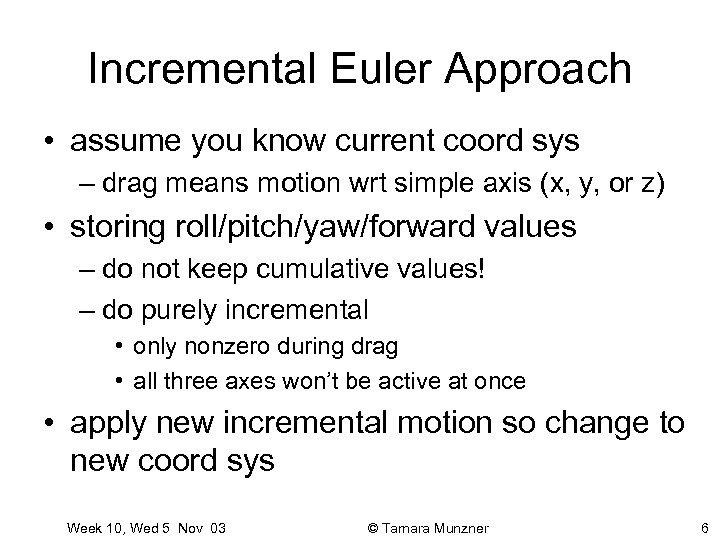
Incremental Euler Approach • assume you know current coord sys – drag means motion wrt simple axis (x, y, or z) • storing roll/pitch/yaw/forward values – do not keep cumulative values! – do purely incremental • only nonzero during drag • all three axes won’t be active at once • apply new incremental motion so change to new coord sys Week 10, Wed 5 Nov 03 © Tamara Munzner 6

Matrix Stack As Calculator, Storage • if not saving cumulative values, how do you know where you are? – if careful to segregate modelling transforms with push/pop, current viewing transformation stored in matrix stack! – don’t just erase with gl. Identity – reuse stack values from last frame instead Week 10, Wed 5 Nov 03 © Tamara Munzner 7

Matrix Stack As Calculator, Storage • transformation order problem – stack only supports p’ = Current Incr p – want p’ = Incr Current p • read out stack into temporary matrix – gl. Get. Doublev, just like when you unproject – then wipe stack, issue incr, issue current – now stack has correct new value, life is good • uses stack to both calculate and to store Week 10, Wed 5 Nov 03 © Tamara Munzner 8
University of British Columbia CPSC 414 Computer Graphics Visibility recap © Tamara Munzner 9
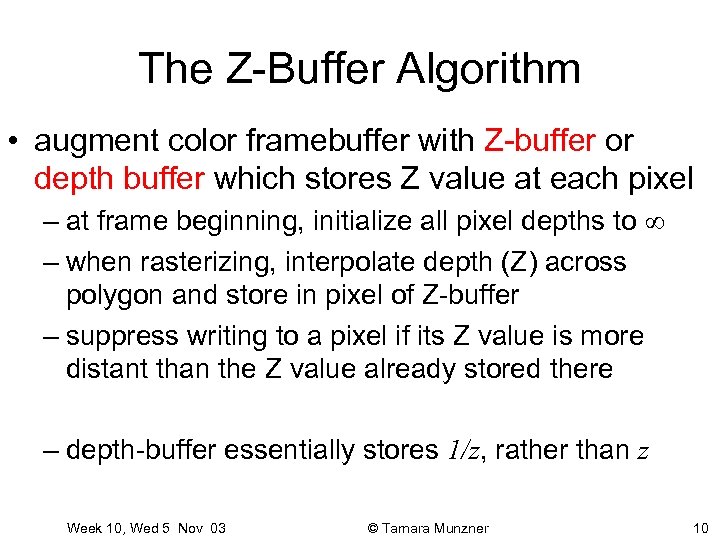
The Z-Buffer Algorithm • augment color framebuffer with Z-buffer or depth buffer which stores Z value at each pixel – at frame beginning, initialize all pixel depths to – when rasterizing, interpolate depth (Z) across polygon and store in pixel of Z-buffer – suppress writing to a pixel if its Z value is more distant than the Z value already stored there – depth-buffer essentially stores 1/z, rather than z Week 10, Wed 5 Nov 03 © Tamara Munzner 10

Z-Buffer Pros • • simple!!! easy to implement in hardware polygons can be processed in arbitrary order easily handles polygon interpenetration Week 10, Wed 5 Nov 03 © Tamara Munzner 11
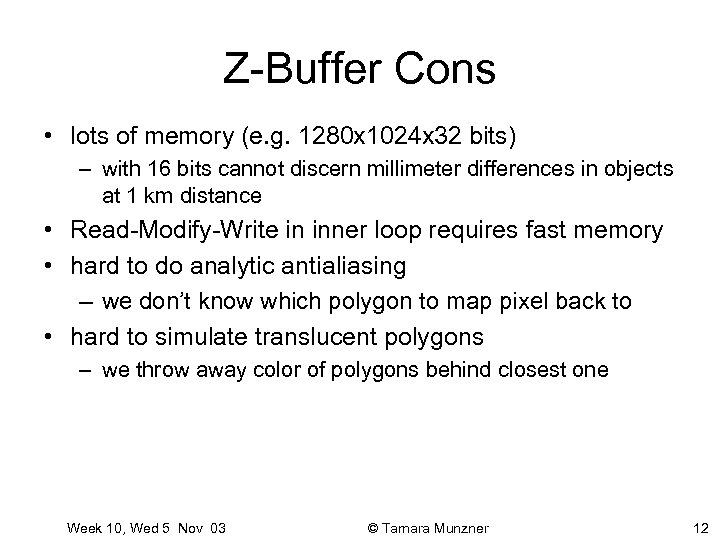
Z-Buffer Cons • lots of memory (e. g. 1280 x 1024 x 32 bits) – with 16 bits cannot discern millimeter differences in objects at 1 km distance • Read-Modify-Write in inner loop requires fast memory • hard to do analytic antialiasing – we don’t know which polygon to map pixel back to • hard to simulate translucent polygons – we throw away color of polygons behind closest one Week 10, Wed 5 Nov 03 © Tamara Munzner 12
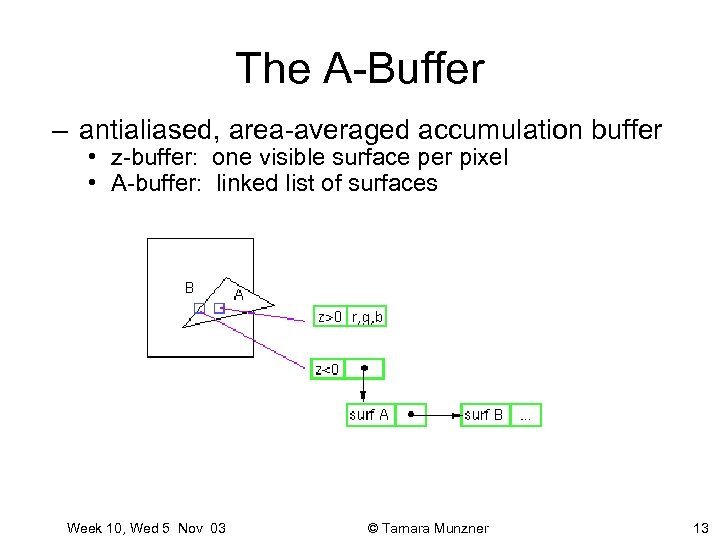
The A-Buffer – antialiased, area-averaged accumulation buffer • z-buffer: one visible surface per pixel • A-buffer: linked list of surfaces Week 10, Wed 5 Nov 03 © Tamara Munzner 13
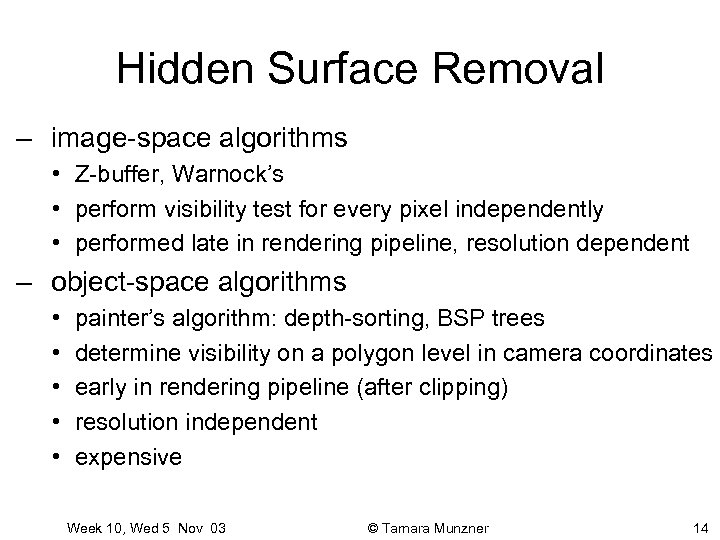
Hidden Surface Removal – image-space algorithms • Z-buffer, Warnock’s • perform visibility test for every pixel independently • performed late in rendering pipeline, resolution dependent – object-space algorithms • • • painter’s algorithm: depth-sorting, BSP trees determine visibility on a polygon level in camera coordinates early in rendering pipeline (after clipping) resolution independent expensive Week 10, Wed 5 Nov 03 © Tamara Munzner 14
University of British Columbia CPSC 414 Computer Graphics Color © Tamara Munzner 15
Color To understand how to make realistic images, we need a basic understanding of the physics and physiology of vision. Here we step away from the code and math for a bit to talk about basic principles. Week 10, Wed 5 Nov 03 © Tamara Munzner 16
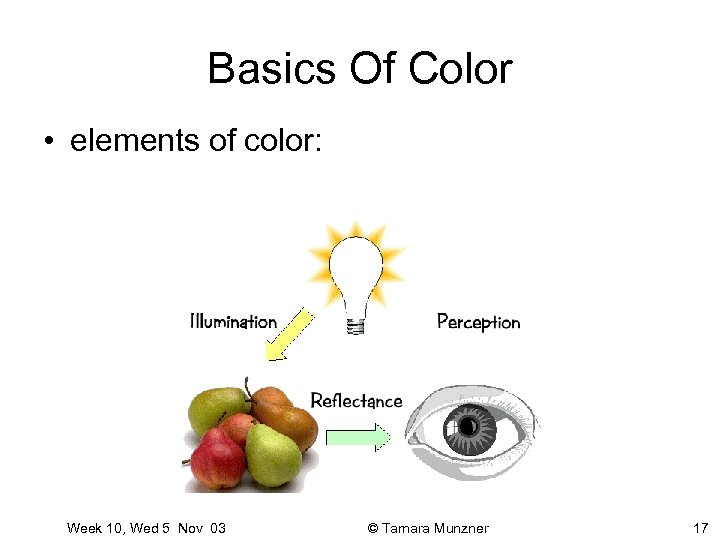
Basics Of Color • elements of color: Week 10, Wed 5 Nov 03 © Tamara Munzner 17
Basics of Color • Physics: – Illumination • Electromagnetic spectra – Reflection • Material properties • Surface geometry and microgeometry (i. e. , polished versus matte versus brushed) • Perception – Physiology and neurophysiology – Perceptual psychology Week 10, Wed 5 Nov 03 © Tamara Munzner 18
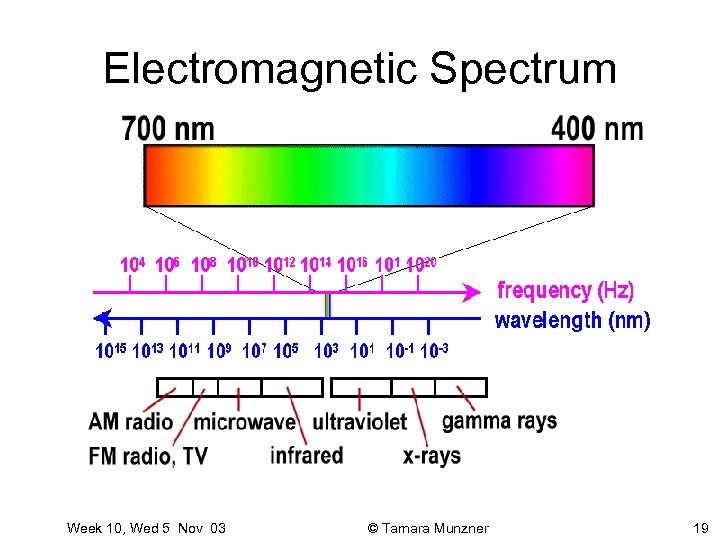
Electromagnetic Spectrum Week 10, Wed 5 Nov 03 © Tamara Munzner 19
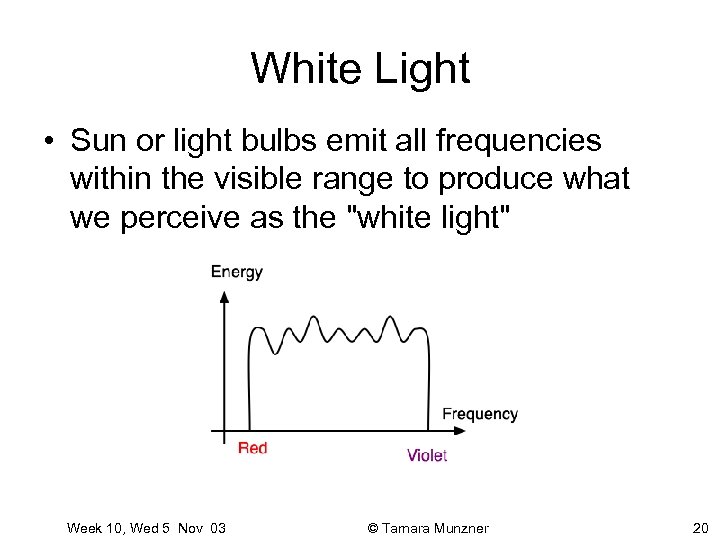
White Light • Sun or light bulbs emit all frequencies within the visible range to produce what we perceive as the "white light" Week 10, Wed 5 Nov 03 © Tamara Munzner 20
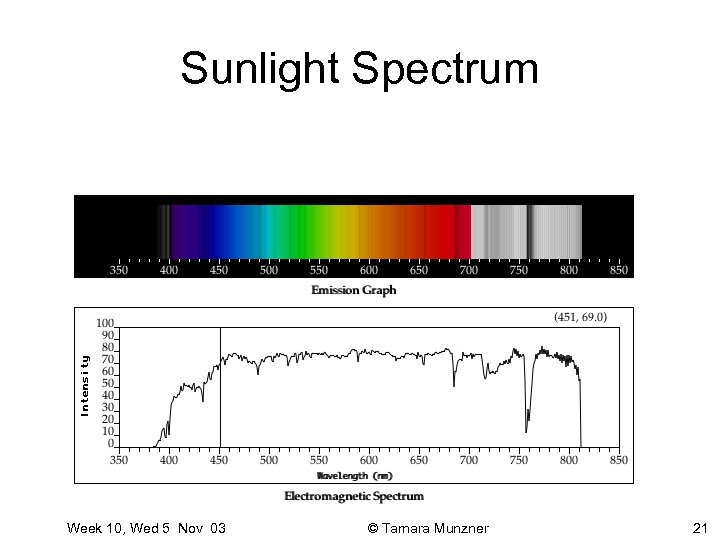
Sunlight Spectrum Week 10, Wed 5 Nov 03 © Tamara Munzner 21
White Light and Color • when white light is incident upon an object, some frequencies are reflected and some are absorbed by the object • combination of frequencies present in the reflected light that determinses what we perceive as the color of the object Week 10, Wed 5 Nov 03 © Tamara Munzner 22
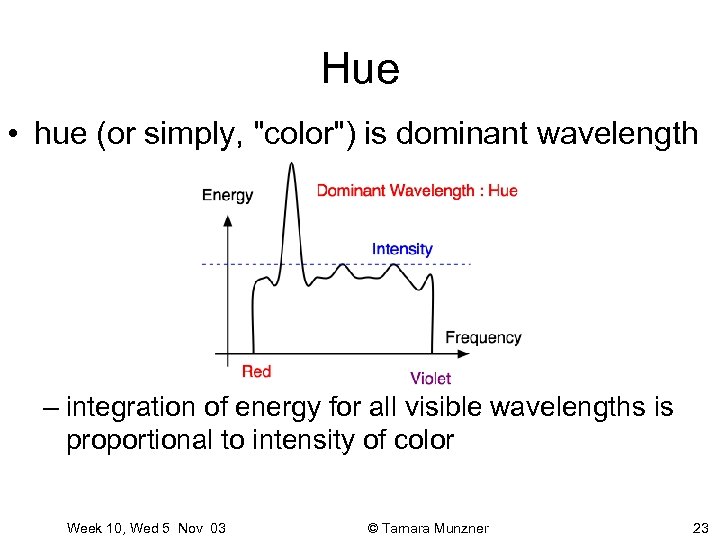
Hue • hue (or simply, "color") is dominant wavelength – integration of energy for all visible wavelengths is proportional to intensity of color Week 10, Wed 5 Nov 03 © Tamara Munzner 23
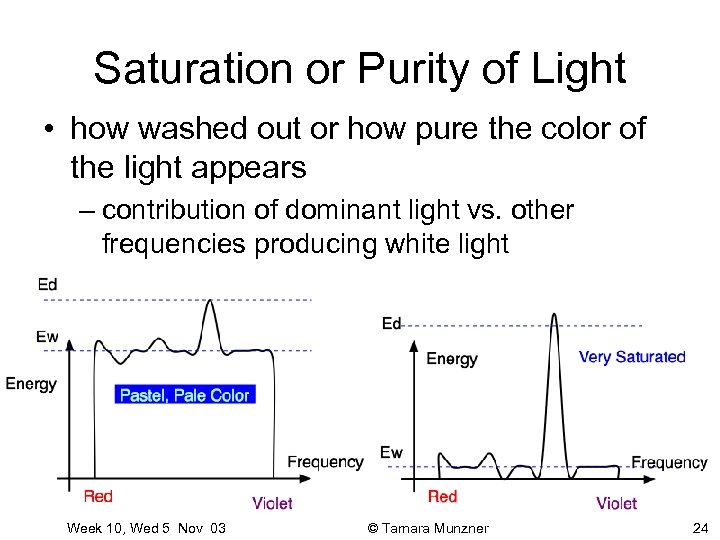
Saturation or Purity of Light • how washed out or how pure the color of the light appears – contribution of dominant light vs. other frequencies producing white light Week 10, Wed 5 Nov 03 © Tamara Munzner 24
Intensity, Brightness • intensity : radiant energy emitted per unit of time, per unit solid angle, and per unit projected area of the source (related to the luminance of the source) • brightness : perceived intensity of light Week 10, Wed 5 Nov 03 © Tamara Munzner 25
Humans and Light • when we view a source of light, our eyes respond to – hue: the color we see (red, green, purple) • dominant frequency – saturation: how far is color from grey • how far is the color from gray (pink is less saturated than red, sky blue is less saturated than royal blue) – brightness: how bright is the color • how bright are the lights illuminating the object? Week 10, Wed 5 Nov 03 © Tamara Munzner 26
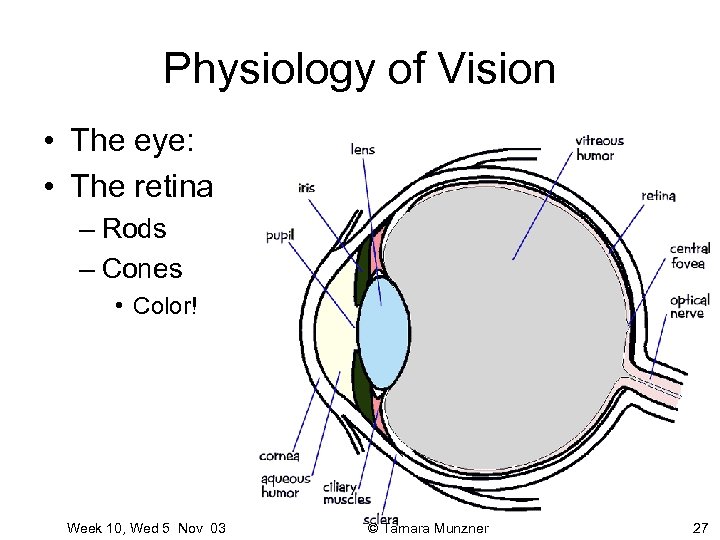
Physiology of Vision • The eye: • The retina – Rods – Cones • Color! Week 10, Wed 5 Nov 03 © Tamara Munzner 27
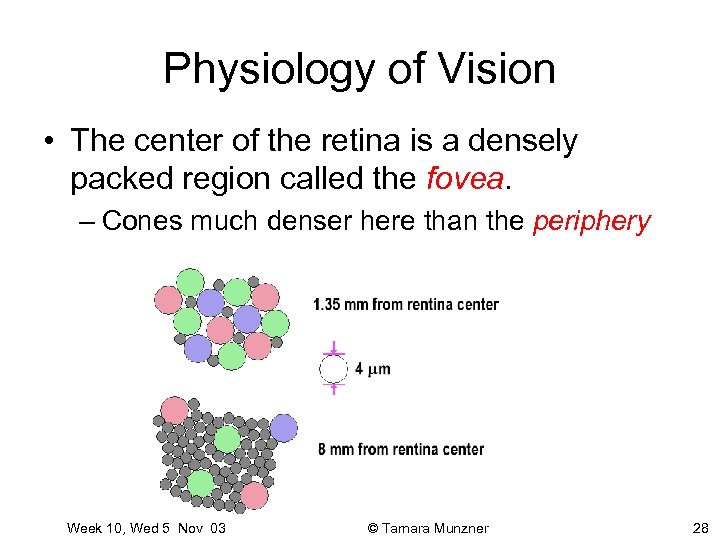
Physiology of Vision • The center of the retina is a densely packed region called the fovea. – Cones much denser here than the periphery Week 10, Wed 5 Nov 03 © Tamara Munzner 28
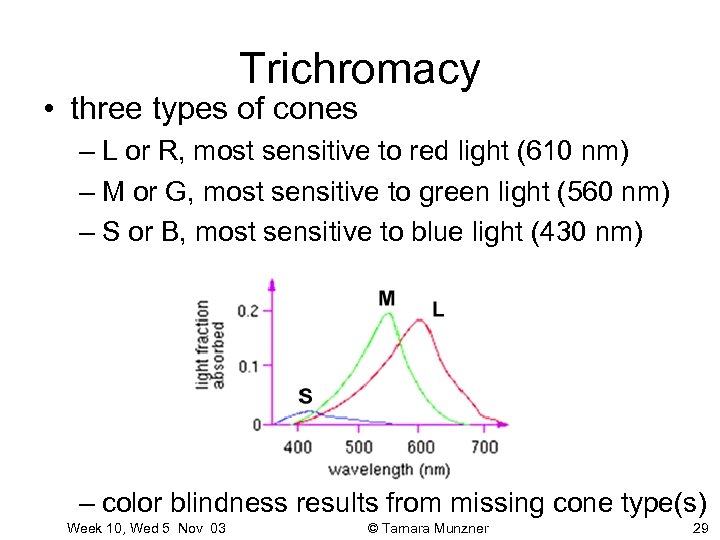
Trichromacy • three types of cones – L or R, most sensitive to red light (610 nm) – M or G, most sensitive to green light (560 nm) – S or B, most sensitive to blue light (430 nm) – color blindness results from missing cone type(s) Week 10, Wed 5 Nov 03 © Tamara Munzner 29
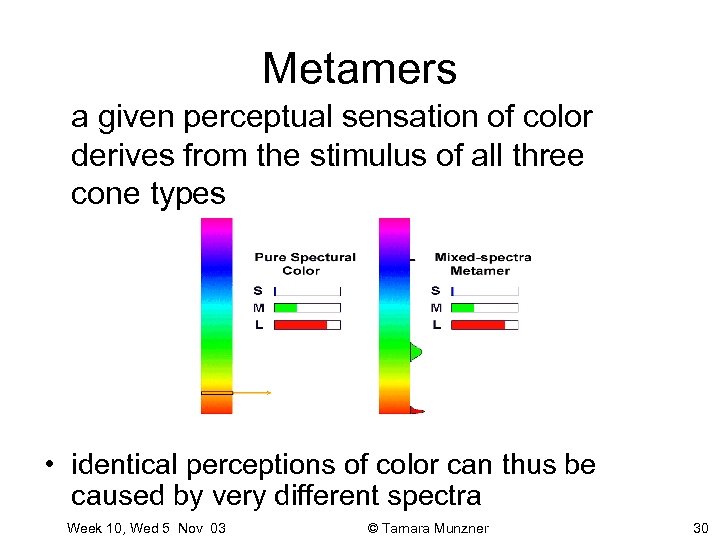
Metamers a given perceptual sensation of color derives from the stimulus of all three cone types • identical perceptions of color can thus be caused by very different spectra Week 10, Wed 5 Nov 03 © Tamara Munzner 30
Metamer Demo • http: //www. cs. brown. edu/exploratories/free. Software/catalogs/color_theory. html Week 10, Wed 5 Nov 03 © Tamara Munzner 31
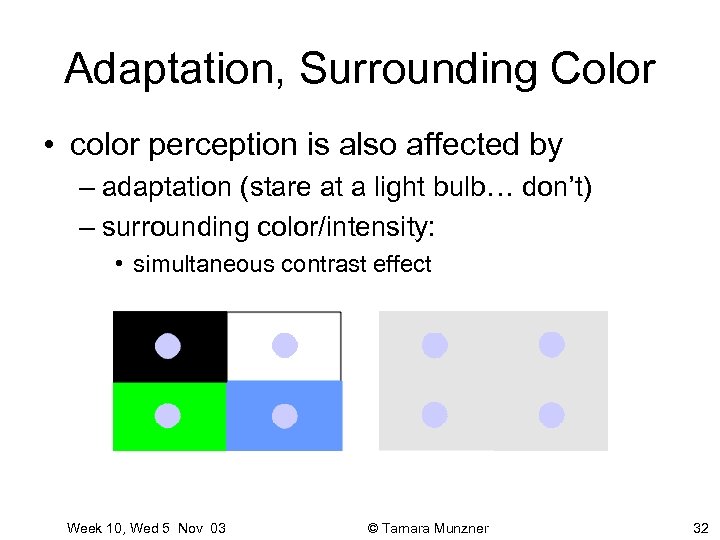
Adaptation, Surrounding Color • color perception is also affected by – adaptation (stare at a light bulb… don’t) – surrounding color/intensity: • simultaneous contrast effect Week 10, Wed 5 Nov 03 © Tamara Munzner 32
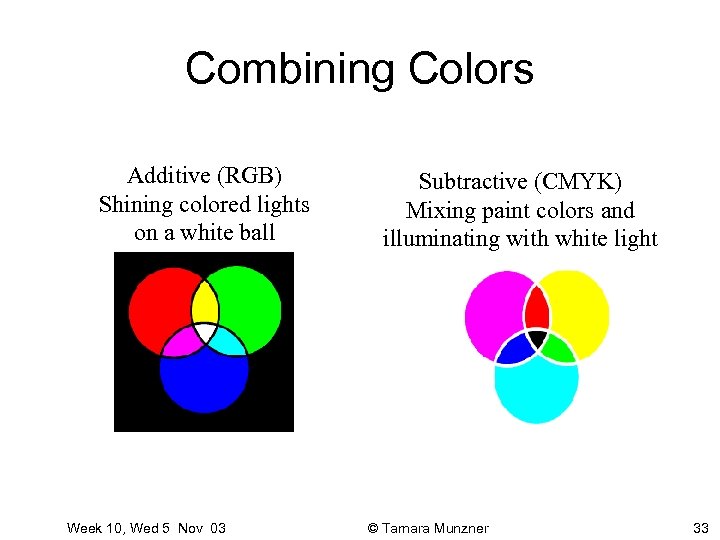
Combining Colors Additive (RGB) Shining colored lights on a white ball Week 10, Wed 5 Nov 03 Subtractive (CMYK) Mixing paint colors and illuminating with white light © Tamara Munzner 33
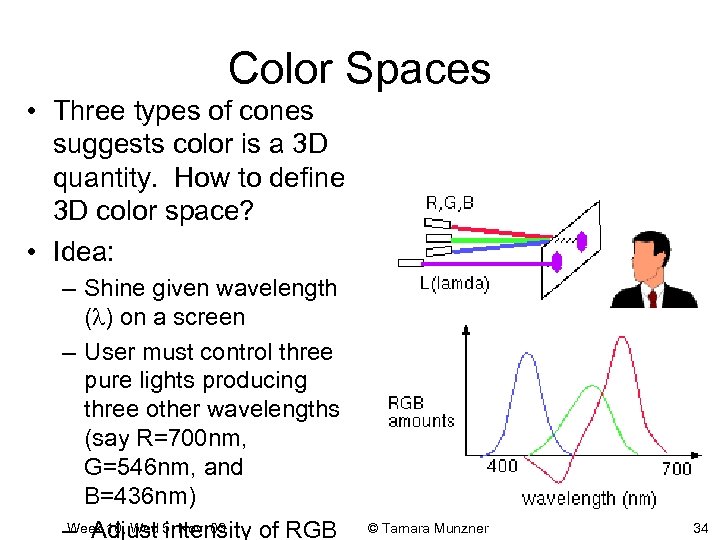
Color Spaces • Three types of cones suggests color is a 3 D quantity. How to define 3 D color space? • Idea: – Shine given wavelength ( ) on a screen – User must control three pure lights producing three other wavelengths (say R=700 nm, G=546 nm, and B=436 nm) Week 10, Wed 5 Nov 03 – Adjust intensity of RGB © Tamara Munzner 34
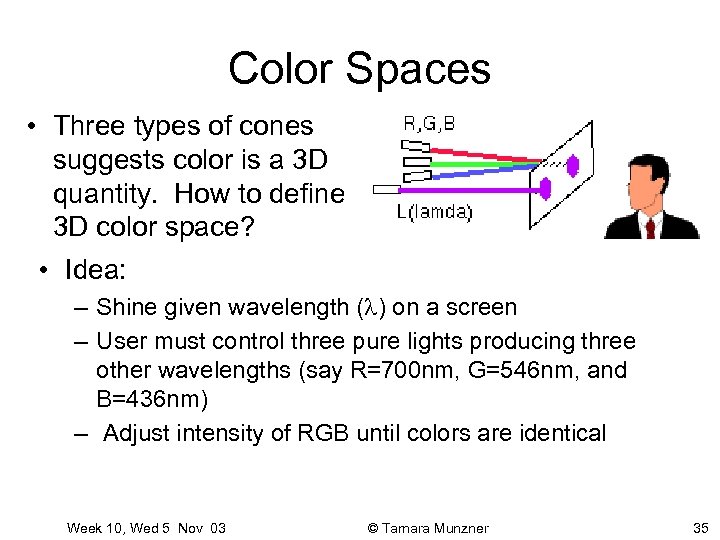
Color Spaces • Three types of cones suggests color is a 3 D quantity. How to define 3 D color space? • Idea: – Shine given wavelength ( ) on a screen – User must control three pure lights producing three other wavelengths (say R=700 nm, G=546 nm, and B=436 nm) – Adjust intensity of RGB until colors are identical Week 10, Wed 5 Nov 03 © Tamara Munzner 35
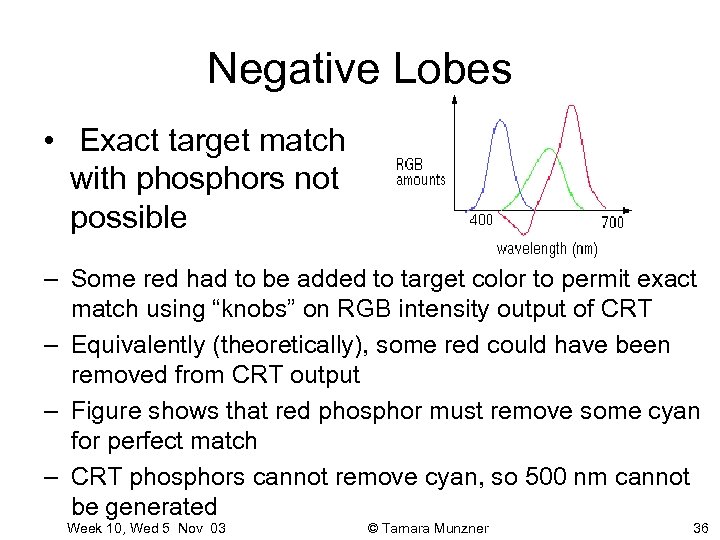
Negative Lobes • Exact target match with phosphors not possible – Some red had to be added to target color to permit exact match using “knobs” on RGB intensity output of CRT – Equivalently (theoretically), some red could have been removed from CRT output – Figure shows that red phosphor must remove some cyan for perfect match – CRT phosphors cannot remove cyan, so 500 nm cannot be generated Week 10, Wed 5 Nov 03 © Tamara Munzner 36
Negative Lobes • can’t generate all other wavelenths with any set of three monochromatic lights! • solution: convert to new synthetic coordinate system to make the job easy Week 10, Wed 5 Nov 03 © Tamara Munzner 37
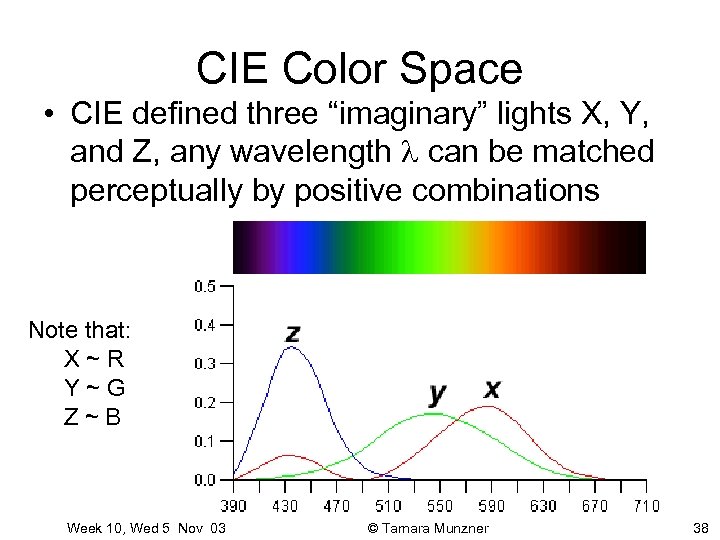
CIE Color Space • CIE defined three “imaginary” lights X, Y, and Z, any wavelength can be matched perceptually by positive combinations Note that: X ~ R Y ~ G Z ~ B Week 10, Wed 5 Nov 03 © Tamara Munzner 38
CIE Color Space • Target spectrum matched by finding corresponding X, Y, and Z quantities – Integrate product of spectral power and each of the three matching curves over all wavelengths Week 10, Wed 5 Nov 03 © Tamara Munzner 39
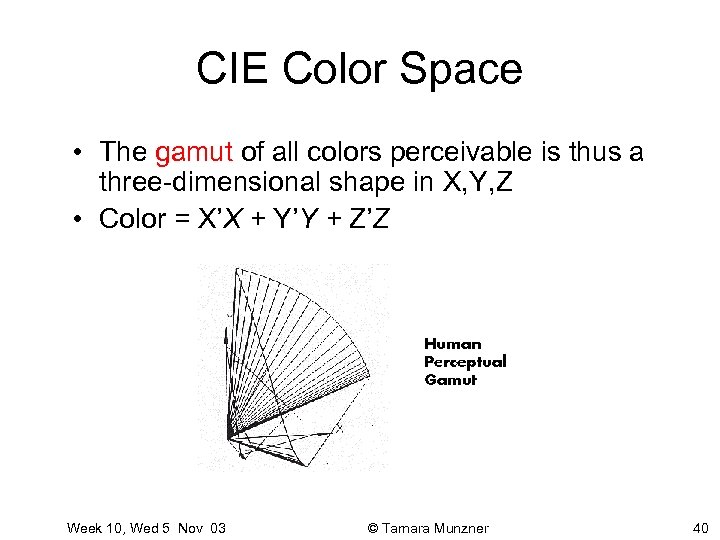
CIE Color Space • The gamut of all colors perceivable is thus a three-dimensional shape in X, Y, Z • Color = X’X + Y’Y + Z’Z Week 10, Wed 5 Nov 03 © Tamara Munzner 40
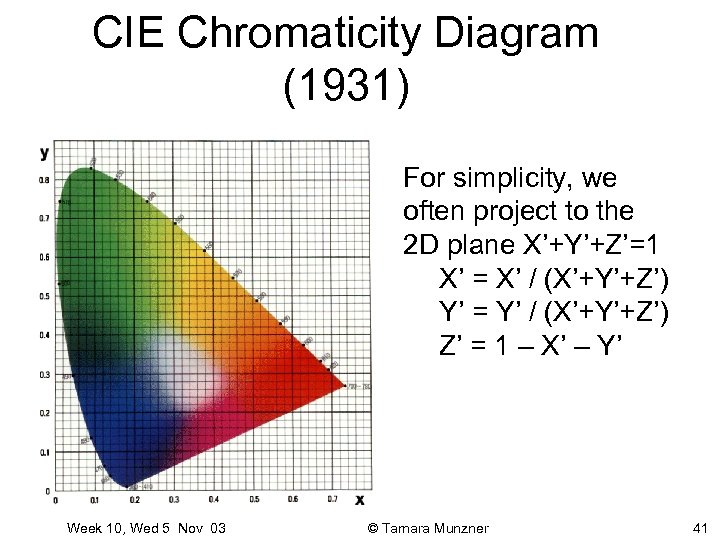
CIE Chromaticity Diagram (1931) For simplicity, we often project to the 2 D plane X’+Y’+Z’=1 X’ = X’ / (X’+Y’+Z’) Y’ = Y’ / (X’+Y’+Z’) Z’ = 1 – X’ – Y’ Week 10, Wed 5 Nov 03 © Tamara Munzner 41
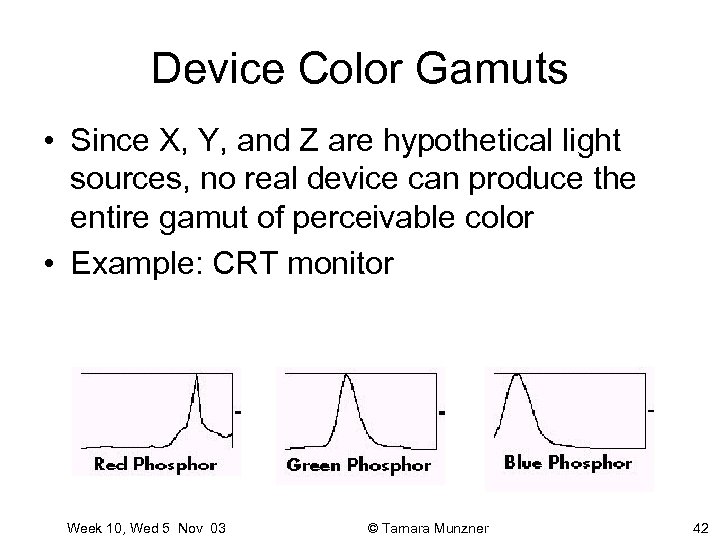
Device Color Gamuts • Since X, Y, and Z are hypothetical light sources, no real device can produce the entire gamut of perceivable color • Example: CRT monitor Week 10, Wed 5 Nov 03 © Tamara Munzner 42
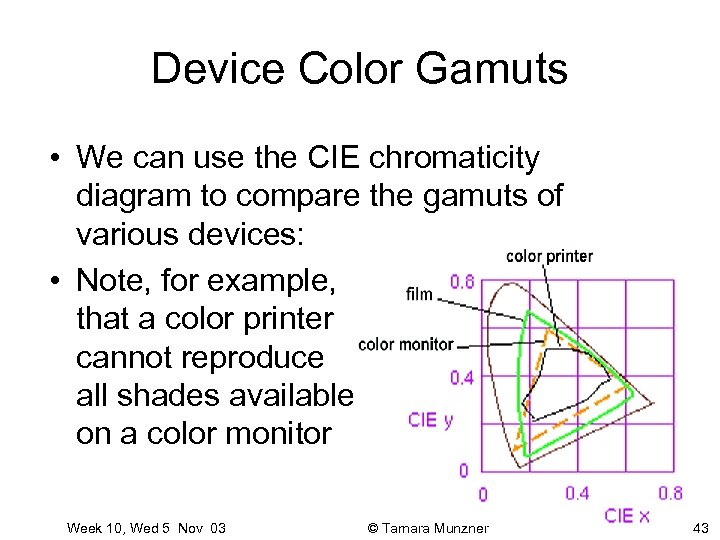
Device Color Gamuts • We can use the CIE chromaticity diagram to compare the gamuts of various devices: • Note, for example, that a color printer cannot reproduce all shades available on a color monitor Week 10, Wed 5 Nov 03 © Tamara Munzner 43
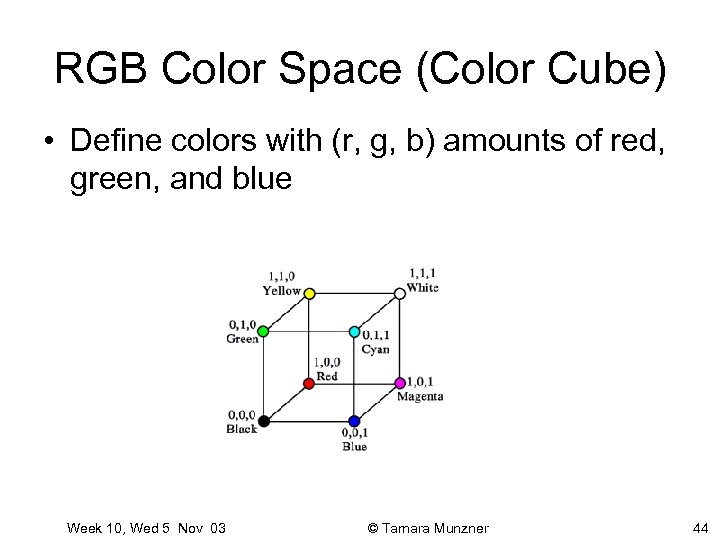
RGB Color Space (Color Cube) • Define colors with (r, g, b) amounts of red, green, and blue Week 10, Wed 5 Nov 03 © Tamara Munzner 44
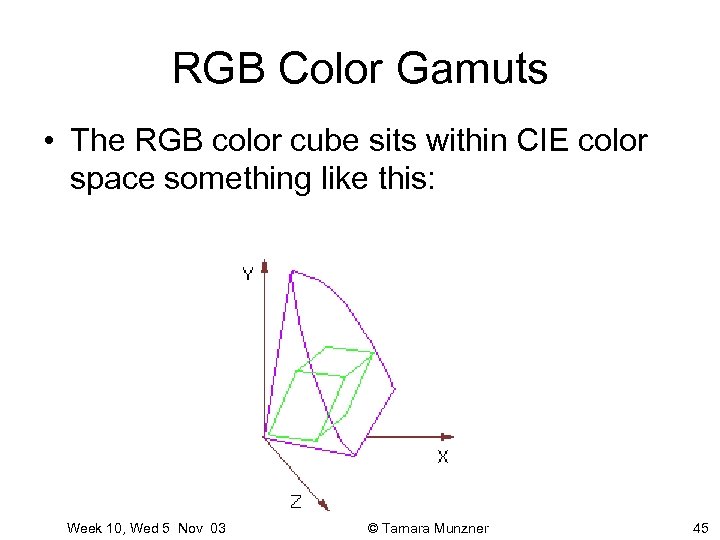
RGB Color Gamuts • The RGB color cube sits within CIE color space something like this: Week 10, Wed 5 Nov 03 © Tamara Munzner 45
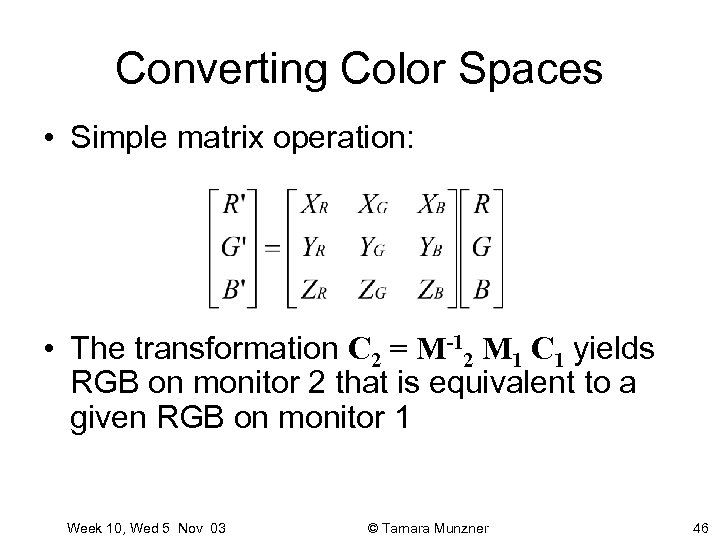
Converting Color Spaces • Simple matrix operation: • The transformation C 2 = M-12 M 1 C 1 yields RGB on monitor 2 that is equivalent to a given RGB on monitor 1 Week 10, Wed 5 Nov 03 © Tamara Munzner 46
YIQ Color Space • YIQ is the color model used for color TV in America. Y is brightness, I & Q are color – Note: Y is the same as CIE’s Y – Result: Use the Y alone and backwards compatibility with B/W TV! – These days when you convert RGB image to B/W image, the green and blue components are thrown away and red is used to control shades of grey (usually) Week 10, Wed 5 Nov 03 © Tamara Munzner 47
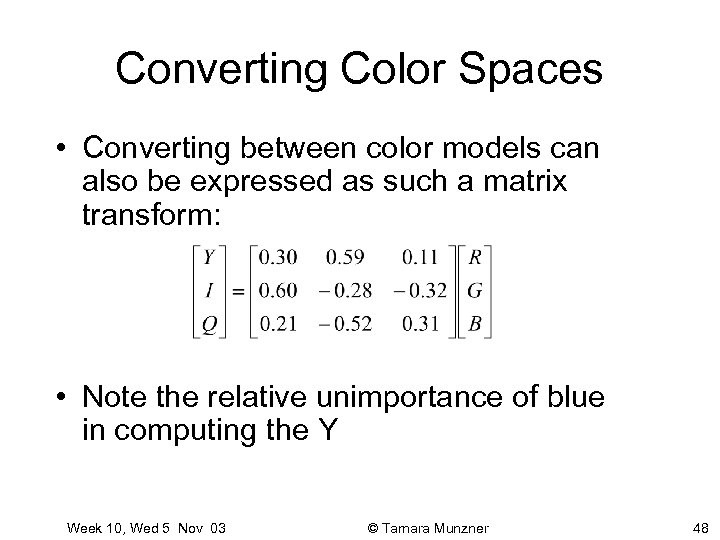
Converting Color Spaces • Converting between color models can also be expressed as such a matrix transform: • Note the relative unimportance of blue in computing the Y Week 10, Wed 5 Nov 03 © Tamara Munzner 48
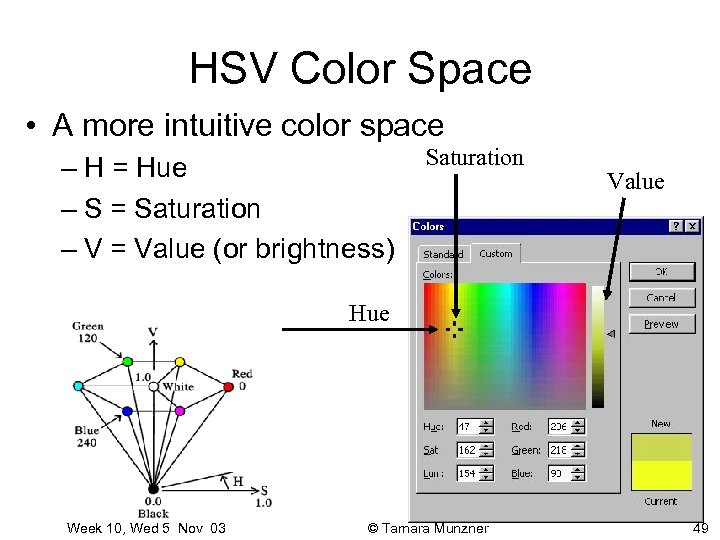
HSV Color Space • A more intuitive color space – H = Hue – S = Saturation – V = Value (or brightness) Saturation Value Hue Week 10, Wed 5 Nov 03 © Tamara Munzner 49
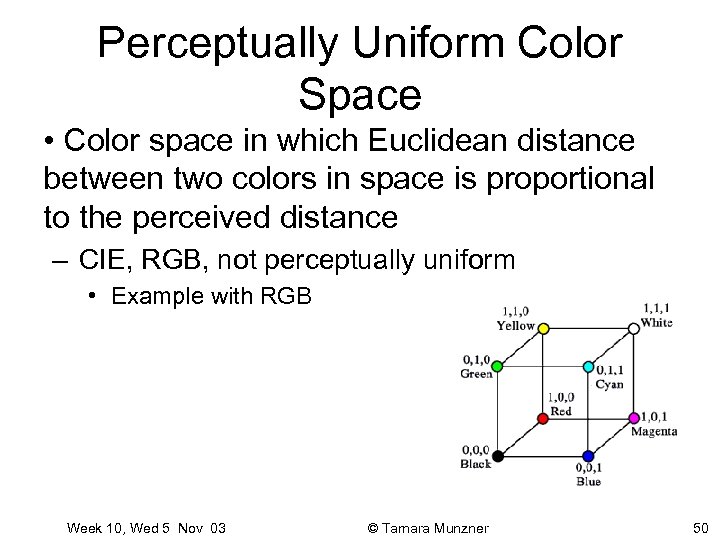
Perceptually Uniform Color Space • Color space in which Euclidean distance between two colors in space is proportional to the perceived distance – CIE, RGB, not perceptually uniform • Example with RGB Week 10, Wed 5 Nov 03 © Tamara Munzner 50

Pick up Homework 1 • take 2 Week 10, Wed 5 Nov 03 © Tamara Munzner 51
Скачать презентацию University of British Columbia CPSC 414 Computer Graphics
de7464b84580efb63bdd42fb455b8cd7.ppt