 Скачать презентацию University of Alaska-Anchorage College of Business
30dfa6c864e6704996d915d9fb174888.ppt
- Количество слайдов: 120



University of Alaska-Anchorage * College of Business & Public Policy M A R K E T I N G M G T. * Marketing Management Simulation * S I M U L A T I O N Course Intro & Overview
M A R K E T I N G M G T. Professor Ed Forrest S I M U L A T I O N • Telephone: – (O)786 -4161 – (c) 854 -8784 • Email: – Edward. F@cbpp. uaa. alaska. edu • W 3 site: http: //www. cbpp. uaa. alaska. edu/afef/
Vita/Resume´ * MBA Program BA 343 Principles of Marketing BA 460 Marketing Management BA 447 International Marketing BA 635 Current Marketing Issues Seminar BA 686 Management Simulation
By End of this Course you will have: • Conducted a situational analysis of consumers, competitor & market conditions • Developed & implemented strategies & plans to enhance organizational performance • Selected—according to operant competitive strategy -- appropriate performance assessment measures • Formulated a business plan based on the results of a market situation & SWOT analysis. • Formulated, implemented & assessed effectiveness of distinct competitive strategies • Determined & implemented specific tactical decisions that demonstrate functional alignment w/ selected competitive strategies
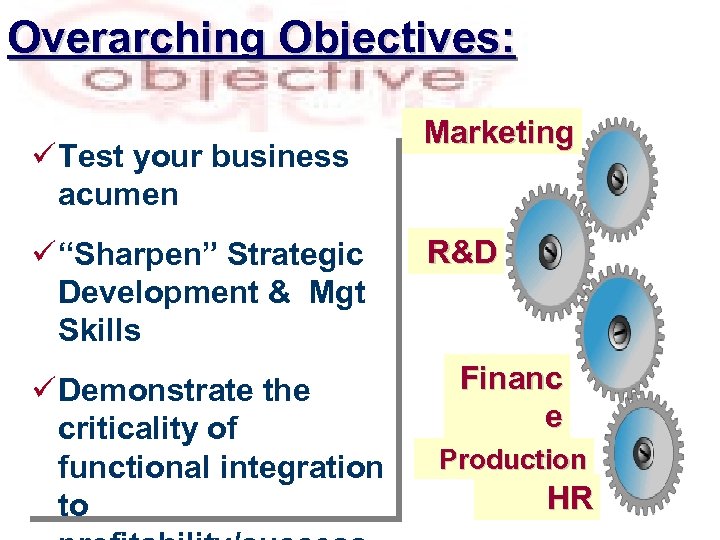
Overarching Objectives: M A R K E T I N G M G T. S I M U L A T I O N ü Test your business acumen ü “Sharpen” Strategic Development & Mgt Skills ü Demonstrate the criticality of functional integration to Marketing R&D Financ e Production HR
M A R K E T I N G M G T. S I M U L A T I O N your “study” of business … piece-meal and in isolation!
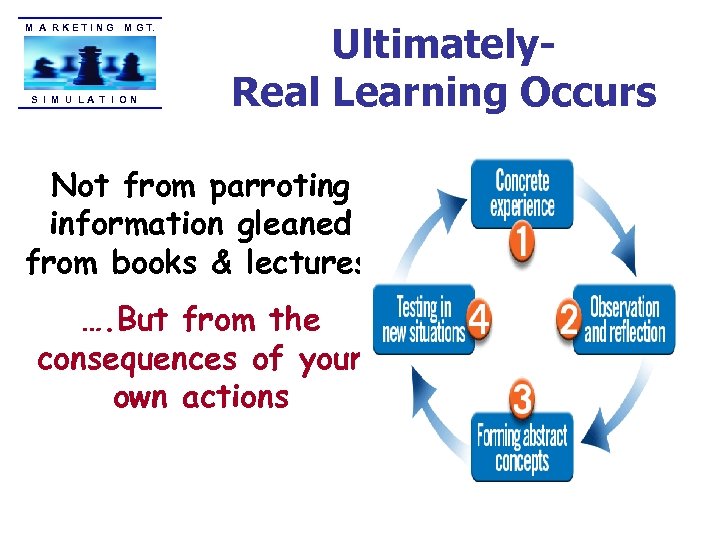
M A R K E T I N G M G T. S I M U L A T I O N Ultimately. Real Learning Occurs Not from parroting information gleaned from books & lectures! …. But from the consequences of your own actions
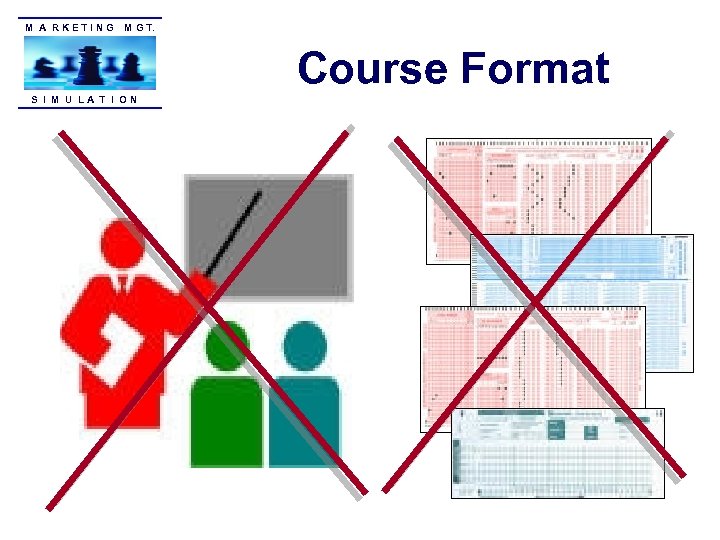
M A R K E T I N G M G T. Course Format S I M U L A T I O N
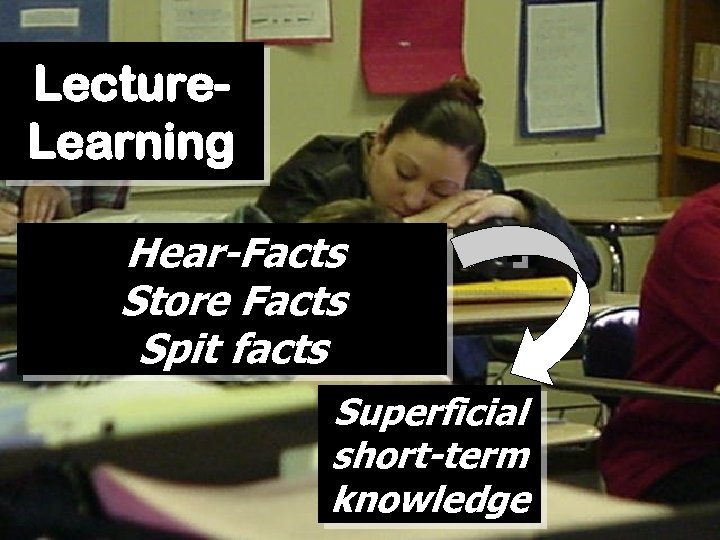
M A R K E T I N G M G T. Lecture. Learning S I M U L A T I O N Hear-Facts Store Facts Spit facts ‘ Superficial short-term knowledge
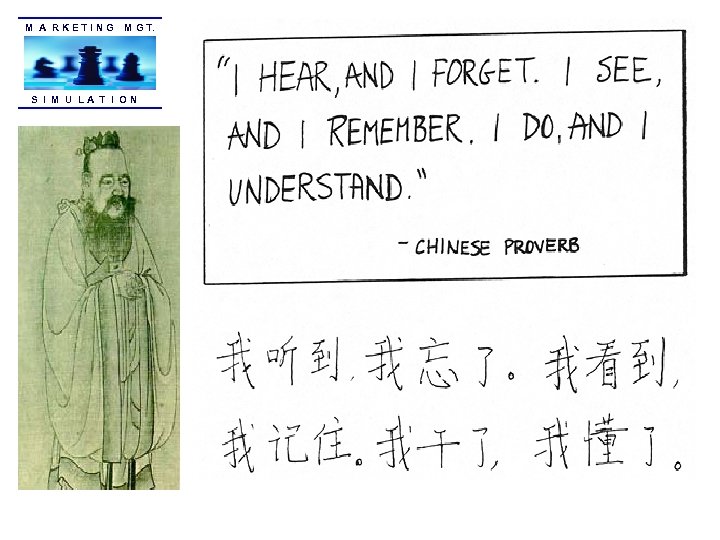
M A R K E T I N G M G T. S I M U L A T I O N
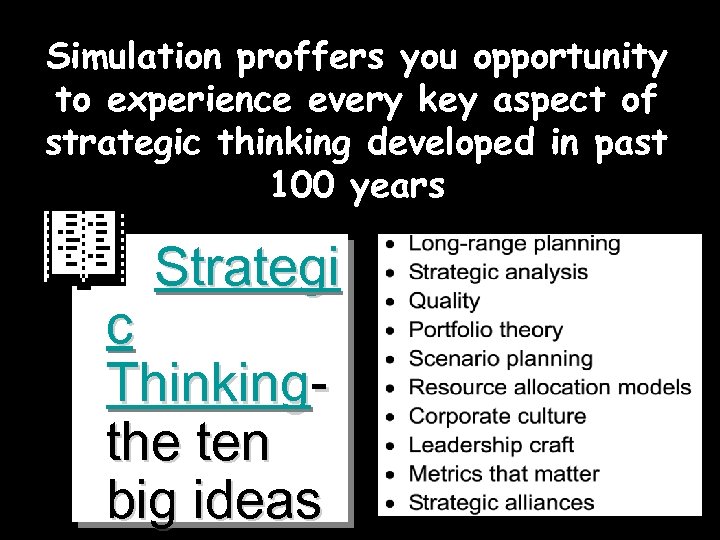
Simulation proffers you opportunity to experience every key aspect of strategic thinking developed in past 100 years Strategi c Thinking- the ten big ideas
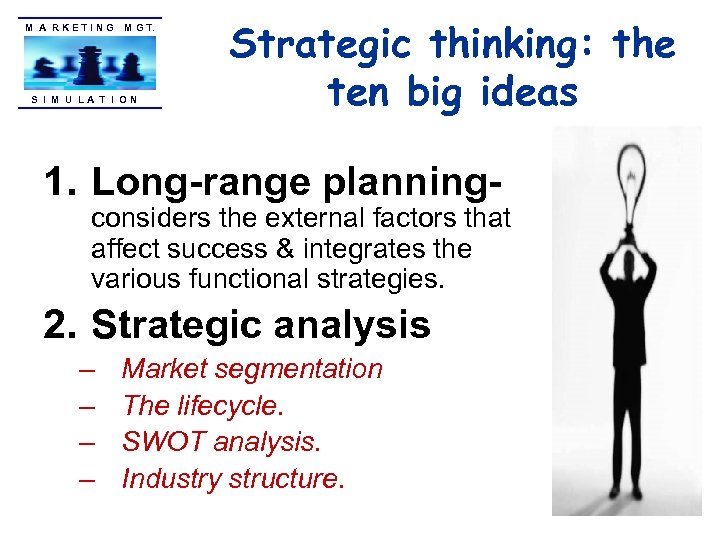
M A R K E T I N G M G T. S I M U L A T I O N Strategic thinking: the ten big ideas 1. Long-range planning- considers the external factors that affect success & integrates the various functional strategies. 2. Strategic analysis – – Market segmentation The lifecycle. SWOT analysis. Industry structure.
M A R K E T I N G M G T. S I M U L A T I O N Strategic thinking: the ten big ideas 3. Quality – Total quality management (TQM) and business process reengineering (BPR) 4. Portfolio theory- – GE-(three-by-three matrix, using business strength & market attractiveness as variables). – The Boston Consulting Group (BCG) introduced its two-by-two matrix-(invest in the stars, divest the dogs, milk the cows, and solve the question marks)
M A R K E T I N G M G T. S I M U L A T I O N Strategic thinking: the ten big ideas 5. Scenario planning - formulation of alternative possible futures for firm & its environment as means of exploring utility of different strategies. 6. Resource allocation models – Porter: strategic choices are set of basic generic strategies (low cost, differentiation, market
M A R K E T I N G M G T. S I M U L A T I O N Strategic thinking: the ten big ideas 7. Corporate culture- corporate behavior, and in particular the resistance of the organization to change, is inevitably a function of its culture (Prof Thomas/ Penn St. able to predict final standings w/in 1 place 90% of time –after observing initial group interaction) 8. Leadership craft- Leaders responsible for assuring strategy links values of firm with its vision & that firm can successfully implement strategy
M A R K E T I N G M G T. S I M U L A T I O N Strategic thinking: the ten big ideas 9. Metrics that matter Du. Pont formula= concept of return on investment Balanced score card- a system that attempts to balance financial performance w/ consideration of customer's perspective, learning & growth perspective, & internal business process perspective 10. Strategic organization design -The strategic business unit (SBU) -- broadly defined as sets of related products & services marketed to similar customers against common competitors
M A R K E T I N G M G T. Looking back & ahead S I M U L A T I O N For years, corporate planners have based strategic choices on some combo of 3 beliefs: 1. the validity of their intuition 2. the wisdom of their peers 3. the robustness of last's year's strategy Recent Exception – “The promising attempts to apply scientific method to strategy formulation, ---notably the profit impact of market strategy (PIMS) research”
M A R K E T I N G M G T. S I M U L A T I O N Profit Impact of Market Strategy (PIMS) • 1 st significant attempt to study correlation betw: strategic position & financial performance – Suggests: specific characteristics of an industry less important than shared strategic attributes, such as market share, quality, and investment intensity
“Generically, profits are driven by the company’s asset base and by its efficiency working those assets”

M A R K E T I N G M G T. S I M U L A T I O N

You Da’ Boss … run a $100 M business ….
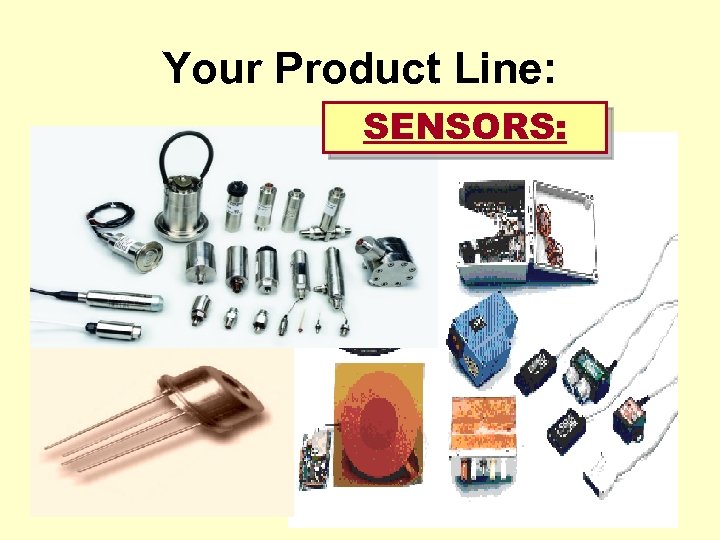
Your Product Line: SENSORS:
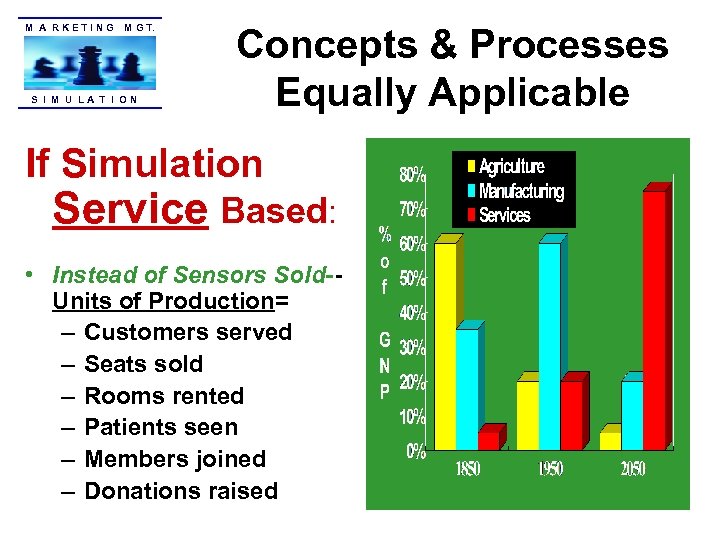
M A R K E T I N G M G T. S I M U L A T I O N Concepts & Processes Equally Applicable If Simulation Service Based: • Instead of Sensors Sold-Units of Production= – Customers served – Seats sold – Rooms rented – Patients seen – Members joined – Donations raised
YOU… • Analyze the market, consumer, your company & competitive situation • Discern & implement your corp. growth & competitive strategies • Must make & integrate decisions in & across all functional areas (Marketing, Research & Development, Production, Human Resources and Finance).
YOUR JOB • Take on key management positions w/in your corporation • Make the myriad of intertwined decisions necessary to create, produce & successfully market your products…
You will Compete against other members of this class –running 5 other Corp’s …. • Andrews • Baldwin • Chester • Digby • Erie • Ferris

Plus… your decisions & business performance will be compared against 1000+ other teams competing at other universities… around the world
THE CAPSTONE SIMULATION Most widely used Business – Simulation Program in the World • Adopted by major Fortune 500 companies. . General Motors, General Electric, Honeywell, Dell, John Deere, Citibank, Alcoa, BP, Allstate, Samsung, Goldman Sachs, Microsoft…
& How –to date-have we fared in this World. Wide Competition? ?
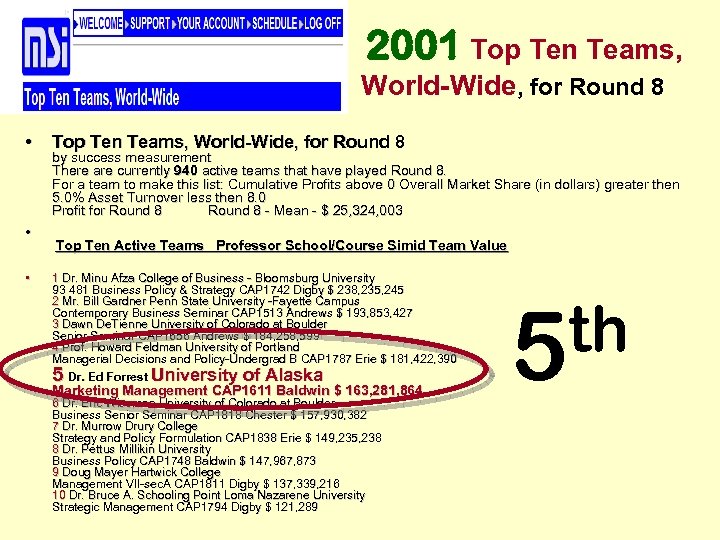
2001 Top Ten Teams, World-Wide, for Round 8 • • • Top Ten Teams, World-Wide, for Round 8 by success measurement There are currently 940 active teams that have played Round 8. For a team to make this list: Cumulative Profits above 0 Overall Market Share (in dollars) greater then 5. 0% Asset Turnover less then 8. 0 Profit for Round 8 - Mean - $ 25, 324, 003 Top Ten Active Teams Professor School/Course Simid Team Value 1 Dr. Minu Afza College of Business - Bloomsburg University 93 481 Business Policy & Strategy CAP 1742 Digby $ 238, 235, 245 2 Mr. Bill Gardner Penn State University -Fayette Campus Contemporary Business Seminar CAP 1513 Andrews $ 193, 853, 427 3 Dawn De. Tienne University of Colorado at Boulder Senior Seminar CAP 1656 Andrews $ 184, 258, 599 4 Prof. Howard Feldman University of Portland Managerial Decisions and Policy-Undergrad B CAP 1787 Erie $ 181, 422, 390 Dr. Ed Forrest University of Alaska Dr. Ed Forrest 5 Marketing Management CAP 1611 Baldwin $ 163, 281, 864 6 Dr. Eric Wiseman University of Colorado at Boulder Business Senior Seminar CAP 1818 Chester $ 157, 930, 382 7 Dr. Murrow Drury College Strategy and Policy Formulation CAP 1838 Erie $ 149, 235, 238 8 Dr. Pettus Millikin University Business Policy CAP 1748 Baldwin $ 147, 967, 873 9 Doug Mayer Hartwick College Management VII-sec. A CAP 1811 Digby $ 137, 339, 216 10 Dr. Bruce A. Schooling Point Loma Nazarene University Strategic Management CAP 1794 Digby $ 121, 289 th 5
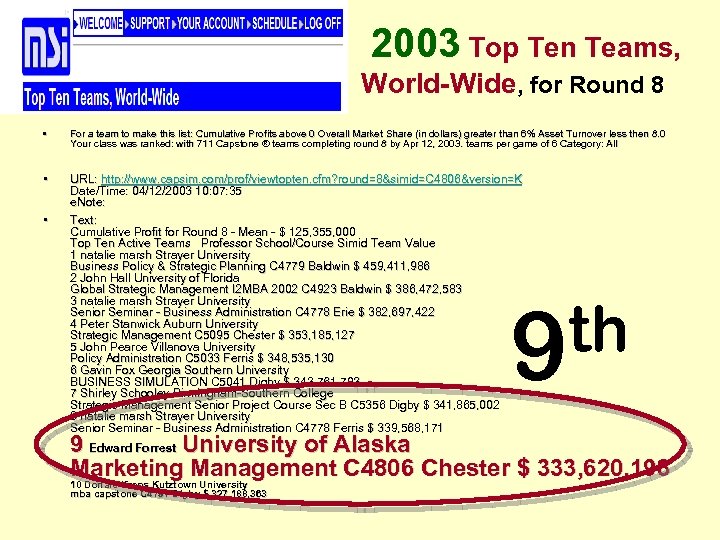
2003 Top Ten Teams, World-Wide, for Round 8 • For a team to make this list: Cumulative Profits above 0 Overall Market Share (in dollars) greater than 6% Asset Turnover less then 8. 0 Your class was ranked: with 711 Capstone ® teams completing round 8 by Apr 12, 2003. teams per game of 6 Category: All • URL: http: //www. capsim. com/prof/viewtopten. cfm? round=8&simid=C 4806&version=K Date/Time: 04/12/2003 10: 07: 35 e. Note: Text: Cumulative Profit for Round 8 - Mean - $ 125, 355, 000 Top Ten Active Teams Professor School/Course Simid Team Value 1 natalie marsh Strayer University Business Policy & Strategic Planning C 4779 Baldwin $ 459, 411, 986 2 John Hall University of Florida Global Strategic Management I 2 MBA 2002 C 4923 Baldwin $ 386, 472, 583 3 natalie marsh Strayer University Senior Seminar - Business Administration C 4778 Erie $ 382, 697, 422 4 Peter Stanwick Auburn University Strategic Management C 5095 Chester $ 353, 185, 127 5 John Pearce Villanova University Policy Administration C 5033 Ferris $ 348, 535, 130 6 Gavin Fox Georgia Southern University BUSINESS SIMULATION C 5041 Digby $ 343, 761, 703 7 Shirley Schooley Birmingham-Southern College Strategic Management Senior Project Course Sec B C 5356 Digby $ 341, 865, 002 8 natalie marsh Strayer University Senior Seminar - Business Administration C 4778 Ferris $ 339, 568, 171 • th 9 9 Edward Forrest University of Alaska Marketing Management C 4806 Chester $ 333, 620, 198 10 Donald Kreps Kutztown University mba capstone C 4797 Digby $ 327, 188, 363
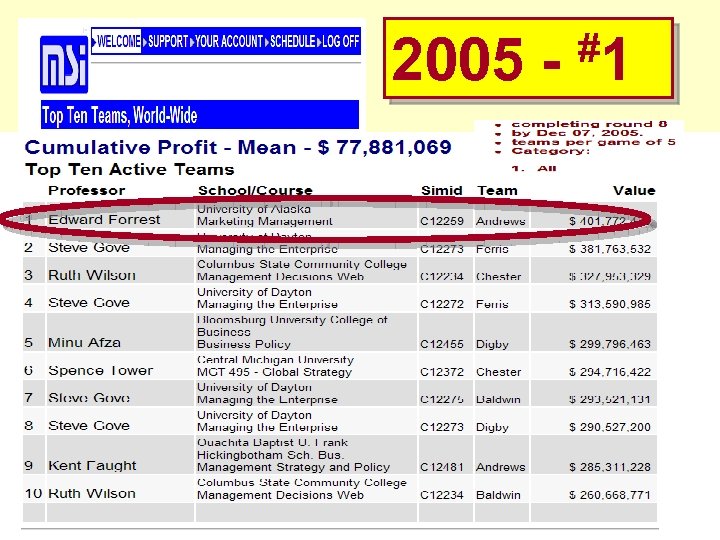
#1 2005 -
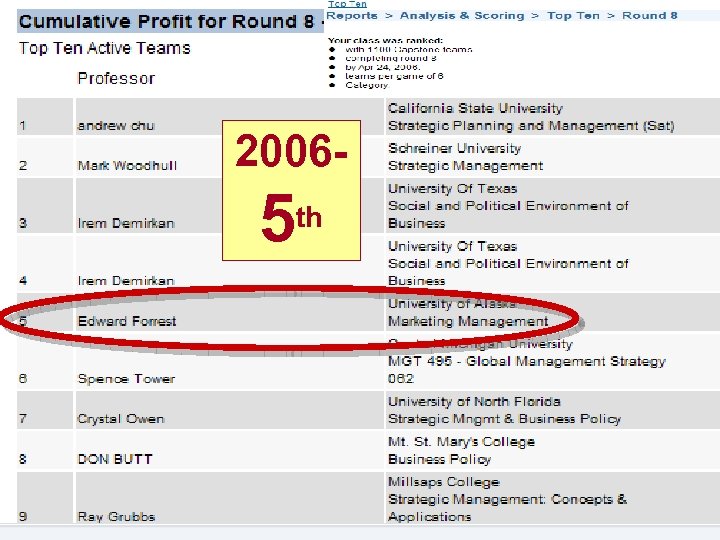
2006 - 5 th
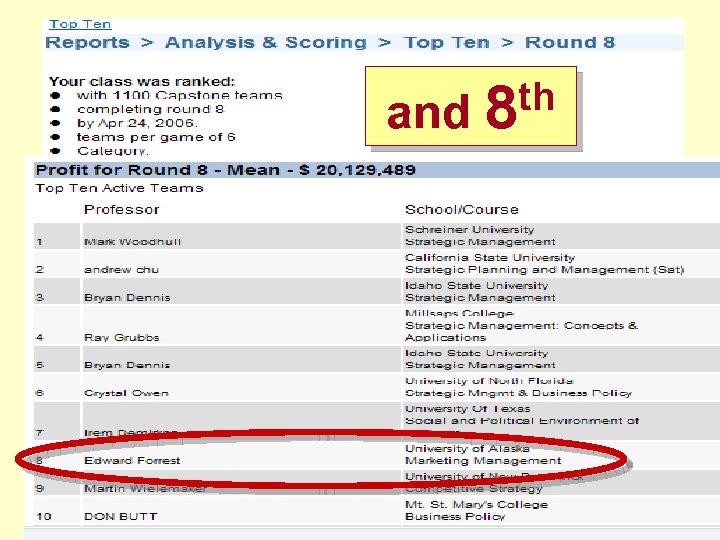
th and 8
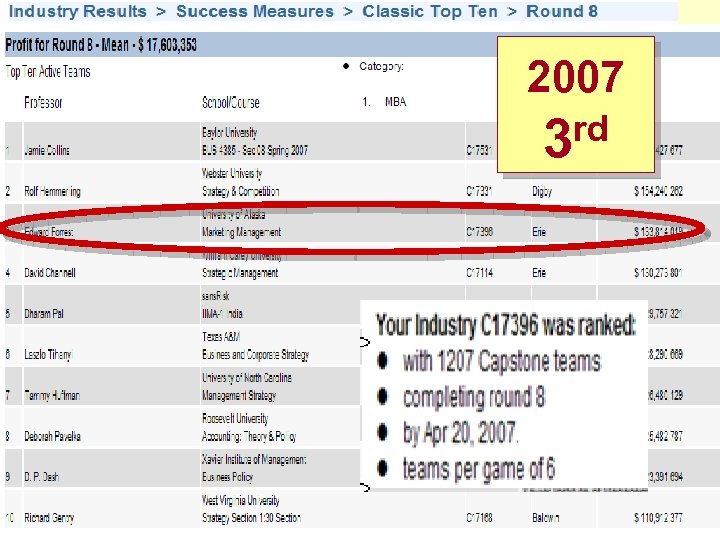
2007 rd 3
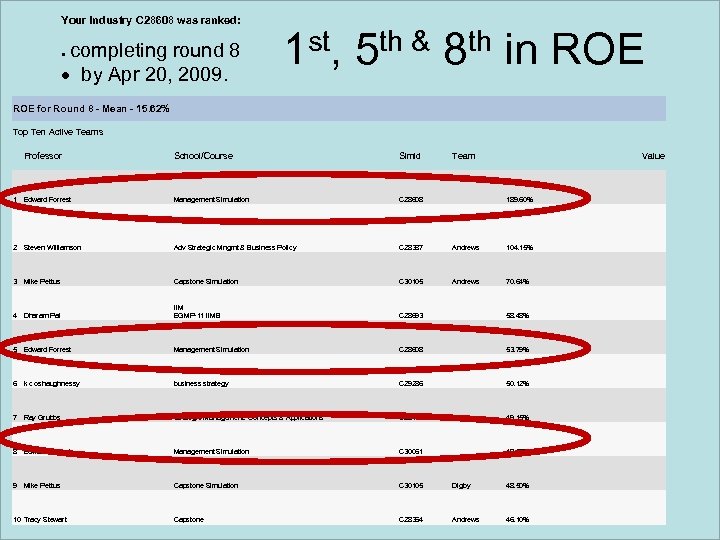
Your Industry C 28608 was ranked: completing round 8 · by Apr 20, 2009. · st, 5 th & 8 th in ROE 1 ROE for Round 8 - Mean - 15. 62% Top Ten Active Teams Professor School/Course Simid Team Value 1 Edward Forrest Management Simulation C 28608 2 Steven Williamson Adv Strategic Mngmt & Business Policy C 28387 Andrews 104. 15% 3 Mike Pettus Capstone Simulation C 30105 Andrews 70. 64% 4 Dharam Pal IIM EGMP-11 IIMB C 28693 58. 48% 5 Edward Forrest Management Simulation C 28608 53. 79% 6 k c oshaughnessy business strategy C 29286 50. 12% 7 Ray Grubbs Strategic Management: Concepts & Applications C 28441 49. 15% 8 Edward Forrest Management Simulation C 30061 48. 65% 9 Mike Pettus Capstone Simulation C 30105 Digby 48. 50% 10 Tracy Stewart Capstone C 28364 Andrews 46. 10% 189. 60%

Marketing Management Simulation
Today- we will: 1. Step back & take a look at the “Big Picture” 2. Overview the simulation 3. Incorporate & begin analysis of “your situation…”
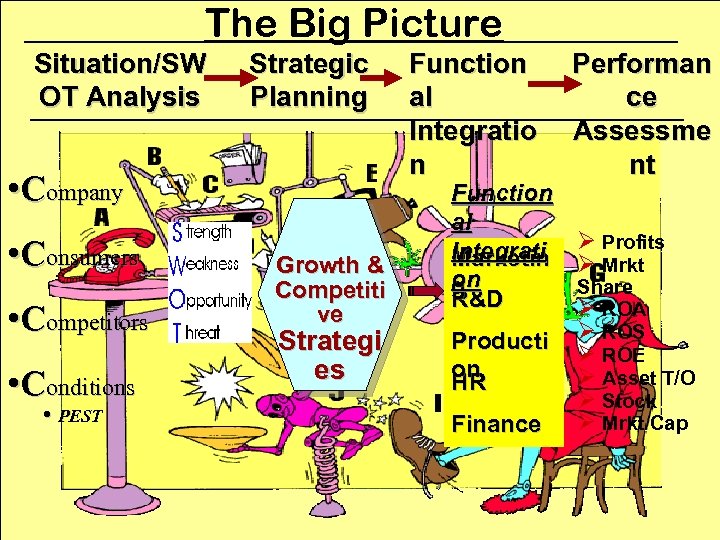
The Big Picture Situation/SW OT Analysis Strategic Planning • Company • Consumers • Competitors • Conditions • PEST Growth & Competiti ve Strategi es Function al Integratio n Function al Integrati Marketin on g R&D Producti on HR Finance Performan ce Assessme nt Ø Profits Ø Mrkt Share Ø ROA Ø ROS Ø ROE Ø Asset T/O Ø Stock Ø Mrkt Cap
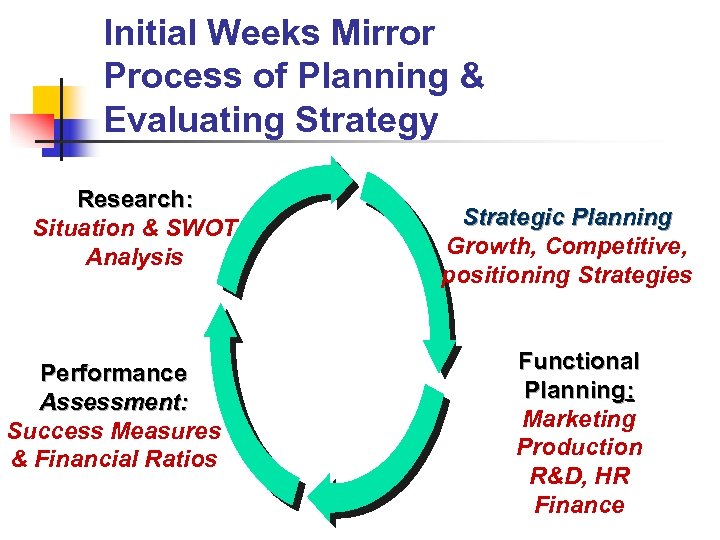
Initial Weeks Mirror Process of Planning & Evaluating Strategy Research: Situation & SWOT Analysis Performance Assessment: Success Measures & Financial Ratios Strategic Planning Growth, Competitive, positioning Strategies Functional Planning: Marketing Production R&D, HR Finance
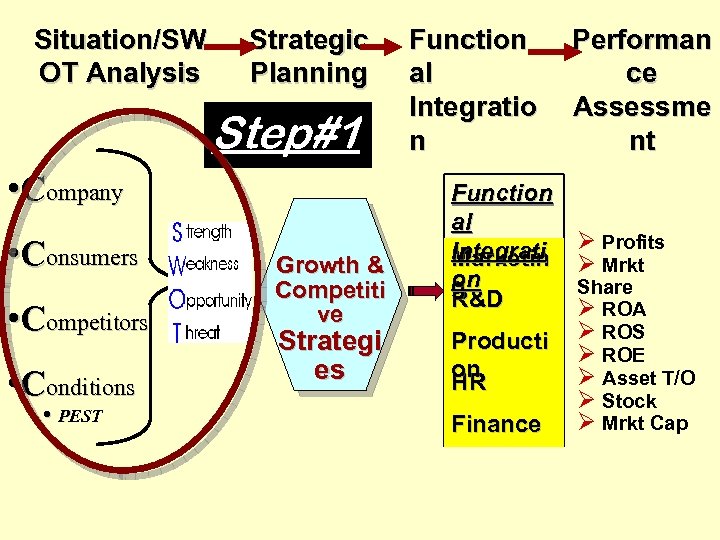
Situation/SW OT Analysis Strategic Planning Step#1 • Company • Consumers • Competitors • Conditions • PEST Growth & Competiti ve Strategi es Function al Integratio n Function al Integrati Marketin on g R&D Producti on HR Finance Performan ce Assessme nt Ø Profits Ø Mrkt Share Ø ROA Ø ROS Ø ROE Ø Asset T/O Ø Stock Ø Mrkt Cap
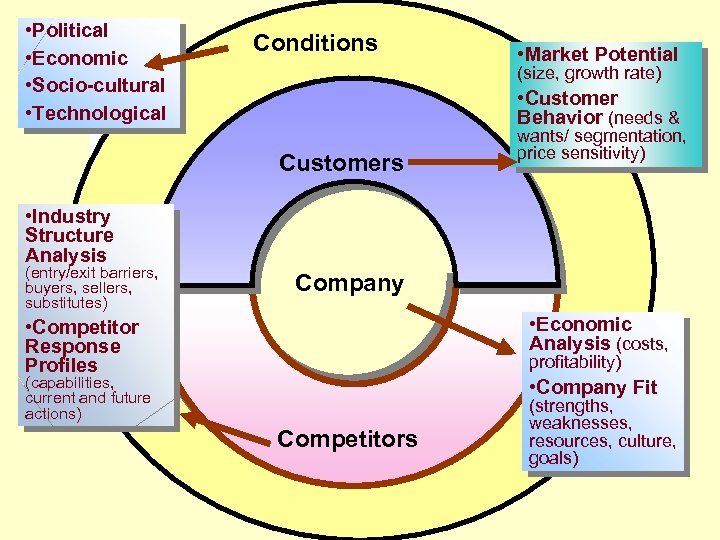
• Political • Economic • Socio-cultural • Technological Conditions • Market Potential (size, growth rate) • Customer Behavior (needs & Customers wants/ segmentation, price sensitivity) • Industry Structure Analysis (entry/exit barriers, buyers, sellers, substitutes) Company • Economic Analysis (costs, • Competitor Response Profiles profitability) (capabilities, current and future actions) • Company Fit Competitors (strengths, weaknesses, resources, culture, goals)
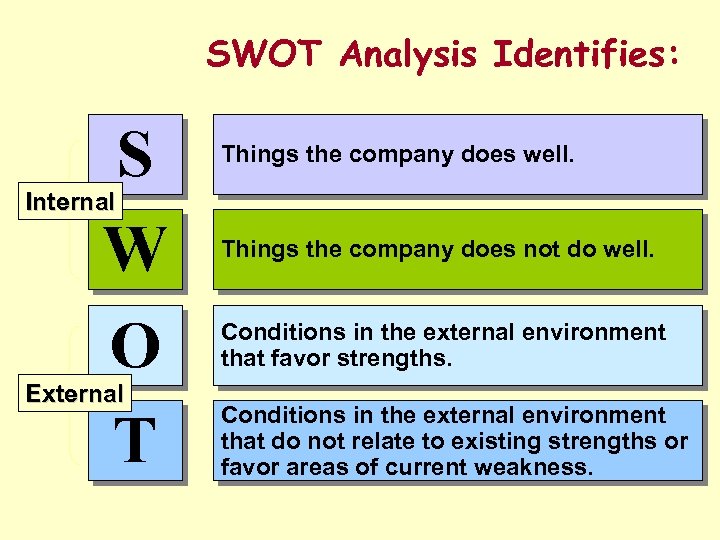
SWOT Analysis Identifies: S W O T Things the company does well. Internal External Things the company does not do well. Conditions in the external environment that favor strengths. Conditions in the external environment that do not relate to existing strengths or favor areas of current weakness. ©South-Western College Publishing
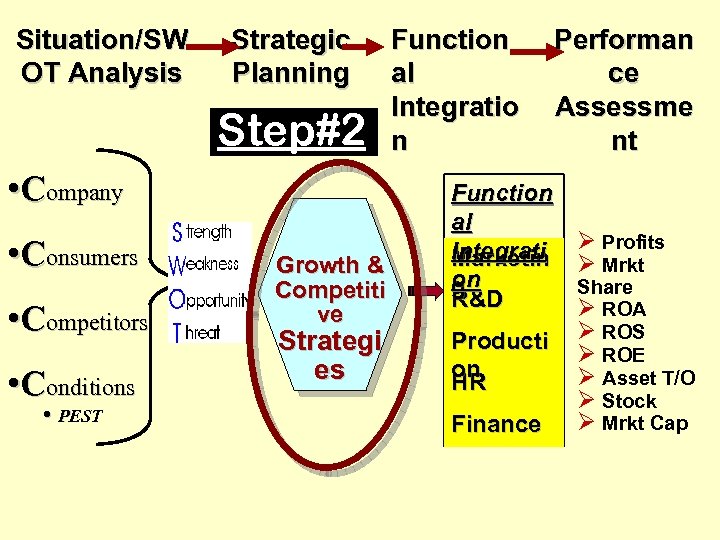
Situation/SW OT Analysis Strategic Planning Step#2 Function al Integratio n • Company • Consumers • Competitors • Conditions • PEST Growth & Competiti ve Strategi es Function al Integrati Marketin on g R&D Producti on HR Finance Performan ce Assessme nt Ø Profits Ø Mrkt Share Ø ROA Ø ROS Ø ROE Ø Asset T/O Ø Stock Ø Mrkt Cap
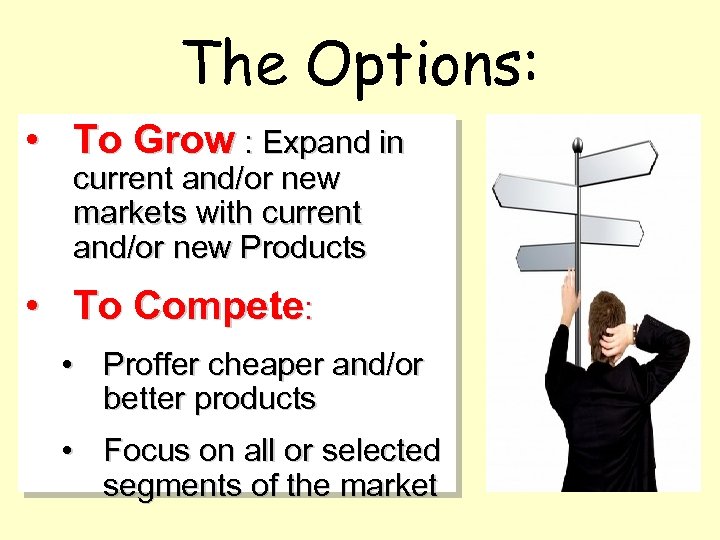
The Options: • To Grow : Expand in current and/or new markets with current and/or new Products • To Compete: • Proffer cheaper and/or better products • Focus on all or selected segments of the market
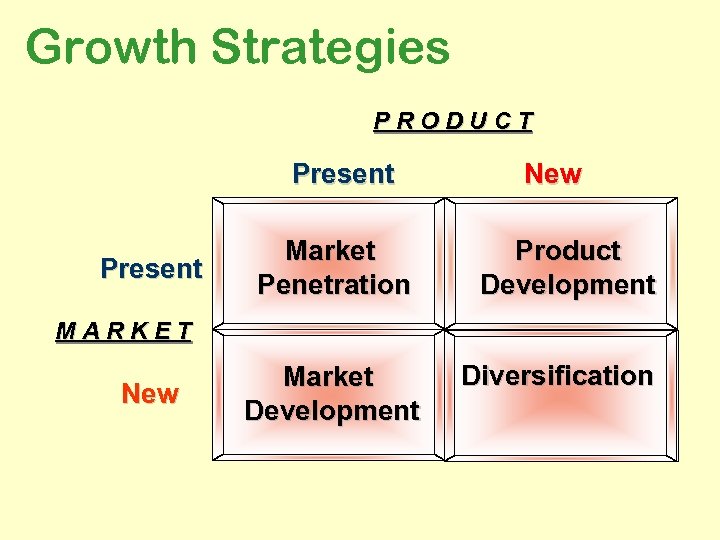
Growth Strategies P R O D U C T Present Market Penetration New Product Development M A R K E T New Market Development Diversification
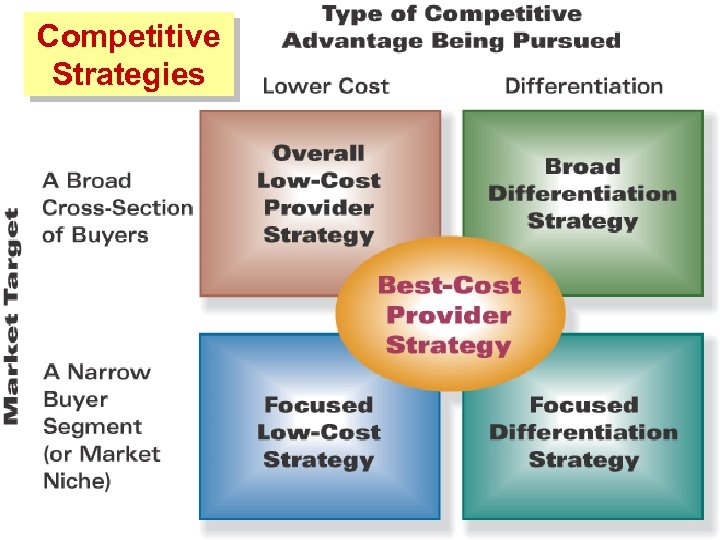
Competitive Strategies
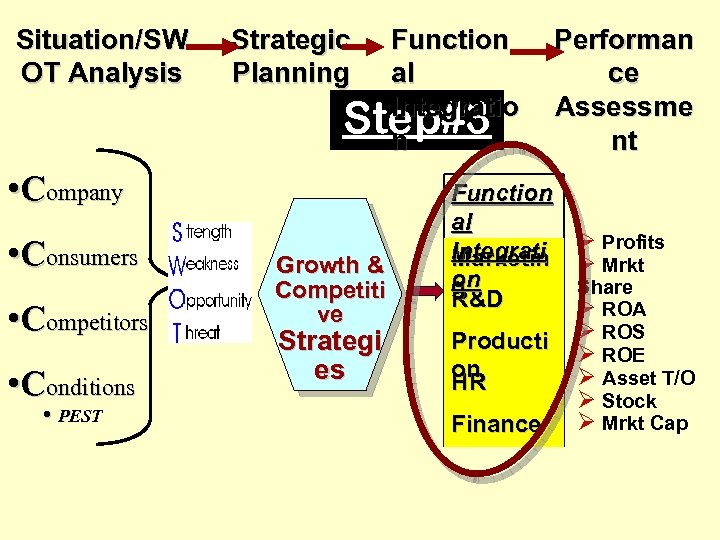
Situation/SW OT Analysis Strategic Planning Function al Integratio Step#3 n • Company • Consumers • Competitors • Conditions • PEST Growth & Competiti ve Strategi es Function al Integrati Marketin on g R&D Producti on HR Finance Performan ce Assessme nt Ø Profits Ø Mrkt Share Ø ROA Ø ROS Ø ROE Ø Asset T/O Ø Stock Ø Mrkt Cap

Need to Align Your Functional Strategies Cross. Functional Integration & Alignment
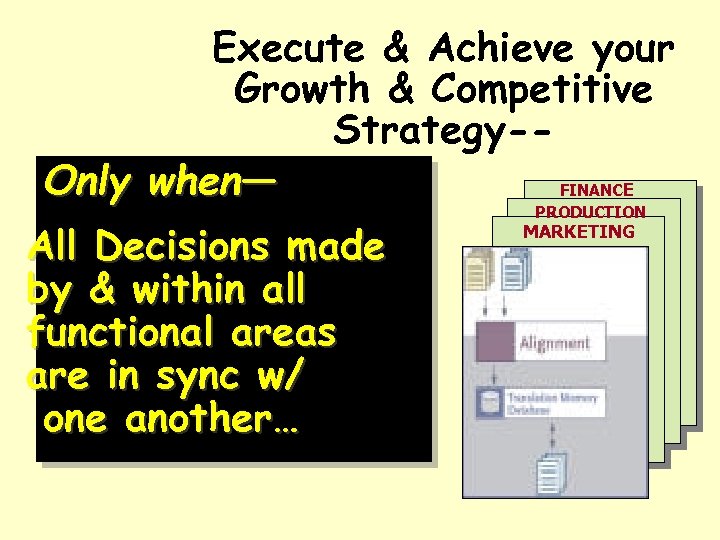
Execute & Achieve your Growth & Competitive Strategy-Only when— E All Decisions made by & within all functional areas are in sync w/ one another… FINANC PRODUCTION MARKETING
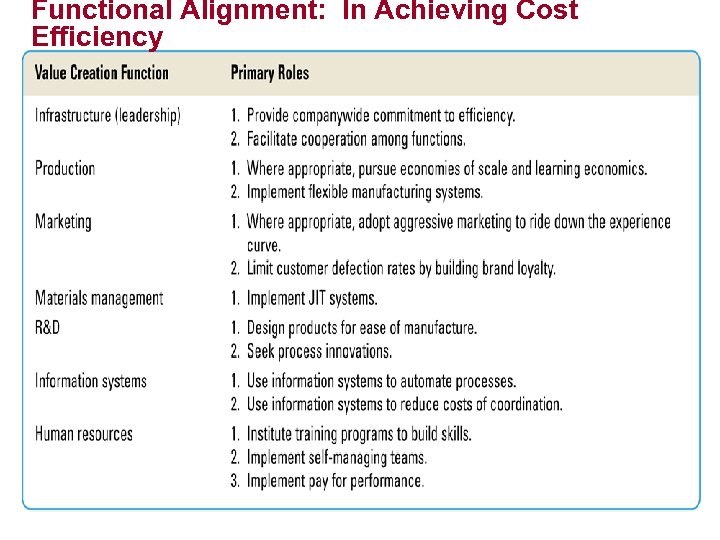
Functional Alignment: In Achieving Cost Efficiency
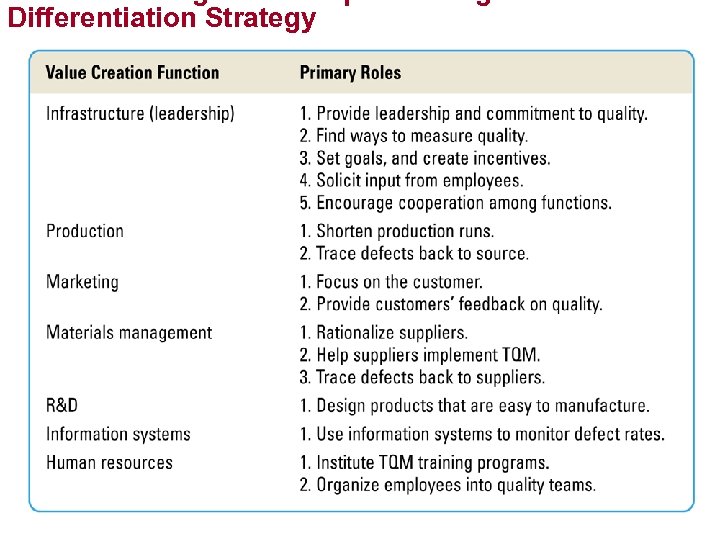
Functional Alignment: Implementing Differentiation Strategy
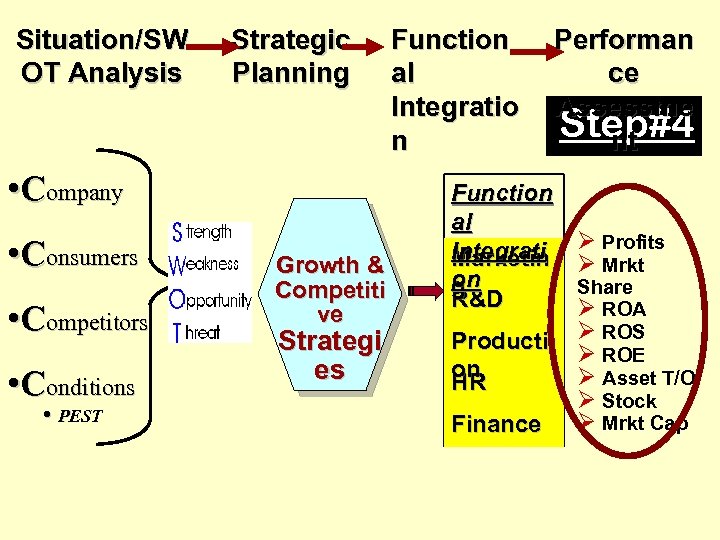
Situation/SW OT Analysis Strategic Planning Function al Integratio n • Company • Consumers • Competitors • Conditions • PEST Growth & Competiti ve Strategi es Function al Integrati Marketin on g R&D Producti on HR Finance Performan ce Assessme Step#4 nt Ø Profits Ø Mrkt Share Ø ROA Ø ROS Ø ROE Ø Asset T/O Ø Stock Ø Mrkt Cap
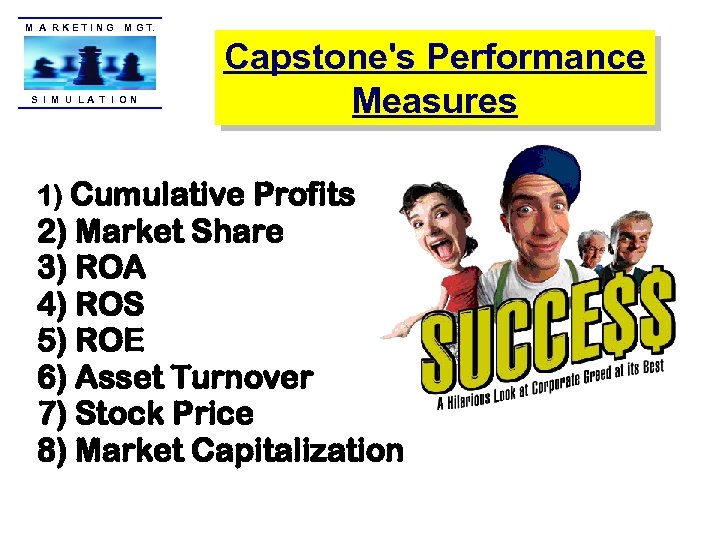
M A R K E T I N G M G T. S I M U L A T I O N Capstone's Performance Measures 1) Cumulative Profits 2) Market Share 3) ROA 4) ROS 5) ROE 6) Asset Turnover 7) Stock Price 8) Market Capitalization
Moving on: 1. Step back & take a look at the “Big Picture” 2. Overview the simulation 3. Incorporate & begin analysis of “your situation…”
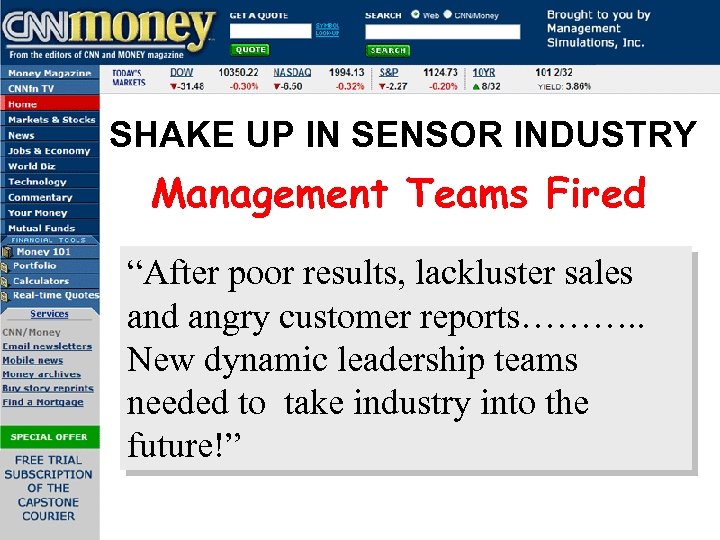
SHAKE UP IN SENSOR INDUSTRY Management Teams Fired “After poor results, lackluster sales and angry customer reports………. . New dynamic leadership teams needed to take industry into the future!”

M A N A G E M E N T S I M U L A T I O N D! IRE H Y R OU
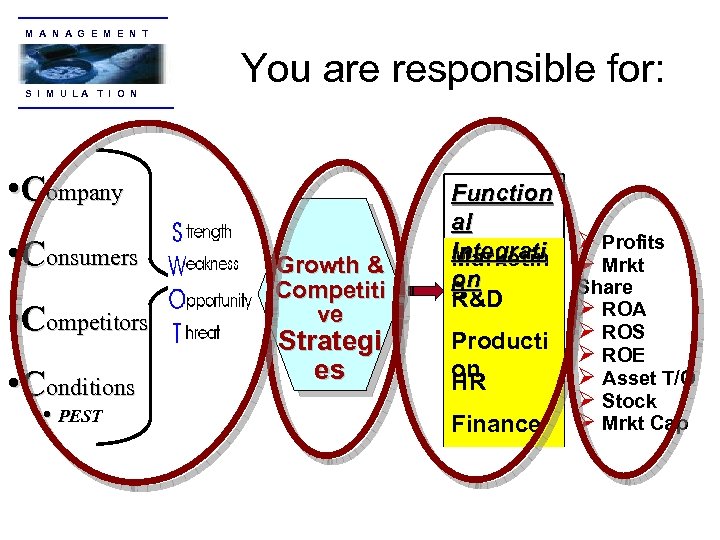
M A N A G E M E N T S I M U L A T I O N You are responsible for: • Company • Consumers • Competitors • Conditions • PEST Growth & Competiti ve Strategi es Function al Integrati Marketin on g R&D Producti on HR Finance Ø Profits Ø Mrkt Share Ø ROA Ø ROS Ø ROE Ø Asset T/O Ø Stock Ø Mrkt Cap

M A N A G E M E N T S I M U L A T I O N Your duties include ALL those of the CEO – … define the mission-vision & strategic direction of your company
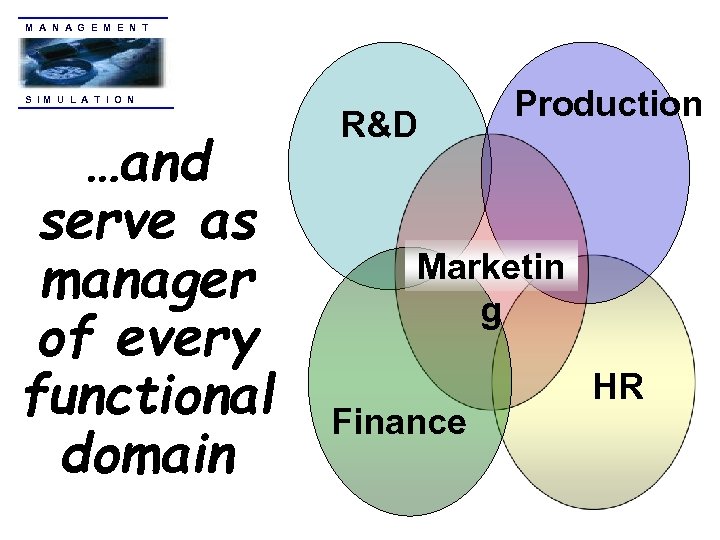
M A N A G E M E N T S I M U L A T I O N …and serve as manager of every functional domain R&D Production Marketin g Finance HR
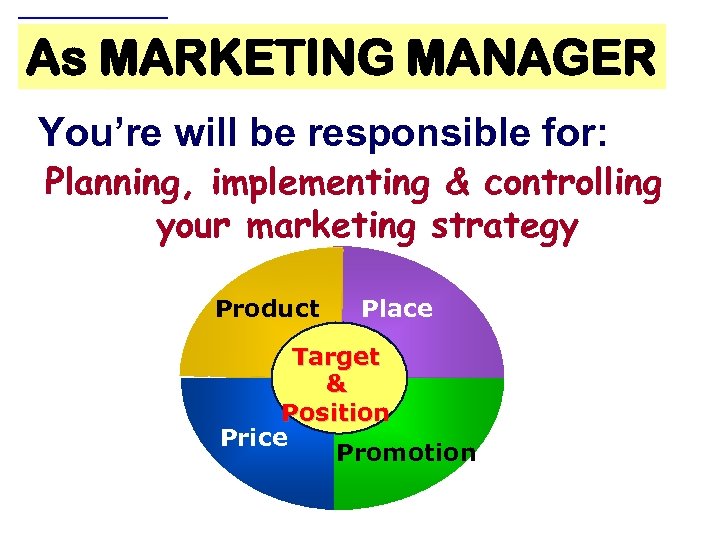
M A N A G E M E N T As MARKETING MANAGER S I M U L A T I O N You’re will be responsible for: Planning, implementing & controlling your marketing strategy Product Place Target & Position Price Promotion
Marketing Managers become one-w/ Relationships betw M A N A G E M E N T S I M U L A T I O N • Price & demand • Price & margin • Promotion budget & awareness • Sales budget & accessibility • A/R policy & demand
MARKETING MANAGER SIMULATION SPREADSHEET
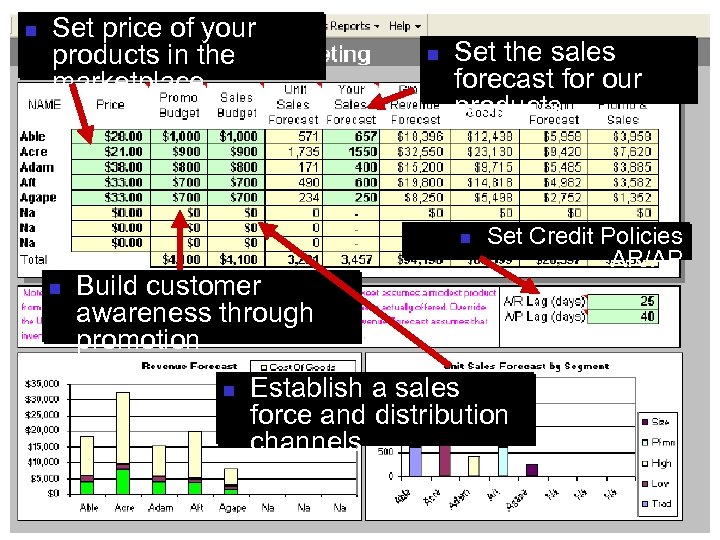
n Set price of your products in the marketplace n Set the sales forecast for our products n n Build customer awareness through promotion n Set Credit Policies AR/AP Establish a sales force and distribution channels
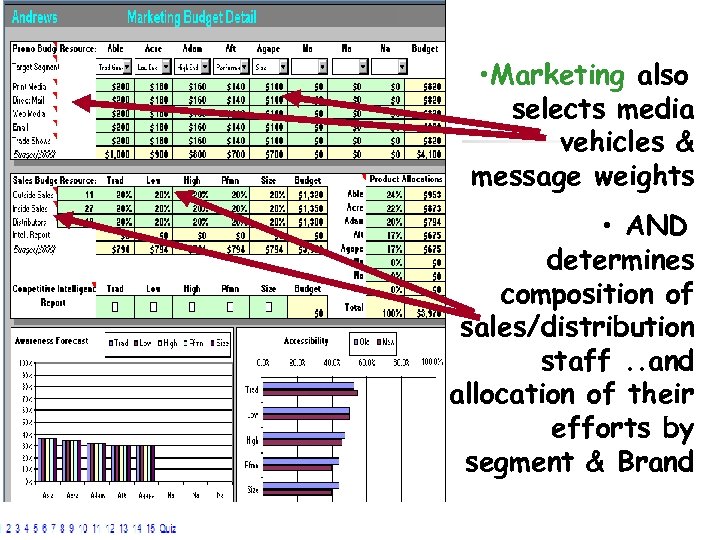
• Marketing also selects media vehicles & message weights • AND determines composition of sales/distribution staff. . and allocation of their efforts by segment & Brand
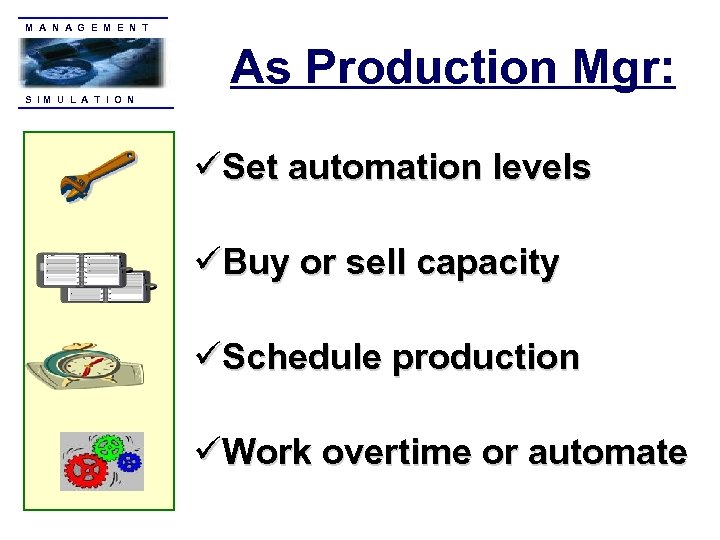
M A N A G E M E N T As Production Mgr: S I M U L A T I O N üSet automation levels üBuy or sell capacity üSchedule production üWork overtime or automate
PRODUCTION MANAGER SIMULATION SPREADSHEET
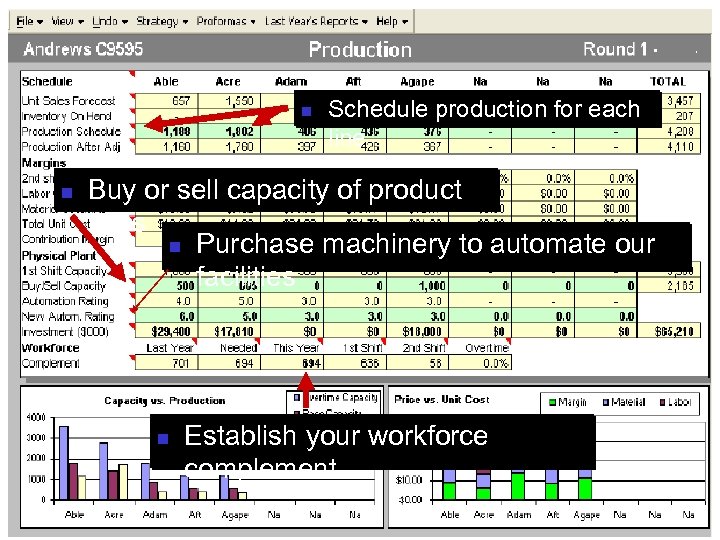
n n Schedule production for each line Buy or sell capacity of product lines n Purchase machinery to automate our facilities n Establish your workforce complement
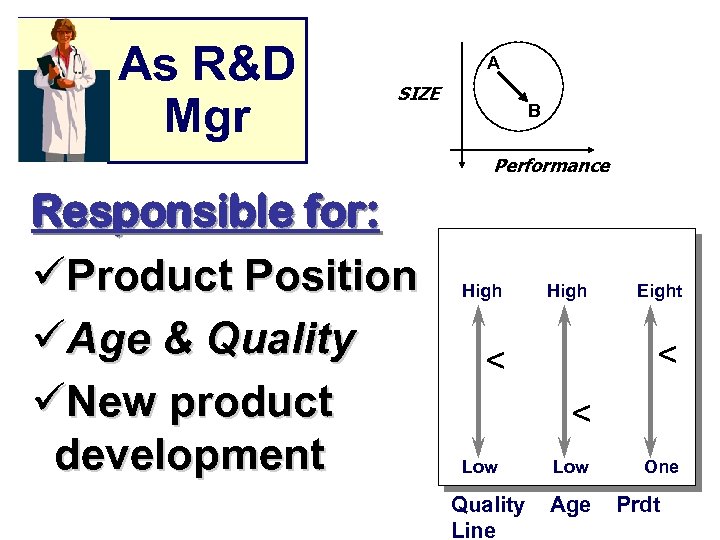
M A N A G E M E N T As R&D Mgr S I M U L A T I O N A SIZE B Performance Responsible for: üProduct Position üAge & Quality üNew product development High Eight < < < Low One Quality Age Prdt Line
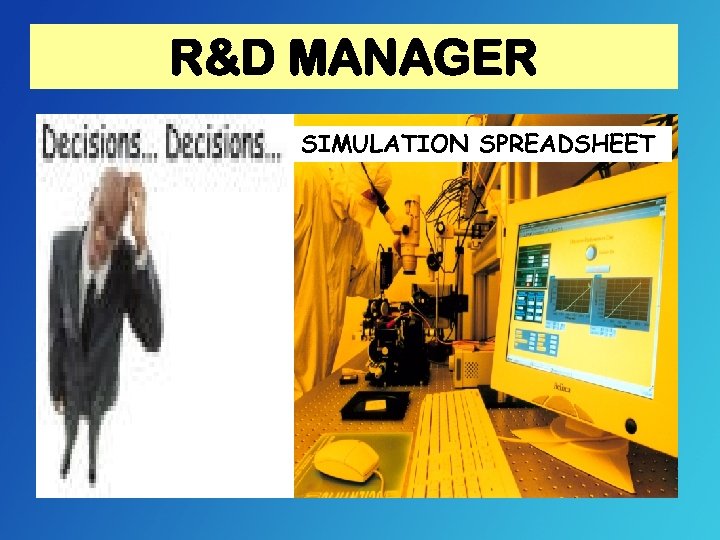
R&D MANAGER SIMULATION SPREADSHEET
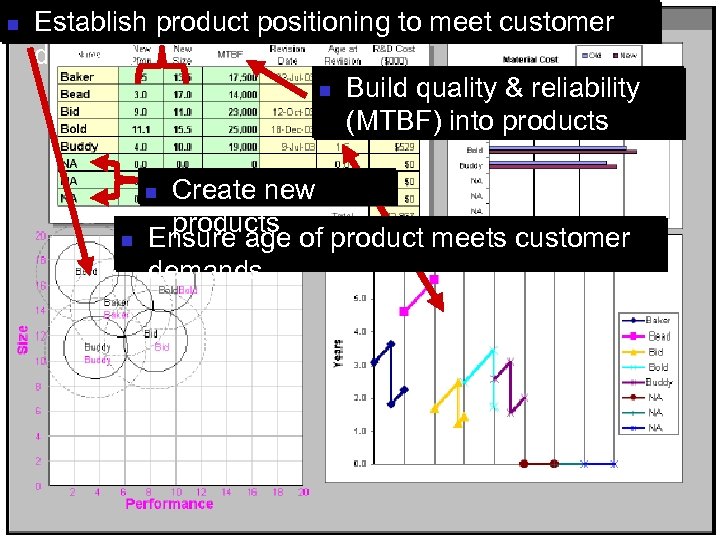
n Establish product positioning to meet customer demand n Build quality & reliability (MTBF) into products Create new products Ensure age of product meets customer demands n n
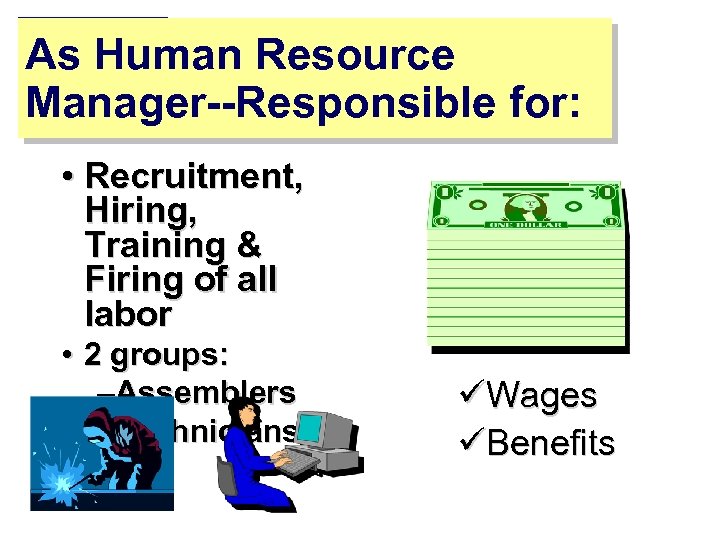
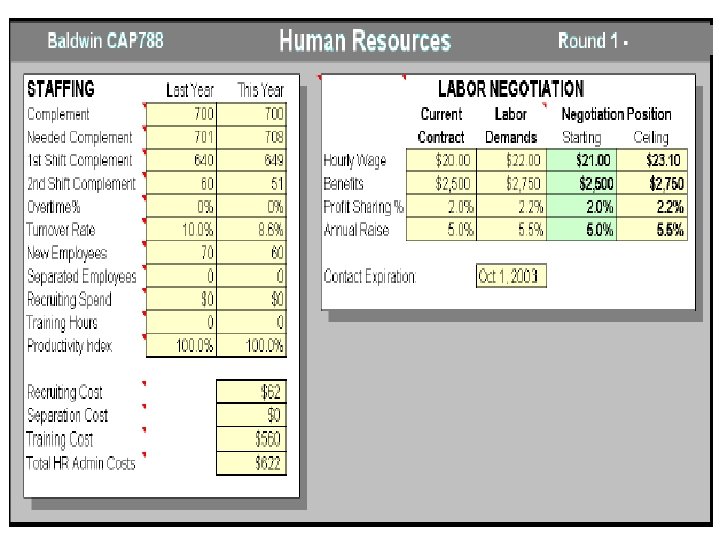
M A R K E T I N G As Human Resource Manager--Responsible for: M A N A G E M E N T • Recruitment, Hiring, Training & Firing of all labor • 2 groups: –Assemblers –Technicians üWages üBenefits

SIMULATION SPREADSHEET
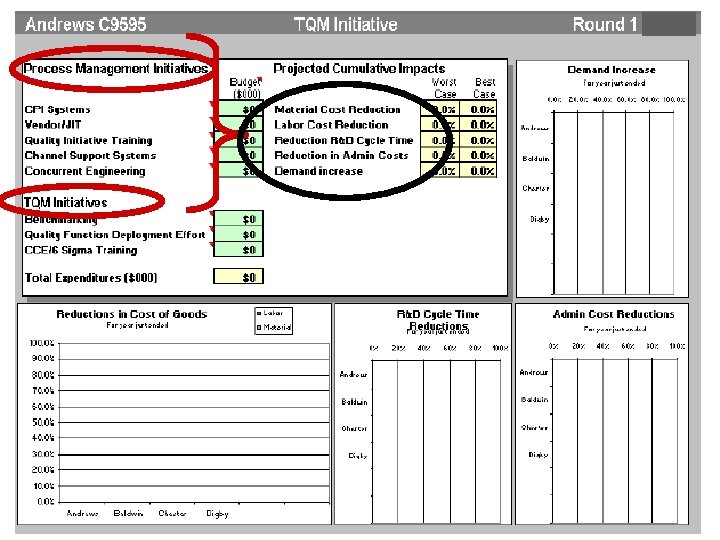
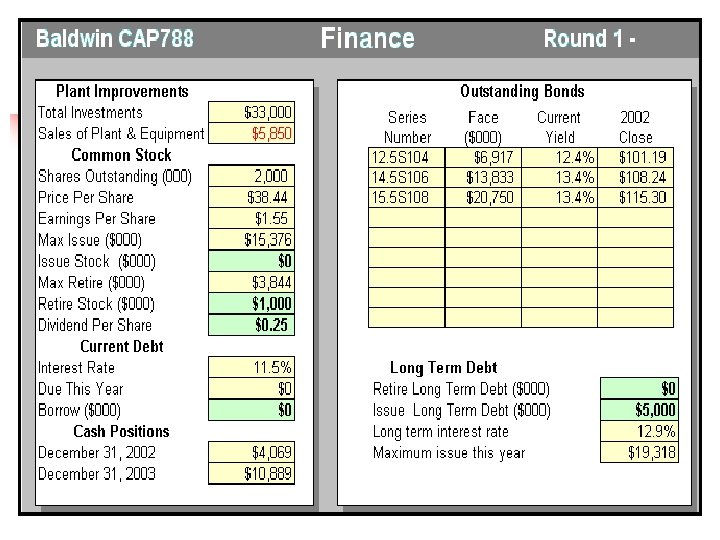
As FINANCIAL MANAGER M A N A G E M E N T üAcquire Capital S I M U L A T I O N – Issue Stock – Short Term Debt – Issue Long Term Bonds üSet Dividend üRetire Long Term Bonds üRetire Stock • Responsible for Emergency Loans Big AL The Loan Shark
FINANCIAL MANAGER SIMULATION SPREADSHEET
Finally: 1. Step back & take a look at the “Big Picture” 2. Overview the simulation 3. Incorporate & begin analysis of “your situation…”
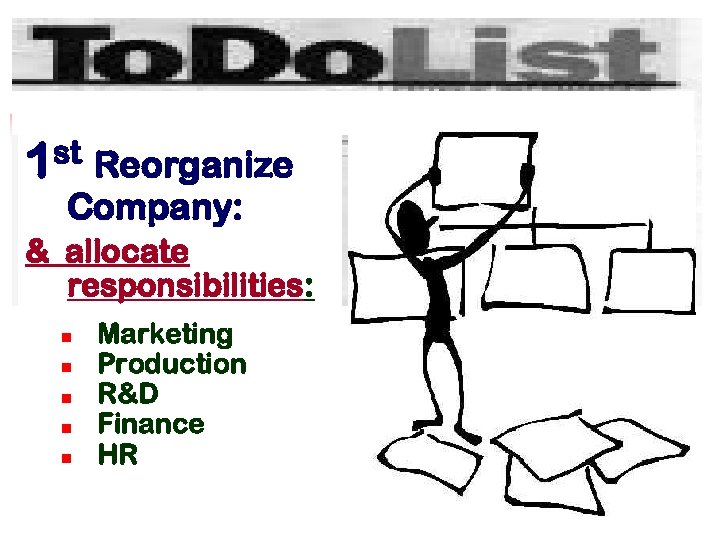
st Reorganize 1 Company: & allocate responsibilities: n n n Marketing Production R&D Finance HR
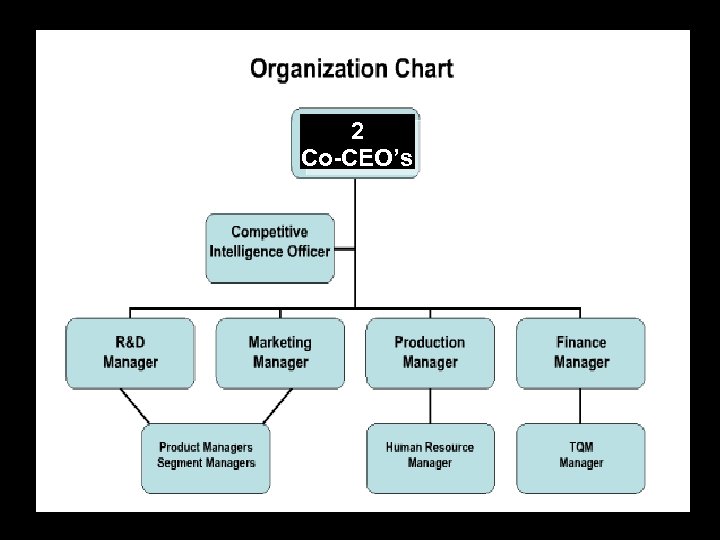
2 Co-CEO’s
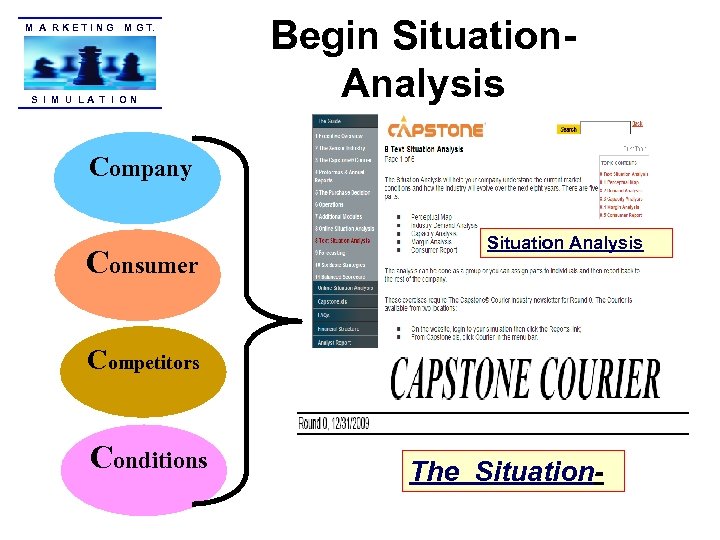
M A R K E T I N G M G T. S I M U L A T I O N Begin Situation. Analysis Company Consumer Situation Analysis Competitors Conditions The Situation-
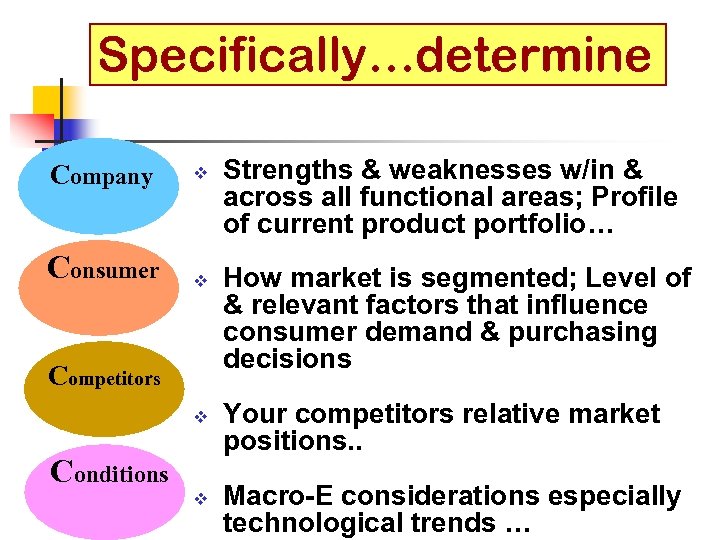
Specifically…determine Company Consumer v v Competitors v Conditions v Strengths & weaknesses w/in & across all functional areas; Profile of current product portfolio… How market is segmented; Level of & relevant factors that influence consumer demand & purchasing decisions Your competitors relative market positions. . Macro-E considerations especially technological trends …
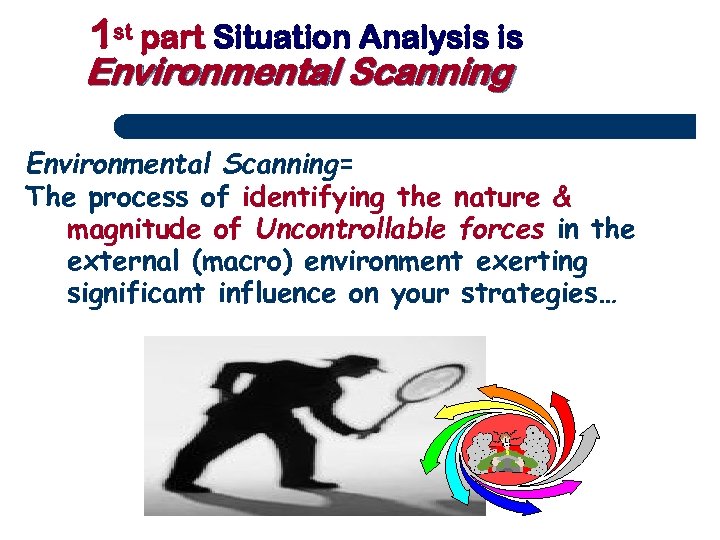
1 st part Situation Analysis is Environmental Scanning= The process of identifying the nature & magnitude of Uncontrollable forces in the external (macro) environment exerting significant influence on your strategies…
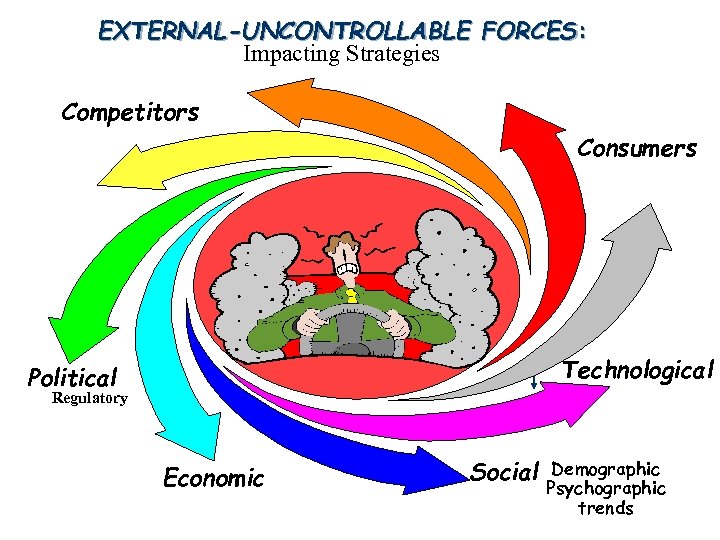
EXTERNAL-UNCONTROLLABLE FORCES: Impacting Strategies Competitors Consumers Political Technological Regulatory Economic Social Demographic Psychographic trends
At Outset your sim-environment a bit more benign than real world n n Your company & all competitors generating ~$100 million in sales. There no outside competitors or product substitutes. A favorable economic environment features moderate growth, low inflation, historically averaged interest rates No economic downturns or other surprises expected.
Sim designed this way for one reason …. want all n strategic options available to you. That way- whatever happens as market evolves will be driven by the tactical execution of strategies, not by external factors.
The Market. Place • Opportunities & Threats: • Ascertain how the market is organized, operates, influenced & evolving
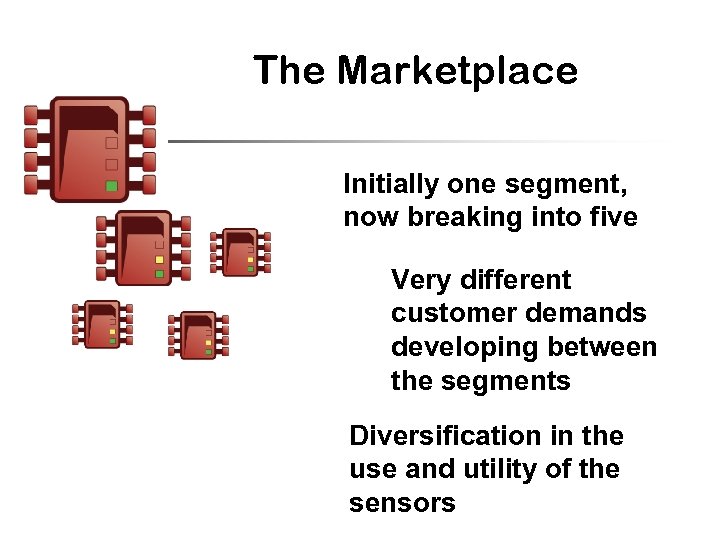
The Marketplace Initially one segment, now breaking into five Very different customer demands developing between the segments Diversification in the use and utility of the sensors
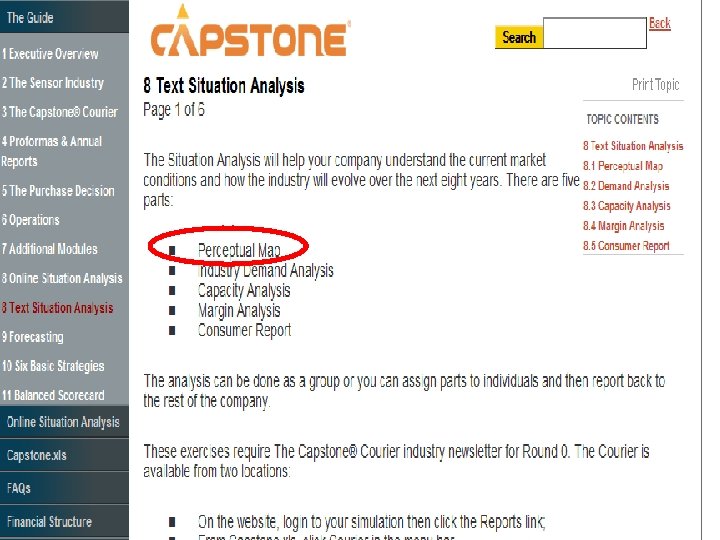
2 4 1 5 3 Drift Demonstration PERCEPTUAL MAP Performance
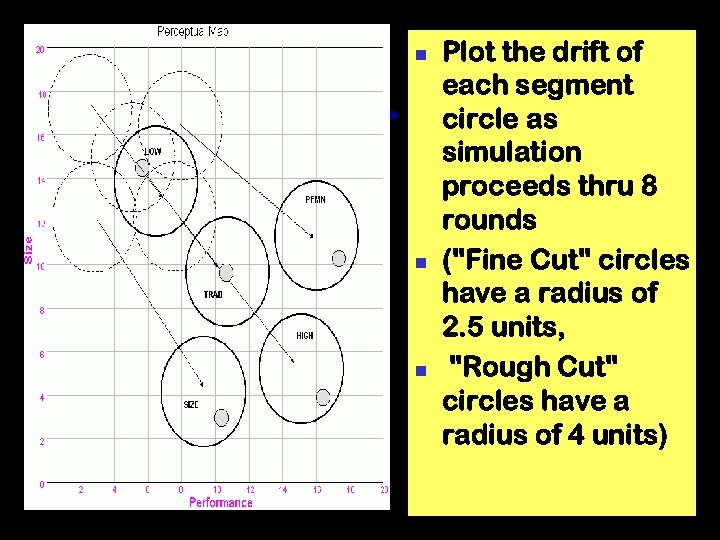
Plot the drift of each segment MAP as circle simulation proceeds thru 8 rounds n ("Fine Cut" circles have a radius of 2. 5 units, n "Rough Cut" circles have a radius of 4 units) n PERCEPTUAL
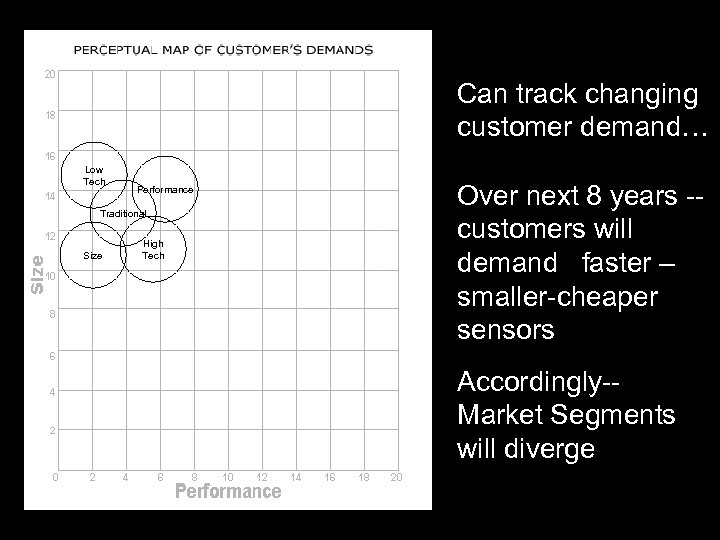
Can track changing customer demand… Low Tech Performance Traditional Size High Tech Over next 8 years -customers will demand faster – smaller-cheaper sensors Accordingly-Market Segments will diverge
Your Consumers
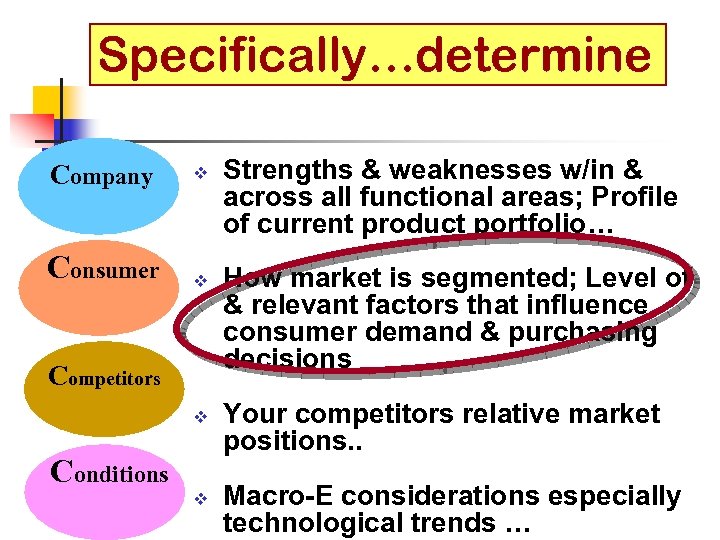
Specifically…determine Company Consumer v v Competitors v Conditions v Strengths & weaknesses w/in & across all functional areas; Profile of current product portfolio… How market is segmented; Level of & relevant factors that influence consumer demand & purchasing decisions Your competitors relative market positions. . Macro-E considerations especially technological trends …
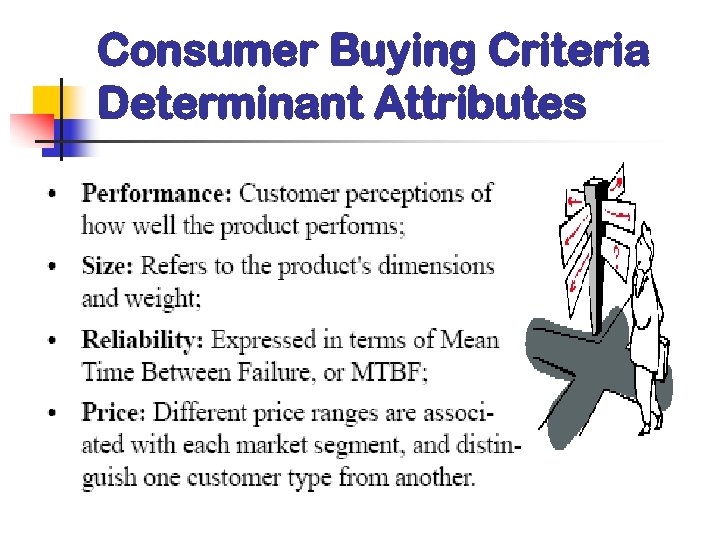
Consumer Buying Criteria Determinant Attributes
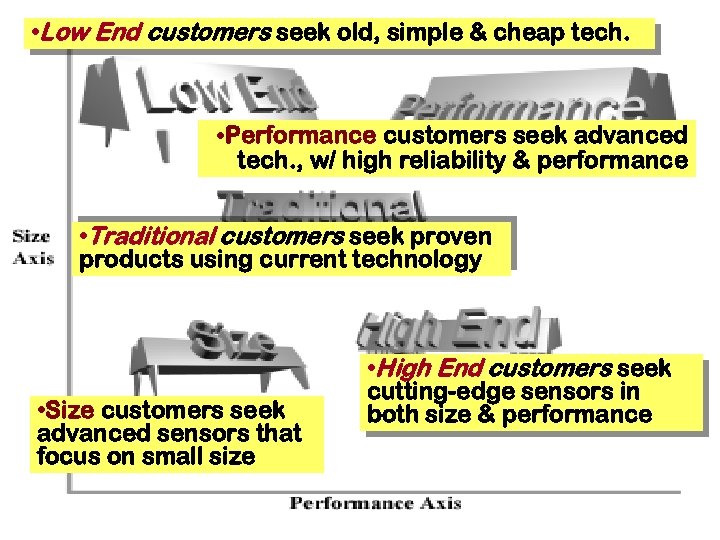
• Low End customers seek old, simple & cheap tech. • Performance customers seek advanced tech. , w/ high reliability & performance • Traditional customers seek proven products using current technology • Size customers seek advanced sensors that focus on small size • High End customers seek cutting-edge sensors in both size & performance
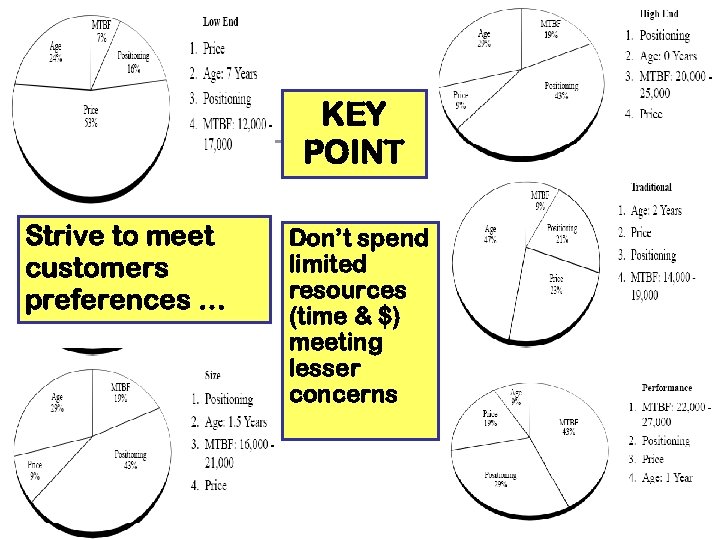
KEY POINT Strive to meet customers preferences … Don’t spend limited resources (time & $) meeting lesser concerns
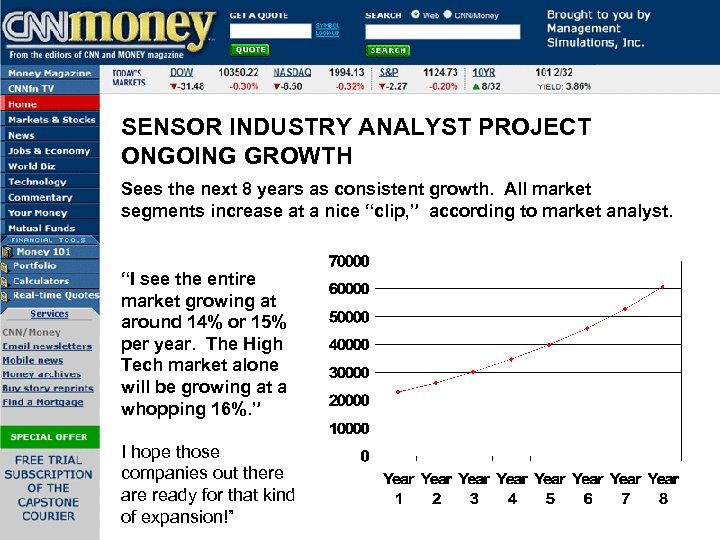
SENSOR INDUSTRY ANALYST PROJECT ONGOING GROWTH Sees the next 8 years as consistent growth. All market segments increase at a nice “clip, ” according to market analyst. “I see the entire market growing at around 14% or 15% per year. The High Tech market alone will be growing at a whopping 16%. ” I hope those companies out there are ready for that kind of expansion!”
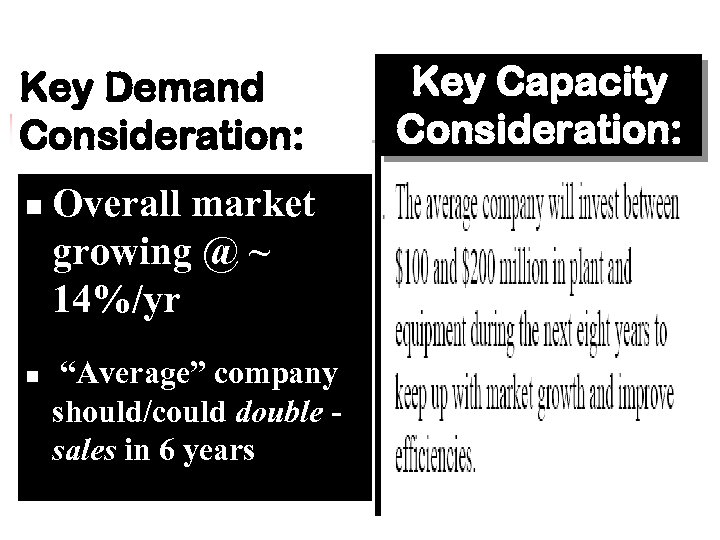
Key Demand Consideration: n n Overall market growing @ ~ 14%/yr “Average” company should/could double sales in 6 years Key Capacity Consideration:
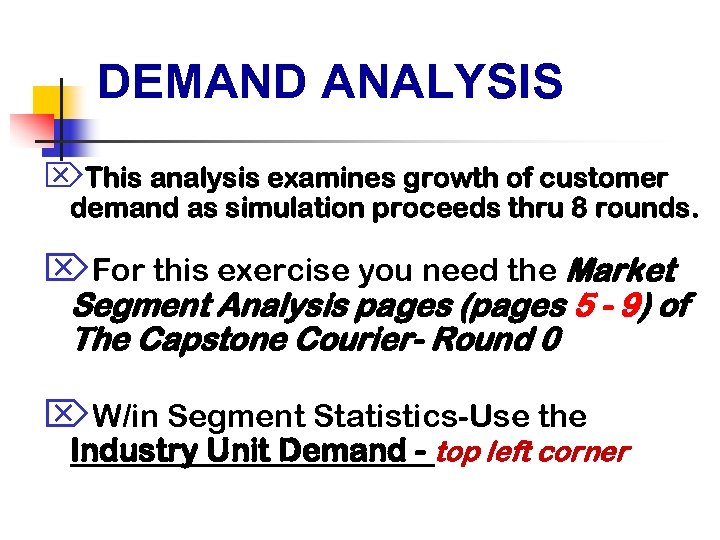
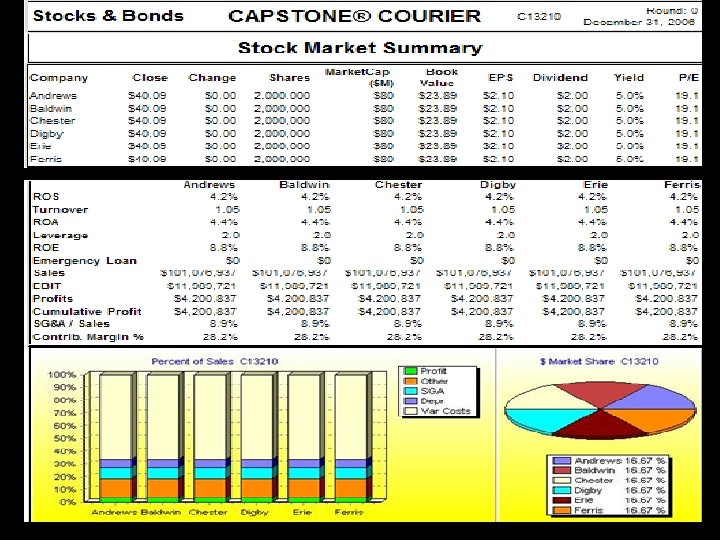
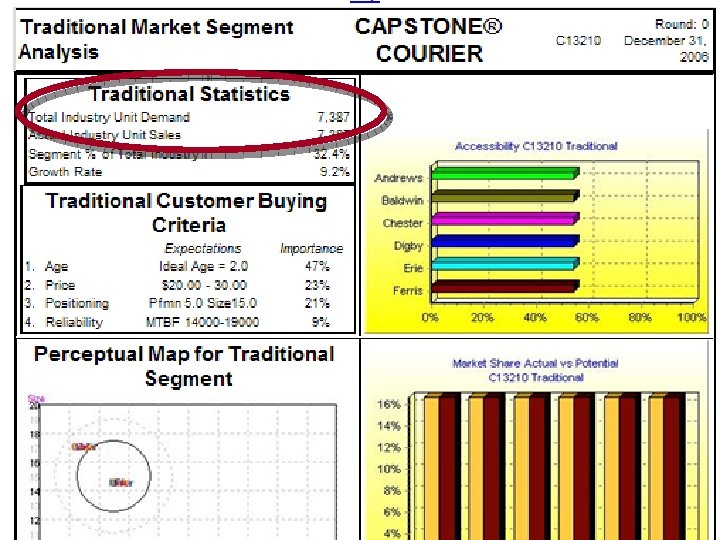
DEMAND ANALYSIS ÖThis analysis examines growth of customer demand as simulation proceeds thru 8 rounds. ÖFor this exercise you need the Market Segment Analysis pages (pages 5 - 9) of The Capstone Courier- Round 0 ÖW/in Segment Statistics-Use the Industry Unit Demand - top left corner
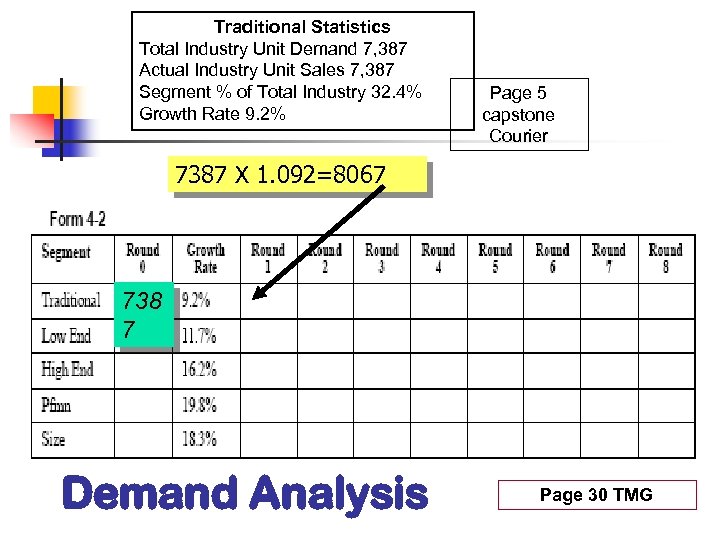
Traditional Statistics Total Industry Unit Demand 7, 387 Actual Industry Unit Sales 7, 387 Segment % of Total Industry 32. 4% Growth Rate 9. 2% Page 5 capstone Courier 7387 X 1. 092=8067 738 7 Demand Analysis Page 30 TMG
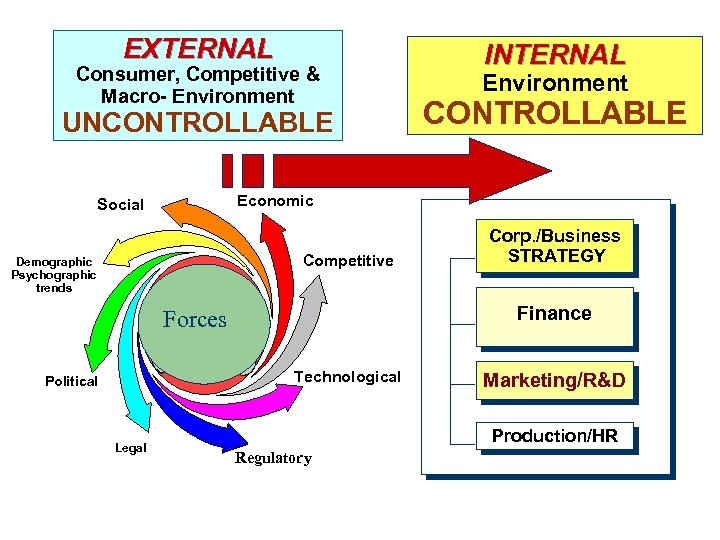
EXTERNAL Consumer, Competitive & Macro- Environment UNCONTROLLABLE Competitive Demographic Psychographic trends CONTROLLABLE Corp. /Business STRATEGY Finance Forces Technological Legal Environment Economic Social Political INTERNAL Marketing/R&D Production/HR Regulatory
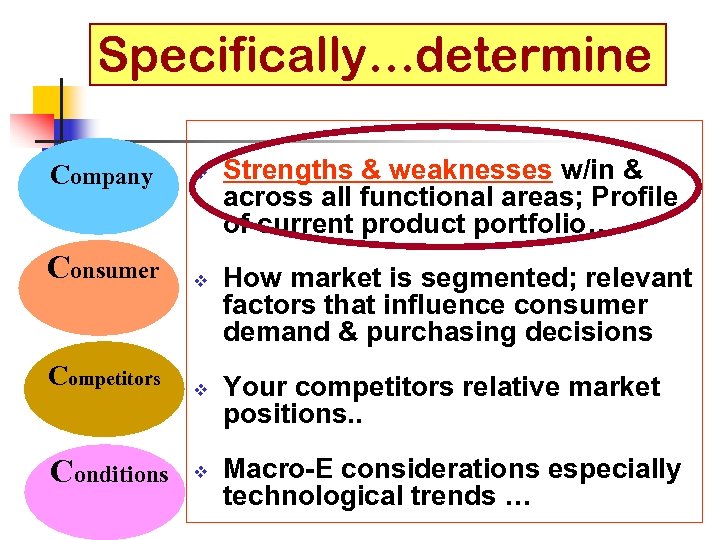
Specifically…determine Company Consumer v v Competitors v Conditions v Strengths & weaknesses w/in & across all functional areas; Profile of current product portfolio… How market is segmented; relevant factors that influence consumer demand & purchasing decisions Your competitors relative market positions. . Macro-E considerations especially technological trends …
2 Big Q’s 1. Is what you are making any good? 2. & is how you are making it— as good as it could/should be?
Company Portfolio Analysis Analyze company’s products w/ respect to: Ø Ø How good your product is…. & How good is the market you sell it in
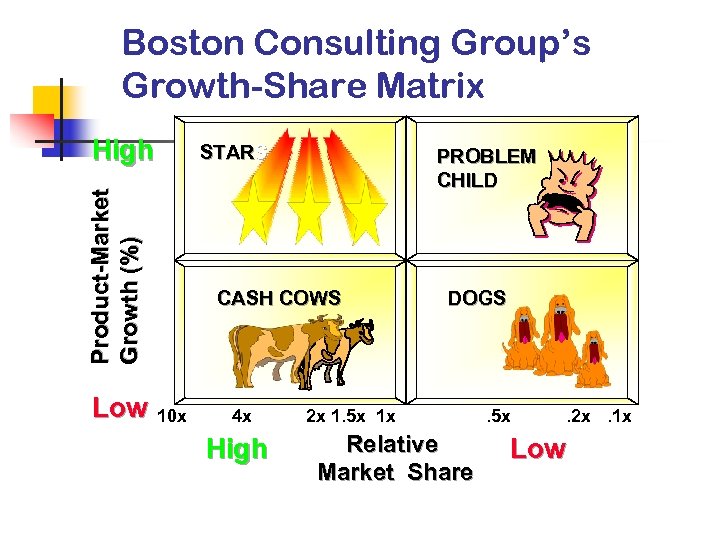
Boston Consulting Group’s Growth-Share Matrix Product-Market Growth (%) High STARS PROBLEM CHILD CASH COWS DOGS Low 10 x 4 x 2 x 1. 5 x 1 x . 5 x . 2 x . 1 x Relative High Low Market Share
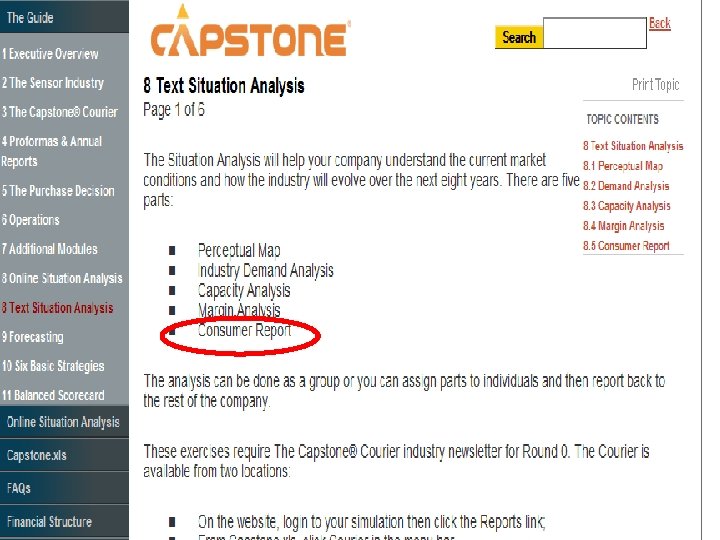
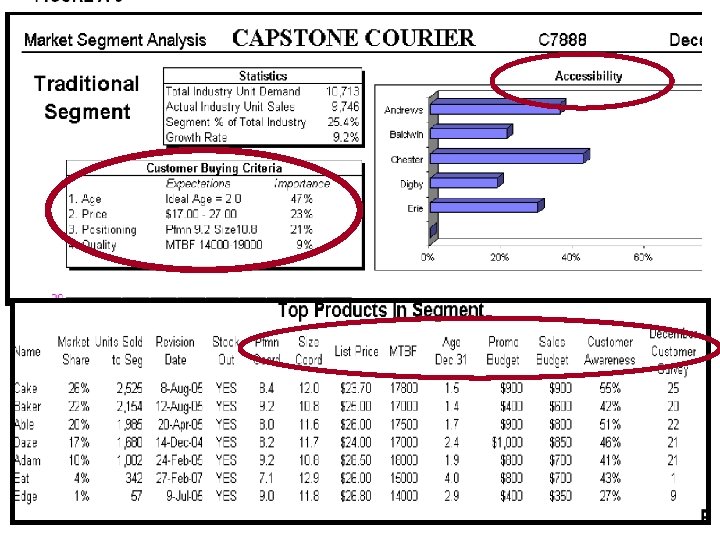
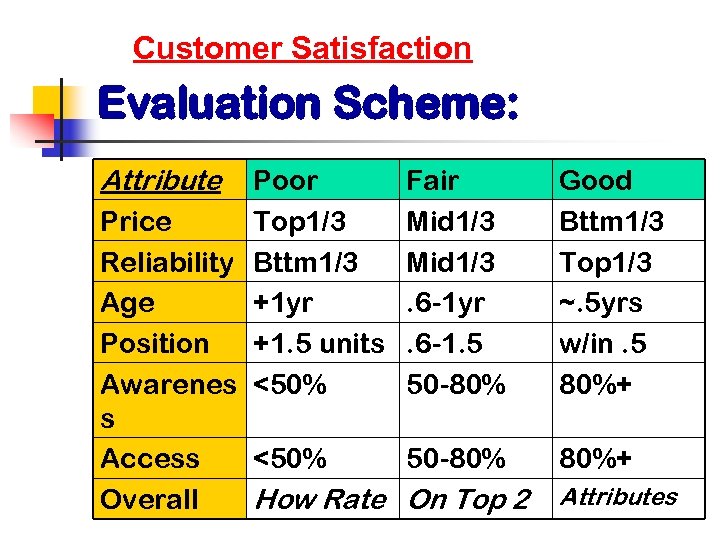
Customer Satisfaction Evaluation Scheme: Attribute Poor Price Top 1/3 Reliability Bttm 1/3 Age +1 yr Position +1. 5 units Awarenes <50% s Access <50% Overall How Rate Fair Mid 1/3. 6 -1 yr. 6 -1. 5 50 -80% Good Bttm 1/3 Top 1/3 ~. 5 yrs w/in. 5 80%+ 50 -80% 80%+ On Top 2 Attributes
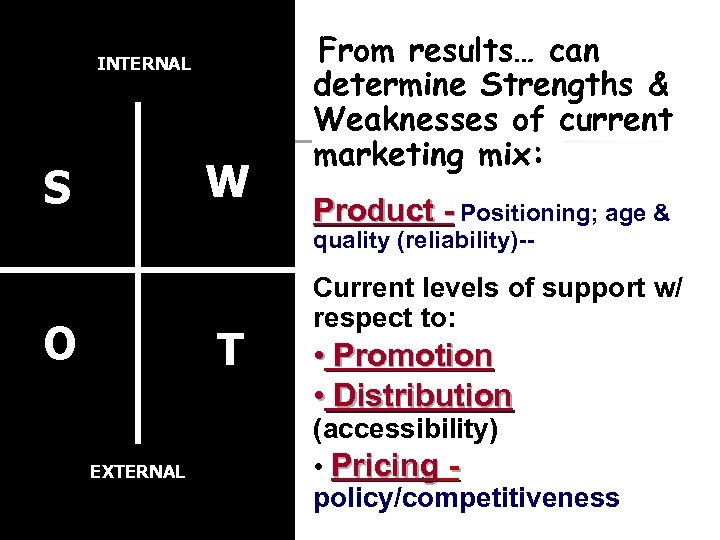
INTERNAL W S From results… can determine Strengths & Weaknesses of current marketing mix: Product - Positioning; age & quality (reliability)-- O T EXTERNAL Current levels of support w/ respect to: • Promotion • Distribution (accessibility) • Pricing - policy/competitiveness
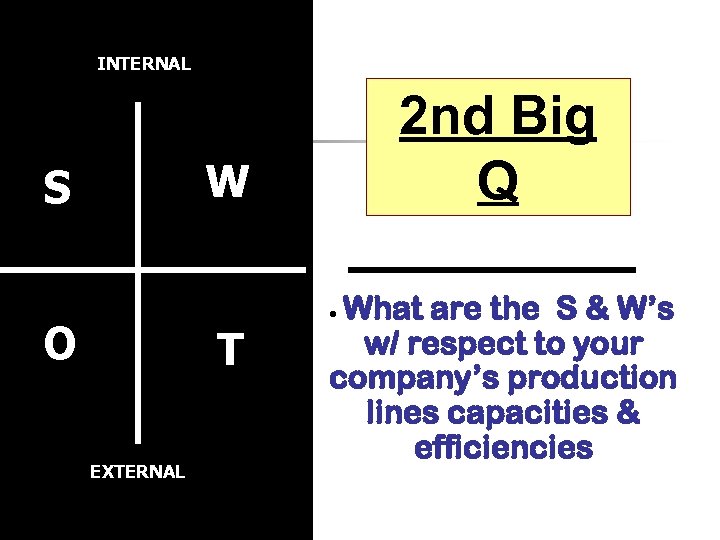
INTERNAL 2 nd Big Q W S O T EXTERNAL What are the S & W’s w/ respect to your company’s production lines capacities & efficiencies •
& Finally – need to Answer 5 key Financial Questions 1) How liquid is your firm? 2) How profitable is your Firm? 3) How effectively are you utilizing your assets ? 4) How are you financing your assets? 5) Are you providing your owners an adequate return on their investment ?
Ascertaining Your Company's Strengths & Weaknesses: Financials n Production & HR n Marketing & R&D n

M A R K E T I N G M G T. S I M U L A T I O N Questions?
M A R K E T I N G M G T. S I M U L A T I O N Can I be excused my brain is full. .
Скачать презентацию University of Alaska-Anchorage College of Business
30dfa6c864e6704996d915d9fb174888.ppt