 Скачать презентацию UNIVERSITY OF ABUJA DEPARTMENT OF BUSINESS ADMINISTRATION FIRST
8120e49544bc3b43d216870d4bc5f6d0.ppt
- Количество слайдов: 74



UNIVERSITY OF ABUJA DEPARTMENT OF BUSINESS ADMINISTRATION FIRST SEMESTER LECTURES, 2014/2015 SESSION Course Code: Bus 213 Course Title: Principles of Marketing I Course Lecturer: Dr. Bello Ayuba, FCAI, MAOM, MAIB, MNIMN 8 th February, 2015
COURSE OUTLINE Introduction The course principles of marketing provides a framework for analyzing recurrent problems in marketing. It focuses on major decisions marketing managers face in their efforts to harmonize the organizations’ objectives, capabilities and resources with market place needs and opportunities. It was designed to give students and marketing practitioners a clear understanding of marketing principles, strategies and practices. Topics to be covered include:
COURSE OUTLINE…………………. 1. Framework of Marketing: Definition of Marketing Evolution of Marketing Basic Concepts of Marketing and Marketing Functions
COURSE OUTLINE…………………. 2. Marketing Mix: Product; Meaning, Levels and Classifications. Price; Meaning, Pricing Objective and Constraints. Place: meaning, influencing factors and types of distribution intermediaries. Promotion; Meaning, Objectives, Needs and Promotional Tools (Advertizing, Personal Selling, Sales Promotion and Publicity) including Factors Influencing Promotional Mix.
COURSE OUTLINE…………………. 3. Marketing Management Philosophies: v Meaning v Marketing Management Concepts & Tools v Managerial Philosophies v Differences Between Selling and Marketing Concepts
COURSE OUTLINE…………………. 4. Product Life-Cycle Strategies: Meaning of Product Life-Cycle Stages of the Product Life-Cycle (i. e Strategies at Introductory Stage, Growth Stage, Maturity and Decline Stages).
COURSE OUTLINE…………………. 5. Marketing Environment: Meaning of Marketing Environment, Macro- Environmental Variables Micro- Environmental Variables Analysis of the Variables
COURSE OUTLINE…………………. 6. Marketing and Society: Relationships Between Marketing and Society Contributions of Marketing to the Society Societal Problems of Marketing Responses to Societal Criticisms Consumerism Marketing Ethics (Ethical and Un-ethical Marketing Practices). Social Responsibility
COURSE OUTLINE…………………. 7. Consumer Behaviour: Definition of Consumer Behaviour Factors Influencing Consumer Buying Behaviours Consumer Buying Decision Process Types of Consumer Buying Behaviours The Buying Roles
Course Outline…………………. 8. Organizational Buying Behaviour: Meaning of Organizational Buying Characteristics of Organizational Buyer Organizational Buying Procedures
Course Outline…………………. 9. Recommended Texts: Kotler, Philip (2006), Principle of Marketing, Prentice Hall, New York. David, Jobber (1998), Marketing, Mc. Graw Hill, London. Ayuba, Bello (2008), Marketing: Principles and Management, Shukrah Printers, Kaduna.
DEFINITION OF MARKETING Kotler (1991) defined Marketing as a social and managerial process by which individuals and groups obtain what they need and want through creating and exchanging products and value with others. Peter Drucker(1973) defined Marketing as the whole business seen from the point of view of its final result, customer satisfaction. Ryam sees marketing as a bridge between production and consumption.
Definition of marketing Continues……. . The American Marketing Association (1935) asserted that, Marketing consists of those activities involved in the flow of goods and services from the point of production to the point of consumption. The amended AMA (2004) definition thus read: “Marketing is an organizational function and a set of processes for creating, communicating, and delivering value to customers and for managing customer relationships in ways that benefit the organization and its stakeholders”.
THE BASIC CONCEPTS OF MARKETING Needs, Wants and Intentions Demand Products or Services Utility, Value and Satisfaction Exchange Transactions and Relationships (Market, Marketers, and Marketing)
MARKETING FUNCTIONS For a marketing system to be effective, there are three general types of functions which it must provide. Exchange functions which comprise buying, selling and pricing. Physical functions which comprises assembling, transport and handling, storage, processing and packaging, grading and standardization. Facilitating Functions which comprises financing and risk bearing, market Information, demand supply creation, market research.
Marketing functions…………. . Identification of Customers Needs or Markets Designing the Products or Services to Satisfy the Needs Communicating Information about the Products or Services Making the Products or Services Available Applying an Appropriate Pricing Strategy Market Information Storage Function Financing Making the Necessary Service Follow-up
MARKETING MIX It is the term used to describe the combination of the four inputs that constitute the core of a company’s marketing system i. e. Product Price Place and Promotion Some authors have extended its usefulness by proposing a seven P’s, such as People, Process and Physical Evidence (Kotler, 1999).
Product Stanton (1964) defined product as a set of tangible and intangible attributes including packaging, colour test, price, manufacturer’s prestige, retailer’s prestige, as well as manufacturers’ and retailer services which the buyer may accept as offering wants satisfaction. A product is anything offered for attention, acquisition, use or consumption that might satisfy a want or need. Products can be physical objects, service, persons, organizations and ideas.
Price According to Marsh (1988: 87), “pricing is a very important element in the marketing mix, as it is the only element of the marketing mix which produces revenue. All the other parts of the marketing mix are cost-driven”. Price is the term being used to describe money value of an item; it is the term expressed in any monetary medium whereby the exchange occurs.
Place is an element of the marketing mix which deals with how manufacturers distribute products to the consumers. The movement of goods and services from the manufacturer to the consumer is known as distribution.
Promotion is any effort whose function is to inform customers about the existence of a product or services with a view to induce them either to start or continue buying the product or services. Promotion is one of the major forms of marketing communications, which include advertising, personal selling, sales promotion, and public relations (Kotler, 1991). These are therefore referred to as the promotional mix.
Three Levels of Product Core Product: Benefits. For instance the purchase of drill is “buying holes: a hotel guest is buying “rest and sleep”. Thus, Marketers must see themselves as benefit providers. Actual or Tangible Product: This include product features such as quality, styling, branding, packaging, labeling etc. Augmented product: This consists of installations, delivery, credit, warranty, and after sales services. Consumers tend to see product as complex bundles of benefits that satisfies their needs.
Products Classification Based On Durability and Tangibility Non Durable Goods: These are tangible goods that are normally consumed in one or two uses e. g. Soap, beer and so on. Durable Goods: These are tangible goods that survived many uses e. g. refrigerators, clothing, radio, television, chairs e. t. c. Services: these are intangible, inseparable, variable and perishable as a result; they normally required more quality control, supplier credibility and adaptability.
Products Classification Continues…. . A. Consumer Goods Armstrong defined consumer goods as products bought by the final consumer for personal consumption. It is any goods that is bought for household use e. g. Cars, food, etc. Consumer goods can further be subdivided into the following: 1. Convenience Goods: consumers have adequate knowledge, they are frequently purchased with a minimum of effort, inexpensive and readily available when customers need them.
Products Classification Continues…. . Convenience goods are further sub-divided into: Staple Goods: These are goods that consumers purchase on a regular basis e. g. Toothpaste, Soap, milk, sugar, oil etc. Impulse Goods: These are goods that consumers have no intention of buying but may decide to buy due to the impulse or how the goods are displayed. E. g. Magazines, Newspapers, Ice-Cream etc. Emergency Goods: These type of goods are purchased when a need is urgent and the cost is usually high because of the urgency e. g. Drugs Umbrella during rainfall.
Products Classification Continues…. . 2. Shopping Goods: Less frequently Purchased, consumers makes comparison on quality, Price and style in buying. E. g. Furniture, Clothing etc. This is sub-divided into: Homogeneous Goods: Goods that are similar in quality but different enough in price to justify shopping comparisons. Heterogeneous Goods: - Goods that are different with features are often more important to the consumer than the price.
Products Classification Continues…. . 3. Specialty Goods: These are consumer goods with unique characteristic and/or brand identification for which a significant group of buyers is habitually willing to make a special purchasing effort. 4. Unsought Goods: These are consumer products that the consumers do not know about or knows about but does not normally think of buying. Most major unsought goods are not known until the consumers become aware of them through advertising. E. g Life insurance, encyclopedias etc.
Products Classification Continues…. . B. Industrial Products These are those products that are purchased for further processing or for use in conducting a business. E. g. A car bought for business purpose. These groups of industrial products are: Materials and Parts Capital Items Suppliers and Business Services
Products Classification Continues…. . Materials and Parts: Raw Materials: (wheat, cotton, livestock, fruits, Vegetables, fish, crude oil, iron ore etc). Farm Products: (Juice: Chivita, five alive, Corn beef etc) which requires assembly, grading, storage, transportation and selling service. Their perish ability and seasonal nature gives rise to special marketing practices. Natural Products: are highly limited in supply. They are usually very expensive and have low unit value and require substantial transportation.
Products Classification Continues…. . Manufactured Materials and Parts Components materials: which includes Iron, Cement, Wires etc they are usually fabricated further. Example cement in building house Components parts include small motors, seat belts, bulbs etc. These enter the finished product completely with no further changes in forms, as seat belts are put in Cars.
Products Classification Continues…. . Capital Items Capital items are long lasting goods, they are of two groups: Installations: which consist of Building (factories and offices) and fixed equipments (generators, elevators, large Computer system, drill presses) Accessory Equipment: They are less expensive and have shorter life’s than installation This consists of: (i) Portable factory equipments and tools (e. g. hand tools, lift trucks) (ii) Office equipments (e. g. Calculator, Cluck, personal Computers desks)
Products Classification Continues…. . 3. Supplies and Business Services: - This is short lasting goods and services that are equivalent to convenience goods in the industrial field; they are usually purchased with a minimum effort on a straight re-buy basis, they are normally marketed through intermediaries because of their low unit value and the great number and geographical dispersion of customers. This include; (i) Operating Supplies: Lubricants, coal, writing paper, panels, stationary etc. (ii) Maintenance and repair items (paint nail, brooms).
Pricing Objectives The Pricing objectives of any Marketing Company are: Price Stability Returns on Investment Profit Motive Maintain or Improve Market Share Prevent Competition
Pricing Problems There are several problems that are commonly encountered which conspire to prevent the objectives of pricing being achieved, these include: A given price, while acceptable in one sector of the market, may be too high or low elsewhere The price may be viewed by sections of the market as exploitative and the company consequently seen as untrustworthy
Pricing Problems Continues…… Price differentials across the product line may be illogical The price may destabilize a previously stable market The price may lead to a degree of confusion in the market The price may damage or inhibit brand loyalty The strategy may well lead to an increase in buyers’ price sensitivity
Place involves those management task concerned with making the product available and accessible to buyers and potential buyers (Distribution). What Is Distribution? Distribution is defined as the movement of products from the point of production to the point of consumption. It can simply be defined as the transfer of goods from producers to consumers. Distribution involves physical activities such as the use of middlemen, transporting and storing of goods in order to provide target customers with time, place and possession utilities.
Place Continues………. There are two aspects of Distribution: Physical Distribution Institutional Distribution Physical Distribution deals with the physical transportation or movements of goods and services from the point of the production line to the point of use. Institutional Distribution deals with the enterprises and individuals such as wholesalers, retailers, Agents, supermarkets and market stores.
Major Activities of Physical Distribution The major decisions issues involved in physical distribution activities include: Inventory Control-(Control of Inventories, Production Schedule). Materials Handling- (Loading and Unloading Trucks, Conveyors and Containers, Packaging, Labeling). Order Processing-(Processing Customers orders) Transportation- (Moving Goods to Places) Storage Function-(Ownership of Warehousing Facilities)
Channels of Distribution The Channels of Distribution are the means employed by manufacturers and sellers to get their products to market and into the hands of users. (Manufacturer ------ Wholesaler ----- Retailer --- Agent ----- Consumer). It is the combination of institutions which direct the company’s product to consumers. Channels are management tools used to move goods from production to consumption; by which the title to goods is transferred from seller to buyer. In essence therefore, Channels are tools hired to do the job of getting goods from factory or place of production into the hands of the ultimate user.
Channels of Distribution Continues… There is a variety of intermediaries that may get involved before a product gets to the final user: Retailers- (operate outlets trade directly) Wholesalers (usually specialize in particular products. Distributors and Dealers: they often sell onto the end user. They provides after-sales service. Franchises: Franchises are independent businesses that operate a branded product (usually a service) in exchange for a license fee and a share of sales. Agents: Operate on Commission
Functions of Distribution Channel Main Function: Provide a link between production and consumption. The many key functions are: Information: marketing intelligence gathering Promotion: communicating information about the product or services. Contact: Finding and communicating with prospective buyers Matching: Adjusting the offer to fit a buyer’s needs, including grading,
Functions of Distribution Channel Continues… Negotiation: Reaching agreement on price, assembling and packaging. Physical Distribution: Transporting and Storage Financing: Acquiring and using funds to cover the cost of the distribution Risk Taking: Assuming some commercial risks by operating the channel (e. g. holding stock) All of the above functions need to be undertaken and of importance is who performs them and how many levels there need to be in the distribution channel in order to make its cost effective?
PROMOTION Promotion is one of the basic elements of the Marketing mix. When product is launched newly into the market, aggressive promotional effort has to be embarked upon to create the awareness in potential customers. In this lecture, we shall attempt to evaluate the objectives of promotion, needs for promotion, promotional mix elements and the factors influencing promotion.
Objectives of Promotion The objectives of promotion are as follows: Behaviour Modification Informing Persuasion Reminder promotion
Needs for Promotion 1. This distance between producers and consumers 2. The number of potential consumers grows daily 3. The Mobility of consumer’s from place to place. 4. The communication network between the manufacturer, the marketing intermediary and the potential customers. 5. The intense competition among firms. 6. Competition between individual firms within an industry.
Needs for Promotion 7. Abundant want satisfaction. Customers are becoming more selective in their buying choices. 8. During period of shortages, advertising can stress product conservation and efficient uses of the product. 9. Promotional activities can be used to aid consumers in “making do” and incidentally, help build the company image. 10. Promotion is needed to maintain the high material standard of living.
Promotional Mix Promotional mix is communicational in nature, they are tools normally classified under promotion, and they are called promo tools. This includes advertising, personal selling, sales promotion, publicity, packaging, sales aids (catalogues, literatures, films), trading stamps, premiums, free samples, coupons etc. The four promotional tools are to be explained as follows:
Promotional Mix Advertising this is any paid form of non-personal presentation and promotion ideas, of goods or services by an identified sponsor. Personal selling this involves presentation oral in a conversation with one or more prospective purchasers for the purpose of making sales. Sales promotion this short-term a is incentive to encourage purchase or sales of a product or service. Publicity this is another form of mass selling. It is any unpaid form of non-personal presentation of ideas, goods or services.
Advertising P. Kotler defined advertising as any paid form of non-personal presentation and promotion of ideas, goods and services through mass media such as newspapers, magazines, television or radio by an identified sponsor. Before advertisement is carried out the following decisions must be made: 1. If the organization is going to make use of an advertising agency or performing the entire function internally and the criteria by which such an agency would be selected.
Advertising 1. 2. 3. How much the organization is going to spend on advertising that will reflect a percentage of anticipated sales? The organization should also decide on when the advertising budget should be spent. If it should be spent evenly in the year or when sales are normally lowest. The media at which the organization will use to advertise in reaching its targeted customers, as well as decisions on how to select the various media organizations for the advert placement.
Reasons for Advertising 1. To create awareness, customer interest or desire. 2. To boost sales. 3. To build brand loyalty (or to maintain it at the existing level). 4. To launch a new product. 5. To change customer attitudes – perhaps trying to move a product more “up market” or to dispel some widely held perceptions about the product. 6. To support the activities of the distribution channel (e. g. supporting a “pull” strategy).
Reasons for Advertising 7. To build the company or brand image. 8. To remind and reassure customers 9. To offset competitor advertising – business may defend market share by responding to competitors’ campaigns with their own advertising. 10. To boost public standing: companies can boost their public standing with advertisements that link them with generally approved campaigns. 11. To support the sales force.
Factors Influencing Promotional Mix. Four factors that should be taken into account in deciding on the promotional mix are: Funds Available The nature of the market The nature of the product and The stages of the product life cycle.
MARKETING MANAGEMENT Introduction Marketing management provides the framework for analyzing recurrent problems in marketing. It focuses on the major decisions marketing managers and top management faces in their efforts to harmonize the organizations objectives, capabilities and resource with market place needs and opportunities. It is comprehensive as it gives clear guide to managers on how to carry out strategic, tactical and administrative marketing.
Marketing Management Continues……. . Marketing management is crucial to the survival of any marketing organization in today’s competitive business world. As organizations continues to expand, through market penetration, product development, market development and diversification, coordination of efforts becomes more complex and strategic and thus, managers find marketing management which involves proper analysis, planning, implementation and control of programs as an important ingredient for the success of any marketing activity.
What Is Marketing Management? America marketing association (1985) defines marketing management as “the process of planning and executing the conception, pricing, promotion and distribution of ideas, goods and services to create exchanges that satisfy individual and organizational objectives. P. Kotler (1991) defines marketing management as “the analysis, planning, implementation and control of programs designed to bring about desired exchange with target markets for the purpose of achieving organizational objectives.
IMPORTANCE OF MARKETING MANAGEMENT The importance of marketing management can never be over emphasized as it’s: Provides the understanding you need about the economic structure of your industry. Helps in identifying segments within your market. Identify the marketing strategy, which best fits, your company. Identifying your target market. Helps in conducting marketing research
Importance of Marketing Management Understand your competitors and their products Develop new products Establish environment-scanning mechanism Understand your coy strength and weakness. Audit your customer’s experience of your brand Develop marketing strategies for your products Create a sustainable competitive advantage. Understand where you want your brands to be in the future, and write marketing Plans. Setup feedback system
MARKETING MANAGEMENT PHILOSOPHIES Marketing management philosophy is a consumer oriented philosophy aimed at identifying and satisfying the consumer’s needs and wants more efficiently and effectively in a manner that organizational goals are achieved. There are six competing concepts under which an organization conducts marketing activities. This philosophy revolves around the following concepts;
Marketing Management Philosophies 1. The Production Concept 2. The Product Concept 3. The Selling Concept 4. The Marketing Concept 5. The Societal Marketing Concept
MARKETING ENVIRONMENT Introduction This lecture deals with how marketing managers respond to environmental changes in the marketing environment. Marketers take the major responsibility of identifying significant changes in the environment. Marketers must be trend trackers and opportunity seekers. A company or organization’s marketing environment consists of the actors and forces outside marketing that affect marketing management’s ability to develop and maintain successful transactions with its target customers.
Marketing Environment Continues…. . The marketing environment consists of a micro environment and a macro environment: The Micro – environment of an organization can best be understood as comprising all those other organizations and individuals who directly or indirectly affect the activities of the organization. The Macro- environment comprises general trends and forces which may not immediately affect the relationships that a company has with its customers, suppliers and intermediaries, but sooner or later, macro environmental changes will alter the nature of these relationships.
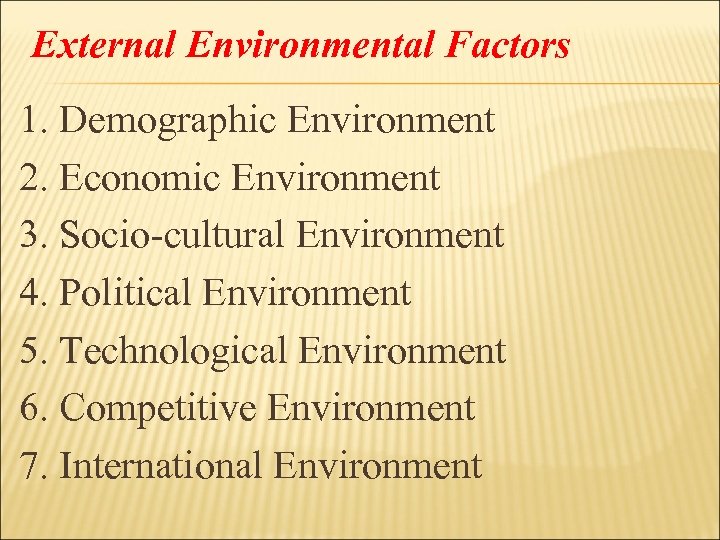
External Environmental Factors 1. Demographic Environment 2. Economic Environment 3. Socio-cultural Environment 4. Political Environment 5. Technological Environment 6. Competitive Environment 7. International Environment
MARKETING AND SOCIETY Introduction Marketing relied heavily on the society for its success post while the society also owes its quality of life to marketing. Generally, marketing makes demands on the society and the society makes demand on marketing. In this lecture, we shall identify the underlying relationships between marketing and society, and the contribution of marketing to the society, as well as the unethical marketing practices.
Marketing and Society Continues…. . Environmental Relationship Marketing operates in an environment that is external to the firm; it reacts to its environment and is, in turn, acted upon by it. The environmental relationships include those with customers, employees, government, vendors, and the society as a whole. External relationships form the basis of the societal issues confronting marketing. Firms marketing relationship to its external environment has a significant effect on the degree of success it achieves. Marketers must always find new ways to deal with social issues facing marketing.
Marketing and Society Continues…. . Contributions of Marketing to the Society: Improvement on the standard of living Massive production of Ys to meet societal demand Specialization of skills Creation of job opportunities Promotion of Social causes Growth of Gross National Product (GNP) Improvement of bilateral relationship between different countries through international trade. Education of the consumers in the society.
Marketing and Society Continues…. . Societal Problems of Marketing: In the course of achieving societal need (satisfaction), some unwanted output and activities are generated consciously or unconsciously. All the unwanted output poses a serious problem to the society. Encouragement of materialism Environmental pollution Problems of implementing marketing mix
Marketing and Society Continues…. . Marketing Ethics Shelby D. Hunt (1986) defines marketing ethics as both the study of moral evaluation of marketing and the standard applied in judgment of marketing decisions, behavior and instructions as morally right or wrong. O. C. Ferrell defines it as the study of right and wrong with respect to marketing policies, practices and systems. That it comprises principles and standards that guide appropriate conduct in organization.
Marketing and Society Continues…. . Unethical Marketing Practices Un-ethical marketing practices are the kind of practices that are deceptive, exploitative and dangerous to human life. Unethical marketing also means criticisms of marketing. The various social criticism of marketing can be classified into those alleged to hurt individual consumers, society as a whole and other business firms. The Areas of un-ethical Marketing practices in Nigeria Include:
Marketing and Society Continues…. . Areas of Un-ethical Practices: Un-ethical Marketing Practices Related to Product Un-ethical Marketing Practices Related to Price Un-ethical Marketing Practices Related to Distribution Un-ethical Marketing Practices Related to Promotion
ORGANIZATIONAL BUYER BEHAVIOR Introduction Business organizations not only sell, but they also buy vast quantities of raw materials, manufactured parts, installations, accessory equipment’s supplies and business services. Government agencies and institutions alike also buy one product, service or the other, in this topic, we are going to consider business organizations and government and institutions as another segment of buyers - the organizational buyer. The mode of buying by these institutions will also be analyzed.
Meaning of Organisational Buyer Behaviour While there are more households consumers than organizational buyers, there a considerable number of people making buying decisions for their organizations. However, there is a vast amount of organizational buying that must be done in order they ultimately reach the household consumers. Organizational buying has been defined as decision -making process by which formal organizations establish the need to purchase products and services and identify, evaluate and choose among alternative brands and suppliers.
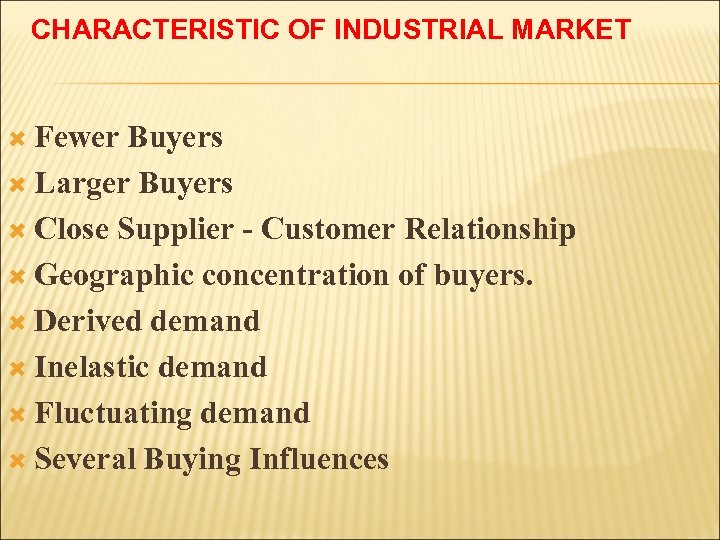
CHARACTERISTIC OF INDUSTRIAL MARKET Fewer Buyers Larger Buyers Close Supplier - Customer Relationship Geographic concentration of buyers. Derived demand Inelastic demand Fluctuating demand Several Buying Influences
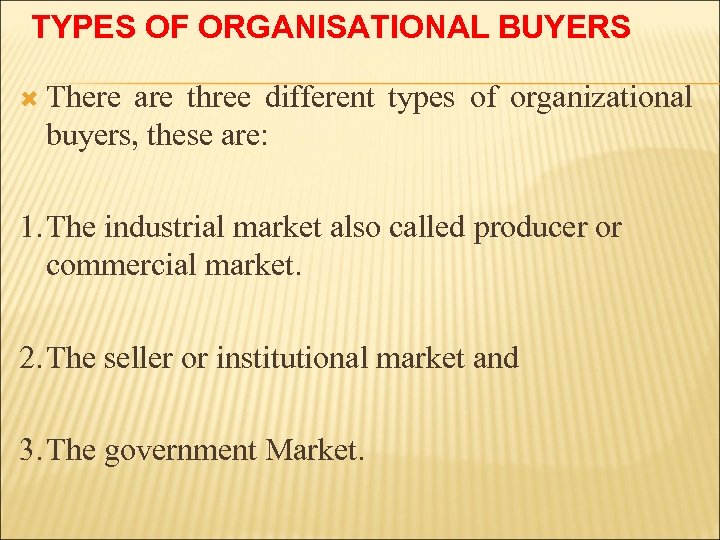
TYPES OF ORGANISATIONAL BUYERS There are three different types of organizational buyers, these are: 1. The industrial market also called producer or commercial market. 2. The seller or institutional market and 3. The government Market.
Скачать презентацию UNIVERSITY OF ABUJA DEPARTMENT OF BUSINESS ADMINISTRATION FIRST
8120e49544bc3b43d216870d4bc5f6d0.ppt