 Скачать презентацию University College Dublin Disability Support Service John Bennett
0c8a90d77c7465461566c6c6f83893d7.ppt
- Количество слайдов: 27



University College Dublin Disability Support Service John Bennett, Disability Officer Deborah Walsh, Educational Psychologist Yvonne Mc. Dermott, T&L Support Officer 15 January 2004
Overview § Overview of DSS § Policy & Legislative Framework § Disability? » What does it include? » Verification § Dyslexia § Services to Students, Faculty, Administration Staff § Admissions § Inclusion § Shaping the Future
Overview of DSS § § § § Set up in 1988 Mainstreaming QA/QI Review Re-establishment of service New Offices Increased Staff Increased range of services Substantial increase in students registering with service
Structure
UCD Policy (Handouts in pack) § Equal Opportunities Policy § Dignity & Respect Policy § DSS policy Statement
National & International Legislation § United Nations Standards Rules for the Equalization of Opportunities for Persons with Disabilities (1993) § [COM (96) 406 'Equality of Opportunity for People with Disabilities - a New Community Disability Strategy']. § Article 13 of the Treaty of Amsterdam (1997) § Employment Equality Act (1998) § University Act (1997) § Equal Status Act (2000)* *Handout in pack
Disability – What is it? § Equal Status Act 2000* § Models of Disability – Social Vs Medical* § Direct and Substantial Effect on achieving academic potential. § Catagories § Verification of Disability *Handout in pack
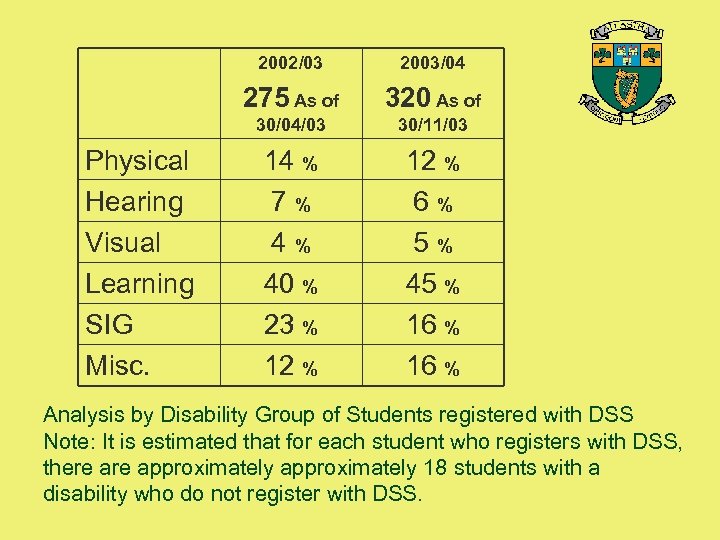
2002/03 275 As of 320 As of 30/04/03 Physical Hearing Visual Learning SIG Misc. 2003/04 30/11/03 14 % 7% 4% 40 % 23 % 12 % 6% 5% 45 % 16 % Analysis by Disability Group of Students registered with DSS Note: It is estimated that for each student who registers with DSS, there approximately 18 students with a disability who do not register with DSS.
Dyslexia § “…a continuum of specific learning disabilities manifested by problems in acquiring one or more basic skills (reading, spelling, writing, number) (Task Force On Dyslexia 2002) § Poor short term memory § Inefficient information processing § § § Poor phonological processing § Difficulties in organisation, sequencing and automaticity § Poor metacognition Positive Aspects Holistic learning Divergent Thinker Innovative thinkers Good Problem solvers
How to recognise Dyslexia § Discrepancy between overall ability & verbal skills § Excessive misspelling § Difficulty taking down telephone numbers/messages (working memory) § Problems organising work § Poor proof-reading § High levels of stress § Aversion to written work § Sequencing difficulties in tasks that are usually automatic § Forgetting instructions § Persistent literacy difficulties § Tendency to talk rather than listen
Research in UCD 2003 Staff § Good awareness of DSS (82%) § Use of multi-sensory techniques (35%) § Poor awareness of student support (6%) § Handout provision (82%) Students § Most supportive level of education § Poor awareness of Dyslexia § Note taking difficulties § Good exam support Recommendations § Raise awareness of learning disabilities & inclusive teaching practice § CPD for academics § Interactive learning environments § Greater approachability of academic staff § Recognition of Dyslexia as a disability § Recognition of learning styles
Seminar Dispelling the myths of Learning Disability § Feb 5 th Student Centre, Belfield, 4: 00 pm. § Exploration of two disabilities: Dyslexia & Dyspraxia § Identification § Assessment § Support § Inclusion § RSVP: Deborah. Walsh@ucd. ie
Services to Students § Advice and Guidance with Admission Process, in conjunction with Admissions Department. § Evaluation of Students Needs on Entering University. § Assistive Technology. § Learning Support Service § Note - Taker Service § Library Assistance. § Material in alternate format. § Short form assessments of students who may have dyslexia
Services to Students § One-to-One Reader Service. § Speedtext Notetaking Service § Alternate Examination Arrangements in conjunction with Examinations Department. § Information & Advice for Students § Funding of Supports for Students with a Disability. § Advocacy
Services to University Faculty Staff Liasing with Faculty Staff on; • Supports for Students with a Disability. • Information & Advice on Alternate Assessment Strategies. • Increasing Awareness of Needs of Students with a Disability. • Supporting the move towards inclusion
Services to University Administrative Departments § Admissions Department. § Examinations Department. § Buildings & Services Department. § Other Academic and Administrative Services. § Other Student Support Services.
Admissions § Standard CAO § Non – Standard Admissions process* § Adult Education RTL/Access § Mature Student Entry
Non Standard Admissions Process § Why have a NSAP for Students with a Disability? § Procedure § Criteria • Overall academic achievement to date, as shown by the Leaving Certificate results; • Academic achievement in key subject areas, as shown by the Leaving Certificate results and any other academic qualifications; • The impact of the disability on academic achievement to date, as shown in the personal statement, the consultant’s report and the letter from the school principal and key teachers.
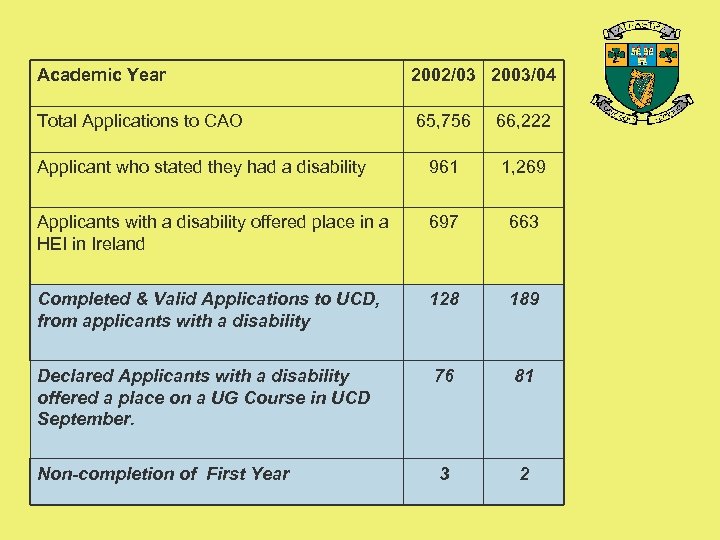
Academic Year 2002/03 2003/04 Total Applications to CAO 65, 756 66, 222 Applicant who stated they had a disability 961 1, 269 Applicants with a disability offered place in a HEI in Ireland 697 663 Completed & Valid Applications to UCD, from applicants with a disability 128 189 Declared Applicants with a disability offered a place on a UG Course in UCD September. 76 81 Non-completion of First Year 3 2
Inclusion “Rather than learners trying to change who they are so that they all ‘fit in’, adult educators must create learning environments in which all learners will thrive”, (Imel, 1995).
Inclusion § Diverse student population § Variety of learning styles § Diversity Challenge of providing equal educational opportunities for all students § Inclusive teaching practice § Assessment issues § Inclusive Teaching Practice/Reasonable Accomodation* § Developing Faculty Strategy *Handout in pack
Developing Faculty Strategy § What academic skills must be mastered? § What knowledge, concepts, principles, must be mastered? § What methods of instruction cannot be modified? § What elements are core? § What auxillary aids could be employed to assist teaching? SLI, TR, etc. (Teachability UK, Alan Hurst)
DSS & Centre for Teaching & Learning § Design of Module on Inclusive Teaching & Learning for new staff & existing staff. § Publication of Guidelines for Inclusive Teaching & Learning § Publication on Dyslexia in University College Dublin § Assist in devevloping Faculty specific Inclusive Teaching & Learning policy & procedures § Research on Inclusive Teaching & Learning
Shaping the future § DSS Steering Committee – all Faculty representation. § Development of Faculty resource teams § Collaborative Process of developing Inclusive education environment § Faculty training seminars – DSS, CTL § Positive mental health strategy – Welfare services § Technology and Innovation § Information exchange § Increasing access for Mature students with a disability § Promotion of UCD as an inclusive learning institution.
Summary § Overview of DSS § Policy & Legislative Framework § Disability? » What does it include? » Verification § Dyslexia § Services to Students, Faculty, Administration Staff § Admissions § Inclusion § Shaping the Future
DSS Staff § John Bennett - Disability Officer § Aiveen Mc. Partlin – Administration § Jean Keating - Projects Officer § Yvonne Mc. Dermott - Teaching & Learning Support Officer § Deborah Walsh - Educational Psychologist § Ted Harvey - Assistive Technology Advisor § Aoife O’Brien - Access Librarian § Finbar Byrne - Braille Officer
Further Information Disability Support Service Level 1 Library Building University College Dublin Belfield Dublin 4. Telephone: 01 716 7565 Email: dss@ucd. ie Web: www. ucd. ie/Disability
Скачать презентацию University College Dublin Disability Support Service John Bennett
0c8a90d77c7465461566c6c6f83893d7.ppt