


 Скачать презентацию Université de Savoie UFR-LLSH LCE 1 UE 103
6d1591ae424cb6ae19b0c9510bf72de9.ppt
- Количество слайдов: 40
 Université de Savoie UFR-LLSH LCE 1 UE 103 CM de Phonétique & Phonologie Alice Henderson ahend@univ-savoie. fr Office 812 1
 Content of the five lectures 1) Introduction, Phonemes 2) Sounds in context: « connected speech » 3) Stress, accent & rhythm 4) Intonation 5) Conclusion 2
 General Outline: Lecture 1 l l l 3 Introduction, Why & How The IPA: History & Importance Generalities about spoken English & spoken French Conclusion Bibliography
 Why have this lecture? l To better understand – – l To arouse your curiosity – – 4 how English is spoken how spoken English can be studied about a living language about a potential subject of research
 Why phonetics? Why phonology? l l to improve your hearing to improve your speaking to improve your communication skills to improve your understanding of: – – 5 the unique features of spoken French (your L 1) the unique features of spoken English
 What is phonetics? l The study of sounds produced by human beings – l 6 « Branche de la linguistique qui étudie les sons des langues naturelles » (Petit Robert) A systematic approach to these sounds
 What is phonology? « Science which studies the function of phonemes in natural languages. » (Phonemes = « the smallest unit of spoken language » ) Source: Petit Robert 7
 What are the branches of this field? l l l 8 General phonetics (acoustic & articulatory/physiological): studies the functionning of the human speech appartus and analyses articulatory capacities & the characteristics of the sounds produced, using acoustic measures Descriptive phonetics : study of phonetic properties of a given language Historical/evolutionary phonetics : study of the phonetic changes of a given language Normative phonetics : prescribes rules for the « good » pronunciation of a given language Forensic phonetics : study of phonetic properties for a medico -legal purpose
 What are the tools of descriptive phonetics? l l 9 A system of symbols which graphically represents human sounds The IPA system (International Phonetics Association)
 General Outline: Lecture 1 l l l 10 Introduction, Why & How The IPA: History & Importance Generalities about spoken English & spoken French Conclusion Bibliography
 Early days of the Association l Dhi Fonètik Tîcerz' Asóciécon (the FTA) l To help children: – – 11 pronounce foreign languages better learn to read more easily
 Basic terminology An articulatory definition for this lecture - consonants - vowels Anatomy of the vocal tract 12
 Understanding the IPA chart l l l 13 Pulmonic consonants Non-pulmonic consonants Vowels Other symbols Diacritic marks Supra-segmental marks: accent, intonation
 Pulmonic consonants (1/2) l Logical, methodical presentation – – – Modes/Manners of articulation (vertical axe) Places of articulation (horizontal axe) Pairs: unvoiced (left), voiced (right) Symbols & examples 14
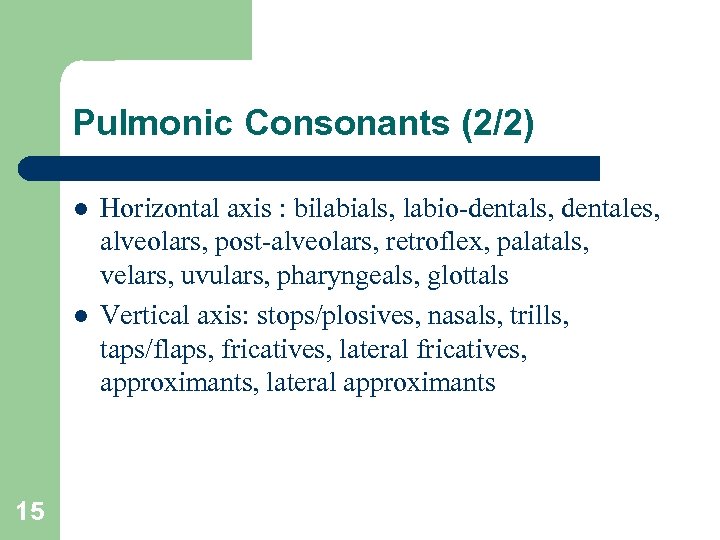 Pulmonic Consonants (2/2) l l 15 Horizontal axis : bilabials, labio-dentals, dentales, alveolars, post-alveolars, retroflex, palatals, velars, uvulars, pharyngeals, glottals Vertical axis: stops/plosives, nasals, trills, taps/flaps, fricatives, lateral fricatives, approximants, lateral approximants
 Non-pulmonic consonants l The air does not come from the lungs Symbols & examples 16
 Try it …. l l 17 Exercises on the Web at UCL « Web Tutor » Exercises with the terminology, adapted from P. Ashby’s Speech Sounds
 Answers … l l l 18 Ex. 8. 1. : palatal, uvular, bilabial, alveolar, palatal, alveolar, velar, uvular Ex. 8. 2. : plosive (2), nasal (1, 3), tap (8), fricative (4, 6, 10), approximant (9), lateral approximant (7), implosive (5). Lateral fricative Ex. 8. 4. : (see white board)
 Understanding the IPA chart l l l 19 Pulmonic consonants Non-pulmonic consonants Vowels Other symbols Diacritic marks Supra-segmental marks: accent, intonation
 Vowels: the Cardinal vowels (1/2) l l Vowel chart « reference points » = Cardinal vowels chart 20
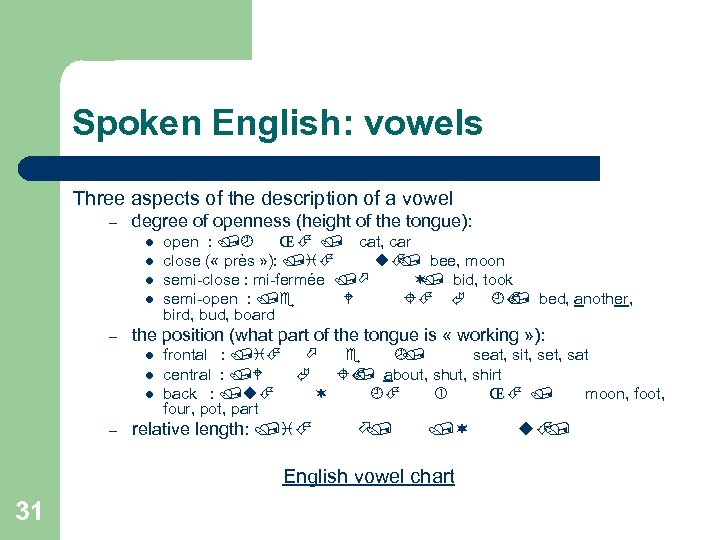
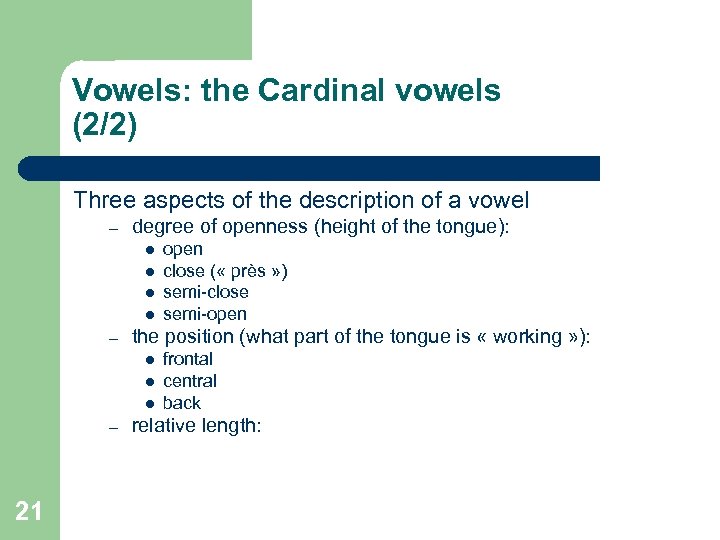 Vowels: the Cardinal vowels (2/2) Three aspects of the description of a vowel – degree of openness (height of the tongue): l l – the position (what part of the tongue is « working » ): l l l – 21 open close ( « près » ) semi-close semi-open frontal central back relative length:
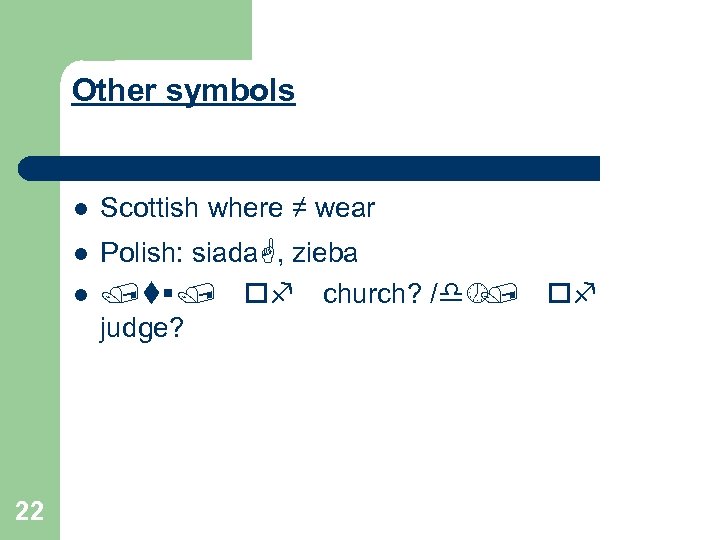 Other symbols l Scottish where ≠ wear l Polish: siada. G, zieba /t§/ of church? /d½ / judge? l 22 of
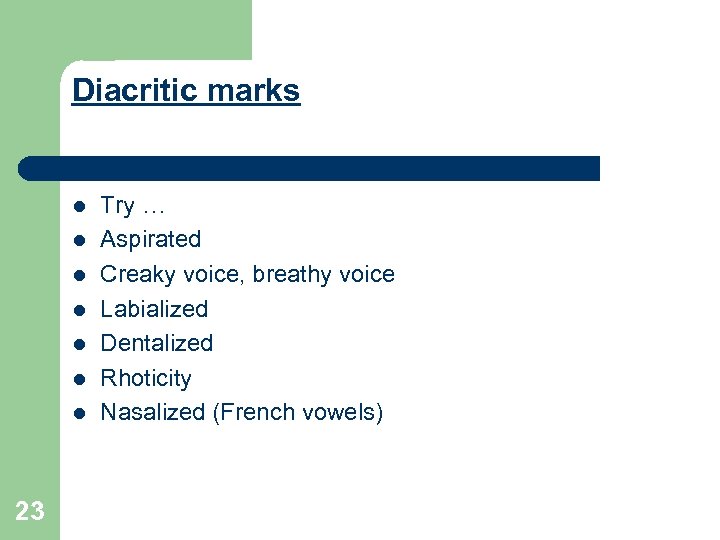 Diacritic marks l l l l 23 Try … Aspirated Creaky voice, breathy voice Labialized Dentalized Rhoticity Nasalized (French vowels)
 Supra-segmental marks l l 24 Accent Intonation
 Summary of the IPA chart l l l 25 Pulmonic consonants Non-pulmonic consonants Vowels Other symbols Diacritic marks Supra-segmental marks: accent, intonation
 General Outline: Lecture 1 l l l 26 Introduction, Why & How The IPA: History & Importance Generalities about spoken English & spoken French Conclusion Bibliography
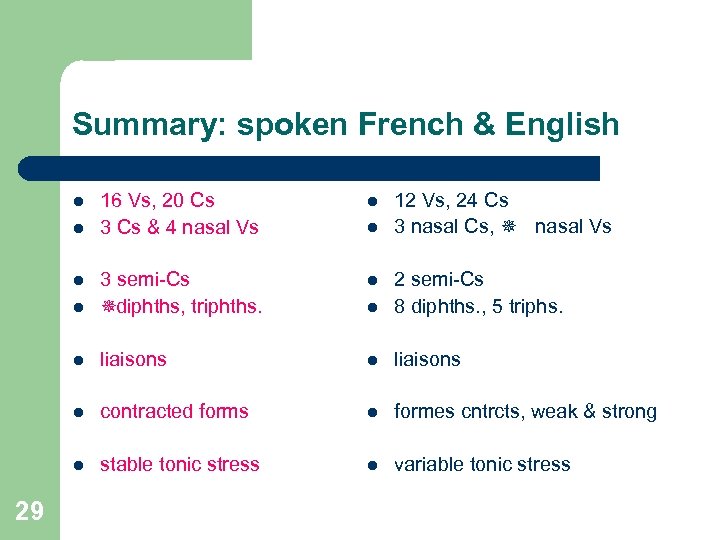
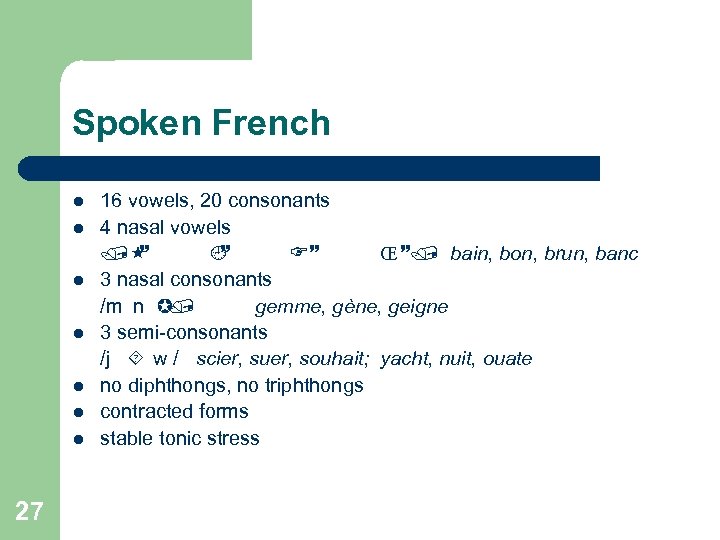 Spoken French l l l l 27 16 vowels, 20 consonants 4 nasal vowels / « ~ ¿ ~ F~ Œ ~/ bain, bon, brun, banc 3 nasal consonants /m n µ / gemme, gène, geigne 3 semi-consonants /j ´ w / scier, suer, souhait; yacht, nuit, ouate no diphthongs, no triphthongs contracted forms stable tonic stress
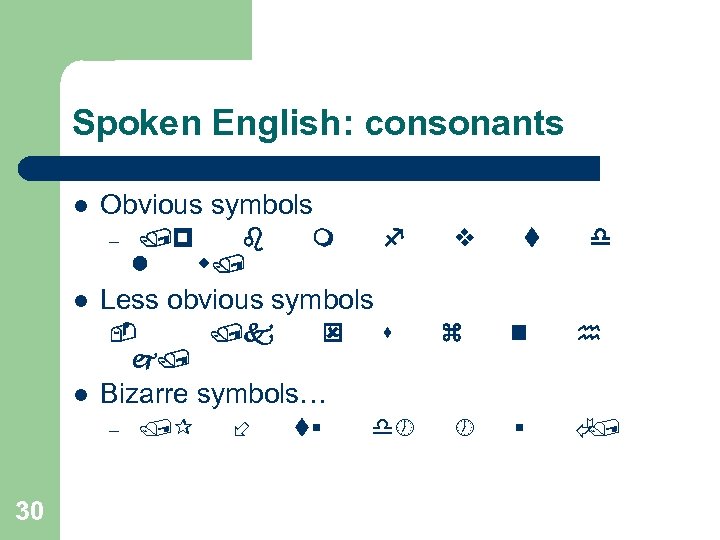
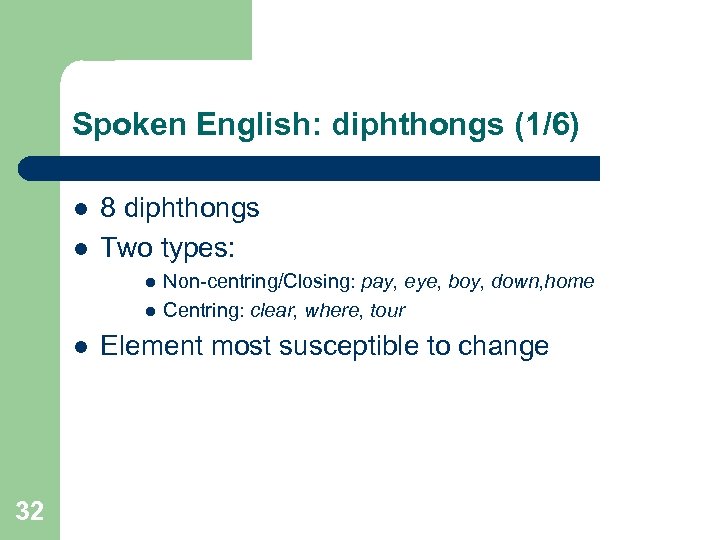
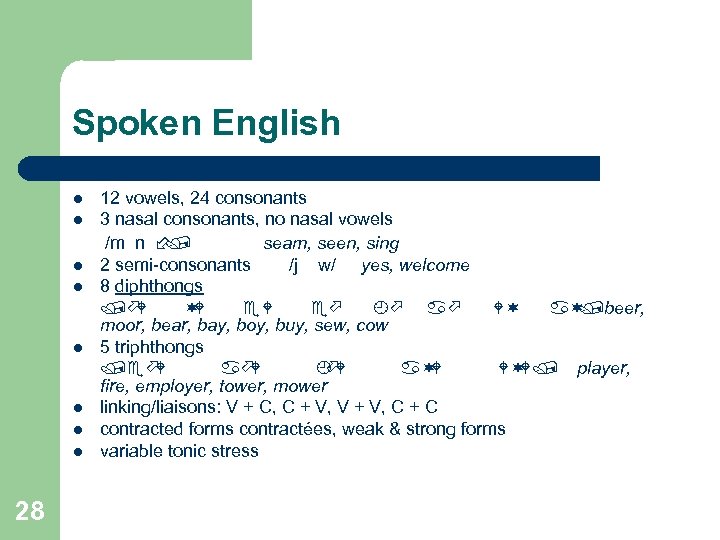 Spoken English l l l l 28 12 vowels, 24 consonants 3 nasal consonants, no nasal vowels /m n ÷ / seam, seen, sing 2 semi-consonants /j w/ yes, welcome 8 diphthongs /ö W ¬ W eö ¿ö aö W¬ a¬ /beer, moor, bear, bay, boy, buy, sew, cow 5 triphthongs /eö W aö W ¿W ö a¬ W W¬ W/ player, fire, employer, tower, mower linking/liaisons: V + C, C + V, V + V, C + C contracted forms contractées, weak & strong forms variable tonic stress
 Summary: spoken French & English 16 Vs, 20 Cs 3 Cs & 4 nasal Vs l l l 3 semi-Cs ¯ diphths, triphths. l 2 semi-Cs 8 diphths. , 5 triphs. l liaisons l contracted forms l formes cntrcts, weak & strong l stable tonic stress l variable tonic stress l l l 29 l 12 Vs, 24 Cs 3 nasal Cs, ¯ nasal Vs
 Spoken English: consonants l Obvious symbols – l /p b l w/ m t d ý s z n h § Ã / Bizarre symbols… – 30 v Less obvious symbols /k j/ l f /¶ ÷ t§ d½ ½
 Spoken English: vowels Three aspects of the description of a vowel – degree of openness (height of the tongue): l l – the position (what part of the tongue is « working » ): l l l – open : /¾ Œ É / cat, car close ( « près » ): /iÉ uÉ / bee, moon semi-close : mi-fermée /ö ¬ / bid, took semi-open : /e W ±É à ¿É / bed, another, bird, bud, board frontal : /iÉ ö e ¾ / seat, sit, set, sat central : /W à ±É / about, shirt back : /uÉ ¬ ¿É ŒÉ / moon, foot, four, pot, part relative length: /iÉ ö / /¬ English vowel chart 31 uÉ /
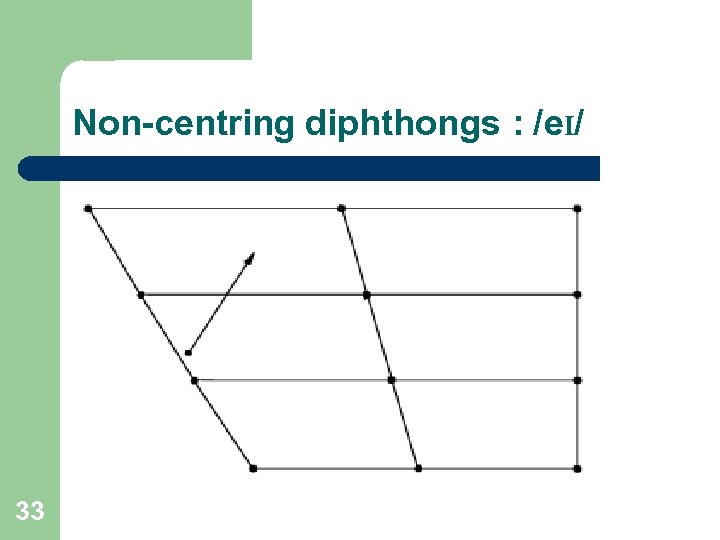
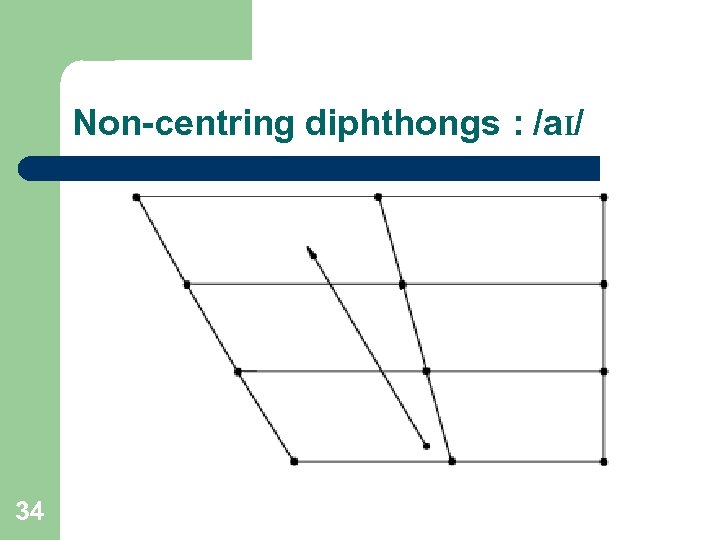
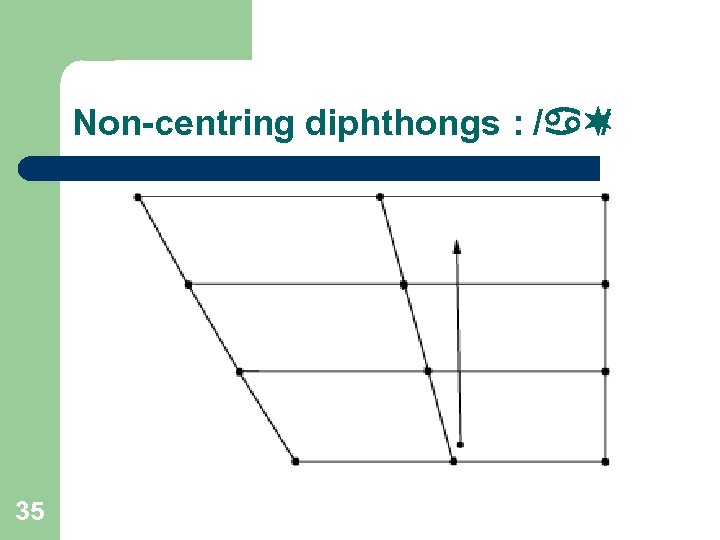
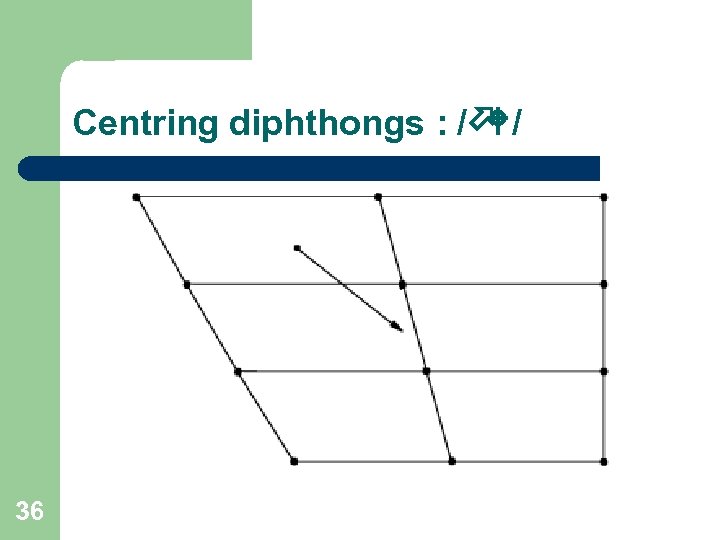
 Spoken English: diphthongs (1/6) l l 8 diphthongs Two types: l l l 32 Non-centring/Closing: pay, eye, boy, down, home Centring: clear, where, tour Element most susceptible to change
 Non-centring diphthongs : /e. I/ 33
 Non-centring diphthongs : /a. I/ 34
 Non-centring diphthongs : /a¬ / 35
 Centring diphthongs : /ö W/ 36
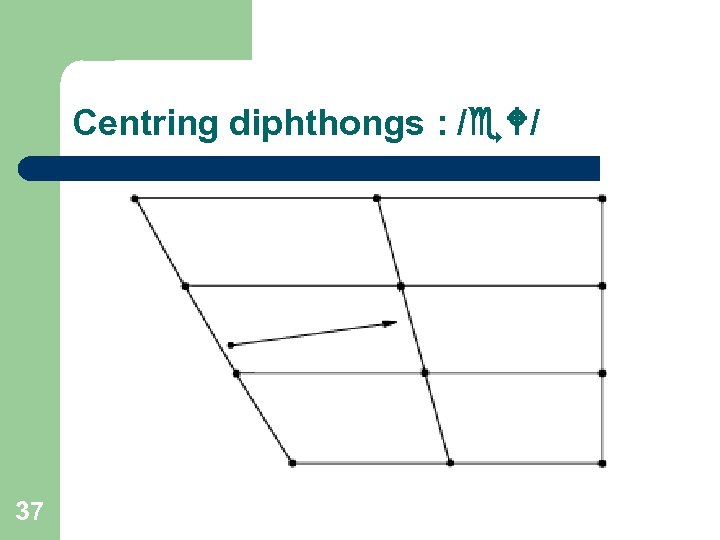 Centring diphthongs : /e. W/ 37
 Spoken English: triphthongs l l 38 Examples Scottish triphthongs
 General Outline: Lecture 1 l l l 39 Introduction, Why & How The IPA: History & Importance Generalities about spoken English & spoken French Conclusion Bibliography
 Bibliography & Useful Sources l l l 40 English Pronouncing Dictionary CD-ROM Wells, J. C. (2004) « Materials for Summer Course in English Phonetics » , University College London Ashby, P. , Speech Sounds, Routledge, 2002 Cruttenden, A. , Gimson’s Pronunciation of English, 6 th ed. , Arnold, 2001 Différents sites Web (see photocopy)