


 Скачать презентацию Université de Savoie UFR-LLSH LCE 1 UE 103
d6998b6ba80a304bfe2f59775d71dc6f.ppt
- Количество слайдов: 69
 Université de Savoie UFR-LLSH LCE 1 UE 103 Lecture: Phonetics & Phonology Alice Henderson ahend@univ-savoie. fr Office 812 1
 Content of the 5 lectures 1) Introduction, Phonemes 2) Sounds in context, connected speech 3) Stress, accent & rhythm 4) Intonation 5) Conclusion 2
 Outline, Lecture 4 l l l l l 3 Go over homework from Previous Lecture Why rhythm, stress, intonation? Stress, accent, pitch, tune Sentence emphasis & focus Chunking & pausing Intonation: Definition & basic tunes Functions Conclusion Bibliography
 Homework from Previous Lecture l l l 4 Coalescence Short review of basic word stress rules Stress in two-word verbs
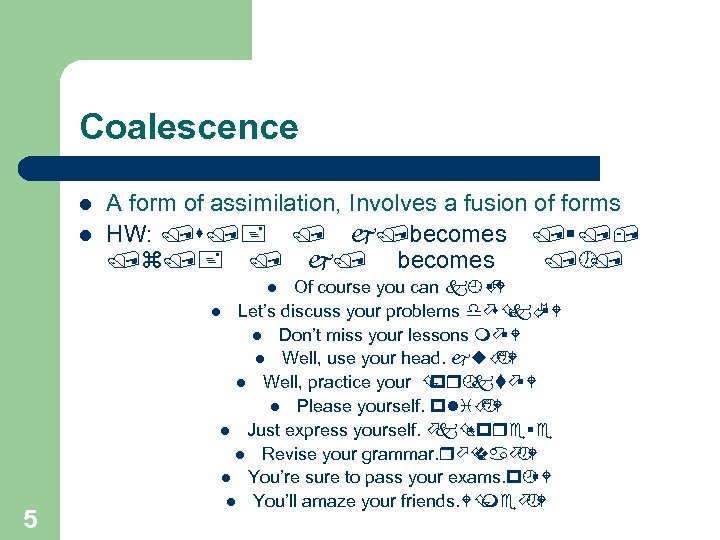 Coalescence l l A form of assimilation, Involves a fusion of forms HW: /s/+ / j/becomes /§/, /z/+ / j/ becomes /½ / Of course you can k¿É §W l Let’s discuss your problems dö kà sÇ §W l Don’t miss your lessons mö §W l Well, use your head. juÉW ½ l Well, practice your Ç pr¾ ktö §W l Please yourself. pliÉW ½ l Just express yourself. ö kÇ spre§e l Revise your grammar. röÇ vaö W ½ l You’re sure to pass your exams. p¾ §W l You’ll amaze your friends. WÇ meö W ½ l 5
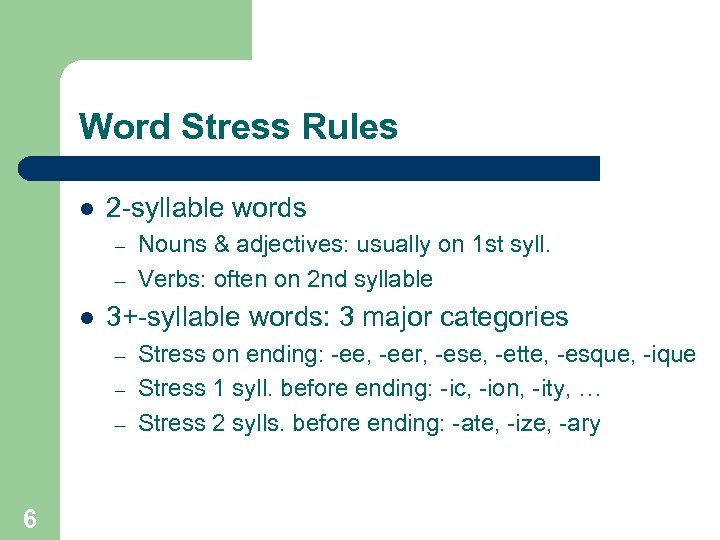 Word Stress Rules l 2 -syllable words – – l 3+-syllable words: 3 major categories – – – 6 Nouns & adjectives: usually on 1 st syll. Verbs: often on 2 nd syllable Stress on ending: -ee, -eer, -ese, -ette, -esque, -ique Stress 1 syll. before ending: -ic, -ion, -ity, … Stress 2 sylls. before ending: -ate, -ize, -ary
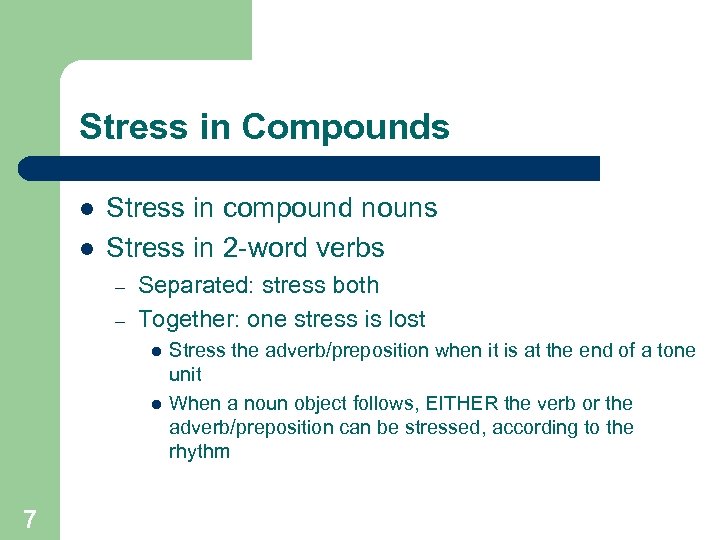 Stress in Compounds l l Stress in compound nouns Stress in 2 -word verbs – – Separated: stress both Together: one stress is lost l l 7 Stress the adverb/preposition when it is at the end of a tone unit When a noun object follows, EITHER the verb or the adverb/preposition can be stressed, according to the rhythm
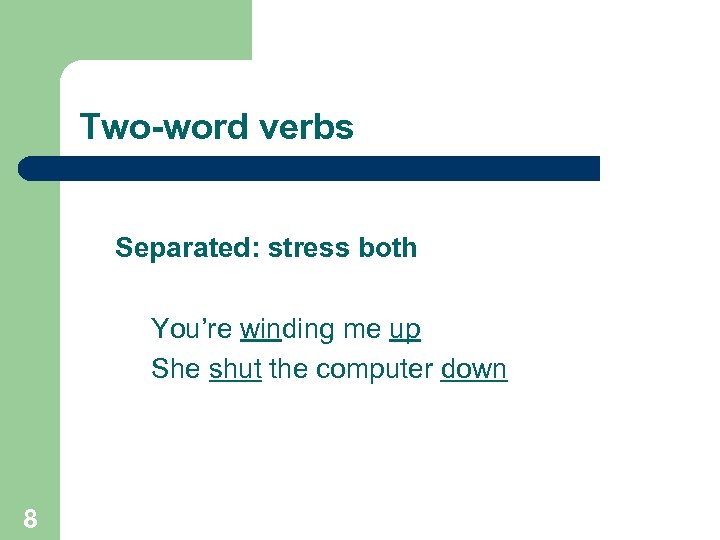 Two-word verbs Separated: stress both You’re winding me up She shut the computer down 8
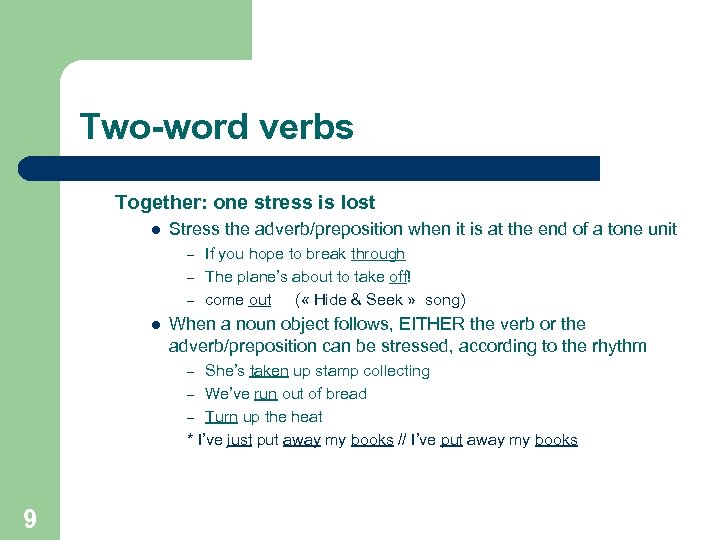 Two-word verbs Together: one stress is lost l Stress the adverb/preposition when it is at the end of a tone unit If you hope to break through – The plane’s about to take off! – come out ( « Hide & Seek » song) – l When a noun object follows, EITHER the verb or the adverb/preposition can be stressed, according to the rhythm She’s taken up stamp collecting – We’ve run out of bread – Turn up the heat * I’ve just put away my books // I’ve put away my books – 9
 Outline, Lecture 4 l l l l l 10 Go over homework from Pevious Lecture Why rhythm, stress, intonation? Stress, accent, pitch, tune Sentence emphasis & focus Chunking & pausing Intonation: Definition & basic tunes Functions Conclusion Bibliography
 Why? l l l Fun? Teachable? Useful? – – 11 For interacting with native speakers For interacting with non-native speakers
 How phenomena are related l l 12 Stressed syllables are key to the rhythm of English Stressed syllables are often where intonation starts to change (e. g. up or down) Intonation signals different types of meaning on different levels (grammatical, attitudinal, etc. ) Therefore, stress is KEY
 What language acquisition research shows l l 13 Each lexical item we know « exists » as an « entry » in our mental lexicon Each entry has encoded information about the lexical item, including the stress pattern When listening, a person must be able to retrieve that entry to understand the message Therefore, if they do not have the correct entry (incl. word stress) retrieval will be affected …
 Implications? l l 14 deviation from normal English stress patterns can cause difficulty in the correct parsing of a message (Setter, 9) « word stress patterns are an integral part of the phonological representations of words in the mental lexicon » (Cutler, 1984, in Setter, 9)
 This influences communication … l l l 15 Between native speakers Between non-native speakers Between NS and NNS
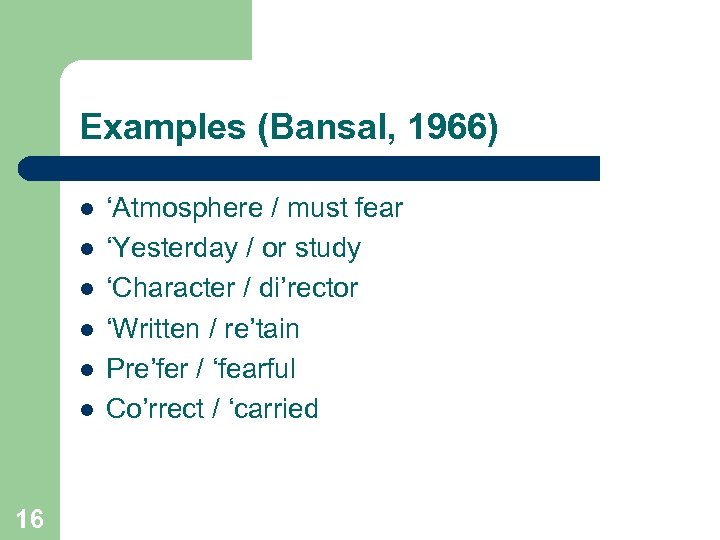 Examples (Bansal, 1966) l l l 16 ‘Atmosphere / must fear ‘Yesterday / or study ‘Character / di’rector ‘Written / re’tain Pre’fer / ‘fearful Co’rrect / ‘carried
 Importance of prosody l l Prosody = how pitch, loudness, length produce accent, rhythm and intonation (Gimson, 6) « prosody is the most critical feature in English pronunciation » (Anderson-Hsieh et al. 1994) (in Setter, 9) l 17 evidence that prosodic features are key to intelligibility of a NNS pronunciation (Magen, 1998) (in Setter, 9)
 Implications? l l 18 Given the nature of English Given the nature of language acquisition Given the nature of sound perception Teachers and learners of English should focus on the importance of stress in order to avoid misunderstandings
 Example of rhymes « provide a convenient framework for the perception and the production of a number of characteristic features of English pronunciation which are often found to be problematic for learners: stress/unstress (and therefore the basis for intonation), vowel length, vowel reduction, elision, compression, pause (between adjacent stresses) » . (Marks, 1999, 198) 19
 Full circle … l l l 20 stress/unstress (and therefore the basis for intonation) vowel length= distinction between live/leave, blue/book vowel reduction= to schwa in unstressed syllables elision= losing /t/ and /d/ compression= hour/ « ah » pause (between adjacent stresses)= the factor of rhythm
 Outline, Lecture 4 l l l l l 21 Go over homework from Previous Lecture Why rhythm, stress, intonation? Stress, accent, pitch, tune Sentence emphasis & focus Chunking & pausing Intonation: Definition & basic tunes Functions Conclusion Bibliography
 Stress & Pitch l Stress in English: a syllable is – – – 22 Longer Louder On a higher pitch
 Stress & Accent l l 23 Stress is not the same as accent Accent marks the beginning of a change in tune
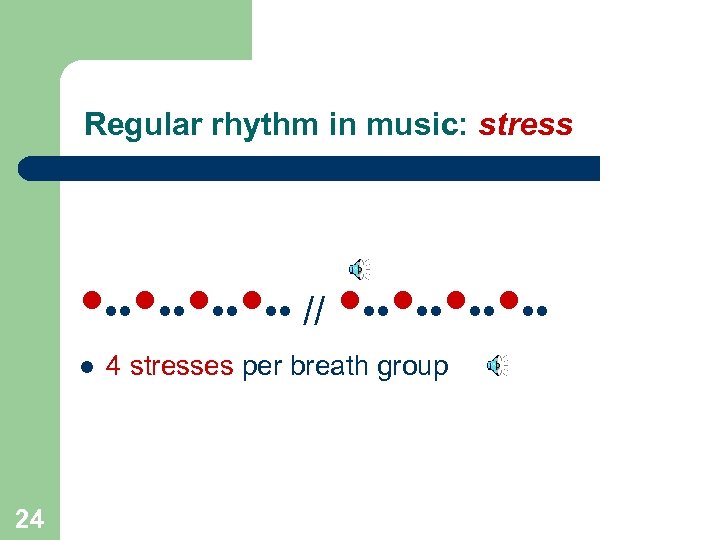 Regular rhythm in music: stress • • • // • • • l 24 4 stresses per breath group
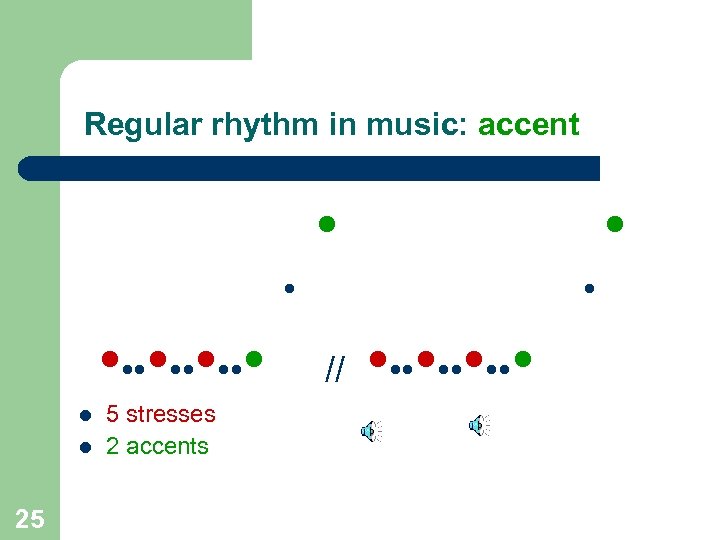 Regular rhythm in music: accent • • • • // • • • • • l l 25 5 stresses 2 accents • •
 Accent, Tune & Pitch l 26 A change in tune involves a change in pitch
 Outline, Lecture 4 l l l l l 27 Go over homework from Previous Lecture Why rhythm, stress, intonation? Stress, accent, pitch, tune Sentence emphasis & focus Chunking & pausing Intonation: Definition & basic tunes Functions Conclusion Bibliography
 Sentence emphasis … l l 28 Stress content words: nouns, main verbs, negative auxiliaries, adverbs, adjectives Use weak forms for structure words: pronouns, prepositions, articles, ‘to be’ verbs, conjunctions, auxiliary verbs
 Tune & sentence emphasis l l 29 Tune change starts on one of the last content words …. usually. Speakers can choose which information to highlight by choosing where to start changing the tune
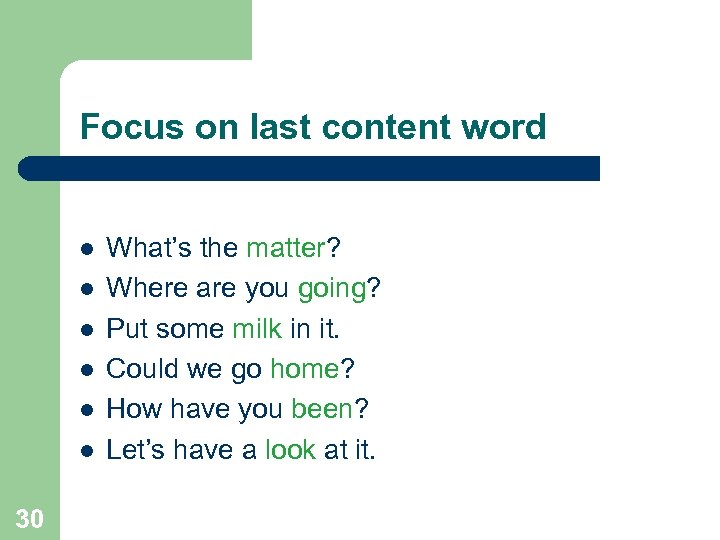 Focus on last content word l l l 30 What’s the matter? Where are you going? Put some milk in it. Could we go home? How have you been? Let’s have a look at it.
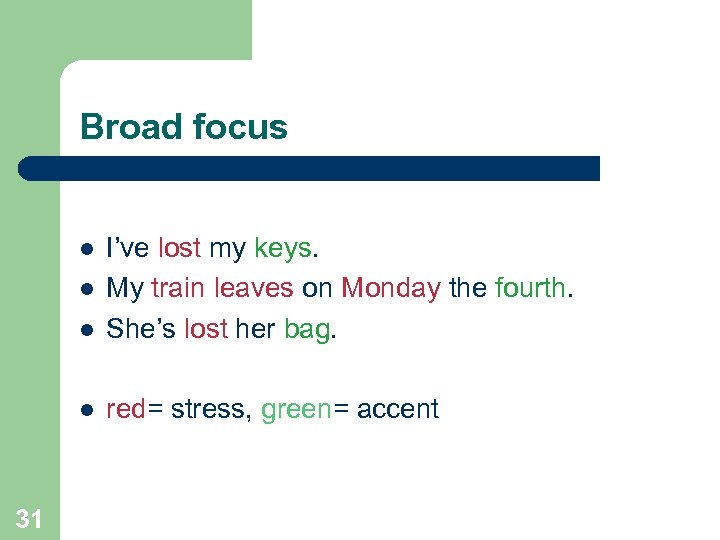 Broad focus l I’ve lost my keys. My train leaves on Monday the fourth. She’s lost her bag. l red= stress, green= accent l l 31
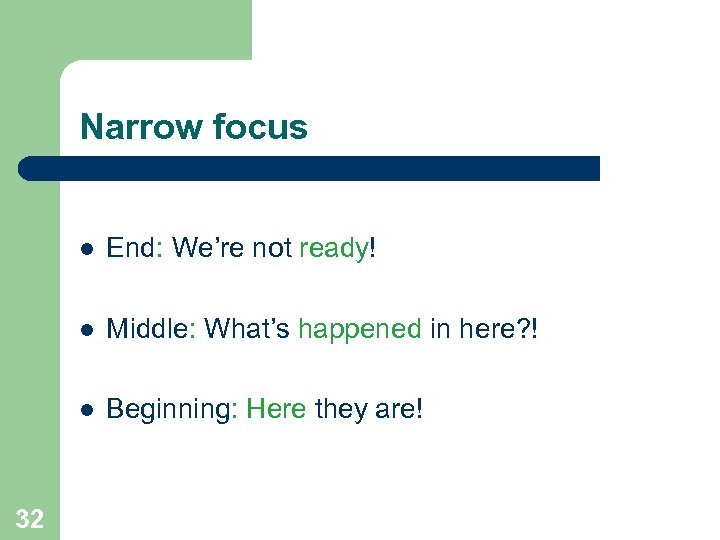 Narrow focus l l Middle: What’s happened in here? ! l 32 End: We’re not ready! Beginning: Here they are!
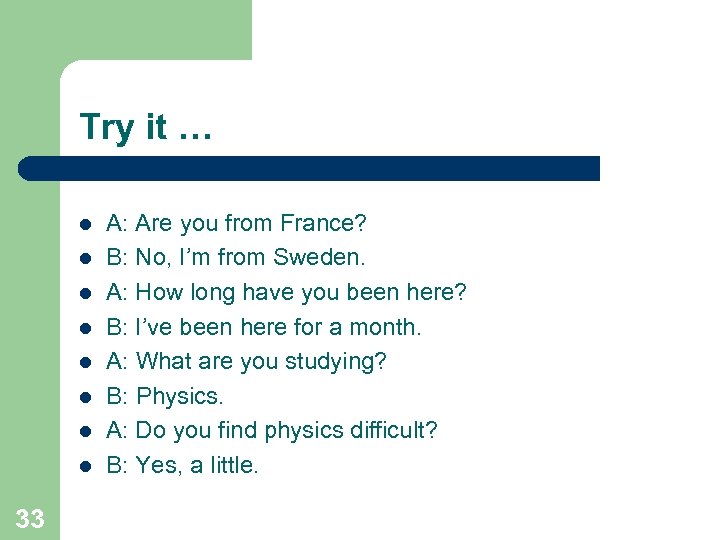 Try it … l l l l 33 A: Are you from France? B: No, I’m from Sweden. A: How long have you been here? B: I’ve been here for a month. A: What are you studying? B: Physics. A: Do you find physics difficult? B: Yes, a little.
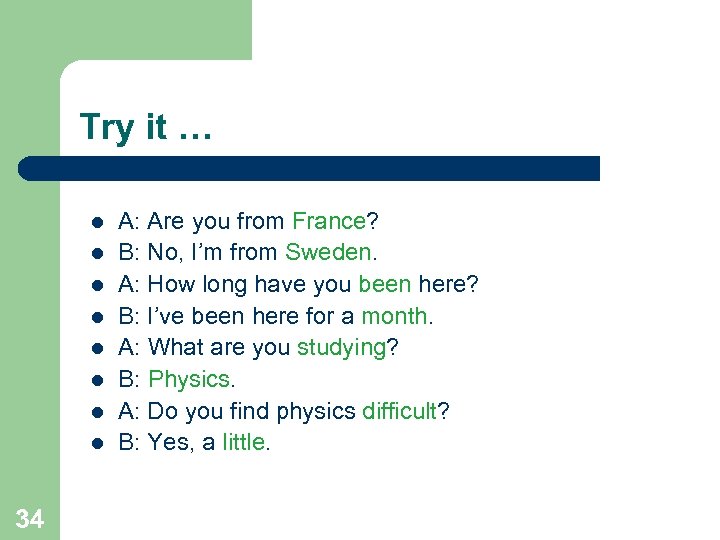 Try it … l l l l 34 A: Are you from France? B: No, I’m from Sweden. A: How long have you been here? B: I’ve been here for a month. A: What are you studying? B: Physics. A: Do you find physics difficult? B: Yes, a little.
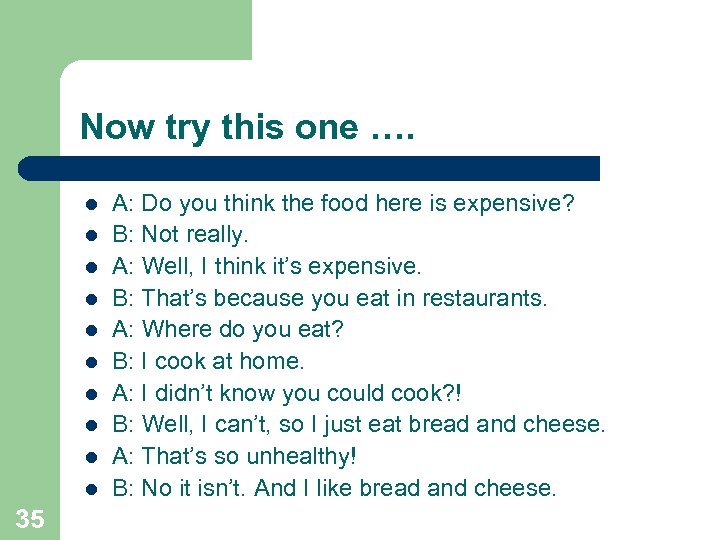 Now try this one …. l l l l l 35 A: Do you think the food here is expensive? B: Not really. A: Well, I think it’s expensive. B: That’s because you eat in restaurants. A: Where do you eat? B: I cook at home. A: I didn’t know you could cook? ! B: Well, I can’t, so I just eat bread and cheese. A: That’s so unhealthy! B: No it isn’t. And I like bread and cheese.
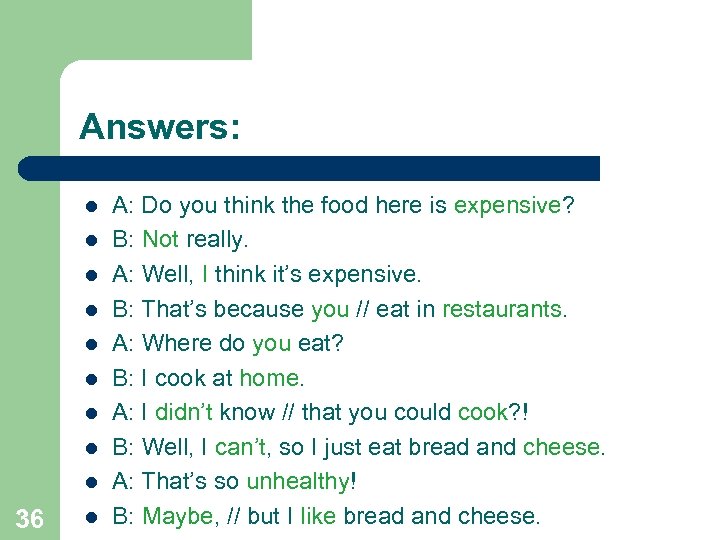 Answers: l l l l l 36 l A: Do you think the food here is expensive? B: Not really. A: Well, I think it’s expensive. B: That’s because you // eat in restaurants. A: Where do you eat? B: I cook at home. A: I didn’t know // that you could cook? ! B: Well, I can’t, so I just eat bread and cheese. A: That’s so unhealthy! B: Maybe, // but I like bread and cheese.
 The Nucleus l l 37 Syllable where the tune begins to change (rise, fall) Look at the « green » words (accent)
 Exercises from the Web l Web Tutorials at University College of London – 38 Focus
 Outline, Lecture 4 l l l l l 39 Go over homework from Previous Lecture Why rhythm, stress, intonation? Stress, accent, pitch, tune Sentence emphasis & focus Chunking & pausing Intonation: Definition & basic tunes Functions Conclusion Bibliography
 Chunking & Pausing l l l 40 The power of silence …. Signals « chunks » of meaning Chunks = thought groups, meaning units Chunks= words which go together to express one idea or thought Pause + falling tune = end of a thought group in English
 Where do we pause? l l l 41 Before conjunctions & prepositions Before relative clauses Between grammatical units (subject, predicate) At punctuation UCL Web tutorials: Chunking
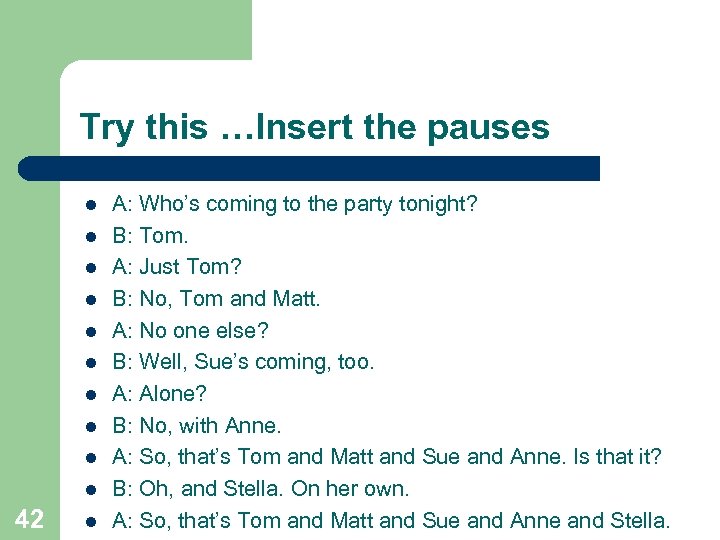 Try this …Insert the pauses l l l l l 42 l A: Who’s coming to the party tonight? B: Tom. A: Just Tom? B: No, Tom and Matt. A: No one else? B: Well, Sue’s coming, too. A: Alone? B: No, with Anne. A: So, that’s Tom and Matt and Sue and Anne. Is that it? B: Oh, and Stella. On her own. A: So, that’s Tom and Matt and Sue and Anne and Stella.
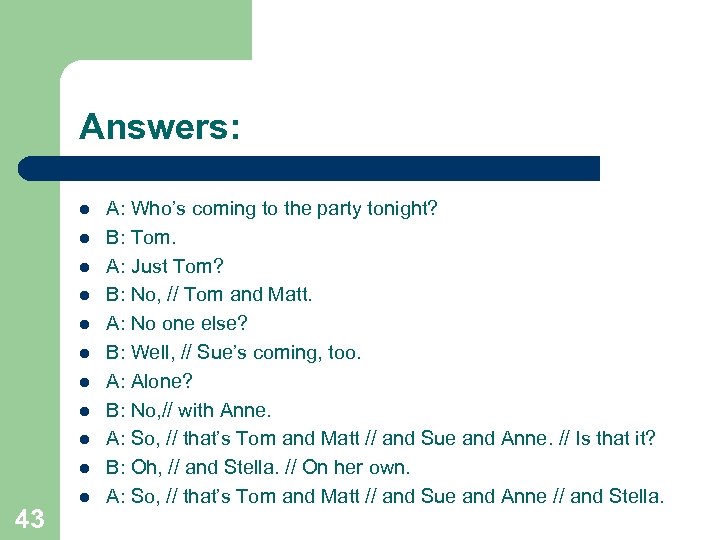 Answers: l l l l l 43 l A: Who’s coming to the party tonight? B: Tom. A: Just Tom? B: No, // Tom and Matt. A: No one else? B: Well, // Sue’s coming, too. A: Alone? B: No, // with Anne. A: So, // that’s Tom and Matt // and Sue and Anne. // Is that it? B: Oh, // and Stella. // On her own. A: So, // that’s Tom and Matt // and Sue and Anne // and Stella.
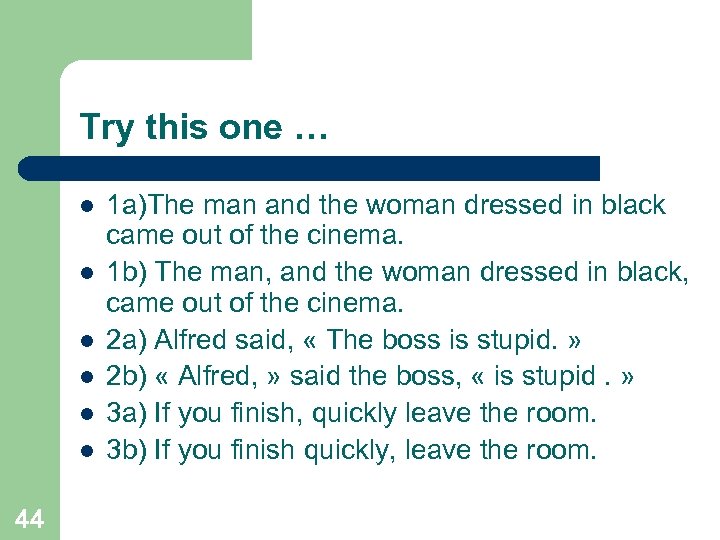 Try this one … l l l 44 1 a)The man and the woman dressed in black came out of the cinema. 1 b) The man, and the woman dressed in black, came out of the cinema. 2 a) Alfred said, « The boss is stupid. » 2 b) « Alfred, » said the boss, « is stupid. » 3 a) If you finish, quickly leave the room. 3 b) If you finish quickly, leave the room.
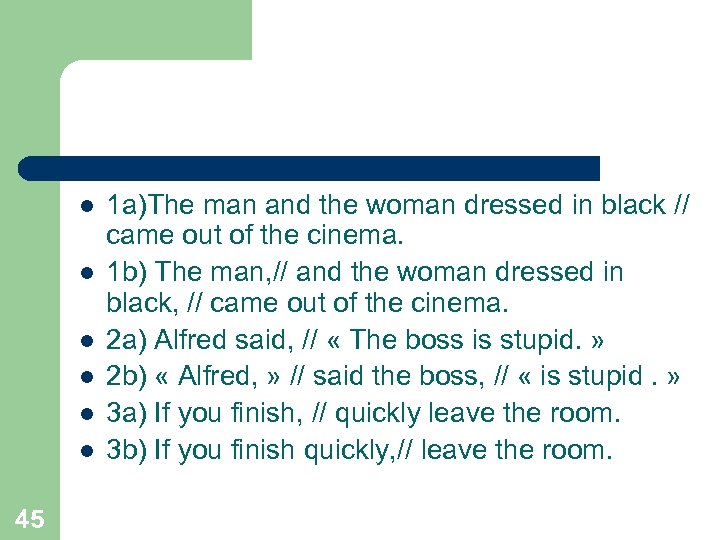 l l l 45 1 a)The man and the woman dressed in black // came out of the cinema. 1 b) The man, // and the woman dressed in black, // came out of the cinema. 2 a) Alfred said, // « The boss is stupid. » 2 b) « Alfred, » // said the boss, // « is stupid. » 3 a) If you finish, // quickly leave the room. 3 b) If you finish quickly, // leave the room.
 Outline, Lecture 4 l l l l l 46 Go over homework from Previous Lecture Why rhythm, stress, intonation? Stress, accent, pitch, tune Sentence emphasis & focus Chunking & pausing Intonation: Definition & basic tunes Functions Conclusion Bibliography
 What is it? Why do we use it? l l 47 Rise & fall in pitch To express a range of meanings, emotions or situations To add more meaning despite English’s fixed word order Punctuation pauses & pitch change
 Expressing emotional range and contextual « importance » l l l 48 French and other Romance languages: stress the end of a sentence, and then use word order to indicate an important change. Other languages, such as Chinese (Cantonese), have a pitch change that indicates different vocabulary words, and then superimpose further pitch change to change meaning or emotion.
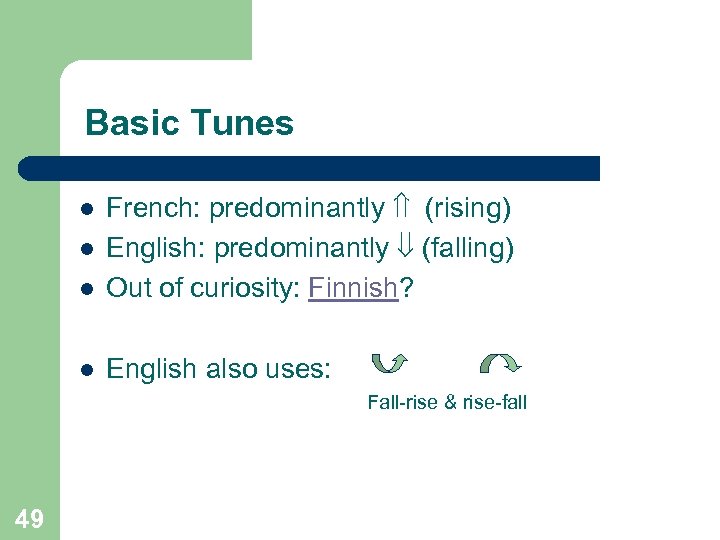 Basic Tunes l French: predominantly (rising) English: predominantly (falling) Out of curiosity: Finnish? l English also uses: l l Fall-rise & rise-fall 49
 Tunes on a single syllable l l l 50 Yes, No Speaker’s choice: vary pitch or not How many different ways can you say them? How many different meanings can you communciate?
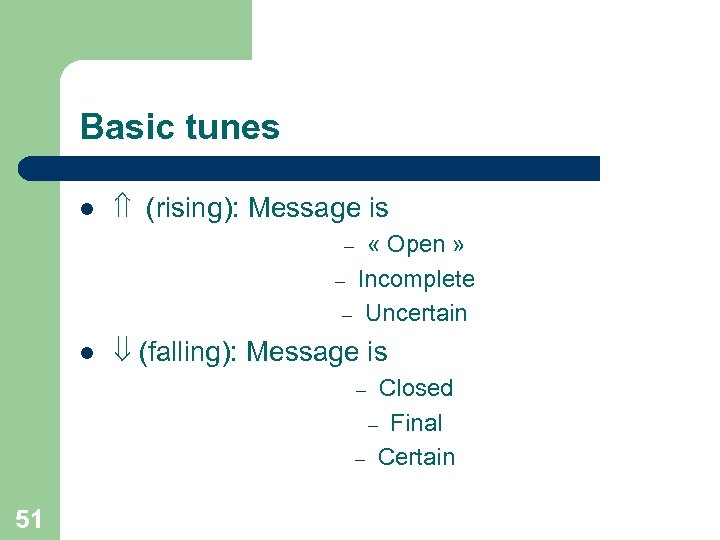 Basic tunes l (rising): Message is « Open » – Incomplete – Uncertain – l (falling): Message is Closed – Final – Certain – 51
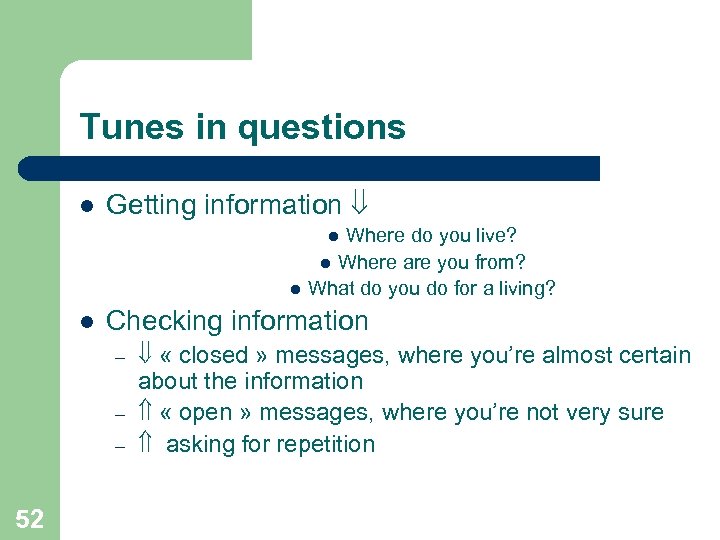 Tunes in questions l Getting information Where do you live? l Where are you from? What do you do for a living? l l l Checking information – – – 52 « closed » messages, where you’re almost certain about the information « open » messages, where you’re not very sure asking for repetition
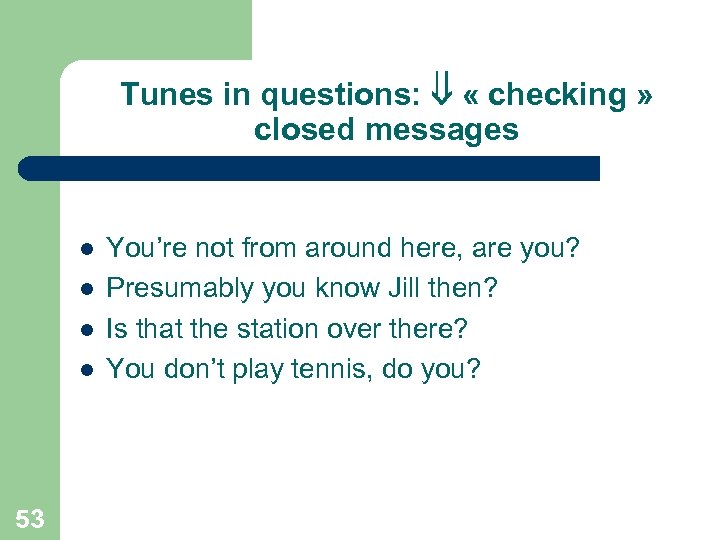 Tunes in questions: « checking » closed messages l l 53 You’re not from around here, are you? Presumably you know Jill then? Is that the station over there? You don’t play tennis, do you?
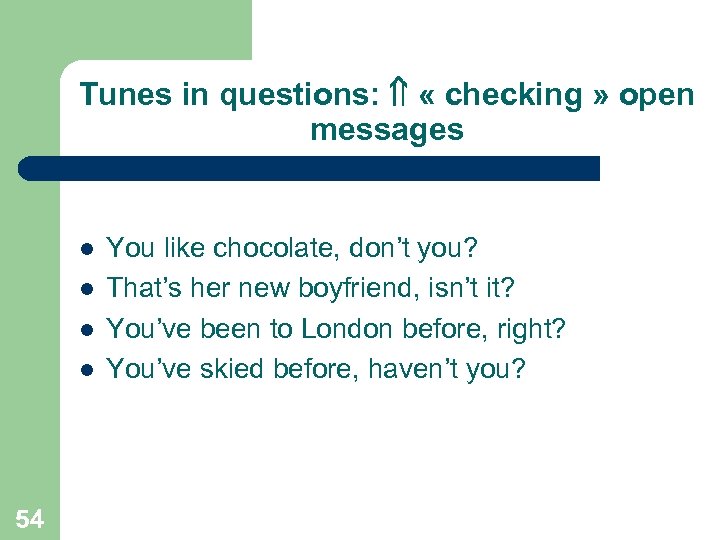 Tunes in questions: « checking » open messages l l 54 You like chocolate, don’t you? That’s her new boyfriend, isn’t it? You’ve been to London before, right? You’ve skied before, haven’t you?
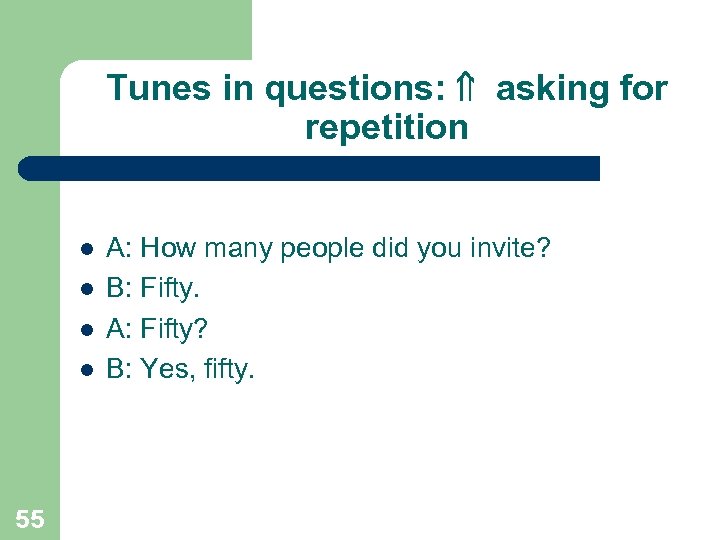 Tunes in questions: asking for repetition l l 55 A: How many people did you invite? B: Fifty. A: Fifty? B: Yes, fifty.
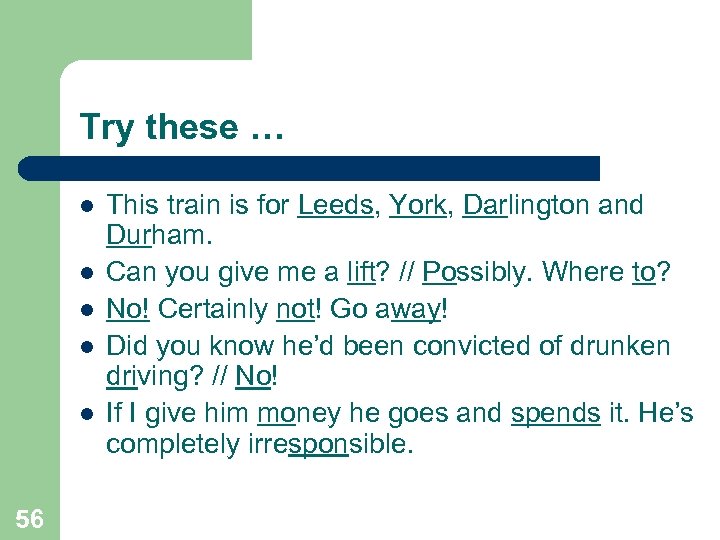 Try these … l l l 56 This train is for Leeds, York, Darlington and Durham. Can you give me a lift? // Possibly. Where to? No! Certainly not! Go away! Did you know he’d been convicted of drunken driving? // No! If I give him money he goes and spends it. He’s completely irresponsible.
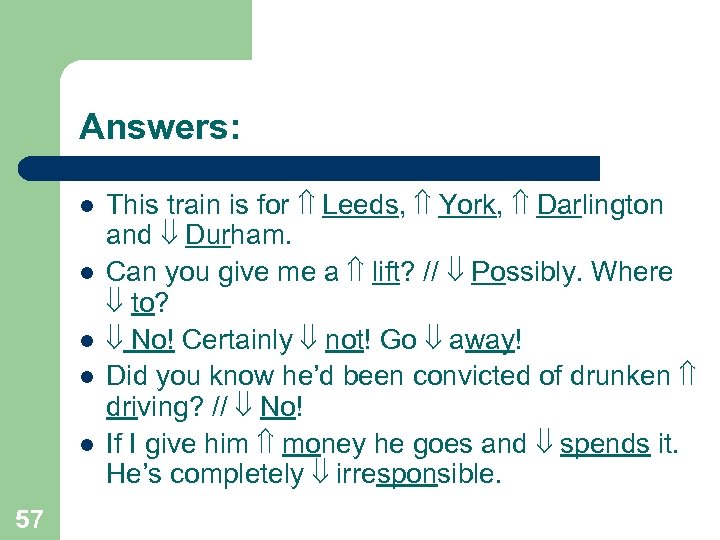 Answers: l l l 57 This train is for Leeds, York, Darlington and Durham. Can you give me a lift? // Possibly. Where to? No! Certainly not! Go away! Did you know he’d been convicted of drunken driving? // No! If I give him money he goes and spends it. He’s completely irresponsible.
 Outline, Lecture 4 l l l l l 58 Go over homework from Previous Lecture Why rhythm, stress, intonation? Stress, accent, pitch, tune Sentence emphasis & focus Chunking & pausing Intonation: Definition & basic tunes Functions Conclusion Bibliography
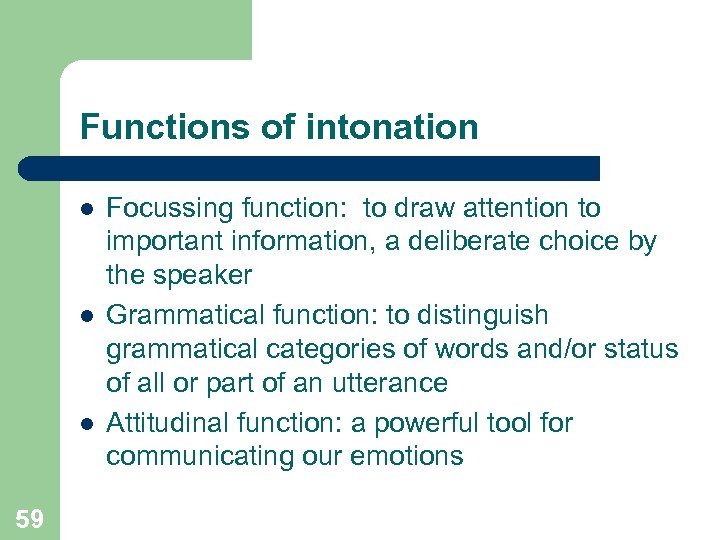 Functions of intonation l l l 59 Focussing function: to draw attention to important information, a deliberate choice by the speaker Grammatical function: to distinguish grammatical categories of words and/or status of all or part of an utterance Attitudinal function: a powerful tool for communicating our emotions
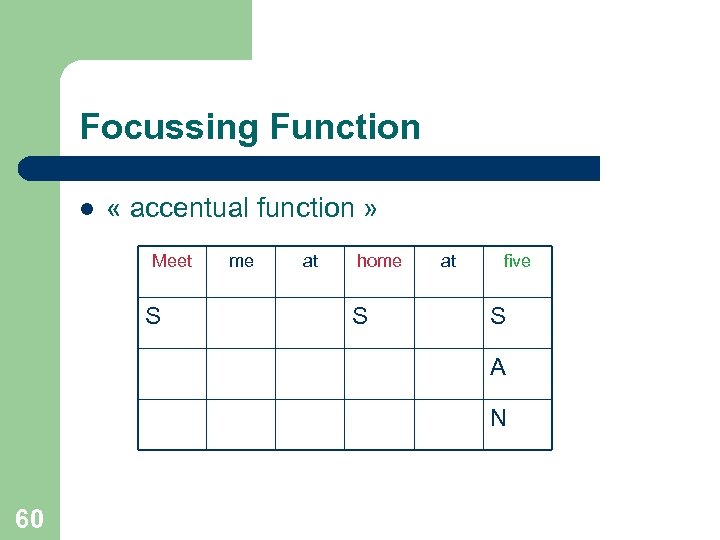 Focussing Function l « accentual function » Meet S me at home S at five S A N 60
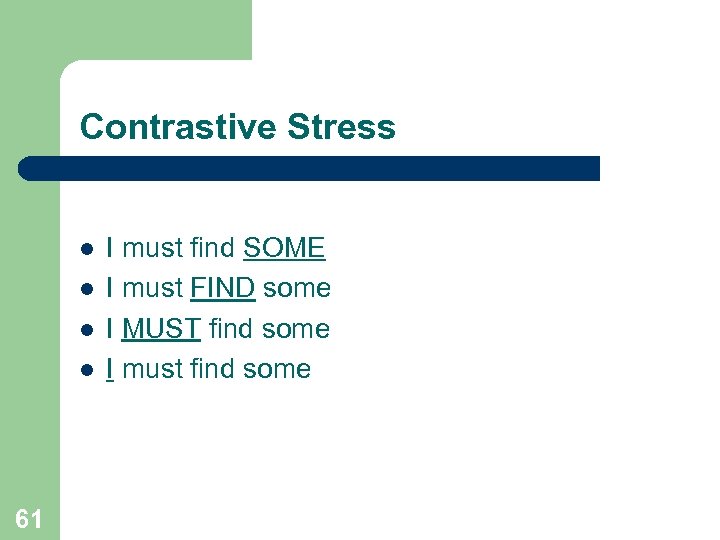 Contrastive Stress l l 61 I must find SOME I must FIND some I MUST find some I must find some
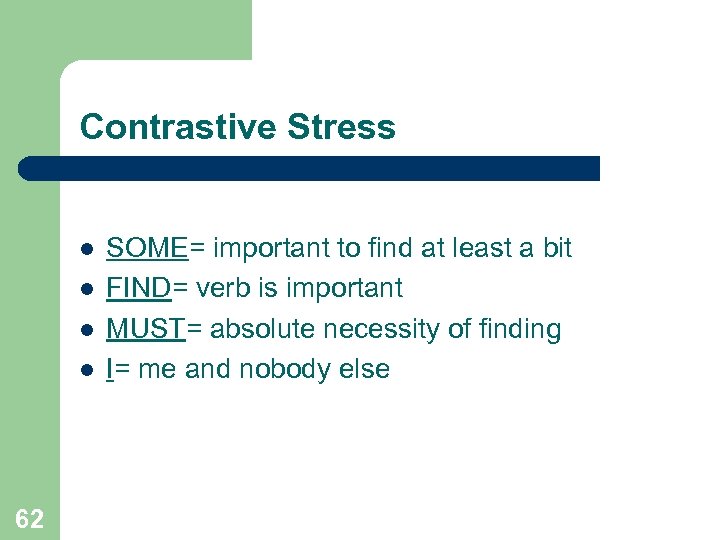 Contrastive Stress l l 62 SOME= important to find at least a bit FIND= verb is important MUST= absolute necessity of finding I= me and nobody else
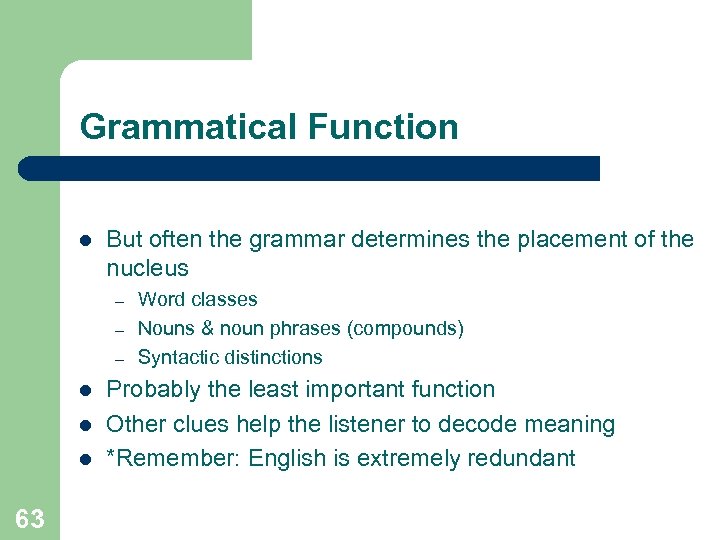 Grammatical Function l But often the grammar determines the placement of the nucleus – – – l l l 63 Word classes Nouns & noun phrases (compounds) Syntactic distinctions Probably the least important function Other clues help the listener to decode meaning *Remember: English is extremely redundant
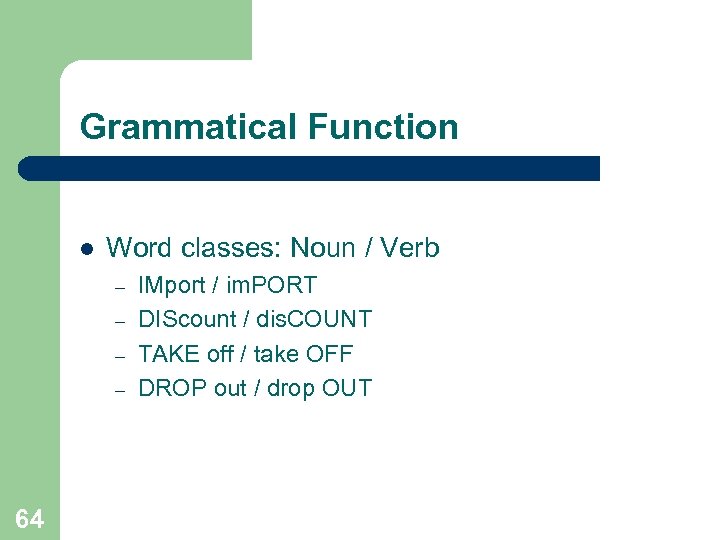 Grammatical Function l Word classes: Noun / Verb – – 64 IMport / im. PORT DIScount / dis. COUNT TAKE off / take OFF DROP out / drop OUT
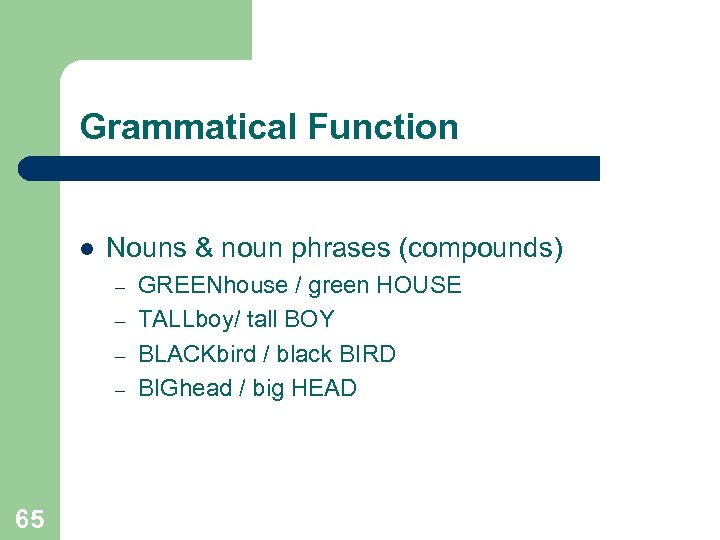 Grammatical Function l Nouns & noun phrases (compounds) – – 65 GREENhouse / green HOUSE TALLboy/ tall BOY BLACKbird / black BIRD BIGhead / big HEAD
 Grammatical Function l l l 66 Defining & non-defining relative clauses Adverbials Vocatives & apositives
 Attitudinal Function l Neutral vs offensive/nasty/grumpy – – l Positive vs negative – – l 67 This is my book / no it’s not, it’s mine Surprise – l Shall we have dinner together then? Yes, fine Oh what a lovely gift Polite vs impolite – l Would you like some help? No, thank you How many times do I have to tell you I hear they’ve had triplets Implication (extra meaning to words) – What do you think of her partner? / Great
 Conclusion l l 68 Stress, accent, pitch, tune Sentence emphasis, focus Chunking & pausing: where, why Basic tunes of English & their functions
 Bibliography l l l l 69 Cruttenden, (ed. ), (2001), Gimson’s Pronunciation of English, 6 th edition, Arnold, London. Marks, J. , (1999), « Is stress-timing real? » , ELT Journal, 53, 3, pp 191 -99. Roach, (1991), English Phonetics & Phonology, Cambridge University Press. Rogerson & Gilbert, (1990), Speaking Clearly, Cambridge University Press. Setter, J. and J. Jenkins, (2005), « State of the art review article: Pronunciation » , Language Teaching Journal, N° 38, pp 1 -17. « Summer Course in English Phonetics » , University College London, Summer 2004. Wells, J. C. , (2004), « Where does the nucles go? » , UCL.