


 Скачать презентацию Universität Dortmund technische universität dortmund Fakultät für Mathematik
0147dfa916c19604c40ef9007ed37d0a.ppt
- Количество слайдов: 17
 Universität Dortmund technische universität dortmund Fakultät für Mathematik IAM A numerical set-up for benchmarking and optimization of fluid-structure interaction Stefan Turek, Mudassar Razzaq and Jaroslav Hron TU Dortmund, Germany with support by M. Schäfer, M. Heck, M. Krafczyk, J. Tölke, S. Geller, H. -J. Bungartz, M. Brenk, R. Rannacher, T. Dunne, W. Wall, A. Gerstenberger, E. Rank, A. Düster, S. Kollmannsberger, K. -U. Bletzinger, R. Wüchner, A. Kupzok, T. Gallinger, U. Israel Open Industrial Day Jyväskylä, Finland March 16, 2009 Integrated Multiphysics Simulations & Design optimization
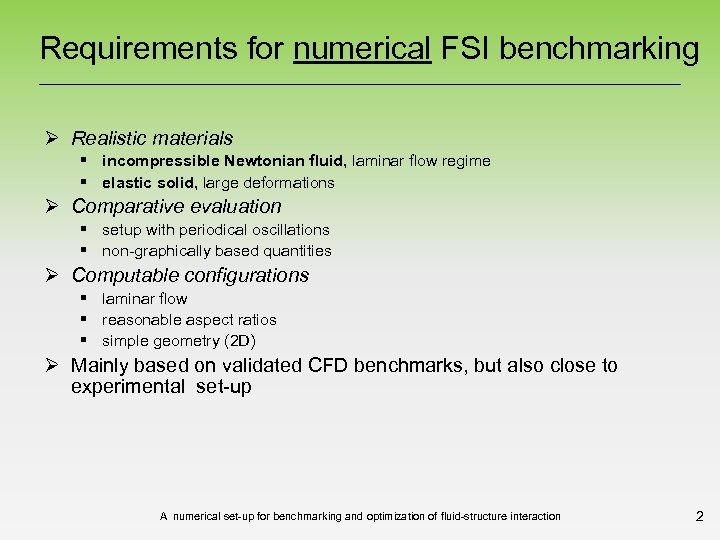 Requirements for numerical FSI benchmarking Ø Realistic materials § incompressible Newtonian fluid, laminar flow regime § elastic solid, large deformations Ø Comparative evaluation § setup with periodical oscillations § non-graphically based quantities Ø Computable configurations § laminar flow § reasonable aspect ratios § simple geometry (2 D) Ø Mainly based on validated CFD benchmarks, but also close to experimental set-up A numerical set-up for benchmarking and optimization of fluid-structure interaction 2
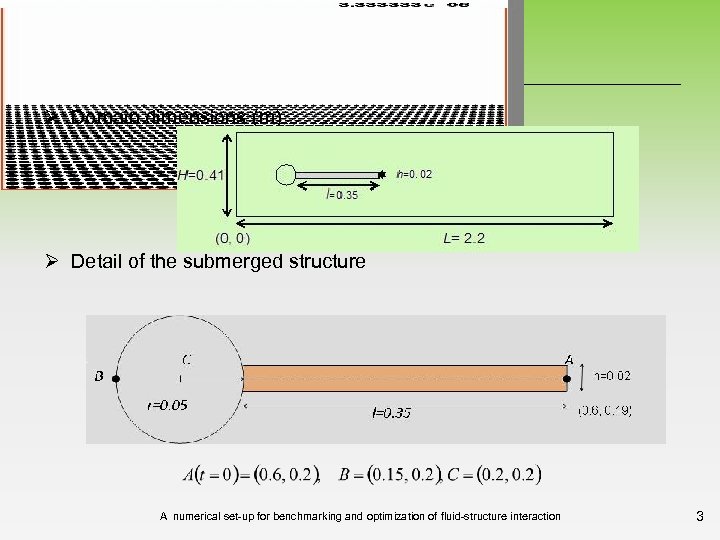 Computational domain Ø Domain dimensions (m) Ø Detail of the submerged structure A numerical set-up for benchmarking and optimization of fluid-structure interaction 3
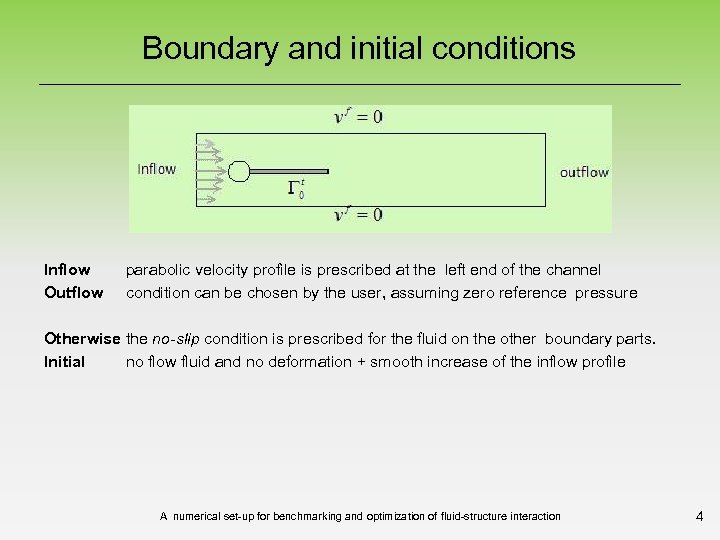 Boundary and initial conditions Inflow Outflow parabolic velocity profile is prescribed at the left end of the channel condition can be chosen by the user, assuming zero reference pressure Otherwise the no-slip condition is prescribed for the fluid on the other boundary parts. Initial no flow fluid and no deformation + smooth increase of the inflow profile A numerical set-up for benchmarking and optimization of fluid-structure interaction 4
 Fluid and structure properties Ø Incompressible fluid with density Ø Elastic material with density, material : St. Venant -- Kirchhoff A numerical set-up for benchmarking and optimization of fluid-structure interaction 5
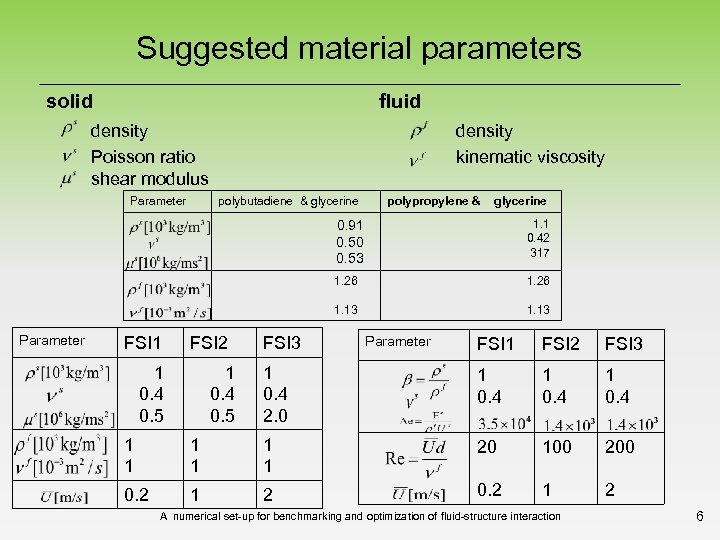 Suggested material parameters solid fluid density Poisson ratio shear modulus Parameter density kinematic viscosity polybutadiene & glycerine polypropylene & glycerine 0. 91 0. 50 0. 53 1. 26 FSI 1 FSI 2 1 0. 4 0. 5 FSI 3 1. 26 1. 13 Parameter 1. 1 0. 42 317 1. 13 Parameter FSI 1 FSI 2 FSI 3 1 0. 4 2. 0 1 0. 4 1 1 1 20 100 200 0. 2 1 2 A numerical set-up for benchmarking and optimization of fluid-structure interaction 6
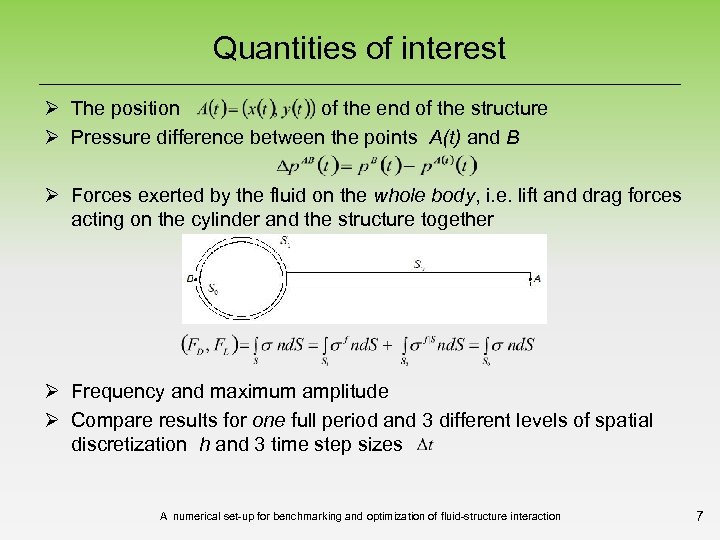 Quantities of interest Ø The position of the end of the structure Ø Pressure difference between the points A(t) and B Ø Forces exerted by the fluid on the whole body, i. e. lift and drag forces acting on the cylinder and the structure together Ø Frequency and maximum amplitude Ø Compare results for one full period and 3 different levels of spatial discretization h and 3 time step sizes A numerical set-up for benchmarking and optimization of fluid-structure interaction 7
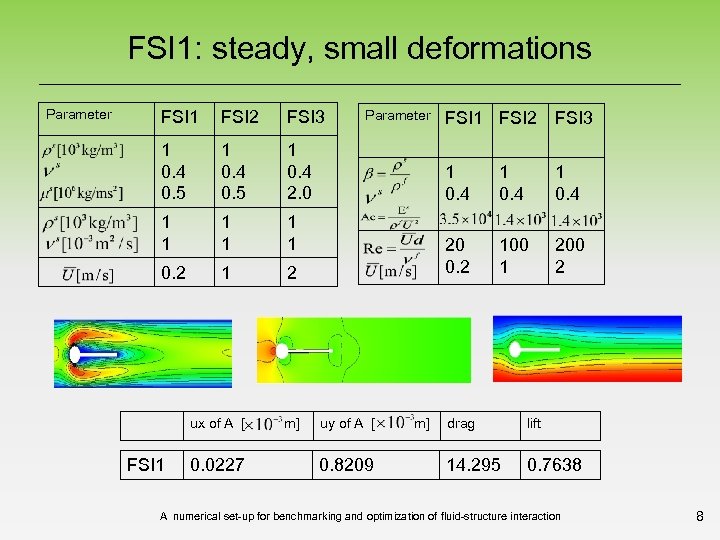 FSI 1: steady, small deformations Parameter FSI 1 FSI 2 FSI 3 1 0. 4 0. 5 1 0. 4 2. 0 1 1 1 0. 2 1 2 ux of A [ FSI 1 0. 0227 m] Parameter 0. 8209 1 0. 4 20 0. 2 m] FSI 3 1 0. 4 uy of A [ FSI 1 FSI 2 100 1 200 2 drag lift 14. 295 0. 7638 A numerical set-up for benchmarking and optimization of fluid-structure interaction 8
![FSI 2: large deformations, periodical oscillations Test ux of A [ m] uy of](https://present5.com/presentation/0147dfa916c19604c40ef9007ed37d0a/image-9.jpg "FSI 2: large deformations, periodical oscillations Test ux of A [ m] uy of") FSI 2: large deformations, periodical oscillations Test ux of A [ m] uy of A [ m] drag lift FSI 2 A numerical set-up for benchmarking and optimization of fluid-structure interaction 9
FSI 2: large deformations, periodical oscillations Test ux of A [ m] uy of A [ m] drag lift FSI 2 A numerical set-up for benchmarking and optimization of fluid-structure interaction 9
![FSI 3: large deformations, complex oscillations Test ux of A [ m] drag lift](https://present5.com/presentation/0147dfa916c19604c40ef9007ed37d0a/image-10.jpg "FSI 3: large deformations, complex oscillations Test ux of A [ m] drag lift") FSI 3: large deformations, complex oscillations Test ux of A [ m] drag lift FSI 3 A numerical set-up for benchmarking and optimization of fluid-structure interaction 10
FSI 3: large deformations, complex oscillations Test ux of A [ m] drag lift FSI 3 A numerical set-up for benchmarking and optimization of fluid-structure interaction 10
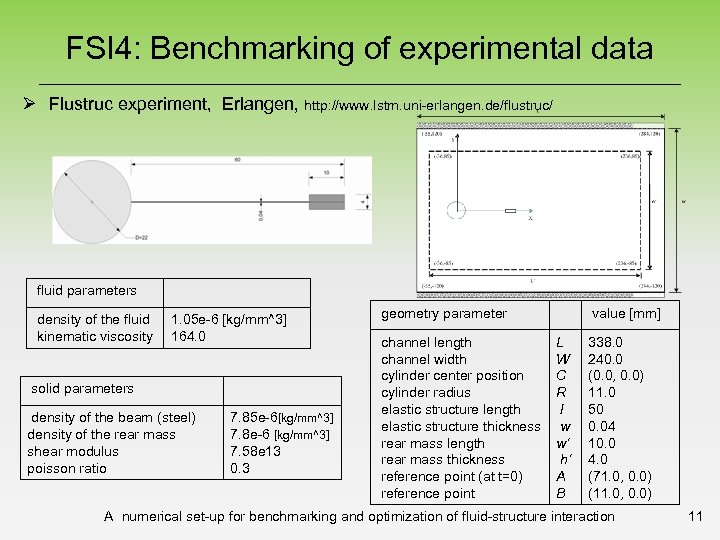 FSI 4: Benchmarking of experimental data Ø Flustruc experiment, Erlangen, http: //www. lstm. uni-erlangen. de/flustruc/ fluid parameters density of the fluid kinematic viscosity 1. 05 e-6 [kg/mm^3] 164. 0 solid parameters density of the beam (steel) density of the rear mass shear modulus poisson ratio 7. 85 e-6[kg/mm^3] 7. 8 e-6 [kg/mm^3] 7. 58 e 13 0. 3 geometry parameter channel length channel width cylinder center position cylinder radius elastic structure length elastic structure thickness rear mass length rear mass thickness reference point (at t=0) reference point value [mm] L W C R l w w‘ h‘ A B 338. 0 240. 0 (0. 0, 0. 0) 11. 0 50 0. 04 10. 0 4. 0 (71. 0, 0. 0) (11. 0, 0. 0) A numerical set-up for benchmarking and optimization of fluid-structure interaction 11
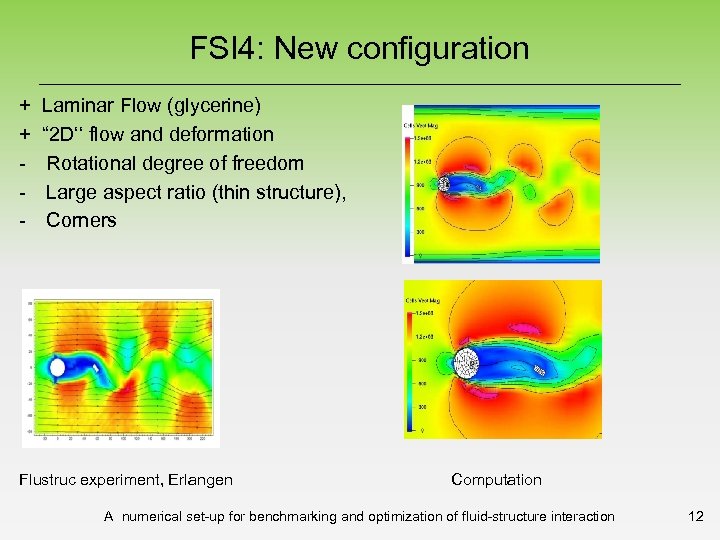 FSI 4: New configuration + + - Laminar Flow (glycerine) “ 2 D‘‘ flow and deformation Rotational degree of freedom Large aspect ratio (thin structure), Corners Flustruc experiment, Erlangen Computation A numerical set-up for benchmarking and optimization of fluid-structure interaction 12
 FSI Optimization Ø Optimization problem Ø Associated design or control variable Ø The main design aims could be I) Drag/Lift minimization II) Minimal pressure loss III) Minimal nonstationary oscillations Ø To reach these aims, we might allow 1. Boundary control of inflow section 2. Change of geometry: elastic channel walls or length/thickness of elastic beam 3. Optimal control of volume forces Ø Optimal control of nonstationary flow might be hard for the starting Ø Results for the moment are combination of I)-III) with 1)-3). A numerical set-up for benchmarking and optimization of fluid-structure interaction 13
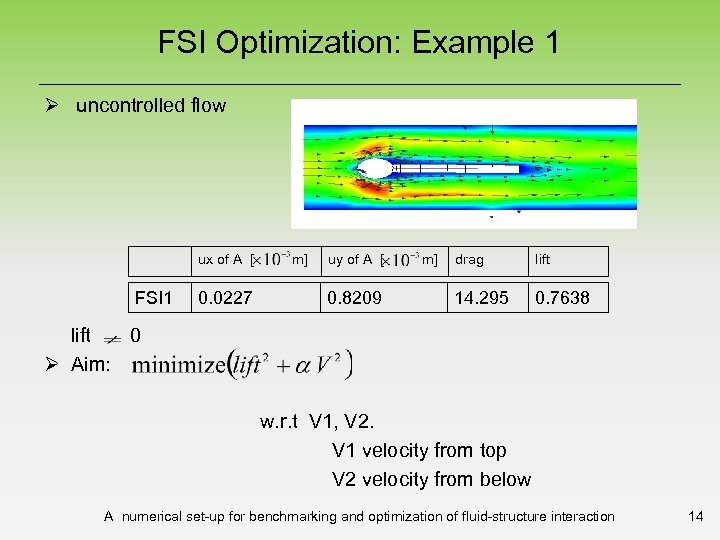 FSI Optimization: Example 1 Ø uncontrolled flow ux of A [ FSI 1 0. 0227 m] uy of A [ 0. 8209 m] drag lift 14. 295 0. 7638 lift 0 Ø Aim: w. r. t V 1, V 2. V 1 velocity from top V 2 velocity from below A numerical set-up for benchmarking and optimization of fluid-structure interaction 14
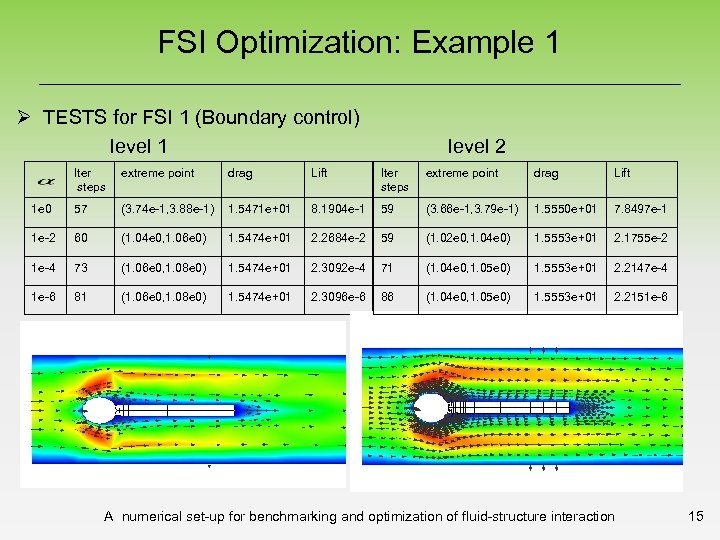 FSI Optimization: Example 1 Ø TESTS for FSI 1 (Boundary control) level 1 level 2 Iter steps extreme point drag Lift 1 e 0 57 (3. 74 e-1, 3. 88 e-1) 1. 5471 e+01 8. 1904 e-1 59 (3. 66 e-1, 3. 79 e-1) 1. 5550 e+01 7. 8497 e-1 1 e-2 60 (1. 04 e 0, 1. 06 e 0) 1. 5474 e+01 2. 2684 e-2 59 (1. 02 e 0, 1. 04 e 0) 1. 5553 e+01 2. 1755 e-2 1 e-4 73 (1. 06 e 0, 1. 08 e 0) 1. 5474 e+01 2. 3092 e-4 71 (1. 04 e 0, 1. 05 e 0) 1. 5553 e+01 2. 2147 e-4 1 e-6 81 (1. 06 e 0, 1. 08 e 0) 1. 5474 e+01 2. 3096 e-6 86 (1. 04 e 0, 1. 05 e 0) 1. 5553 e+01 2. 2151 e-6 A numerical set-up for benchmarking and optimization of fluid-structure interaction 15
 More examples Ø further examples might be: 1. for deformed case 2. pressure loss minimize: w. r. t elastic deformation of the wall or w. r. t geometrical and material properties of beam A numerical set-up for benchmarking and optimization of fluid-structure interaction 16
 Suggestions 0) Validate your FSI Code 1) FSI 1 + EX 1 send us results 1) Preliminary tests: for other examples until summer discuss via internet, until fall A numerical set-up for benchmarking and optimization of fluid-structure interaction 17