 Скачать презентацию Università Bocconi A A 2005 -2006 Comparative public
03f05fb7924f2a1f85530fa35756593a.ppt
- Количество слайдов: 16



Università Bocconi A. A. 2005 -2006 Comparative public economics Giampaolo Arachi Università Bocconi, A. A: 2005 -2006 Mec – Comparative public economics
Outline Implicit taxes Clienteles Arbitrage Restrictions and frictions References: M. Scholes, M. A. Wolfson, M. Erickson, E. L. Maydew, T. Shevlin (SWEMS), Taxes and business strategy: a planning approach, Pearson Prentice Hall, third edition, 2005, ch. 5 and 6 Università Bocconi, A. A: 2005 -2006 Mec – Comparative public economics 2
Outline Implicit taxes Clienteles Arbitrage Restrictions and frictions Università Bocconi, A. A: 2005 -2006 Mec – Comparative public economics 3
Implicit taxes • When two assets give rise to identical pretax cash flows, but one asset is taxed more favorably than the other one, taxpayers will bid for the right to hold the tax -favored asset • As a result, the price of the tax-favored asset will increase relative to the price of the tax-disfavored asset • This implies that the pretax rate of return of the taxfavored asset will fall below of that of the tax disfavored asset • In the absence of tax-rule restrictions or market frictions, in equilibrium the of after-tax returns will be the same for the marginal investor Università Bocconi, A. A: 2005 -2006 Mec – Comparative public economics 4
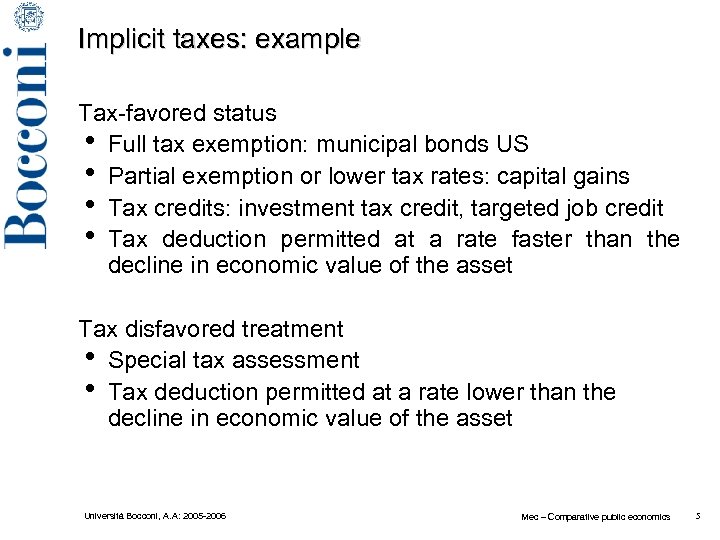
Implicit taxes: example Tax-favored status h Full tax exemption: municipal bonds US h Partial exemption or lower tax rates: capital gains h Tax credits: investment tax credit, targeted job credit h Tax deduction permitted at a rate faster than the decline in economic value of the asset Tax disfavored treatment h Special tax assessment h Tax deduction permitted at a rate lower than the decline in economic value of the asset Università Bocconi, A. A: 2005 -2006 Mec – Comparative public economics 5
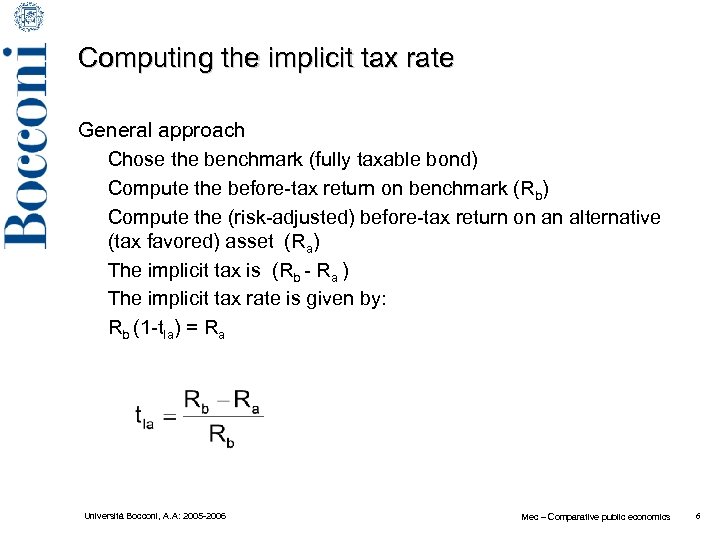
Computing the implicit tax rate General approach Chose the benchmark (fully taxable bond) Compute the before-tax return on benchmark (Rb) Compute the (risk-adjusted) before-tax return on an alternative (tax favored) asset (Ra) The implicit tax is (Rb - Ra ) The implicit tax rate is given by: Rb (1 -t. Ia) = Ra Università Bocconi, A. A: 2005 -2006 Mec – Comparative public economics 6
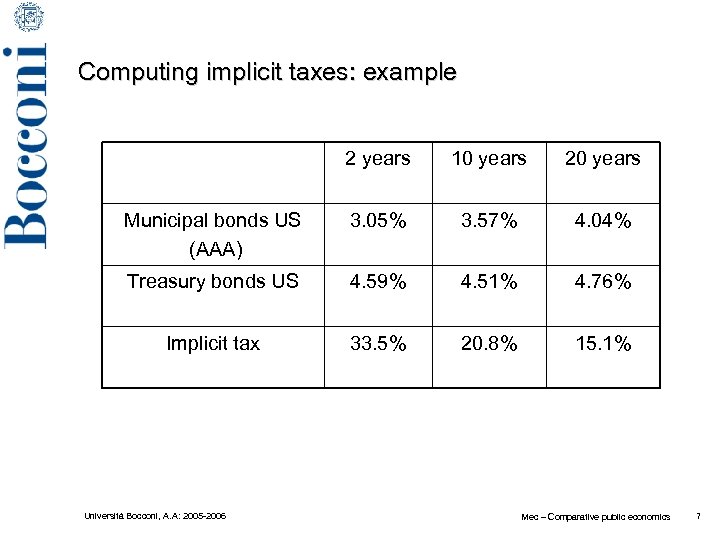
Computing implicit taxes: example 2 years 10 years 20 years Municipal bonds US (AAA) 3. 05% 3. 57% 4. 04% Treasury bonds US 4. 59% 4. 51% 4. 76% Implicit tax 33. 5% 20. 8% 15. 1% Università Bocconi, A. A: 2005 -2006 Mec – Comparative public economics 7
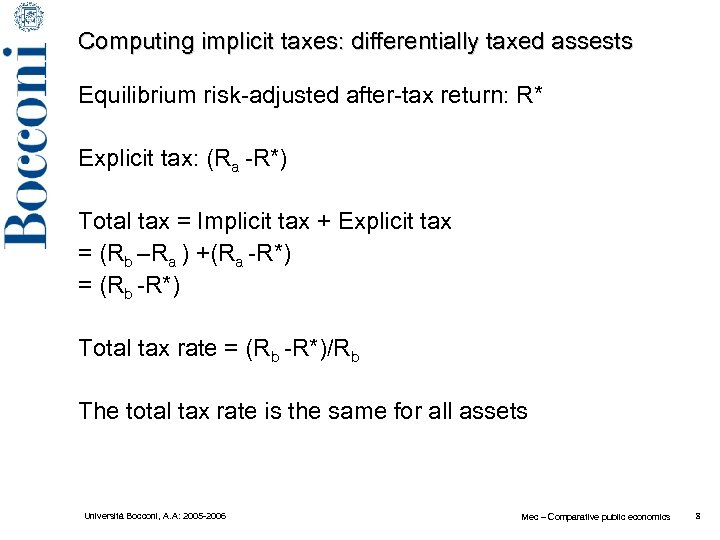
Computing implicit taxes: differentially taxed assests Equilibrium risk-adjusted after-tax return: R* Explicit tax: (Ra -R*) Total tax = Implicit tax + Explicit tax = (Rb –Ra ) +(Ra -R*) = (Rb -R*) Total tax rate = (Rb -R*)/Rb The total tax rate is the same for all assets Università Bocconi, A. A: 2005 -2006 Mec – Comparative public economics 8
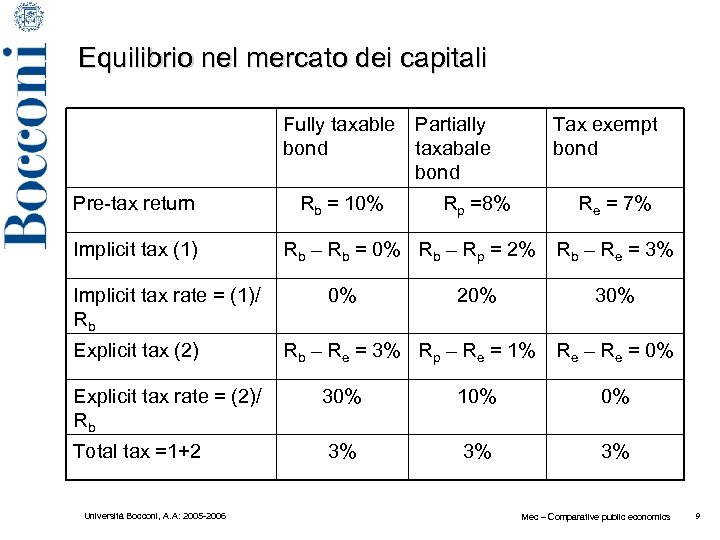
Equilibrio nel mercato dei capitali Fully taxable Partially bond taxabale bond Pre-tax return Implicit tax (1) Implicit tax rate = (1)/ Rb Explicit tax (2) Rb = 10% Tax exempt bond Rp =8% Re = 7% Rb – Rb = 0% Rb – Rp = 2% 0% 20% Rb – Re = 3% 30% Rb – Re = 3% Rp – Re = 1% Re – Re = 0% Explicit tax rate = (2)/ Rb 30% 10% 0% Total tax =1+2 3% 3% 3% Università Bocconi, A. A: 2005 -2006 Mec – Comparative public economics 9
Outline Implicit taxes Clienteles Arbitrage Restrictions and frictions Università Bocconi, A. A: 2005 -2006 Mec – Comparative public economics 10
Outline Implicit taxes Clienteles Arbitrage Restrictions and frictions Università Bocconi, A. A: 2005 -2006 Mec – Comparative public economics 13
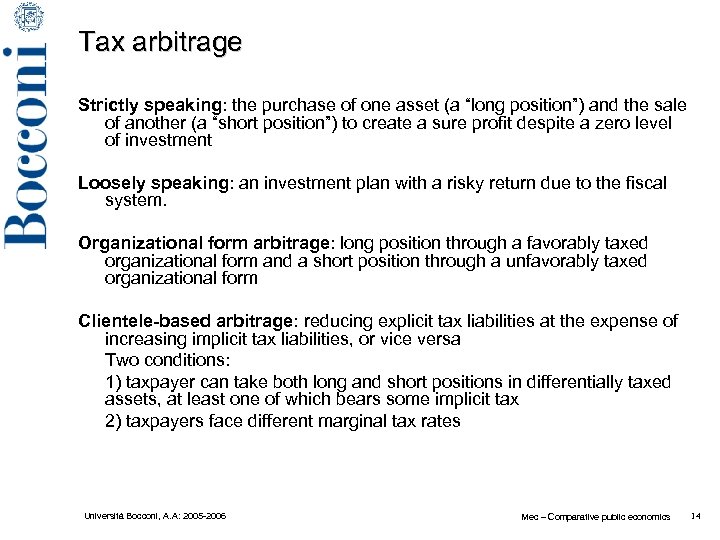
Tax arbitrage Strictly speaking: the purchase of one asset (a “long position”) and the sale of another (a “short position”) to create a sure profit despite a zero level of investment Loosely speaking: an investment plan with a risky return due to the fiscal system. Organizational form arbitrage: long position through a favorably taxed organizational form and a short position through a unfavorably taxed organizational form Clientele-based arbitrage: reducing explicit tax liabilities at the expense of increasing implicit tax liabilities, or vice versa Two conditions: 1) taxpayer can take both long and short positions in differentially taxed assets, at least one of which bears some implicit tax 2) taxpayers face different marginal tax rates Università Bocconi, A. A: 2005 -2006 Mec – Comparative public economics 14
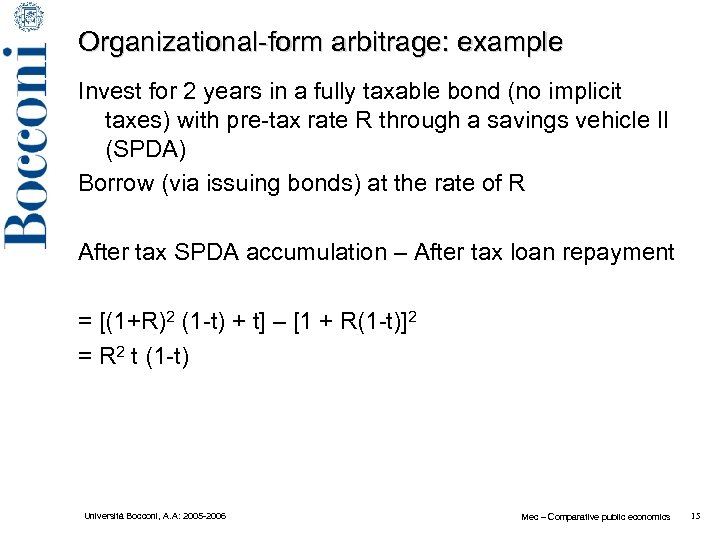
Organizational-form arbitrage: example Invest for 2 years in a fully taxable bond (no implicit taxes) with pre-tax rate R through a savings vehicle II (SPDA) Borrow (via issuing bonds) at the rate of R After tax SPDA accumulation – After tax loan repayment = [(1+R)2 (1 -t) + t] – [1 + R(1 -t)]2 = R 2 t (1 -t) Università Bocconi, A. A: 2005 -2006 Mec – Comparative public economics 15
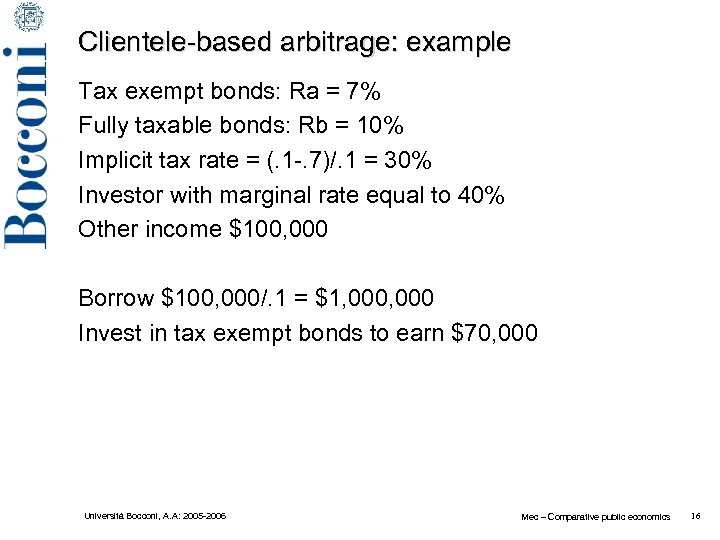
Clientele-based arbitrage: example Tax exempt bonds: Ra = 7% Fully taxable bonds: Rb = 10% Implicit tax rate = (. 1 -. 7)/. 1 = 30% Investor with marginal rate equal to 40% Other income $100, 000 Borrow $100, 000/. 1 = $1, 000 Invest in tax exempt bonds to earn $70, 000 Università Bocconi, A. A: 2005 -2006 Mec – Comparative public economics 16
Outline Implicit taxes Clienteles Arbitrage Restrictions and frictions Università Bocconi, A. A: 2005 -2006 Mec – Comparative public economics 17
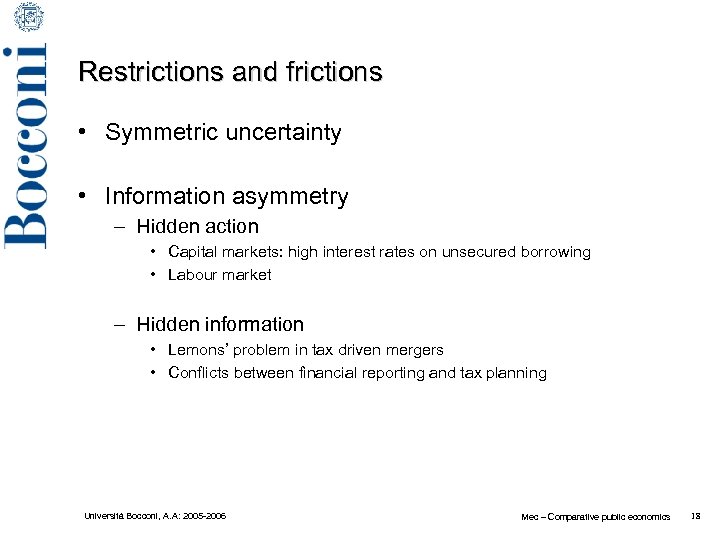
Restrictions and frictions • Symmetric uncertainty • Information asymmetry – Hidden action • Capital markets: high interest rates on unsecured borrowing • Labour market – Hidden information • Lemons’ problem in tax driven mergers • Conflicts between financial reporting and tax planning Università Bocconi, A. A: 2005 -2006 Mec – Comparative public economics 18
Скачать презентацию Università Bocconi A A 2005 -2006 Comparative public
03f05fb7924f2a1f85530fa35756593a.ppt