


 Скачать презентацию Universidad de Chile Department of Mechanical Engineering Laminar
d40901b313ecf41e129119b84eb2987b.ppt
- Количество слайдов: 46
 Universidad de Chile Department of Mechanical Engineering Laminar unsteady flow and heat transfer in confined channel flow past square bars arranged side by side Professor Alvaro Valencia University of Notre Dame Tuesday, December 4, 2001
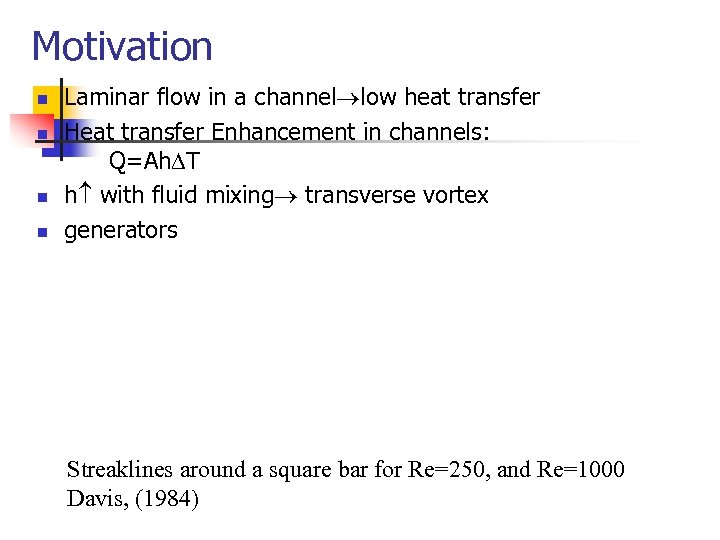 Motivation n n Laminar flow in a channel low heat transfer Heat transfer Enhancement in channels: Q=Ah T h with fluid mixing transverse vortex generators Streaklines around a square bar for Re=250, and Re=1000 Davis, (1984)
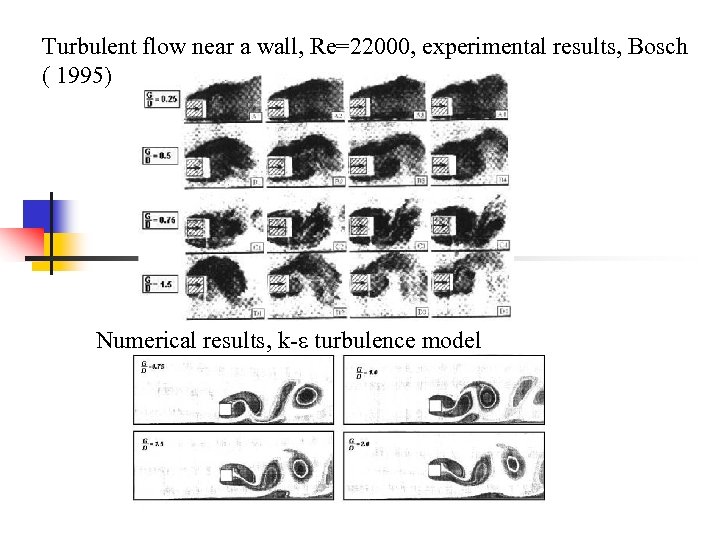 Turbulent flow near a wall, Re=22000, experimental results, Bosch ( 1995) Numerical results, k- turbulence model
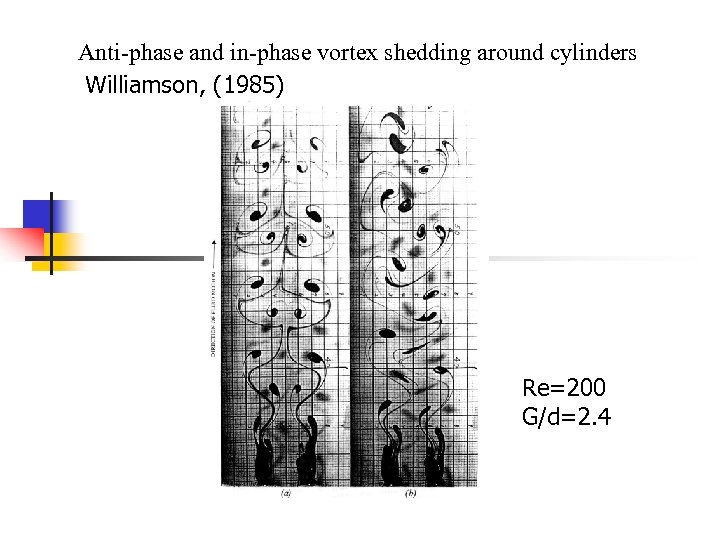 Anti-phase and in-phase vortex shedding around cylinders Williamson, (1985) Re=200 G/d=2. 4
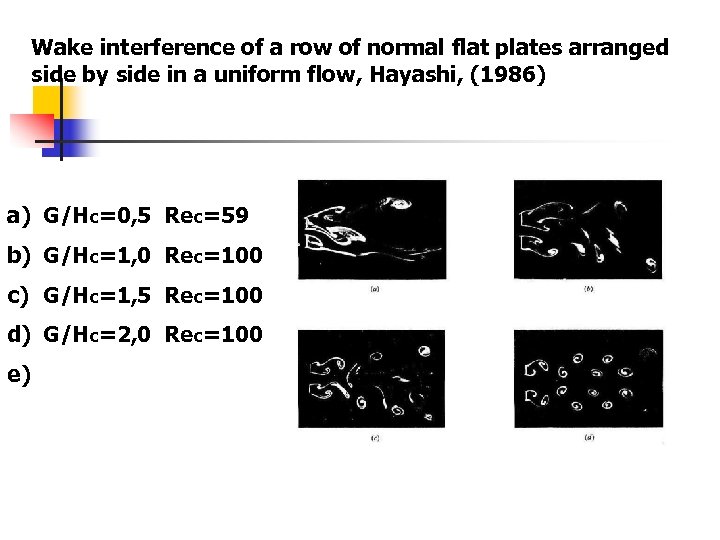 Wake interference of a row of normal flat plates arranged side by side in a uniform flow, Hayashi, (1986) a) G/Hc=0, 5 Rec=59 b) G/Hc=1, 0 Rec=100 c) G/Hc=1, 5 Rec=100 d) G/Hc=2, 0 Rec=100 e)
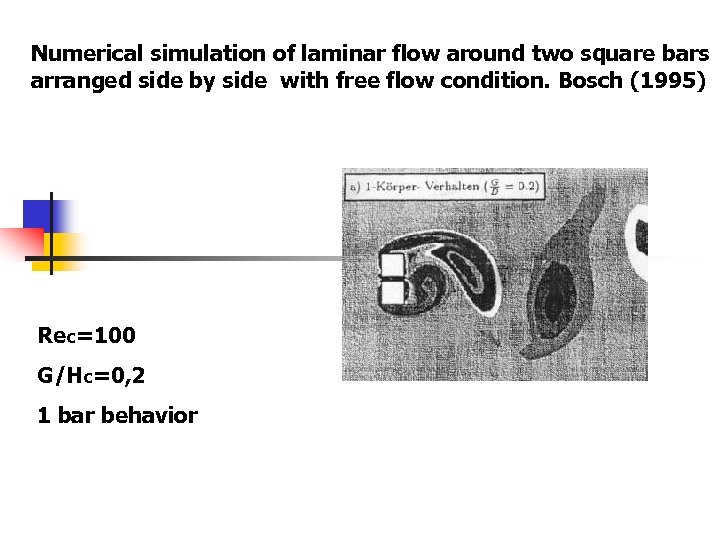 Numerical simulation of laminar flow around two square bars arranged side by side with free flow condition. Bosch (1995) Rec=100 G/Hc=0, 2 1 bar behavior
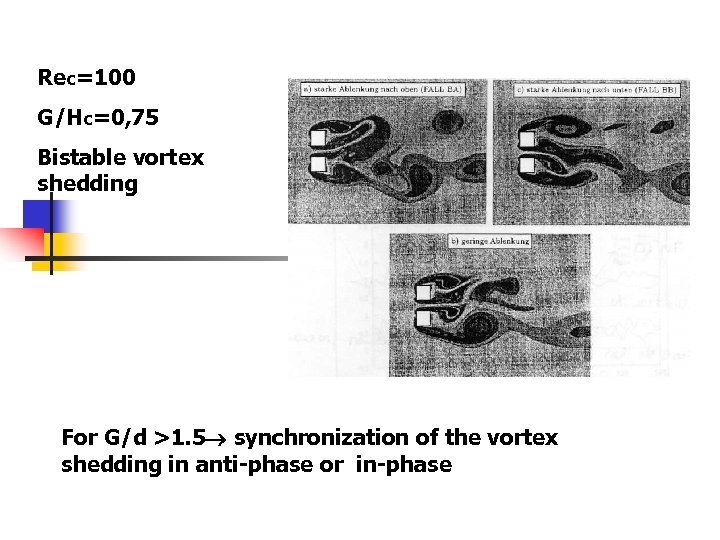 Rec=100 G/Hc=0, 75 Bistable vortex shedding For G/d >1. 5 synchronization of the vortex shedding in anti-phase or in-phase
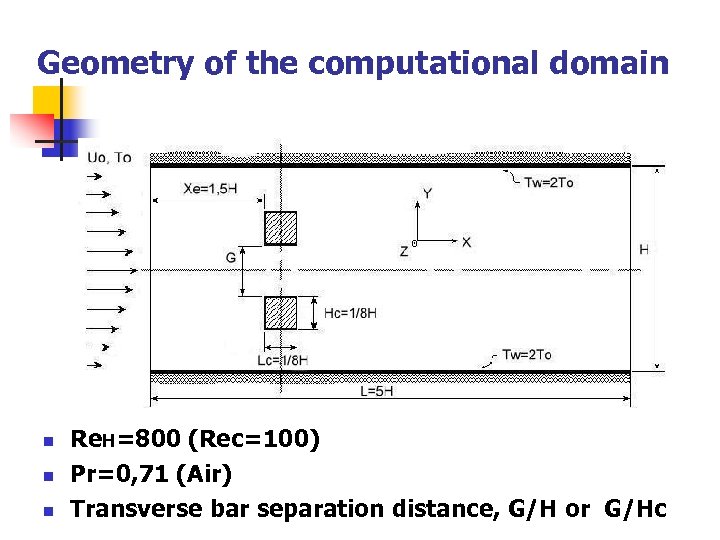 Geometry of the computational domain n Re. H=800 (Rec=100) Pr=0, 71 (Air) Transverse bar separation distance, G/H or G/Hc
 Mathematical formulation y. Continuity y. Navier Stokes equations (momentum) y. Thermal energy The variables were non-dimensionalized with Uo, H, and To.
 Boundary Conditions n Inlet: n Fully developed parabolic velocity profile n Constant temperature To Walls: Constant wall temperature Tw=2 To Thermal entrance region
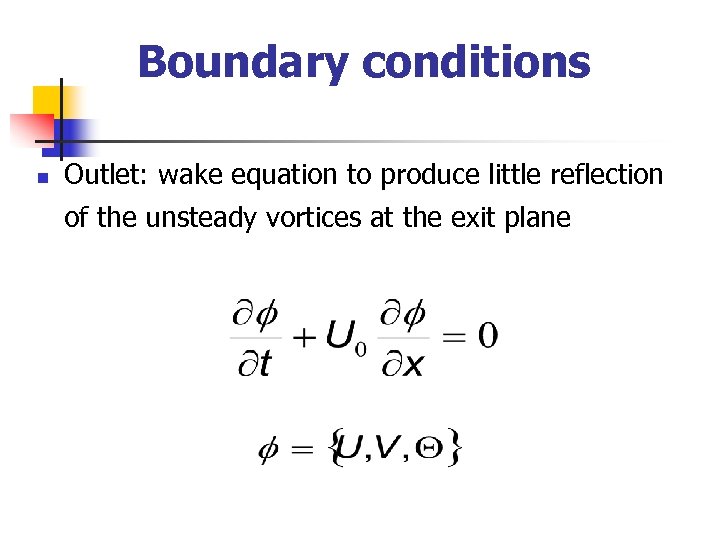 Boundary conditions n Outlet: wake equation to produce little reflection of the unsteady vortices at the exit plane
 Numerical solution technique n n n Differential equations were solved with an iterative finitevolume method described in Patankar( 1980). The convection terms were approximated using a powerlaw sheme The method uses a staggered grid and handles the pressure -velocity coupling with the SIMPLEC algorithm, van Doormal (1984). A first-order accurate fully implicit method was used for time discretization in connection with a very small time step. 1. 5 Uo t/ x=0. 1 A tipical run of 70. 000 time steps with the 192 x 960 grid points takes about 4 days in a personal computer Pentium III.
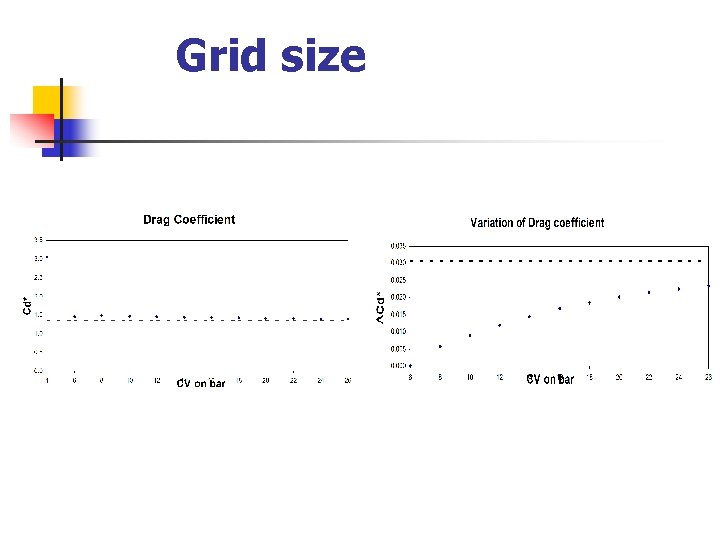
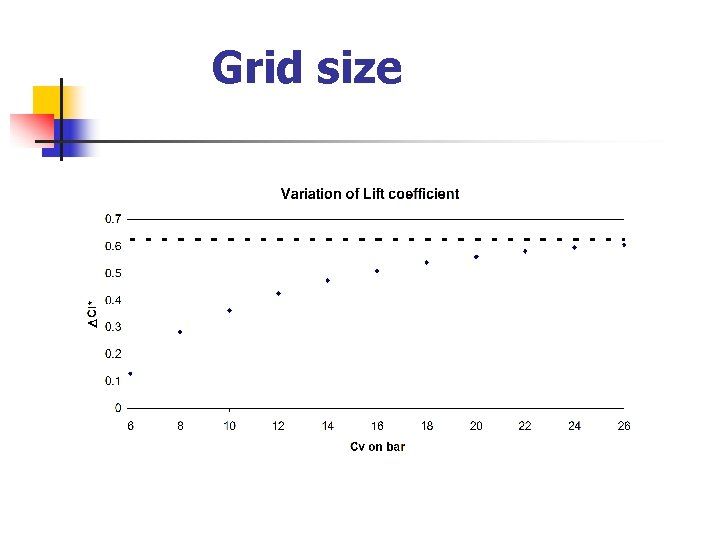
 Grid selection n n The confined flow around a square bar mounted inside a plane channel was chosen for evaluate the numerical method and grid size. A lot of data was found in the literature for the confined laminar flow past a square bar, it was found also a great dispersion of the results. M. Breuer et al presented accurate computations of the laminar flow past a square cylinder based on two different methods, (2000). The present numerical results were compared with their results
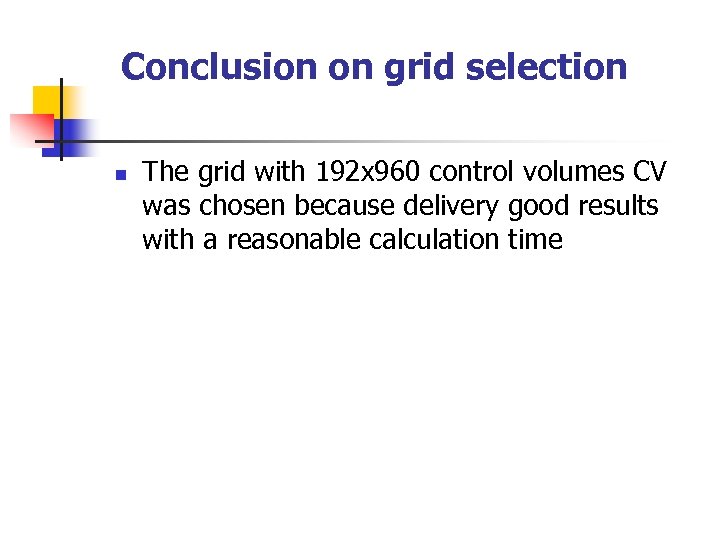
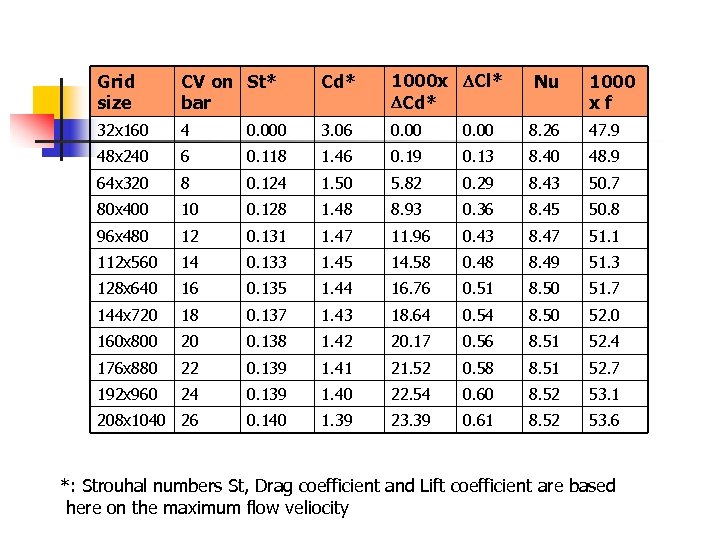 Grid size CV on St* bar Cd* 1000 x Cl* Cd* 32 x 160 4 0. 000 3. 06 0. 00 8. 26 47. 9 48 x 240 6 0. 118 1. 46 0. 19 0. 13 8. 40 48. 9 64 x 320 8 0. 124 1. 50 5. 82 0. 29 8. 43 50. 7 80 x 400 10 0. 128 1. 48 8. 93 0. 36 8. 45 50. 8 96 x 480 12 0. 131 1. 47 11. 96 0. 43 8. 47 51. 1 112 x 560 14 0. 133 1. 45 14. 58 0. 48 8. 49 51. 3 128 x 640 16 0. 135 1. 44 16. 76 0. 51 8. 50 51. 7 144 x 720 18 0. 137 1. 43 18. 64 0. 54 8. 50 52. 0 160 x 800 20 0. 138 1. 42 20. 17 0. 56 8. 51 52. 4 176 x 880 22 0. 139 1. 41 21. 52 0. 58 8. 51 52. 7 192 x 960 24 0. 139 1. 40 22. 54 0. 60 8. 52 53. 1 208 x 1040 26 0. 140 1. 39 23. 39 0. 61 8. 52 53. 6 Nu 1000 xf *: Strouhal numbers St, Drag coefficient and Lift coefficient are based here on the maximum flow veliocity
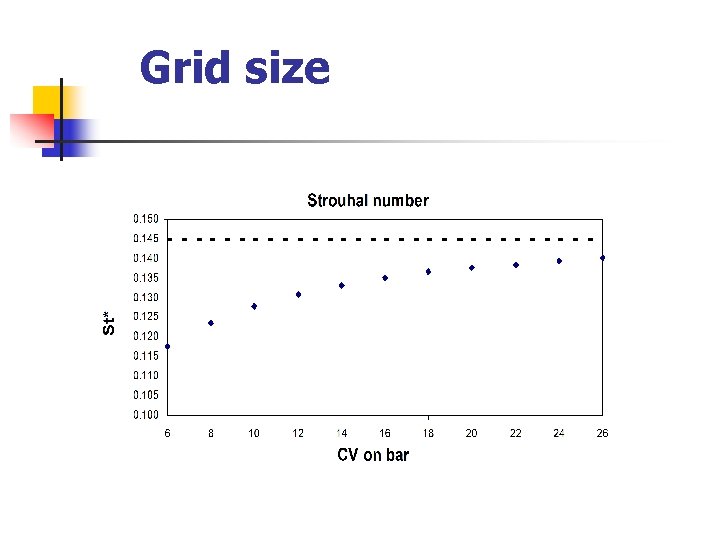 Grid size
 Grid size
 Grid size
 Conclusion on grid selection n The grid with 192 x 960 control volumes CV was chosen because delivery good results with a reasonable calculation time
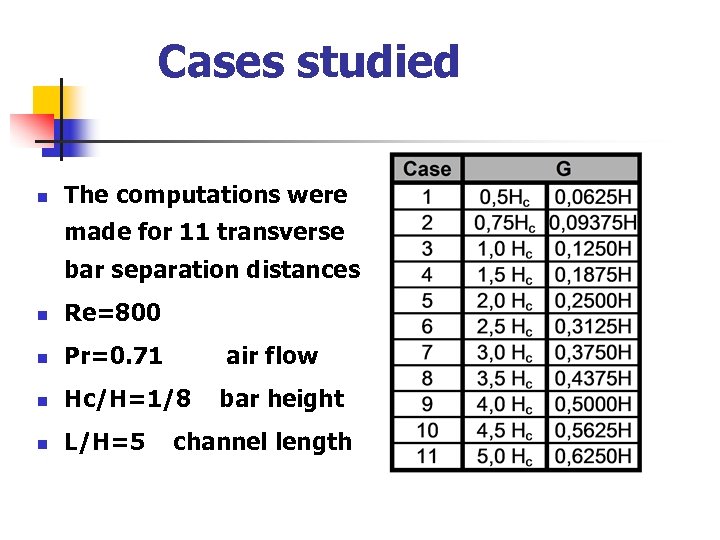 Cases studied n The computations were made for 11 transverse bar separation distances n Re=800 n Pr=0. 71 air flow n Hc/H=1/8 bar height n L/H=5 channel length
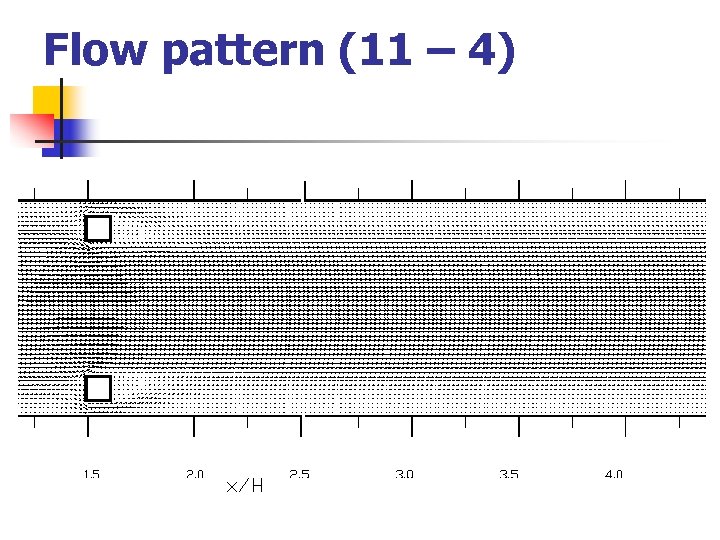 Flow pattern (11 – 4)
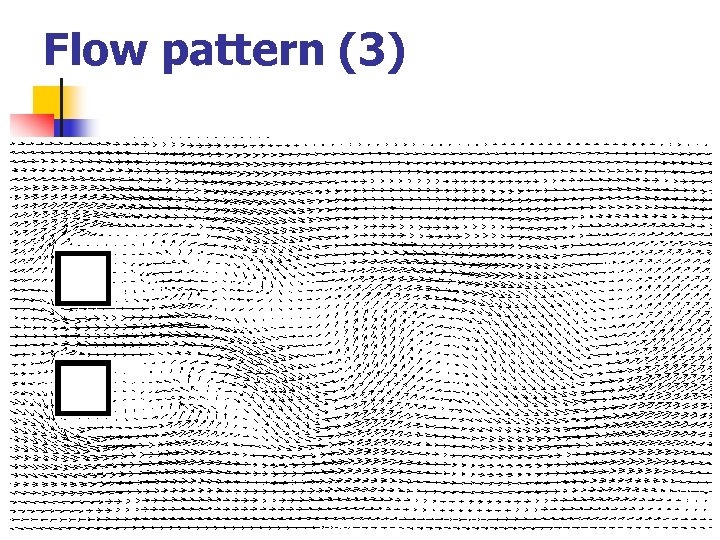 Flow pattern (3)
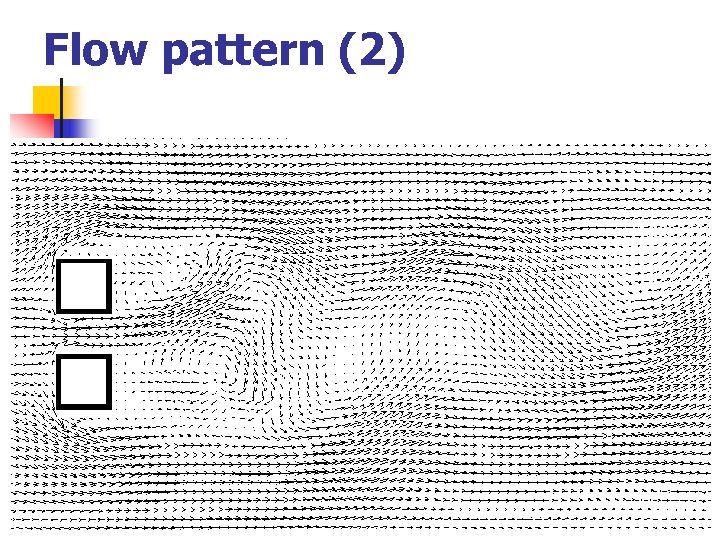 Flow pattern (2)
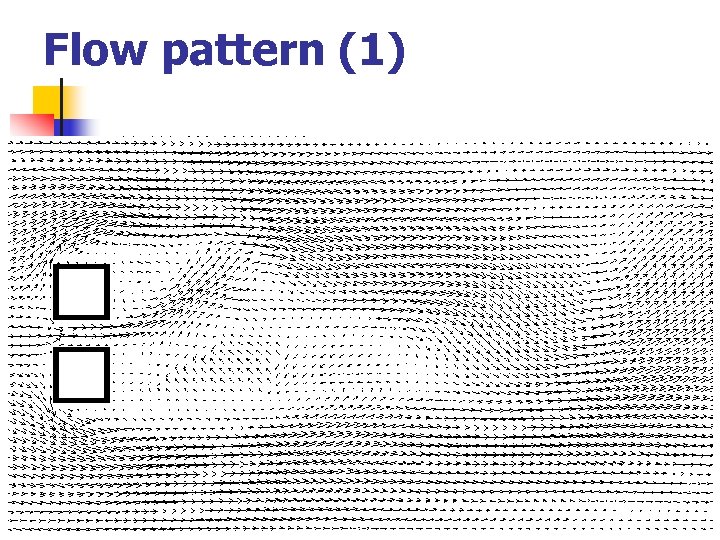 Flow pattern (1)
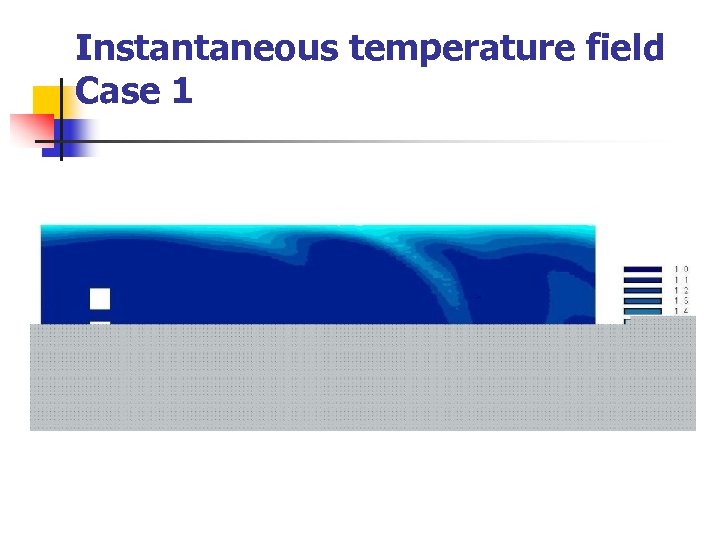 Instantaneous temperature field Case 1
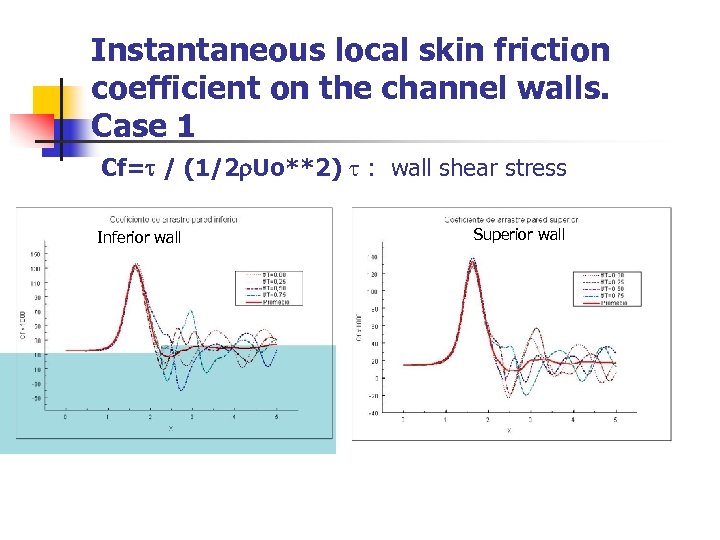 Instantaneous local skin friction coefficient on the channel walls. Case 1 Cf= / (1/2 Uo**2) : wall shear stress Inferior wall Superior wall
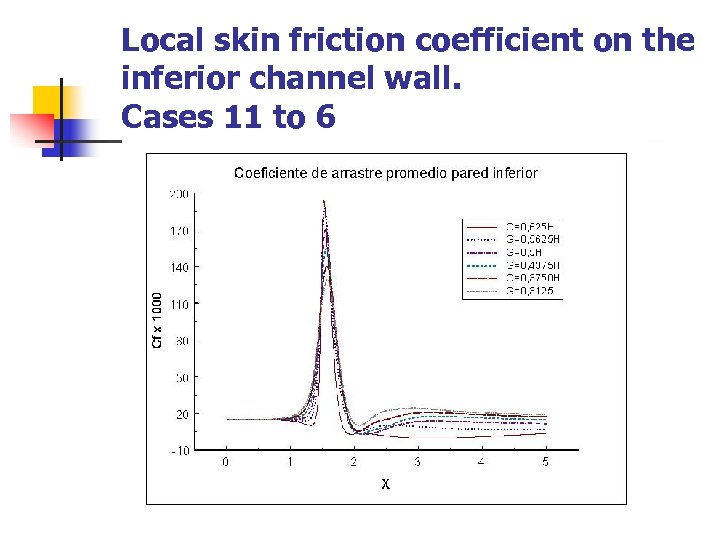 Local skin friction coefficient on the inferior channel wall. Cases 11 to 6
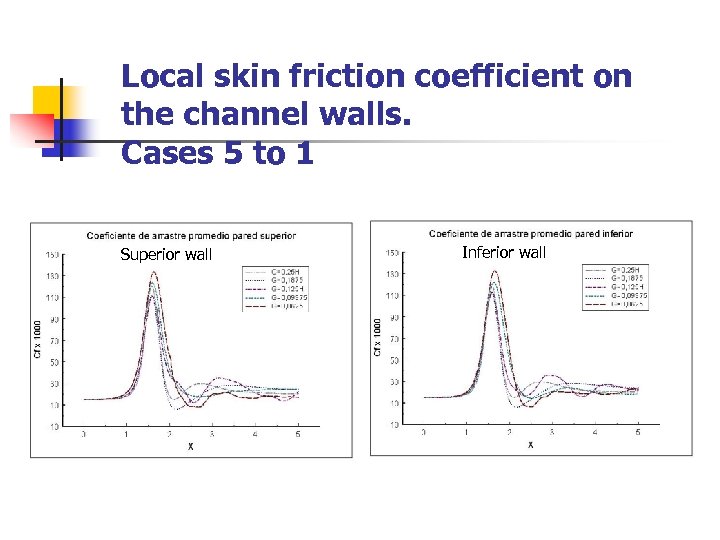 Local skin friction coefficient on the channel walls. Cases 5 to 1 Superior wall Inferior wall
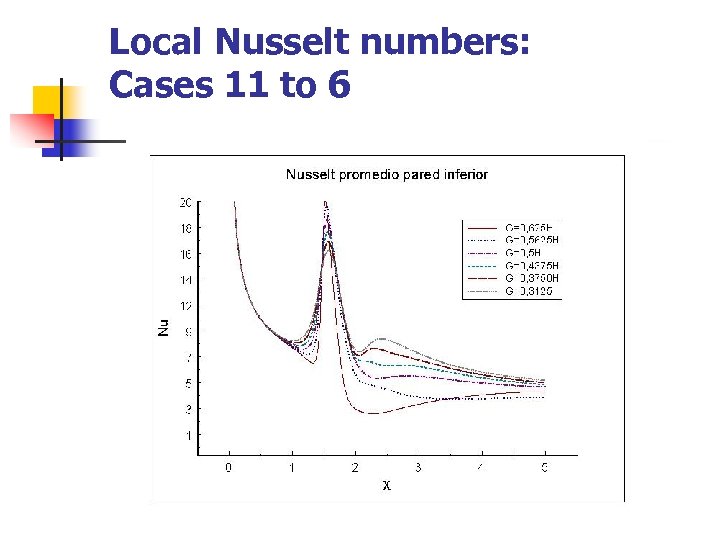 Local Nusselt numbers: Cases 11 to 6
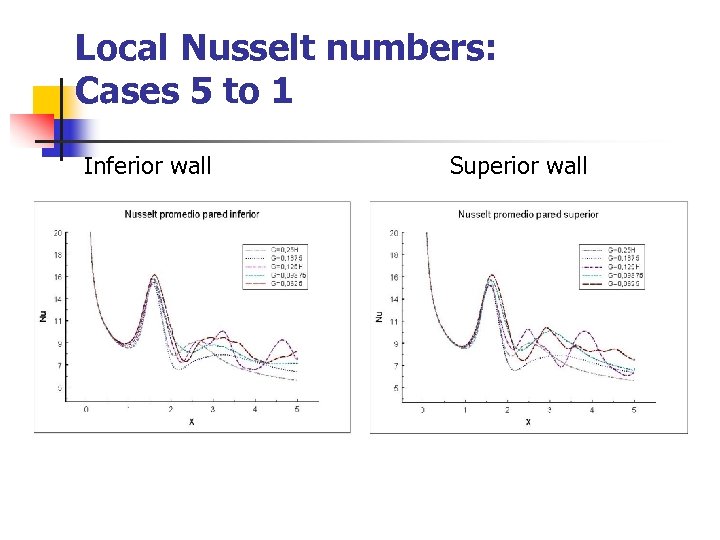 Local Nusselt numbers: Cases 5 to 1 Inferior wall Superior wall
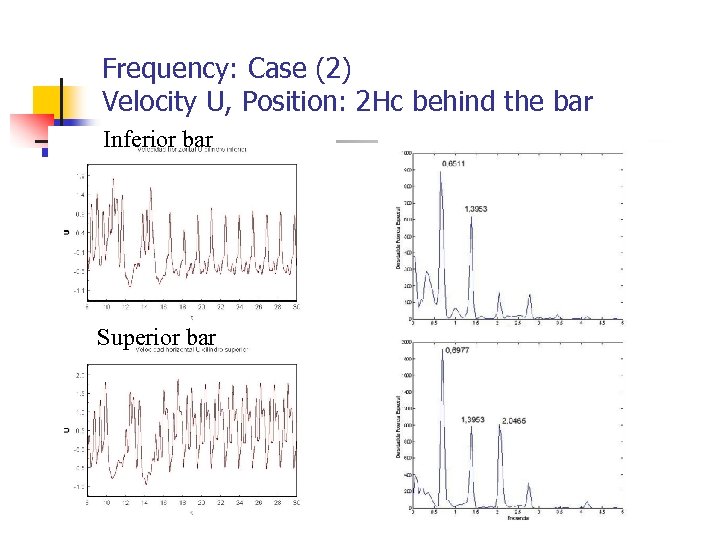 Frequency: Case (2) Velocity U, Position: 2 Hc behind the bar Inferior bar Superior bar
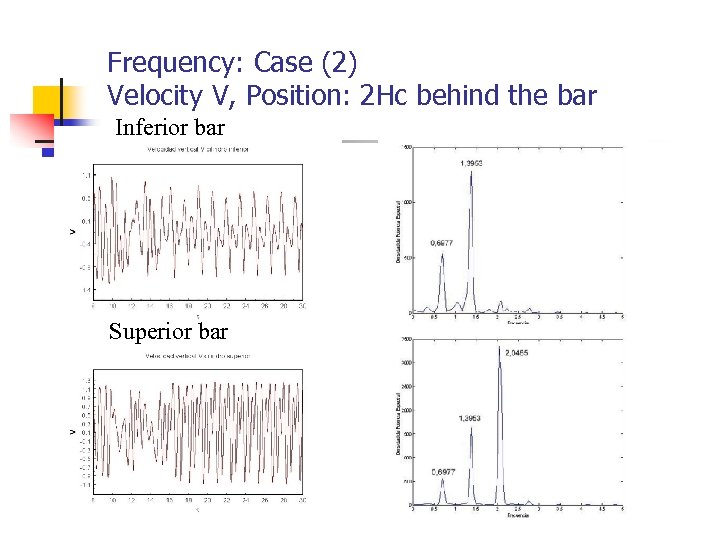 Frequency: Case (2) Velocity V, Position: 2 Hc behind the bar Inferior bar Superior bar
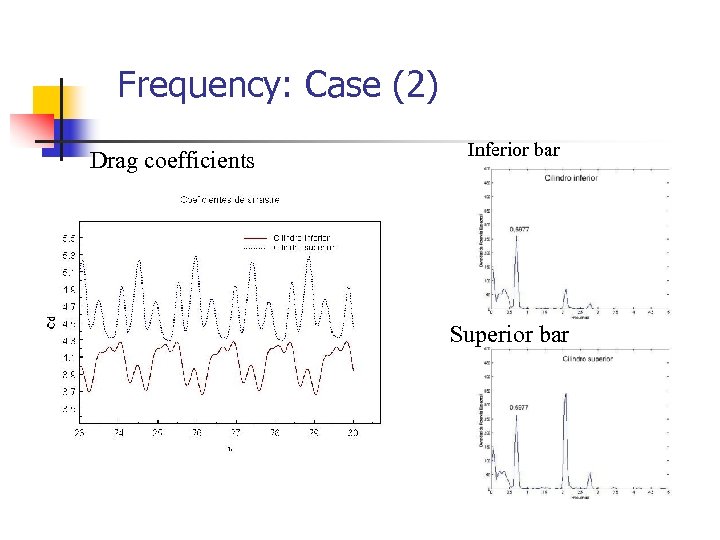 Frequency: Case (2) Drag coefficients Inferior bar Superior bar
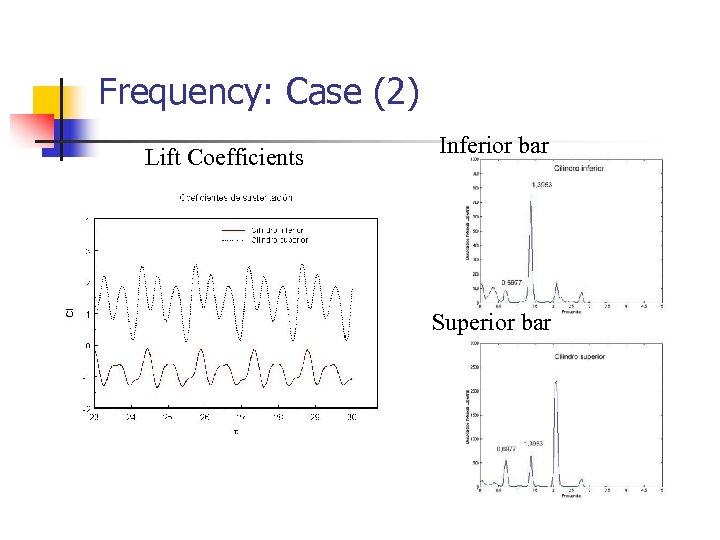 Frequency: Case (2) Lift Coefficients Inferior bar Superior bar
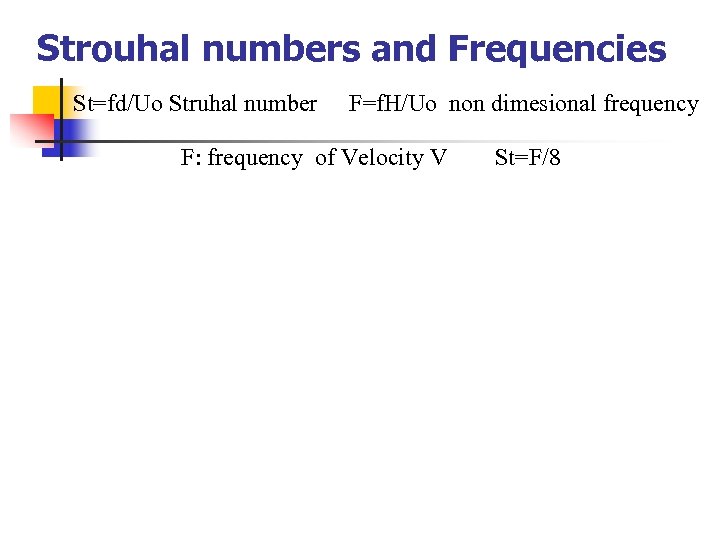 Strouhal numbers and Frequencies St=fd/Uo Struhal number F=f. H/Uo non dimesional frequency F: frequency of Velocity V St=F/8
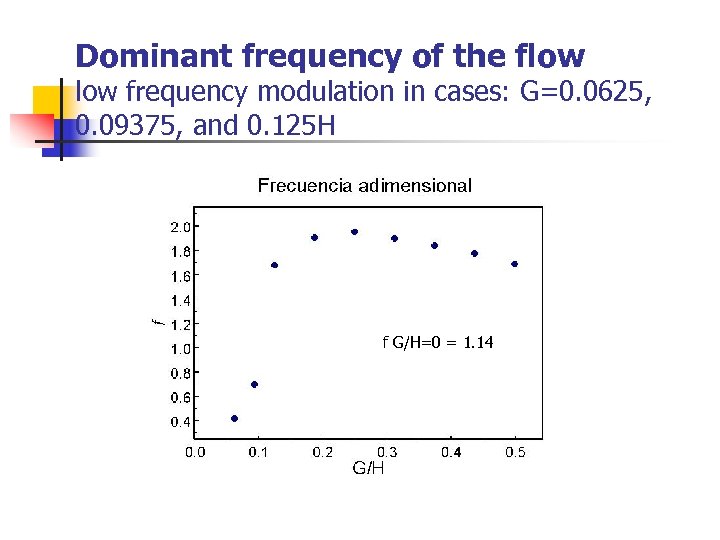 Dominant frequency of the flow frequency modulation in cases: G=0. 0625, 0. 09375, and 0. 125 H f G/H=0 = 1. 14
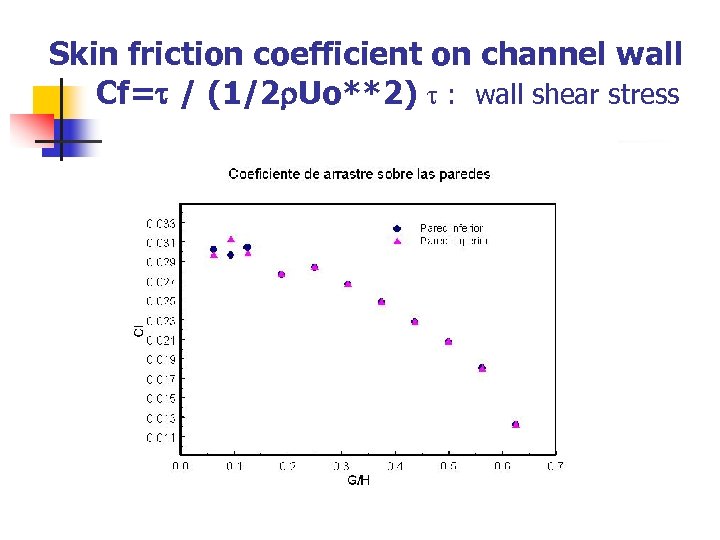 Skin friction coefficient on channel wall Cf= / (1/2 Uo**2) : wall shear stress
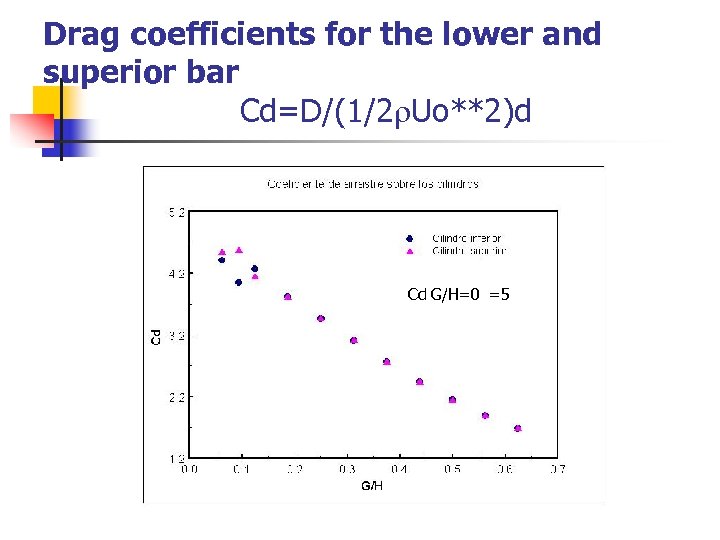 Drag coefficients for the lower and superior bar Cd=D/(1/2 Uo**2)d Cd G/H=0 =5
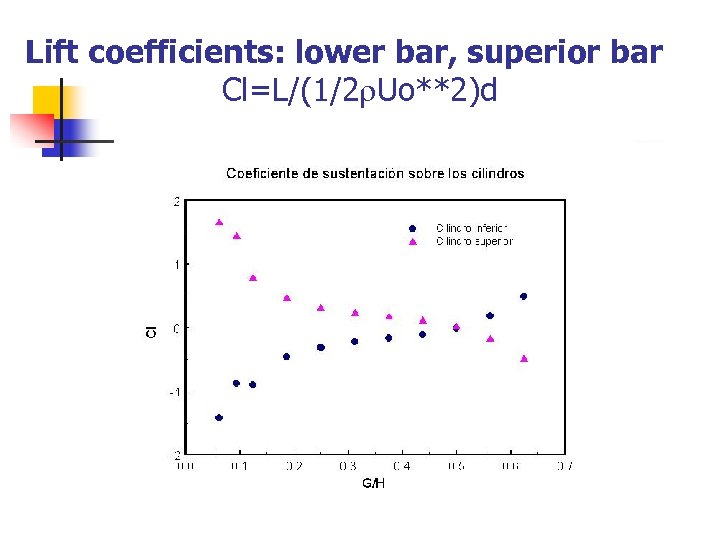 Lift coefficients: lower bar, superior bar Cl=L/(1/2 Uo**2)d
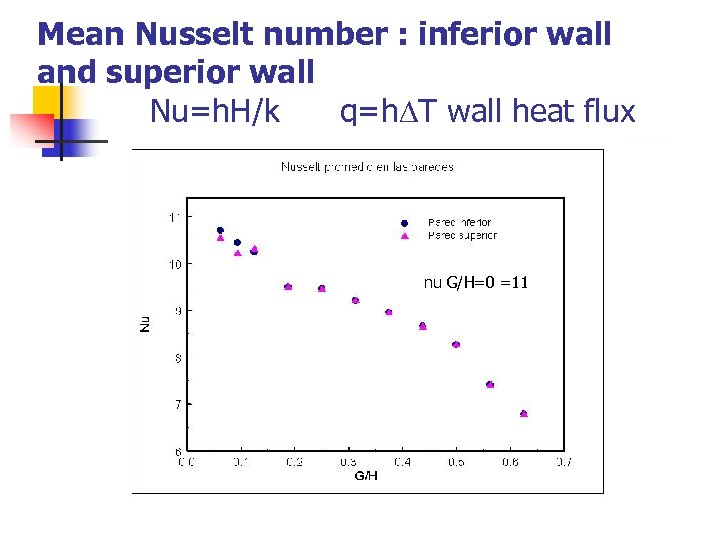 Mean Nusselt number : inferior wall and superior wall Nu=h. H/k q=h T wall heat flux nu G/H=0 =11
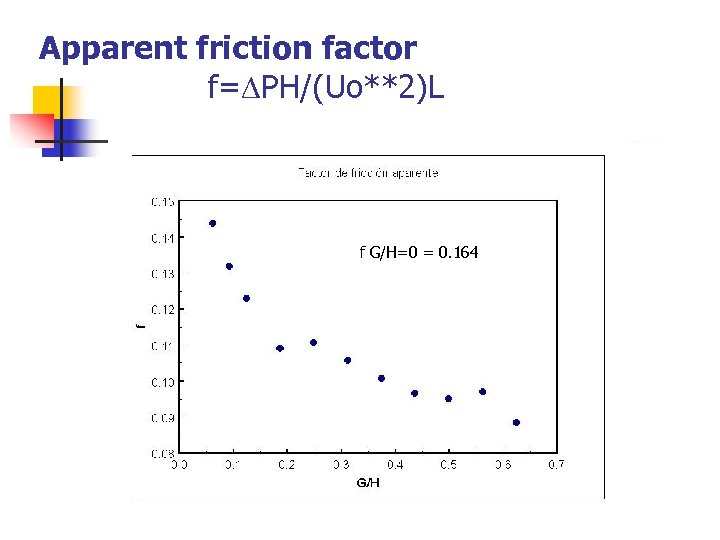 Apparent friction factor f= PH/(Uo**2)L f G/H=0 = 0. 164
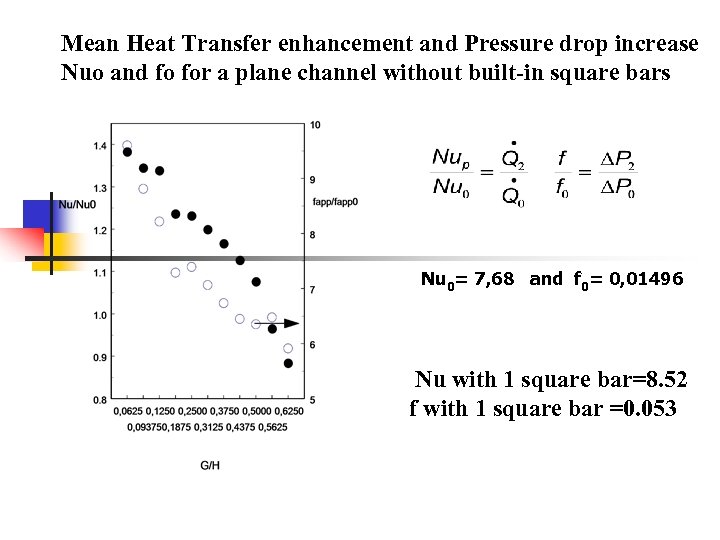 Mean Heat Transfer enhancement and Pressure drop increase Nuo and fo for a plane channel without built-in square bars Nu 0= 7, 68 and f 0= 0, 01496 Nu with 1 square bar=8. 52 f with 1 square bar =0. 053
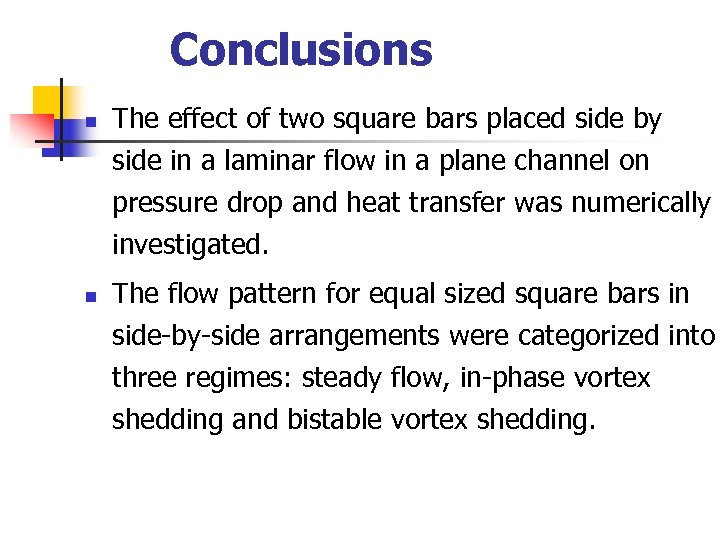 Conclusions n The effect of two square bars placed side by side in a laminar flow in a plane channel on pressure drop and heat transfer was numerically investigated. n The flow pattern for equal sized square bars in side-by-side arrangements were categorized into three regimes: steady flow, in-phase vortex shedding and bistable vortex shedding.
 n In the cases with vortex-shedding synchronization the frequency of the unsteady flow are almost four times that in the cases without synchronization of the periodic unsteady flow.
 n The results show that the local and global heat transfer on the channel walls are strongly increased by the unsteady vortex shedding induced by the bars.
![References [1] H. Suzuki, Y. Inoue, T. Nishimura, K. Fukutani, k. Suzuki, Unsteady flow](https://present5.com/presentation/d40901b313ecf41e129119b84eb2987b/image-46.jpg "References [1] H. Suzuki, Y. Inoue, T. Nishimura, K. Fukutani, k. Suzuki, Unsteady flow") References [1] H. Suzuki, Y. Inoue, T. Nishimura, K. Fukutani, k. Suzuki, Unsteady flow in a channel obstructed by a square rod (crisscross motion of vortex). International Journal of Heat and Fluid Flow 14 (1993) 2 -9. [2] A. K. Saha, K. Muralidhar, G. Biswas, Transition and chaos in two-dimensional flow past a square cylinder, Journal of Engineering Mechanics, 126, (2000), 523 -532. [3] M. Breuer, J. Bernsdorf, T. Zeiser, F. Durst, Accurate computations of the laminar flow past a square cylinder based on two different methods: lattice-Boltzmann and finite-volume, International Journal of Heat and Fluid Flow, 21, (2000), 186196. [4] J. L Rosales, A. Ortega, J. A. C. Humphrey, A numerical simulation of the convective heat transfer in confined channel flow past square cylinders: comparison of inline and offset tandem pairs, International Journal of Heat and Mass Transfer, 44, (2001), 587 -603. [5] K. Tatsutani, R. Devarakonda, J. A. C. Humphrey, Unsteady flow and heat transfer for cylinder pairs in a channel, International Journal of Heat and Mass Transfer, 36, (1993), 3311 -3328. [6] A. Valencia, Numerical study of self-sustained oscillatory flows and heat transfer in channels with a tandem of transverse vortex generators, Heat and Mass Transfer, 33, (1998), 465 -470. [7] D. Sumner, S. J. Price, M. P. Païdoussis, Flow-pattern identification for two staggered circular cylinders in cross-flow, Journal of Fluid Mechanics, 411, (2000), 263 -303. [8] C. H. K. Williamson, Evolution of a single wake behind a pair of bluff bodies, Journal of Fluid Mechanics, 159, (1985), 118. [9] J. J. Miau, H. B. Wang, J. H. Chou, Flopping phenomenon of flow behind two plates placed side-by-side normal to the flow direction, Fluid Dynamics Research, 17, (1996), 311 -328. [10] M. Hayashi, A. Sakurai, Wake interference of a row of normal flat plates arranged side by side in a uniform flow, Journal of Fluid Mechanics, 164, (1986), 1 -25. [11] S. C. Luo, L. L. Li, D. A. Shah, Aerodynamic stability of the downstream of two tandem square-section cylinders, Journal of Wind Engineering and Industrial Aerodynamics, 79, (1999), 79 -103. [12] G. Bosch, Experimentelle und theoretische Untersuchung der instationären Strömung um zylindrische Strukturen, Ph. D. Dissertation, Universität Fridericiana zu Karlsruhe, Germany, (1995). [13] S. Patankar, Numerical heat transfer and fluid flow, Hemisphere Publishing Co. , New York, (1980). [14] J. P. van Doormaal, G. D. Raithby, Enhancements of the SIMPLE method for predicting incompressible fluid flows. Numerical Heat Transfer, 7, (1984), 147 -163.
References [1] H. Suzuki, Y. Inoue, T. Nishimura, K. Fukutani, k. Suzuki, Unsteady flow in a channel obstructed by a square rod (crisscross motion of vortex). International Journal of Heat and Fluid Flow 14 (1993) 2 -9. [2] A. K. Saha, K. Muralidhar, G. Biswas, Transition and chaos in two-dimensional flow past a square cylinder, Journal of Engineering Mechanics, 126, (2000), 523 -532. [3] M. Breuer, J. Bernsdorf, T. Zeiser, F. Durst, Accurate computations of the laminar flow past a square cylinder based on two different methods: lattice-Boltzmann and finite-volume, International Journal of Heat and Fluid Flow, 21, (2000), 186196. [4] J. L Rosales, A. Ortega, J. A. C. Humphrey, A numerical simulation of the convective heat transfer in confined channel flow past square cylinders: comparison of inline and offset tandem pairs, International Journal of Heat and Mass Transfer, 44, (2001), 587 -603. [5] K. Tatsutani, R. Devarakonda, J. A. C. Humphrey, Unsteady flow and heat transfer for cylinder pairs in a channel, International Journal of Heat and Mass Transfer, 36, (1993), 3311 -3328. [6] A. Valencia, Numerical study of self-sustained oscillatory flows and heat transfer in channels with a tandem of transverse vortex generators, Heat and Mass Transfer, 33, (1998), 465 -470. [7] D. Sumner, S. J. Price, M. P. Païdoussis, Flow-pattern identification for two staggered circular cylinders in cross-flow, Journal of Fluid Mechanics, 411, (2000), 263 -303. [8] C. H. K. Williamson, Evolution of a single wake behind a pair of bluff bodies, Journal of Fluid Mechanics, 159, (1985), 118. [9] J. J. Miau, H. B. Wang, J. H. Chou, Flopping phenomenon of flow behind two plates placed side-by-side normal to the flow direction, Fluid Dynamics Research, 17, (1996), 311 -328. [10] M. Hayashi, A. Sakurai, Wake interference of a row of normal flat plates arranged side by side in a uniform flow, Journal of Fluid Mechanics, 164, (1986), 1 -25. [11] S. C. Luo, L. L. Li, D. A. Shah, Aerodynamic stability of the downstream of two tandem square-section cylinders, Journal of Wind Engineering and Industrial Aerodynamics, 79, (1999), 79 -103. [12] G. Bosch, Experimentelle und theoretische Untersuchung der instationären Strömung um zylindrische Strukturen, Ph. D. Dissertation, Universität Fridericiana zu Karlsruhe, Germany, (1995). [13] S. Patankar, Numerical heat transfer and fluid flow, Hemisphere Publishing Co. , New York, (1980). [14] J. P. van Doormaal, G. D. Raithby, Enhancements of the SIMPLE method for predicting incompressible fluid flows. Numerical Heat Transfer, 7, (1984), 147 -163.