


 Скачать презентацию UNIVERSAL POSTAL UNION UPU S 42 INTERNATIONAL ADDRESSING
3983021d138b4e25f326c7795ff308c0.ppt
- Количество слайдов: 27
 UNIVERSAL POSTAL UNION (UPU) S 42 INTERNATIONAL ADDRESSING STANDARD AND ADDRESS DATA INTERCHANGE SPECIFICATION (ADIS): OPPORTUNITIES AND BENEFITS Joe Lubenow and Associates Presented to MTAC 4 August 2004
 REPORT OF UPU INTERNATIONAL BUREAU TO UPU ADVISORY GROUP The POST*Code project team “is in the process of developing a standard for international postal address elements and structures, which identifies and describes all international address elements”. “Following a series of tests, the standard will be adapted as necessary, then gradually supplemented with descriptions of the address structures in natural language and XML of all UPU member countries. ” October 14, 2002 2
 KEY PARTICIPANTS • • UPU POST*Code project team European CEN Technical Committee 331 UPU DMAB Address Management Project Team USPS International Address Template Working Group (IATWG) • IDEAlliance Address Data Interchange Specification (ADIS) working group 3
 PARTICIPATING COUNTRIES (TO DATE) • • • • Australia Brazil Chile Finland France Germany Great Britain Japan Morocco Netherlands New Zealand Portugal Sweden United States of America Venezuela 4
 ADVANTAGES OF EXTENSIBLE MARKUP LANGUAGE (XML) • XML is defined by the World Wide Web Consortium (W 3 C) • XML is used on the Internet and for transferring data in computer systems • XML incorporates UNICODE and supports many alphabets • XML W 3 C schemas offer strong data typing and validation capabilities • XML W 3 C schemas correlate well with programming language constructs 5
 ADDRESS ELEMENTS A postal address element is a “basic entity of a postal address that has a well defined meaning, has significance for customer or postal processing purposes and cannot usefully be divided into smaller units for exchange or printing purposes”. from UPU document “International Postal Address Components and Templates” 6
 ADDRESS ELEMENTS • Basic units of postal addresses • Standard based on element list and definitions provided by CEN TC 331 • Over fifty elements have been defined • Includes name and address elements • Does not include mail production elements • POST*Code group considers amendments if needed 7
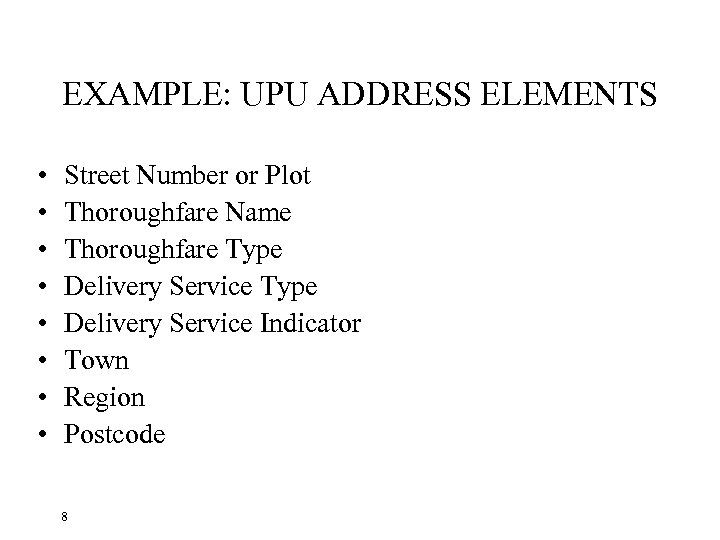 EXAMPLE: UPU ADDRESS ELEMENTS • • Street Number or Plot Thoroughfare Name Thoroughfare Type Delivery Service Indicator Town Region Postcode 8
 ADDRESS TEMPLATES “An address template states how an address is to be written; in particular, it shows the order in which address elements are to appear, distinguishes between mandatory and optional elements and provides rendition instructions. ” “Each country may have its own characteristic address templates. ” from UPU document “International Postal Address Components and Templates” 9
 ADDRESS TEMPLATES • Address templates reflect address types or patterns • Country based templates will be defined – Using natural language template (NLT) notation – Postal Address Template Description Language (PATDL) • • Language(s) of presentation must be specified A template is a sequential ordering of lines and elements Address format varies if mailing is internal vs. external Usable for single country applications without external knowledge • Templates need to support variations in formats – Support “trigger conditions” – Support user preferences 10
 POSTAL ADDRESS TEMPLATE DESCRIPTION LANGUAGE (PATDL) PATDL Version 2. 2 is included in UPU standard as a way to define templates in XML Does not define a format for address data, contains only address metadata Constitutes a link between the UPU standard and the IDEAlliance ADIS standard for business mail Includes integrated rendition instructions for final presentation of address Supports integrated tables for validation and abbreviation of element data 11
 POSTAL ADDRESS TEMPLATE DESCRIPTION LANGUAGE (PATDL) Supports multiple code sets or natural language XML tags • UPU elements, sub-types and codes • ADIS elements and codes • OASIS x. NAL elements • ECCMA codes • Other formats from defined sources Supports user preferences and job variables Implements conditional logic for conditional selection and branching Enables multiple sub-templates to be combined into one master address template per country 12
 RENDITION INSTRUCTIONS “Rendition instructions define how address elements must be rendered, or optionally may be rendered, when printed on a mail piece. They reflect rules for properly formatting addresses, including punctuation, spacing, fonts, the format of the postcode, locations for identifying marks and codes, abbreviations, and techniques for shortening and reorganizing components to ensure deliverability when there are constraints on available label space. ” from UPU document “International Postal Address Components and Templates” 13
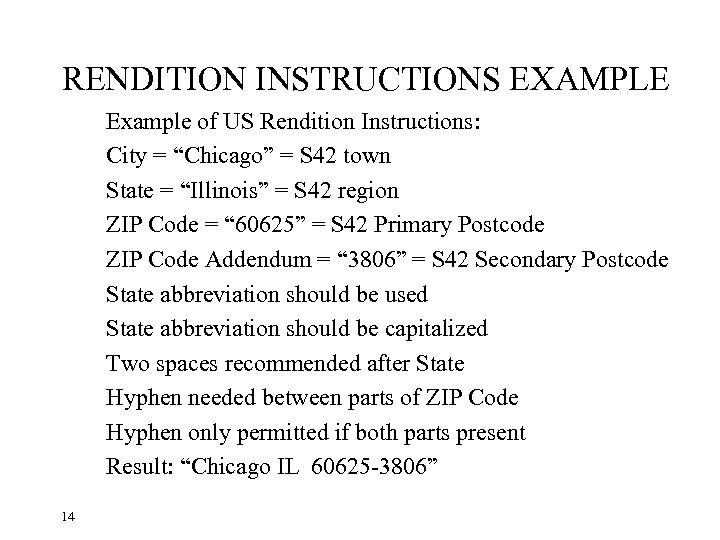 RENDITION INSTRUCTIONS EXAMPLE Example of US Rendition Instructions: City = “Chicago” = S 42 town State = “Illinois” = S 42 region ZIP Code = “ 60625” = S 42 Primary Postcode ZIP Code Addendum = “ 3806” = S 42 Secondary Postcode State abbreviation should be used State abbreviation should be capitalized Two spaces recommended after State Hyphen needed between parts of ZIP Code Hyphen only permitted if both parts present Result: “Chicago IL 60625 -3806” 14
 TEST PLAN Identify address types within each country Select 50 or more sample addresses of each type Identify the address elements individually Utilize all address elements found in the country Include name elements following privacy restrictions Define natural language and XML templates Specify trigger conditions when multiple branches defined Define result of passing data elements through templates If there is a delivery point database: Compare results to known delivery point formats Otherwise: Evaluation by subject matter experts Note that this procedure can be replicated as needed 15
 MILESTONES AND NEXT STEPS • S 42 -3 “International Postal Address Components and Templates” approved 3 February 2004 • S 42 -4 to be submitted to UPU Standards Board on 6 July 2004 • Templates will be developed in natural language and XML for more UPU member countries • IDEAlliance ADIS 04 -1 to be published after final editorial modifications • ADIS is an implementation of UPU S 42 for domestic and international business mail • ADIS defines an XML format for names and addresses as well as related information 16
 ADIS OPPORTUNITIES AND BENEFITS • Make UPU standard definition of address elements and templates available for all postal customers – – – Single list of elements worldwide Useful for database design Useful for disassembly of addresses Templates for each country Mail formatted per specifications of each Post Useful as part of validation process • This process has developed some momentum in Europe and North America 17
 ADIS OPPORTUNITIES AND BENEFITS • Customer databases may be redesigned to permanently retain address elements – – – Typically customers retain information line-by-line today This causes difficulty in validation and quality control Missing elements are hard to detect Elements must be parsed over and over again Information may be truncated during presentation • Need for transfer of data to legacy systems 18
 ADIS OPPORTUNITIES AND BENEFITS • Address formatting will be directly derived from stored data, templates and rendition instructions for any needed format – User may specify style preferences and label block size – After that, formatting will be automatic – Rendition will produce the most deliverable address subject to space constraints • Larger companies have multiple ways to do this • Smaller companies can use a turnkey solution 19
 ADIS OPPORTUNITIES AND BENEFITS • Economics of direct mail will be more advantageous – – – Less work for the Posts delivering mail Better response rates from accurate addressing Leads to increased mail volume for Posts Fewer problems with return of items Posts will compete better vs. other modes of communication • Need direct connection to address validation to make this advantage clear • Cost-based rates for addressing will help 20
 ADIS OPPORTUNITIES AND BENEFITS • Reduction in undeliverable mail and returned mail will benefit the Posts – – Some erroneous mail will never be sent Fewer duplicates will be mailed Question remains: what if recipient has moved? Question remains: how to make returns more efficient? • International electronic nixie and COA services need to be developed 21
 PERMANENT PARSING • Address parsed into elements when first encountered • Coding process is reduced from parsing and matching to matching only • Simpler and more reliable de-duplication • Can easily identify and exchange missing components • Once coded, only need to refresh coding at intervals • Parsing problems shown in earlier GCA study to account for two-thirds of coding failures 22
 AUTOMATIC FORMATTING • • • Place full and uncompromisingly rich data into database UPU templates and trigger conditions Set up rendition instructions for output format Create output file in ADIS format Addresses will be the best possible for the specified conditions • All defects can be measured as long as there is a delivery point database to define completeness and correctness 23
 MOVE UPDATE MANAGEMENT • Validate against databases of delivery points to allow mailers to maintain complete and correct addresses • Use change of address systems and procedures to the best effect since matching problems will be minimized • Document move update performance and methods used on an address by address basis to secure USPS discounts • Perform move update process as late as possible right up until the time of mailing • Generate Mail. dat and ADIS files and go to production 24
 COMPOSITE MAIL PIECES • Periodical “firm bundles” have reduced postage • Standard Mail and Bound Printed Matter composite mail pieces have reduced postage • The term “firm bundle” is misleading • A more accurate term is “delivery point bundle” • These bundles can be created when addresses are known to be complete and correct delivery point matches • Multiple magazines can be polywrapped into a single piece if schedules match • Several non-competing catalogs make one composite mail piece at reduced postage 25
 MAKING MAIL INTELLIGENT • USPS developing plans for future mail to identify sender and receiver and include information about itself • “Intelligent mail®” bar codes will not carry all relevant data • Example: 31 characters in 4 -state code • Even two-dimensional codes need updated or amended data • Some information in human readable form • Some information in the barcode • Some information accessible by unique key in barcode • ADIS supports any variation of the above three scenarios 26
 HOW TO IMPROVE MERLIN • MERLIN moving into address quality area but restricted to limited sample • Like presort and barcode quality errors, address quality deficiencies are not randomly distributed • MERLIN lets some errors through and by extrapolation, penalizes others too much • Portable electronic standardized file sets are a solution • Mail. dat in MERLIN would make presort evaluation more accurate and fair • ADIS in MERLIN would make address quality evaluation more accurate and fair 27