


 Скачать презентацию Universal Design Technology and Transportation Systems Aaron Steinfeld
efe7414258fb43f8f85502db5b38e3d1.ppt
- Количество слайдов: 19
 Universal Design, Technology, and Transportation Systems Aaron Steinfeld Robotics Institute, Carnegie Mellon University Rehabilitation Engineering Research Center on Accessible Public Transportation (RERC-APT) Co-Director Quality of Life Technologies Engineering Research Center (Qo. LT ERC) Lead, Safe Driving Qo. LT Systems Accessing the Future 2009
 Cast of Many RERC-APT Carnegie Mellon Anthony Tomasic John Zimmerman Ellen Ayoob Tim Andrianoff Steve Gardiner Rafae Aziz Jiseon (Daisy) Yoo Lauren Von Dehsen Alumni: Sun Young Park Priyanka Shetye Jean-Pierre (JP) Arsenault University at Buffalo Ed Steinfeld Jordana Maisel Victor Paquet James Lenker Heamchand Subryan Danise Levine Clive D’Souza United Spinal Association Gillig Corporation Grimshaw-Architects Safe Driving Qo. LT Carnegie Mellon Drew Bagnell Anind Dey Arne Suppe Brian Ziebart University of Pittsburgh Linda van Roosmalen Nahom Beyene Amy Lane Person & Society team Industry partners. . .
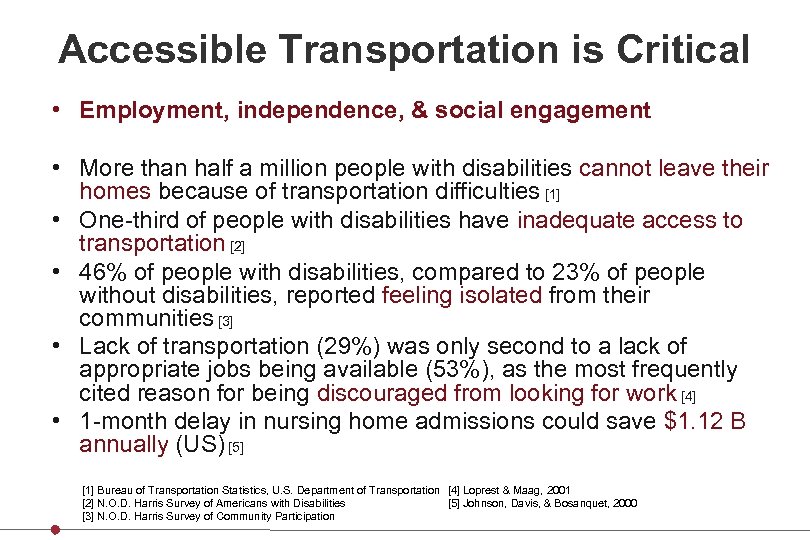 Accessible Transportation is Critical • Employment, independence, & social engagement • More than half a million people with disabilities cannot leave their homes because of transportation difficulties [1] • One-third of people with disabilities have inadequate access to transportation [2] • 46% of people with disabilities, compared to 23% of people without disabilities, reported feeling isolated from their communities [3] • Lack of transportation (29%) was only second to a lack of appropriate jobs being available (53%), as the most frequently cited reason for being discouraged from looking for work [4] • 1 -month delay in nursing home admissions could save $1. 12 B annually (US) [5] [1] Bureau of Transportation Statistics, U. S. Department of Transportation [4] Loprest & Maag, 2001 [5] Johnson, Davis, & Bosanquet, 2000 [2] N. O. D. Harris Survey of Americans with Disabilities [3] N. O. D. Harris Survey of Community Participation
 Apply IT advances in methods and technology to transportation Focus on need & capability, not diagnosis
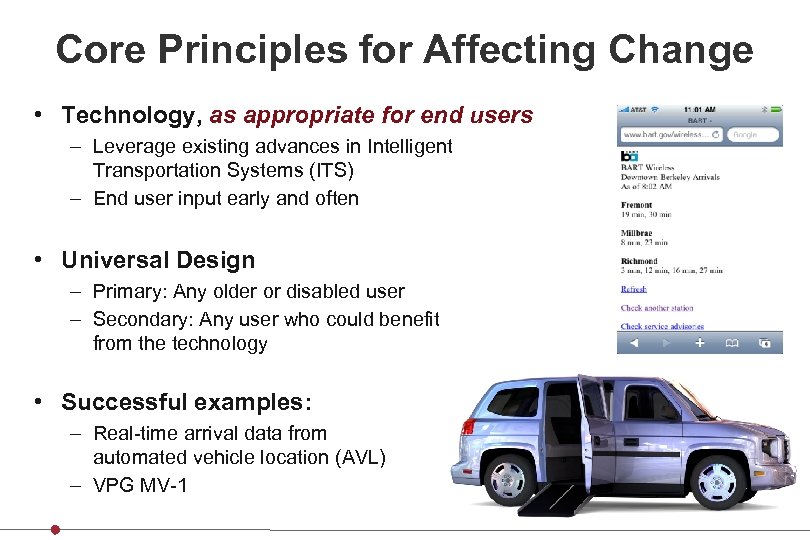 Core Principles for Affecting Change • Technology, as appropriate for end users – Leverage existing advances in Intelligent Transportation Systems (ITS) – End user input early and often • Universal Design – Primary: Any older or disabled user – Secondary: Any user who could benefit from the technology • Successful examples: – Real-time arrival data from automated vehicle location (AVL) – VPG MV-1
 Transit Status Quo • Funding, relationships, & complexity – Size and complexity of transit systems – Consistent funding challenges – Difficult to foster collaborative consumer participation – Paratransit is very expensive – More integration of accessibility into mainline components needed
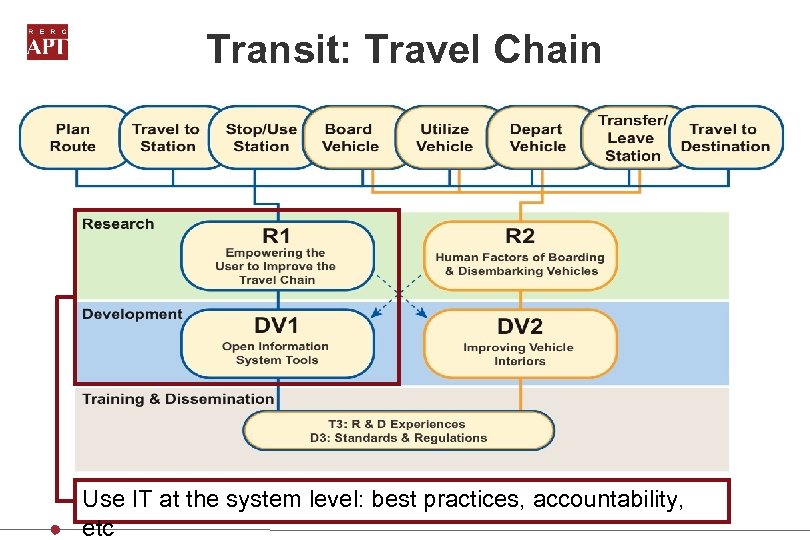 Transit: Travel Chain Use IT at the system level: best practices, accountability, etc
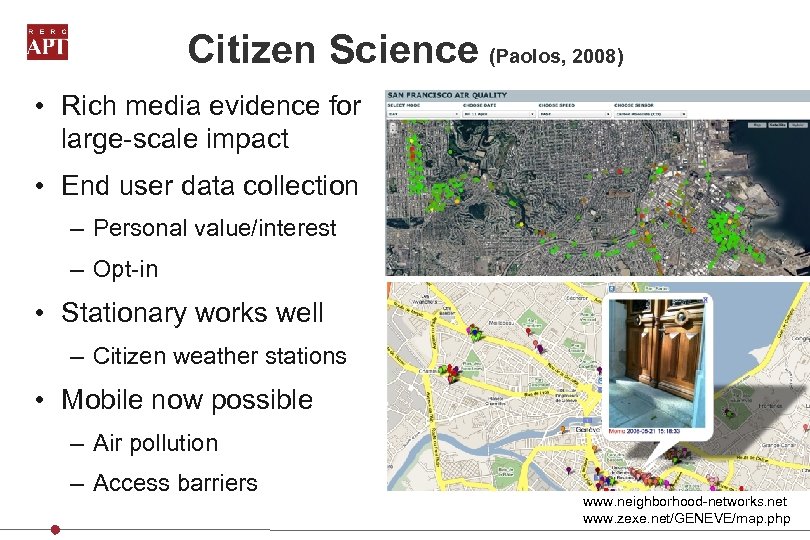 Citizen Science (Paolos, 2008) • Rich media evidence for large-scale impact • End user data collection – Personal value/interest – Opt-in • Stationary works well – Citizen weather stations • Mobile now possible – Air pollution – Access barriers www. neighborhood-networks. net www. zexe. net/GENEVE/map. php
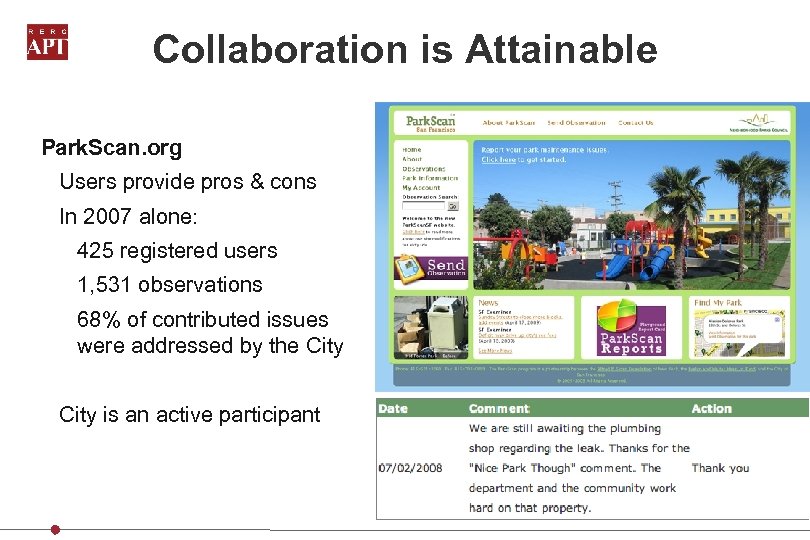 Collaboration is Attainable Park. Scan. org Users provide pros & cons In 2007 alone: 425 registered users 1, 531 observations 68% of contributed issues were addressed by the City is an active participant
 Transit
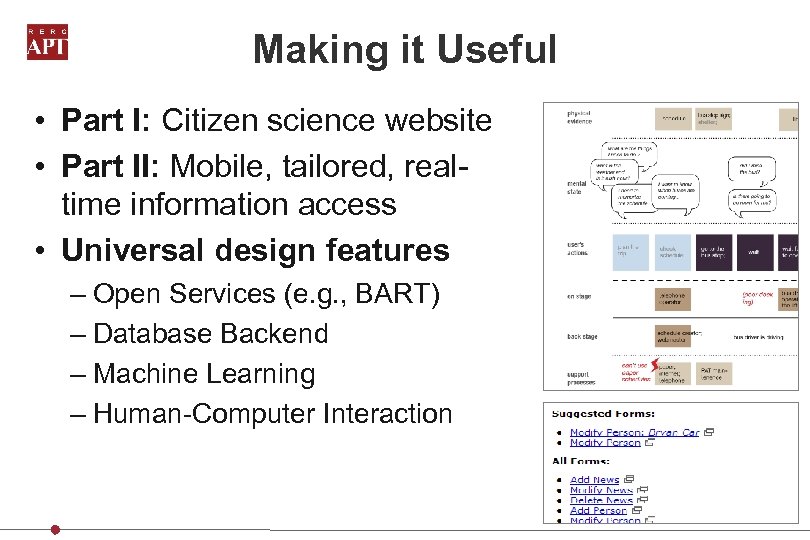 Making it Useful • Part I: Citizen science website • Part II: Mobile, tailored, realtime information access • Universal design features – Open Services (e. g. , BART) – Database Backend – Machine Learning – Human-Computer Interaction
 Personal Vehicles Status Quo • Reactive, infrequent, & incomplete – Driving assessment: Doctor screening via interviews and surveys, simulation/simulated driving assessments • May not detect changes rapidly, occur infrequently • By and large, discount importance of vehicle and environment familiarity – Only ~400 Driver rehabilitation specialists (CDRS) in the US – Vehicle changes are not cheap or easy to implement • Hand controls (with training) start at $2 k • Conversion vans for wheelchairs start at $20 k and rise quickly
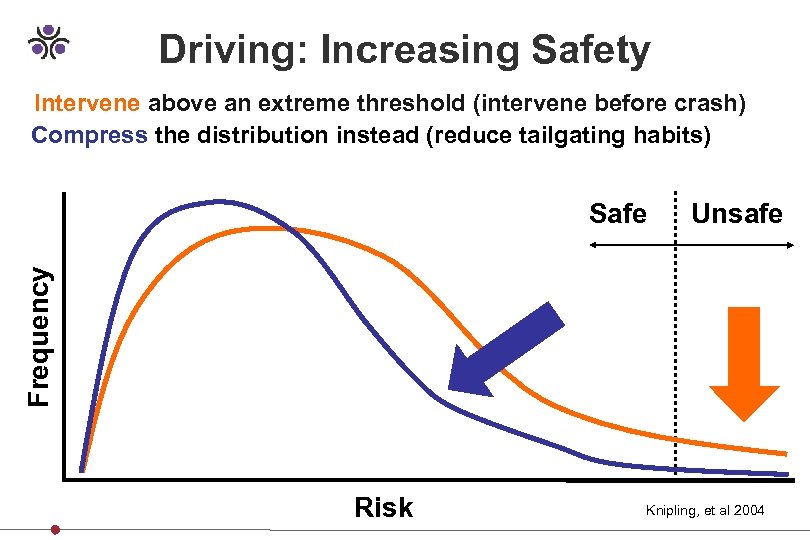 Driving: Increasing Safety Intervene above an extreme threshold (intervene before crash) Compress the distribution instead (reduce tailgating habits) Unsafe Frequency Safe Risk Knipling, et al 2004
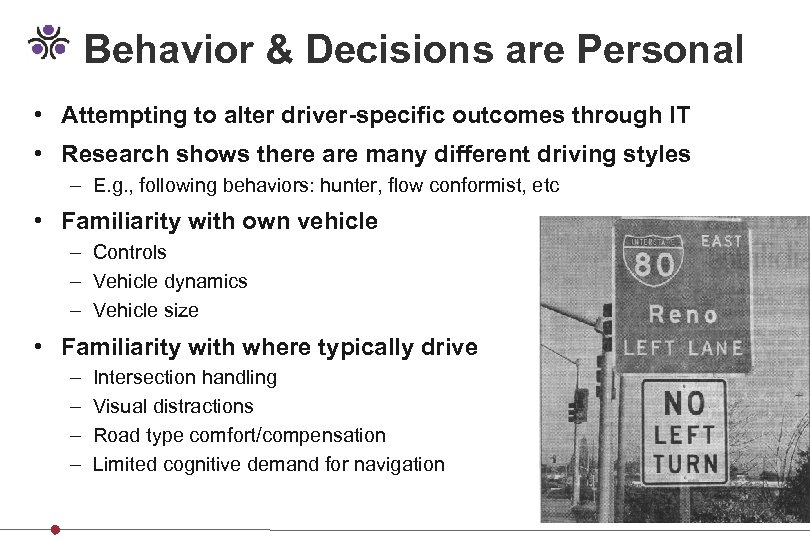 Behavior & Decisions are Personal • Attempting to alter driver-specific outcomes through IT • Research shows there are many different driving styles – E. g. , following behaviors: hunter, flow conformist, etc • Familiarity with own vehicle – Controls – Vehicle dynamics – Vehicle size • Familiarity with where typically drive – – Intersection handling Visual distractions Road type comfort/compensation Limited cognitive demand for navigation
 Safe Driving Projects • Drive. Cap: Low-cost aftermarket system that can measure capability on common denominator driving tasks in a wide range of vehicles • Drive. Cap Advisor: Extend Drive. Cap to provide acceptable driver advice • Drive. Cap Navigator: In-vehicle navigation that learns and supports robust application of rules related to driver capability and vehicle limits • Vehicle Transformation: Basic research that enables safer driving through key design and vehicle control improvements • Vehicle Enhancement: Basic development that enables safer driving through semi-autonomous vehicle control • Policy, payment, acceptance, and related issues throughout
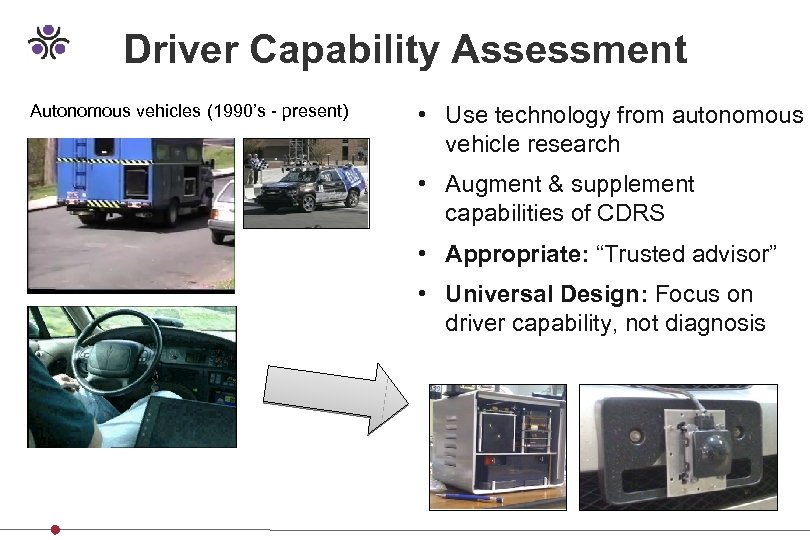 Driver Capability Assessment Autonomous vehicles (1990’s - present) • Use technology from autonomous vehicle research • Augment & supplement capabilities of CDRS • Appropriate: “Trusted advisor” • Universal Design: Focus on driver capability, not diagnosis
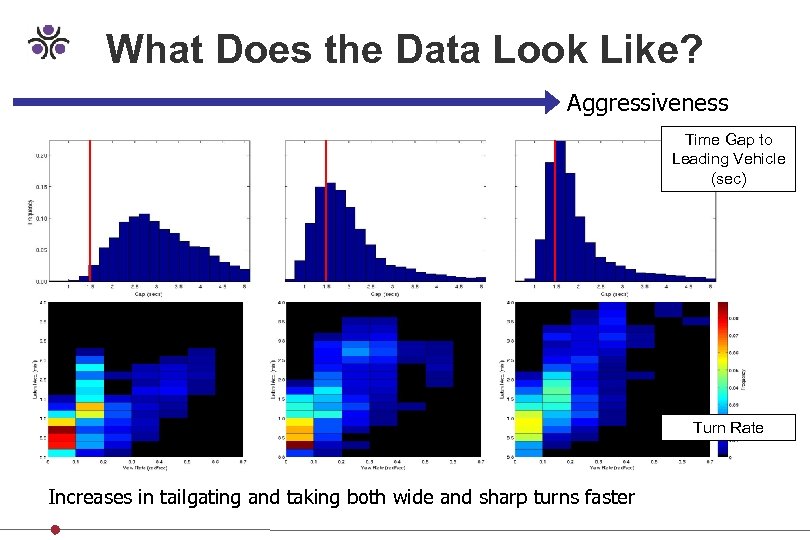 What Does the Data Look Like? Aggressiveness Time Gap to Leading Vehicle (sec) Turn Rate Increases in tailgating and taking both wide and sharp turns faster
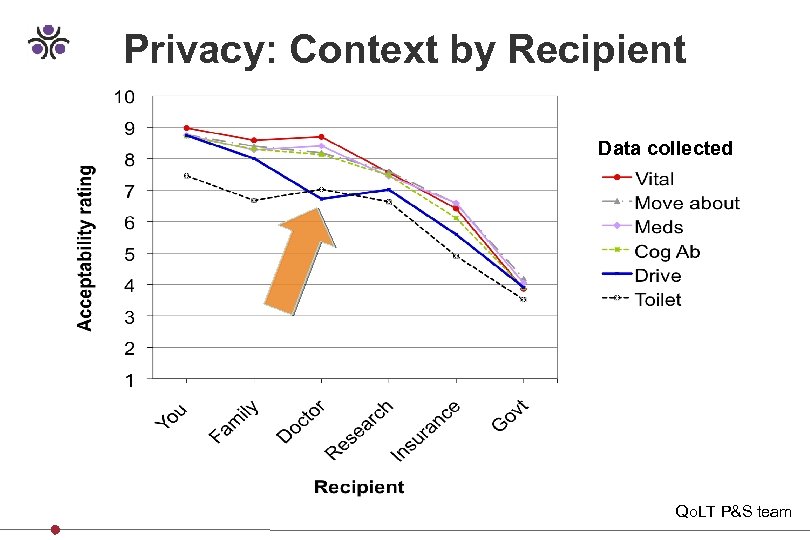 Privacy: Context by Recipient Data collected Qo. LT P&S team
 Thank You Funding provided by the U. S. Dept. of Education, National Institute on Disability and Rehabilitation Research, grant number H 133 E 080019. Project Website: http: //www. rercapt. org Part of this work is based on work supported by the National Science Foundation under Grant No. EEEC-540865. Project Website: http: //www. qolt. org Robotics Institute School of Computer Science Carnegie Mellon University Email: steinfeld@cmu. edu