


 Скачать презентацию Universal Design for Learning and Feminist Pedagogies Sarah
0b7d378d58ab05c6f9a03827b6634b04.ppt
- Количество слайдов: 16
 Universal Design for Learning and Feminist Pedagogies Sarah Smith Rainey Bowling Green State University Val Erwin Southern Methodist University
 Feminist Pedagogy Six Principles (Allen, Walker, and Webb 2002) 1. Reform relation between professor and student 2. Empowerment 3. Build community 4. Privilege voice (especially marginalized) 5. Respect diversity of experience 6. Challenge traditional pedagogical notions
 Universal Design The design of products and environments to be usable by all people to the greatest extent possible, without the need for adaptation or specialized design (Center for Universal Design at North Carolina State University, 1997). Examples: l Curb cuts l Automatic doors
 Why UDL in feminist pedagogy? l Maximizes learning and engagement for all kinds of students l l l Shows a willingness to accommodate individually when/if needed New generation of students who expect UDL and/or disability accommodations in higher ed Challenge traditional pedagogical notions l What counts as knowledge, learning, and learners
 Universal Design for Learning l Principle I: Provide Multiple Means of Representation l Principle II: Provide Multiple Means of Action and Expression l Principle III: Provide Multiple Means of Engagement
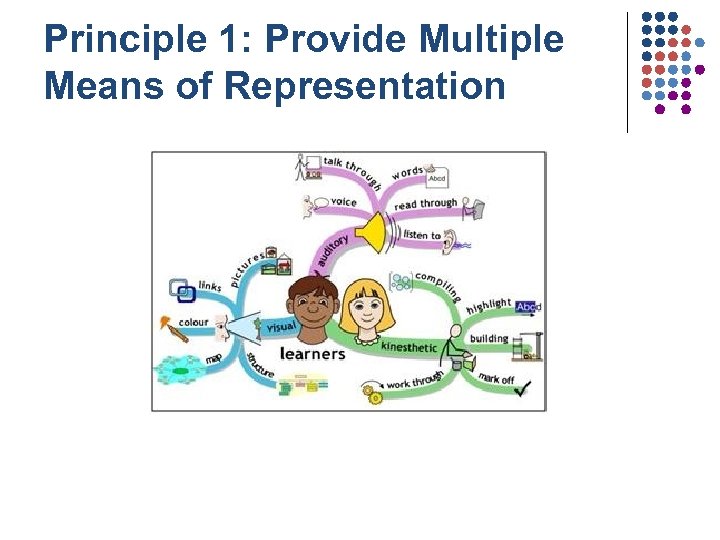 Principle 1: Provide Multiple Means of Representation
 Principle II: Provide Multiple Means of Action and Expression l Vary assessments l l Writing (formal papers, blogs, essays, etc. ), creative projects, worksheets, quizzes, group projects, oral reports, tests (short answer, multiple choice, verbal response, etc. ) Technology l Consider using technology to facilitate expression and improve communication
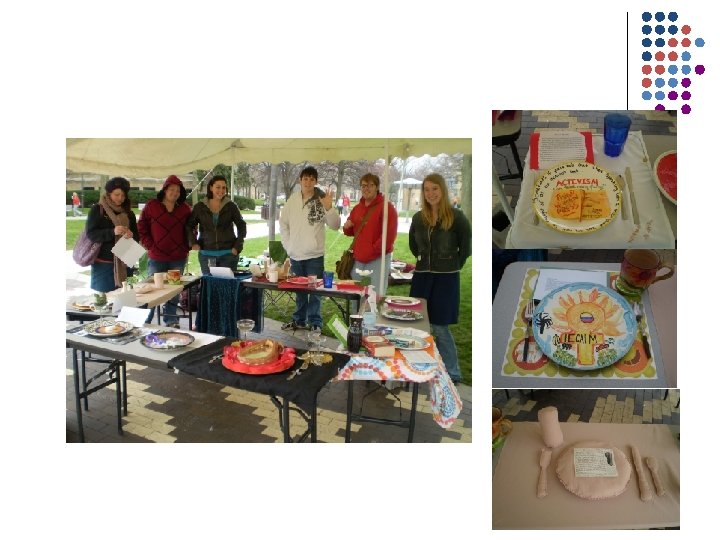
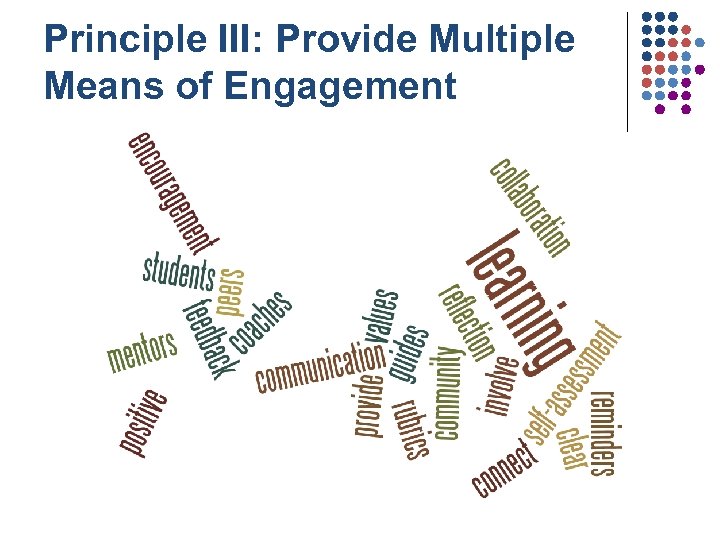 Principle III: Provide Multiple Means of Engagement
 UDL in Student Services l Create welcoming spaces l Develop, implement, and evaluate pathways for communication among students, staff, and faculty l Ensure that each student and staff member has an equal opportunity to learn and grow
 UDL in Student Services Cont. l Communicate clear expectations utilizing multiple formats l Use methods and strategies that consider diverse learning styles and abilities l Ensure confidentiality (PASS-IT, University of Minnesota, 2006)
 Barriers to Universal Design l l Disability services vary widely across campuses Faculty and staff attitudes Lack of knowledge of ways to provide access People thinking that Universal Design will solve all accommodation needs
 Case Studies l A women’s center is located in a two story house on campus with no elevator. The bottom floor is accessible but half of their space is upstairs. They have four spaces downstairs and three spaces upstairs. They have a library, three staff offices, a kitchen, a meeting space, and a lactation location. What places would you make accessible and how would you make sure people could use some of the parts that might be inaccessible?
 You have a class that is very discussion based what are ways to incorporate universal design principles into a class that is primarily discussion? What are ways you could set up a room? Encourage dialogue on different levels?
 A Universal Design Check List and Questions?
 References l l l l l Alexandrin, J. R. , Schreiber, J. L. , & Henry, E. (2008). Why Not Disclose? In J. Higbee & E. Goff (Eds. ), Pedagogy and Student Services for Institutional Transformation: Implementing Universal Design in Higher Education. Minneapolis, Minnesota. Center for Research on Developmental Education and Urban Literacy CAST http: //www. cast. org/index. html Evans, N. J. , & Herriott, T. K. (2009). Philosophical and theoretical approaches to disability. In J. L. Higbee & A. A. Mitchell (Eds. ), Making good on the promise: Student affairs professionals with disabilities (pp. 27 -40). Washington, DC: ACPA—College Student Educators International and University Press of America. Hackman, (2008). Broadening the Pathway to Academic Success: The Critical Intersections of Social Justice Education, and Universal Instructional Design In J. Higbee & E. Goff (Eds. ), Pedagogy and Student Services for Institutional Transformation: Implementing Universal Design in Higher Education. Minneapolis, Minnesota. Center for Research on Developmental Education and Urban Literacy Higbee, J. L. , & Goff, E. (2008). Pedagogy and student services for institutional transformation: Implementing universal design in higher education. Minneapolis: University of Minnesota, Center for Research on Developmental Education and Urban Literacy. Higbee, J. L. , & Mitchell, Alice A. (2009). Making good on the promise: Student affairs professionals with disabilities. Washington, DC: ACPA—College Student Educators International and University Press of America. Linton, S. (1998). Claiming disabilities: Knowledge and identity. New York, NY: New York University Press. North Carolina Office on Disability and Health (2004). Removing barriers: Planning meetings that are accessible to all participants. Chapel Hill: The University of North Carolina, FPG Child Development Institute, NCODH Opitz, D. L. & Block, L. S. (2008). Universal Learning Support Sesign Maximizing Learning Beyond the Classroom In J. Higbee & E. Goff (Eds. ), Pedagogy and Student Services for Institutional Transformation: Implementing Universal Design in Higher Education. Minneapolis, Minnesota. Center for Research on Developmental Education and Urban Literacy