 Скачать презентацию Universal Design Accessibility challenges opportunities and limitations European
b4153a84a6e024c9ce2c45585415f2b2.ppt
- Количество слайдов: 28



Universal Design/Accessibility – challenges, opportunities and limitations European Conference Protecting and promoting the rights of persons with disabilities in Europe: towards full participation, inclusion and empowerment Strasbourg, 29 -30 October 2008 Siemens Accessibility Competence Center Klaus-Peter Wegge © 2008 Klaus-Peter Wegge Unauthorized Distribution prohibited
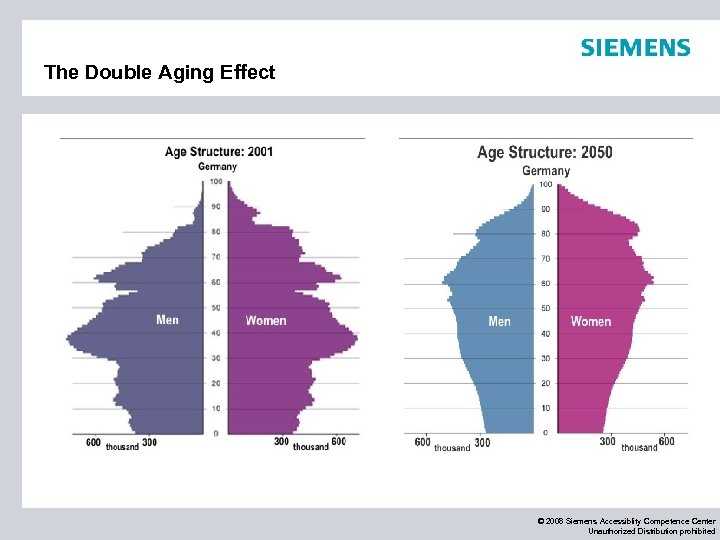
The Double Aging Effect © 2008 Siemens Accessiblity Competence Center Unauthorized Distribution prohibited
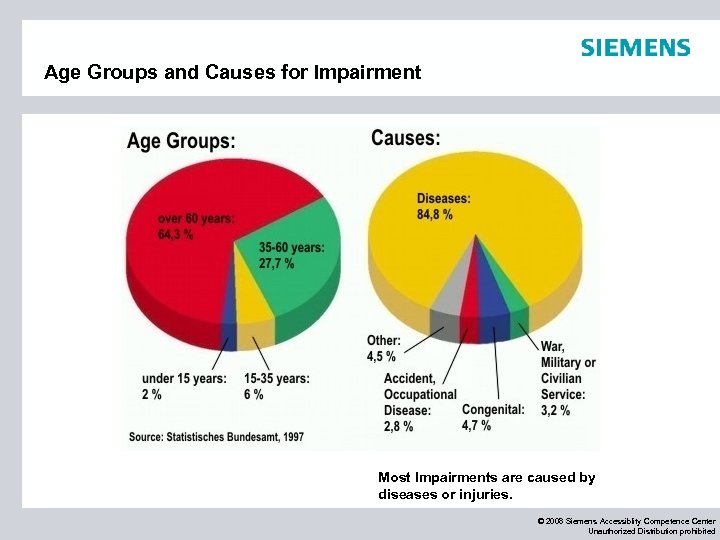
Age Groups and Causes for Impairment Most Impairments are caused by diseases or injuries. © 2008 Siemens Accessiblity Competence Center Unauthorized Distribution prohibited
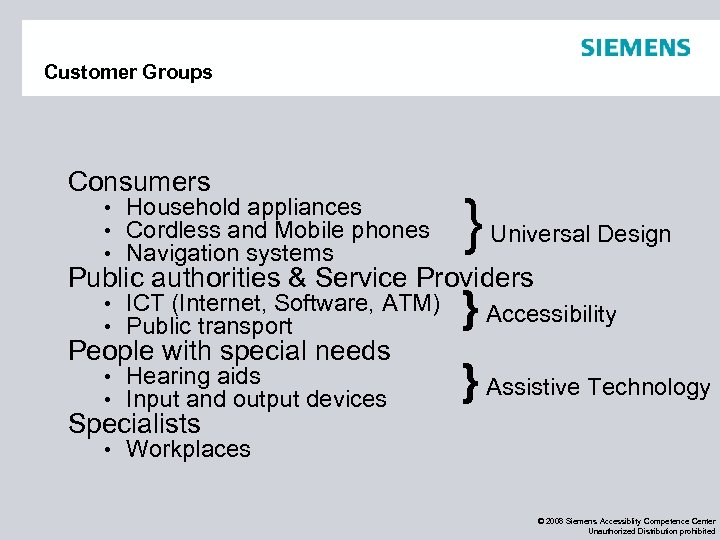
Customer Groups Consumers • Household appliances • Cordless and Mobile phones • Navigation systems } • ICT (Internet, Software, ATM) • Public transport } Accessibility • Hearing aids • Input and output devices } Assistive Technology Universal Design Public authorities & Service Providers People with special needs Specialists • Workplaces © 2008 Siemens Accessiblity Competence Center Unauthorized Distribution prohibited
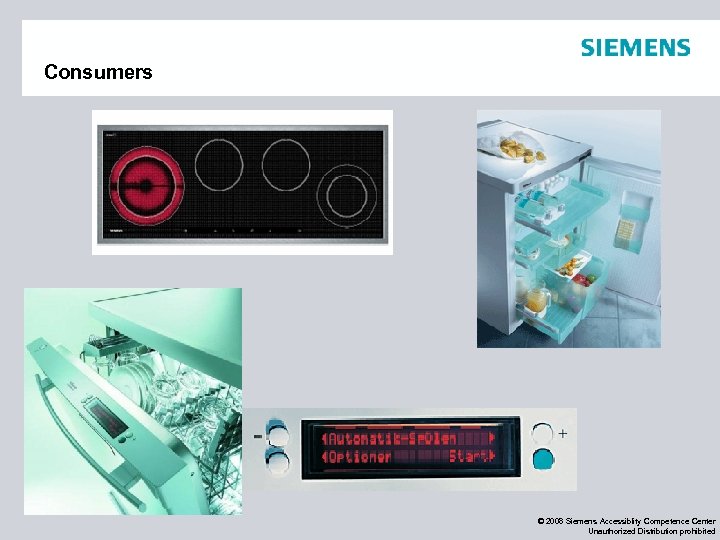
Consumers © 2008 Siemens Accessiblity Competence Center Unauthorized Distribution prohibited
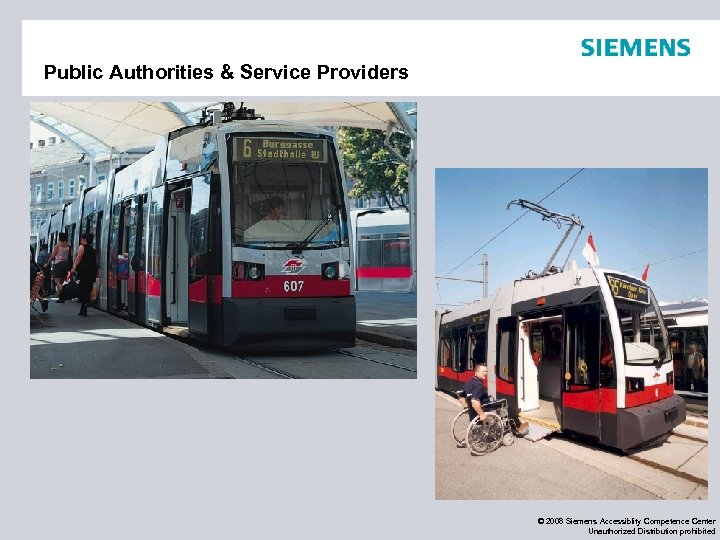
Public Authorities & Service Providers © 2008 Siemens Accessiblity Competence Center Unauthorized Distribution prohibited
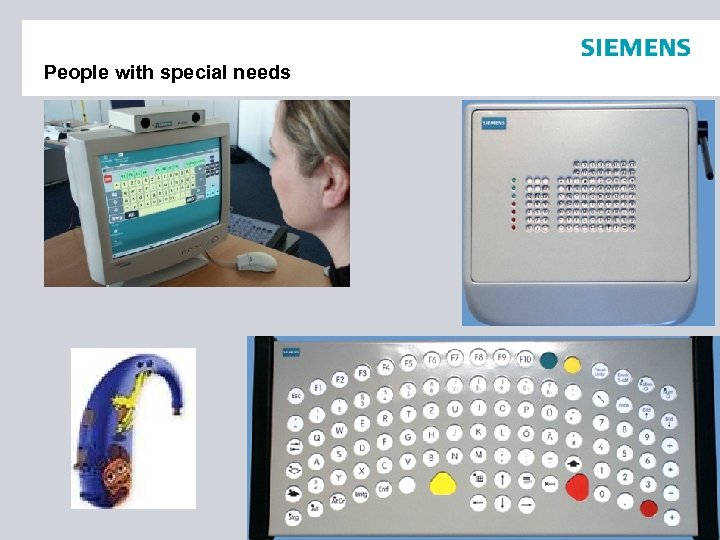
People with special needs © 2008 Siemens Accessiblity Competence Center Unauthorized Distribution prohibited
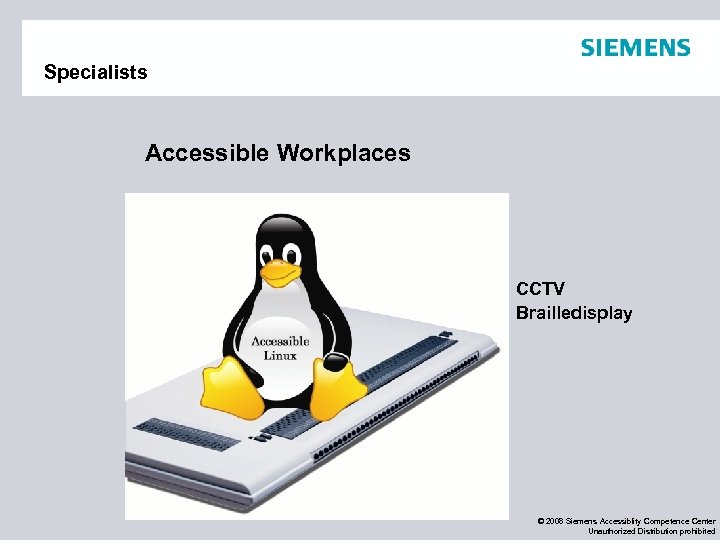
Specialists Accessible Workplaces CCTV Brailledisplay © 2008 Siemens Accessiblity Competence Center Unauthorized Distribution prohibited
Universal Design § Universal/Accessible design: “Design focussed on principles of extending standard design to people with some type of performance limitation to maximize the number of potential customers who can readily use a product, building or service. ” (ISO/IEC Guide 71) § There are three main strategies for Design for All: - design for most users without modifications, - design for easy adaptation to different users - design with a view to connect seamlessly to assistive devices. (European Commission) © 2008 Siemens Accessiblity Competence Center Unauthorized Distribution prohibited
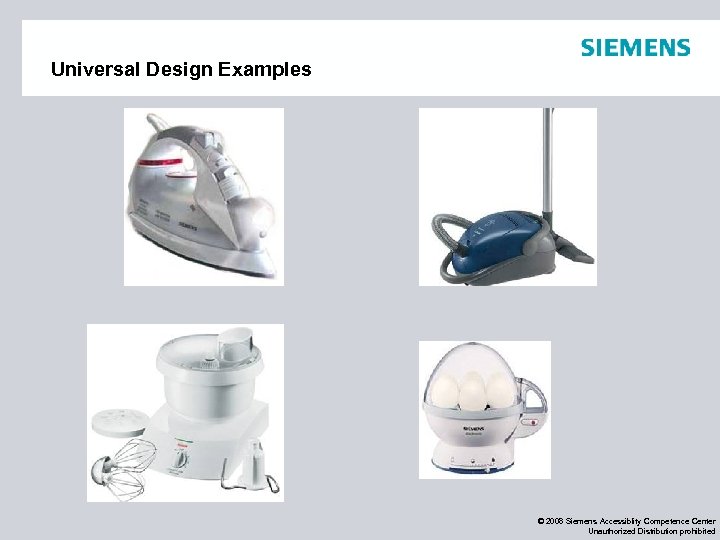
Universal Design Examples © 2008 Siemens Accessiblity Competence Center Unauthorized Distribution prohibited
The SIEMENS Accessibility Competence Center § § § Participation in the early design process In-house evaluation and training Accessibility engineers Specialists with different types of impairments Learning from users: • Exhibitions and conferences • Participation in R&D-Projects • Cooperation with organisations of disabled persons & providers of assistive technology © 2008 Siemens Accessiblity Competence Center Unauthorized Distribution prohibited
Implementation of Universal Design § Siemens Corporate Statement on Disability Access and Design for All / Universal Design § Internal coordination and information exchange § Contact partner to regulators and industry associations § Contribution to Accessibility standardisation (ISO, CEN/CENELEC, . . . ) § Handling of inquiries © 2008 Siemens Accessiblity Competence Center Unauthorized Distribution prohibited
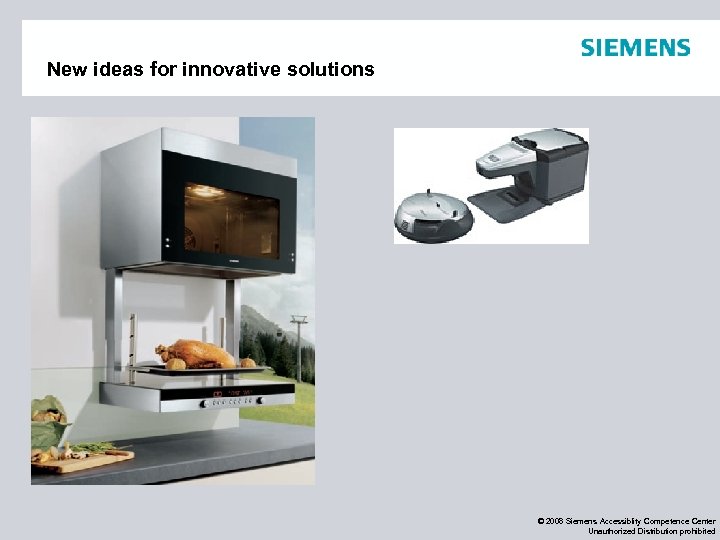
New ideas for innovative solutions © 2008 Siemens Accessiblity Competence Center Unauthorized Distribution prohibited
Older People as Consumers § Older people are a non-homogeneous user group! § Information of consumers, resellers and architects are required § Installation and configuration is crucial for usability § Special briefing, training and instruction materials are necessary § Who makes the buying decision for whom? The usability of a product is perceived very individually due to age, experience, training or type and degree of impairment. © 2008 Siemens Accessiblity Competence Center Unauthorized Distribution prohibited
People with impairments as Consumers § People with impairments are a non-homogeneous user group! § Information of consumers, resellers and providers of assistive technologies are required § Installation and configuration is crucial for accessibility § Special briefing, training and instruction materials are necessary The accessibility of a product is perceived very individually due to age, experience, training or type and degree of impairment. © 2008 Siemens Accessiblity Competence Center Unauthorized Distribution prohibited
Advancing Universal Design Requirements of elderly people and people with different types of impairments are nearly the same in all countries, and companies are producing for a global market, but: • incompatible definitions and terms • different national regulation • inconsistent (national) standards • contradictory guidelines • contradictory user requirements © 2008 Siemens Accessiblity Competence Center Unauthorized Distribution prohibited
Principles and Challenges § § § § No disadvantages to users No discrimination against or stigmatization of users What is readily achievable or reasonable? Who pays for Universal Design/Accessibility? Is accessibility a yes/no decision? Self declaration versus (third party) certification Who will benefit from accessibility labeling? © 2008 Siemens Accessiblity Competence Center Unauthorized Distribution prohibited
Instruments to improve Universal Design § Encourage users and buyers to buy accessible § Accessibility in Public Procurement (EU mandate 376) § Awarenessrising (engineers designers) § More scientific knowledge on the ergonomic data of elderly people or persons with reduced abilities is required. § Terms, definitions, user requirements and recommendations need to be simplified. § Harmonised and easy applicable standards and tools are required. Example: ISO TR 22411 "Ergonomics data and guidelines for the application of ISO/IEC Guide 71 to products and services to address the needs of older persons and persons with disabilities" © 2008 Siemens Accessiblity Competence Center Unauthorized Distribution prohibited
New Stakeholders in Universal Design § Accessibility is always years behind current technology. A sustainable commitment is required to include accessibility in the development of new technologies. § "Ambient assisted living" will support elderly people for a longer independent living at their homes. Intelligent assisting solutions have to be accessible. § Active users (WEB 2. 0) should support accessibility. © 2008 Siemens Accessiblity Competence Center Unauthorized Distribution prohibited
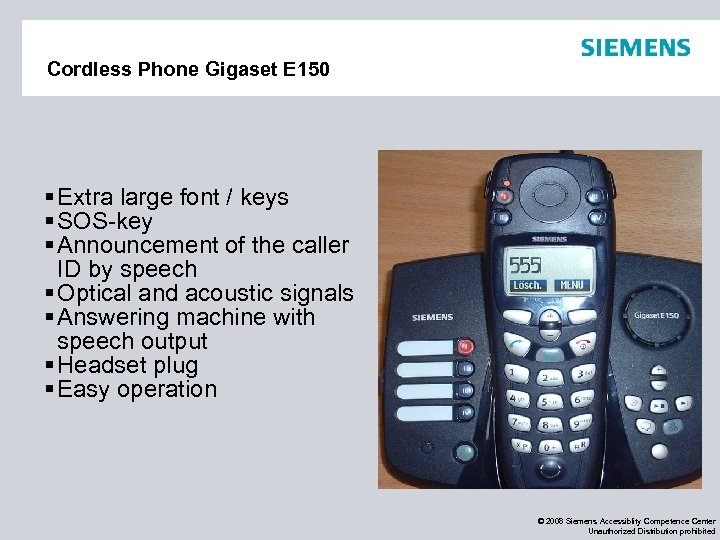
Cordless Phone Gigaset E 150 § Extra large font / keys § SOS-key § Announcement of the caller ID by speech § Optical and acoustic signals § Answering machine with speech output § Headset plug § Easy operation © 2008 Siemens Accessiblity Competence Center Unauthorized Distribution prohibited
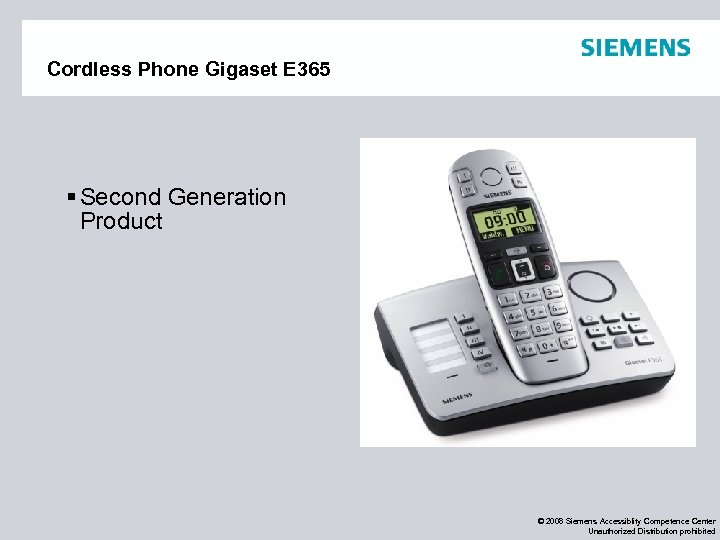
Cordless Phone Gigaset E 365 § Second Generation Product © 2008 Siemens Accessiblity Competence Center Unauthorized Distribution prohibited
Mandat 376 of the European Commission „STANDARDISATION MANDATE TO CEN, CENELEC AND ETSI IN SUPPORT OF EUROPEAN ACCESSIBILITY REQUIREMENTS FOR PUBLIC PROCUREMENT OF PRODUCTS AND SERVICES IN THE ICT DOMAIN“ Objectives: to harmonise and facilitate the public procurement of accessible ICT products and services by identifying a set of functional European accessibility requirements for public procurement of products and services in the ICT domain, and n to provide a mechanism through which the public procurers have access to an electronic toolkit, enabling them to make use of these harmonised requirements in procurement process. n © 2008 Siemens Accessiblity Competence Center Unauthorized Distribution prohibited
Mandate 376 Phase I Inventory of European and international accessibility requirements and assessment of suitable testing and conformity schemes Results: 1 a) An inventory of ICT products and services 1 b) A list of functional accessibility requirements 1 c) Identification of gaps where no accessibility requirements exist 1 d) A list of existing standards 1 e) A proposal for the development of requirements and award criteria 2) Report on analysis on testing and conformity schemes of products and services meeting accessibility requirements © 2008 Siemens Accessiblity Competence Center Unauthorized Distribution prohibited
References § European Commisssion: Mandate 376: http: //ec. europa. eu/information_society/policy/accessibility/deploy/pubproc/esom 376/index_en. htm § ETSI Technical Report ETSI DTR 102 612: “Human Factors (HF); European accessibility requirements for public procurement of products and services in the ICT domain“ http: //portal. etsi. org/stfs/STF_Home. Pages/STF 333. asp § CEN/CENELEC Report: “Analysis on testing and conformance schemes of products and services meeting accessibility requirements“ http: //www. econformance. eu/euconformancereport. html § EICTA: “White paper on e. Accessibility“ http: //www. eicta. org/fileadmin/user_upload/document 1166614008. pdf § EICTA: “Accessibility Best Practice Booklet" http: //www. eicta. org/web/news/telecharger. php? iddoc=627 © 2008 Siemens Accessiblity Competence Center Unauthorized Distribution prohibited
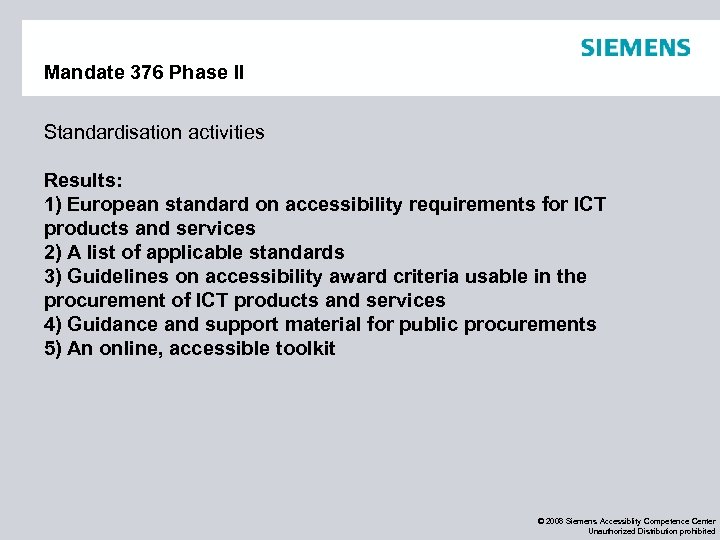
Mandate 376 Phase II Standardisation activities Results: 1) European standard on accessibility requirements for ICT products and services 2) A list of applicable standards 3) Guidelines on accessibility award criteria usable in the procurement of ICT products and services 4) Guidance and support material for public procurements 5) An online, accessible toolkit © 2008 Siemens Accessiblity Competence Center Unauthorized Distribution prohibited
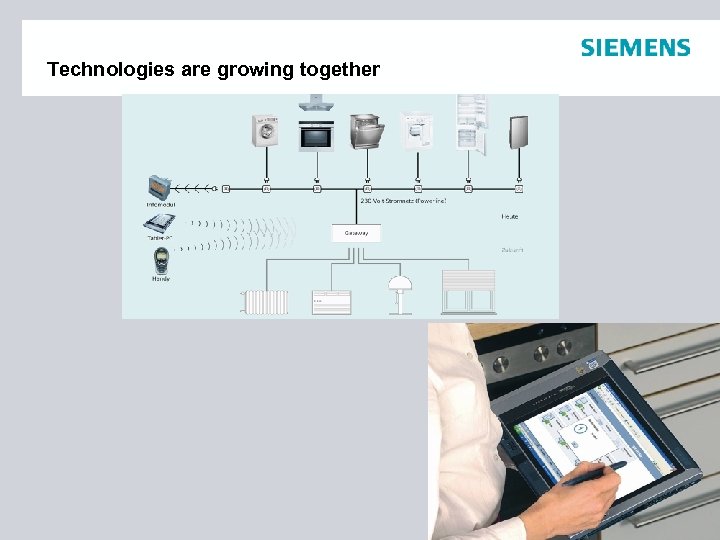
Technologies are growing together © 2008 Siemens Accessiblity Competence Center Unauthorized Distribution prohibited
"I have always wished for my computer to be as easy to use as my telephone; my wish has come true because I can no longer figure out how to use my telephone“ Bjarne Stroustrup © 2008 Siemens Accessiblity Competence Center Unauthorized Distribution prohibited
Contact Siemens AG Accessibility Competence Center SIS C-LAB Fürstenallee 11 33102 Paderborn Germany Klaus-Peter Wegge Phone: Fax: Mobile: Mail: +49 5251 -606144 +49 5251 -606065 +49 171 -5537500 wegge@c-lab. de © 2008 Siemens Accessiblity Competence Center Unauthorized Distribution prohibited
Скачать презентацию Universal Design Accessibility challenges opportunities and limitations European
b4153a84a6e024c9ce2c45585415f2b2.ppt