


 Скачать презентацию Units of Play Simple Complex Super Units
1dc088681452213c87885c51a18749d6.ppt
- Количество слайдов: 8
 Units of Play (Simple, Complex, Super Units) • Simple unit – one primary purpose in play – generally used by one child at a time for the intended purpose – usually does not have subparts – e. g. a drum, a spinning toy, a windup toy = one play space (when calculating the complexity of the play environment) Shipley, D. (1993). Empowering children: Play-based curriculum for lifelong learning. Scarborough, Ont. : Nelson Canada
 Units of Play (Simple, Complex, Super Units) • Complex units – a play unit with subparts – offers flexibility for various types of play – can be created by combining two or more simple units, or by adding simple units to one that is complex – E. g. • a telephone (a simple unit) + note pads (a simple unit) • a tape recorder (a simple unit) + a few sets of earphones (a simple unit) • a doll house with furniture / a doctor’s kits / a puppet theatre with hand puppets – Require sufficient space for children to use the same toy either in small group or on his own = four play spaces (when calculating the complexity of the play environment)
 Units of Play (Simple, Complex, Super Units) • Super units – having one or more additional play materials – e. g. a toy shelf stocked with grocery boxes and tins, and paper bags – e. g. adding blankets and tables to the playhouse = eight play spaces (assuming the space in which the super unit is set up can house eight children)
 Example • a 1 -metre-square water table with jugs & plastic bottles • string painting at a round table for four • 4 single-sided easels • a small listening centre with 2 headsets • a climber with slide, firefighter’s pole, and helmets • a table and 4 chairs with a tea set • one set of unit blocks with wooden accessories • 4 hoops • a bean bag target toss with four bean bags
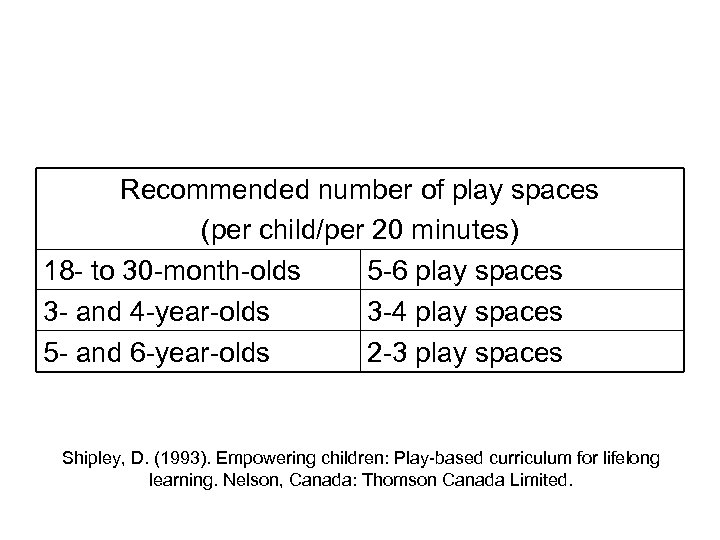 Recommended number of play spaces (per child/per 20 minutes) 18 - to 30 -month-olds 5 -6 play spaces 3 - and 4 -year-olds 3 -4 play spaces 5 - and 6 -year-olds 2 -3 play spaces Shipley, D. (1993). Empowering children: Play-based curriculum for lifelong learning. Nelson, Canada: Thomson Canada Limited.
 Contents of Play Space • Variety – How many kinds of things are there to do in the learning environment? – Is there a disproportionate amount of any one kind of thing to do? – Does the variety of the play units address the interests and developmental needs of all children individually?
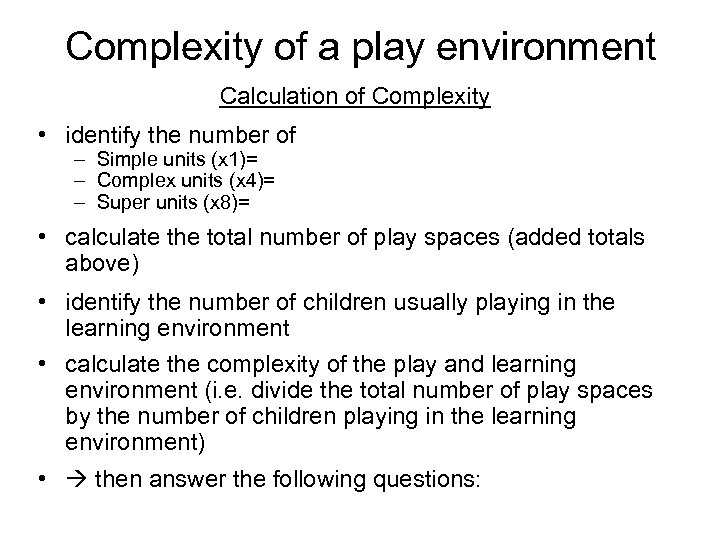 Complexity of a play environment Calculation of Complexity • identify the number of – Simple units (x 1)= – Complex units (x 4)= – Super units (x 8)= • calculate the total number of play spaces (added totals above) • identify the number of children usually playing in the learning environment • calculate the complexity of the play and learning environment (i. e. divide the total number of play spaces by the number of children playing in the learning environment) • then answer the following questions:
 • Is the proportion of things to do per child within the ranges deemed acceptable for the age group: – 1 -2 years = 5 -6 play space? – 3 -4 years = 3 -4 play space? – 5 -6 years = 2 -3 play space? • Is there a need for: – More simple units? More complex units? More super units? • Is there a need to combine units? – List the play units which can be added to each learning centre to raise total number of play spaces: daily living/active role play/quiet thinking/science discovery/technology/unit blocks/creative • Total number of additional play units? – Calculate revised complexity using formulas: • Total number of play spaces divided by number of children normally playing in a learning environment equals the complexity or amount to do per child.