


 Скачать презентацию United States Immigration and Immigration Policies Colonial Times
5d0f02a937f95a8c2b5cf13ba25bf8b4.ppt
- Количество слайдов: 44
 United States Immigration and Immigration Policies, Colonial Times to Present
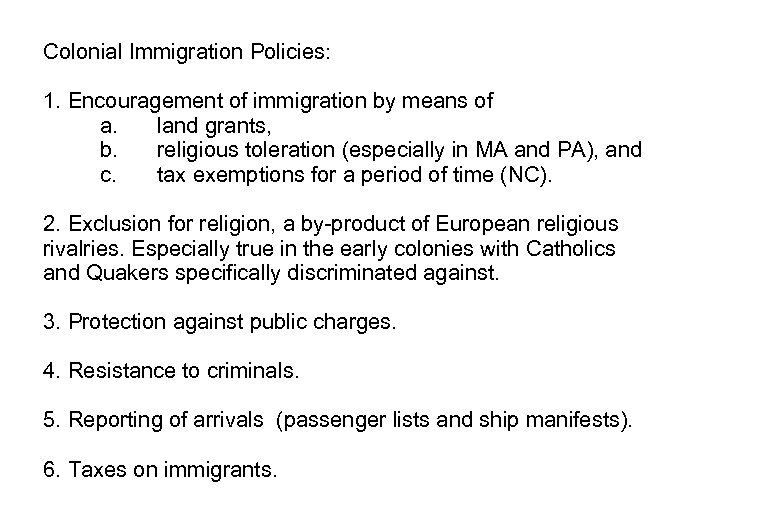 Colonial Immigration Policies: 1. Encouragement of immigration by means of a. land grants, b. religious toleration (especially in MA and PA), and c. tax exemptions for a period of time (NC). 2. Exclusion for religion, a by-product of European religious rivalries. Especially true in the early colonies with Catholics and Quakers specifically discriminated against. 3. Protection against public charges. 4. Resistance to criminals. 5. Reporting of arrivals (passenger lists and ship manifests). 6. Taxes on immigrants.
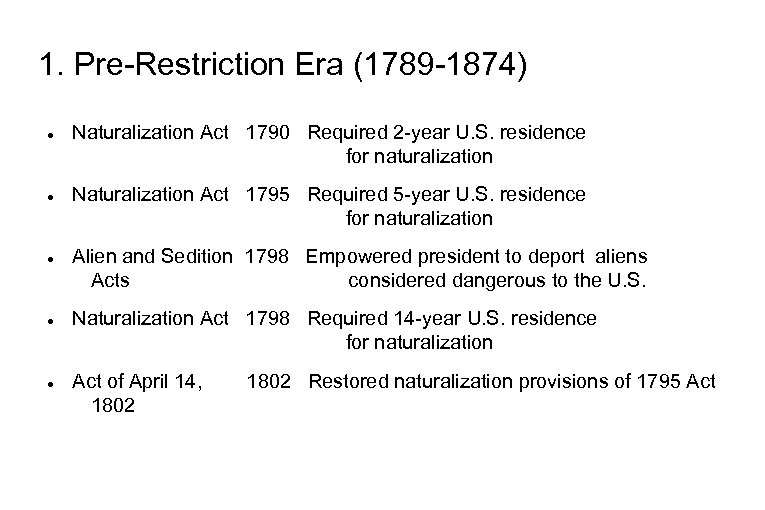 1. Pre-Restriction Era (1789 -1874) Naturalization Act 1790 Required 2 -year U. S. residence for naturalization Naturalization Act 1795 Required 5 -year U. S. residence for naturalization Alien and Sedition 1798 Empowered president to deport aliens Acts considered dangerous to the U. S. Naturalization Act 1798 Required 14 -year U. S. residence for naturalization Act of April 14, 1802 Restored naturalization provisions of 1795 Act
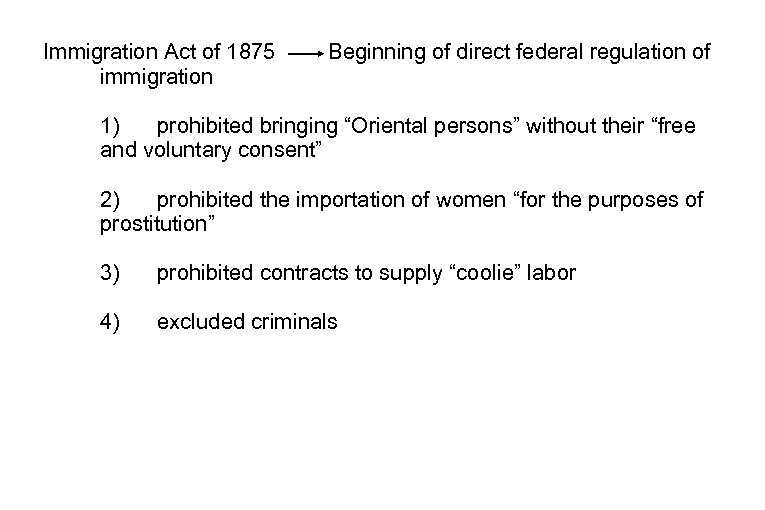 Immigration Act of 1875 immigration Beginning of direct federal regulation of 1) prohibited bringing “Oriental persons” without their “free and voluntary consent” 2) prohibited the importation of women “for the purposes of prostitution” 3) prohibited contracts to supply “coolie” labor 4) excluded criminals
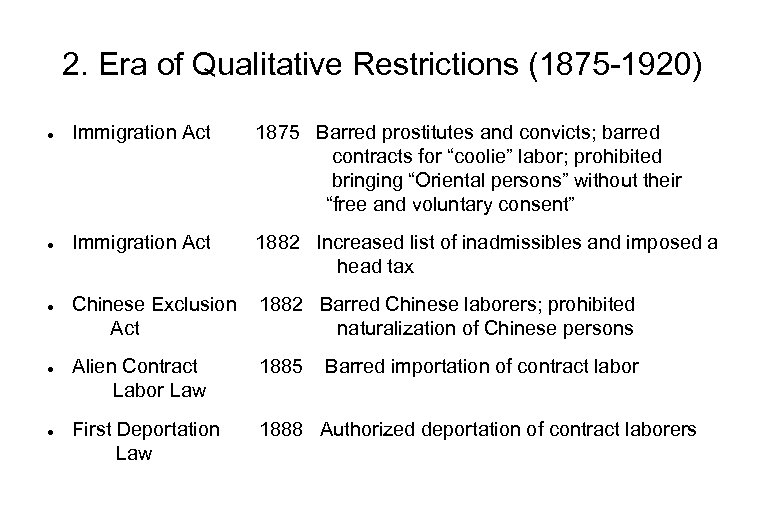 2. Era of Qualitative Restrictions (1875 -1920) Immigration Act 1875 Barred prostitutes and convicts; barred contracts for “coolie” labor; prohibited bringing “Oriental persons” without their “free and voluntary consent” Immigration Act 1882 Increased list of inadmissibles and imposed a head tax Chinese Exclusion Act 1882 Barred Chinese laborers; prohibited naturalization of Chinese persons Alien Contract Labor Law 1885 First Deportation Law 1888 Authorized deportation of contract laborers Barred importation of contract labor
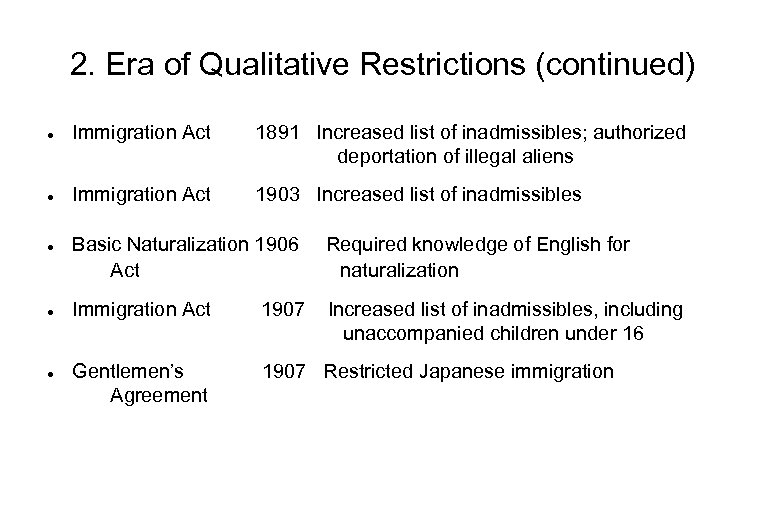 2. Era of Qualitative Restrictions (continued) Immigration Act 1891 Increased list of inadmissibles; authorized deportation of illegal aliens Immigration Act 1903 Increased list of inadmissibles Basic Naturalization 1906 Act Required knowledge of English for naturalization Immigration Act 1907 Increased list of inadmissibles, including unaccompanied children under 16 Gentlemen’s Agreement 1907 Restricted Japanese immigration
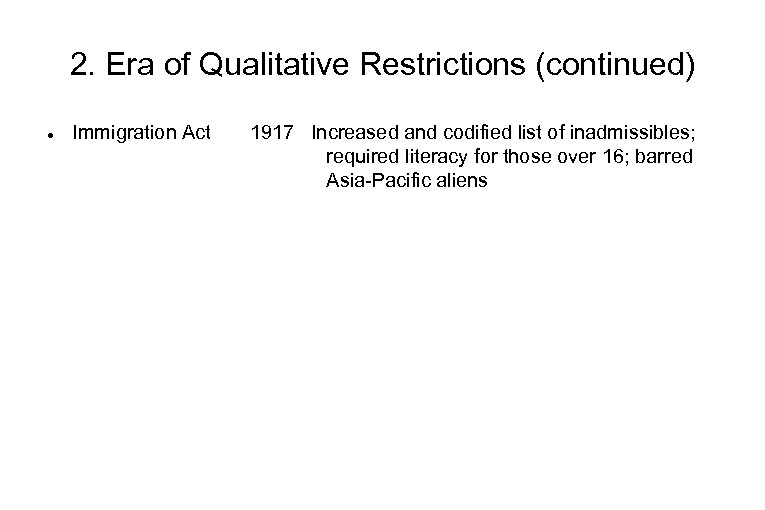 2. Era of Qualitative Restrictions (continued) Immigration Act 1917 Increased and codified list of inadmissibles; required literacy for those over 16; barred Asia-Pacific aliens
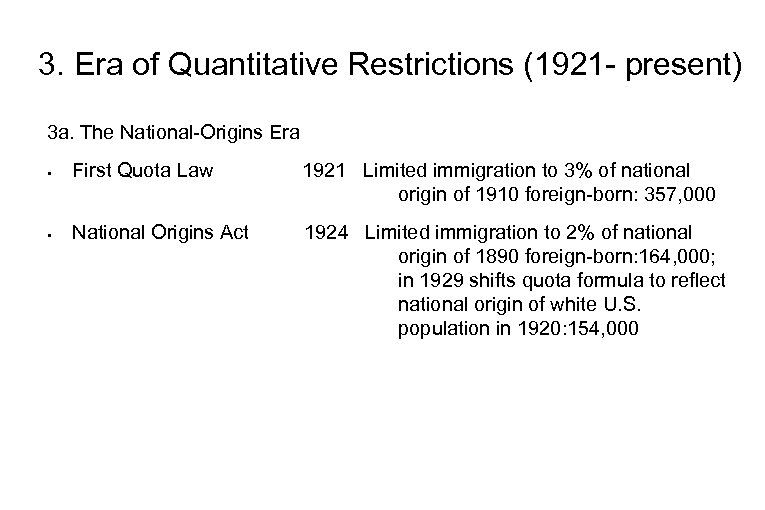 3. Era of Quantitative Restrictions (1921 - present) 3 a. The National-Origins Era § First Quota Law 1921 Limited immigration to 3% of national origin of 1910 foreign-born: 357, 000 § National Origins Act 1924 Limited immigration to 2% of national origin of 1890 foreign-born: 164, 000; in 1929 shifts quota formula to reflect national origin of white U. S. population in 1920: 154, 000
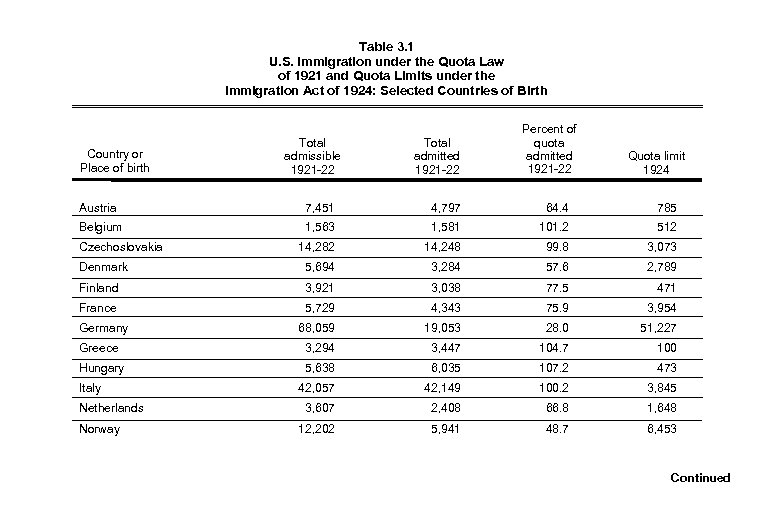 Table 3. 1 U. S. Immigration under the Quota Law of 1921 and Quota Limits under the Immigration Act of 1924: Selected Countries of Birth Country or Place of birth Total admissible 1921 -22 Total admitted 1921 -22 Percent of quota admitted 1921 -22 Quota limit 1924 Austria 7, 451 4, 797 64. 4 785 Belgium 1, 563 1, 581 101. 2 512 14, 282 14, 248 99. 8 3, 073 Denmark 5, 694 3, 284 57. 6 2, 789 Finland 3, 921 3, 038 77. 5 471 France 5, 729 4, 343 75. 9 3, 954 68, 059 19, 053 28. 0 51, 227 Greece 3, 294 3, 447 104. 7 100 Hungary 5, 638 6, 035 107. 2 473 42, 057 42, 149 100. 2 3, 845 3, 607 2, 408 66. 8 1, 648 12, 202 5, 941 48. 7 6, 453 Czechoslovakia Germany Italy Netherlands Norway Continued
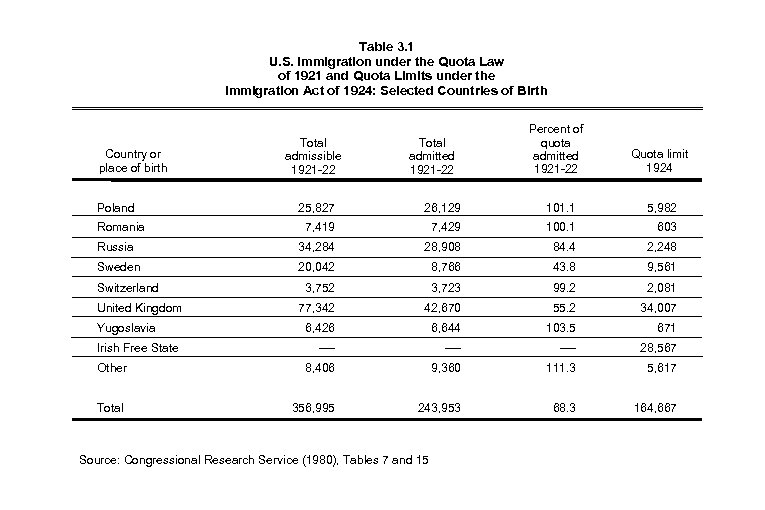 Table 3. 1 U. S. Immigration under the Quota Law of 1921 and Quota Limits under the Immigration Act of 1924: Selected Countries of Birth Country or place of birth Poland Total admissible 1921 -22 Total admitted 1921 -22 Percent of quota admitted 1921 -22 Quota limit 1924 25, 827 26, 129 101. 1 5, 982 7, 419 7, 429 100. 1 603 Russia 34, 284 28, 908 84. 4 2, 248 Sweden 20, 042 8, 766 43. 8 9, 561 3, 752 3, 723 99. 2 2, 081 77, 342 42, 670 55. 2 34, 007 6, 426 6, 644 103. 5 671 ---- 28, 567 Other 8, 406 9, 360 111. 3 5, 617 Total 356, 995 243, 953 68. 3 164, 667 Romania Switzerland United Kingdom Yugoslavia Irish Free State Source: Congressional Research Service (1980), Tables 7 and 15
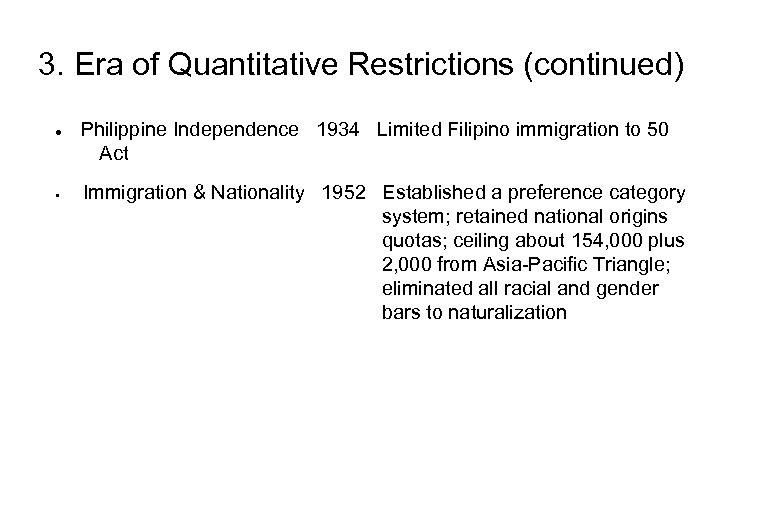 3. Era of Quantitative Restrictions (continued) § Philippine Independence 1934 Limited Filipino immigration to 50 Act Immigration & Nationality 1952 Established a preference category system; retained national origins quotas; ceiling about 154, 000 plus 2, 000 from Asia-Pacific Triangle; eliminated all racial and gender bars to naturalization
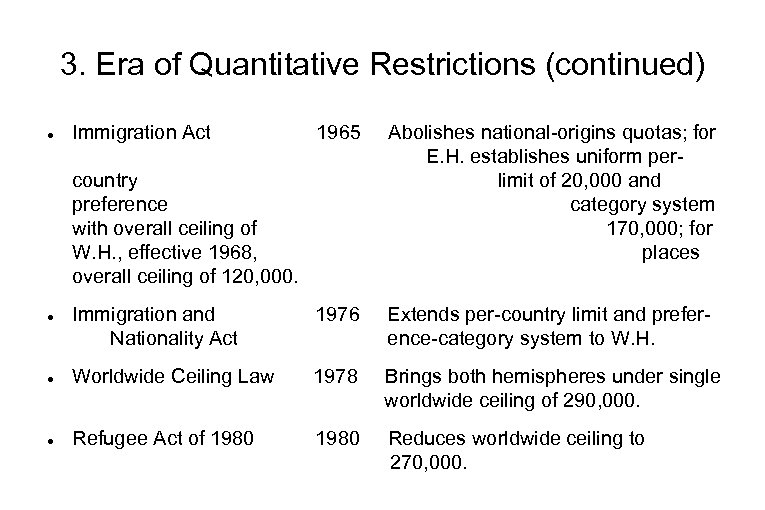 3. Era of Quantitative Restrictions (continued) 1965 Abolishes national-origins quotas; for E. H. establishes uniform perlimit of 20, 000 and category system 170, 000; for places Immigration and Nationality Act 1976 Extends per-country limit and preference-category system to W. H. Worldwide Ceiling Law 1978 Brings both hemispheres under single worldwide ceiling of 290, 000. Refugee Act of 1980 Reduces worldwide ceiling to 270, 000. Immigration Act country preference with overall ceiling of W. H. , effective 1968, overall ceiling of 120, 000.
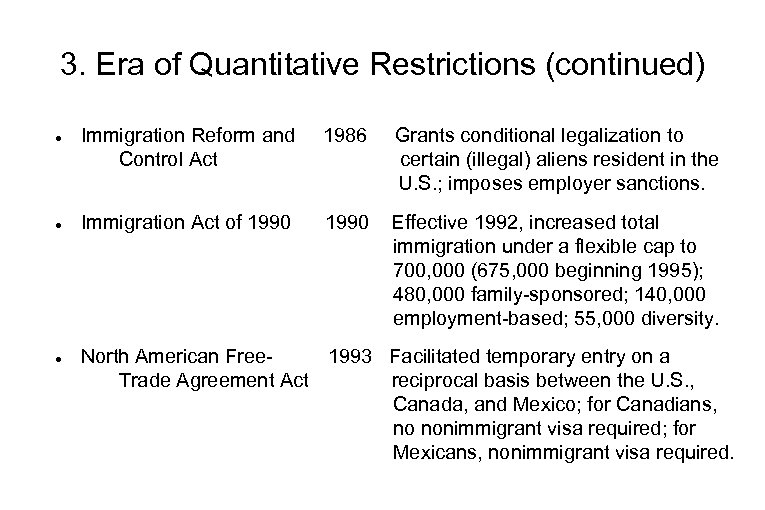 3. Era of Quantitative Restrictions (continued) Immigration Reform and Control Act 1986 Grants conditional legalization to certain (illegal) aliens resident in the U. S. ; imposes employer sanctions. Immigration Act of 1990 Effective 1992, increased total immigration under a flexible cap to 700, 000 (675, 000 beginning 1995); 480, 000 family-sponsored; 140, 000 employment-based; 55, 000 diversity. North American Free 1993 Facilitated temporary entry on a Trade Agreement Act reciprocal basis between the U. S. , Canada, and Mexico; for Canadians, no nonimmigrant visa required; for Mexicans, nonimmigrant visa required.
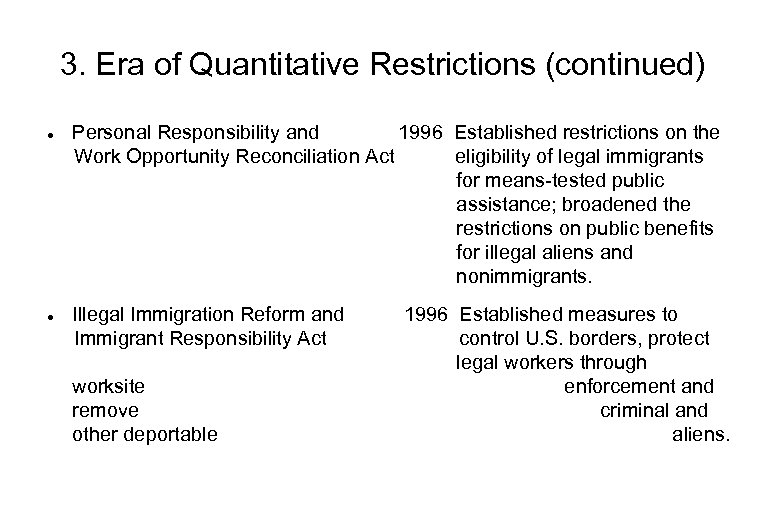 3. Era of Quantitative Restrictions (continued) Personal Responsibility and 1996 Established restrictions on the Work Opportunity Reconciliation Act eligibility of legal immigrants for means-tested public assistance; broadened the restrictions on public benefits for illegal aliens and nonimmigrants. Illegal Immigration Reform and Immigrant Responsibility Act worksite remove other deportable 1996 Established measures to control U. S. borders, protect legal workers through enforcement and criminal and aliens.
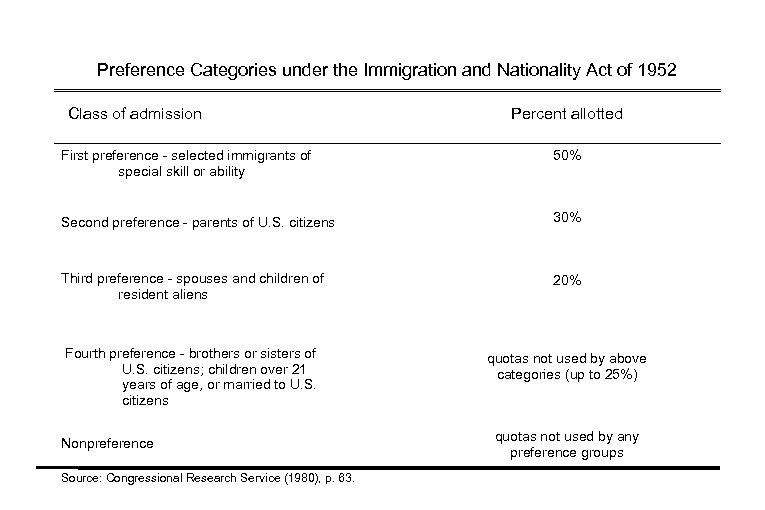 Preference Categories under the Immigration and Nationality Act of 1952 Class of admission Percent allotted First preference - selected immigrants of special skill or ability 50% Second preference - parents of U. S. citizens 30% Third preference - spouses and children of resident aliens 20% Fourth preference - brothers or sisters of U. S. citizens; children over 21 years of age, or married to U. S. citizens quotas not used by above categories (up to 25%) Nonpreference Source: Congressional Research Service (1980), p. 63. quotas not used by any preference groups
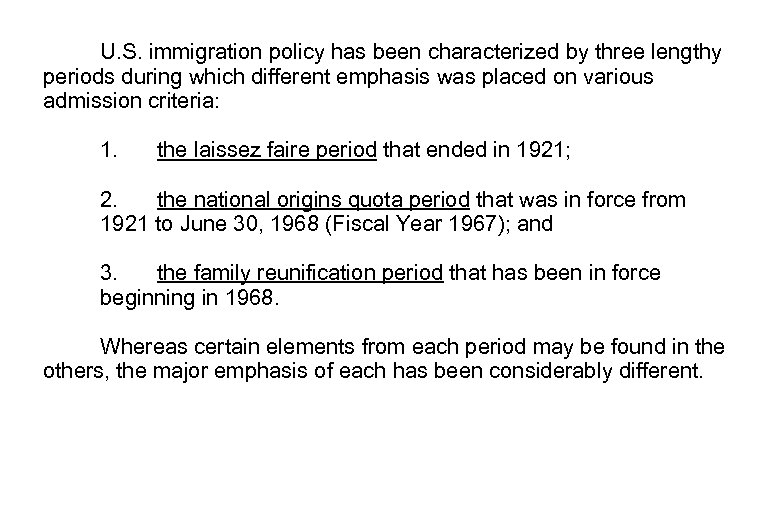 U. S. immigration policy has been characterized by three lengthy periods during which different emphasis was placed on various admission criteria: 1. the laissez faire period that ended in 1921; 2. the national origins quota period that was in force from 1921 to June 30, 1968 (Fiscal Year 1967); and 3. the family reunification period that has been in force beginning in 1968. Whereas certain elements from each period may be found in the others, the major emphasis of each has been considerably different.
 The laissez faire period Almost all persons were welcome to enter the United States with the exception of the Chinese (after 1882) and certain types of individuals such as criminals and prostitutes. Between 1820 and 1921, 34. 5 million persons were admitted to the U. S. as legal resident aliens -- an annual average of 337, 843.
 The national origins quota period The emphasis in admissions during this period was on the country of birth of immigrants Between 1922 and June 30, 1968, 9. 5 million persons were admitted to the U. S. as legal resident aliens -- an annual average of 206, 875.
 The family reunification period The emphasis during this period has been on family ties. From July 1, 1968, through FY 2009, 31. 4 million persons were admitted to the United States -- an annual average of 747, 159.
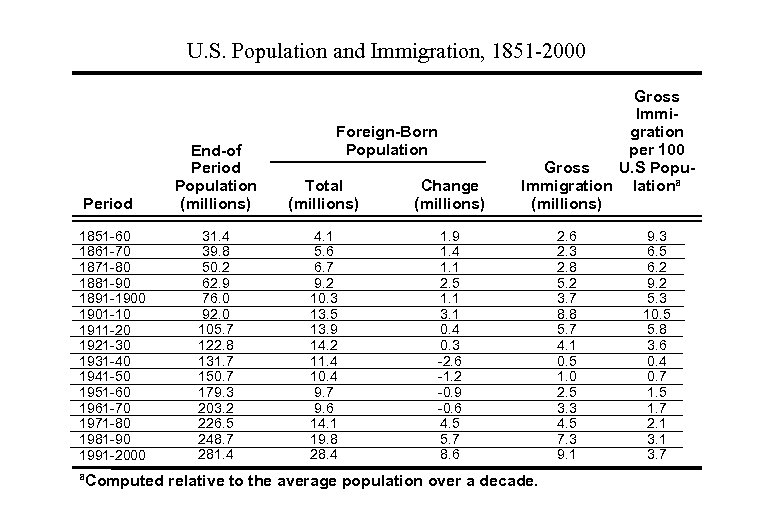 U. S. Population and Immigration, 1851 -2000 Period 1851 -60 1861 -70 1871 -80 1881 -90 1891 -1900 1901 -10 1911 -20 1921 -30 1931 -40 1941 -50 1951 -60 1961 -70 1971 -80 1981 -90 1991 -2000 a. Computed Foreign-Born Population End-of Period Population (millions) Total (millions) Change (millions) 31. 4 39. 8 50. 2 62. 9 76. 0 92. 0 105. 7 122. 8 131. 7 150. 7 179. 3 203. 2 226. 5 248. 7 281. 4 4. 1 5. 6 6. 7 9. 2 10. 3 13. 5 13. 9 14. 2 11. 4 10. 4 9. 7 9. 6 14. 1 19. 8 28. 4 Gross Immigration per 100 U. S Popu. Gross Immigration lationa (millions) 1. 9 1. 4 1. 1 2. 5 1. 1 3. 1 0. 4 0. 3 -2. 6 -1. 2 -0. 9 -0. 6 4. 5 5. 7 8. 6 relative to the average population over a decade. 2. 6 2. 3 2. 8 5. 2 3. 7 8. 8 5. 7 4. 1 0. 5 1. 0 2. 5 3. 3 4. 5 7. 3 9. 1 9. 3 6. 5 6. 2 9. 2 5. 3 10. 5 5. 8 3. 6 0. 4 0. 7 1. 5 1. 7 2. 1 3. 7
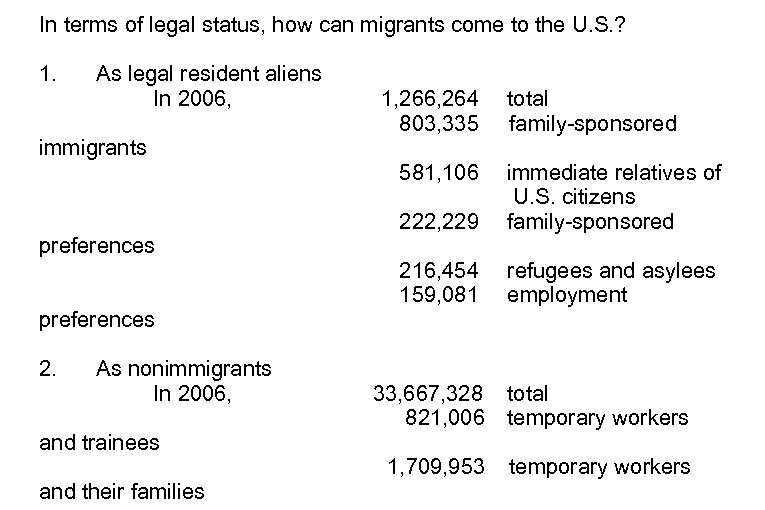 In terms of legal status, how can migrants come to the U. S. ? 1. As legal resident aliens In 2006, 1, 266, 264 803, 335 total family-sponsored immigrants 581, 106 222, 229 preferences immediate relatives of U. S. citizens family-sponsored 216, 454 159, 081 refugees and asylees employment preferences 2. As nonimmigrants In 2006, 33, 667, 328 821, 006 total temporary workers 1, 709, 953 temporary workers and trainees and their families
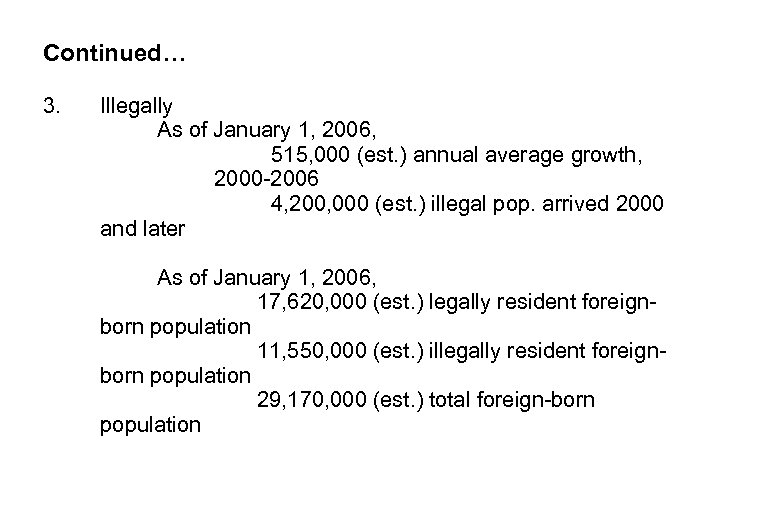 Continued… 3. Illegally As of January 1, 2006, 515, 000 (est. ) annual average growth, 2000 -2006 4, 200, 000 (est. ) illegal pop. arrived 2000 and later As of January 1, 2006, 17, 620, 000 (est. ) legally resident foreignborn population 11, 550, 000 (est. ) illegally resident foreignborn population 29, 170, 000 (est. ) total foreign-born population
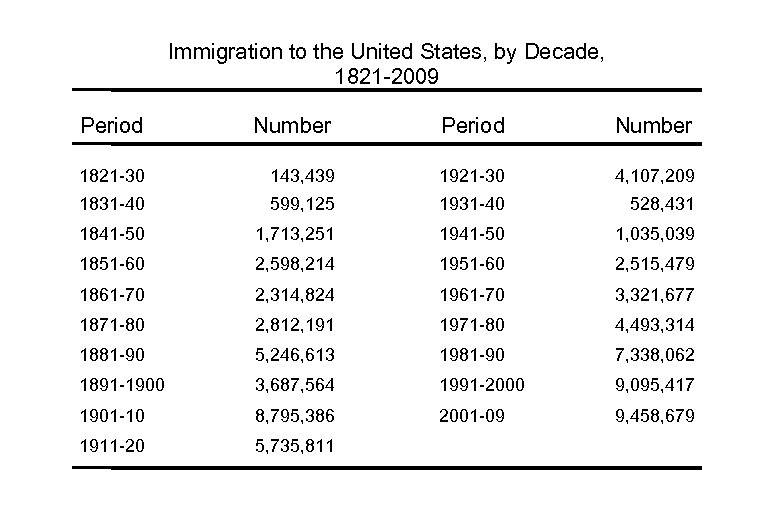 Immigration to the United States, by Decade, 1821 -2009 Period Number 1821 -30 143, 439 1921 -30 4, 107, 209 1831 -40 599, 125 1931 -40 528, 431 1841 -50 1, 713, 251 1941 -50 1, 035, 039 1851 -60 2, 598, 214 1951 -60 2, 515, 479 1861 -70 2, 314, 824 1961 -70 3, 321, 677 1871 -80 2, 812, 191 1971 -80 4, 493, 314 1881 -90 5, 246, 613 1981 -90 7, 338, 062 1891 -1900 3, 687, 564 1991 -2000 9, 095, 417 1901 -10 8, 795, 386 2001 -09 9, 458, 679 1911 -20 5, 735, 811
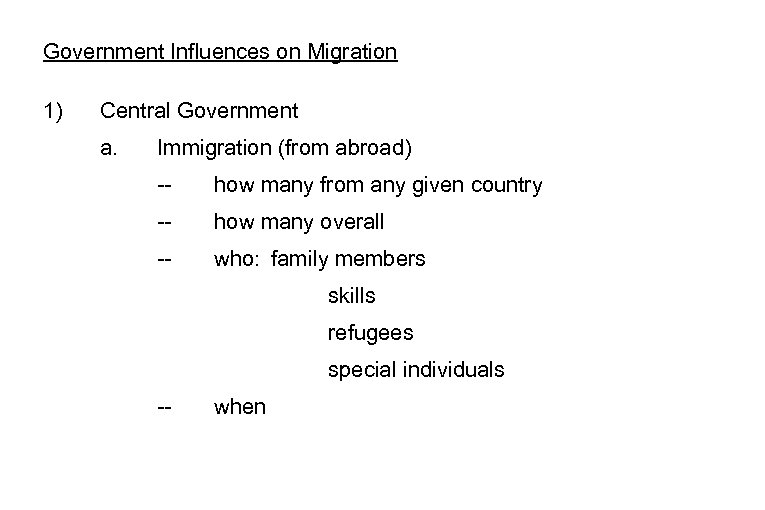 Government Influences on Migration 1) Central Government a. Immigration (from abroad) -- how many from any given country -- how many overall -- who: family members skills refugees special individuals -- when
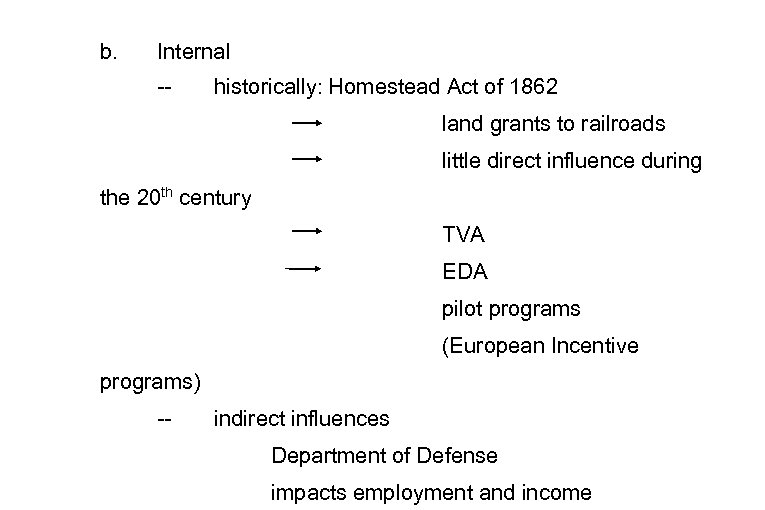 b. Internal -- historically: Homestead Act of 1862 land grants to railroads little direct influence during the 20 th century TVA EDA pilot programs (European Incentive programs) -- indirect influences Department of Defense impacts employment and income
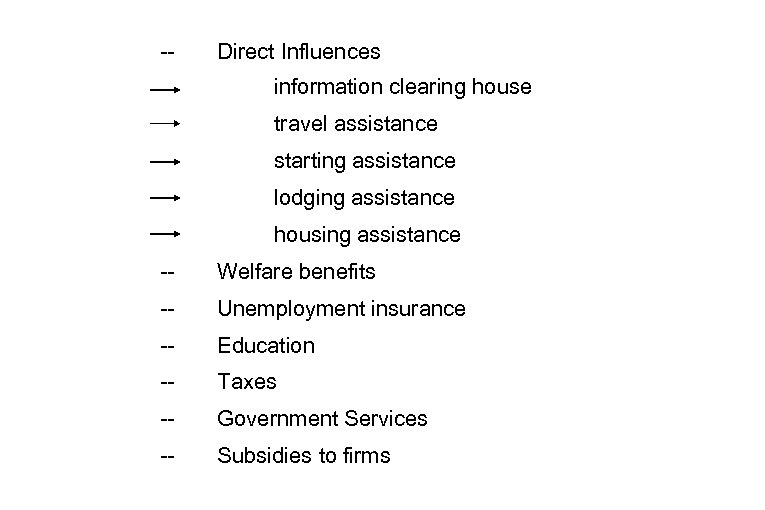 -- Direct Influences information clearing house travel assistance starting assistance lodging assistance housing assistance -- Welfare benefits -- Unemployment insurance -- Education -- Taxes -- Government Services -- Subsidies to firms
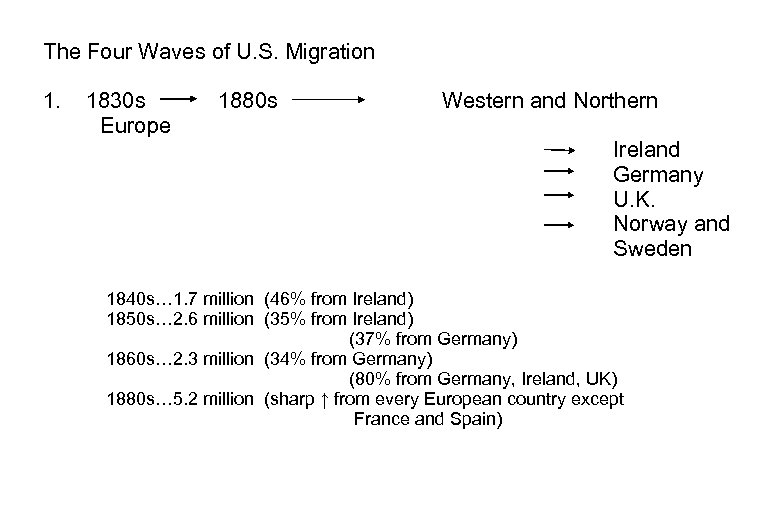 The Four Waves of U. S. Migration 1. 1830 s Europe 1880 s Western and Northern Ireland Germany U. K. Norway and Sweden 1840 s… 1. 7 million (46% from Ireland) 1850 s… 2. 6 million (35% from Ireland) (37% from Germany) 1860 s… 2. 3 million (34% from Germany) (80% from Germany, Ireland, UK) 1880 s… 5. 2 million (sharp ↑ from every European country except France and Spain)
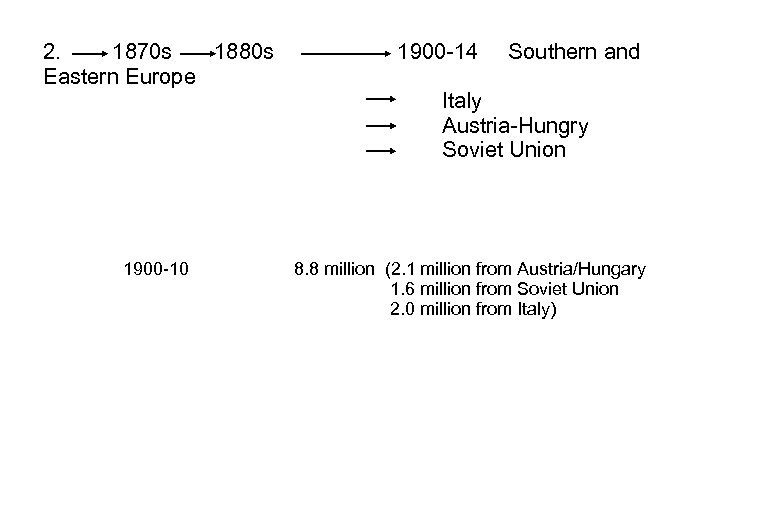 2. 1870 s 1880 s Eastern Europe 1900 -14 Southern and Italy Austria-Hungry Soviet Union 1900 -10 8. 8 million (2. 1 million from Austria/Hungary 1. 6 million from Soviet Union 2. 0 million from Italy)
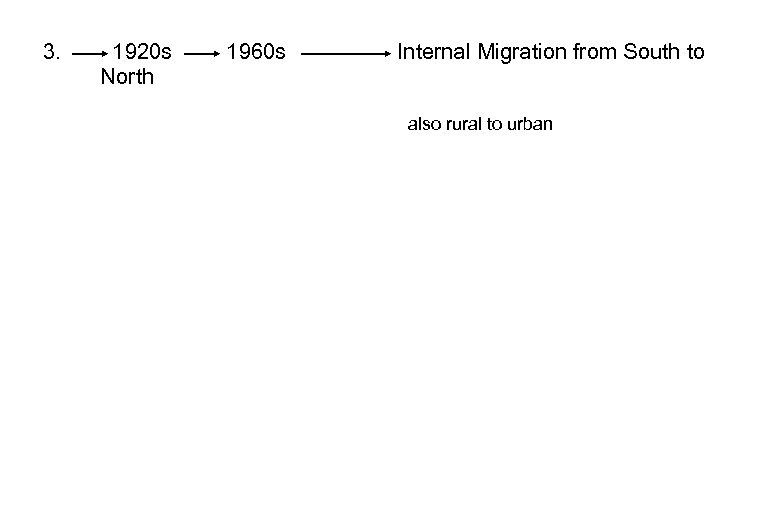 3. 1920 s North 1960 s Internal Migration from South to also rural to urban
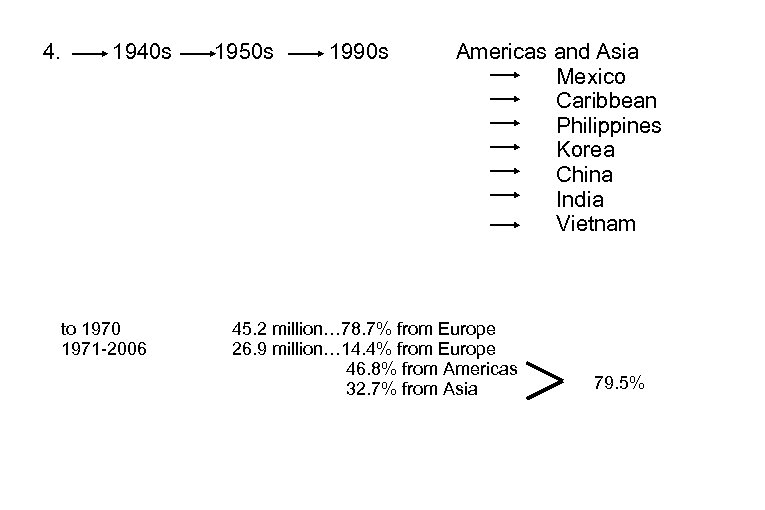 4. 1940 s to 1970 1971 -2006 1950 s 1990 s Americas and Asia Mexico Caribbean Philippines Korea China India Vietnam 45. 2 million… 78. 7% from Europe 26. 9 million… 14. 4% from Europe 46. 8% from Americas 32. 7% from Asia 79. 5%
 At first the federal government was reluctant to interfere with the perogatives of the states, so there was at least tacit recognition of state jurisdiction over immigration. Congress first exerted its authority with respect to naturalization (Need for uniform treatment was recognized) Constitution (1789), article 1, section 8, clause 4, states that “Congress shall have power…to establish a uniform Rule of Naturalization” In the early years, strong anti-alien sentiment
 1965 Amendments 1. Abolished the national origins quota system. 2. Established a 7 -category preference system 3. Established a group of immigrants exempt from quota limitations: a. immediate relatives of U. S. citizens 21 and over (spouses, children, parents). b. special immigrants.
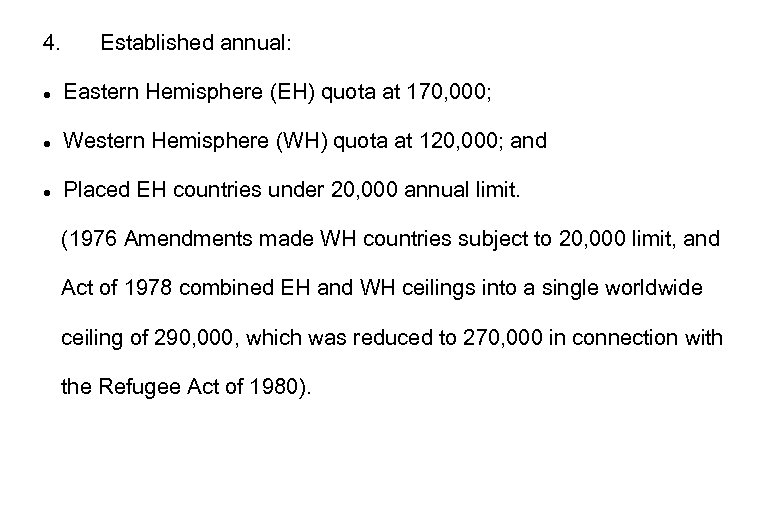 4. Established annual: Eastern Hemisphere (EH) quota at 170, 000; Western Hemisphere (WH) quota at 120, 000; and Placed EH countries under 20, 000 annual limit. (1976 Amendments made WH countries subject to 20, 000 limit, and Act of 1978 combined EH and WH ceilings into a single worldwide ceiling of 290, 000, which was reduced to 270, 000 in connection with the Refugee Act of 1980).
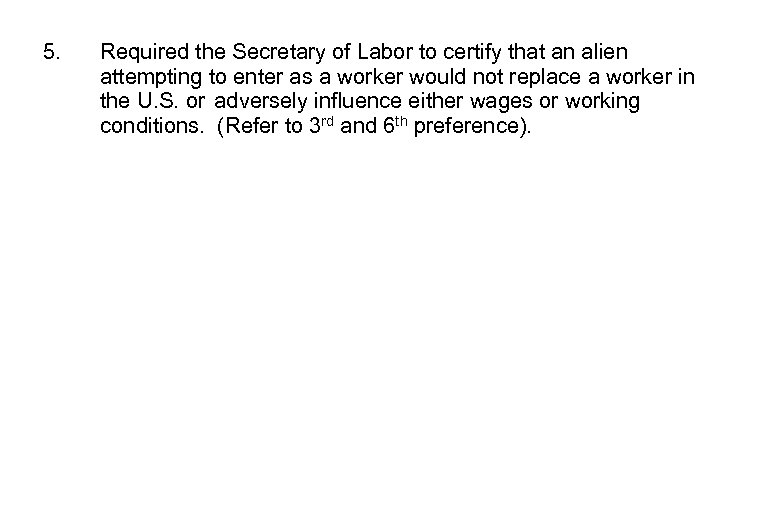 5. Required the Secretary of Labor to certify that an alien attempting to enter as a worker would not replace a worker in the U. S. or adversely influence either wages or working conditions. (Refer to 3 rd and 6 th preference).
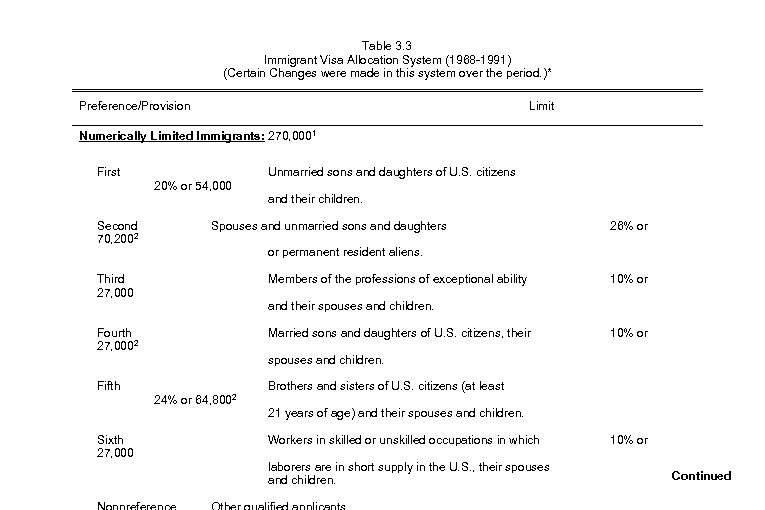 Table 3. 3 Immigrant Visa Allocation System (1968 -1991) (Certain Changes were made in this system over the period. )* Preference/Provision Limit Numerically Limited Immigrants: 270, 0001 First Unmarried sons and daughters of U. S. citizens 20% or 54, 000 and their children. Second 70, 2002 Spouses and unmarried sons and daughters or permanent resident aliens. Third 27, 000 Members of the professions of exceptional ability Fourth 27, 0002 Married sons and daughters of U. S. citizens, their Fifth Sixth 27, 000 26% or 10% or and their spouses and children. 10% or spouses and children. 2 24% or 64, 800 Brothers and sisters of U. S. citizens (at least 21 years of age) and their spouses and children. Workers in skilled or unskilled occupations in which laborers are in short supply in the U. S. , their spouses and children. 10% or Continued
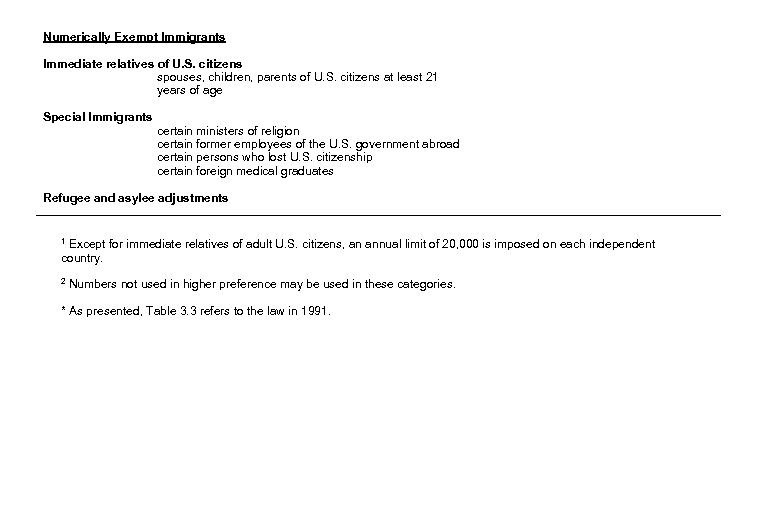 Numerically Exempt Immigrants Immediate relatives of U. S. citizens spouses, children, parents of U. S. citizens at least 21 years of age Special Immigrants certain ministers of religion certain former employees of the U. S. government abroad certain persons who lost U. S. citizenship certain foreign medical graduates Refugee and asylee adjustments 1 Except for immediate relatives of adult U. S. citizens, an annual limit of 20, 000 is imposed on each independent country. 2 Numbers not used in higher preference may be used in these categories. * As presented, Table 3. 3 refers to the law in 1991.
 Immigration Act of 1990 1. The worldwide immigration ceiling was raised to 700, 000 for fiscal years 1992, 1993, and 1994, falling to 675, 000 for 1995 and later years. The ceiling is, however, “flexible” in the sense discussed below. 2. Although immediate relatives of U. S. citizens are included under the worldwide quota “cap, ” their number is unlimited, which is what makes the ceiling a flexible one. 3. Family-based immigration is guaranteed at least 226, 000 visa numbers. These numbers are allocated per year to four preference categories as indicated in Table 3. B. 4. The employment-based preferences are allotted 140, 000 visas annually and are grouped into five preference classes as reported in Table 3. B.
 5. So called “diversity immigrants” were allocated 40, 000 visas each in 1992, 1993, and 1994, with 1993 and 1994 gaining the unused numbers from the prior year. The diversity quota rises to 55, 000 per year beginning in 1995. Diversity immigrants are those aliens born in countries adversely affected by the 1965 law and their spouses and children. To be eligible for a diversity visa, a prospective immigrant must have at least a high school education or its equivalent and at least two years of training and experience (and this experience must be during the five years immediately preceding the date of application). Thus, diversity immigrants are a kind of occupational immigrant, but without specificity regarding the precise or even the general occupation.
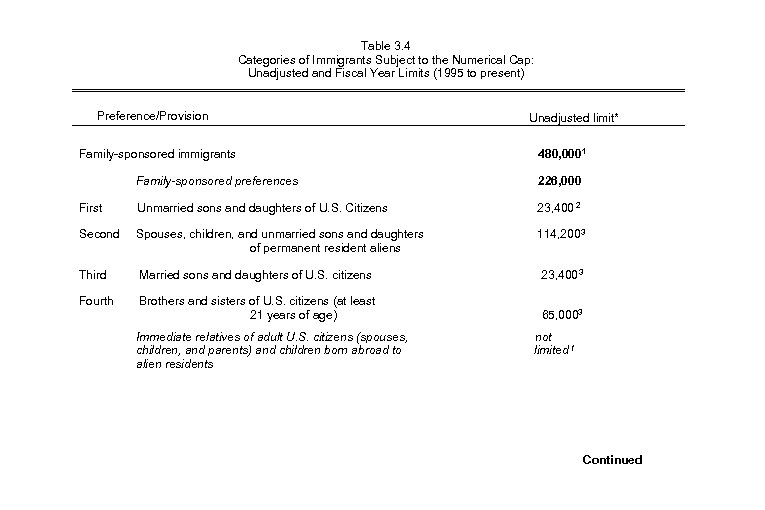 Table 3. 4 Categories of Immigrants Subject to the Numerical Cap: Unadjusted and Fiscal Year Limits (1995 to present) Preference/Provision Family-sponsored immigrants Unadjusted limit* 480, 0001 Family-sponsored preferences 226, 000 First Unmarried sons and daughters of U. S. Citizens 23, 400 2 Second Spouses, children, and unmarried sons and daughters of permanent resident aliens 114, 200 3 Third Married sons and daughters of U. S. citizens 23, 400 3 Fourth Brothers and sisters of U. S. citizens (at least 21 years of age) 65, 0003 Immediate relatives of adult U. S. citizens (spouses, children, and parents) and children born abroad to alien residents not limited 1 Continued
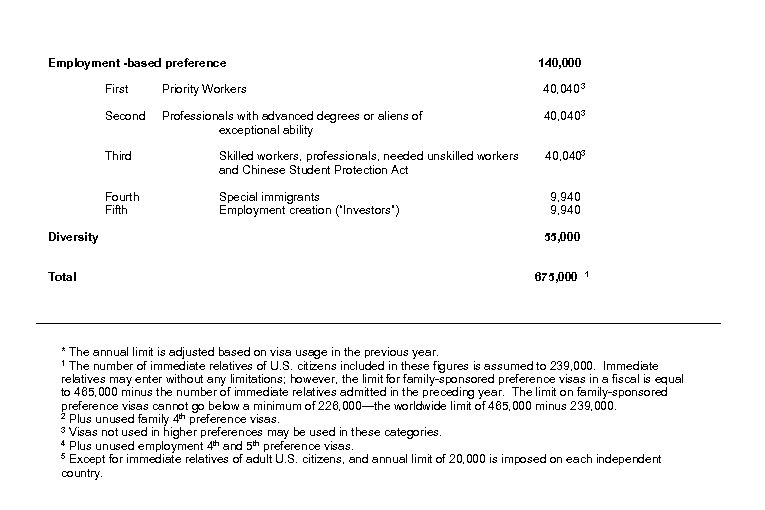 Employment -based preference 140, 000 First Priority Workers 40, 040 3 Second Professionals with advanced degrees or aliens of exceptional ability 40, 040 3 Third Fourth Fifth Diversity Total Skilled workers, professionals, needed unskilled workers and Chinese Student Protection Act Special immigrants Employment creation (“Investors”) 40, 0403 9, 940 55, 000 675, 000 1 * The annual limit is adjusted based on visa usage in the previous year. 1 The number of immediate relatives of U. S. citizens included in these figures is assumed to 239, 000. Immediate relatives may enter without any limitations; however, the limit for family-sponsored preference visas in a fiscal is equal to 465, 000 minus the number of immediate relatives admitted in the preceding year. The limit on family-sponsored preference visas cannot go below a minimum of 226, 000—the worldwide limit of 465, 000 minus 239, 000. 2 Plus unused family 4 th preference visas. 3 Visas not used in higher preferences may be used in these categories. 4 Plus unused employment 4 th and 5 th preference visas. 5 Except for immediate relatives of adult U. S. citizens, and annual limit of 20, 000 is imposed on each independent country.
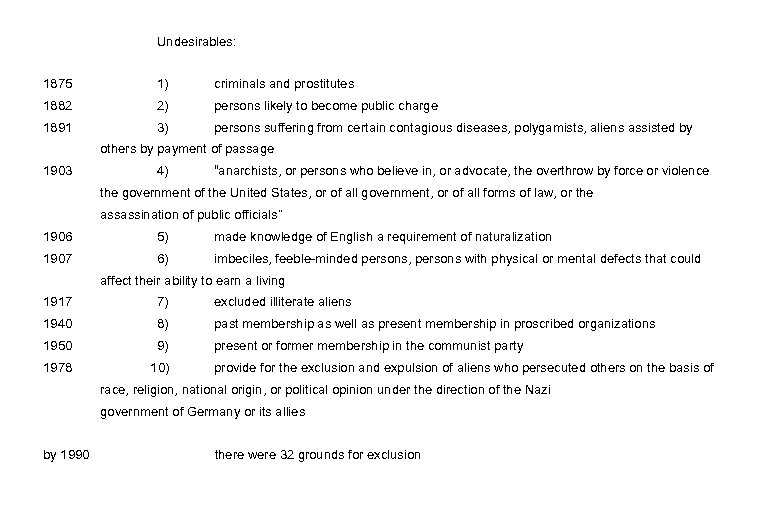 Undesirables: 1875 1) criminals and prostitutes 1882 2) persons likely to become public charge 1891 3) persons suffering from certain contagious diseases, polygamists, aliens assisted by others by payment of passage 1903 4) “anarchists, or persons who believe in, or advocate, the overthrow by force or violence the government of the United States, or of all government, or of all forms of law, or the assassination of public officials” 1906 5) made knowledge of English a requirement of naturalization 1907 6) imbeciles, feeble-minded persons, persons with physical or mental defects that could affect their ability to earn a living 1917 7) excluded illiterate aliens 1940 8) past membership as well as present membership in proscribed organizations 1950 9) present or former membership in the communist party 1978 10) provide for the exclusion and expulsion of aliens who persecuted others on the basis of race, religion, national origin, or political opinion under the direction of the Nazi government of Germany or its allies by 1990 there were 32 grounds for exclusion
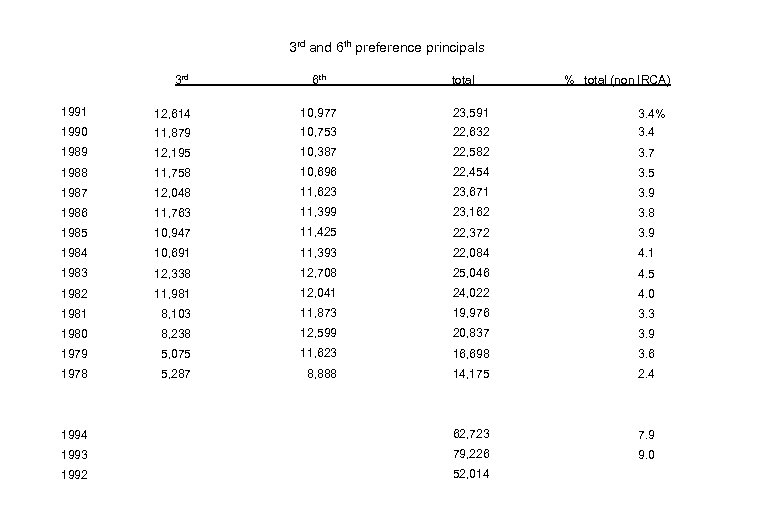 3 rd and 6 th preference principals 3 rd 6 th total % total (non IRCA) 1991 12, 614 10, 977 23, 591 3. 4% 1990 11, 879 10, 753 22, 632 3. 4 1989 12, 195 10, 387 22, 582 3. 7 1988 11, 758 10, 696 22, 454 3. 5 1987 12, 048 11, 623 23, 671 3. 9 1986 11, 763 11, 399 23, 162 3. 8 1985 10, 947 11, 425 22, 372 3. 9 1984 10, 691 11, 393 22, 084 4. 1 1983 12, 338 12, 708 25, 046 4. 5 1982 11, 981 12, 041 24, 022 4. 0 1981 8, 103 11, 873 19, 976 3. 3 1980 8, 238 12, 599 20, 837 3. 9 1979 5, 075 11, 623 16, 698 3. 6 1978 5, 287 8, 888 14, 175 2. 4 1994 62, 723 7. 9 1993 79, 226 9. 0 1992 52, 014
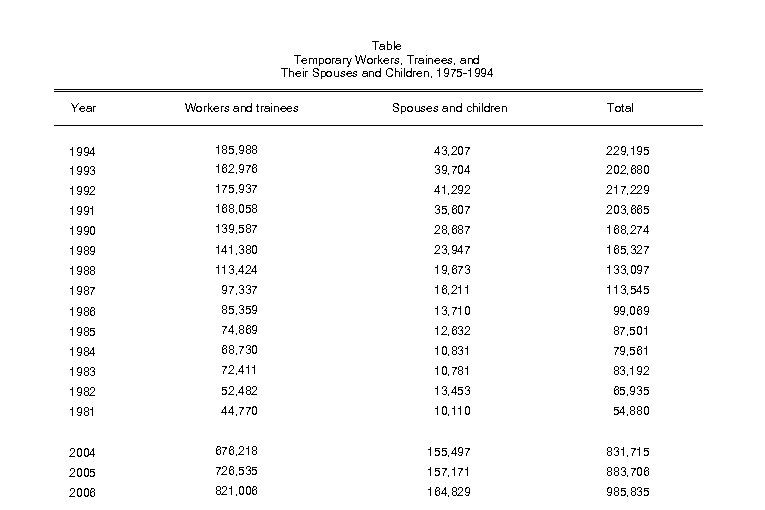 Table Temporary Workers, Trainees, and Their Spouses and Children, 1975 -1994 Year Workers and trainees Spouses and children Total 1994 185, 988 43, 207 229, 195 1993 162, 976 39, 704 202, 680 1992 175, 937 41, 292 217, 229 1991 168, 058 35, 607 203, 665 1990 139, 587 28, 687 168, 274 1989 141, 380 23, 947 165, 327 1988 113, 424 19, 673 133, 097 1987 97, 337 16, 211 113, 545 1986 85, 359 13, 710 99, 069 1985 74, 869 12, 632 87, 501 1984 68, 730 10, 831 79, 561 1983 72, 411 10, 781 83, 192 1982 52, 482 13, 453 65, 935 1981 44, 770 10, 110 54, 880 2004 676, 218 155, 497 831, 715 2005 726, 535 157, 171 883, 706 2006 821, 006 164, 829 985, 835
 References that served as a source for the history of U. S. immigration policy E. P. Hutchinson, Legislative History of American Immigration Policy, Philadelphia: University of Pennsylvania Press, 1981. G. Jasso and M. R. Rosenzweig, The New Chosen People: Immigrants in the United States, New York: Russell Sage Foundation, 1984.