


 Скачать презентацию UNITED STATES CONSTITUTION The 4 th Amendment Search
f3e8b74206d5ca4bcfdadc76d81be3af.ppt
- Количество слайдов: 35
 UNITED STATES CONSTITUTION The 4 th Amendment Search and Seizure
 James Madison drafted the Bill of Rights in 1789 and it was adopted by the states in 1791. He is called the “father” of the Constitution. The Bill of Rights was created because our country’s founding leaders were afraid the government would have too much power. They wanted to be certain that particular, important rights were explicitly stated and protected.
 Thomas Jefferson was one of those founding leaders. He believed governments do not give rights to people, but rather have the responsibility to protect the rights that all people have naturally. They call his school of thought "Enlightenment". The original Constitution did not have a Bill of Rights.
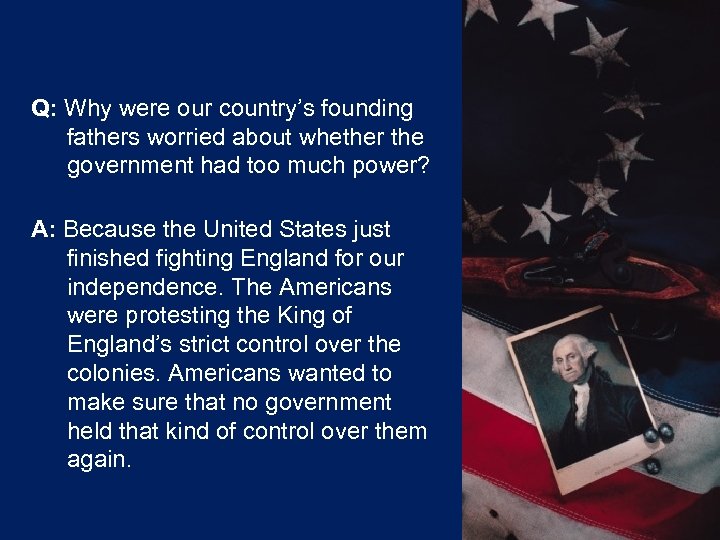 Q: Why were our country’s founding fathers worried about whether the government had too much power? A: Because the United States just finished fighting England for our independence. The Americans were protesting the King of England’s strict control over the colonies. Americans wanted to make sure that no government held that kind of control over them again.
 Q: What specifically did British officials do to Americans and their homes before America gained its independence? A: They ransacked their homes and arrested them without warrants
 Q: Which amendment to the Constitution protects Americans against unreasonable searches and seizures by government officials? A: The Fourth Amendment
 The Fourth Amendment to the U. S. Constitution states: "The right of the people to be secure in their persons, houses, papers and effects, against unreasonable searches and seizures shall not be violated, and no Warrants shall issue, but upon probable cause, supported by Oath or affirmation, and particularly describing the place to be searched, and the persons or things to be seized. "
 HOW IT WORKS When is the Fourth Amendment Implicated? a. The Fourth Amendment is implicated when a person is seized by the police. A person is seized within the meaning of the Fourth Amendment when, in view of all circumstances, a reasonable person would not believe he is free to leave. See United States v. Mendhenhall, 446 US 544 (1980). In California v. Hodari D. , 499 US 621 (1991), the Court held that a seizure occurs when the suspect is physically restrained or submits to a show of authority.
 Three Levels of Police Encounters/Interactions Consensual Encounters: Police are always free to engage a person as long as the person is free to decline.
 Three Levels of Police Encounters/Interactions Terry Stops & Frisks While presumptively any search or seizure that implicates the 4 th am must be supported by probable cause, there a couple of exceptions to this rule. Terry stops are the biggest ones. This level of police/individual encounter was authorized in Terry v. Ohio, 392 U. S. 1 (1968). A Terry stop is a brief investigatory detention justified when a police officer has reasonable suspicion that crime is afoot. The stop is only permitted for the time it takes the officer to either confirm or dispel his or her suspicion. A Terry Frisk is a limited search where there is reasonable belief that the suspect is armed. The right to conduct a frisk is not automatic whenever there is a stop. Because the justification for the frisk is officer safety, the search is limited to a pat-down of the outer clothing to check for weapons. Any additional manipulation of an item to determine what it is exceeds the scope authorized by Terry. See Minnesota v. Dickerson.
 Three Levels of Police Encounters/Interactions Arrest: The third level of police/individual interaction is an arrest. An arrest must be supported by probable cause.
 Probable Cause & Reasonable Articulable Suspicion a. Probable cause is a low standard. The definition comes from Beck v. Ohio. An Officer has probable cause when at time of arrest, the facts and circumstances within officer’s knowledge, and of which they have trustworthy information, were sufficient to warrant a prudent man in believing the target had committed or was committing a crime. b. Reasonable articulable suspicion is less than probable cause but more than an inchoate and unparticularized suspicion or hunch. It must be based on specific articulable facts taken together with rational inferences from those facts and the suspicion must be associated with the specific individual
 Exclusionary Rule a. Once a court determines that a person’s Fourth Amendment rights has been violated, the next question is whether the exclusionary rule applies. b. Under the exclusionary rule, any evidence that is the fruit of (or discovered as the result of ) the illegality should be suppressed, or not permitted to be used against the person whose rights were violated.
 US Supreme Court Justice Louis Brandeis said the Fourth Amendment secures “the right to be let alone – the most comprehensive of rights and the right most valued by civilized men. ” (the “right to privacy )
 • The Fourth Amendment does not use the word privacy. To whom does the Fourth Amendment apply? • Government? • Mom and Dad? • Teacher? • Police? • When should the government be allowed to invade someone’s personal space? • If a crime has been committed • Investigate • Prevent • Punish crime
 • What would happen if there were no exceptions to the fourth amendment? • Chaos • Mayhem • Lawlessness • Scale weighing expectations of privacy and interest in civil order.
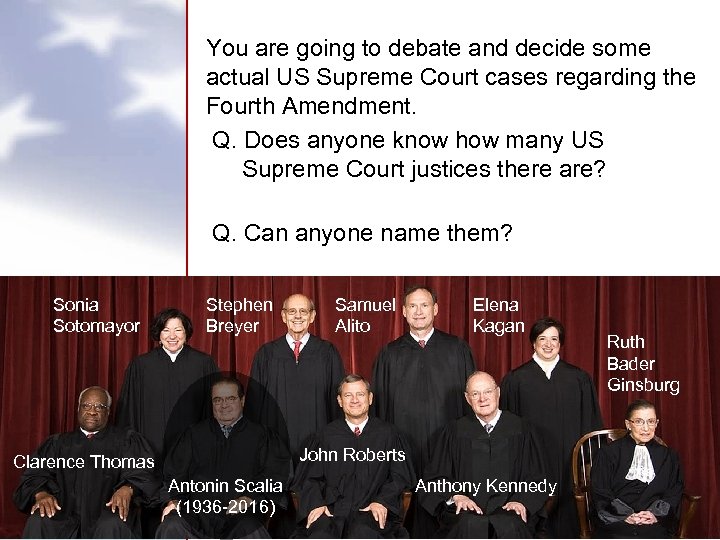 You are going to debate and decide some actual US Supreme Court cases regarding the Fourth Amendment. Q. Does anyone know how many US Supreme Court justices there are? Q. Can anyone name them? Sonia Sotomayor Stephen Breyer Samuel Alito Elena Kagan John Roberts Clarence Thomas Antonin Scalia (1936 -2016) Anthony Kennedy Ruth Bader Ginsburg
 U. S. Supreme Court Justices: • • • Antonin Scalia (Reagan appointee) Anthony Kennedy (Reagan appointee) Clarence Thomas (G Bush appointee) Ruth Bader Ginsburg (Clinton appointee) Stephen Breyer (Clinton appointee) John Roberts (GW Bush appointee) – Chief Justice • Samuel Alito (GW Bush appointee) • Sonia Sotomayor (Obama appointee) • Elena Kagan (Obama appointee)
 Let’s Look at a Supreme Court of the United States case involving the fourth amendment and cell phones
 Digital Data Riley v California, 573 U. S. __(2014)
 David Riley was stopped by a police officer for driving with expired registration tags. Riley was also driving on a suspended license. Riley’s car was impounded and searched. Loaded firearms were found under the hood. Riley v California, 573 U. S. __(2014) Riley was arrested for possession of concealed weapons and searched. During the search, the police found a cell phone in Riley’s pocket. The police viewed information stored in the cell phone. The information led them to charge Riley with firing at an occupied vehicle, assault with a semiautomatic firearm, and attempted murder.
 Another point in a similar case but par of the Riley case. Brima Wurie was observed during a police surveillance as making a drug sale from a car. He was arrested and taken to the police station. Officers seized his phone. Riley v California, 573 U. S. __(2014) Wurie’s phone kept ringing and identifying the number as “my house. ” With out obtaining a warrant, the police looked through Wurie’s call log and detected the address of a residence where they found cocaine, marijuana, drug paraphernalia, a firearm, ammunition and cash. Wurie was charged with distributing crack cocaine and being a felon in possession of a firearm and ammunition. Was it legal for the police to look at the call log?
 The court held the police generally may not, without a warrant, search digital information on a cell phone seized from an individual who has been arrested. Riley v California, 573 U. S. __(2014) A warrantless search is reasonable only if it falls within a specific exception to the Fourth Amendment “incident to a lawful arrest. ” Officers may search property found on or near an arrestee in three instances:
 What does “incident to a lawful arrest mean? A “Chimel” search—may search the area within the arrestee’s immediate control. Where it is justified by the interests in • officer safety and • preventing the destruction of evidence. Riley v California, 573 U. S. __(2014) • The “Robinson” rule—says Chimel searches are legal regardless of whethere is a specific concern about the loss of evidence or threat to officers. The “Gant” exception—may search a car where the arrestee is • unsecured and • within reaching distance of the passenger compartment, or • where it is reasonable to believe that evidence of the crime of arrest might be found in the vehicle.
 In the Riley case, the court weighed the degree of intrusion upon an individual’s privacy and the degree to which it is needed for the promotion of legitimate governmental interests. Why doesn’t the cell phone data fall under an exception to the fourth amendment? Riley v California, 573 U. S. __(2014) • Because digital data cannot be used as a weapon to harm an arresting officer or • Because digital data cannot be used to effectuate an arrestee’s escape
 To Search or not to Search: Rapid Fire Decisions!
 HYPO 1: Rodriguez v. United States, No. 13 -9972 (2015): Officer Struble, a K– 9 officer, stopped Rodriguez for driving on a highway shoulder, a violation of Nebraska law. After Struble attended to everything relating to the stop – including checking the driver’s licenses of Rodriguez and his passenger and issuing a warning for the traffic offense – he asked Rodriguez for permission to walk his dog around the vehicle. When Rodriguez refused, Struble detained him until a second officer arrived. Struble then retrieved his dog, who alerted to the presence of drugs in the vehicle. The ensuing search discovered methamphetamine. Seven or eight minutes elapsed from the time Struble issued the written warning until the dog alerted. The entire seizure of Rodriguez – from the time he was stopped until he was arrested after the methamphetamine was found – lasted 29 minutes. Was this search ok? Why or why not? Holding: The Court held, 6 -3, that officers may not conduct a “walk-around” by a drug detection dog after a traffic stop is completed. The Court’s opinion was written by Justice Ginsburg. Her rationale for the Court’s decision is that once a traffic stop has been completed – or reasonably should have been – the justification for the continued detention of the vehicle and its occupants no longer exists. The Court did not take issue with the officer’s checking the driver’s license of the driver, running a check for outstanding warrants, or inspecting the vehicle’s registration and proof of insurance. These actions were characterized as “ordinary inquiries incident to [the traffic] stop. ” However, the use of the drug detection dog was related to an effort to detect evidence of criminal wrongdoing and was not related to the purpose of the traffic stop, i. e. , to insure public safety on the highways.
 HYPO 2: In Utah v. Strieff, 136 S. Ct. 2056 (2016) the defendant was stopped by an officer after he was seen leaving a house suspected of drug activity. After briefly questioning the defendant, the officer learned from dispatch that the defendant had an outstanding warrant for a traffic violation. Based on that warrant, the officer arrested the defendant and located drugs on his person pursuant to a search incident to arrest. Did the officer have reasonable suspicion for stopping and questioning the suspect? After determining the suspect had an outstanding warrant, did the officer have a right to use that information as justification for searching and arresting him? The Court held that even if the officers lacked reasonable suspicion for the Terry stop, the drugs were admissible because the discovery of the valid warrant attenuated the connection between the unconstitutional stop and the evidence seized incident to arrest. In other words, the Court believed that because the suspect had an outstanding warrant, the illegality of their conduct was dissipated.
 HYPO 3: Brandon was hanging out in his neighborhood talking to friends. His neighborhood is notoriously known as the “bottoms” and the police consider it a high crime area. A police cruiser drives by Brandon and his friends; and Brandon, for no apparent reasons, takes off running. The police chase him, catch him, search him, and find a pistol and marijuana in his pants. Brandon is charged with carrying a pistol w/o a license, and simple possession fo marijuana. Brandon’s lawyer files a Motion to Suppress the drugs and gun based on an illegal stop and search. Have attorneys argue motion and students decide case. Illinois v. Wardlow, 528 US 119 (2000): In a 5 -4 decision the Court held that police had reasonable suspicion.
 HYPO 4: John and Dave were standing in an alley near their house arguing over University of Michigan football. Their neighborhood is considered a high drug trafficking area. The police pull into the alley, and the two men briskly walk away. The police stopped John and asked him to identify himself and explain what he was doing in the alley. John refused to identify himself and attempted to leave. The police arrested him and charged him for violating a MI statue which makes it a crime for a person to refuse to give his name and address to an officer “who has lawfully stopped him and requested the information. ” The officer’s reason for the stop was that the men looked suspicious. You file a motion arguing that the statute violated John’s Fourth Amendment rights. What are the arguments for and against? Brown v. Texas, 443 U. S. 47 (1979): The application of the Texas statute to detain appellant and require him to ID himself violated the Fourth amendment because the officers lacked any reasonable suspicion to believe that appellant was engaged or had engaged in criminal conduct.
 Case Number 1 Ann Arbor High just held its graduation commencement ceremony and students are holding graduation parties all over town. Mrs. Busybody is walking her dog around the block and sees such a party in full swing. Her dog, a well-trained German Shepherd, starts barking ferociously at one of the cars parked in the street in front of the house where the party is taking place. The car belongs to Sam Seaside. Mrs. Busybody calls the police and tells them her dog has found drugs in a car in her neighborhood. The police arrive and talk to Mrs. Busybody. They are very impressed with her dog. Nothing looks unusual about the car, but the dog continues to bark at it. May the police search the car?
 Case Number 1 C After being pulled over by the police, Sam is shaken up and decides to skip the car wash and go to his friend’s house to unwind before going home. His friend offers him a beer and he drinks it. He’s never had a beer before. His friend tells him to take the beer can and pitch it on the way home. A short time later, Sam starts driving home with his empty beer can. The same police officers observe his car driving along the center line, then along the curb. They follow him and he continues to drive in this manner, going back and forth within his lane. They decide to pull him over again. This time, they smell beer on his breath and see the empty beer can. Based on these observations, they allow their certified drug-detecting dog, Aldo, to circle the car and sniff the open air. Aldo goes crazy when he reaches the driver’s side door. The police open the door, look under the seat and find a bag of illegal pills. Did the police have the right to search the car?
 Case Number 2 A A freshman on the public high school field hockey team, Savannah, is changing out of her uniform into her street clothes when the school’s principal comes into the locker room and tells her to remove her clothing for a body inspection. When Savannah asks why, the principal says someone else on the team was found with ibuprofen, which is against school policy. The teammate told the principal she got it from Savannah submits to the search. No ibuprofen is found. Her parents sue on her behalf for money damages. Is the principal’s search of Savannah a violation of the Fourth Amendment? Should Savannah get money damages? What if Savannah attended a private school, not a public school?
 Case Number 2 B The summer following Savannah's high school graduation, she is pulled over by the city police for a broken taillight. When the officer checks Savannah's identification against the statewide computer database, he learns that Savannah has a bench warrant for her arrest due to her failing to appear in court on a speeding ticket. The speeding ticket is punishable by fine, not jail time. Savannah is arrested and taken to the county detention center. While detained, the police conduct a strip search on Savannah. It is the center’s policy to strip search everyone coming into the detention center for the safety of its staff and other detainees. Does the detention center have a right to strip search Savannah and other detainees? Does it make a difference if the detainee is there for a violation that is punishable by fine or by jail?
 Case Number 3 B It is 10 years later and Vernonia High School has had a principal for the past 10 years who was a high-ranking officer in the military before becoming a school administrator. His administration has been tough and strict and it has paid off because the student body is ranking highest in the state academically. Sports teams appear to be “clean” of any drug use and students are actually excelling in the fine arts to boot. The principal has decided to retire at the peak of his successful career and the new principal has decided to resurrect the old random drug screening policy. Is the policy a violation of the students’ Fourth Amendment rights?