


 Скачать презентацию United Nations Environment Programme PIC Network Meeting of
f0f60743a97962dbf10e0167168f35fb.ppt
- Количество слайдов: 24
 United Nations Environment Programme PIC Network Meeting of ODS Officers Fiji, 28 -30 July 2010 Enforcement Campaign Sky Hole Patching (SHP) and informal Prior Informed Consent (i. PIC) for control and monitoring ODS Trade Regional Ozone Network for Asia and the Pacific Compliance Assistance Programme

 • Proposed by China Customs • Coordinated by RILO A/P and UNEP • Main objective: To form an united anti-environmental crime front (in the A/P region) to curb the illegal trade in ODS and hazardous wastes • Use of CENCOM • 20 countries took part in the first phase of the operation. During 2010 global operation, 80 countries and 270 sea ports/check posts/airports are taking part (as of June 30 th 2010). • Seizures of Refrigerant 134 a and Refrigerant 12 (Thailand), cylinders, freezers and compressors containing R-12, R-134 a and R-600 a and mixture, (Croatia, Sweden and Kenya).
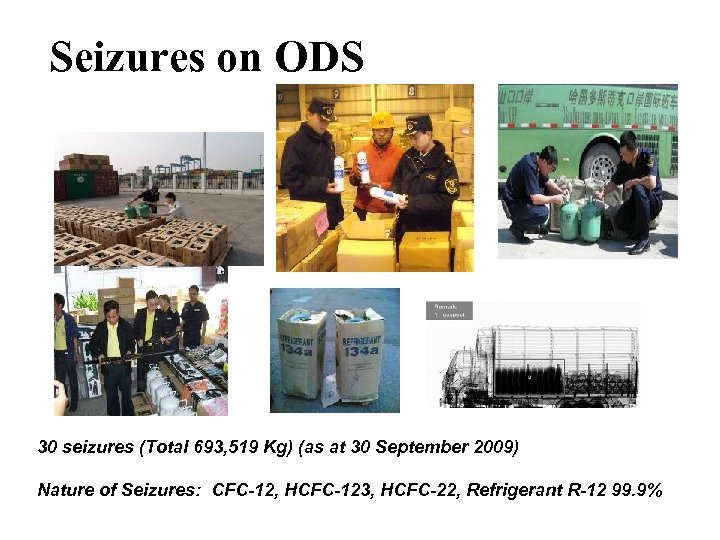 Seizures on ODS 30 seizures (Total 693, 519 Kg) (as at 30 September 2009) Nature of Seizures: CFC-12, HCFC-123, HCFC-22, Refrigerant R-12 99. 9%
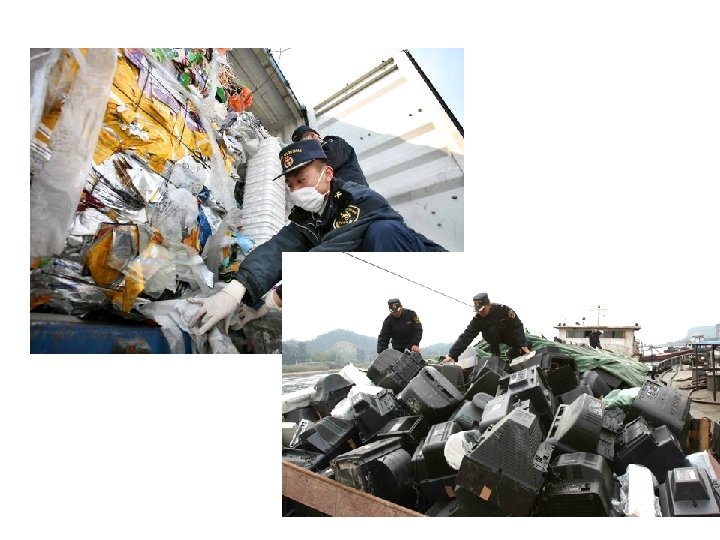
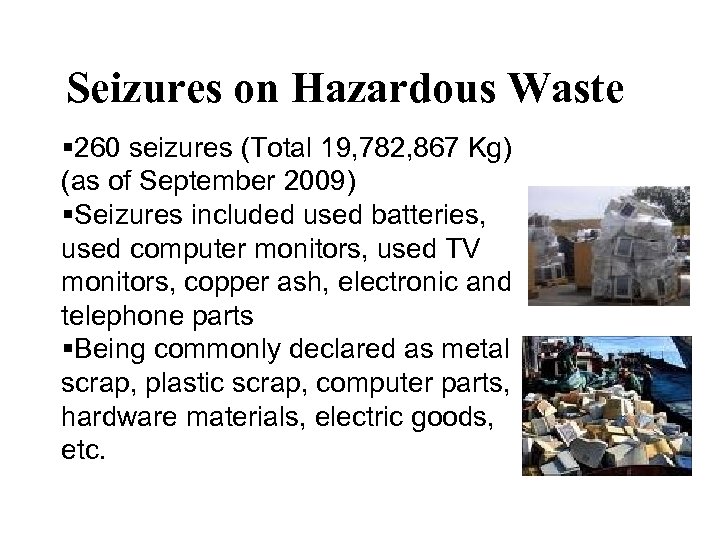 Seizures on Hazardous Waste § 260 seizures (Total 19, 782, 867 Kg) (as of September 2009) §Seizures included used batteries, used computer monitors, used TV monitors, copper ash, electronic and telephone parts §Being commonly declared as metal scrap, plastic scrap, computer parts, hardware materials, electric goods, etc.

 United Nations Environment Programme Outline History and background Objectives and process Participating countries and Operation in 2008 – 2010 Reflections The Way forward
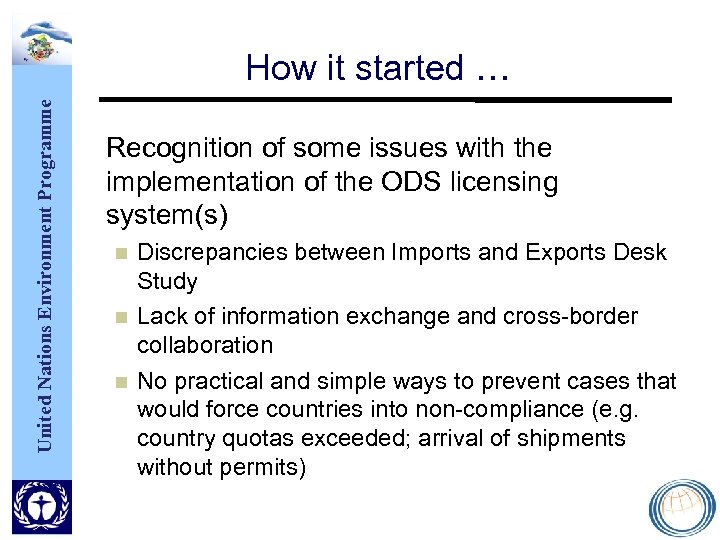 United Nations Environment Programme How it started … Recognition of some issues with the implementation of the ODS licensing system(s) Discrepancies between Imports and Exports Desk Study Lack of information exchange and cross-border collaboration No practical and simple ways to prevent cases that would force countries into non-compliance (e. g. country quotas exceeded; arrival of shipments without permits)
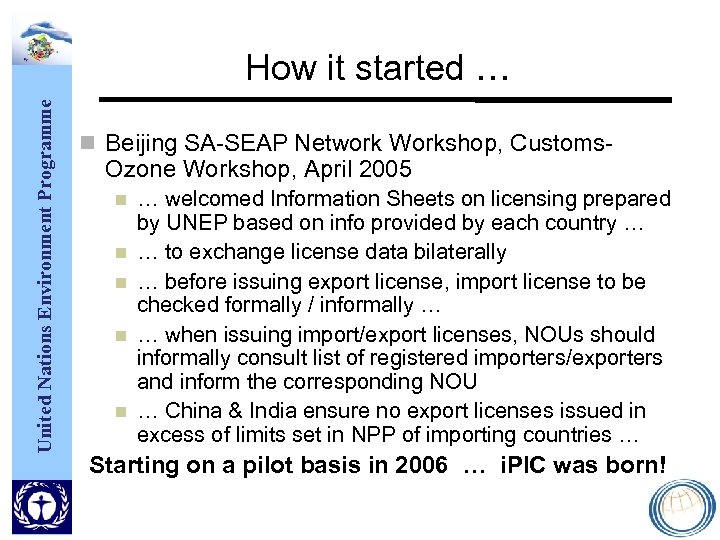 United Nations Environment Programme How it started … Beijing SA-SEAP Network Workshop, Customs- Ozone Workshop, April 2005 … welcomed Information Sheets on licensing prepared by UNEP based on info provided by each country … … to exchange license data bilaterally … before issuing export license, import license to be checked formally / informally … … when issuing import/export licenses, NOUs should informally consult list of registered importers/exporters and inform the corresponding NOU … China & India ensure no export licenses issued in excess of limits set in NPP of importing countries … Starting on a pilot basis in 2006 … i. PIC was born!
 United Nations Environment Programme i. PIC Objectives • Effective implemention of licensing systems. • Remaining in compliance – Avoid surprises of unwanted shipments arriving on your doorstep. • Prevention of illegal trade in ODS.
 United Nations Environment Programme Basic elements/requirements of a licensing system All importers and exporters of ODS need to be registered A license is issued per single shipment of ODS An exporter should add the contract to the request for import license Exporters should give the details of the destinations Importing countries agree to inform exporting countries of their registered importers and the quantities allocated in the beginning of each year. Exporting countries check the copy of import licenses voluntarily before issuing export licenses
 United Nations Environment Programme 2008: Participating Countries 56 countries with i. PIC 19 ROAP Network countries (Brunei, Cambodia, China, Fiji, Indonesia, Iran, Republic of Korea, Laos, Malaysia, Maldives, Mongolia, Philippines, Singapore, Sri Lanka, Thailand, Vietnam, Afghanistan, India, Pakistan) 27 European Union countries Australia, New Zealand, Japan 6 ECA Network countries (Armenia, Kazakhstan, Kyrgyzstan, Tajikistan, Turkmenistan, Uzbekistan) 1 ROLAC Network country (Colombia)
 United Nations Environment Programme 2009: Participating Countries 65 countries with i. PIC 19 ROAP Network countries 27 European Union countries Australia, New Zealand 1 ROWA Network countries - Oman 7 ECA Network countries Armenia – Kazakhstan – Kyrgyzstan – Tajikistan – Serbia – Turkmenistan – Uzbekistan 9 ROLAC Network countries Antigua and Barbuda - Bahamas – Barbados – Belize – Guyana – Jamaica – Saint Lucia – St Vincent and the Grenadines – Trinidad and Tobago
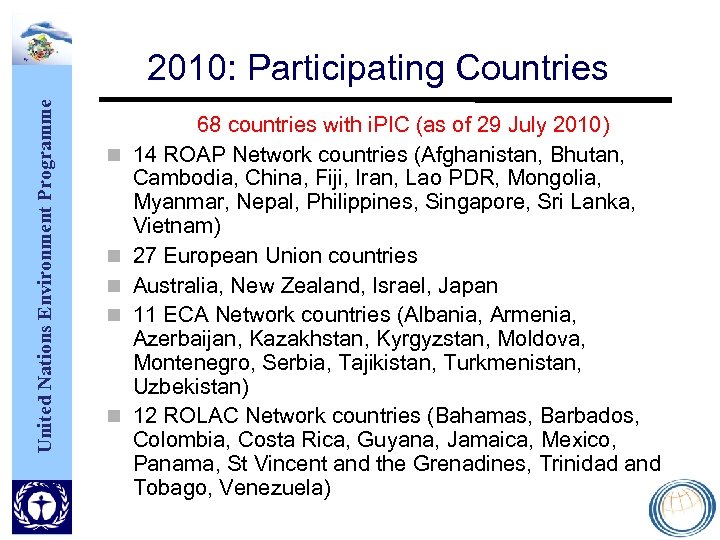 United Nations Environment Programme 2010: Participating Countries 68 countries with i. PIC (as of 29 July 2010) 14 ROAP Network countries (Afghanistan, Bhutan, Cambodia, China, Fiji, Iran, Lao PDR, Mongolia, Myanmar, Nepal, Philippines, Singapore, Sri Lanka, Vietnam) 27 European Union countries Australia, New Zealand, Israel, Japan 11 ECA Network countries (Albania, Armenia, Azerbaijan, Kazakhstan, Kyrgyzstan, Moldova, Montenegro, Serbia, Tajikistan, Turkmenistan, Uzbekistan) 12 ROLAC Network countries (Bahamas, Barbados, Colombia, Costa Rica, Guyana, Jamaica, Mexico, Panama, St Vincent and the Grenadines, Trinidad and Tobago, Venezuela)
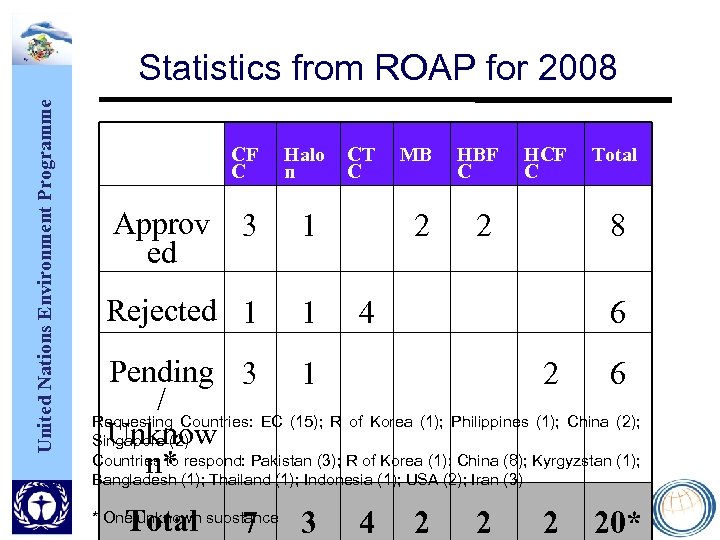 United Nations Environment Programme Statistics from ROAP for 2008 CF C Halo n Approv 3 ed 1 Rejected 1 1 CT C MB 2 HBF C HCF C 2 Total 8 4 6 Pending 3 1 2 6 / Requesting Countries: EC (15); R of Korea (1); Philippines (1); China (2); Unknow Singapore (2) Countries to respond: Pakistan (3); R of Korea (1); China (8); Kyrgyzstan (1); n* Bangladesh (1); Thailand (1); Indonesia (1); USA (2); Iran (3) Total 7 * One unknown substance 3 4 2 20*
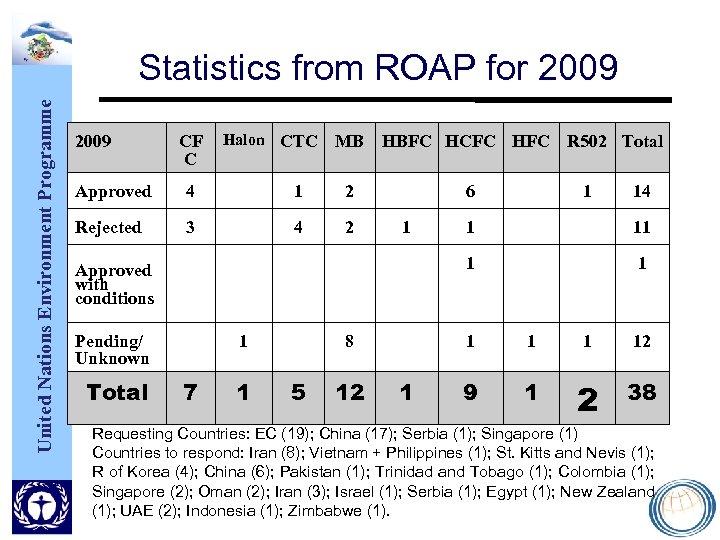 United Nations Environment Programme Statistics from ROAP for 2009 CF C Halon CTC MB HBFC HCFC HFC R 502 Total Approved 4 1 2 Rejected 3 4 2 6 1 14 Pending/ Unknown 1 7 1 8 5 12 1 11 1 Approved with conditions Total 1 1 1 12 9 1 2 38 Requesting Countries: EC (19); China (17); Serbia (1); Singapore (1) Countries to respond: Iran (8); Vietnam + Philippines (1); St. Kitts and Nevis (1); R of Korea (4); China (6); Pakistan (1); Trinidad and Tobago (1); Colombia (1); Singapore (2); Oman (2); Iran (3); Israel (1); Serbia (1); Egypt (1); New Zealand (1); UAE (2); Indonesia (1); Zimbabwe (1).
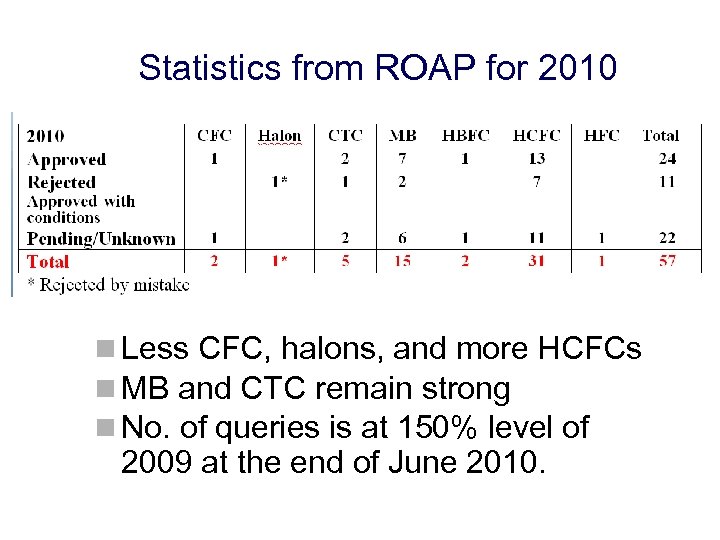 Statistics from ROAP for 2010 Less CFC, halons, and more HCFCs MB and CTC remain strong No. of queries is at 150% level of 2009 at the end of June 2010.
 United Nations Environment Programme Reflections (1) Significant increase in i. PIC queries; 20 (21) in 2008, 38 in 2009, and 57 in 2010 (at mid year) A query on R 502 that appeared in 2009, has not surfaced yet in 2010. The proportions of “Approved”, “Rejected”, and “Unknown” remain relatively same over the years until 2009. In 2010, 19% rejection in 2010, compared to 29% in 2009. Pending/ Unknown was 31. 5% in 2009; this year, it has grown to 38. 6%. Some key countries in trade not participating – e. g. India. Some participating countries do not respond to queries. e. g. The Philippines, Malaysia.
 United Nations Environment Programme Reflections (2) In addition to fulfilling its objectives, the mechanism is helpful in: Identification of “new” importers/exporters Awareness-raising: need for import/export license Improved knowledge about: products / trade names; routing; investigation skills; other countries licensing systems.
 United Nations Environment Programme Reflections (3) Will only address a small fraction of all ODS trade. Slow submission of i. PIC infosheet by countries in 2010. 1 st ODS group banned, the 2 nd group not controlled yet (no quota). Less motivation for i. PIC? Staff change? Workload of starting HPMP?
 United Nations Environment Programme Reflections (4) Issue of language used. Who would bear the cost of translation? How to deal with Free Trade Zone, Bilateral Trade Agreements, Sale to Flagged ships? 7 out of 57 queries so far in 2010 are for servicing for vessels. Trade for destruction of ODS started. e. g. Panama to EU.
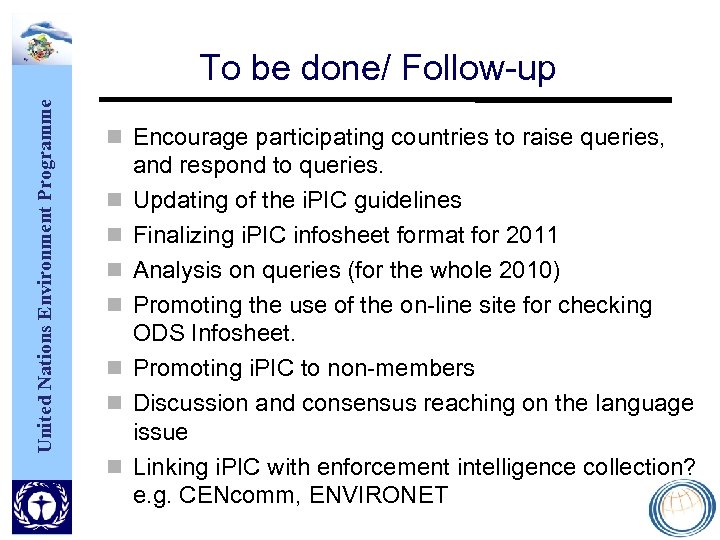 United Nations Environment Programme To be done/ Follow-up Encourage participating countries to raise queries, and respond to queries. Updating of the i. PIC guidelines Finalizing i. PIC infosheet format for 2011 Analysis on queries (for the whole 2010) Promoting the use of the on-line site for checking ODS Infosheet. Promoting i. PIC to non-members Discussion and consensus reaching on the language issue Linking i. PIC with enforcement intelligence collection? e. g. CENcomm, ENVIRONET
 Kakuko Nagatani (kakuko. nagatani@unep. org) Tel: +66 22 88 1679 Ozon. Action CAP Team UNEP Regional Office for Asia and the Pacific 2 F, B-wing, UN Building, Rajdamnern Nok Avenue, Bangkok 10200, Thailand http: //www. unep. fr/ozonaction/index. asp