


 Скачать презентацию United Nations Economic Commission for African Centre for
a3655ce3091b985dde3b9534ce8929d1.ppt
- Количество слайдов: 26
 United Nations Economic Commission for African Centre for Statistics Addressing Data Discrepancies in MDG Monitoring: The Role of UN Regional Commissions Workshop on MDG Monitoring 5 -8 May 2008, Kampala, Uganda Ben Kiregyera, Ph. D. Director
 Outline = Background = Data discrepancies: potential role for the UN Regional Commissions = Meeting data challenges: National Strategies for the Development of Statistics (NSDS) = The 2 way forward
 Background 3
 MDG monitoring The Millennium Declaration (2000) l Mechanisms in place to monitor and evaluate the MDGs include the establishment of the IAEG on MDGs Indicators l Coordination among international agencies and an attempt to fully use available data at international level l There are still a number of challenges hampering the smooth monitoring of MDGs l 4
 Concerns with the reporting mechanism (1) 1. 5 Report of the Friends of the Chair of the UN Statistical Commission on MDG indicators (2006) identified following challenges: Ø inadequate mechanisms for reporting to international agencies Ølack of coordination among data sources within countries Øinternational agencies visit countries to collect data rather than build capacity
 Concerns with the reporting mechanism (2) 6 Øindicators in countries often differ between countries and agencies because of country priorities Øfor most goals, more data available at national level & used in national MDG reports than used at international level Øpoor metadata for some indicators Øuse of imputation to fill data gaps at international level Ødata discrepancies between national and international sources
 Concerns with the reporting mechanism (3) ØNot all available data are used by agencies responsible for providing the MDG indicators ØIn many cases population estimates used to produce MDG indicators are not the same ØInadequate coordination within the country and between the country and international organizations in charge of reporting on given indicators 7
 Data discrepancies: potential role of UN Regional Commissions 8
 Strengthening the role of UN RCs in MDG monitoring Several calls for UN RCs to be involved in reconciling discrepancies between national and international data on MDGs: 1. ØReport of the Friends of the Chair on the MDG indicators (E/CN. 3/2006/15) ØReport to the Secretary General on Indicators for monitoring the MDGs (E/CN. 3/2007/13) ØIAEG meeting on MDG Indicators (Paris, November 2007) 9
 Rationale behind the UN RCs involvement = UN RCs: not directly responsible for collecting data on the MDGs = Play a pivotal role and serve as a useful bridge between countries and international agencies = Strong knowledge of country statistical systems = Close collaboration with countries in their respective regions = Potential to play an important role to address the issue of MDG data discrepancies between national and international estimates 10
 What the UN RCs have been doing = Providing technical assistance to countries: Ø Statistical advocacy Ø Assessments Ø Development Account Project on MDGs in Africa (ECOWAS, SADC) = Regional databases and reports = Establish and/or improve coordination mechanisms at country and regional levels through various initiatives (capacity building initiatives) = UNECA’s role in the MDG Africa Working 11 Group (established 2007)
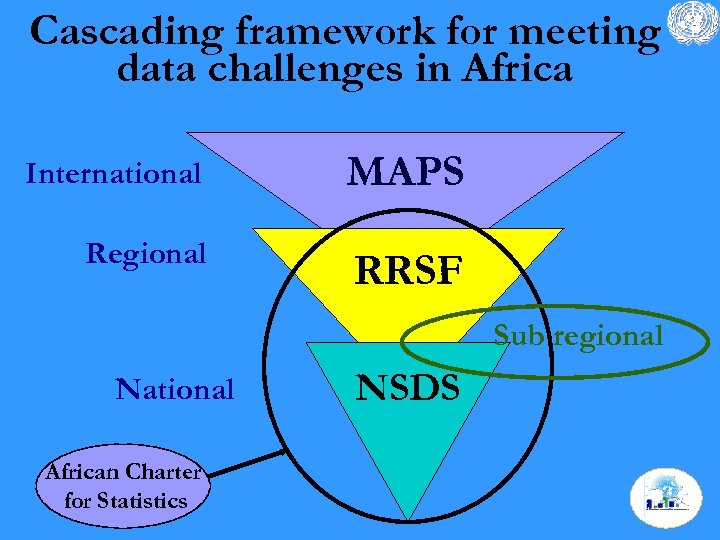 Cascading framework for meeting data challenges in Africa International MAPS Regional RRSF Sub regional National African Charter for Statistics NSDS
 Meeting data challenges: Designing National Strategies for the Development of Statistics (NSDS) 13
 National Strategy for the Development of Statistics = Coordination is paramount in the delivery of coherent information for MDG monitoring = Designing NSDS is overarching action point of MAPS & headline strategy of the RRSF = NSDS: Ø Assists to mainstream statistics in national development policies, processes & budgets Ø A plan aimed at strengthening statistical capacity across the entire NSS Ø Comprehensive and coherent framework: cover entire NSS & all sectors Ø Framework for mobilizing, prioritizing use of resources & 14 coordinating donor assistance to countries
 Types of coordination = Coordination between data producers and users =Inter-institutional (horizontal & vertical – subnational) coordination among data producers =Technical coordination of data sources: standardization of concepts, definitions, classification = Coordination between data producers and research and training institutions (academic statisticians/official statisticians) = Coordination of partners at country level 15
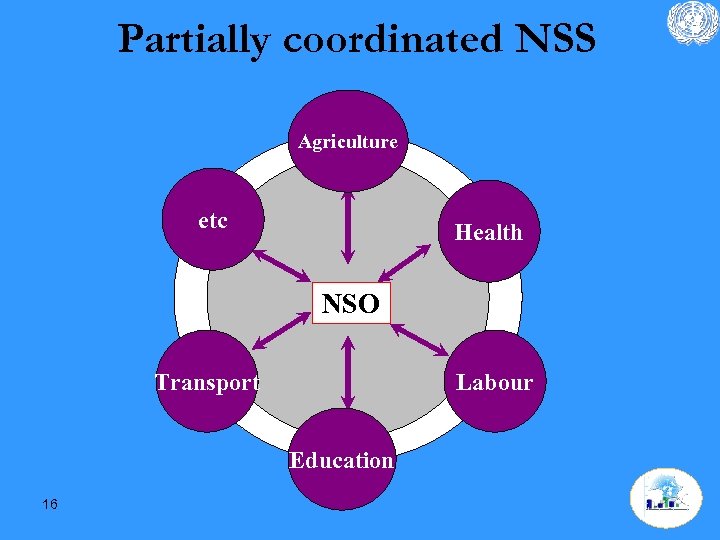 Partially coordinated NSS Agriculture etc Health NSO Transport Labour Education 16
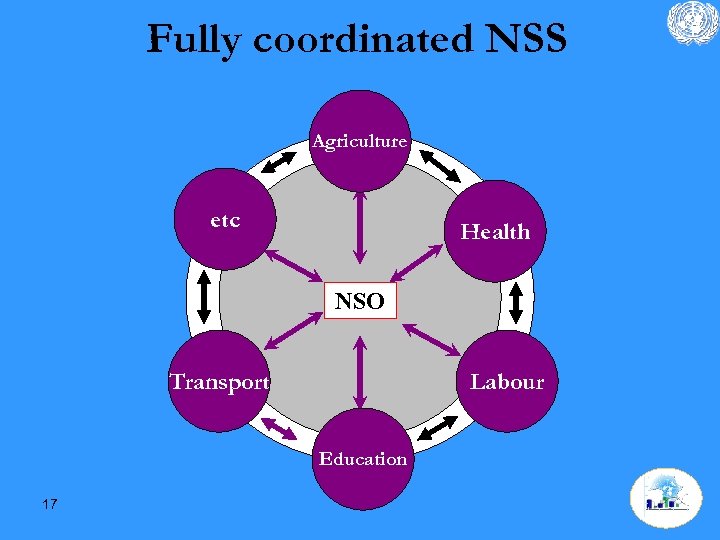 Fully coordinated NSS Agriculture etc Health NSO Transport Labour Education 17
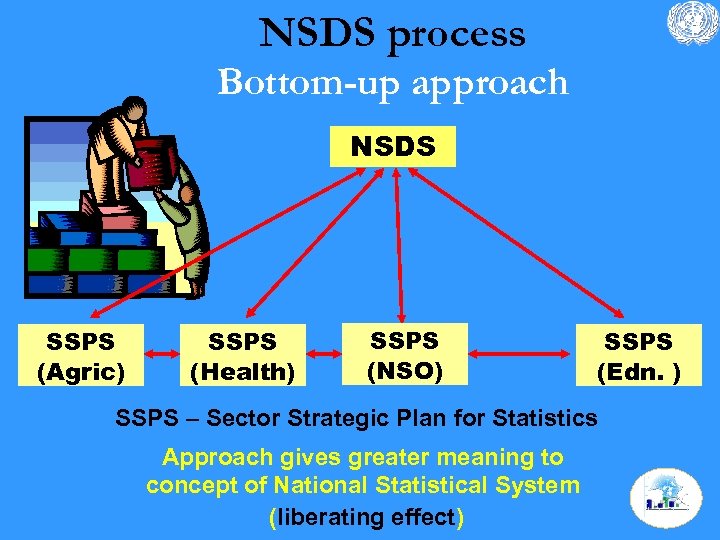 NSDS process Bottom-up approach NSDS SSPS (Agric) SSPS (Health) SSPS (NSO) SSPS (Edn. ) SSPS – Sector Strategic Plan for Statistics Approach gives greater meaning to concept of National Statistical System (liberating effect)
 Rationale for integration of sectors =A lot of development data are collected, compiled by sectors: v. Agriculture, Health, Education, Labour, etc =Need for voice in sectors and NSS =Need to reinforce the capacity of sectors to produce reliable information 19
 Scope of the NSDS 1. Organizational development (statistical awareness, coordination, networking, information sharing, statistical legislation – official statistics, professional autonomy, data access) 2. Institutional development (Management Information Systems, Capacity building - human resources, staff motivation, etc) 3. Infrastructure development and equipment (offices, survey infrastructure, IT infrastructure including databases, library, etc. ) 20
 4. Data development (enhancing data quality, improving censuses and surveys, improving administrative data, civil/vital registration system, new statistical products – poverty maps) 5. Data management (data archiving, integration, analysis and mining, storage and security, databases, reporting including to agencies, dissemination, access & use) 6. Implementation, monitoring, evaluation and reporting (action plan, policies, performance indicators, targets, benchmarking, reporting system) 7. Proposed budget and financing (recurrent and development budget, investment plan - basket 21 funding, sustainability)
 The way forward 22
 RC’s assessment of data discrepancies: a first step = Examination of current data sources: census, survey or administrative system = Review national agencies responsible for data collection and coordination mechanisms = Sustainability of data production: periodicity of censuses, surveys = Examination of data quality issues: coverage, consistency, reliability, timeliness and disaggregatability = The feasibility of using estimation or 23 imputation methodologies
 Sharing the outcomes of the assessment =Present the results of the assessment to the November 2008 IAEG =Consolidation of assessments from all UN RCs =Organize regional workshops to discuss existing discrepancies and remedial measures, involving all stakeholders 24
 Follow up actions = Develop subsequent, targeted capacity building activities: ØTraining ØTechnical or financial support = Promote and strengthen the coordination at the national level within NSDS = Strengthen the coordination between national and international agencies to improve data availability and consistency 25
 Thank you! African Centre for Statistics Visit us at http: //www. uneca. org/statistics / 26