 Скачать презентацию United Kingdom By Alexander Dudakov Vladislav Galachinskiy and
United Kingdom.pptx
- Количество слайдов: 15



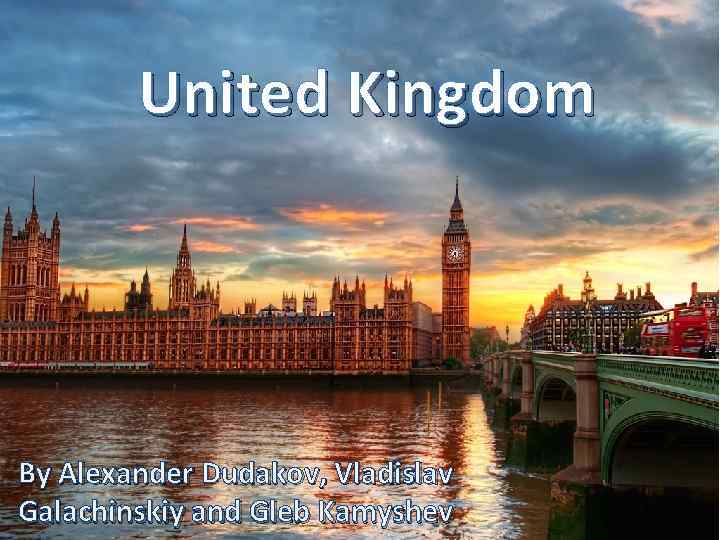
United Kingdom By Alexander Dudakov, Vladislav Galachinskiy and Gleb Kamyshev
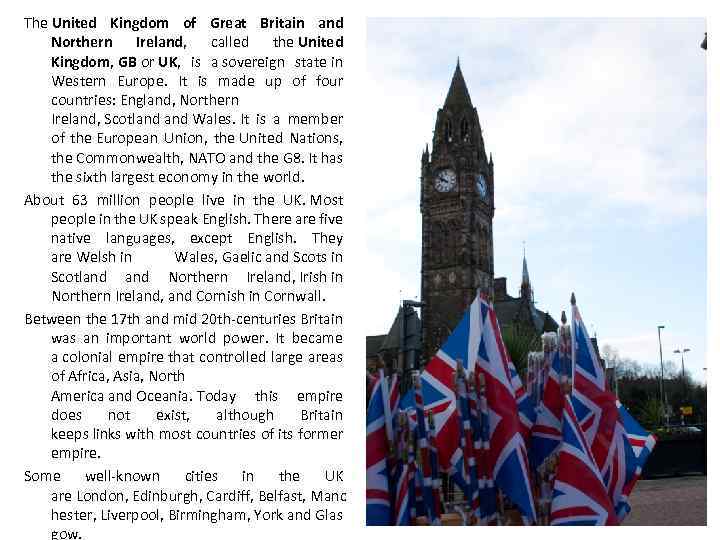
The United Kingdom of Great Britain and Northern Ireland, called the United Kingdom, GB or UK, is a sovereign state in Western Europe. It is made up of four countries: England, Northern Ireland, Scotland Wales. It is a member of the European Union, the United Nations, the Commonwealth, NATO and the G 8. It has the sixth largest economy in the world. About 63 million people live in the UK. Most people in the UK speak English. There are five native languages, except English. They are Welsh in Wales, Gaelic and Scots in Scotland Northern Ireland, Irish in Northern Ireland, and Cornish in Cornwall. Between the 17 th and mid 20 th-centuries Britain was an important world power. It became a colonial empire that controlled large areas of Africa, Asia, North America and Oceania. Today this empire does not exist, although Britain keeps links with most countries of its former empire. Some well-known cities in the UK are London, Edinburgh, Cardiff, Belfast, Manc hester, Liverpool, Birmingham, York and Glas gow.
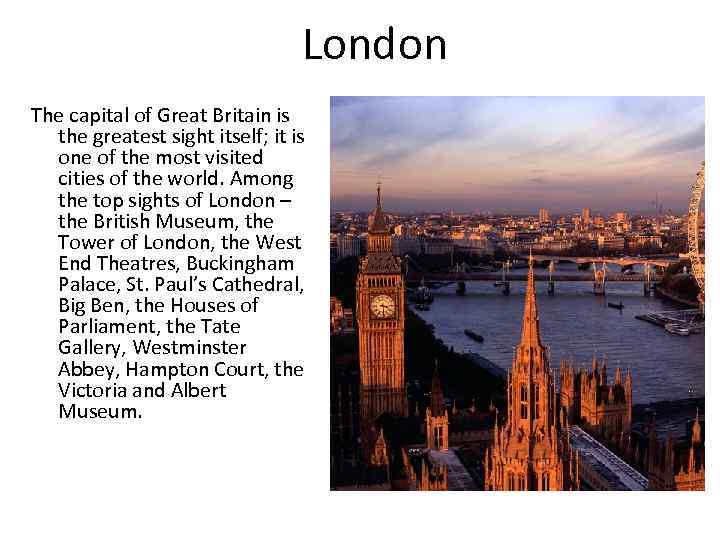
London The capital of Great Britain is the greatest sight itself; it is one of the most visited cities of the world. Among the top sights of London – the British Museum, the Tower of London, the West End Theatres, Buckingham Palace, St. Paul’s Cathedral, Big Ben, the Houses of Parliament, the Tate Gallery, Westminster Abbey, Hampton Court, the Victoria and Albert Museum.
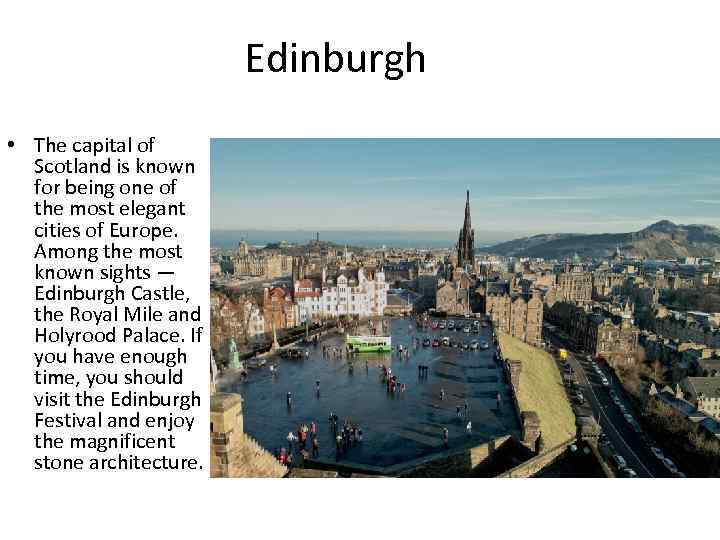
Edinburgh • The capital of Scotland is known for being one of the most elegant cities of Europe. Among the most known sights — Edinburgh Castle, the Royal Mile and Holyrood Palace. If you have enough time, you should visit the Edinburgh Festival and enjoy the magnificent stone architecture.
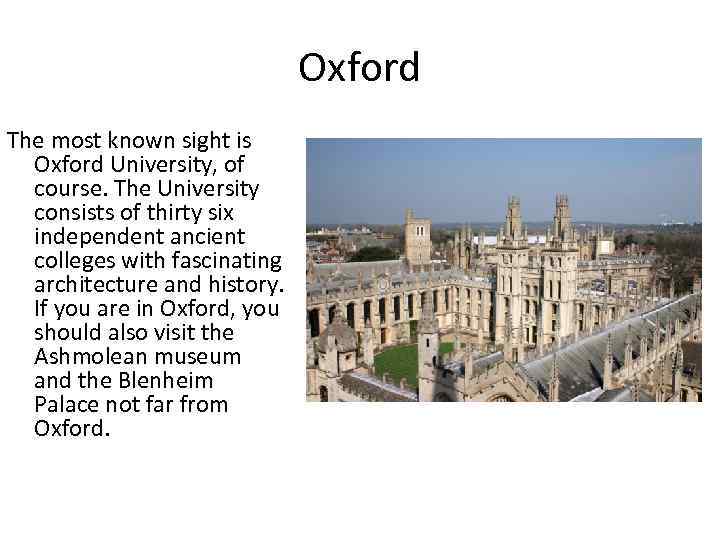
Oxford The most known sight is Oxford University, of course. The University consists of thirty six independent ancient colleges with fascinating architecture and history. If you are in Oxford, you should also visit the Ashmolean museum and the Blenheim Palace not far from Oxford.
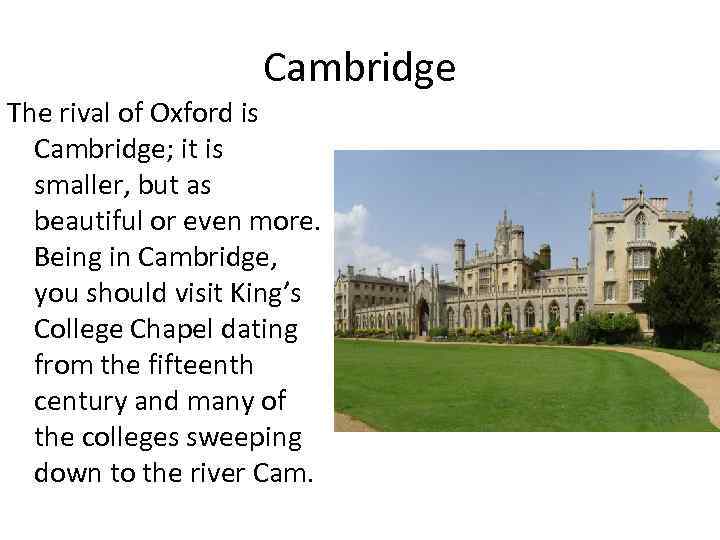
Cambridge The rival of Oxford is Cambridge; it is smaller, but as beautiful or even more. Being in Cambridge, you should visit King’s College Chapel dating from the fifteenth century and many of the colleges sweeping down to the river Cam.
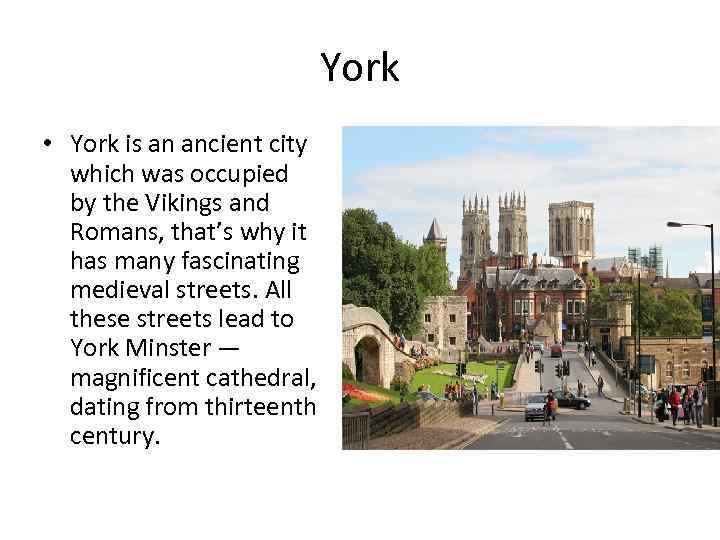
York • York is an ancient city which was occupied by the Vikings and Romans, that’s why it has many fascinating medieval streets. All these streets lead to York Minster — magnificent cathedral, dating from thirteenth century.
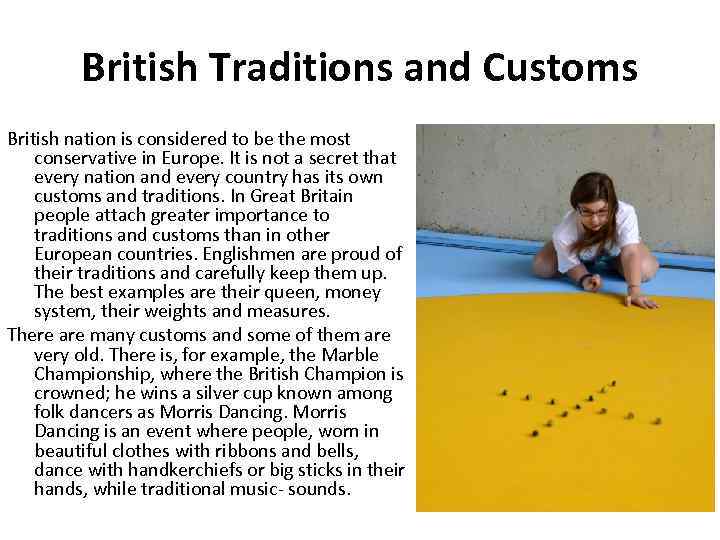
British Traditions and Customs British nation is considered to be the most conservative in Europe. It is not a secret that every nation and every country has its own customs and traditions. In Great Britain people attach greater importance to traditions and customs than in other European countries. Englishmen are proud of their traditions and carefully keep them up. The best examples are their queen, money system, their weights and measures. There are many customs and some of them are very old. There is, for example, the Marble Championship, where the British Champion is crowned; he wins a silver cup known among folk dancers as Morris Dancing is an event where people, worn in beautiful clothes with ribbons and bells, dance with handkerchiefs or big sticks in their hands, while traditional music- sounds.
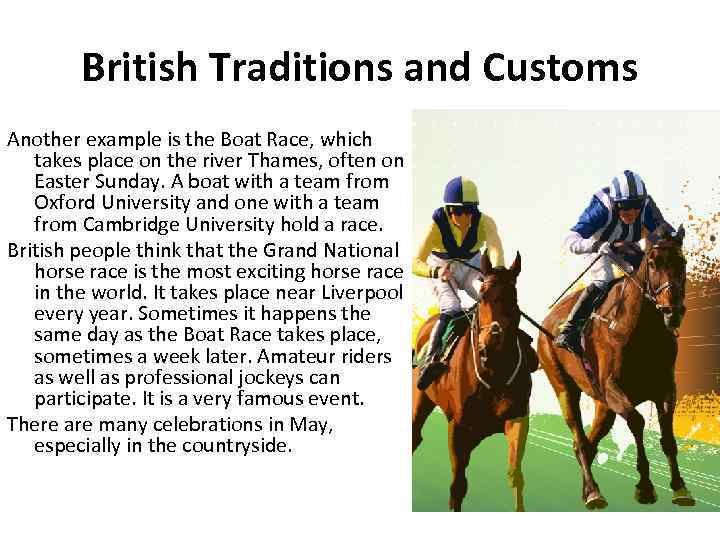
British Traditions and Customs Another example is the Boat Race, which takes place on the river Thames, often on Easter Sunday. A boat with a team from Oxford University and one with a team from Cambridge University hold a race. British people think that the Grand National horse race is the most exciting horse race in the world. It takes place near Liverpool every year. Sometimes it happens the same day as the Boat Race takes place, sometimes a week later. Amateur riders as well as professional jockeys can participate. It is a very famous event. There are many celebrations in May, especially in the countryside.
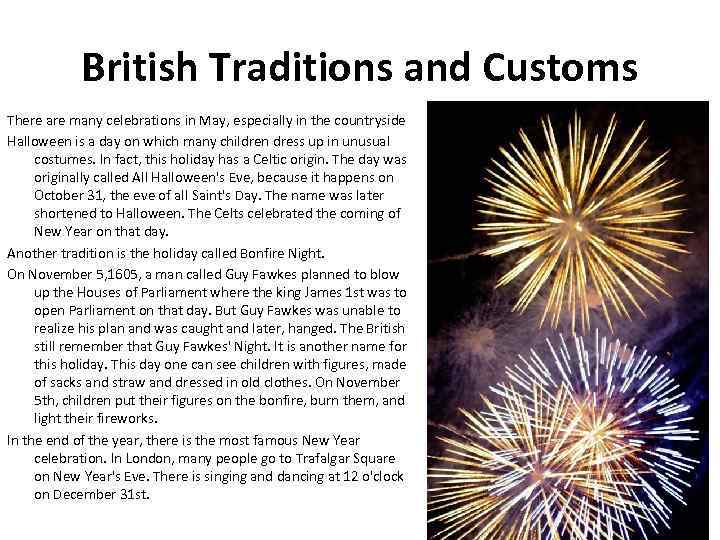
British Traditions and Customs There are many celebrations in May, especially in the countryside Halloween is a day on which many children dress up in unusual costumes. In fact, this holiday has a Celtic origin. The day was originally called All Halloween's Eve, because it happens on October 31, the eve of all Saint's Day. The name was later shortened to Halloween. The Celts celebrated the coming of New Year on that day. Another tradition is the holiday called Bonfire Night. On November 5, 1605, a man called Guy Fawkes planned to blow up the Houses of Parliament where the king James 1 st was to open Parliament on that day. But Guy Fawkes was unable to realize his plan and was caught and later, hanged. The British still remember that Guy Fawkes' Night. It is another name for this holiday. This day one can see children with figures, made of sacks and straw and dressed in old clothes. On November 5 th, children put their figures on the bonfire, burn them, and light their fireworks. In the end of the year, there is the most famous New Year celebration. In London, many people go to Trafalgar Square on New Year's Eve. There is singing and dancing at 12 o'clock on December 31 st.
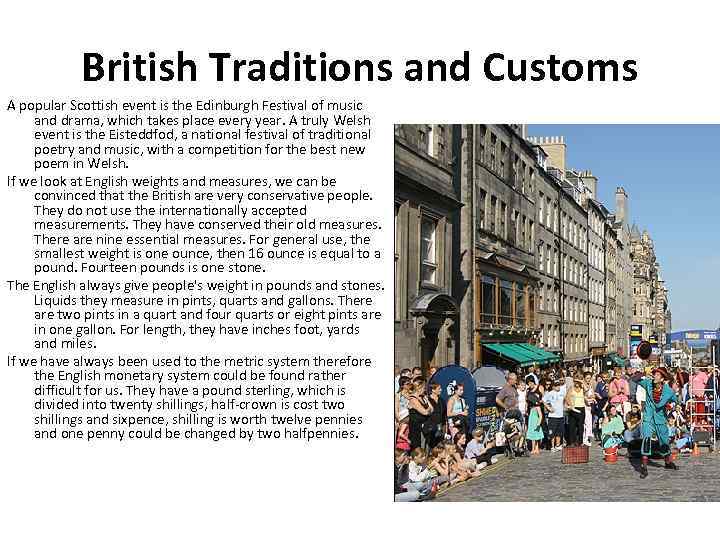
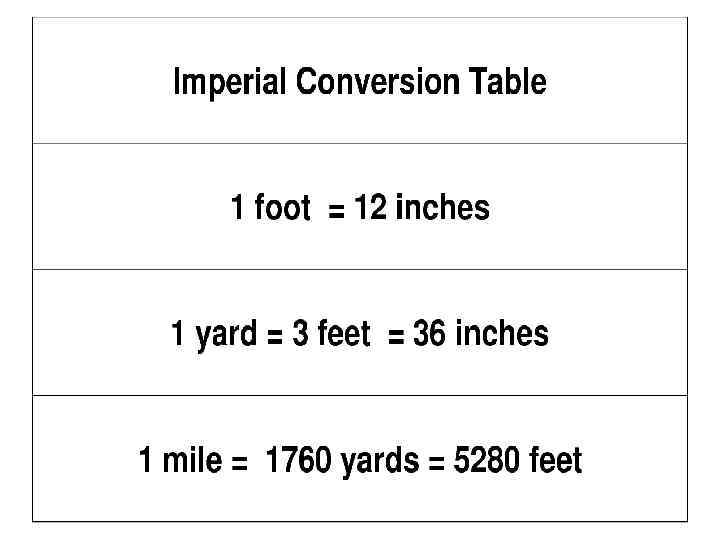
British Traditions and Customs A popular Scottish event is the Edinburgh Festival of music and drama, which takes place every year. A truly Welsh event is the Eisteddfod, a national festival of traditional poetry and music, with a competition for the best new poem in Welsh. If we look at English weights and measures, we can be convinced that the British are very conservative people. They do not use the internationally accepted measurements. They have conserved their old measures. There are nine essential measures. For general use, the smallest weight is one ounce, then 16 ounce is equal to a pound. Fourteen pounds is one stone. The English always give people's weight in pounds and stones. Liquids they measure in pints, quarts and gallons. There are two pints in a quart and four quarts or eight pints are in one gallon. For length, they have inches foot, yards and miles. If we have always been used to the metric system therefore the English monetary system could be found rather difficult for us. They have a pound sterling, which is divided into twenty shillings, half-crown is cost two shillings and sixpence, shilling is worth twelve pennies and one penny could be changed by two halfpennies.
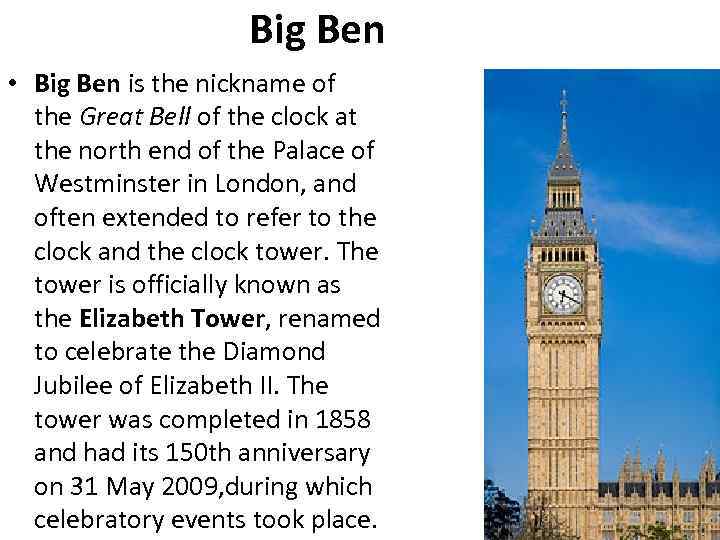
Big Ben • Big Ben is the nickname of the Great Bell of the clock at the north end of the Palace of Westminster in London, and often extended to refer to the clock and the clock tower. The tower is officially known as the Elizabeth Tower, renamed to celebrate the Diamond Jubilee of Elizabeth II. The tower was completed in 1858 and had its 150 th anniversary on 31 May 2009, during which celebratory events took place.
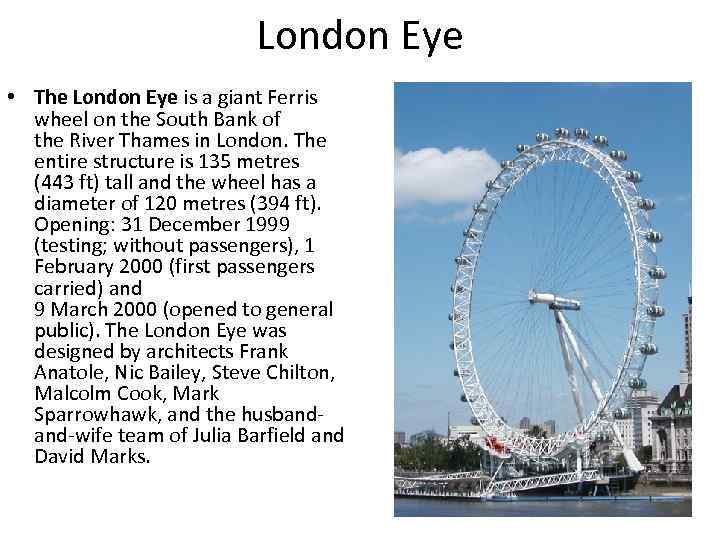
London Eye • The London Eye is a giant Ferris wheel on the South Bank of the River Thames in London. The entire structure is 135 metres (443 ft) tall and the wheel has a diameter of 120 metres (394 ft). Opening: 31 December 1999 (testing; without passengers), 1 February 2000 (first passengers carried) and 9 March 2000 (opened to general public). The London Eye was designed by architects Frank Anatole, Nic Bailey, Steve Chilton, Malcolm Cook, Mark Sparrowhawk, and the husbandand-wife team of Julia Barfield and David Marks.
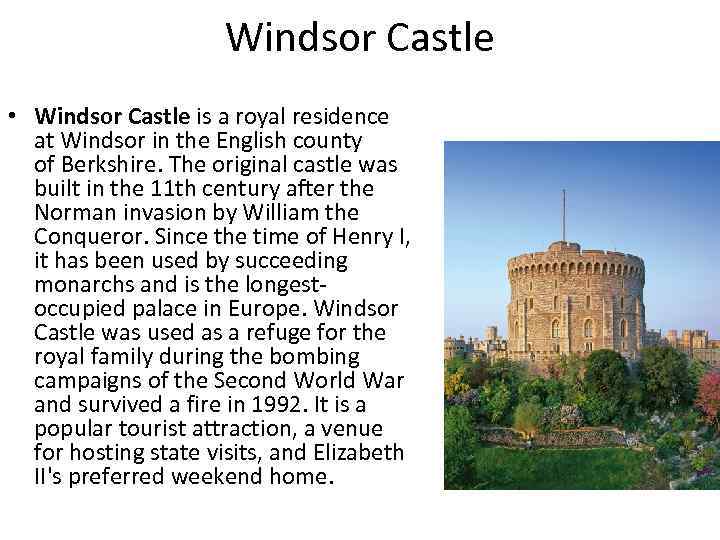
Windsor Castle • Windsor Castle is a royal residence at Windsor in the English county of Berkshire. The original castle was built in the 11 th century after the Norman invasion by William the Conqueror. Since the time of Henry I, it has been used by succeeding monarchs and is the longestoccupied palace in Europe. Windsor Castle was used as a refuge for the royal family during the bombing campaigns of the Second World War and survived a fire in 1992. It is a popular tourist attraction, a venue for hosting state visits, and Elizabeth II's preferred weekend home.
Скачать презентацию United Kingdom By Alexander Dudakov Vladislav Galachinskiy and
United Kingdom.pptx