


 Скачать презентацию UNITÉ 6 Quit Le shopping LEÇON 20 Alice
2b2a1ff4e8aa51a4f8ff8169a1a9bc24.ppt
- Количество слайдов: 8
 UNITÉ 6 Quit Le shopping LEÇON 20 Alice a un job A Le pronom on p. 288 B Les verbes réguliers en -re p. 290 C L’impératif p. 291
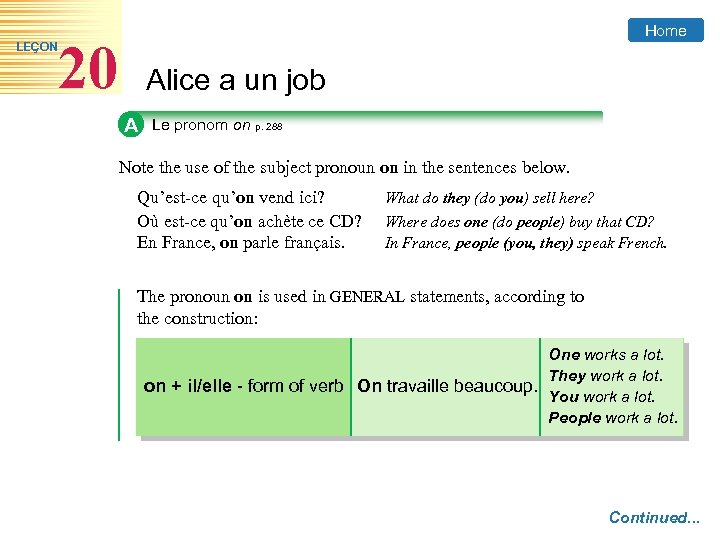 LEÇON Home 20 Alice a un job A Le pronom on p. 288 Note the use of the subject pronoun on in the sentences below. Qu’est-ce qu’on vend ici? Où est-ce qu’on achète ce CD? En France, on parle français. What do they (do you) sell here? Where does one (do people) buy that CD? In France, people (you, they) speak French. The pronoun on is used in GENERAL statements, according to the construction: One works a lot. They work a lot. on + il/elle - form of verb On travaille beaucoup. You work a lot. People work a lot. Continued. . .
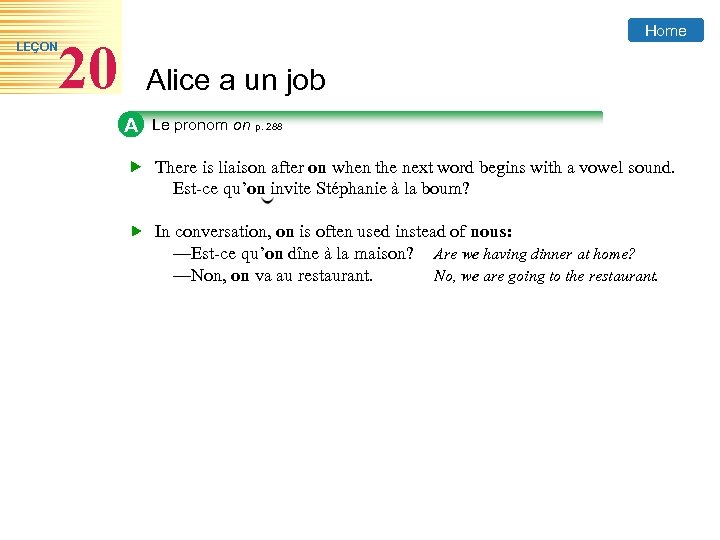 LEÇON Home 20 Alice a un job A Le pronom on p. 288 There is liaison after on when the next word begins with a vowel sound. Est-ce qu’on invite Stéphanie à la boum? In conversation, on is often used instead of nous: —Est-ce qu’on dîne à la maison? Are we having dinner at home? —Non, on va au restaurant. No, we are going to the restaurant.
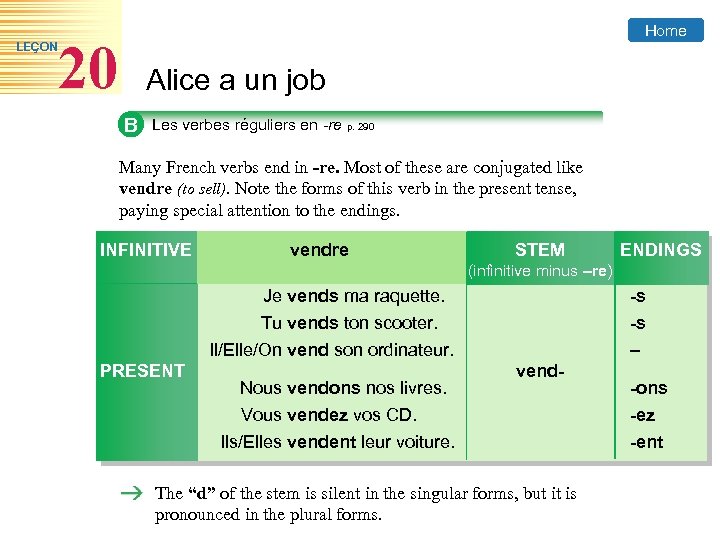 LEÇON Home 20 Alice a un job B Les verbes réguliers en -re p. 290 Many French verbs end in -re. Most of these are conjugated like vendre (to sell). Note the forms of this verb in the present tense, paying special attention to the endings. INFINITIVE vendre STEM ENDINGS (infinitive minus –re) Je vends ma raquette. Tu vends ton scooter. Il/Elle/On vend son ordinateur. PRESENT Nous vendons nos livres. -s -s – vend- Vous vendez vos CD. Ils/Elles vendent leur voiture. The “d” of the stem is silent in the singular forms, but it is pronounced in the plural forms. -ons -ez -ent
 LEÇON Home 20 Alice a un job C L’impératif p. 291 LEARNING ABOUT LANGUAGE The IMPERATIVE is used to make suggestions and to give orders and advice. The commands or suggestions may be affirmative or negative. Continued. . .
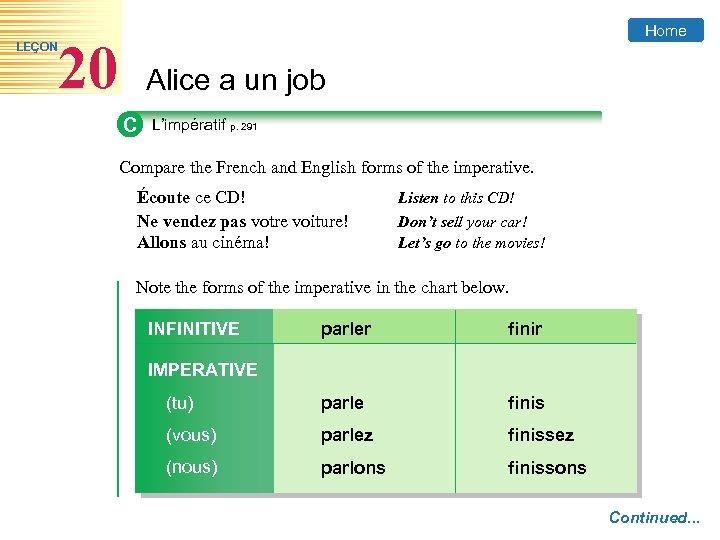 LEÇON Home 20 Alice a un job C L’impératif p. 291 Compare the French and English forms of the imperative. Écoute ce CD! Ne vendez pas votre voiture! Allons au cinéma! Listen to this CD! Don’t sell your car! Let’s go to the movies! Note the forms of the imperative in the chart below. INFINITIVE parler finir (tu) parle finis (vous) parlez finissez (nous) parlons finissons IMPERATIVE Continued. . .
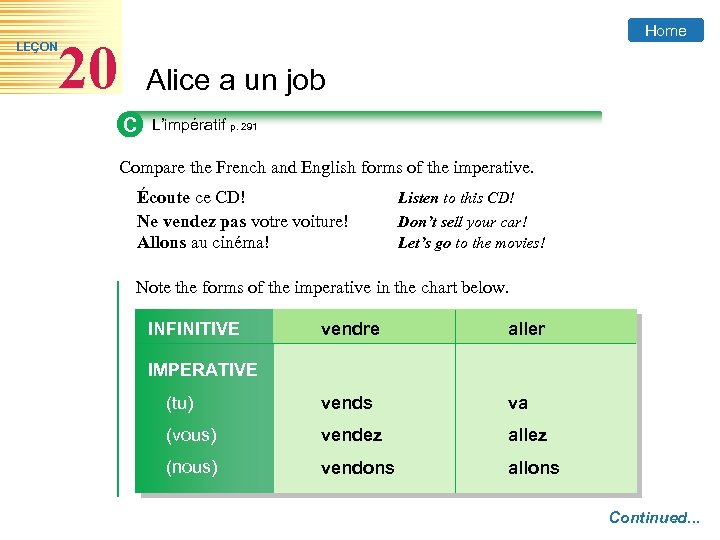 LEÇON Home 20 Alice a un job C L’impératif p. 291 Compare the French and English forms of the imperative. Écoute ce CD! Ne vendez pas votre voiture! Allons au cinéma! Listen to this CD! Don’t sell your car! Let’s go to the movies! Note the forms of the imperative in the chart below. INFINITIVE vendre aller (tu) vends va (vous) vendez allez (nous) vendons allons IMPERATIVE Continued. . .
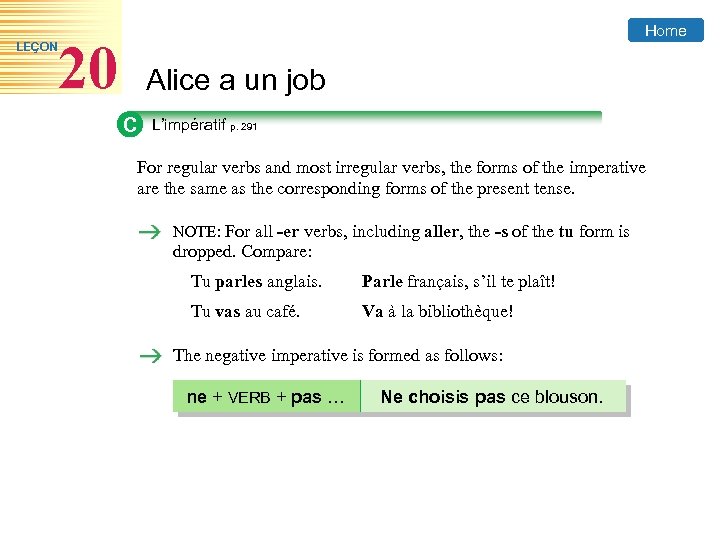 LEÇON Home 20 Alice a un job C L’impératif p. 291 For regular verbs and most irregular verbs, the forms of the imperative are the same as the corresponding forms of the present tense. NOTE: For all -er verbs, including aller, the -s of the tu form is dropped. Compare: Tu parles anglais. Parle français, s’il te plaît! Tu vas au café. Va à la bibliothèque! The negative imperative is formed as follows: ne + VERB + pas … Ne choisis pas ce blouson.