


 Скачать презентацию Unit V Cooperative Law Legislative Impacts on
65d829d1ed5c1f3492b7454f7d5cf9f4.ppt
- Количество слайдов: 39
 Unit V. Cooperative Law
 Legislative Impacts on Co-ops 1. How must co-ops be organized? 2. How must co-ops be operated? 3. How will co-ops be treated?
 Legislation Pertaining to Co-ops Antitrust p State p Marketing p Credit p Electrification p Taxation p Consumer p
 Significant Iowa Cooperative Laws p Chapter 499: n p Chapter 501: n p Pertains to traditional Iowa co-ops (i. e. marketing, supply) Pertains to value-added or New Generation Iowa co-ops Chapter 501 A: n Pertains to co-ops wishing to organize more like a partnership with limited liability
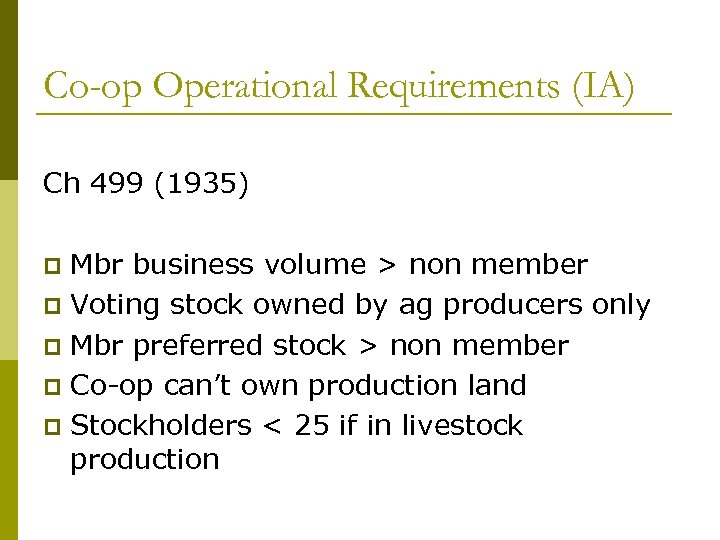 Co-op Operational Requirements (IA) Ch 499 (1935) Mbr business volume > non member p Voting stock owned by ag producers only p Mbr preferred stock > non member p Co-op can’t own production land p Stockholders < 25 if in livestock production p
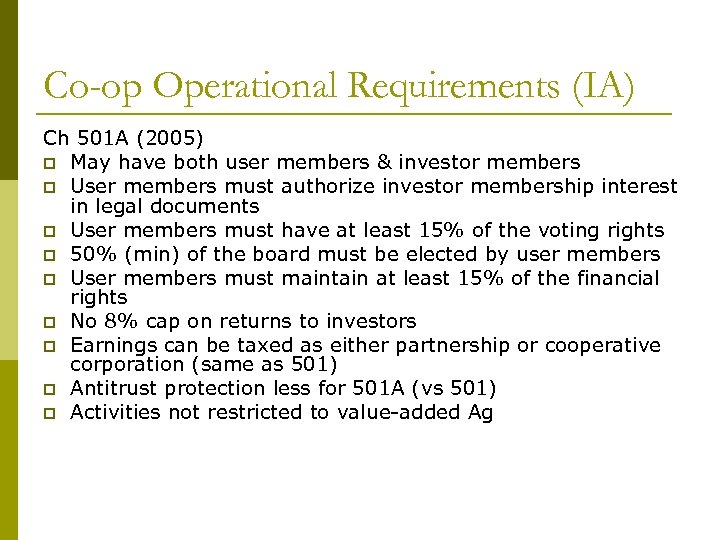 Co-op Operational Requirements (IA) Ch 501 A (2005) p May have both user members & investor members p User members must authorize investor membership interest in legal documents p User members must have at least 15% of the voting rights p 50% (min) of the board must be elected by user members p User members must maintain at least 15% of the financial rights p No 8% cap on returns to investors p Earnings can be taxed as either partnership or cooperative corporation (same as 501) p Antitrust protection less for 501 A (vs 501) p Activities not restricted to value-added Ag
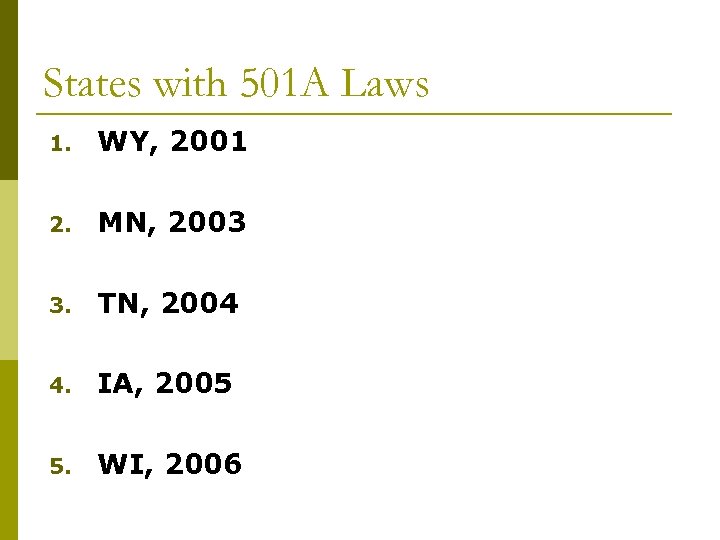 States with 501 A Laws 1. WY, 2001 2. MN, 2003 3. TN, 2004 4. IA, 2005 5. WI, 2006
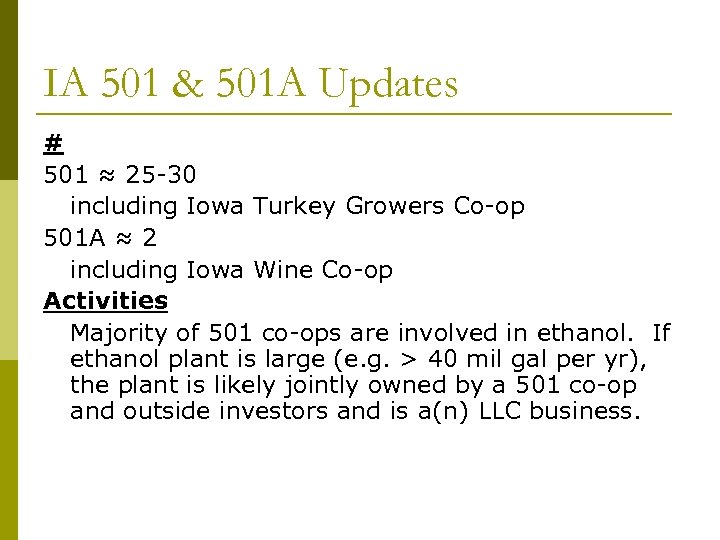 IA 501 & 501 A Updates # 501 ≈ 25 -30 including Iowa Turkey Growers Co-op 501 A ≈ 2 including Iowa Wine Co-op Activities Majority of 501 co-ops are involved in ethanol. If ethanol plant is large (e. g. > 40 mil gal per yr), the plant is likely jointly owned by a 501 co-op and outside investors and is a(n) LLC business.
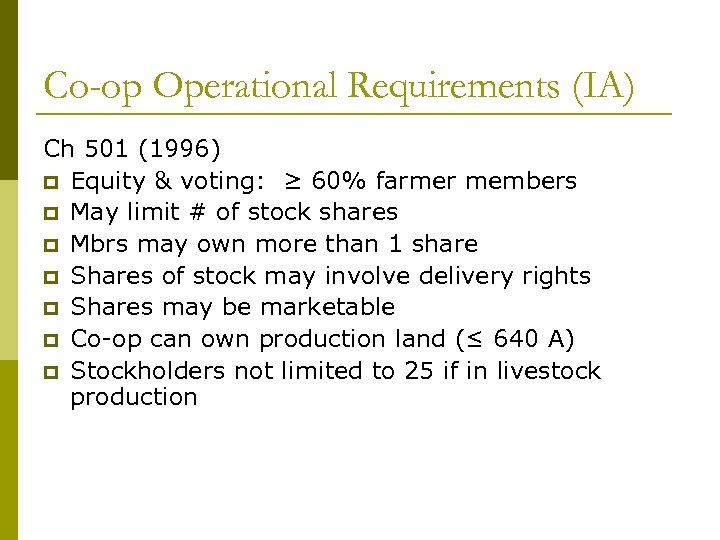 Co-op Operational Requirements (IA) Ch 501 (1996) p Equity & voting: ≥ 60% farmer members p May limit # of stock shares p Mbrs may own more than 1 share p Shares of stock may involve delivery rights p Shares may be marketable p Co-op can own production land (≤ 640 A) p Stockholders not limited to 25 if in livestock production
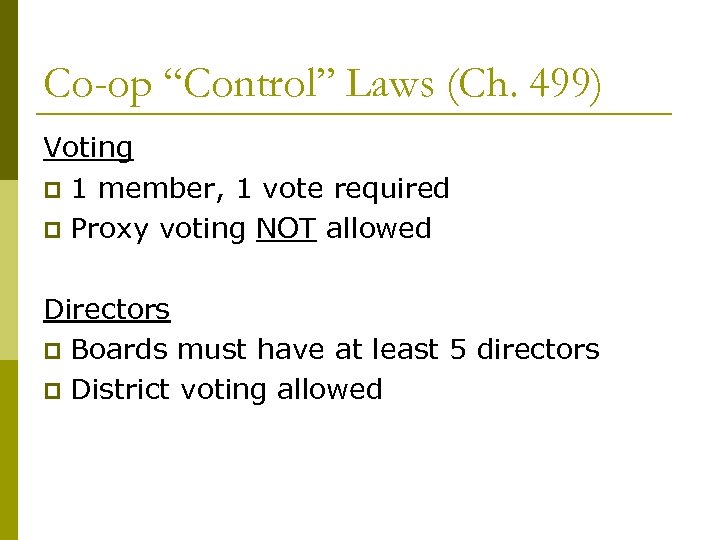 Co-op “Control” Laws (Ch. 499) Voting p 1 member, 1 vote required p Proxy voting NOT allowed Directors p Boards must have at least 5 directors p District voting allowed
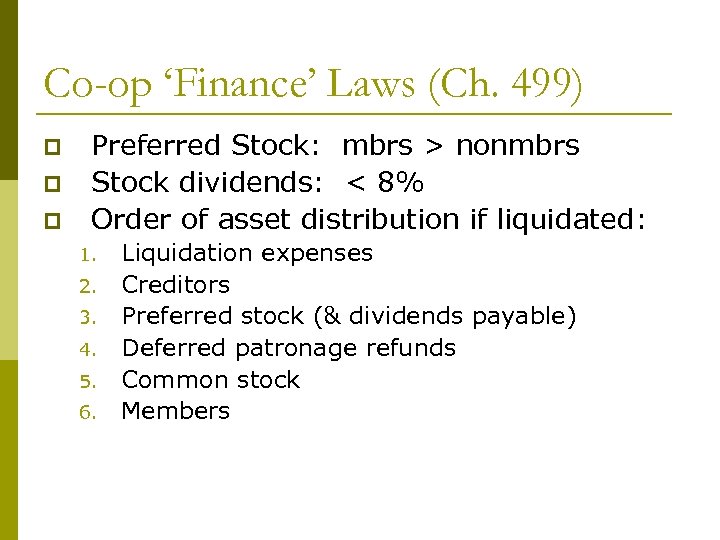 Co-op ‘Finance’ Laws (Ch. 499) p p p Preferred Stock: mbrs > nonmbrs Stock dividends: < 8% Order of asset distribution if liquidated: 1. 2. 3. 4. 5. 6. Liquidation expenses Creditors Preferred stock (& dividends payable) Deferred patronage refunds Common stock Members
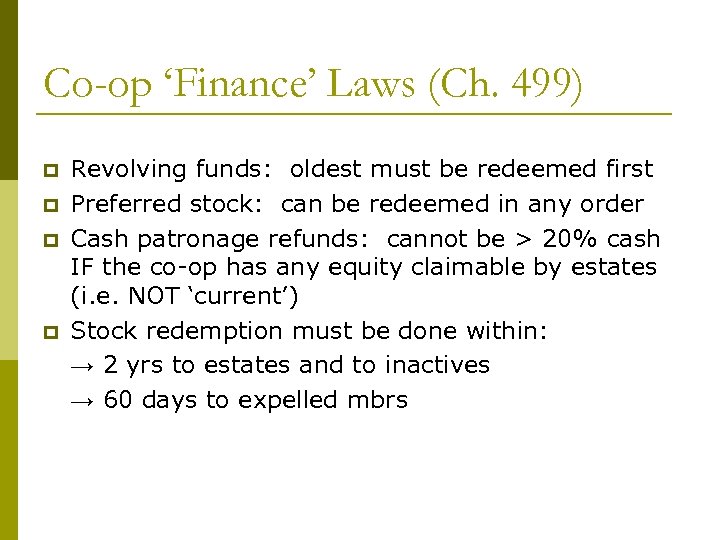 Co-op ‘Finance’ Laws (Ch. 499) p p Revolving funds: oldest must be redeemed first Preferred stock: can be redeemed in any order Cash patronage refunds: cannot be > 20% cash IF the co-op has any equity claimable by estates (i. e. NOT ‘current’) Stock redemption must be done within: → 2 yrs to estates and to inactives → 60 days to expelled mbrs
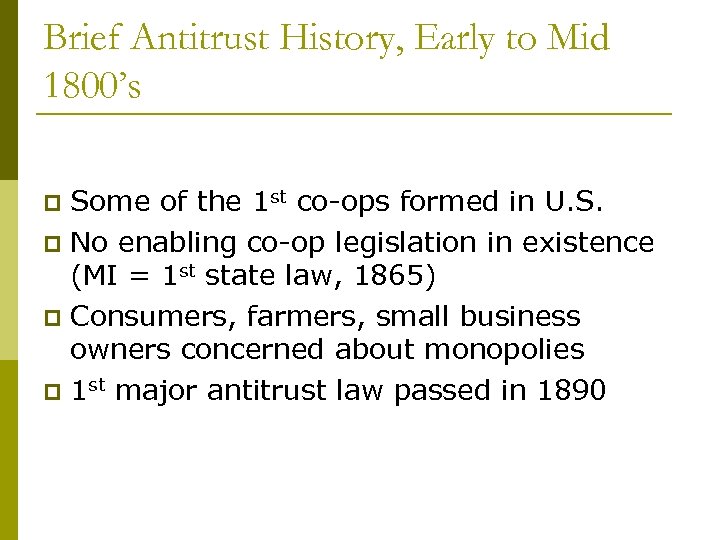 Brief Antitrust History, Early to Mid 1800’s Some of the 1 st co-ops formed in U. S. p No enabling co-op legislation in existence (MI = 1 st state law, 1865) p Consumers, farmers, small business owners concerned about monopolies p 1 st major antitrust law passed in 1890 p
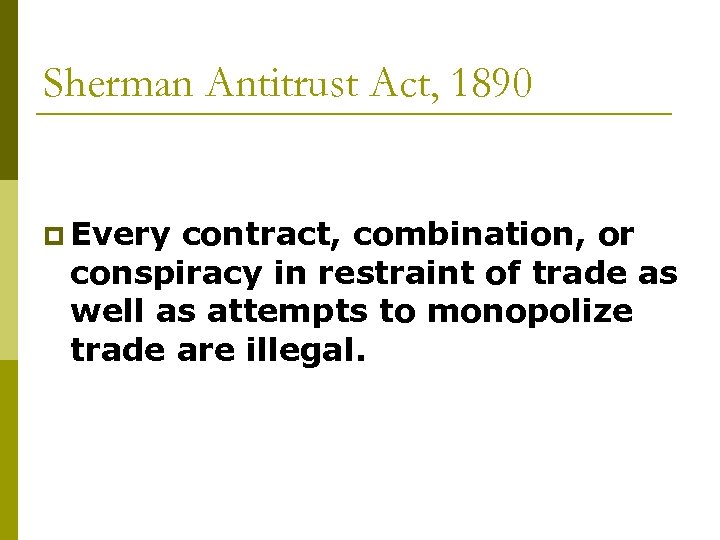 Sherman Antitrust Act, 1890 p Every contract, combination, or conspiracy in restraint of trade as well as attempts to monopolize trade are illegal.
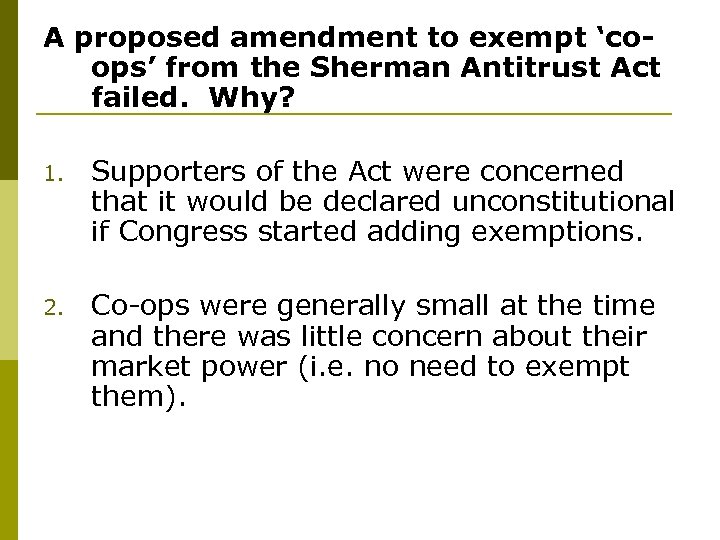 A proposed amendment to exempt ‘coops’ from the Sherman Antitrust Act failed. Why? 1. Supporters of the Act were concerned that it would be declared unconstitutional if Congress started adding exemptions. 2. Co-ops were generally small at the time and there was little concern about their market power (i. e. no need to exempt them).
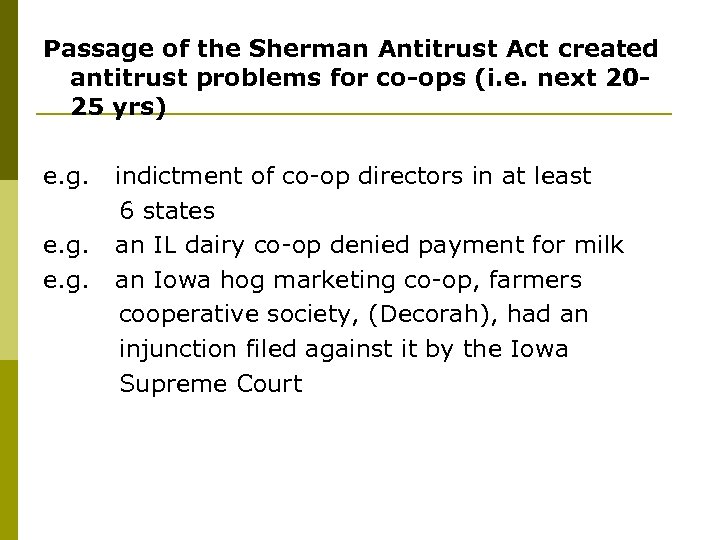 Passage of the Sherman Antitrust Act created antitrust problems for co-ops (i. e. next 2025 yrs) e. g. indictment of co-op directors in at least 6 states an IL dairy co-op denied payment for milk an Iowa hog marketing co-op, farmers cooperative society, (Decorah), had an injunction filed against it by the Iowa Supreme Court
 An Iowa Example of a Sherman Antitrust Act Violation p 1913 in Decorah, a group of local farmers, mostly hog producers, org’d the Farmer’s Cooperative Society to primarily mkt hogs. Had about 350 mbrs. Had in their by-laws a provision which required mbrs to pay 5¢/cwt. For every 100 lbs. of hogs sold to someone other than co-op. A buyer from the Chi. Stockyards claimed that the combined action of the farmers made it necessary for him to pay more for hogs in the Decorah area than what he previously had paid. He claimed the co-op was restraining trade & stifling competition. Filed a law suit. In 1913, IA Supreme Court issued an injunction against this Decorah co-op on the grounds that it was a violation of Sherman Antitrust Act.
 CLAYTON Act, 1914 p Anticompetitive p Nonstock mergers illegal ag co-ops legal
 FEDERAL TRADE COMMISSION Act, 1914 p Established (FTC) a regulatory agency
 Q. Can you guess the ‘Year’? World Series: NY Giants beat the NY Yankees p U. S. Golf Open: Gene Sarazen wins p Pro Football: American Professional Football Assn changes name to NFL; Chicago ‘Staleys’ change name to ‘Bears’ p Mussolini becomes Italy’s dictator p VEISHEA begins at ISU p Capper Volstead Act passed p
 A. 1922
 CAPPER VOLSTEAD Act, 1922 Sect. 1 Identifies: 1. 2. 3. Who can organize a co-op? How a co-op is to be organized/operated? What activities a co-op can undertake?
 CAPPER VOLSTEAD Act, 1922 Sect. 2: Authorizes the Sec. of Ag to order a co-op to cease from unduly enhancing prices as a result of monopolizing or restraining trade.
 Capper & Volstead p Capper: senator from NY p Volstead: representative from KS Note: had introduced the ‘Prohibition’ law, in effect 1920 -1933
 Rep. Volstead: Trying to make it so farmers can put their money together into a business, much like businessmen do in corporations, without being charged with violating antitrust laws. The formation of corporations does not violate the Sherman Antitrust Act; the creation of subsidiaries does not violate the Sherman Act; neither should the formation of a co-op.
 Senator Capper: Trying simply to make definite and unquestioned the legal right, which already is generally admitted, of farmers to organize co-op associations – a legal right, which in view of the Sherman Act, may be questioned or doubted by those whose interests are not identical with the farmer. . .
 Who Can Organize a Co-op? p Persons engaged in the production of agricultural products as farmers, planters, ranchmen, dairymen, nut or fruit growers may act together in associations, corporate or otherwise, with or without capital stock.
 Capper Volstead Organizational/Operational Requirements 1. One person, one vote or dividends on stock cannot exceed 8%. 2. Member business volume must exceed nonmember business volume.
 Activities Authorized by Capper Volstead: 1. 2. 3. 4. 5. 6. Organization Processing Handling Marketing agencies in common Member contracts
 What Capper Volstead Does NOT Do: 1. 2. 3. 4. 5. Enable co-ops to incorporate under it. Determine taxation treatment of co-ops. Regulate or limit production or size of coops. Specify how co-ops are to be financed. Grant co-ops operational immunity from antitrust laws.
 Rep. Volstead: In the event that associations authorized by this bill shall do anything forbidden by the Sherman Antitrust Act, they will be subject to the penalties imposed by that law. This bill is not intended to place coops above the law but rather to grant them the same immunity from prosecution that corporations now enjoy.
 Illegal Cooperative Activities: (not authorized by Capper Volstead or any other Act) 1. 2. 3. 4. Price controlling or price fixing with noncooperative firms. Merger with or acquisition of a noncooperative firm where the intent is to suppress competition. Predatory practices (not limited to dealings with non-cooperative businesses). Unduly enhancing prices.
 National Broiler Mktg Assoc. p p p Formed 1970 75 mbrs = IOF Agribusinesses (e. g. Cargill, Pillsbury, Ralston Purina, Central Soya, Allied Mills) Businesses = feed mills, processing plants, and all but 6 had breeding flocks and hatcheries Chicks raised by contract growers NOT a legal co-op, Sup. Ct. , 1978 1. 2. Not ALL members were producers. Members were NOT farmers in traditional sense.
 MD & VA Milk Producers Assn. p p p Had 80% mkt share, Washington, D. C. milk market. Pd excessive P for a competing dairy (Embassy) Interfered with milk shipments of non co-op members. In 1960, in violation of Sherman Act Showed: Predatory co-op behavior, in restraint of trade, not immune from prosecution; reaffirmed during 1970 s with charges against AMPI
 BORDEN Co. p p = IOF, fluid milk processor Conspired with dairy co-op to raise retail prices by limiting milk supply In 1939, in violation of Sherman Act Showed: 1. 2. Antitrust action against co-op did NOT have to be initiated by Sec. of Ag. Co-ops could NOT conspire with non co-ops to raise prices
 MD Co-op Milk Producers MD & VA Milk Producers Assn. Formed a common mktg agency p Jointly set prices and made sales p In 1956, found NOT guilty of antitrust violation p Showed: p Co-ops could have common marketing agencies.
 Possible Explanations as to Why the Sec. of Ag has Never Ordered a Co-op to Stop Unduly Enhancing Prices: 1. 2. 3. 4. 5. 6. Difficulty in defining undue price enhancement. Lack of evidence suggesting farm prices have increased faster than other prices. Co-ops tend to be relatively small in size compared to a) market size or b) the size of non-cooperative firms in the same industry or in the economy. Co-ops inability to control supply or production. Would be contradictory with USDA self help policy. No such specific policy exists for non-cooperative firms.
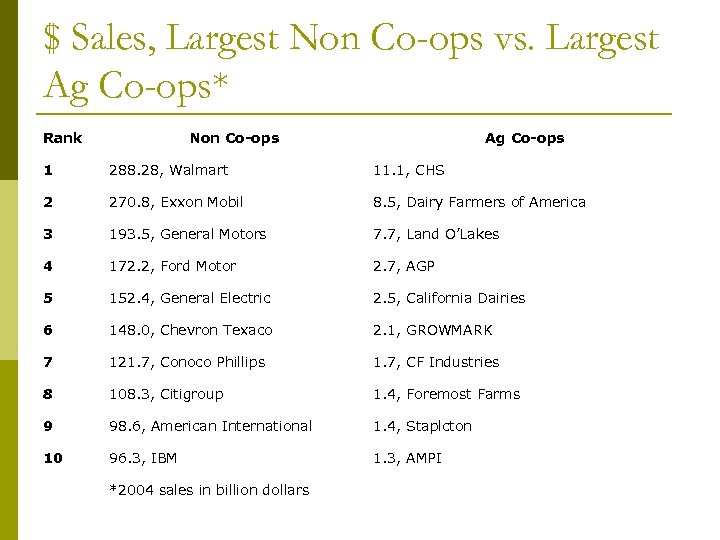 $ Sales, Largest Non Co-ops vs. Largest Ag Co-ops* Rank Non Co-ops Ag Co-ops 1 288. 28, Walmart 11. 1, CHS 2 270. 8, Exxon Mobil 8. 5, Dairy Farmers of America 3 193. 5, General Motors 7. 7, Land O’Lakes 4 172. 2, Ford Motor 2. 7, AGP 5 152. 4, General Electric 2. 5, California Dairies 6 148. 0, Chevron Texaco 2. 1, GROWMARK 7 121. 7, Conoco Phillips 1. 7, CF Industries 8 108. 3, Citigroup 1. 4, Foremost Farms 9 98. 6, American International 1. 4, Staplcton 10 96. 3, IBM 1. 3, AMPI *2004 sales in billion dollars
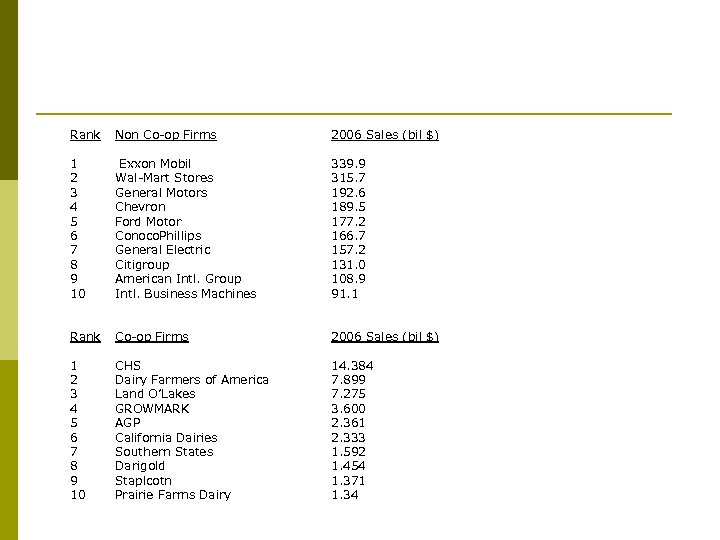 Rank Non Co-op Firms 2006 Sales (bil $) 1 2 3 4 5 6 7 8 9 10 Exxon Mobil Wal-Mart Stores General Motors Chevron Ford Motor Conoco. Phillips General Electric Citigroup American Intl. Group Intl. Business Machines 339. 9 315. 7 192. 6 189. 5 177. 2 166. 7 157. 2 131. 0 108. 9 91. 1 Rank Co-op Firms 2006 Sales (bil $) 1 2 3 4 5 6 7 8 9 10 CHS Dairy Farmers of America Land O’Lakes GROWMARK AGP California Dairies Southern States Darigold Staplcotn Prairie Farms Dairy 14. 384 7. 899 7. 275 3. 600 2. 361 2. 333 1. 592 1. 454 1. 371 1. 34