 Скачать презентацию Unit Three Marketing Contents 1 Brief on
0807d5052dd41f6836a4fbc9324ef43f.ppt
- Количество слайдов: 126




Unit Three Marketing
Contents 1 Brief on Marketing 4 2 Lead-in 5 3 Reading 6 Business Practice 7 Extension Words & Phrases Exercises
Brief on marketing Simply, marketing is the process or act of bringing together buyers and sellers. The American Marketing Association (AMA) states, “marketing is the process of planning, executing, and controlling the conception, pricing, promotion, and distribution of ideas, goods, and services to create exchanges that satisfy individual, organizational, and societal objectives”. In a word, marketing is the delivery of customer satisfaction at a profit.
Brief on marketing The twofold goal of marketing is to attract new customers by promising superior value and to keep current customers by delivering satisfaction, and the two major factors of marketing are the recruitment of new customers (acquisition) and the retention and expansion of relationships with existing customers (base management). Once a marketer has converted the prospective buyer, base management marketing takes over. The process for base management shifts the marketer to building a relationship, nurturing the links, enhancing the benefits that sold the buyer in the first place, and improving the product/service continuously to protect the business from competitive encroachments.
Brief on marketing Generally, we can divide marketing into two levels. Strategic Marketing attempts to determine how an organization competes against its competitors in a market place. In particular, it aims at generating a competitive advantage relative to its competitors. Operational Marketing executes marketing functions to attract and keep customers and to maximize the value derived for them, as well as to satisfy the customer with prompt services and meet the customer expectations. Operational Marketing includes the determination of the marketing mix.
Brief on marketing In terms of marketing mix, it is universally recognized as the 4 Ps, which are delivered by E. Jerome Mc. Carthy [ E. Jerome Mc. Carthy is a professor at Michigan State University, USA, and an internationally known marketing consultant. ]. They include: Product — it deals with the specifications of the actual goods or services, and how it relates to the end-user’s needs and wants. The scope of a product generally includes supporting elements such as warranties, guarantees, and support. Pricing — this refers to the process of setting a price for a product, including discounts. The price need not be monetary — it can simply be what is exchanged for the product or services, e. g. time, energy, psychology or attention.
Brief on marketing Promotion — this includes advertising, sales promotion, publicity, and personal selling, and refers to the various methods of promoting the product, brand, or company. Placement / distribution — it refers to how the product gets to the customer, for example, point of sale placement or retailing. This fourth P has also sometimes been called Place, referring to the channel by which a product or services is sold (e. g. online vs. retail) to which geographic region or industry, to which segment (young adults, families, business people), etc. From Wikipedia, the free encyclopedia
Lead-in Ø 1. Discuss the following questions with your partner. Ø 2. The following pictures may associate us with some well-known companies and products. Look at them and discuss the questions with your group members.
Lead-in 1. Discuss the following questions with your partner. 1) What are roles of marketing? What parts of it might you find the most appealing? What is appealing about them? 2) How many ways do you know to promote a product?Try to make a list of them. Which of the ways seem to be the most common? What ways seem to be the most unique? 3) Think of some products you bought under the influence of the marketing mix (the four Ps: product, price, promotion, and place). Tell which of the four Ps was a decisive factor when you bought the product. Remember to give the reasons and justify your answers.
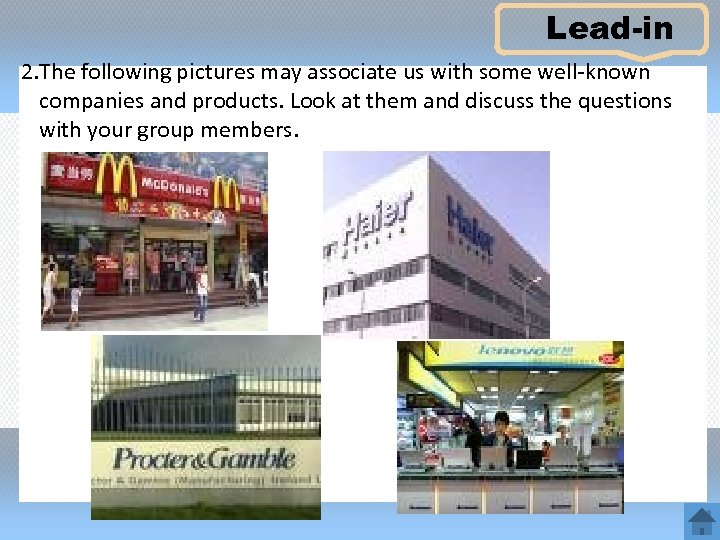
Lead-in 2. The following pictures may associate us with some well-known companies and products. Look at them and discuss the questions with your group members.
Lead-in 1)What competition are they each facing now? 2)Try to tell how they are marketing their products to cope with the competition? 3)Take one of them as an example; try to tell how marketing relates to the success of a modern business?
Preview: Reading In this article, Sarah White explains the concept of marketing by developing the vivid example of Kalika, a small business owner. White defines the four basic elements of marketing — product, price, promotion and place by describing Kalika’s marketing activities: providing a suitable product, choosing a right place, attracting potential customers, and satisfying the customer’s need. Furthermore, Sarah White points out that a marketing manager should take all the four basic elements into consideration when formulating a marketing strategy and meanwhile try to build a trust in potential customers.
![Reading What Is Marketing Anyway? By Sarah White [1] Marketing is the process of](https://present5.com/presentation/0807d5052dd41f6836a4fbc9324ef43f/image-13.jpg "Reading What Is Marketing Anyway? By Sarah White [1] Marketing is the process of")
Reading What Is Marketing Anyway? By Sarah White [1] Marketing is the process of creating a product, then planning and carrying out the pricing, promotion, and placement of that product by stimulating buying exchanges in which both buyer and seller profit in some way. Got that? Of course not, it’s simply too big an idea to swallow whole. Instead, let’s look at the parts. An example will help. Translation
![Reading [2] Kalika is new to this country. She’s turned to entrepreneurship to create](https://present5.com/presentation/0807d5052dd41f6836a4fbc9324ef43f/image-14.jpg "Reading [2] Kalika is new to this country. She’s turned to entrepreneurship to create")
Reading [2] Kalika is new to this country. She’s turned to entrepreneurship to create a job opportunity. She owns a lemonade stand, or more precisely a juice cart. She tows a cabin on wheels down to the local university campus everyday and serves juice and peanut butter and banana sandwiches to students. Translation
![Reading [3] How is Kalika engaged in marketing? First, she’s selected a family of](https://present5.com/presentation/0807d5052dd41f6836a4fbc9324ef43f/image-15.jpg "Reading [3] How is Kalika engaged in marketing? First, she’s selected a family of")
Reading [3] How is Kalika engaged in marketing? First, she’s selected a family of products she knows something about and believes that students want. Second, she’s arrived at a price for those products, based on the costs for her materials, her cart, and the value she puts on her time. She promotes her wares with brightly colored signs and menu boards around the cart. If she were a little more sophisticated, she might create promotional strategies like buy-one-get-one-free coupons, multiple-purchase discount cards, or business-card drawings. Translation
![Reading [4] She begins the act of placing her product by maneuvering her cart](https://present5.com/presentation/0807d5052dd41f6836a4fbc9324ef43f/image-16.jpg "Reading [4] She begins the act of placing her product by maneuvering her cart")
Reading [4] She begins the act of placing her product by maneuvering her cart into position in the morning. With that ungainly drive, she brings the factory to the store to the customer. Kalika does more than just place her product in front of her customers: She is a one-woman distribution channel. Kalika the factory worker cuts fruit, then blends to order with skill and speed. Kalika the distributor sees to it that raw materials are on hand, and supplies like silverware and cups are also at the ready. Kalika the sales agent discusses menu options with prospects, helping them decide what sizes and flavors will satisfy their appetite and thirst. She even provides support after the sale — mostly filling requests for more ice or a napkin. That’s Kalika’s marketing activity. Translation
![Reading [5] What was the last part of that marketing definition? “. . .](https://present5.com/presentation/0807d5052dd41f6836a4fbc9324ef43f/image-17.jpg "Reading [5] What was the last part of that marketing definition? “. . .")
Reading [5] What was the last part of that marketing definition? “. . . stimulating buying exchanges in which both buyer and seller profit in some way. ” If both aren’t profiting, one or the other will hesitate before repeating the experience. Translation
![Reading [6] Kalika and her customers both feel happy with the buying exchange at](https://present5.com/presentation/0807d5052dd41f6836a4fbc9324ef43f/image-18.jpg "Reading [6] Kalika and her customers both feel happy with the buying exchange at")
Reading [6] Kalika and her customers both feel happy with the buying exchange at the juice stand. Her customers satisfy their hunger or thirst. Kalika satisfies her profit objectives, going home with lighter fruit baskets and a heavier cash drawer. Both parties of the exchange look forward to repeating the experience soon and often. Translation
![Reading [7] I bring up Kalika and her juice cart to introduce you to](https://present5.com/presentation/0807d5052dd41f6836a4fbc9324ef43f/image-19.jpg "Reading [7] I bring up Kalika and her juice cart to introduce you to")
Reading [7] I bring up Kalika and her juice cart to introduce you to one of the most fundamental ways to understand marketing. There a number of activities involved. To get a handle on them, we break down the activities into the “Four Ps”. These are Product, Price. Promotion, and Place (or distribution). As a manager of marketing activity, you need to study each area and formulate a strategy for your situation. Translation
![Reading [8] In the meantime, let’s move on to another important marketing fundamental: What,](https://present5.com/presentation/0807d5052dd41f6836a4fbc9324ef43f/image-20.jpg "Reading [8] In the meantime, let’s move on to another important marketing fundamental: What,")
Reading [8] In the meantime, let’s move on to another important marketing fundamental: What, and why, do people buy? [9] Your audience, or target market, is the universe of potential customers for your products or service. I use the word “audience” more, and there’s a reason. It reminds me that life is like theater. As a marketer, you’re like an actor trying to please and entertain. You need your audience to believe in who you are and what you’re offering. You’ll also hear this group of people called customers, clients, prospects, or a market segment. You want those people to know about you. Translation
![Reading [10] Product to a marketer is an umbrella unfurled to cover not just](https://present5.com/presentation/0807d5052dd41f6836a4fbc9324ef43f/image-21.jpg "Reading [10] Product to a marketer is an umbrella unfurled to cover not just")
Reading [10] Product to a marketer is an umbrella unfurled to cover not just tangible products but also services and even ideas. Most marketing involves promoting a combination of products and services, for example, a photocopier (product) and its extended maintenance contract (service). Services can include the selling of products too. Think about how your hairdresser sells you shampoo, or how attending a movie might also include purchasing refreshments. Product is what you offer that has value to your audience. (680 words) From English World Translation The end
Reading 1. . it’s simply too big an idea to swallow whole. — The definition above given covers too much information, so it is just a big concept for people to understand completely without breaking it down into smaller “bites” or segments.
Reading 2. . . the value she puts on her time. — She takes her time into consideration when she calculates the total cost for her product.
Reading 3. business-card drawings — Customers put a business card into a bowl and the business draws from the cards for a prize. This strategy provides names and contact information for customers.
Reading. . . maneuvering her cart into position. . . —. . . moving her cart to the place where she can sell drinks. . .
Reading With that ungainly drive, she brings the factory to the store to the customer. — With that basic move, she brings the so-called factory where the drinks are processed to the store and thus brings the factory in front of customer. In other words, her store is also her factory and it is close to customer.
Reading. . . then blends to order with skill and speed. —. . . then skillfully and rapidly mixes the drinks according to the customer’s request.
Reading Product to a marketer is an umbrella unfurled to cover not just tangible products but also services and even ideas. — To a marketer, the concept of a product includes not only physical products but also services and even ideas.
Reference Chinese 究竟什么是市场营销? 萨拉·怀特 市场营销是一个过程,它包括通过刺激购买交易来实现的产 品开发、营销规划、产品定价、促销以及分销几个环节,在交易 过程中,买卖双方均以某种方式获益。明白了吗?当然没有,因 为这个概念实在太大,不能一下子完全理解。那么,让我们看看 市场营销各部分的内容吧!下面的例子会有助于我们的理解。
Reference Chinese 卡丽卡对这个国家不熟悉。她为了创造 作机会而自主创业。 她有一个柠檬水售货摊,或者更确切地说是一个出售果汁的手推 车。她每天推着货车去当地的大学校园向学生出售果汁、花生酱 和香蕉三明治。
Reference Chinese 卡丽卡是如何进行市场营销的呢?首先,她选择了一类她了 解的产品,并且相信学生们也需要这类产品。其次,她根据原材 料、手推车的成本和她所付出的时间的价值对这些产品进行定价。 她用色彩鲜艳的标志和价目牌装饰她的手推车,以此来促销她的 货物。如果她再老练些,她也许会制定一些促销策略,比如买一 赠一优惠券、多买多得折扣卡,或者抽奖卡等。
Reference Chinese 早上她把手推车停放到合适的位置来开始她的销售 作。 通过这种笨拙的推销过程,她提供了从 厂到商店再到顾客的 售货服务。卡丽卡并不仅仅是把产品展示在顾客面前:她,一 个单身女性,就是货物的销售渠道。作为 厂的生产者,卡丽 卡切好水果,然后娴熟快速地将其混合好。作为经销商,卡丽 卡确保原材料伸手可及,并且将餐具和杯子等准备就绪。作为 销售代理,卡丽卡与准顾客讨论货物单上可选择的产品,并根 据顾客的食欲和口渴的程度,帮助他们决定所需的份量和口味。 她甚至提供售后服务 — 大多是满足顾客多加些冰或者再给一 张纸巾的要求。这就是卡丽卡的营销活动。
Reference Chinese 营销定义的最后一部分是什么?“……刺激购买交易,使买卖 双方以某种方式从中获益。”如果双方都不能获益,一方或者另 一方就会在下次交易时犹豫不决。
Reference Chinese 卡丽卡和她的顾客对在果汁摊进行的购买交易都感到满意。 顾客满足了他们的饥渴需求。卡丽卡完成了自己的利润目标,回 到家里时,果篮变轻了,而钱屉却加重了。交易双方都期待着很 快、并且能经常地再进行这种交易。
Reference Chinese 我举了卡丽卡和她的果汁手推车的例子,就是要向大家介绍 一个理解市场营销的最基本的方式。这其中涉及几项活动。为了 理解这些活动,我们将其分解为“ 4 P”。他们是:产品,价格,促 销和分销。作为一个市场营销活动的管理者,你需要研究各个领 域,并且根据自己的情况制定策略。
Reference Chinese 同时,让我们继续讨论另一个重要的营销原则:人们要买什 么,为什么买? 你的受众,或者说目标市场,就是你的产品或服务的潜在顾 客市场。我更多使用“受众”这个词是有原因的。它提醒我,人生 就如戏。作为一个市场营销人员,你就像是一个极力取悦和娱乐 观众的演员。你需要让观众相信你是谁,并且相信你为他们提供 的一切。你也会听到这群人被称作顾客、客户、潜在客户,或细 分顾客。你想让这些人了解你。
Reference Chinese 对于营销人员而言,产品就是一把撑开的伞,它不仅涵盖有 形的产品,同时也包括服务,甚至理念。大多数营销活动都采用 产品和服务相结合的手段,比如,一个影印机(产品)和它延伸 的保养合同(服务)。服务也可以包括销售产品。想想看,你的 美发师是如何向你推销香波的,或者看电影时可能同时也要购买 点心和饮料。产品就是你所提供的对受众有价值的东西。
Words & Phrases Ø Words Ø Phrases
Words & Phrases Words placement distributor profit promote formulate swallow maneuver unfurl promote maneuver
Words & Phrases turn to arrive at put on see to it that bring up get a handle on
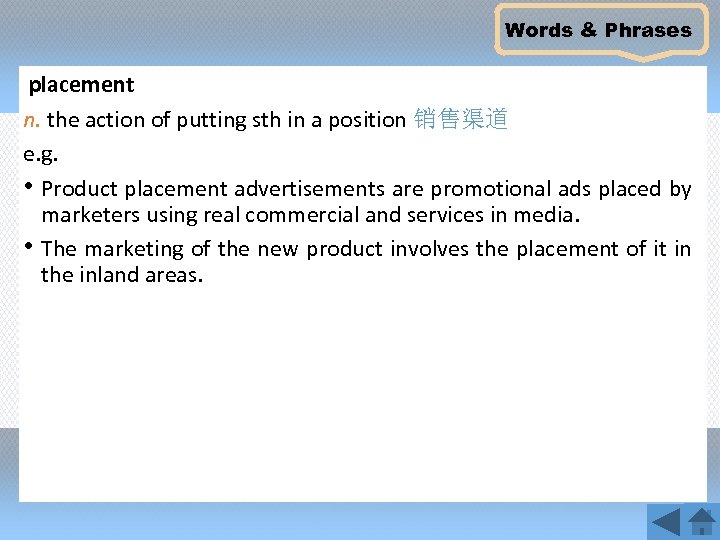
Words & Phrases placement n. the action of putting sth in a position 销售渠道 e. g. • Product placement advertisements are promotional ads placed by marketers using real commercial and services in media. • The marketing of the new product involves the placement of it in the inland areas.
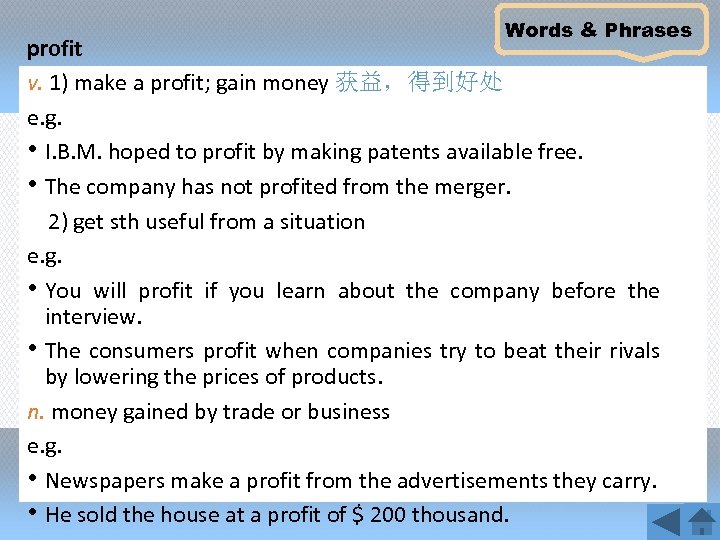
Words & Phrases profit ν. 1) make a profit; gain money 获益,得到好处 e. g. • I. B. M. hoped to profit by making patents available free. • The company has not profited from the merger. 2) get sth useful from a situation e. g. • You will profit if you learn about the company before the interview. • The consumers profit when companies try to beat their rivals by lowering the prices of products. n. money gained by trade or business e. g. • Newspapers make a profit from the advertisements they carry. • He sold the house at a profit of $ 200 thousand.
Words & Phrases Swallow 吞,咽 v. 1) believe, in spite of doubt e. g. • The company had to swallow its defeat in investing in the politically instable country. • The workers had to swallow the unpleasant working conditions. 2) swallow one’s pride: do something even though it is embarrassing e. g. • I swallowed my pride and asked him for a loan. • He swallowed his pride and asked for a second chance. Next
Words & Phrases 3) swallow one’s words: admit that something one said is wrong. e. g. • It’s hard for a haughty man to swallow his words. • Stock prices didn't fall as he predicated. So he had to swallow his words. 4) swallow up: take in or use completely; cause to disappear e. g. • The increase in commodity prices swallowed up our pay increase. • The small company was swallowed up by a multinational.
Words & Phrases promote 宣传;推销;促销 v. 1) bring (goods) to public notices in order to increase sales e. g. • The company planned a big advertising campaign to promote the new toothpaste. • Many car manufactures took part in the car exhibition to promote their products. 2) help in the growth or development of e. g. • The agreement will promote the bilateral relations between the two countries. • The local governments are encouraged to promote tourism.
Words & Phrases maneuver v. move 移动 e. g. • Learn to be flexible; it makes the curves in your life path much easier to maneuver. • Winning mobile-phone sales by giving customer more choice and better service, the electronic retailer is able to maneuver into the more profitable areas. n. a skillful or carefully planned process intended to deceive, to gain an advantage, to get out of a difficult position, etc. e. g. • Businesses use maneuvers to have their industry organized to their own advantage. • The company tried diplomatic maneuvers to secure an overseas contract.
Words & Phrases distributor n. a person or company that supplies goods to shops/stores, etc. 经销商;分销商 e. g. • JGO has been the sole distributor of Fleur Aromatherapy products in Hong Kong since year 2001. • Three generations of Heldmans have for decades consistently, built the sales and profits of this manufacturer and distributor of uniforms.
Words & Phrases formulate v. invent and prepare 设计;规划 e. g. • The State Council formulated fiscal and tax policies conducive to economic development. • A listed company shall formulate standardized rules and procedures governing the steering of the supervisory board.
Words & Phrases unfurl v. unroll and open (a flag, sail, etc. ) 展开;拉开 e. g. • The president unfurled the company’s plans for restructuring at the meeting. • The mayor would unfurl a list of energy-saving initiatives at the summit.
Words & Phrases 1. turn to 开始 作;着手 1) begin work; work e. g. • In such situations, accountants turn to a process costing system to accumulate costs. • Some farmers have turned to keeping deer, and there about 4, 500 deer farms in the country. 2) go to for help, advice, sympathy, comfort, etc. e. g. • Developers can turn to the Web for help when they run into problems. • People with chronic diseases turn to the internet for health information.
Words & Phrases 2. arrive at 做出(决议等);得出(结论等) decide on or find sth, especially after discussion and thought e. g. • You can arrive at the best price for your products by comparing your products to your competitors’ and then calculating the cost. • After long discussion by video conferencing, the board directors arrived at the same conclusion.
Words & Phrases 3. put on 增加,添加 add to e. g. • The government has decided to put tax on the products manufactured by foreign companies. • Most executives of big companies are failing to put a value on their IT assets, which challenged them to make the right investment decisions.
Words & Phrases 4. see to it that 务必做到;保证 attend to; make sure that e. g. • Before packing, you have to see to it that the products are assembled perfectly. • We will see to it that delivery of your orders is made promptly.
Words & Phrases 5. bring up 提出;引出 raise; introduce e. g. • The sales manager brought up the topic of packing for discussion in the meeting. • At the meeting they brought up many problems and discussed them one by one.
Words & Phrases 6. get a handle on 弄懂,理解,搞明白 understand or know about sth / sb especially so that you can deal with it or them later e. g. • In order to get a handle on the holiday stress, people are recommended to do things that are normally comforting. • He was finally able to get a handle on the true nature of the problem.
Exercises ØComprehension 1. Answering questions 2. Completing the table ØCritical Thinking ØGlossary 1. Writing sentences 2. Filling blanks 3. Rewriting ØTranslation 1. English to Chinese 2. Chinese to English
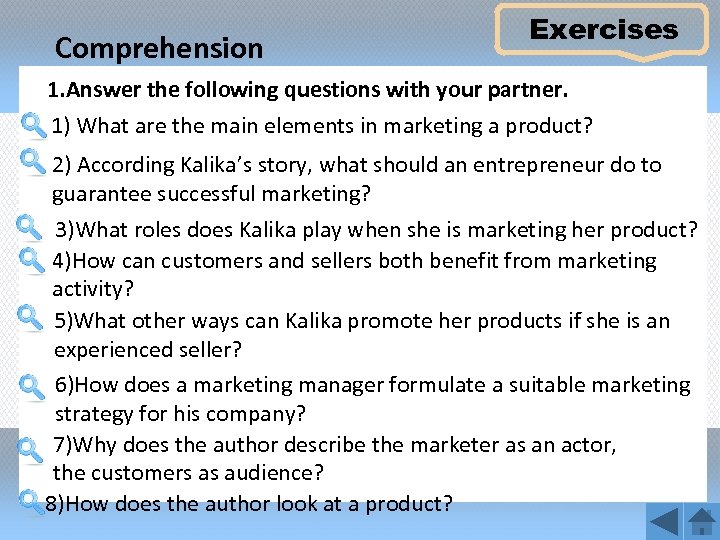
Comprehension Exercises 1. Answer the following questions with your partner. 1) What are the main elements in marketing a product? 2) According Kalika’s story, what should an entrepreneur do to guarantee successful marketing? 3)What roles does Kalika play when she is marketing her product? 4)How can customers and sellers both benefit from marketing activity? 5)What other ways can Kalika promote her products if she is an experienced seller? 6)How does a marketing manager formulate a suitable marketing strategy for his company? 7)Why does the author describe the marketer as an actor, the customers as audience? 8)How does the author look at a product?
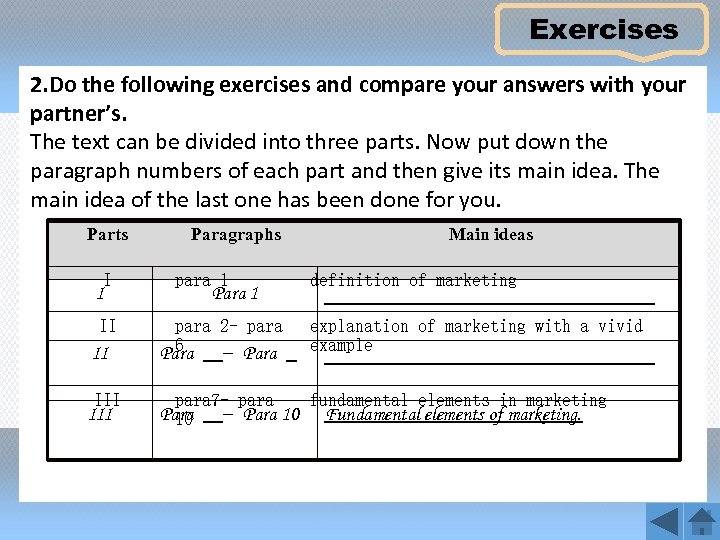
Exercises 2. Do the following exercises and compare your answers with your partner’s. The text can be divided into three parts. Now put down the paragraph numbers of each part and then give its main idea. The main idea of the last one has been done for you. Parts I I II II III Paragraphs para 1 Para 1 para 2 - para 6 Para – Para para 7 - para Para 10 – Para 10 Main ideas definition of marketing explanation of marketing with a vivid example fundamental elements in marketing Fundamental elements of marketing.
Critical Thinking Exercises 1. How does the simple example of Kalika’s business compare to a more complex product, such as the strategies needed for marketing a bicycle, a telephone, or even a set of dishes? 2. In the example, Kalika is not apparently taking advantage of modern technologies to market her product. How might computers, telephones, cameras, and other technological devices be used to enhance her business? 3. Kalika’s business relies entirely upon her. What weaknesses or dangers are there in having such a business? For example, how might her business be affected if she suddenly developed a skin problem? How do larger businesses shield themselves from such weaknesses?
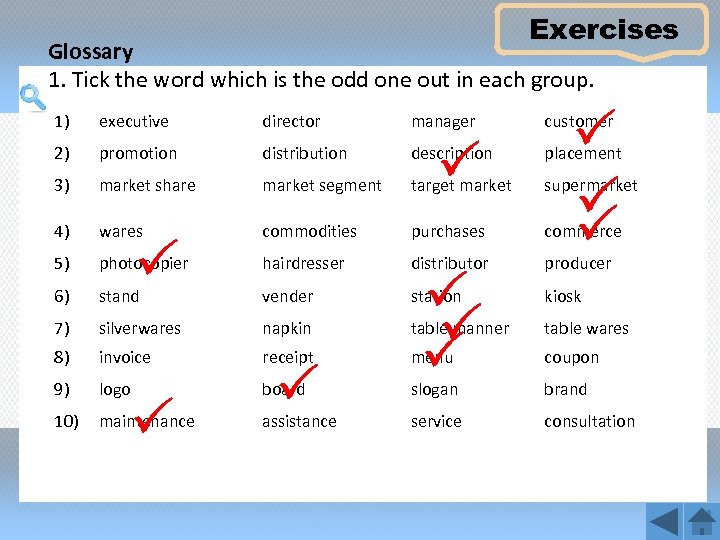
Exercises Glossary 1. Tick the word which is the odd one out in each group. 1) executive director manager customer 2) promotion distribution description placement 3) market share market segment target market supermarket 4) wares commodities purchases commerce 5) photocopier hairdresser distributor producer 6) stand vender station kiosk 7) silverwares napkin table manner table wares 8) invoice receipt menu coupon 9) logo board slogan brand 10) maintenance assistance service consultation
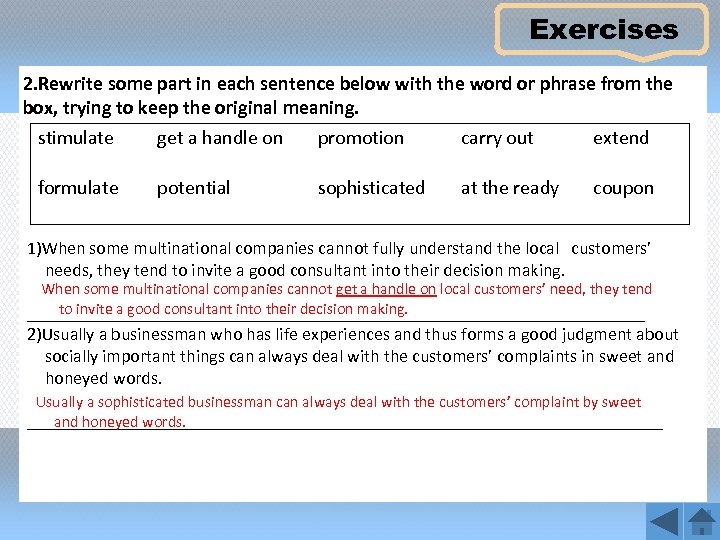
Exercises 2. Rewrite some part in each sentence below with the word or phrase from the box, trying to keep the original meaning. stimulate get a handle on promotion carry out extend formulate potential sophisticated at the ready coupon 1)When some multinational companies cannot fully understand the local customers’ needs, they tend to invite a good consultant into their decision making. When some multinational companies cannot get a handle on local customers’ need, they tend to invite a good consultant into their decision making. ___________________________________ 2)Usually a businessman who has life experiences and thus forms a good judgment about socially important things can always deal with the customers’ complaints in sweet and honeyed words. Usually a sophisticated businessman can always deal with the customers’ complaint by sweet and honeyed words. ____________________________________
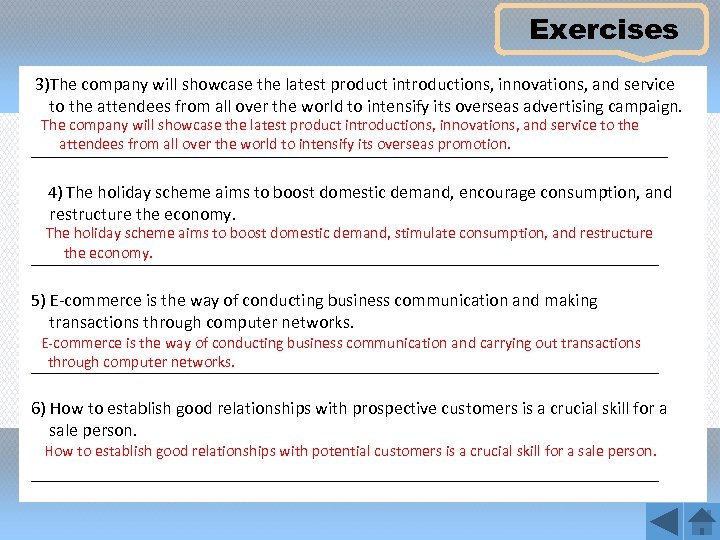
Exercises 3)The company will showcase the latest product introductions, innovations, and service to the attendees from all over the world to intensify its overseas advertising campaign. The company will showcase the latest product introductions, innovations, and service to the attendees from all over the world to intensify its overseas promotion. ____________________________________ 4) The holiday scheme aims to boost domestic demand, encourage consumption, and restructure the economy. The holiday scheme aims to boost domestic demand, stimulate consumption, and restructure the economy. ___________________________________ 5) E-commerce is the way of conducting business communication and making transactions through computer networks. E-commerce is the way of conducting business communication and carrying out transactions through computer networks. ___________________________________ 6) How to establish good relationships with prospective customers is a crucial skill for a sale person. How to establish good relationships with potential customers is a crucial skill for a sale person. ___________________________________
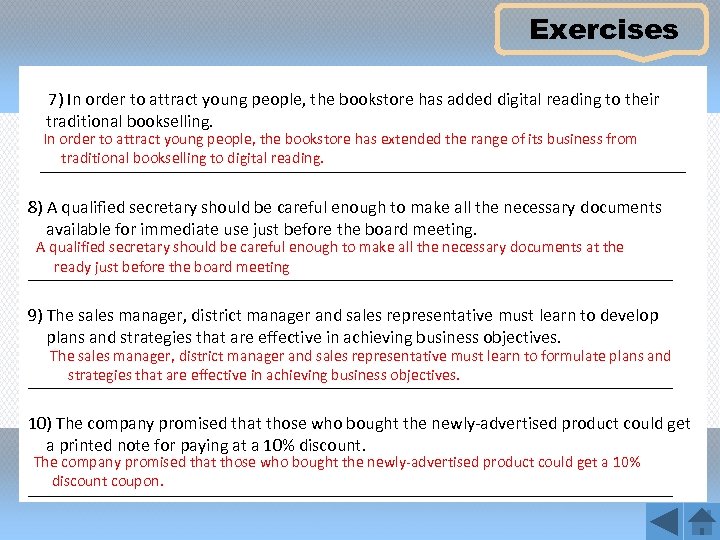
Exercises 7) In order to attract young people, the bookstore has added digital reading to their traditional bookselling. In order to attract young people, the bookstore has extended the range of its business from traditional bookselling to digital reading. ____________________________________ 8) A qualified secretary should be careful enough to make all the necessary documents available for immediate use just before the board meeting. A qualified secretary should be careful enough to make all the necessary documents at the ready just before the board meeting ____________________________________ 9) The sales manager, district manager and sales representative must learn to develop plans and strategies that are effective in achieving business objectives. The sales manager, district manager and sales representative must learn to formulate plans and strategies that are effective in achieving business objectives. ____________________________________ 10) The company promised that those who bought the newly-advertised product could get a printed note for paying at a 10% discount. The company promised that those who bought the newly-advertised product could get a 10% discount coupon. ____________________________________
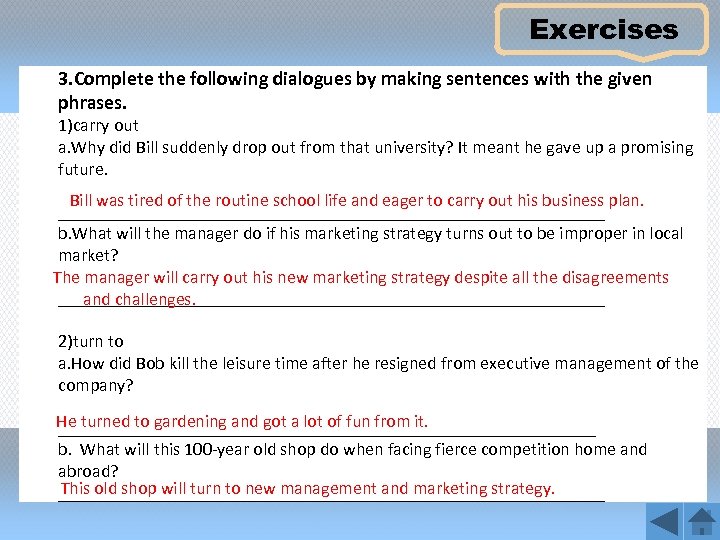
Exercises 3. Complete the following dialogues by making sentences with the given phrases. 1)carry out a. Why did Bill suddenly drop out from that university? It meant he gave up a promising future. Bill was tired of the routine school life and eager to carry out his business plan. _______________________________ b. What will the manager do if his marketing strategy turns out to be improper in local market? The manager will carry out his new marketing strategy despite all the disagreements _______________________________ and challenges. 2)turn to a. How did Bob kill the leisure time after he resigned from executive management of the company? He turned to gardening and got a lot of fun from it. ______________________________ b. What will this 100 -year old shop do when facing fierce competition home and abroad? This old shop will turn to new management and marketing strategy. _______________________________
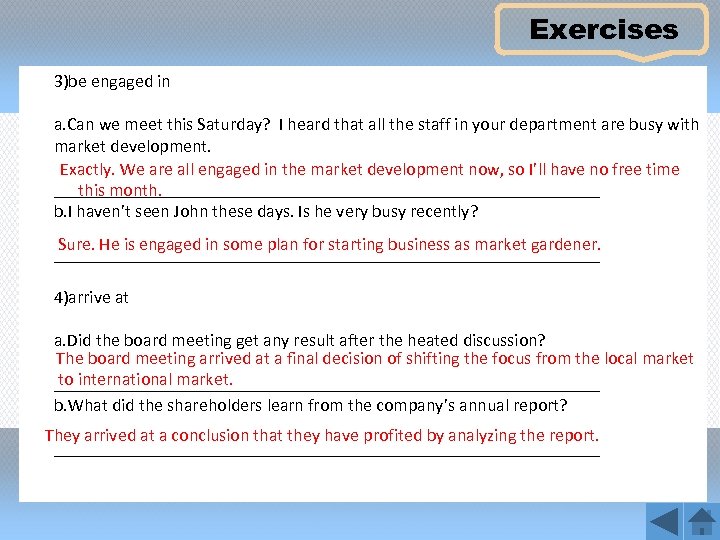
Exercises 3)be engaged in a. Can we meet this Saturday? I heard that all the staff in your department are busy with market development. Exactly. We are all engaged in the market development now, so I’ll have no free time _______________________________ this month. b. I haven’t seen John these days. Is he very busy recently? Sure. He is engaged in some plan for starting business as market gardener. _______________________________ 4)arrive at a. Did the board meeting get any result after the heated discussion? The board meeting arrived at a final decision of shifting the focus from the local market to international market. _______________________________ b. What did the shareholders learn from the company’s annual report? They arrived at a conclusion that they have profited by analyzing the report. _______________________________
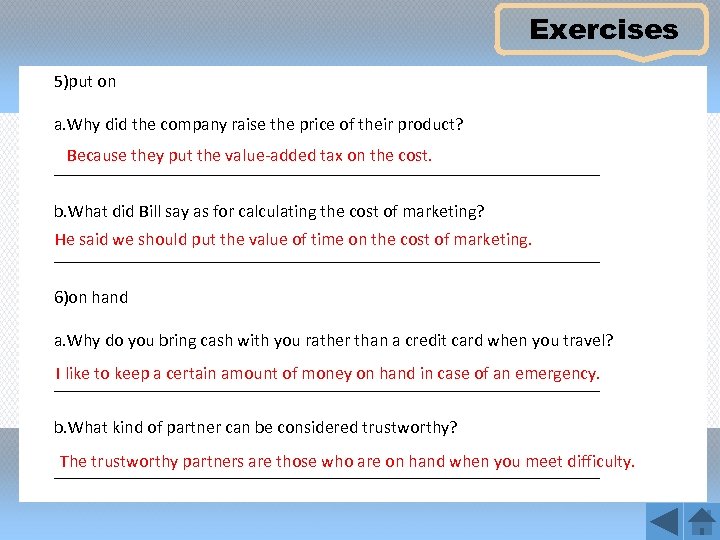
Exercises 5)put on a. Why did the company raise the price of their product? Because they put the value-added tax on the cost. _______________________________ b. What did Bill say as for calculating the cost of marketing? He said we should put the value of time on the cost of marketing. _______________________________ 6)on hand a. Why do you bring cash with you rather than a credit card when you travel? I like to keep a certain amount of money on hand in case of an emergency. _______________________________ b. What kind of partner can be considered trustworthy? The trustworthy partners are those who are on hand when you meet difficulty. _______________________________
Exercises 7)bring up a. Why did the director look so angry after the board meeting? Did his proposal on reform meet challenge? Yes, several executives brought up disagreement against his proposal. _______________________________ b. Are there any chances for ordinary employees to put forward their suggestions in your company? Of course. They can bring up their suggestions in public or in direct communication with managers. _______________________________ 8)break down (into) a. Is your boss satisfied with the annual report made by John? Yes. He is very pleased with it because John made it absolutely clear by breaking it _______________________________ down into several logical parts. b. What can we do with the Logistics department? It has too many staff and is difficult to manage. You may break it down into several sections and assign each of them a definite duty. _______________________________
Translation Exercises 1. Translate the following sentences into Chinese. 1) Marketing is the process of creating a product, then planning and carrying out the pricing, promotion, and placement of that product by stimulating buying exchanges in which both buyer and seller profit in some way. 2) Your audience, or target market, is the universe of potential customers for your products or service. 3) As a marketer, you’re like an actor trying to please and entertain because you need your audience to believe in who you are and what you’re offering. 4) This group of people can also be called customers, clients, prospects, or a market segment.
Translation Exercises 1. 1) 市场营销是一个过程,它包括通过刺激购买交易来实现的产品开发、营销 规划、产品定价、促销以及分销几个环节,在交易过程中,买卖双方均以某 种方式获益。 2) 你的受众,或者说目标市场,就是你的产品或服务的潜在顾客市场。 3) 作为一个市场营销人员,你就像是一个极力取悦和娱乐观众的演员。 4) 这群人被称作顾客、客户、潜在客户,或细分顾客。
Exercises 2. Put the following sentences into English, using the words and phrases given in the brackets. 1)创业者必须建立一支专业的市场营销团队, 这支团队, 凭借良好的市场营销 知识, 负责提出合适的营销策略。(entrepreneurship, bring up,marketing strategy,) 2)只有制定合适的营销策略,他们才能促进产品或服务的销售,但是执行 营销策略并不简单。(formulate, promote,carry out) 3)市场销售人员,就像演员一样,应该使消费者感兴趣并能激发他们的购 买欲望。(entertain, potential, stimulate) 4)在市场营销中,销售代表应该取得顾客的信任,并与顾客保持良好的关 系,以使顾客信任他们所销售的产品。(sales representative, offer)
Exercises 2. 1) Those who start entrepreneurship must build a professional marketing team which can take the responsibility to bring up proper marketing strategy on the basis of good knowledge on marketing. 2) Only by formulating a proper marketing strategy, can they promote the sales of their products or services, but it’s no easy job to carry out this marketing strategy. 3) A marketer, like an actor, should entertain the potential customers and stimulate their desire to buy. 4) Sales representatives in marketing have to gain the customers’ trust and maintain a good relationship with them to make the customers believe in what they are offering. (sales representatives, offer)
Business Practice ØBusiness Practice 1. SWOT Analysis 2. Executive Summary
SWOT Analysis Business Practice It is useful to complete an analysis that takes into account not only your own business, but your competitors’ activities and current industry happenings as well when conducting strategic planning for any company — online and/or offline. A SWOT is one such analysis. Work in group of five. Suppose you are staff of the marketing department, discussing a marketing plan of a certain product in a meeting. What you focus on is the SWOT analysis of the product.
SWOT Analysis Business Practice 1)(Turn to page …). Each group chooses a product with 5 cards including executive summary and SWOT analysis. 2)Each student in a group gets one card, reads the card respectively and then teaches it to your group. 3)Summarize the information on your cards, and share it with the whole class, trying to answer any questions. Your summary should include at least the following points: Name of the product; Its strengths; Its weaknesses; Its opportunities; Its threats; Others…
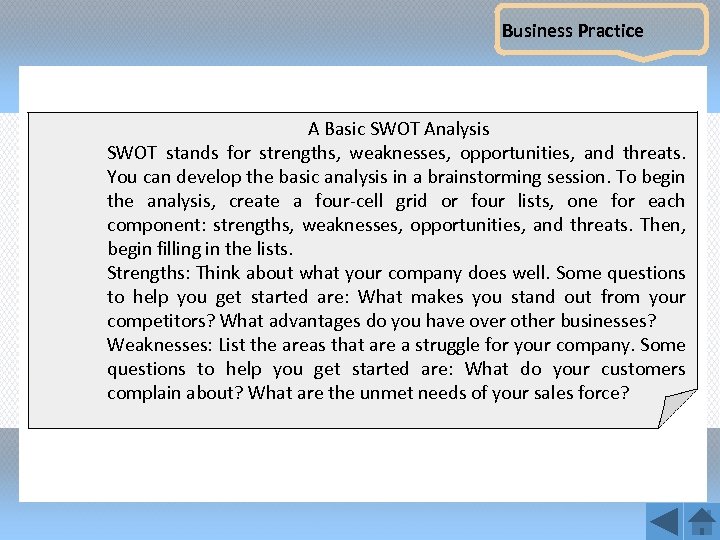
Business Practice A Basic SWOT Analysis SWOT stands for strengths, weaknesses, opportunities, and threats. You can develop the basic analysis in a brainstorming session. To begin the analysis, create a four-cell grid or four lists, one for each component: strengths, weaknesses, opportunities, and threats. Then, begin filling in the lists. Strengths: Think about what your company does well. Some questions to help you get started are: What makes you stand out from your competitors? What advantages do you have over other businesses? Weaknesses: List the areas that are a struggle for your company. Some questions to help you get started are: What do your customers complain about? What are the unmet needs of your sales force?
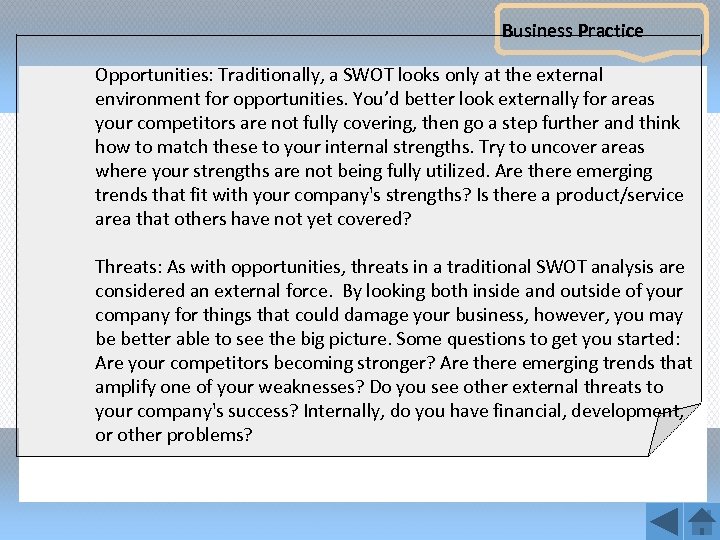
Business Practice Opportunities: Traditionally, a SWOT looks only at the external environment for opportunities. You’d better look externally for areas your competitors are not fully covering, then go a step further and think how to match these to your internal strengths. Try to uncover areas where your strengths are not being fully utilized. Are there emerging trends that fit with your company's strengths? Is there a product/service area that others have not yet covered? Threats: As with opportunities, threats in a traditional SWOT analysis are considered an external force. By looking both inside and outside of your company for things that could damage your business, however, you may be better able to see the big picture. Some questions to get you started: Are your competitors becoming stronger? Are there emerging trends that amplify one of your weaknesses? Do you see other external threats to your company's success? Internally, do you have financial, development, or other problems?
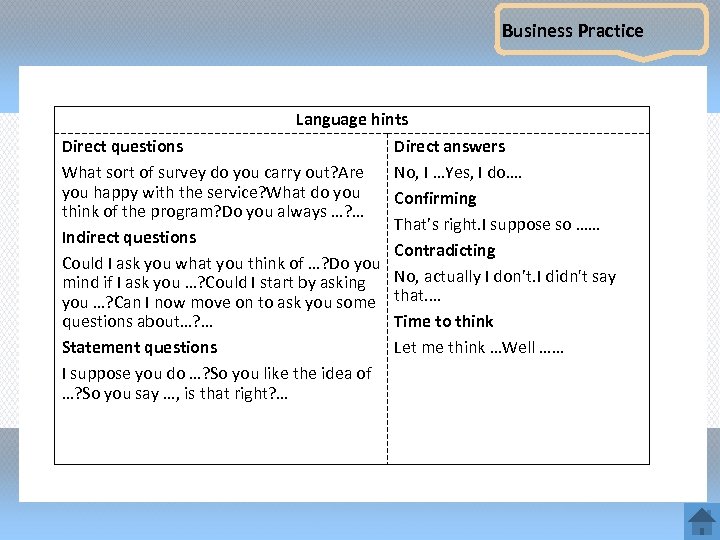
Business Practice Language hints Direct questions What sort of survey do you carry out? Are you happy with the service? What do you think of the program? Do you always …? … Indirect questions Could I ask you what you think of …? Do you mind if I ask you …? Could I start by asking you …? Can I now move on to ask you some questions about…? … Statement questions I suppose you do …? So you like the idea of …? So you say …, is that right? … Direct answers No, I …Yes, I do. … Confirming That’s right. I suppose so …… Contradicting No, actually I don’t. I didn't say that. … Time to think Let me think …Well ……
Business Practice SWOT Analysis Completing a SWOT analysis can help a company identify ways to minimize the affect of weaknesses in its business while maximizing its strengths. Traditionally, a SWOT analysis confines strengths and weaknesses to a company’s internal workings while opportunities and threats refer only to the external environment.
Expanded SWOT Analysis Business Practice A more complete SWOT analysis can help better understand a company’s competitive situation. One way is to include more detailed competitor information in the analysis. Note Internet-related activities such as trade organization participation, search engine inclusion, and outside links to the sites. This will better help spot opportunities for and threats to a company. Another way is to take a closer look at the business environment. Often, opportunities arise as a result of a changing business environment that would affect a SWOT analysis. A SWOT analysis can be expanded through surveys. A company can learn more about its own as well as competitor’s sites and businesses. Areas to consider researching include 1) customer awareness, interest, trial, and usage levels, 2) brand, site, and/or company image, 3) importance of different site or product attributes to your customers, and 4) product and/or site performance. Whether using a basic or more advanced approach to SWOT analysis, it is sure to come away with newfound insights. Use these to increase a company’s effectiveness and as input into its business or marketing plan.
Business Practice SWOT Analysis Completing a SWOT analysis can help a company identify ways to minimize the affect of weaknesses in its business while maximizing its strengths. Traditionally, a SWOT analysis confines strengths and weaknesses to a company’s internal workings while opportunities and threats refer only to the external environment.
Executive Summary Business Practice Executive Summary An executive summary is an overview. The purpose of an executive summary is to summarize the key points of a document for its readers, saving them time and preparing them for the upcoming content. In business, the most common use of an executive summary is as part of a business plan. The purpose of the executive summary of the business plan is to provide your readers with an overview of the business plan. Think of it as an introduction to your business. Therefore, your business plan’s executive summary will include summaries of: a description of your company, including your products and/or services your mission statement your business’s management the market and your customer marketing and sales your competition your business’s operations financial projections and plans
Executive Summary Business Practice The executive summary will end with a summary statement, a “last kick at the can” sentence or two designed to persuade the readers of your business plan that your business is a winner. Do’s and Don’ts of Executive Summary: Be persuasive Don’t be demonstrative (don’t focus on features) With active-voice sentences Keep a strong, enthusiastic, and proactive language Convert passive-voice sentences as much as possible Write simple, short sentences intended to be read by an executive Keep your executive summary short Don’t provide unnecessary, technical details, remember, an executive should be able to read it Avoid excessive jargon, and write the definition first Correct spelling, punctuation, style, and grammar errors
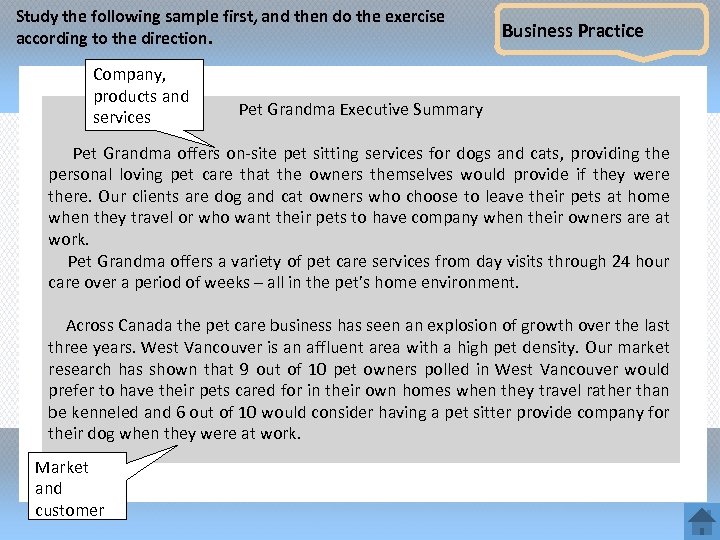
Study the following sample first, and then do the exercise according to the direction. Company, products and services Business Practice Pet Grandma Executive Summary Pet Grandma offers on-site pet sitting services for dogs and cats, providing the personal loving pet care that the owners themselves would provide if they were there. Our clients are dog and cat owners who choose to leave their pets at home when they travel or who want their pets to have company when their owners are at work. Pet Grandma offers a variety of pet care services from day visits through 24 hour care over a period of weeks – all in the pet’s home environment. Across Canada the pet care business has seen an explosion of growth over the last three years. West Vancouver is an affluent area with a high pet density. Our market research has shown that 9 out of 10 pet owners polled in West Vancouver would prefer to have their pets cared for in their own homes when they travel rather than be kenneled and 6 out of 10 would consider having a pet sitter provide company for their dog when they were at work. Market and customer
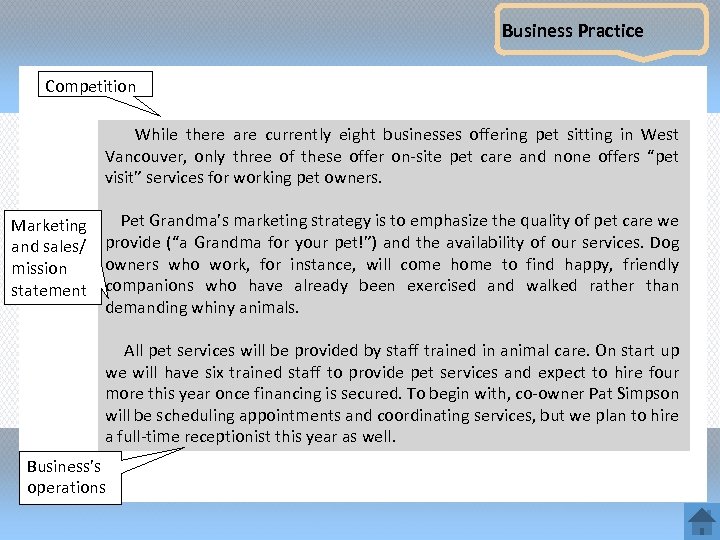
Business Practice Competition While there are currently eight businesses offering pet sitting in West Vancouver, only three of these offer on-site pet care and none offers “pet visit” services for working pet owners. Marketing and sales/ mission statement Pet Grandma’s marketing strategy is to emphasize the quality of pet care we provide (“a Grandma for your pet!”) and the availability of our services. Dog owners who work, for instance, will come home to find happy, friendly companions who have already been exercised and walked rather than demanding whiny animals. All pet services will be provided by staff trained in animal care. On start up we will have six trained staff to provide pet services and expect to hire four more this year once financing is secured. To begin with, co-owner Pat Simpson will be scheduling appointments and coordinating services, but we plan to hire a full-time receptionist this year as well. Business’s operations
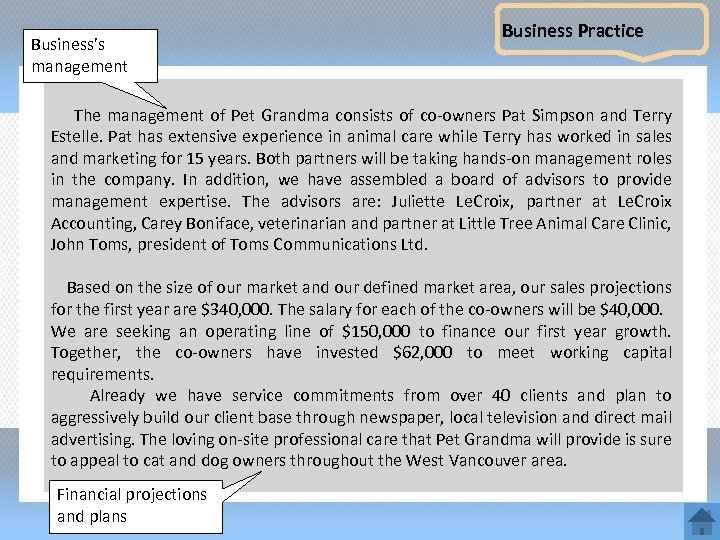
Business’s management Business Practice The management of Pet Grandma consists of co-owners Pat Simpson and Terry Estelle. Pat has extensive experience in animal care while Terry has worked in sales and marketing for 15 years. Both partners will be taking hands-on management roles in the company. In addition, we have assembled a board of advisors to provide management expertise. The advisors are: Juliette Le. Croix, partner at Le. Croix Accounting, Carey Boniface, veterinarian and partner at Little Tree Animal Care Clinic, John Toms, president of Toms Communications Ltd. Based on the size of our market and our defined market area, our sales projections for the first year are $340, 000. The salary for each of the co-owners will be $40, 000. We are seeking an operating line of $150, 000 to finance our first year growth. Together, the co-owners have invested $62, 000 to meet working capital requirements. Already we have service commitments from over 40 clients and plan to aggressively build our client base through newspaper, local television and direct mail advertising. The loving on-site professional care that Pet Grandma will provide is sure to appeal to cat and dog owners throughout the West Vancouver area. Financial projections and plans
Exercise: Business Practice Suppose you are working in the management of Studio 67 and are asked to present an executive summary to the bank from which your company is to borrow some start-up funds. Though discussing with your staff, you have got some data and ideas in terms of Service, Customers, and Management (listed below). Some parts of the summary are already done for you. Continue to write it up with the given information. You need to reorganize the information to make it more logical and readable.
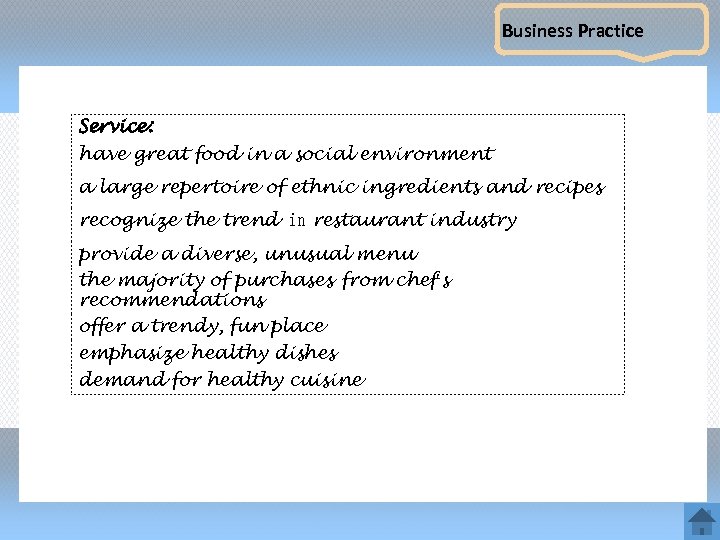
Business Practice Service: have great food in a social environment a large repertoire of ethnic ingredients and recipes recognize the trend in restaurant industry provide a diverse, unusual menu the majority of purchases from chef’s recommendations offer a trendy, fun place emphasize healthy dishes demand for healthy cuisine
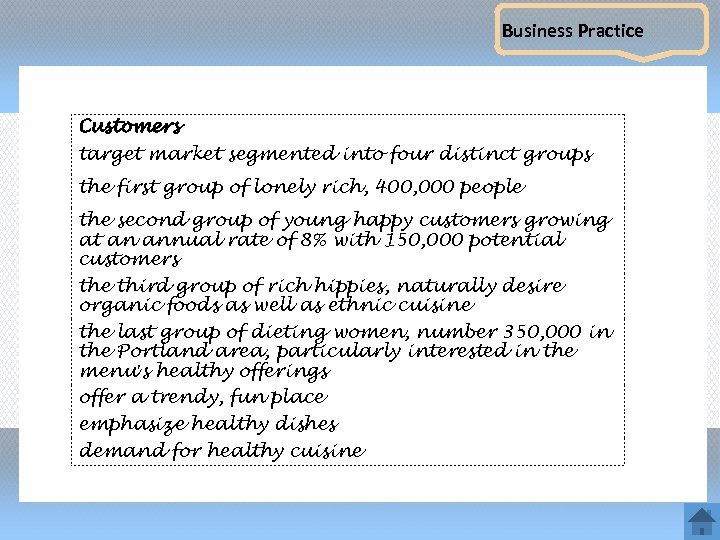
Business Practice Customers target market segmented into four distinct groups the first group of lonely rich, 400, 000 people the second group of young happy customers growing at an annual rate of 8% with 150, 000 potential customers the third group of rich hippies, naturally desire organic foods as well as ethnic cuisine the last group of dieting women, number 350, 000 in the Portland area, particularly interested in the menu’s healthy offerings offer a trendy, fun place emphasize healthy dishes demand for healthy cuisine
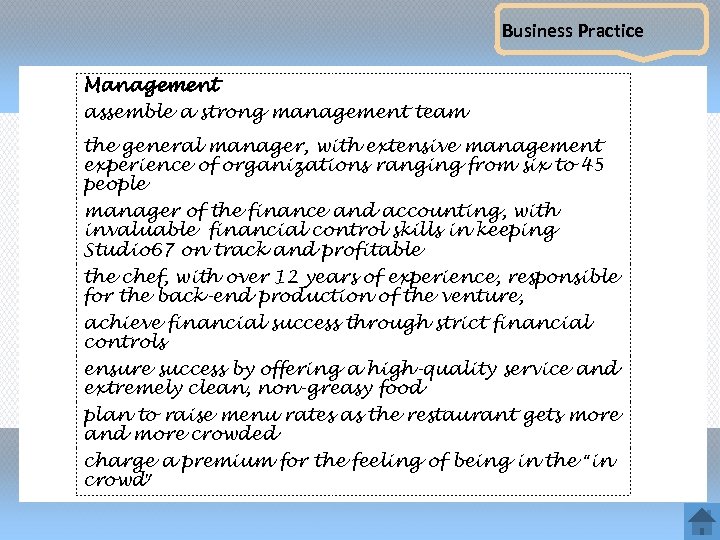
Business Practice Management assemble a strong management team the general manager, with extensive management experience of organizations ranging from six to 45 people manager of the finance and accounting, with invaluable financial control skills in keeping Studio 67 on track and profitable the chef, with over 12 years of experience, responsible for the back-end production of the venture, achieve financial success through strict financial controls ensure success by offering a high-quality service and extremely clean, non-greasy food plan to raise menu rates as the restaurant gets more and more crowded charge a premium for the feeling of being in the “in crowd”
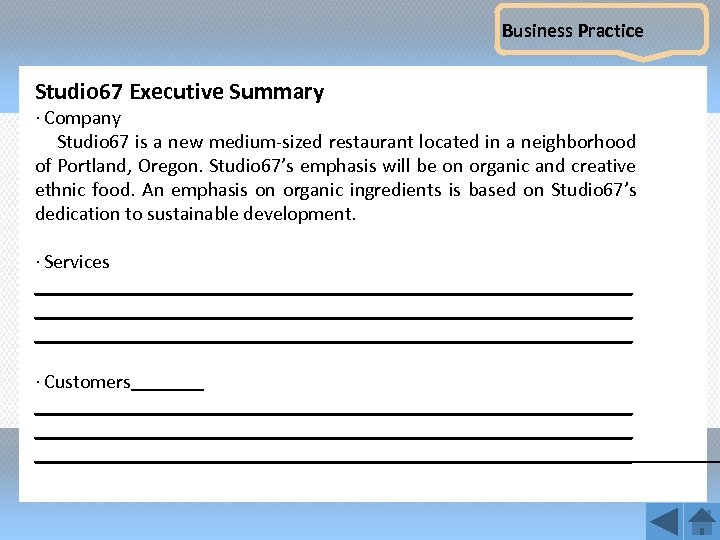
Business Practice Studio 67 Executive Summary · Company Studio 67 is a new medium-sized restaurant located in a neighborhood of Portland, Oregon. Studio 67’s emphasis will be on organic and creative ethnic food. An emphasis on organic ingredients is based on Studio 67’s dedication to sustainable development. · Services ____________________________________________________________ · Customers ____________________________________________________________
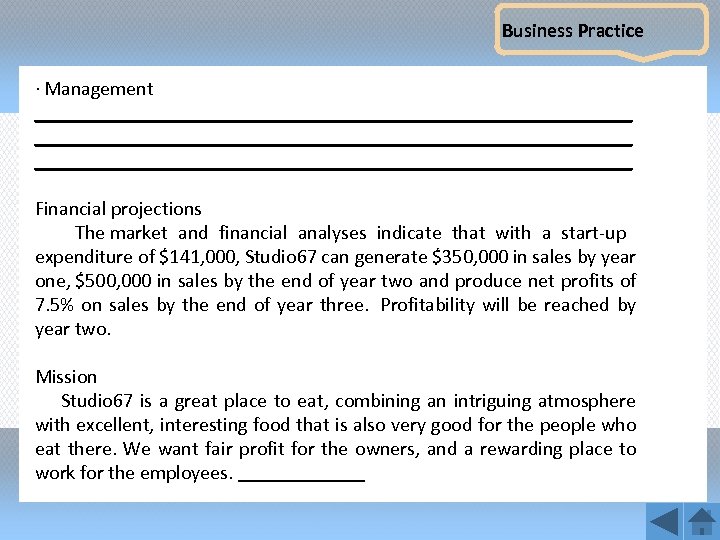
Business Practice · Management ____________________________________________________________ Financial projections The market and financial analyses indicate that with a start-up expenditure of $141, 000, Studio 67 can generate $350, 000 in sales by year one, $500, 000 in sales by the end of year two and produce net profits of 7. 5% on sales by the end of year three. Profitability will be reached by year two. Mission Studio 67 is a great place to eat, combining an intriguing atmosphere with excellent, interesting food that is also very good for the people who eat there. We want fair profit for the owners, and a rewarding place to work for the employees.
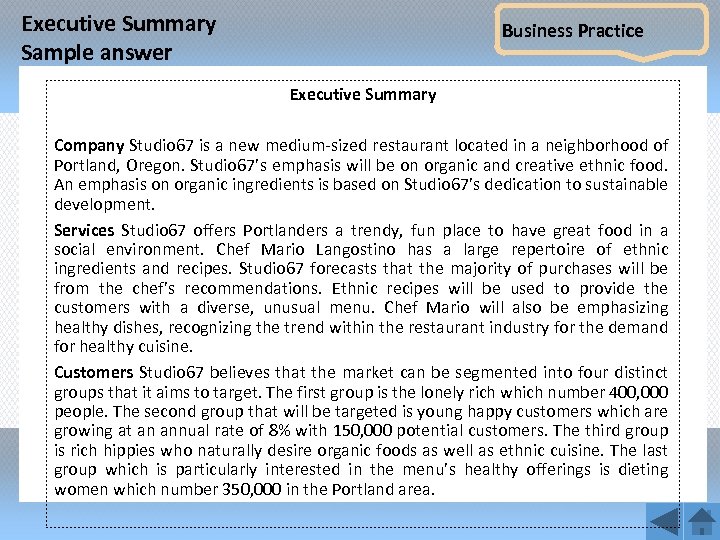
Executive Summary Sample answer Business Practice Executive Summary Company Studio 67 is a new medium-sized restaurant located in a neighborhood of Portland, Oregon. Studio 67’s emphasis will be on organic and creative ethnic food. An emphasis on organic ingredients is based on Studio 67’s dedication to sustainable development. Services Studio 67 offers Portlanders a trendy, fun place to have great food in a social environment. Chef Mario Langostino has a large repertoire of ethnic ingredients and recipes. Studio 67 forecasts that the majority of purchases will be from the chef’s recommendations. Ethnic recipes will be used to provide the customers with a diverse, unusual menu. Chef Mario will also be emphasizing healthy dishes, recognizing the trend within the restaurant industry for the demand for healthy cuisine. Customers Studio 67 believes that the market can be segmented into four distinct groups that it aims to target. The first group is the lonely rich which number 400, 000 people. The second group that will be targeted is young happy customers which are growing at an annual rate of 8% with 150, 000 potential customers. The third group is rich hippies who naturally desire organic foods as well as ethnic cuisine. The last group which is particularly interested in the menu’s healthy offerings is dieting women which number 350, 000 in the Portland area.
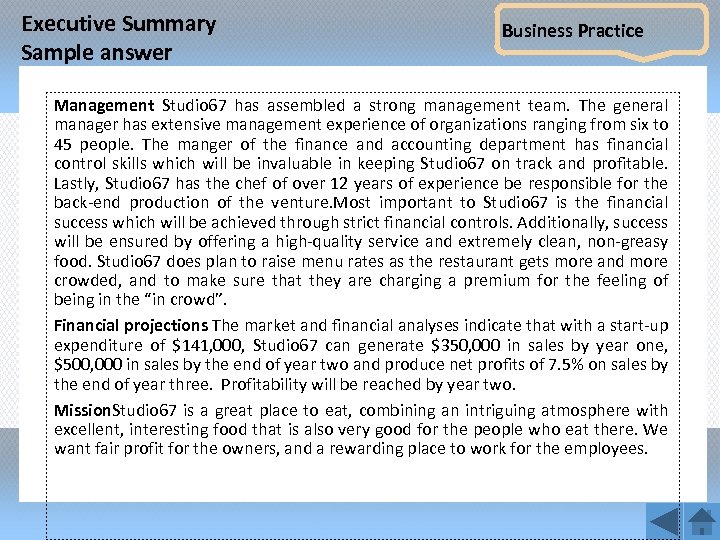
Executive Summary Sample answer Business Practice Management Studio 67 has assembled a strong management team. The general manager has extensive management experience of organizations ranging from six to 45 people. The manger of the finance and accounting department has financial control skills which will be invaluable in keeping Studio 67 on track and profitable. Lastly, Studio 67 has the chef of over 12 years of experience be responsible for the back-end production of the venture. Most important to Studio 67 is the financial success which will be achieved through strict financial controls. Additionally, success will be ensured by offering a high-quality service and extremely clean, non-greasy food. Studio 67 does plan to raise menu rates as the restaurant gets more and more crowded, and to make sure that they are charging a premium for the feeling of being in the “in crowd”. Financial projections The market and financial analyses indicate that with a start-up expenditure of $141, 000, Studio 67 can generate $350, 000 in sales by year one, $500, 000 in sales by the end of year two and produce net profits of 7. 5% on sales by the end of year three. Profitability will be reached by year two. Mission. Studio 67 is a great place to eat, combining an intriguing atmosphere with excellent, interesting food that is also very good for the people who eat there. We want fair profit for the owners, and a rewarding place to work for the employees.
Exercises Ø Business Expressions Matching words Completing sentences Ø Specialized Reading
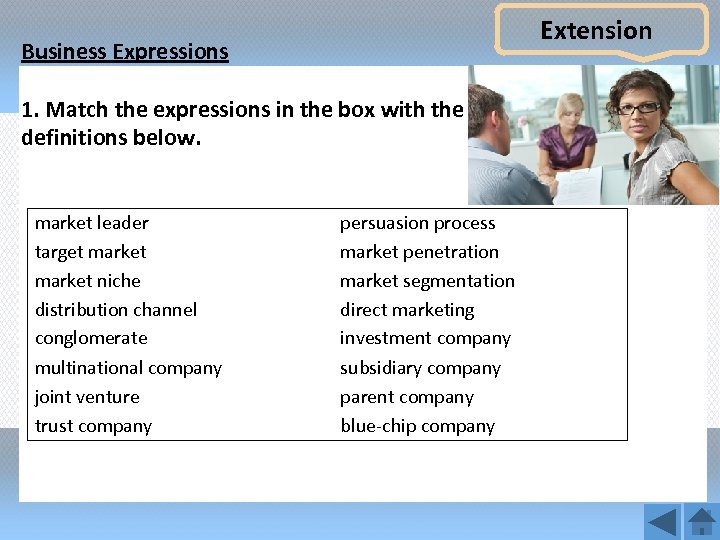
Extension Business Expressions 1. Match the expressions in the box with the definitions below. market leader target market niche distribution channel conglomerate multinational company joint venture trust company persuasion process market penetration market segmentation direct marketing investment company subsidiary company parent company blue-chip company
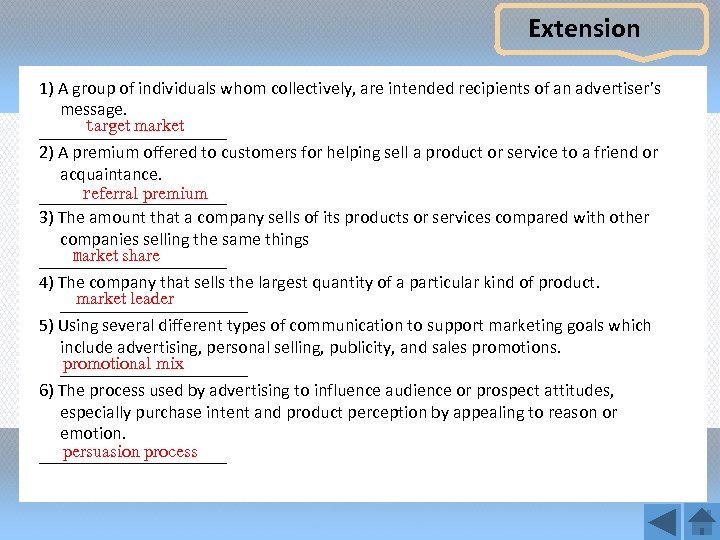
Extension 1) A group of individuals whom collectively, are intended recipients of an advertiser’s message. target market ___________ 2) A premium offered to customers for helping sell a product or service to a friend or acquaintance. referral premium ___________ 3) The amount that a company sells of its products or services compared with other companies selling the same things market share ___________ 4) The company that sells the largest quantity of a particular kind of product. market leader ___________ 5) Using several different types of communication to support marketing goals which include advertising, personal selling, publicity, and sales promotions. promotional mix ___________ 6) The process used by advertising to influence audience or prospect attitudes, especially purchase intent and product perception by appealing to reason or emotion. persuasion process ___________
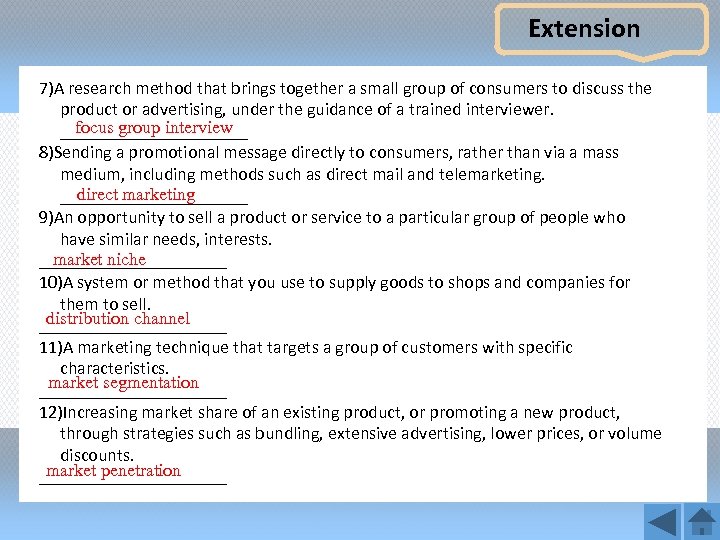
Extension 7)A research method that brings together a small group of consumers to discuss the product or advertising, under the guidance of a trained interviewer. focus group interview ___________ 8)Sending a promotional message directly to consumers, rather than via a mass medium, including methods such as direct mail and telemarketing. direct marketing ___________ 9)An opportunity to sell a product or service to a particular group of people who have similar needs, interests. market niche ___________ 10)A system or method that you use to supply goods to shops and companies for them to sell. distribution channel ___________ 11)A marketing technique that targets a group of customers with specific characteristics. market segmentation ___________ 12)Increasing market share of an existing product, or promoting a new product, through strategies such as bundling, extensive advertising, lower prices, or volume discounts. market penetration ___________
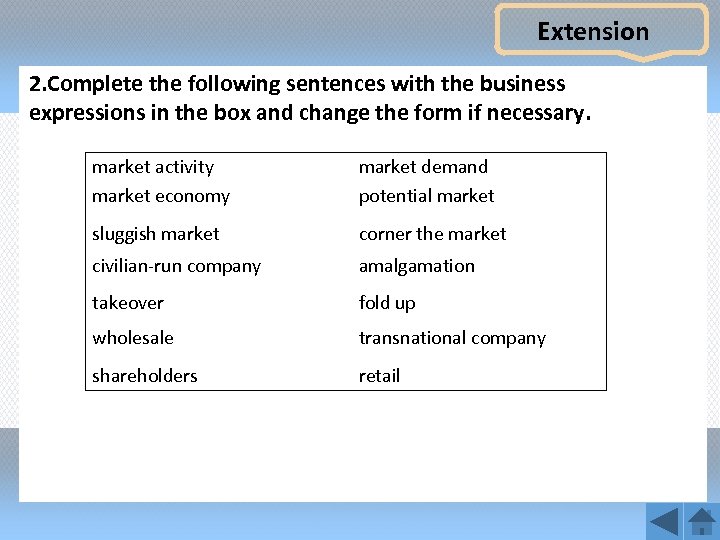
Extension 2. Complete the following sentences with the business expressions in the box and change the form if necessary. market activity market economy market demand potential market sluggish market corner the market civilian-run company amalgamation takeover fold up wholesale transnational company shareholders retail
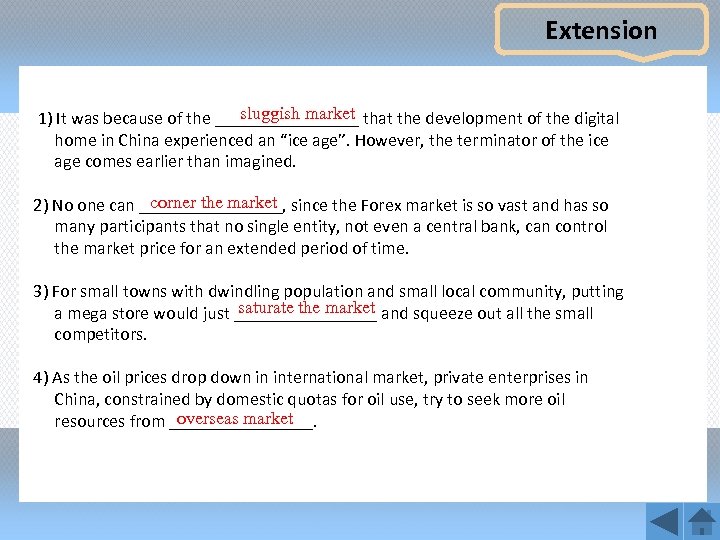
Extension sluggish market 1) It was because of the ________ that the development of the digital home in China experienced an “ice age”. However, the terminator of the ice age comes earlier than imagined. corner the market 2) No one can ________, since the Forex market is so vast and has so many participants that no single entity, not even a central bank, can control the market price for an extended period of time. 3) For small towns with dwindling population and small local community, putting saturate the market a mega store would just ________ and squeeze out all the small competitors. 4) As the oil prices drop down in international market, private enterprises in China, constrained by domestic quotas for oil use, try to seek more oil overseas market resources from ________.
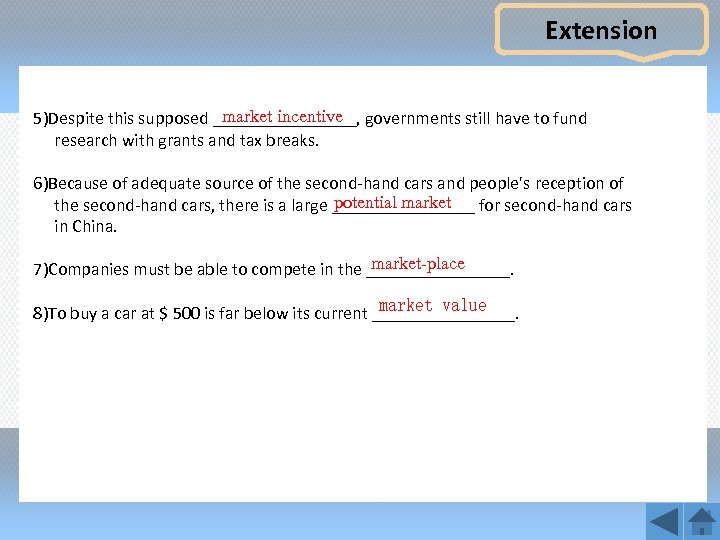
Extension market incentive 5)Despite this supposed ________, governments still have to fund research with grants and tax breaks. 6)Because of adequate source of the second-hand cars and people's reception of potential market the second-hand cars, there is a large ________ for second-hand cars in China. market-place 7)Companies must be able to compete in the ________. market value 8)To buy a car at $ 500 is far below its current ________.
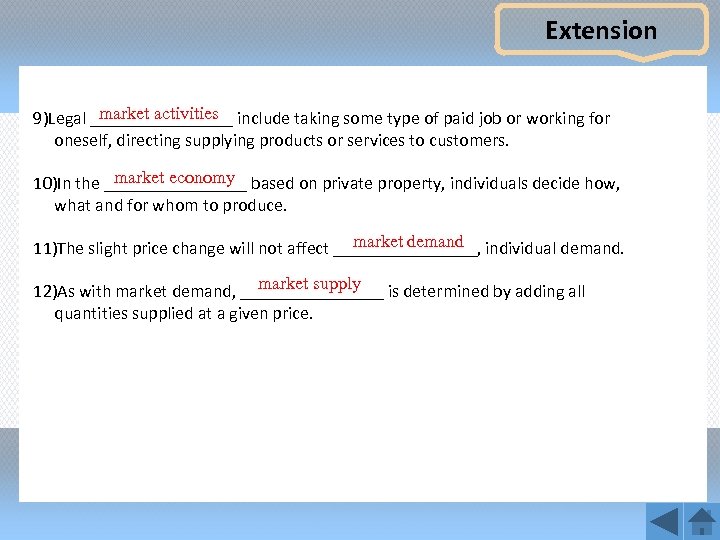
Extension market activities 9)Legal ________ include taking some type of paid job or working for oneself, directing supplying products or services to customers. market economy 10)In the ________ based on private property, individuals decide how, what and for whom to produce. market demand 11)The slight price change will not affect ________, individual demand. market supply 12)As with market demand, ________ is determined by adding all quantities supplied at a given price.
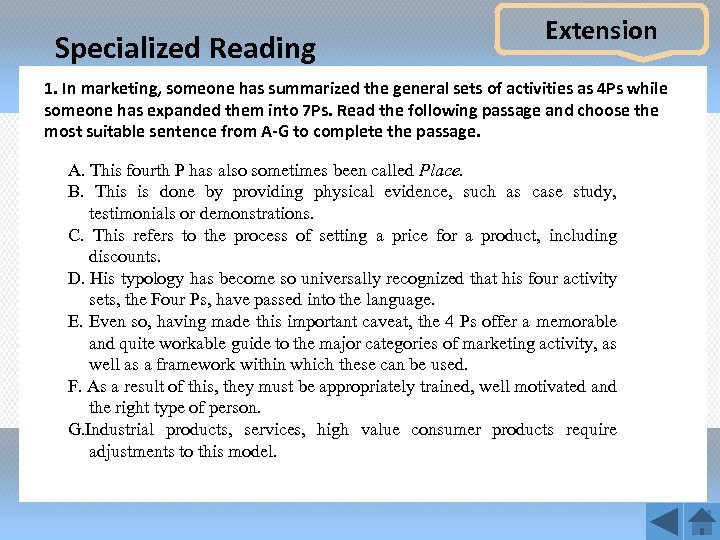
Specialized Reading Extension 1. In marketing, someone has summarized the general sets of activities as 4 Ps while someone has expanded them into 7 Ps. Read the following passage and choose the most suitable sentence from A-G to complete the passage. A. This fourth P has also sometimes been called Place. B. This is done by providing physical evidence, such as case study, testimonials or demonstrations. C. This refers to the process of setting a price for a product, including discounts. D. His typology has become so universally recognized that his four activity sets, the Four Ps, have passed into the language. E. Even so, having made this important caveat, the 4 Ps offer a memorable and quite workable guide to the major categories of marketing activity, as well as a framework within which these can be used. F. As a result of this, they must be appropriately trained, well motivated and the right type of person. G. Industrial products, services, high value consumer products require adjustments to this model.
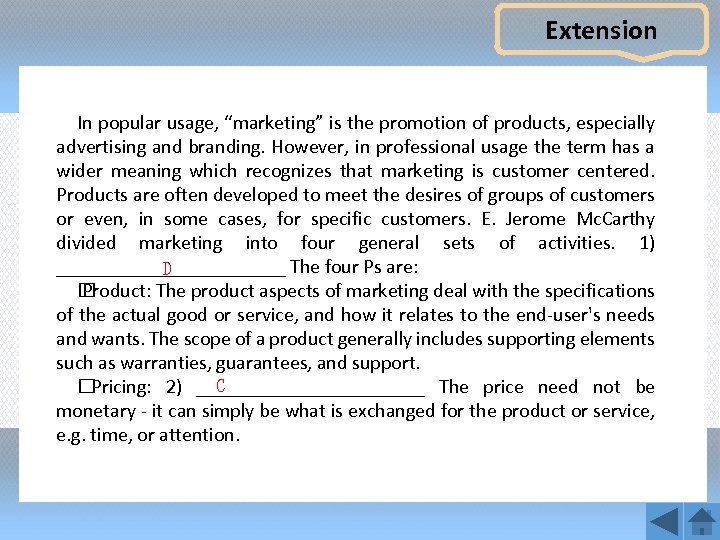
Extension In popular usage, “marketing” is the promotion of products, especially advertising and branding. However, in professional usage the term has a wider meaning which recognizes that marketing is customer centered. Products are often developed to meet the desires of groups of customers or even, in some cases, for specific customers. E. Jerome Mc. Carthy divided marketing into four general sets of activities. 1) ____________ The four Ps are: D Product: The product aspects of marketing deal with the specifications of the actual good or service, and how it relates to the end-user's needs and wants. The scope of a product generally includes supporting elements such as warranties, guarantees, and support. C Pricing: 2) ____________ The price need not be monetary - it can simply be what is exchanged for the product or service, e. g. time, or attention.
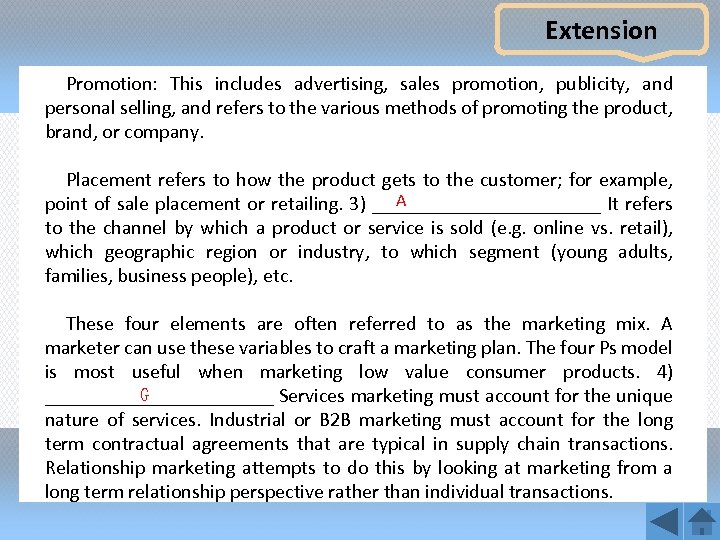
Extension Promotion: This includes advertising, sales promotion, publicity, and personal selling, and refers to the various methods of promoting the product, brand, or company. Placement refers to how the product gets to the customer; for example, A point of sale placement or retailing. 3) ____________ It refers to the channel by which a product or service is sold (e. g. online vs. retail), which geographic region or industry, to which segment (young adults, families, business people), etc. These four elements are often referred to as the marketing mix. A marketer can use these variables to craft a marketing plan. The four Ps model is most useful when marketing low value consumer products. 4) G ____________ Services marketing must account for the unique nature of services. Industrial or B 2 B marketing must account for the long term contractual agreements that are typical in supply chain transactions. Relationship marketing attempts to do this by looking at marketing from a long term relationship perspective rather than individual transactions.
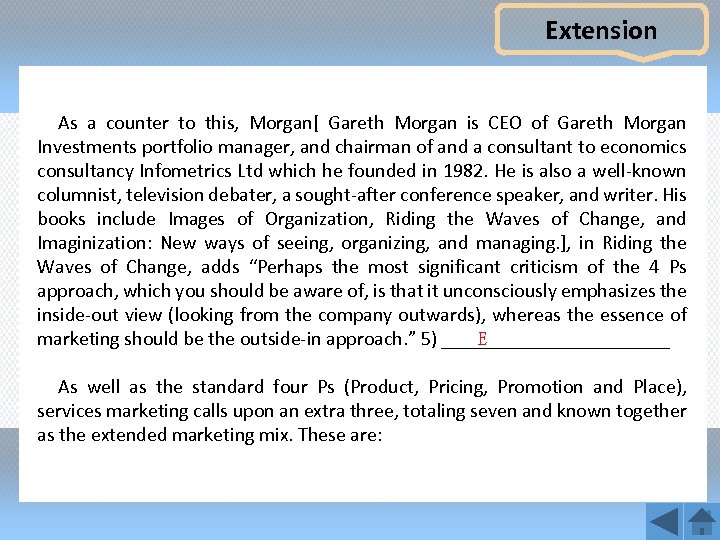
Extension As a counter to this, Morgan[ Gareth Morgan is CEO of Gareth Morgan Investments portfolio manager, and chairman of and a consultant to economics consultancy Infometrics Ltd which he founded in 1982. He is also a well-known columnist, television debater, a sought-after conference speaker, and writer. His books include Images of Organization, Riding the Waves of Change, and Imaginization: New ways of seeing, organizing, and managing. ], in Riding the Waves of Change, adds “Perhaps the most significant criticism of the 4 Ps approach, which you should be aware of, is that it unconsciously emphasizes the inside-out view (looking from the company outwards), whereas the essence of E marketing should be the outside-in approach. ” 5) ____________ As well as the standard four Ps (Product, Pricing, Promotion and Place), services marketing calls upon an extra three, totaling seven and known together as the extended marketing mix. These are:
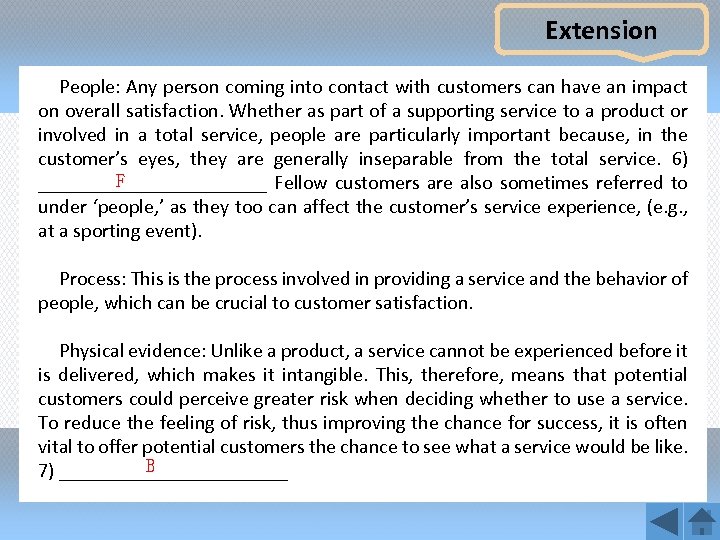
Extension People: Any person coming into contact with customers can have an impact on overall satisfaction. Whether as part of a supporting service to a product or involved in a total service, people are particularly important because, in the customer’s eyes, they are generally inseparable from the total service. 6) F ____________ Fellow customers are also sometimes referred to under ‘people, ’ as they too can affect the customer’s service experience, (e. g. , at a sporting event). Process: This is the process involved in providing a service and the behavior of people, which can be crucial to customer satisfaction. Physical evidence: Unlike a product, a service cannot be experienced before it is delivered, which makes it intangible. This, therefore, means that potential customers could perceive greater risk when deciding whether to use a service. To reduce the feeling of risk, thus improving the chance for success, it is often vital to offer potential customers the chance to see what a service would be like. B 7) ____________
Extension 2. Discuss the following questions with your group members. 1)“PHILOSOPHY” is the potential 8 th P of marketing. What do you think of the 8 Ps in conducting marketing for the charities? 2)In India, there are 4 As, which referred to Acceptability of the product or services; Affordability of the product or services; Awareness of the product and services; Availability of the product and services. Compare and comment on 4 Ps and 4 As.

Thank you!
Lead-in 1)Marketing plays an important role in business: it collects and analyses data on target markets and potential consumers. This information is quite helpful in decision making as to which products should be produced and the best methods to promote them. I like this work, for it is quite challenging: it requires careful study of target market and high responsibility of making right conclusion. Meanwhile, it provides many chances to communicate with different people and at the same time, it is essential for a business in decision making.
Lead-in 2)There are several ways to promote a product including: advertisement on TV, newspaper or bus; discount for large purchase; buy one get one free; free after-sale service; famous person as product representative, etc. Nowadays, TV commercial may be the most effective way because it is likely to attract the consumers by its charming image and persuasive effect.
Lead-in 3)Among the marketing mix, price was a decisive factor when I bought the product because we students are not economically independent yet and we have to save money in our daily life. If the two products have similar function, I definitely choose the cheap one.
Lead-in Mac. Donald is facing the fierce competition from KFC. As the leading fast food brands, they have dominated the market for many years and taken the lead in turn. P&G now facing the competition from the local companies all over the world, the local companies now make use of its cultural identity and try to take up more market share from the P&G. As the leading Chinese brand, Haier now facing the competition in international market, it started to develop overseas market and meet difficulties in the aspects of quality standards and cultural differences. Lenovo now facing the competition home and abroad, it has to compete with such international brands as Dell and Sony, as well as some domestic brands in Chinese market. In overseas market, it has to face the fierce competition in price.
Lead-in Mc. Donald tends to focus on the potential customer of young people and children; they shot ads on TV frequently and try to attract their attention. P&G owns many brands of daily care product from high to low price, by which, it tries to keep their market share. Haier makes efforts in quality control to adapt to the international market and tries to build up an image of high quality. Lenovo intends to reduce marketing cost by making use of local distribution channel.
Exercises 1) What are the main elements in marketing a product? In marketing a product, the main elements are pricing, promotion and placement of the product.
Exercises 2) According Kalika’s story, what should an entrepreneur do to guarantee successful marketing? An entrepreneur should choose a product he is familiar with, set a reasonable price for it and then make full use of promotion.
Exercises 3)What roles does Kalika play when she is marketing her product? She plays the role of a sale agent.
Exercises 4)How can customers and sellers both benefit from marketing activity? The customers can satisfy their personal need in convenience while the sellers get the money and reputation.
Exercises 5)What other ways can Kalika promote her products if she is an experienced seller? She can use various way of promotion such as buy-one-get-onefree coupon, discount coupon or a lucky draws.
Exercises 6)How does a marketing manager formulate a suitable marketing strategy for his company? He has to study the product, price, promotion and place respectively and then formulate a comprehensive strategy by taking all of them into consideration.
Exercises 7)Why does the author describe the marketer as an actor, the customers as audience? Just like the relationship between actor and audience in theater, the marketer has to attract the customers and try to inspire their trust on him.
Exercises 8)How does the author look at a product? The “product” in marketing refers to what the seller offers that has value to customers including products, services and ideas.
Exercises 1. In the example, Kalika does not need to communicate the cost of materials or production to another person or department. She herself makes all decisions and takes all the actions in the business. Marketing more complex products requires good communication and negotiating skills, because you must accommodate the needs of more individuals, and more of the process is out of your control.
Exercises 2. Kalika’s business does not lend itself well to much technology; however, she might have a web site and/or email address where customers could provide feedback on products. She could take telephone orders. She could have a small computer that she uses for collecting and keeping track of sales.
Exercises 3. Larger businesses are capable of accommodating temporary problems by sharing workload, switching duties, or maintaining a variety of products and/or stores, among other things.
Exercises 2) Your audience, or target market, is the universe of potential customers for your products or service. I use the word “audience” more, and there’s a reason. It reminds me that life is like theater. As a marketer, you’re like an actor trying to please and entertain. You need your audience to believe in who you are and what you’re offering. You’ll also hear this group of people called customers, clients, prospects, or a market segment. You want those people to know about you. 你的受众,或者说目标市场,就是你的产品或服务的潜在顾客 市场。我更多使用“受众”这个词是有原因的。它提醒我,人生就如 戏。作为一个市场营销人员,你就像是一个极力取悦和娱乐观众的 演员。你需要让观众相信你是谁,并且相信你为他们提供的一切。 你也会听到这群人被称作顾客、客户、潜在客户,或细分顾客。你 想让这些人了解你。
Extension 1)Products (or services) should reflect the underlying philosophy of the organization. It should also be clear what the philosophy behind the introduction of the particular product is, as well. Marketing can be successful only when the philosophy of a certain product is disclosed. 2)4 Ps are the basic and fundamental elements in marketing while 4 As have a consumer-centered perspective which take consumer’s feeling into consideration.
Скачать презентацию Unit Three Marketing Contents 1 Brief on
0807d5052dd41f6836a4fbc9324ef43f.ppt