


 Скачать презентацию Unit Three Career Reading One The modern
39a7a8894cd904a59259e2f6796ea122.ppt
- Количество слайдов: 38
 Unit Three Career
 Reading One The modern Servant — Nanny v v v I. Self-study guidance 1. Learning aims By the end of this lesson, students should be able to: A. Know something about career development. B. Understand career development and make the right choice in his/her life. C. Master the words or phrases related to career.
 II. Background information 1. Choosing your career 2. Your career choice determines the course that your life will take — it determines how successful you are, how happy you are and whether you live a good, bad or indifferent life. You have to think through what you want to achieve with your life in important areas such as your career, your family artistic or sporting goals and public service. A crucial part of this is setting priorities in these different areas. No one has the time to excel in all areas — if the major focus of your life is to spend a lot of time with your family and contribute to voluntary organizations, then you must recognize that this will limit the time and effort you can dedicate to your career. If you want to focus exclusively on your career, then you must understand manage the consequences. Bear in mind that your priorities will probably change over time — many people focus completely on their careers in their twenties as they
 Make a place for themselves in the world. In their thirties, they may take more of a family focus, and other things may become important later on — this is a normal part of life. 2. Planning your career In order to choose an appropriate career which suits your abilities, skills, ambitions and ideals, you have to plan your career very carefully. Here are the steps you can follow: 1) Develop a career plan. Think about what you want to do and find out more about the kind of training, education, and skills you will need to achieve your career goal. 2) Assess your skills and interests. Think hard about what you enjoy, what you are good at, what kind of personality you are, and the values you hold. 3) Research occupations. Find out more about the nature of the jobs that interest you, such as educational requirements, salary, working conditions, future outlook, and anything else that can
 Help you narrow your focus. 4. Compare your skills and interests with the occupations you’ve selected. The career that matches your skills, interests and personality the closest may be the career for you. 5. Choose your career goal. Once you’ve decided what occupation matches up best with you, then you can begin developing a plan to reach your career goal.
 Reading I I. Brainstorming: Work with your partner and list the spaces provided below occupations you think are The most interesting The most boring teacher waiter / waitress doctor driver engineer shop assistant polite typist The most promising The most stressful business person manager designer CEO writer journalist architect accountant
 3. Language points Key words Reading I 1) career n. 职业 Churchill's career 邱吉尔的职业生涯 an advertising career广告事业 a career diplomat职业外交家 e. g. She realized that her acting career was over. The position of ambassador is not a career position to him, but it is the highest position he’s ever taken in his life. 比较 career & profession Career is a job or profession for which one is trained and which one intends to follow for part or the whole of one’s life. ( 需要 特别训练的并终身或长期从事的职业;一生的事业) Profession is a form of employment, esp. one that is possible only for an educated person and after training (such as law, medicine, or teaching) and that is respected in society as honorable. ( 尤指受过教育和专门训练的法律﹑ 医学﹑ 教育等脑力劳 动方面的专业﹑ 职业)
 e. g. He is a lawyer by profession. The teaching profession claims to be badly paid. He was well respected in the medical profession. Professional adj. 职业的 e. g. professional standard 职业标准 a professional photographer 职业摄影师 professional foul (体育运动中的)故意犯规 He is a footballer who turned professional. Professional can also be a noun, which refers to a person who has great experience and high professional standard. 专业人士;内行; 专家 e. g. She is a real professional. 2) adore v. 热爱;非常细欢;敬慕;尊敬 e. g. She adores going to the cinema. John adores his grandchildren. A number of students hated the subject but adored the teacher. Mr. Wang absolutely adores a teacher. He adores his elder brother.
 3) organize v. 安排,筹划 organize a strike 组织罢 e. g. Organize your thoughts before you being to speak. The staff organize a protest march. He organized his speech so that his most telling points came last. 4) fantastic a. 极好的 fantastic story 怪诞的故事 fantastic dream 怪诞的梦 fantastic garb奇装异服 fantastic hopes 异想天开 a fantastic trip to Europe. 美好的欧洲之旅 e. g. It sounds like a fantastic idea.
 5) traditional a. 传统的 the traditional handshake 惯例性的握手; a traditional wedding ceremony 传统婚娶典礼 traditional Chinese painting中国画 traditional Chinese medicine中药 e. g. There also people who come to take such courses as Chinese traditional medicine, painting, calligraphy and photography. It is traditional for the manager to make a speech on the opening ceremony. 6) footstep n. 脚步声,足迹 follow (in) sb’s footsteps 仿效某人, 步某人的后尘 tread in sb's footsteps 仿效某人, 步某人的后尘 walk in sb's footsteps 仿效某人, 步某人的后尘 e. g. I heard footsteps in the room behind me. The thief heard soft footsteps coming down the stairs.
 7) apply v. 申请,请求 be applied to 适用于, 应用于, 施加于, 用来表示, 与. . . 接触 apply for申请; 请求, 接洽 apply oneself to 致力于, 集中精力做某事 apply sth. to把. . . 施于. . . ; 把. . . 运用于. . . apply a theory to practice把理论应用于实践 e. g. Lily applied for the post of Mark’s secretary. I applied to three companies and was accepted by all of them. New technology is being applied to almost every industrial process. 8) encourage v. 鼓励 encourage sb. to do something鼓励某人做某事 e. g. Eliot encourages her to apply for the job. Policies are designed to encourage private investment. A good public transport encourages people to leave their cars at home.
 9) complain v. 投诉, 抱怨 e. g. Neighbors complained to the police about the dog’s barking. They complained about the food. Almost immediately the worker began to complain about the salary. The boss complains that too much money spent on advertisement has increased the cost. 10) fashionable a. 时兴的,流行的 e. g. Black is fashionable at any time. She added a touch of glamour by wearing a fashionable hat. We lunched in a fashionable restaurant yesterday.
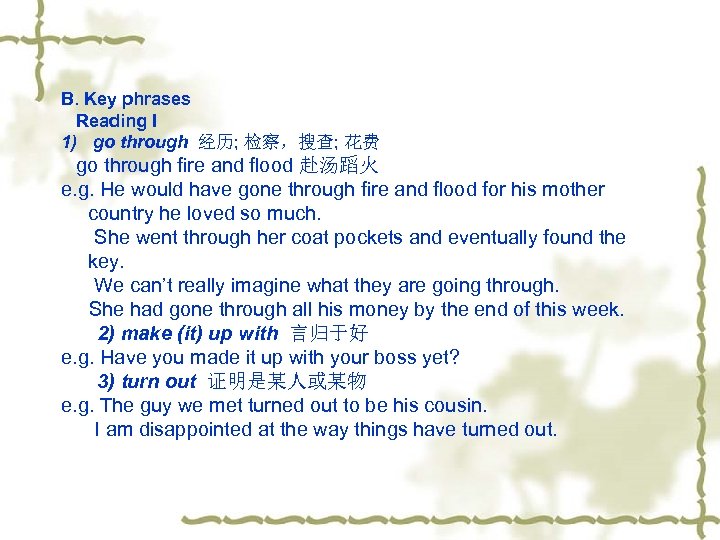 B. Key phrases Reading I 1) go through 经历; 检察,搜查; 花费 go through fire and flood 赴汤蹈火 e. g. He would have gone through fire and flood for his mother country he loved so much. She went through her coat pockets and eventually found the key. We can’t really imagine what they are going through. She had gone through all his money by the end of this week. 2) make (it) up with 言归于好 e. g. Have you made it up with your boss yet? 3) turn out 证明是某人或某物 e. g. The guy we met turned out to be his cousin. I am disappointed at the way things have turned out.
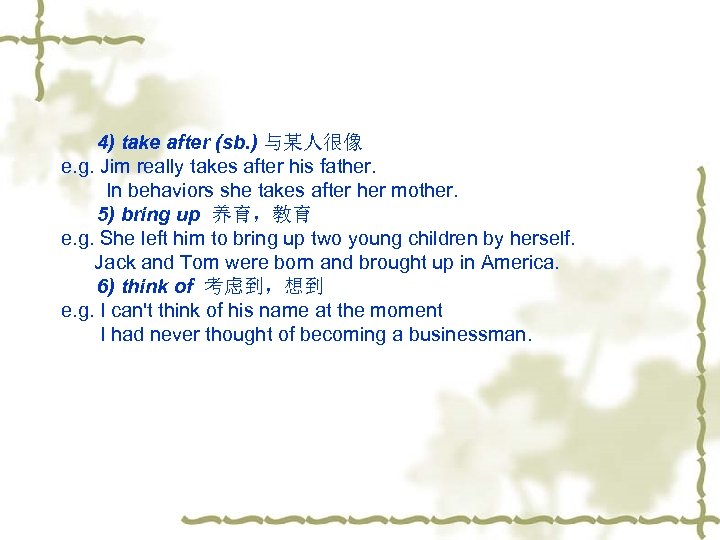 4) take after (sb. ) 与某人很像 e. g. Jim really takes after his father. In behaviors she takes after her mother. 5) bring up 养育,教育 e. g. She left him to bring up two young children by herself. Jack and Tom were born and brought up in America. 6) think of 考虑到,想到 e. g. I can't think of his name at the moment I had never thought of becoming a businessman.
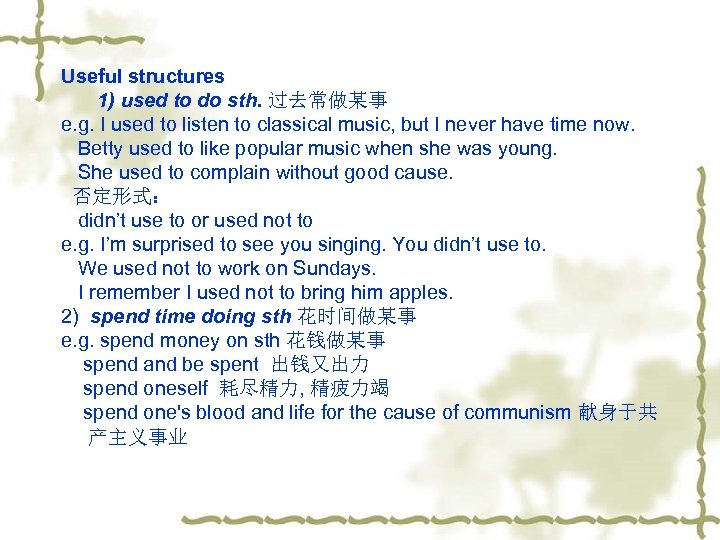 Useful structures 1) used to do sth. 过去常做某事 e. g. I used to listen to classical music, but I never have time now. Betty used to like popular music when she was young. She used to complain without good cause. 否定形式: didn’t use to or used not to e. g. I’m surprised to see you singing. You didn’t use to. We used not to work on Sundays. I remember I used not to bring him apples. 2) spend time doing sth 花时间做某事 e. g. spend money on sth 花钱做某事 spend and be spent 出钱又出力 spend oneself 耗尽精力, 精疲力竭 spend one's blood and life for the cause of communism 献身于共 产主义事业
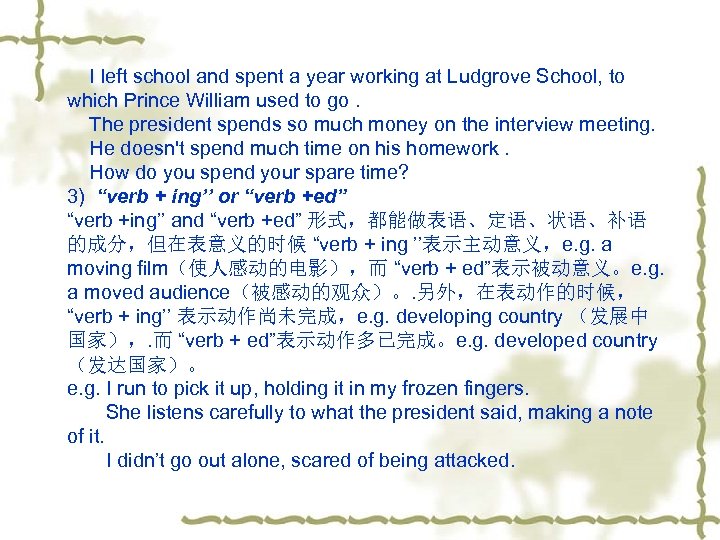 I left school and spent a year working at Ludgrove School, to which Prince William used to go. The president spends so much money on the interview meeting. He doesn't spend much time on his homework. How do you spend your spare time? 3) “verb + ing’’ or “verb +ed” “verb +ing’’ and “verb +ed” 形式,都能做表语、定语、状语、补语 的成分,但在表意义的时候 “verb + ing ’’表示主动意义,e. g. a moving film(使人感动的电影),而 “verb + ed”表示被动意义。e. g. a moved audience(被感动的观众)。. 另外,在表动作的时候, “verb + ing’’ 表示动作尚未完成,e. g. developing country (发展中 国家),. 而 “verb + ed”表示动作多已完成。e. g. developed country (发达国家)。 e. g. I run to pick it up, holding it in my frozen fingers. She listens carefully to what the president said, making a note of it. I didn’t go out alone, scared of being attacked.
 They try to change their policy, frightened of losing power. I’m almost dead, surviving from day to day, from hour to hour. I have lost everything that was precious to me including my family.
 Difficult sentences Reading I 1) After school she made us delicious teas and read us stories in bed. 要点 要求双宾语的动词 句型(一) 结构vt. +sb. (间接宾语)+ sth. (直接宾语) vt. + sth. + to sb e. g. I give him a book. I give a book to him. 这类动词还有 allow, leave, hand, lend, offer, bring, pay, post, read, teach, throw, send, show, etc.
 句型(二) 结构vt. +sb. +sth. vt. + sth. + for sb. e. g. He bought me a hat. He bought a hat for me. 这类动词还有 call, order, cut, do, prepare, play, reach, find, get, save, sing, make, etc. 注意: 1. 当直接宾语较短或由代词充当时,须采用介词短语表示间接 宾语 2. 有时,既不用介词to, 也不用for,而需要根据搭配关系,选用 其他介词。 e. g. He plays me a trick. He plays a trick on me. 译文 放学后,她给我们做美味的茶点,还在床上给我们讲故事。
 2) It was then that I realized that I wanted to be a nanny. 要点 该句型为强调结构。英语中常用的强调结构是:it is (was)+被强 调部分(主语、宾语或状语)+ who (that)…。一般说来,被强调部 分指人时用who, 指物时用that (但that也可指人)。 e. g. John wore his best suit to the meeting last night. 我们可用强调结构来强调句中的主语、宾语和状语: It was John who (that) wore his best suit to the meeting last night. (强调主语) It was his best suit (that) John wore to the meeting last night. ( 强调宾语) It was last night (that) John wore his best suit to the meeting. (强 调状语last night) 译文 正是那个时候我意识到长大了我想当保姆。
 4. Summary, structure and writing techniques of Reading I A. Summary of Reading I The author introduces the modern servant-nanny through Amanda’s description. Amanda wanted to be a qualified nanny in the future for her good personality, so she started her training course and after graduation applied for the post of nanny for six month old twins. Through her hard work and achievements, Amanda proved her value - being a nanny. She was respected by the parents. Finally her parents accept her and her job, they think they’re both proud and also pleased because her daughter has made her own right decisions in life and done so well. Nowadays there are so many kinds of jobs, and these jobs are very different from those in the past. All of us should have the right attitude towards them and make the right choice. Maybe in the future, the job we do now will disappear and new kinds of jobs will appear constantly. In your career, maybe you’ll do a certain job that nobody knows. So you must get ready for it and try your best to do it well.
 B. Structure of Reading I Part One (Para. 1) Introduction: In this paragraph, the author introduces some information about Amanda Peniston-Bird’s choice of career. Part two (Paras. 2 -3) Amanda’s view on future careers 1. Introduce her sister’s nanny—Alison’s common life. 2. Introduce her sister’s another nanny’s life, because of this, she wanted to be a nanny in the future, and she decided to start her training course at Norland College. Part three (Para. 4) Amanda’s mother’s view on her daughter’s new career—to be a nanny. Although Amanda’s father felt a little disappointed, his daughter didn’t take after his career, but her mother felt they were both proud, and also pleased, that she has made her own decisions in life and done so well.
 C. Writing techniques of Reading I parallelism (paragraph 3)
 Exercises I. Reading the text careful again and discuss the following questions. 1. What is Amanda’s father? 2. He was a lawyer. 3. 2. Who was Alison? 4. Alison was the nanny to look after Amanda and her sister. 5. 3. When did Alison come to be with Amanda’s family? 6. When Amanda’s sister was born and when Amanda was seven years old. 7. 4. Why did little Amanda adore Alison very much? 8. She was young and wonderful.
 5. How was Nanny Barnes different from Alison? She was older than Alison. She was a trained nanny and lived with Amanda’s family. 6. When did Amanda realize that she wanted to be a nanny? It was at the time that Alison left and Barnes arrived. 7. What did Amanda’s parents think of young Amanda’s decision at the time? They though that it was just a childish phrase I was going through. 8. What career did Amanda’s parents expect her to pursue? They expected her to study law like her father. 9. When did Amanda’s parents begin to encourage her instead of frowning on her career choice? Before I went to college, they have encouraged me ever since. 10. Why did Amanda’s parents’ attitude change toward her choice of career? Because times have changed and “nanny” has been socially acceptable.
 11. Why do Amanda’ parents feel proud of their daughter? Because she has made her own decisions in life and done so well. 12. How would your parents react to your decision to be a nanny? They will be very sad, I think. Because in China as a professional nanny — the new career is not acceptable by many Chinese people, and also their social status is very low.
 Exercises; 6. Word Study 1. a. Many young females adore visiting fashion shows. b. Most of the indigenous tribes on the island adorn her as a goddess. c. Girls and boys adore this film for its eye-catching special effects. 2. a. He accepted the task without realizing the risk he was taking. b. She spoke English so well that I never realized she was German. c. She realized her ambition of becoming an actress after ceaseless efforts. 3. a. He seated himself in the boat and began rowing towards the harbor’s mouth. b. He’s always having a row with his wife about trifles. c. We stood in rows to receive our certificates from the headmaster.
 4. a. The mood of the meeting turned solemn when the problem became known. b. I waited so long for my turn to see the doctor that I missed my train. c. Many countries are starting to turn their attention to new forms of energy. 5. a. He’s spent most of his life working for the same company. b. The minister was looking forward to spending more time with his family. c. They are only able to spend money on basic necessity.
 Reading II The Gardener v v Dictation I know that times have changed, but I was brought up with a nanny and a cook to look after me, and I never went near the kitchen. I was taken aback at first when my son announced that he wanted to be a cook. His grandfather still hasn’t got over it, but his mother and I are happy that he is doing something he enjoys. Nowadays anyone with a job that they enjoy is very lucky.
 Key Words of Reading II 1) surveyor n. / survey v. 调查, 勘测 v make a survey of测量, 勘察; 对. . . 作全面的调查[观察] e. g. accident survey事故调查, 事故鉴定 v survey of income and expenditure收支调查 v Almost 70 % of those surveyed said they supported the manager’s action. v Have the house surveyed before you offer to buy it. 2) spend v. 花钱,花费;度过,消磨 e. g. More money should be spent on health and education. v Much of his time is spent studying financial reports. v John wants to spend more time with his family.
![3) furious a. 狂怒的,激烈的 be furious with sb. [at sth] 生某人、某事的气 a furious debate](https://present5.com/presentation/39a7a8894cd904a59259e2f6796ea122/image-31.jpg "3) furious a. 狂怒的,激烈的 be furious with sb. [at sth] 生某人、某事的气 a furious debate") 3) furious a. 狂怒的,激烈的 be furious with sb. [at sth] 生某人、某事的气 a furious debate in Parliament over the new system 议会关于新 体制的激烈辩论 e. g. I’ve never been so furious in my whole life. The boss’s furious activity put us all to shame. 4) decision n. 决定 e. g. make a decision 下决心 take a decision 做出决定 come to / reach a decision 得出结论 His wife’s made the decision to leave him. The committee is due to make its decision this week. Sometimes the government needs to take a decisions quickly when facing crisis. The scientists haven’t come to the final decision.
3) furious a. 狂怒的,激烈的 be furious with sb. [at sth] 生某人、某事的气 a furious debate in Parliament over the new system 议会关于新 体制的激烈辩论 e. g. I’ve never been so furious in my whole life. The boss’s furious activity put us all to shame. 4) decision n. 决定 e. g. make a decision 下决心 take a decision 做出决定 come to / reach a decision 得出结论 His wife’s made the decision to leave him. The committee is due to make its decision this week. Sometimes the government needs to take a decisions quickly when facing crisis. The scientists haven’t come to the final decision.
 5) redundant a. 失业的,解雇的 make sb. redundant 使某人失业 e. g. Over one hundred factory workers were made redundant in the resulting wave. 6) delight v. 使某人高兴,愉快 be transported with delight欣喜若狂 be delirious with delight 欣喜若狂 e. g. He delighted them with his charm and sparkling wit. I was delighted to be invited to work in her company. He delighted the audience with his performance. 7) manual a. 手 的,用手做的 e. g. manual labor/work/skills 手 劳动 It would take too long to do a manual search of all the data.
 Key Phrases of Reading II 1) drop out 辍学; 消失 e. g. He dropped out of college last year. v The word gradually became redundant and dropped out of the language. 2) carry on 继续做,坚持;开展,进行 e. g. If you carry on spending money like that, you will end up in debt. v Negotiations were being carried on, in spite of the war. 3) fall out 争吵; 脱落 e. g. She’s fallen out with her boss. v My dad’s hair fell out when he was only 32. 4) take aback 对---吃一惊 e. g. be taken aback对---吃一惊 v The president seemed quite taken aback by the good information. v He was taken aback by her rudeness. v Your request took me aback.
 5) find out 查找,发现 e. g. Please find out what time the delegation will come. Please find out when the ship sails for New York. Follow your nose and see what you can find out. The office called to find out where you have been this afternoon.
 Difficult Sentences of reading II 1) I’ve enjoyed every moment of the last four years and my parents have learnt to accept what I do, not only because they can see how happy I am, but also because a lot of my university friends have found it difficult to find good jobs or have been made redundant. 要点 not only…but also是英语中较为常见的一个关联词组。其主要用法如 下: A. 连接主语: v Not only I but also Tom and Mary are fond of watching television. v 由于not only A but also B句式的重点在B上,所以谓语动词一般要与B保 持人称和数的一致。 B. 连接谓语动词 v The Americans and the British not only speak the same language but also share a large number of social customs. v 英国人和美国人不但语言相同,而且有很多相同的风俗习惯。 C. 连接宾语: v The problem for the recipient was trying to guess not only who the sender was, but also what his secret feelings might be. v 收信人不仅要尽力猜出是谁的,还要推测寄信人内心有什么想法。
 D. 连接从句: He didn’t let us off the hook until we had proved not only that we knew what an organism was but also that we had the fortitude to stand up for the truth. 直到我们证明了我们不仅知道什么是生物体,而且具有坚持真理的不屈 不挠精神时,他这才放过我们。 E. 连接状语: If your friend reminds you kindly of your faults, take what he says not merely pleasantly but thankfully. 如果你的朋友善意地指明出你的缺点,你不但要欣然接受,而且要心怀 感激之情。 当然,not only…but also 的用法还有很多,这里就不在一一列举了。 译文 我对过去四年的每分每秒都很满意,并且我的父母也接受了我的 作,不但是因为他们看到我自己很快乐,而且也由于我大学的许多朋 友发现找到好的 作确实很难或是已经下岗了。
 Exercises Translation 1. The new secretary of the general manager got on very well with the staff of the company. 2. The child dreams of becoming an entrepreneur when he grows up. 3. A businessman will have to go through many difficulties and severe tests before he succeeds. 4. If you want to apply for a job with a company, you need to write a letter of application first. 5. Victor had to drop out in his junior year when he developed lung trouble. 6. The budget report of the financial department turned out to be impractical. 7. If you want to market your product, it’s very necessary to spend much time doing market research.
 8. He gave up his job and set up a clothing factory to earn more money. 9. He made a decision that the vice-president should be in charge of the company’s business when he was away. 10. We should not only be bold, but also be cautious in trading. 11. Mary fell out with some of her colleagues and decided to look for a new job. 12. I was completely taken aback by his aggressive and unreasonable attitude.