 Скачать презентацию Unit Seven Brands Contents 1 Brief on
d2b2572319bb9ea4d507ff7a948f84fe.ppt
- Количество слайдов: 155



Unit Seven Brands
Contents 1 Brief on Brands 4 Words & Phrases 2 Lead-in 5 Exercises 3 Reading 6 Business Practice 7 Extension
Brief on Brands are identifying symbols, words, or marks that distinguish a product or company from its competitors. Usually brands are registered with a regulatory authority and so cannot be used freely by other parties. For many products and companies, branding is an essential part of marketing. Specifically, a brand includes a name, logo, slogan, and/or design scheme associated with a product or service. Brand recognition and other reactions are created by the use of the product or service and through the influence of advertising, design, and media commentary. A brand is a symbolic embodiment of all the information connected to the product and serves to create associations and expectations around it. As said above, it often includes a logo, fonts, color schemes, symbols, and sound, which may be developed to represent implicit values, ideas, and even personality.
Brief on Brands Although brands have a long history, those brands in the field of marketing originated with the advent of packaged goods in the 19 th century. Industrialization moved the production of many household items, such as soap, from local communities to centralized factories. The packaged goods manufacturers needed to convince the market that the public could place just as much trust in the non-local product.
Brief on Brands Around 1900, James Walter Thompson[ James Walter Thompson ( 1847– 1928) was the namesake of the JWT advertising agency and a pioneer of many advertising techniques. He was born in Pittsfield, Massachusetts. ] published a house ad explaining trademark advertising, in an early commercial description of what we now know as branding. Companies soon adopted slogans, mascots, and jingles which began to appear on radio and early television. Later on, manufacturers began to recognize the way in which consumers were developing relationships with their brands in a social/psychological/anthropological sense and quickly learned to associate other kinds of brand values, such as youthfulness, fun or luxury, with their products. This began the practice we now know as branding, where it is felt that consumers buy the brand instead of the product.
Brief on Brands Nowadays, therefore, developing a brand has a significant sense. Marketers engaged in branding seek to develop or align the expectations behind the brand experience, creating the impression that a brand associated with a product or service has certain qualities or characteristics that make it special or unique. A brand image may be developed by attributing a ''personality'' to or associating an ''image'' with a product or service, whereby the personality or image is ''branded'' into the consciousness of consumers. A brand is therefore one of the most valuable elements in an advertising theme. The art of creating and maintaining a brand is called brand management. From Wikipedia, the free encyclopedia
Lead-in Ø 1. Look at the following brands which are famous either internationally or nationally, and discuss the questions with your partner. Ø 2. The following are the top 10 most valued global brands listed by a recent survey. Rank the brands yourself first, then discuss your ranking with your group members to come up with a group ranking, and discuss the following questions at the same time.
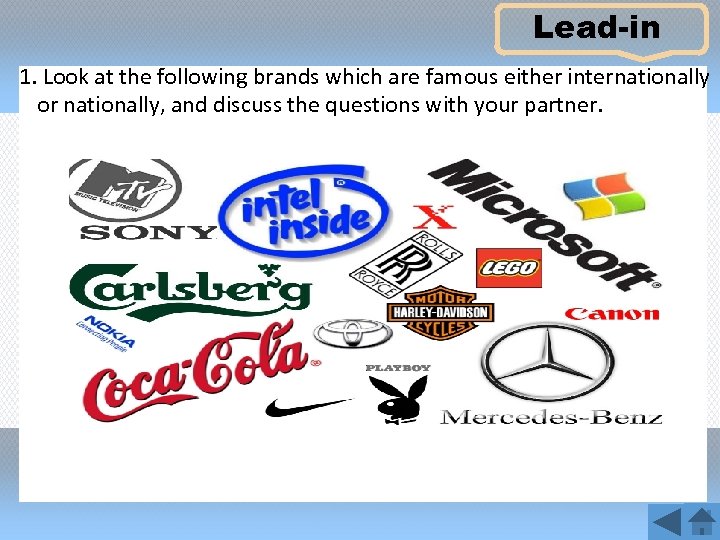
Lead-in 1. Look at the following brands which are famous either internationally or nationally, and discuss the questions with your partner.
Lead-in 1) Are there any of your favorite brands on the list? If not, try to add yours to it. 2) Why do you like these brands? What qualities does each of them have? 3) What qualities are in common for the brands you like? 4) Do you often buy branded goods? If not, why not? Why might you buy a product of a less-preferred brand? 5) Describe the qualities associated with the brand you like most? (e. g. reliable, classy, family-oriented, up-to-date, charming, imaginative, unique, original, friendly, cheerful, spirited, trendy, etc. )
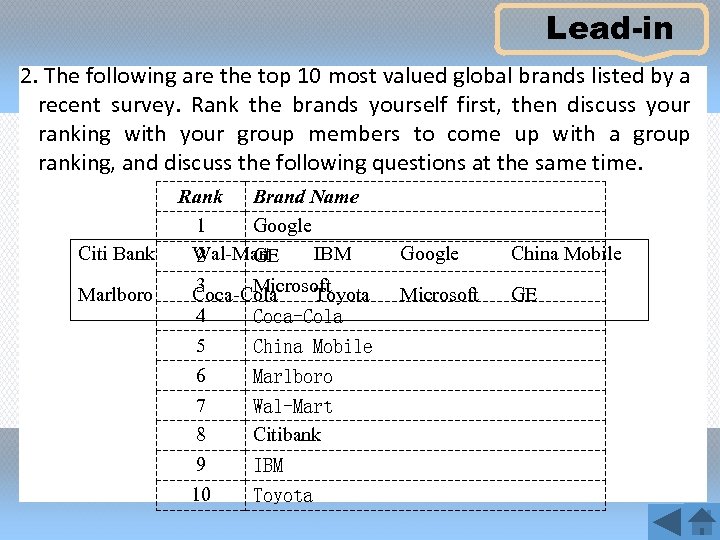
Lead-in 2. The following are the top 10 most valued global brands listed by a recent survey. Rank the brands yourself first, then discuss your ranking with your group members to come up with a group ranking, and discuss the following questions at the same time. Citi Bank Marlboro Rank Brand Name 1 Google Wal-Mart IBM 2 GE 3 Microsoft Coca-Cola Toyota 4 Coca-Cola 5 China Mobile 6 Marlboro 7 Wal-Mart 8 Citibank 9 IBM 10 Toyota Google China Mobile Microsoft GE
Lead-in 1) Why are the above brands valued so high? 2) How many of the above brands are American? What is your general impression of American brands? 3) What does a brand mean to a company and the company's consumers?
Preview: Reading In an increasingly competitive market where there are just too many products on the shelves, how does a company struggle for market domination? The answer is simple: do not underestimate the power of the brand. What exactly is a brand? Is a brand just a name, a sign, or a symbol that makes a product special and different from other similar ones? Does a brand have something else that is more important and valuable for a company? How does a company establish and maintain a brand that will sustain sales in the face of competition with other similar products? These are just the focus of the passage you are to read.
Reading What, Exactly, Is a Brand? By Christopher Kenton Don't believe the mystifying, long-winded explanations of trendy marketers. The answer is much simpler — and absolutely essential to grasp. [1] I have an easy solution for dramatically improving the quality of marketing. For months I've been writing on the hidden trends underlying business valuations, the esoteric debates over strategic focus, and the minutiae of new marketing metrics all in an attempt to help marketers find some solid ground in an increasingly chaotic environment. Yet what people really want is a simple formula. ''Cut to the chase'' is the mantra I can hear from the crowd. Translation
![Reading [2] So here's my simple formula. I promise it will solve anything that](https://present5.com/presentation/d2b2572319bb9ea4d507ff7a948f84fe/image-14.jpg "Reading [2] So here's my simple formula. I promise it will solve anything that")
Reading [2] So here's my simple formula. I promise it will solve anything that ails your marketing efforts. [3] If you have an in-house marketing team, call them into your office. If you use consultants, get them on the phone. If you're a marketer yourself, look directly into the mirror. Dispense with the small talk, and let some silence build dramatic tension in the room. Then, in a thoughtful voice, ask the one question that has the power to cleanse the earth of mushy-headed marketing. ''So tell me, what exactly is a brand? '' Translation
![Reading [4] If the answer is anything other than a clear, tangible description that](https://present5.com/presentation/d2b2572319bb9ea4d507ff7a948f84fe/image-15.jpg "Reading [4] If the answer is anything other than a clear, tangible description that")
Reading [4] If the answer is anything other than a clear, tangible description that can be summarized in a single sentence your crazy old aunt Alice can understand, throw the bums off the boat. Think of yourself as the bridgekeeper on Monty Python's Bridge of Death. If someone says a brand is a relationship, toss them over the side. If they say a brand is an image in the mind of the consumer, give 'em the heave-ho. Don't suffer any long-winded explanations. Keep a clear resolve. Translation
![Reading [5] After the gullies pile up with trendy marketers, you'll eventually find your](https://present5.com/presentation/d2b2572319bb9ea4d507ff7a948f84fe/image-16.jpg "Reading [5] After the gullies pile up with trendy marketers, you'll eventually find your")
Reading [5] After the gullies pile up with trendy marketers, you'll eventually find your way to someone who tells you a brand is just a name, a sign, or a symbol that distinguishes the products and services of one company from all others. If the loftiest metaphor they use in their description is a burning scar on the side of a cow, hire them. Give them a raise. Hug them for heaven's sake and your budget's sake. You've just found someone who won't lead your company over the cliff with all the other marketing lemmings. Translation
![Reading [6] Your brand is your name, your logo, your trade dress. You own](https://present5.com/presentation/d2b2572319bb9ea4d507ff7a948f84fe/image-17.jpg "Reading [6] Your brand is your name, your logo, your trade dress. You own")
Reading [6] Your brand is your name, your logo, your trade dress. You own it. There are clearly written laws to protect it. It is tangible enough to put a price on it. And yet, an entire generation of marketers has found a way to obscure the obvious, to make the brand more fantastic, and to make it hard enough to understand that you need consultants to help you figure it out. Translation
![Reading [7] It all started decades ago, with the simple recognition that in a](https://present5.com/presentation/d2b2572319bb9ea4d507ff7a948f84fe/image-18.jpg "Reading [7] It all started decades ago, with the simple recognition that in a")
Reading [7] It all started decades ago, with the simple recognition that in a mass market teeming with disposable products, consumers latch on to brands they've grown to trust. No one wants to sit around reconsidering whether they'd like Coke or Fred's Cola every time they're thirsty. Once you have tried Coke and like it, and if it stays consistently likable every subsequent time you drink it, you can relegate that small decision to one of the 10, 000 you don't have to think about every day. Translation
![Reading [8] Not thinking about every little decision is good for you. You can](https://present5.com/presentation/d2b2572319bb9ea4d507ff7a948f84fe/image-19.jpg "Reading [8] Not thinking about every little decision is good for you. You can")
Reading [8] Not thinking about every little decision is good for you. You can save those synapses for something more important. It's also good for Coke, since it ensures a steady stream of revenue, as long as customers can rely on the product delivering the same experience and value. That's where all this stuff came up about your brand being a promise to the consumer of the quality of your product. Except that it's not. Translation
![Reading [9] Your brand is your name, your logo, your burning scar on the](https://present5.com/presentation/d2b2572319bb9ea4d507ff7a948f84fe/image-20.jpg "Reading [9] Your brand is your name, your logo, your burning scar on the")
Reading [9] Your brand is your name, your logo, your burning scar on the side of your product. The expectation that consumers begin to attach to your brand is something else. It's an important something else that has value and that you should consider an important asset worthy of investment, but it's something else. In fact, a brand has a few something elses that are important associates of it and create value for your company. Translation
![Reading [10] There's brand experience, the sum of all impressions consumers gain from interactions](https://present5.com/presentation/d2b2572319bb9ea4d507ff7a948f84fe/image-21.jpg "Reading [10] There's brand experience, the sum of all impressions consumers gain from interactions")
Reading [10] There's brand experience, the sum of all impressions consumers gain from interactions with your company. How does your receptionist answer the phone? How courteous are your truck drivers? Such experiences strongly influence another brand associate, brand image, which is often closely tied to brand reputation. Translation
![Reading [11] What does your market think of your brand? How does it make](https://present5.com/presentation/d2b2572319bb9ea4d507ff7a948f84fe/image-22.jpg "Reading [11] What does your market think of your brand? How does it make")
Reading [11] What does your market think of your brand? How does it make your customers feel? Will they use it again? Will they recommend it to friends? If your brand image is hot, and your brand reputation strong, it can improve your ''brand equity, '' or the bankable value your brand has acquired from its ability to attract and retain customers. Translation
![Reading [12] All of these things are important, but they don't constitute brand. They're](https://present5.com/presentation/d2b2572319bb9ea4d507ff7a948f84fe/image-23.jpg "Reading [12] All of these things are important, but they don't constitute brand. They're")
Reading [12] All of these things are important, but they don't constitute brand. They're derivatives of brand. The more they're confused, the more susceptible businesses become to trendy theories that lead them over the cliff, like the one Heidi Schultz rails against in the American Marketing Assn. 's Marketing Management. The notion that customers ''own'' your brand. Translation
![Reading [13] It's a seductive thought for companies that value their clients, but a](https://present5.com/presentation/d2b2572319bb9ea4d507ff7a948f84fe/image-24.jpg "Reading [13] It's a seductive thought for companies that value their clients, but a")
Reading [13] It's a seductive thought for companies that value their clients, but a misguided one. Your customers own their impressions, and you can influence those impressions with the quality of your product, and the experiences you foster. But your brand is just the symbol that anchors those impressions to the product you create. Translation
![Reading [14] Don't take my formula too lightly. The definition of brand is the](https://present5.com/presentation/d2b2572319bb9ea4d507ff7a948f84fe/image-25.jpg "Reading [14] Don't take my formula too lightly. The definition of brand is the")
Reading [14] Don't take my formula too lightly. The definition of brand is the canary in the coal mine. If you're working with marketers who are't clear-headed enough to distinguish between a tangible brand its derivatives, how will they have the clarity to advise you on building a market? Get rid of them and find a marketer who can think straight. We'll all be better off. (959 words) From Business Week Translation The end
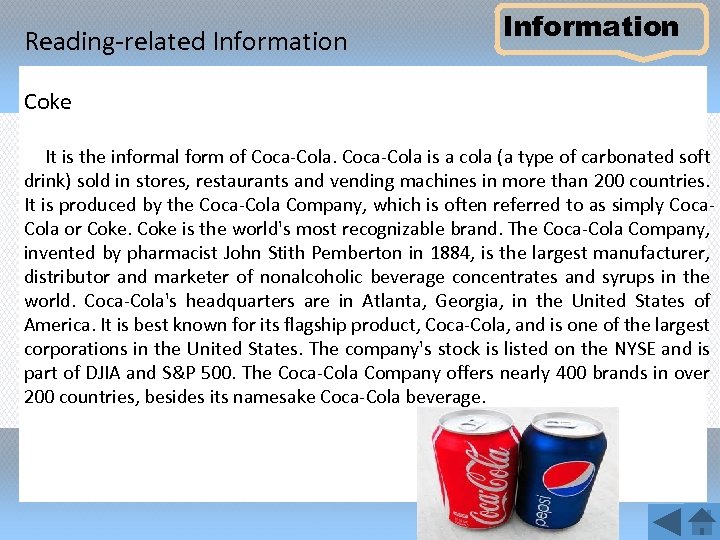
Reading-related Information Coke It is the informal form of Coca-Cola is a cola (a type of carbonated soft drink) sold in stores, restaurants and vending machines in more than 200 countries. It is produced by the Coca-Cola Company, which is often referred to as simply Coca. Cola or Coke is the world's most recognizable brand. The Coca-Cola Company, invented by pharmacist John Stith Pemberton in 1884, is the largest manufacturer, distributor and marketer of nonalcoholic beverage concentrates and syrups in the world. Coca-Cola's headquarters are in Atlanta, Georgia, in the United States of America. It is best known for its flagship product, Coca-Cola, and is one of the largest corporations in the United States. The company's stock is listed on the NYSE and is part of DJIA and S&P 500. The Coca-Cola Company offers nearly 400 brands in over 200 countries, besides its namesake Coca-Cola beverage.
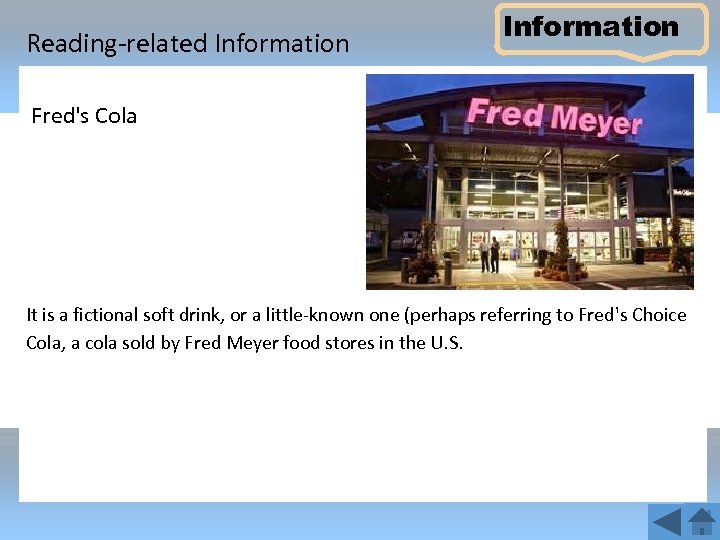
Reading-related Information Fred's Cola It is a fictional soft drink, or a little-known one (perhaps referring to Fred's Choice Cola, a cola sold by Fred Meyer food stores in the U. S.
Reading 1. ''Cut to the chase'' is the mantra I can hear from the crowd. — People appreciate getting to the point without wasting time, so I hear many people repeatedly saying ''cut to the chase, '' which means ''get to the point. ''
Reading 2. . that ails your marketing efforts. —. . . that causes problems for your attempts to market successfully.
Reading 3. . look directly into the mirror. —. . . think of yourself without hesitation.
Reading 4. Dispense with the small talk, and let some silence build dramatic tension in the room. —Avoid unimportant conversation and keep quiet for a while to create a tense atmosphere in the room that may bring some exciting effect.
Reading 5. . ask the one question that has the power to cleanse the earth of mushy-headed marketing. —. . . ask the vital question that can purify the world of the unfocused, vague marketing.
Reading 6. If the answer is anything other than a clear, tangible description that can be summarized in a single sentence your crazy old aunt Alice can understand, throw the bums off the boat. — If the answer is not something clear and definite that even a simple non-expert can understand, dismiss those unqualified persons. In this sentence, ''crazy old aunt Alice'' is used figuratively to refer to people who require simple, direct explanations.
Reading 7. Think of yourself as the bridgekeeper on Monty Python's Bridge of Death. —Monty Python is a British comedy group that created television programs and films. The ''Bridge of Death'' appears in the Monty Python and The Holy Grail. The keeper of Bridge of Death would ask travelers who want to cross the bridge three questions. One who can answer these questions correctly may cross in safety. In the text, the writer just draws an analogy to teach the readers how to find out the right person.
Reading 8. . toss them over the side. — Literally, it means to throw them off the bridge. Here the meaning is to put them into the group to be fired.
Reading 9. After the gullies pile up with trendy marketers. . . —After you have filled the ditches with marketers you have thrown off the bridge. . .
Reading 10. If the loftiest metaphor they use in their description is a burning scar on the side of a cow, hire them. —Hire someone who is able to describe a brand as something used to distinguish, for example, your cow from another (a burning scar on livestock is referred to as a brand, still used in the U. S. ).
Reading 11. Hug them for heaven's sake and your budget's sake. — Be sure to give him or her a hug and they will save your money.
Reading 12. . who won't lead your company over the cliff with all the other marketing lemmings. —. . . who will not recommend faulty marketing strategies simply because other marketers are promoting them.
Reading 13. It is tangible enough to put a price on it. —It is something you can place a value on.
Reading 14. . a way to obscure the obvious, to make the brand more fantastic. . . —. . . a way to make something clear impossible to be easily understood, to make the brand become more unpractical. Here the writer wants to point out that today some marketers focus on creating an extraordinary brand by making it complicated and not easily understood.
Reading 15. . if it stays consistently likable every subsequent time you drink it, you can relegate that small decision to one of the 10, 000 you don't have to think about every day. —. . . if Coke retains its pleasant taste, you no longer choose what to drink, but rather accept drinking Coke as an given.
Reading 16. You can save those synapses for something more important. —You can save your thinking for more important things.
Reading 17. The expectation that consumers begin to attach to your brand is something else. —What customers think about your brand is something other than what your brand is. In other words, a brand its reputation are separate items.
Reading 18. In fact, a brand has a few something elses that are important associates of it and create value for your company. — In fact, a brand involves some other things that are closely related to it and beneficial to your company.
Reading 19. The more they're confused, the more susceptible businesses become to trendy theories that lead them over the cliff. . . — If brand its related concepts are not clearly defined, businesses will be more easily influenced by popular theories that lead them into trouble. . .
Reading 20. . the one Heidi Schultz rails against in the American Marketing Assn. 's Marketing Management. —Heidi Schultz is the executive vice-president of Agora, Inc. , a marketing and branding consulting firm and a lecturer in Northwestern University's Department of Integrated Marketing Communications. In one of publications of the AMA ''Marketing Management'', Schultz delivers her protest against such trendy theories as the idea that customers ''own'' your brand.
Reading 21. Don't take my formula too lightly. —Be serious about my method.
Reading 22. The definition of brand is the canary in the coal mine. —The definition of brand can be served as a warning. The phrase refers to the idea that early underground coal mines featured poor ventilation systems, so miners often took a caged canary into the mines. As long as the canary in a coal mine kept singing, the miners knew their air supply was safe. The ''canary in a coal mine'' has become a popular expression. Some large corporations use a ''canary in a coal mine'' strategy for future growth or reduction. A small company may use to test the waters for a new product line, for instance. Even if the company only experiences modest profits or losses, the parent corporation can evaluate the feasibility of the product without risking a large investment. By carefully observing a canary in a coal mine, industries can avoid major failures down the road or benefit from a jump on the competition.
Reading 23. Get rid of them and find a marketer who can think straight. We'll all be better off. —Dismiss them and find a marketer who can think clearly and correctly. Then all of us will benefit.
Reference Chinese 究竟什么是品牌? 不要相信赶潮流的市场商人令人难解、啰嗦冗长的说明。答案非常简单 — 绝对有必要去领会它。 克里斯托弗·肯顿 我有一个简单的办法可以大幅度提高营销质量。我花了几个 月时间撰文论述有关商业评估基础的潜在趋势、战略焦点的深奥 讨论和新营销规则的一些细节。这完全是想帮助营销人员在日益 混乱的环境中找到坚实的理论基础。然而人们真正想要的是一种 简单的方法。“切入正题”是我经常听人们讲的一句话。
Reference Chinese 因此,我这里有个简单的方法。我保证它能解决任何使你的 营销 作受挫的问题。 如果你有一支内部营销团队,把他们叫进你的办公室。如果 你有咨询顾问,就打电话给他们。如果你本人是营销人员,那就 直接自省。不要闲聊,让沉默在房间里制造出扣人心弦的紧张气 氛。然后,用一种深思熟虑的声音问一个问题,这个问题足以将 令人费解的营销概念阐释清楚:“那么告诉我,究境什么是品牌 ?”
Reference Chinese 如果回答不清晰,不明确,不能用一句话概括以便让你上了 年纪且古怪的爱丽丝阿姨弄明白,就把这些吃闲饭的家伙从营销 团队的船上扔下去。将你自己视作蒙蒂·派森的喜剧《死亡之桥 》中的守桥人。如果有人说品牌就是一种关系,就将他们推下桥 去。如果他们说品牌是消费者心目中的一种形象,就将他们开除 出局。不要费劲地去做作任何冗长啰嗦的解释。要言简意赅。
Reference Chinese 当深沟里挤满那些盲目跟风的营销人员时,你最终会发现 某个人,他会告诉你品牌就是使一个公司的产品及服务区别于其 他公司的产品及服务的名字、符号或标志。如果他们用最精彩的 比喻将品牌描述成奶牛身体侧面的烧伤瘢痕,那么就起用他们, 给他们加薪。看在上帝的份上,为了公司的预算,去拥抱他们。 你已经找到了合适的人,他们不会和所有其他旅鼠般盲目的营销 人员一样带着你的公司冲下悬崖。
Reference Chinese 你的公司的品牌指公司名称、公司标志和公司的商业外观。 你拥有它。有明确的成文法保护它。它是实实在在的,可以标价 的。然而,整整一代营销人员居然把这种显而易见的东西搞得模 糊不清,使品牌的概念听起来荒诞怪异,让人很难理解,以至于 需要咨询顾问来帮助弄明白。
Reference Chinese 品牌概念在几十年前就有了,因为人们很容易意识到,在充 斥着一次性用品的大众市场上,消费者只依赖他们信得过的品牌。 每当口渴的时候,没人愿意坐在那里反复考虑是喝可口可乐,还 是喝弗瑞德可乐。一旦你喝过可口可乐,而且喜欢它,以后每当 你喝它时,你都会始终如一地喜欢它,你可能就会将那个小小的 决定置于你每天都不必考虑的一万种商品之中了。
Reference Chinese 无需考虑每个小的决定对你是有好处的。因为你可以节省脑 力考虑更重要的事情。对可口可乐也有好处,因为只要顾客依赖 这种带给他们相同体验和价值的产品,它就可以确保稳定效益。 所有关于公司的品牌是其产品质量的承诺的说法讲得就是这一点。 除非它不是质量的承诺。
Reference Chinese 你公司的品牌就是公司的名称、公司标志和印在公司产品上 的标识。顾客开始对公司的产品寄于期望是品牌的另一方面。这 种期望是有价值的重要因素,公司应该将其视为一种值得投资的 重要资产。但它只是与品牌相关的一个方面。 事实上,品牌还 包括其他几个与之相关、并且能为公司创造价值的重要因素。
Reference Chinese 品牌体验是消费者在与公司互动过程中获得的总体印象。 公司的接待人员如何接电话?公司的货车司机是否谦恭有礼?这 些体验极大地影响着另一个与品牌相关的因素,即品牌形象,它 往往与品牌声誉紧密相连。
Reference Chinese 市场对公司的品牌如何评价?顾客对它感觉如何?他们会再 次使用它吗?他们会向朋友们推荐吗?如果公司的品牌形象很好, 品牌声誉又很高,那么它可以提高公司的“品牌价值”,或者说是 公司品牌能吸引并留住顾客而得到的可赢利的价值。
Reference Chinese 所有这些都很重要,但是它们并不构成品牌。它们是品牌 的衍生物。对它们理解得越不清楚,公司就越容易受那些将其 引上悬崖的流行理论的影响,正如海蒂·舒尔茨在美国市场营销 协会的《市场营销管理》中所批驳的那种概念 — 顾客“拥有”公 司的品牌。
Reference Chinese 对于重视客户的公司来说,这是一个诱人、但具有误导性的 想法。顾客拥有的是他们对产品的印象,公司可以通过产品质量 和所促进的产品体验来影响顾客的感觉。但是公司的品牌仅仅是 一种将顾客的感觉与公司生产的产品牢固维系在一起的标志。
Reference Chinese 不要小看我的方法。品牌的定义就像是煤矿中的金丝雀。如 果与你共事的营销人员不能清楚地辨别什么是确切的品牌,什么 是它的衍生物的话,他们怎么能头脑清晰地为你提供市场开发的 建议呢?甩掉他们,去找一个思考清晰到位的营销人员。这样大 家都会过上好日子。
Words & Phrases Ø Words Ø Phrases
Words & Phrases Words underlie relegate toss asset obscure courteous teeming retain disposable constitute foster
Phrases dispense with figure out latch onto be better off Words & Phrases
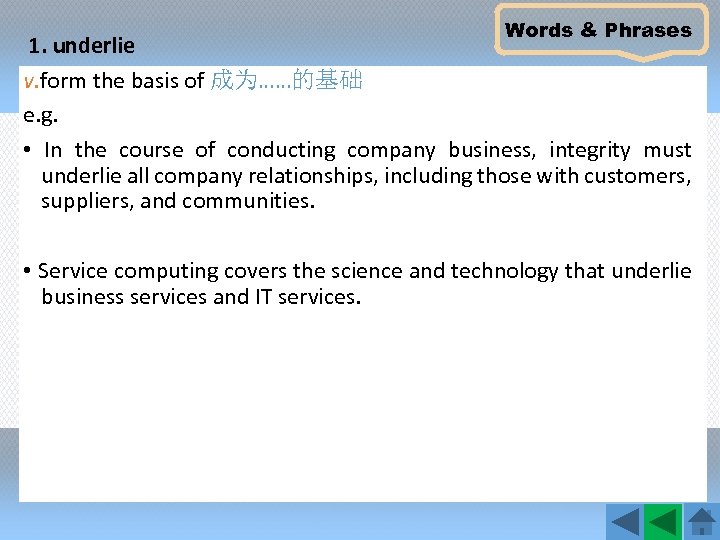
Words & Phrases 1. underlie v. form the basis of 成为……的基础 e. g. • In the course of conducting company business, integrity must underlie all company relationships, including those with customers, suppliers, and communities. • Service computing covers the science and technology that underlie business services and IT services.
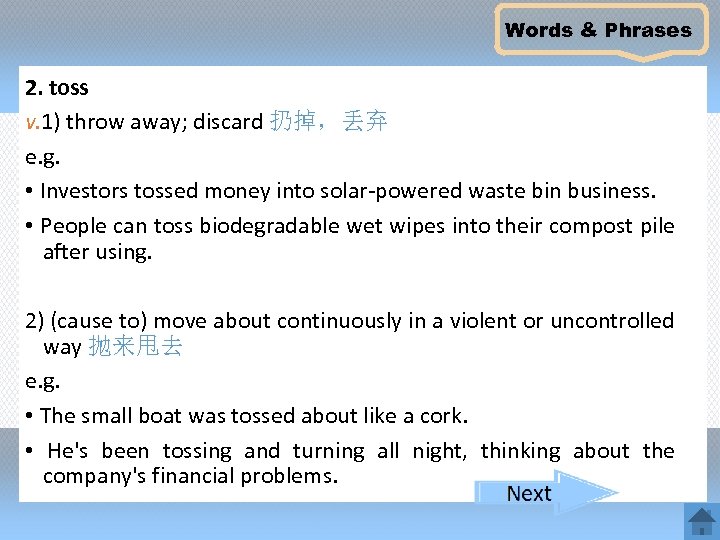
Words & Phrases 2. toss v. 1) throw away; discard 扔掉,丢弃 e. g. • Investors tossed money into solar-powered waste bin business. • People can toss biodegradable wet wipes into their compost pile after using. 2) (cause to) move about continuously in a violent or uncontrolled way 抛来甩去 e. g. • The small boat was tossed about like a cork. • He's been tossing and turning all night, thinking about the company's financial problems.
Words & Phrases 3) toss one's head/hair: move one's head or hair back suddenly, often with a shaking movement showing anger 把……甩开 e. g. • The manager tossed his head angrily and left the room. • The horse tossed its head back and smelt the wind. 4) toss off: produce quickly with little effort 轻而易举地处理 e. g. • The journalist tossed off an article for the newspaper in an hour. • He tossed off a report about the sales of the new product.
Words & Phrases 3. obscure v. 1) make dim or indistinct 使变模糊;使变暗或不分明 e. g. • Managers deliberately obscured the real situation from federal investigators. • Recent successes have obscured the fact that the company is still in trouble. 2) to prevent something from being seen or heard clearly 掩盖;遮 掩 e. g. • Two new skyscrapers had sprung up, obscuring the view from her window. • Clouds obscured the sun.
Words & Phrases a. 1) not well known and usually not very important 不著名的 e. g. • It is a tradition in America that obscure novels were adapted into excellent films. • An obscure politician was nominated governor of the state. 2) difficult to understand 难理解的 e. g. • Official policies have changed, for reasons that remain obscure. • The manager's answers to the reporter were obscure and confusing.
Words & Phrases 4. teeming a. full of; present in large numbers 充满……的;丰富的,大量的 e. g. • The shopping mall is often teeming with shoppers on weekends. • His mind is teeming with brilliant ideas.
Words & Phrases 5. disposable a. 1) available for use 可任意使用的 e. g. • The average per capita disposable income reached 5000 yuan for city dwellers. • The national total production volume of disposable energy resources was 2% higher than that of last year. 2) intended to be use once or for a short time and then thrown away 一次性的;用后即抛的 e. g. • The company produces disposable nappies. • It's more hygienic to use disposable paper tissues.
Words & Phrases 6. relegate v. 1) give someone or something a less important position than before 将……置于次要的地位 e. g. • He has been relegated to a post at one of the branches of the company. • The story was relegated to the middle pages of the paper. 2) (Br. E) if a sports team is relegated, it is moved into a lower division 降级 e. g. • If the team loses again they may be relegated from the Premier League to the First Division. • We were relegated to the Fourth Division last year.
Words & Phrases 7. asset n. 1) a valuable item that is owned; an advantage or a resource 一件 有价值的所有物; 优势或资财 e. g. • Ability to get along with people is an asset in business. • Good reputation is an intangible asset for a company. 2) the things that a company owns, that can be sold to pay debts 资 产;财富 e. g. • Her assets include shares in the company and a house in France. • That is a corporation with $9 billion in assets.
Words & Phrases 8. courteous a. polite; good-mannered 有礼貌的;谦恭的 e. g. • Although she often disagreed with me, she was always courteous. • It was courteous of him to help the old lady with her bundles.
Words & Phrases 9. retain v. 1) continue to have; keep (sth) in place or use 保留,保持 e. g. • The seller is entitled to retain the goods until the buyer pays him the reasonable expenses. • He lost his battle to retain control of the company. 2) store or keep sth inside sth else 留在心中 e. g. • A lot of information can be retained in the computer. • The sea retains the sun's warmth longer than the land. 3) remember information 记住 e. g. • He has a good memory and is able to retain facts easily. • He retains a clear memory of those glorious days in college.
Words & Phrases 10. constitute v. 1) make up or form 组成 e. g. • Women constitute about 10% of the staff of the company. • The annexes to the agreement constitute an integral part. 2) be considered to be something 等同于 e. g. • Failing to complete the work constitutes a breach of the employment contract. • This latest defeat constitutes a major setback for the government.
Words & Phrases 11. foster v. 1) encourage sth to develop 促进;培养 e. g. • The government tried to foster economy by lowering taxes. • The mother tried to foster an interest in classical music in her daughter. 2) take care of a child, usually for a limited time, without being the child's legal parent 抚育 e. g. • The couple wanted to adopt the child they had been fostering. • They fostered the little boy for several months while his mother was in hospital.
Words & Phrases 1. dispense with get rid of; manage without 免除;省却 e. g. • Software upgrades are frequent and automatic, and dispense with the need for outside consultants. • They dispensed with the formalities and proceeded their discussions on an informal basis.
Words & Phrases 2. figure out think about a problem or situation until you find the answer or understand what has happened 解决;领会到;断定 e. g. • They tried to figure out how they were going to market the product. • Even the repairman couldn't figure out what had gone wrong with the washer.
Words & Phrases 3. latch onto 1) become interested in an idea, story or activity, and to start to use it 变得依附于…… e. g. • It didn't take the company a long time to latch onto all the new technology now available. • Unfortunately the press has already latched onto the story about the company's bankruptcy. 2) stay close to someone or spend a lot of time with them, usually when they do not want you with them 缠住;搭上 e. g. • She latched onto me at the party and bored me for hours with silly gossip. • The stray dog latched onto the children and wouldn't go home.

Words & Phrases 4. be better off 1) used to say that sb is/would be happier or more satisfied if they were in a particular position or did a particular thing (在某种情况 下)更幸福;更满意 e. g. • He'd be better off working for a bigger company. • It's unbearable for me to watch you do it. I'd be better off doing it myself. 2) having more money than someone else or than you had before 更富裕;生活更好 e. g. • Township enterprises have opened ways for the peasants to be better off. • Those who work hard and smart are better off than the sloth.
Exercises ØComprehension 1. Answering questions 2. Filling blanks ØCritical Thinking ØVocabulary 1. Filling blanks 2. Rewriting 3. Completing sentences ØTranslation 1. English to Chinese 2. Chinese to English
Comprehension Exercises 1. Answer the following questions with your partner. 1) What is the writer's purpose in this passage? To provide the solution for improving the quality of marketing. 2) According to the passage, what is the main problem with people's understanding of brand? They tend to believe the mystifying, long-winded explanations of trendy marketers and do not have a clear understanding of what exactly a brand is. 3) How important is it to make clear the definition of brand? The clear definition of brand has the power to cleanse the earth of mushy-headed marketing.
Comprehension Exercises 4) According to the writer, which metaphor can best describe what a brand is? A burning scar on the side of a cow. 5) What will customers develop once they have tried a brand like it? A lasting reliance on a brand. 6) What is the importance of a brand to a company? How should a company regard it? A brand has a few something elses that are important associates of it and create value for a company. It's an important something else that has value and a company should consider it an important asset worthy of investment.
Comprehension Exercises 7) What are ''derivatives of brand'' mentioned in this passage? Brand experience, brand image, brand reputation, brand equity. 8) According to the passage, who own a brand, companies or customers? Companies. 9) How can companies influence their customers' impressions of a brand? With the quality of their product and the experiences they foster. 10) What is the simple solution suggested in this passage for improving the quality of marketing? Working with marketers who are clear-headed enough to distinguish between a tangible brand its derivatives.
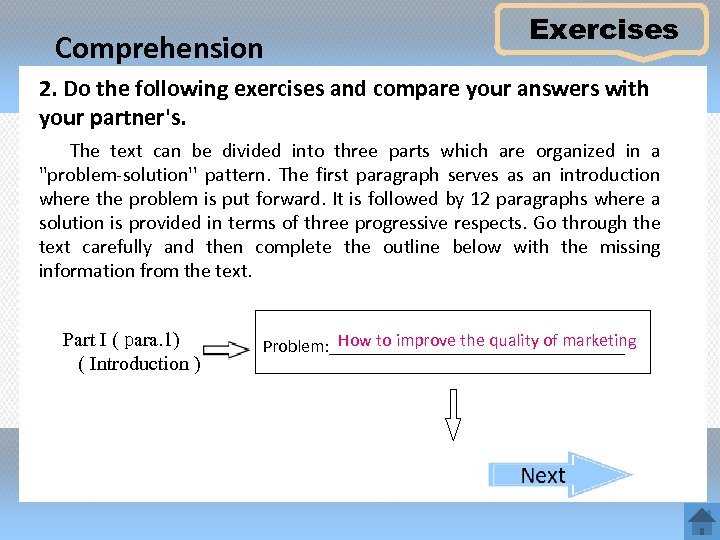
Comprehension Exercises 2. Do the following exercises and compare your answers with your partner's. The text can be divided into three parts which are organized in a ''problem-solution'' pattern. The first paragraph serves as an introduction where the problem is put forward. It is followed by 12 paragraphs where a solution is provided in terms of three progressive respects. Go through the text carefully and then complete the outline below with the missing information from the text. Part I ( para. 1) ( Introduction ) How to improve the quality of marketing Problem: _________________
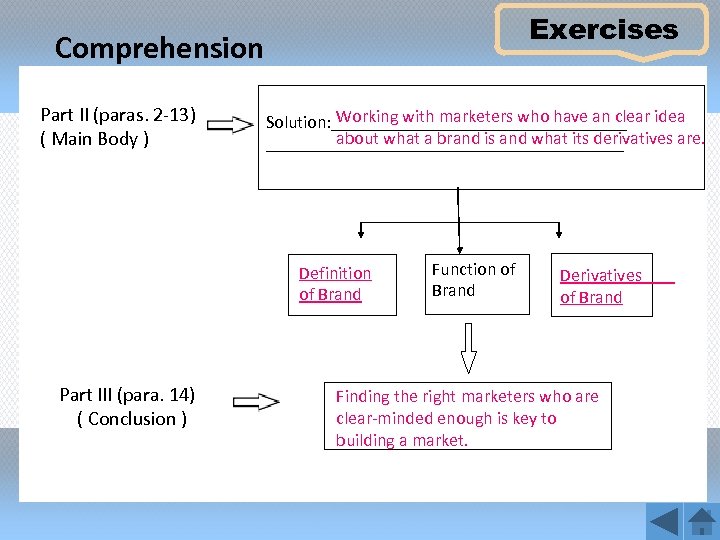
Exercises Comprehension Part II (paras. 2 -13) ( Main Body ) Working with marketers who have an clear idea Solution: _________________ about what a brand is and what its derivatives are. ____________________ Definition of Brand Part III (para. 14) ( Conclusion ) Function of Brand Derivatives of Brand Finding the right marketers who are clear-minded enough is key to building a market.
Critical Thinking Exercises 1. If you are loyal to one brand, will you be equally loyal to its derivatives? Give your reasons. 2. If your idol is using a certain brand, will you follow him or her? Why or why not? 3. What will influence your decision of using a brand?
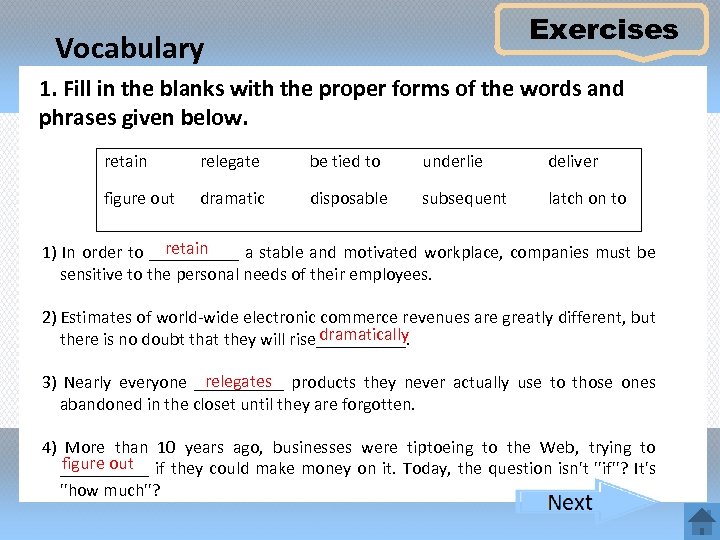
Exercises Vocabulary 1. Fill in the blanks with the proper forms of the words and phrases given below. retain relegate be tied to underlie deliver figure out dramatic disposable subsequent latch on to retain 1) In order to _____ a stable and motivated workplace, companies must be sensitive to the personal needs of their employees. 2) Estimates of world-wide electronic commerce revenues are greatly different, but dramatically there is no doubt that they will rise_____. relegates 3) Nearly everyone _____ products they never actually use to those ones abandoned in the closet until they are forgotten. 4) More than 10 years ago, businesses were tiptoeing to the Web, trying to figure out _____ if they could make money on it. Today, the question isn't ''if''? It's ''how much''?
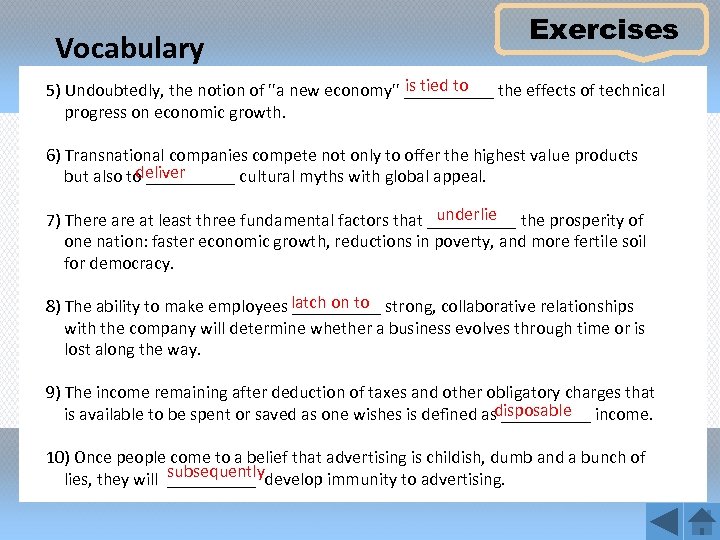
Vocabulary Exercises is tied to 5) Undoubtedly, the notion of ''a new economy'' _____ the effects of technical progress on economic growth. 6) Transnational companies compete not only to offer the highest value products deliver but also to _____ cultural myths with global appeal. underlie 7) There at least three fundamental factors that _____ the prosperity of one nation: faster economic growth, reductions in poverty, and more fertile soil for democracy. latch on to 8) The ability to make employees _____ strong, collaborative relationships with the company will determine whether a business evolves through time or is lost along the way. 9) The income remaining after deduction of taxes and other obligatory charges that disposable is available to be spent or saved as one wishes is defined as _____ income. 10) Once people come to a belief that advertising is childish, dumb and a bunch of subsequently lies, they will _____ develop immunity to advertising.
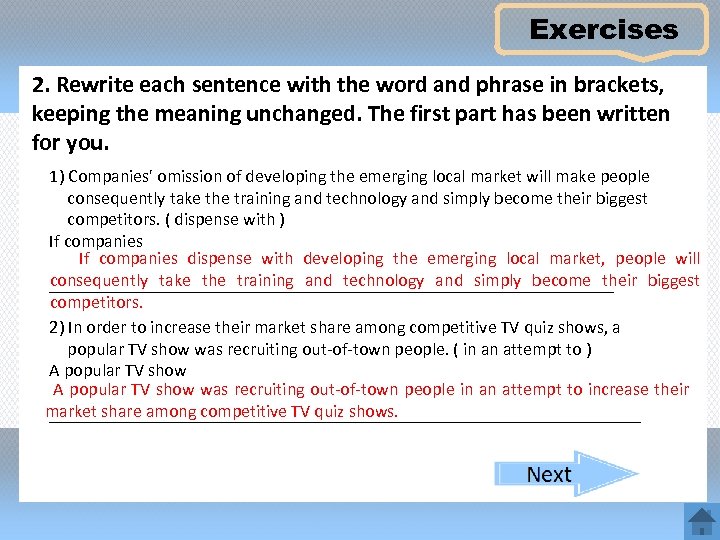
Exercises 2. Rewrite each sentence with the word and phrase in brackets, keeping the meaning unchanged. The first part has been written for you. 1) Companies' omission of developing the emerging local market will make people consequently take the training and technology and simply become their biggest competitors. ( dispense with ) If companies If companies dispense with developing the emerging local market, people will consequently take the training and technology and simply become their biggest ________________________________ competitors. 2) In order to increase their market share among competitive TV quiz shows, a popular TV show was recruiting out-of-town people. ( in an attempt to ) A popular TV show was recruiting out-of-town people in an attempt to increase their market share among competitive TV quiz shows. _________________________________
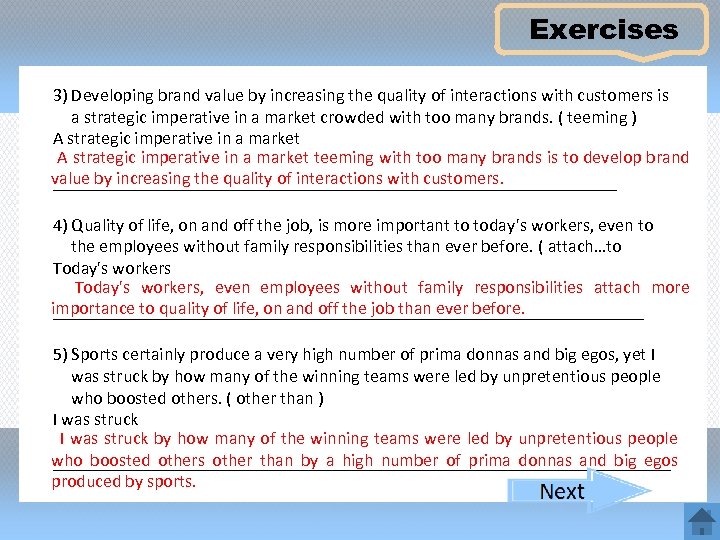
Exercises 3) Developing brand value by increasing the quality of interactions with customers is a strategic imperative in a market crowded with too many brands. ( teeming ) A strategic imperative in a market A strategic imperative in a market teeming with too many brands is to develop brand value by increasing the quality of interactions with customers. ________________________________ 4) Quality of life, on and off the job, is more important to today's workers, even to the employees without family responsibilities than ever before. ( attach…to Today's workers Today's workers, even employees without family responsibilities attach more importance to quality of life, on and off the job than ever before. _________________________________ 5) Sports certainly produce a very high number of prima donnas and big egos, yet I was struck by how many of the winning teams were led by unpretentious people who boosted others. ( other than ) I was struck I was struck by how many of the winning teams were led by unpretentious people who boosted others other than by a high number of prima donnas and big egos ___________________________________ produced by sports.
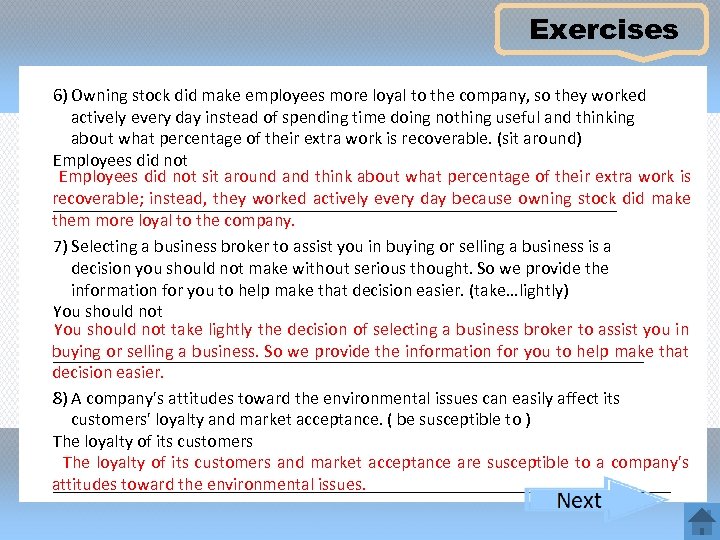
Exercises 6) Owning stock did make employees more loyal to the company, so they worked actively every day instead of spending time doing nothing useful and thinking about what percentage of their extra work is recoverable. (sit around) Employees did not Employees did not sit around and think about what percentage of their extra work is recoverable; instead, they worked actively every day because owning stock did make ________________________________ them more loyal to the company. 7) Selecting a business broker to assist you in buying or selling a business is a decision you should not make without serious thought. So we provide the information for you to help make that decision easier. (take…lightly) You should not take lightly the decision of selecting a business broker to assist you in buying or selling a business. So we provide the information for you to help make that _________________________________ decision easier. 8) A company's attitudes toward the environmental issues can easily affect its customers' loyalty and market acceptance. ( be susceptible to ) The loyalty of its customers The loyalty of its customers and market acceptance are susceptible to a company's ___________________________________ attitudes toward the environmental issues.
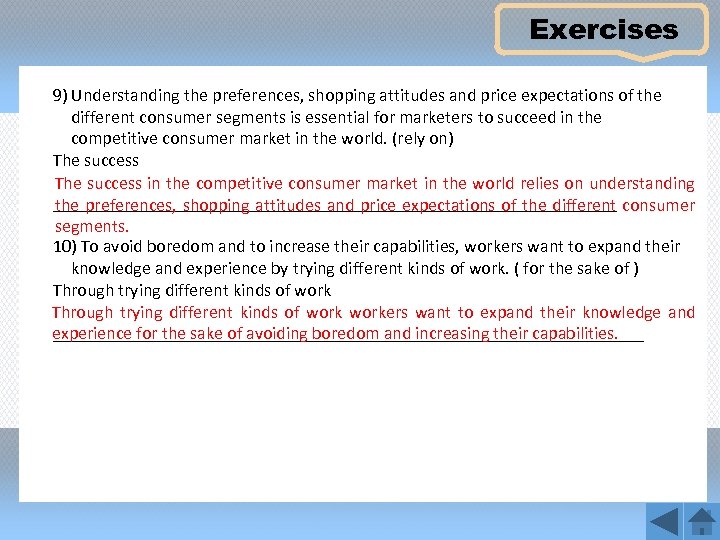
Exercises 9) Understanding the preferences, shopping attitudes and price expectations of the different consumer segments is essential for marketers to succeed in the competitive consumer market in the world. (rely on) The success The success in the competitive consumer market in the world relies on understanding ________________________________ the preferences, shopping attitudes and price expectations of the different consumer segments. 10) To avoid boredom and to increase their capabilities, workers want to expand their knowledge and experience by trying different kinds of work. ( for the sake of ) Through trying different kinds of workers want to expand their knowledge and _________________________________ experience for the sake of avoiding boredom and increasing their capabilities.
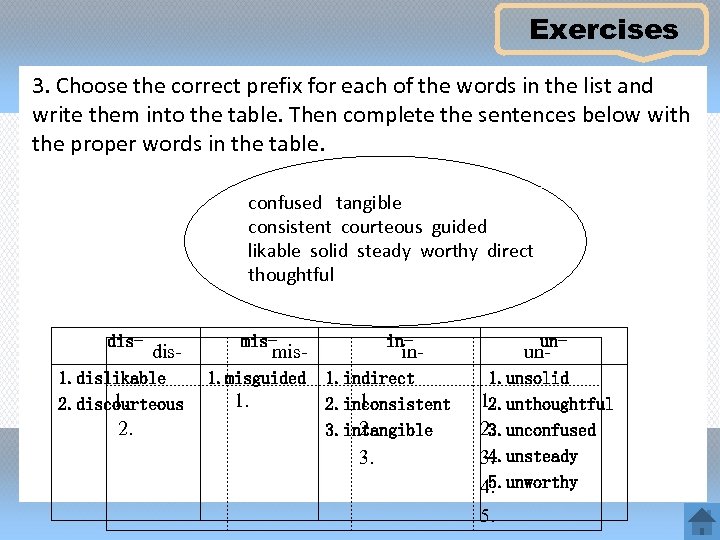
Exercises 3. Choose the correct prefix for each of the words in the list and write them into the table. Then complete the sentences below with the proper words in the table. confused tangible consistent courteous guided likable solid steady worthy direct thoughtful dis- 1. dislikable 1. 2. discourteous 2. mis- in- mis- 1. misguided 1. un- in- 1. indirect 1. 2. inconsistent 2. 3. intangible 3. un- 1. unsolid 1. 2. unthoughtful 2. 3. unconfused 4. unsteady 3. 5. unworthy 4. 5.
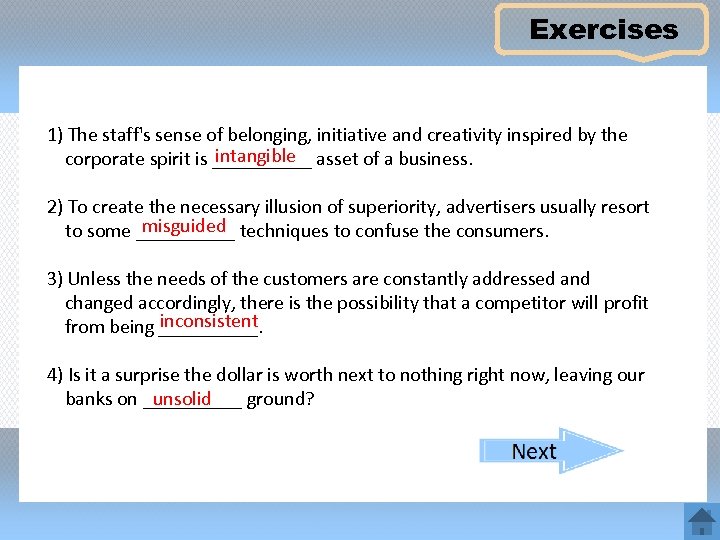
Exercises 1) The staff's sense of belonging, initiative and creativity inspired by the intangible corporate spirit is _____ asset of a business. 2) To create the necessary illusion of superiority, advertisers usually resort misguided to some _____ techniques to confuse the consumers. 3) Unless the needs of the customers are constantly addressed and changed accordingly, there is the possibility that a competitor will profit inconsistent from being _____. 4) Is it a surprise the dollar is worth next to nothing right now, leaving our banks on _____ ground? unsolid
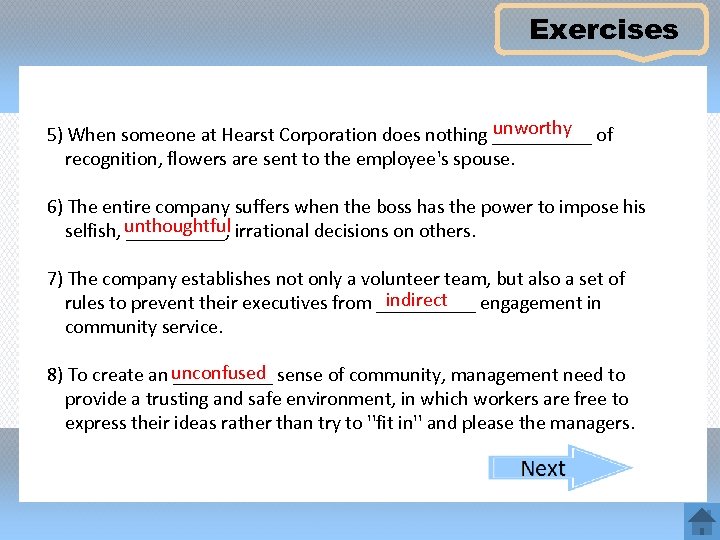
Exercises unworthy 5) When someone at Hearst Corporation does nothing _____ of recognition, flowers are sent to the employee's spouse. 6) The entire company suffers when the boss has the power to impose his unthoughtful selfish, _____, irrational decisions on others. 7) The company establishes not only a volunteer team, but also a set of indirect rules to prevent their executives from _____ engagement in community service. unconfused 8) To create an _____ sense of community, management need to provide a trusting and safe environment, in which workers are free to express their ideas rather than try to ''fit in'' and please the managers.
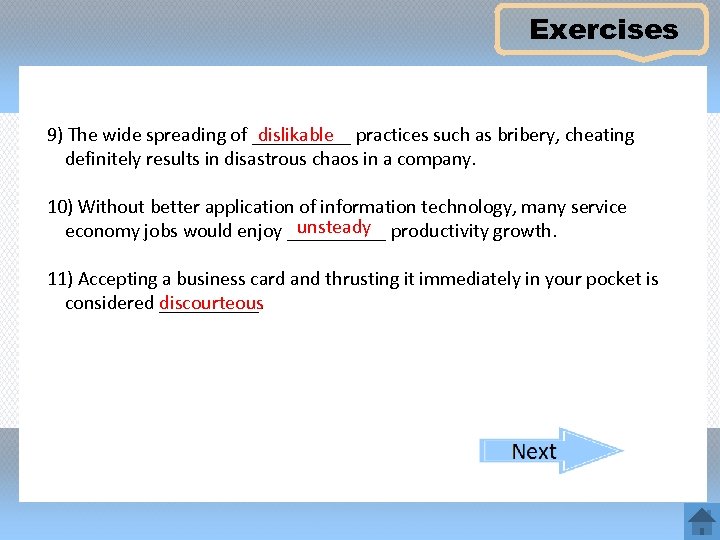
Exercises 9) The wide spreading of _____ practices such as bribery, cheating dislikable definitely results in disastrous chaos in a company. 10) Without better application of information technology, many service unsteady economy jobs would enjoy _____ productivity growth. 11) Accepting a business card and thrusting it immediately in your pocket is considered _____. discourteous
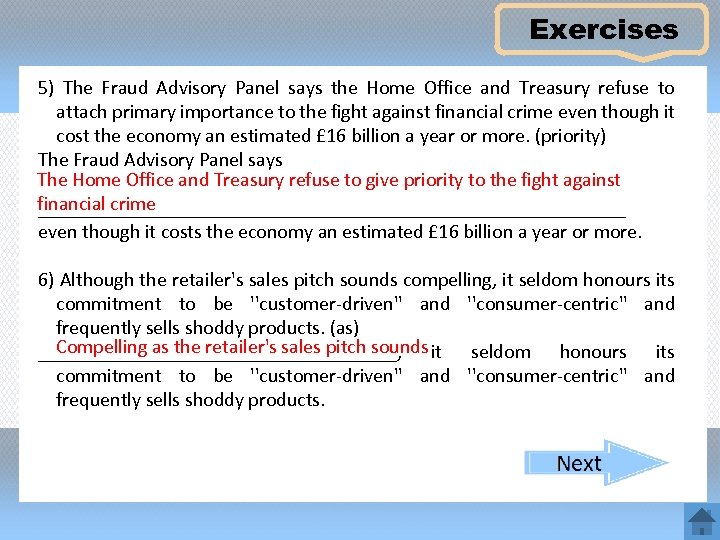
Exercises 5) The Fraud Advisory Panel says the Home Office and Treasury refuse to attach primary importance to the fight against financial crime even though it cost the economy an estimated £ 16 billion a year or more. (priority) The Fraud Advisory Panel says The Home Office and Treasury refuse to give priority to the fight against financial crime ______________________________ even though it costs the economy an estimated £ 16 billion a year or more. 6) Although the retailer's sales pitch sounds compelling, it seldom honours its commitment to be ''customer-driven'' and ''consumer-centric'' and frequently sells shoddy products. (as) Compelling as the retailer's sales pitch sounds __________________, it seldom honours its commitment to be ''customer-driven'' and ''consumer-centric'' and frequently sells shoddy products.
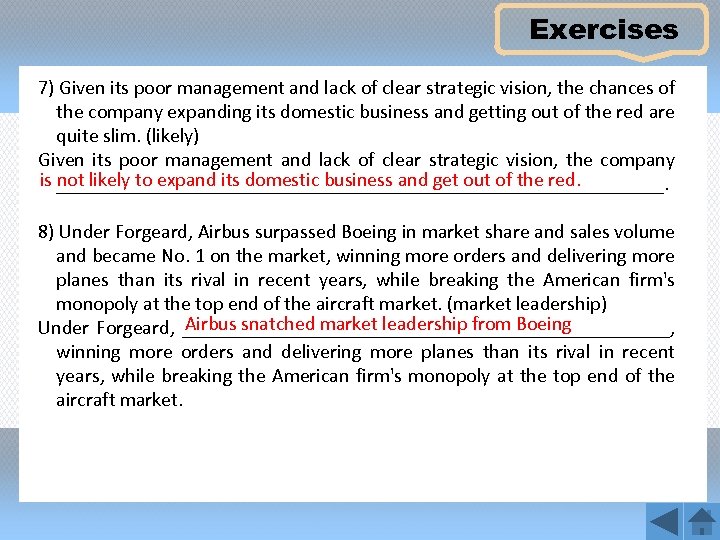
Exercises 7) Given its poor management and lack of clear strategic vision, the chances of the company expanding its domestic business and getting out of the red are quite slim. (likely) Given its poor management and lack of clear strategic vision, the company is not likely to expand its domestic business and get out of the red. _______________________________. 8) Under Forgeard, Airbus surpassed Boeing in market share and sales volume and became No. 1 on the market, winning more orders and delivering more planes than its rival in recent years, while breaking the American firm's monopoly at the top end of the aircraft market. (market leadership) Airbus snatched market leadership from Boeing Under Forgeard, _________________________, winning more orders and delivering more planes than its rival in recent years, while breaking the American firm's monopoly at the top end of the aircraft market.
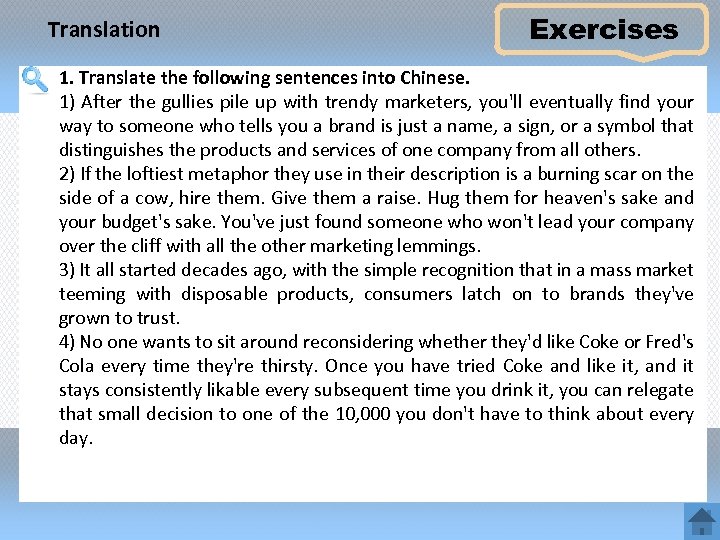
Translation Exercises 1. Translate the following sentences into Chinese. 1) After the gullies pile up with trendy marketers, you'll eventually find your way to someone who tells you a brand is just a name, a sign, or a symbol that distinguishes the products and services of one company from all others. 2) If the loftiest metaphor they use in their description is a burning scar on the side of a cow, hire them. Give them a raise. Hug them for heaven's sake and your budget's sake. You've just found someone who won't lead your company over the cliff with all the other marketing lemmings. 3) It all started decades ago, with the simple recognition that in a mass market teeming with disposable products, consumers latch on to brands they've grown to trust. 4) No one wants to sit around reconsidering whether they'd like Coke or Fred's Cola every time they're thirsty. Once you have tried Coke and like it, and it stays consistently likable every subsequent time you drink it, you can relegate that small decision to one of the 10, 000 you don't have to think about every day.
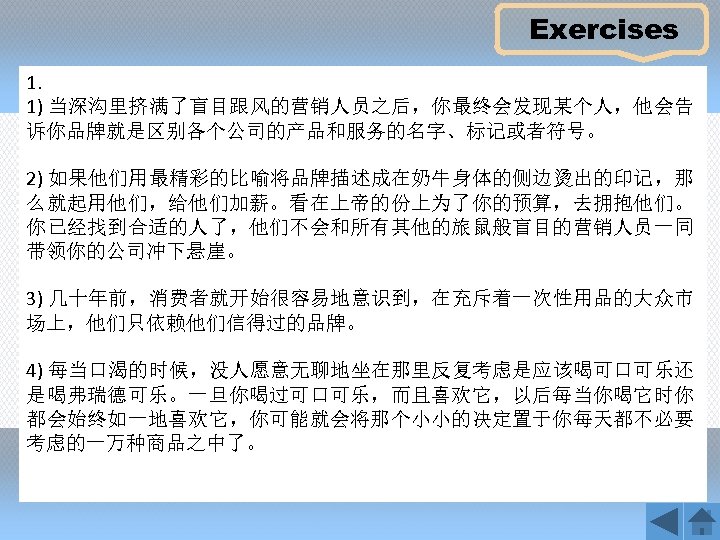
Exercises 1. 1) 当深沟里挤满了盲目跟风的营销人员之后,你最终会发现某个人,他会告 诉你品牌就是区别各个公司的产品和服务的名字、标记或者符号。 2) 如果他们用最精彩的比喻将品牌描述成在奶牛身体的侧边烫出的印记,那 么就起用他们,给他们加薪。看在上帝的份上为了你的预算,去拥抱他们。 你已经找到合适的人了,他们不会和所有其他的旅鼠般盲目的营销人员一同 带领你的公司冲下悬崖。 3) 几十年前,消费者就开始很容易地意识到,在充斥着一次性用品的大众市 场上,他们只依赖他们信得过的品牌。 4) 每当口渴的时候,没人愿意无聊地坐在那里反复考虑是应该喝可口可乐还 是喝弗瑞德可乐。一旦你喝过可口可乐,而且喜欢它,以后每当你喝它时你 都会始终如一地喜欢它,你可能就会将那个小小的决定置于你每天都不必要 考虑的一万种商品之中了。
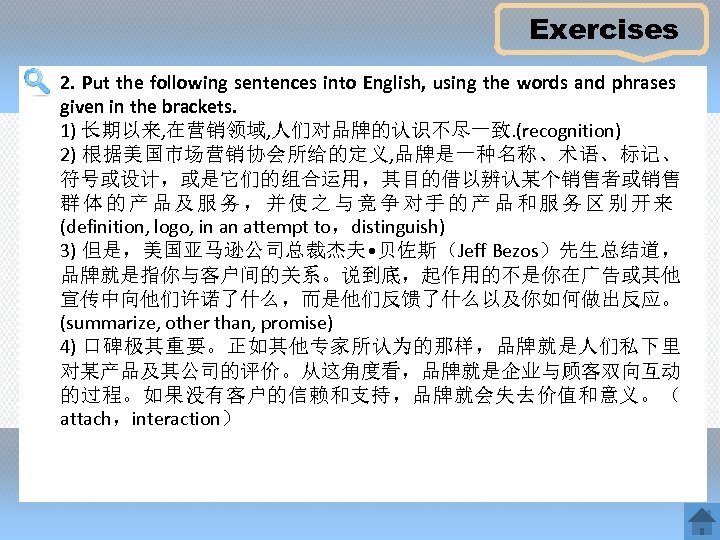
Exercises 2. Put the following sentences into English, using the words and phrases given in the brackets. 1) 长期以来, 在营销领域, 人们对品牌的认识不尽一致. (recognition) 2) 根据美国市场营销协会所给的定义, 品牌是一种名称、术语、标记、 符号或设计,或是它们的组合运用,其目的借以辨认某个销售者或销售 群体的产品及服务,并使之与竞争对手的产品和服务区别开来 (definition, logo, in an attempt to,distinguish) 3) 但是,美国亚马逊公司总裁杰夫 • 贝佐斯(Jeff Bezos)先生总结道, 品牌就是指你与客户间的关系。说到底,起作用的不是你在广告或其他 宣传中向他们许诺了什么,而是他们反馈了什么以及你如何做出反应。 (summarize, other than, promise) 4) 口碑极其重要。正如其他专家所认为的那样,品牌就是人们私下里 对某产品及其公司的评价。从这角度看,品牌就是企业与顾客双向互动 的过程。如果没有客户的信赖和支持,品牌就会失去价值和意义。( attach,interaction)
Exercises 2. 1) For a long time, there has been a variety of recognition of brand in the field of marketing. 2) According to the definition suggested by the American Marketing Association, brand is a name, a logo, a sign, a symbol or a design, or a combination of all being used in an attempt to identify the products or services of a marketer or a group of marketers and distinguish them from those of competitors. 3) Jeff Bezos, the president of an American Corporation Amazon, however, has summarized, brand refers to the relationship between you and your clients. Above all, what really matters is the feedback from customers and how you respond to them other than what you have promised to them in advertising or other publicity. 4) Public praise attached to your brand is of great importance. As other experts suggest, brand is what people privately think about a product and its company. From this point of view, brand is a mutual interaction between corporations and their clients.
Business Practice ØBusiness Practice 1. Promotional Campaign 2. Press Release
Promotional Campaign Business Practice Nowadays, in order to arouse the consumer's interests in knowing more about their products and brands, some companies draw consumers into their promotional campaign. Work in groups. Suppose you are the customers of these companies, designing and participating in such kinds of activities for the companies' brands or products. You may refer to Unit Four for some tips if necessary. 1) Each group chooses a company on page… and reads the given information. Or you may choose any other companies as you like. 2) Prepare a promotional campaign for the company. You may design the campaign by discussing the following points: The campaign's key message; The special features of the brand or product; The unique selling points;
Promotional Campaign Business Practice The target audience; The proper media (TV, radio, newspaper, Internet, etc. ); The special promotions; The slogans; Others … 3) Show your campaign to the whole class, trying to answer any questions they ask. 4) The class evaluates the campaign in terms of the following points: Having a clear and effective message; Differentiating the brand or product; Impressing the target audience deeply; Others …
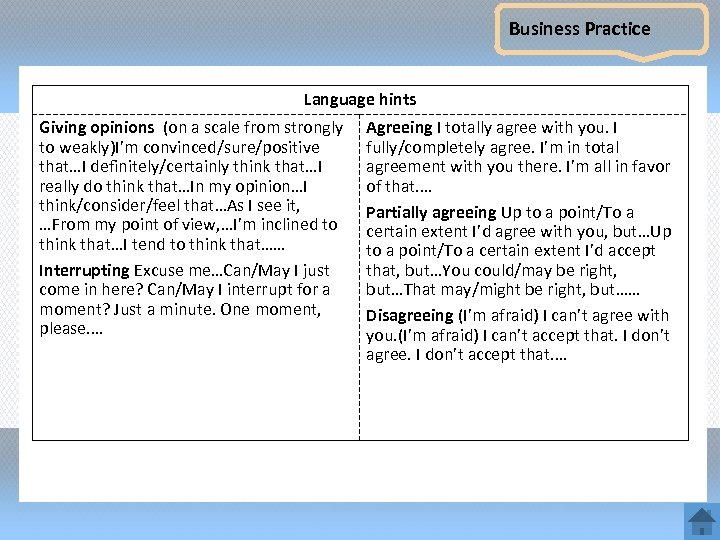
Business Practice Language hints Giving opinions (on a scale from strongly to weakly)I’m convinced/sure/positive that…I definitely/certainly think that…I really do think that…In my opinion…I think/consider/feel that…As I see it, …From my point of view, …I’m inclined to think that…I tend to think that…… Interrupting Excuse me…Can/May I just come in here? Can/May I interrupt for a moment? Just a minute. One moment, please. … Agreeing I totally agree with you. I fully/completely agree. I’m in total agreement with you there. I’m all in favor of that. … Partially agreeing Up to a point/To a certain extent I’d agree with you, but…Up to a point/To a certain extent I’d accept that, but…You could/may be right, but…That may/might be right, but…… Disagreeing (I’m afraid) I can’t agree with you. (I’m afraid) I can’t accept that. I don’t agree. I don’t accept that. …
Business Practice Suggestion: This part needs preparations after class. Guide the students through the instructions and the related information given in this part in class. Assign the tasks to them. Ask them to prepare for their tasks after class. Give them some time to discuss and prepare for their performance just before they begin showing and explaining the campaign to the whole class and answering the questions.
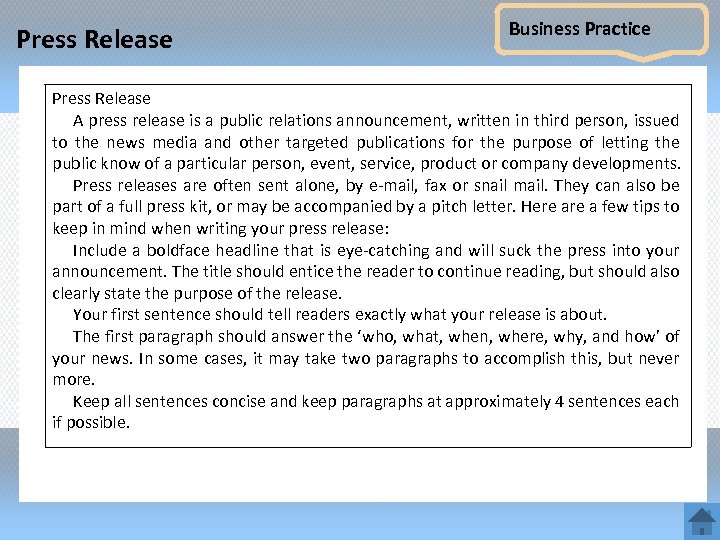
Press Release Business Practice Press Release A press release is a public relations announcement, written in third person, issued to the news media and other targeted publications for the purpose of letting the public know of a particular person, event, service, product or company developments. Press releases are often sent alone, by e-mail, fax or snail mail. They can also be part of a full press kit, or may be accompanied by a pitch letter. Here a few tips to keep in mind when writing your press release: Include a boldface headline that is eye-catching and will suck the press into your announcement. The title should entice the reader to continue reading, but should also clearly state the purpose of the release. Your first sentence should tell readers exactly what your release is about. The first paragraph should answer the ‘who, what, when, where, why, and how’ of your news. In some cases, it may take two paragraphs to accomplish this, but never more. Keep all sentences concise and keep paragraphs at approximately 4 sentences each if possible.
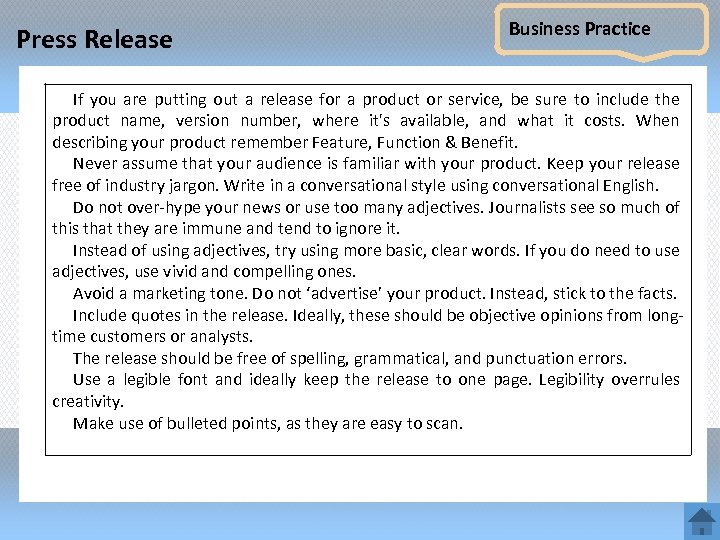
Press Release Business Practice If you are putting out a release for a product or service, be sure to include the product name, version number, where it's available, and what it costs. When describing your product remember Feature, Function & Benefit. Never assume that your audience is familiar with your product. Keep your release free of industry jargon. Write in a conversational style using conversational English. Do not over-hype your news or use too many adjectives. Journalists see so much of this that they are immune and tend to ignore it. Instead of using adjectives, try using more basic, clear words. If you do need to use adjectives, use vivid and compelling ones. Avoid a marketing tone. Do not ‘advertise’ your product. Instead, stick to the facts. Include quotes in the release. Ideally, these should be objective opinions from longtime customers or analysts. The release should be free of spelling, grammatical, and punctuation errors. Use a legible font and ideally keep the release to one page. Legibility overrules creativity. Make use of bulleted points, as they are easy to scan.
Press Release Business Practice Make use of bulleted points, as they are easy to scan. Include a brief company history section at the bottom of your release. Be sure to include information about your products or services that will help establish your expertise. Also mention your location, years in business, and any other pertinent information. Be sure to keep it short and concise, but detailed. Provide a link to your website where they can find additional information. Always provide a contact name, telephone number, address, and email address. If your contact person is not readily available, consider providing two contacts. The contact person should be familiar with all the news in the release, and should be ready to answer questions. Type ### at the end of your release to indicate the end and there are no more pages. If there is more than one page, put - more - at the bottom of your release. Note that it is highly recommended that you keep your releases to one page. Most stories about new products tend to be one or two paragraphs in most trade magazines. A release longer than two pages will most likely not be read to the end.
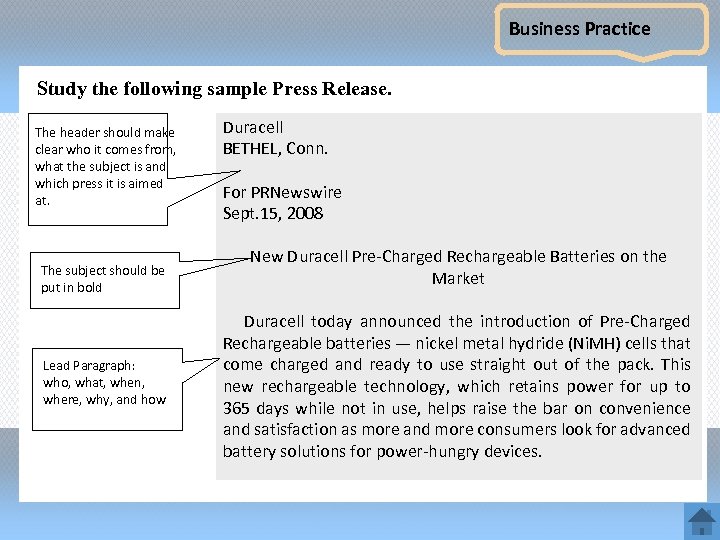
Business Practice Study the following sample Press Release. The header should make clear who it comes from, what the subject is and which press it is aimed at. The subject should be put in bold Lead Paragraph: who, what, when, where, why, and how Duracell BETHEL, Conn. For PRNewswire Sept. 15, 2008 New Duracell Pre-Charged Rechargeable Batteries on the Market Duracell today announced the introduction of Pre-Charged Rechargeable batteries — nickel metal hydride (Ni. MH) cells that come charged and ready to use straight out of the pack. This new rechargeable technology, which retains power for up to 365 days while not in use, helps raise the bar on convenience and satisfaction as more and more consumers look for advanced battery solutions for power-hungry devices.
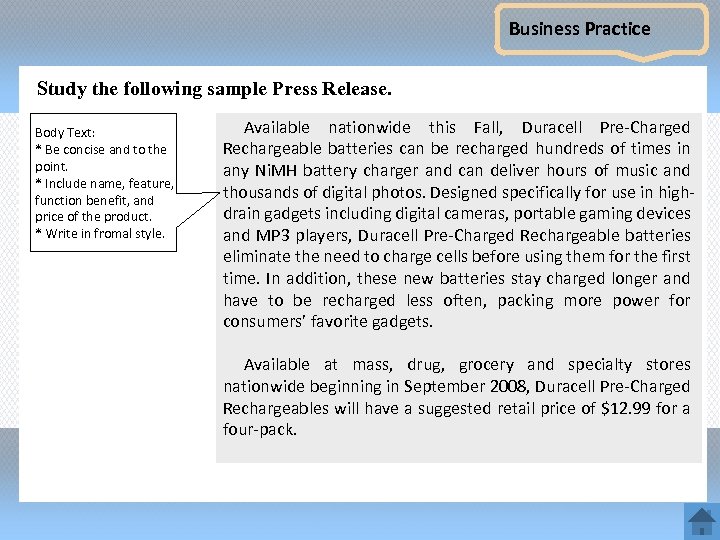
Business Practice Study the following sample Press Release. Body Text: * Be concise and to the point. * Include name, feature, function benefit, and price of the product. * Write in fromal style. Available nationwide this Fall, Duracell Pre-Charged Rechargeable batteries can be recharged hundreds of times in any Ni. MH battery charger and can deliver hours of music and thousands of digital photos. Designed specifically for use in highdrain gadgets including digital cameras, portable gaming devices and MP 3 players, Duracell Pre-Charged Rechargeable batteries eliminate the need to charge cells before using them for the first time. In addition, these new batteries stay charged longer and have to be recharged less often, packing more power for consumers’ favorite gadgets. Available at mass, drug, grocery and specialty stores nationwide beginning in September 2008, Duracell Pre-Charged Rechargeables will have a suggested retail price of $12. 99 for a four-pack.
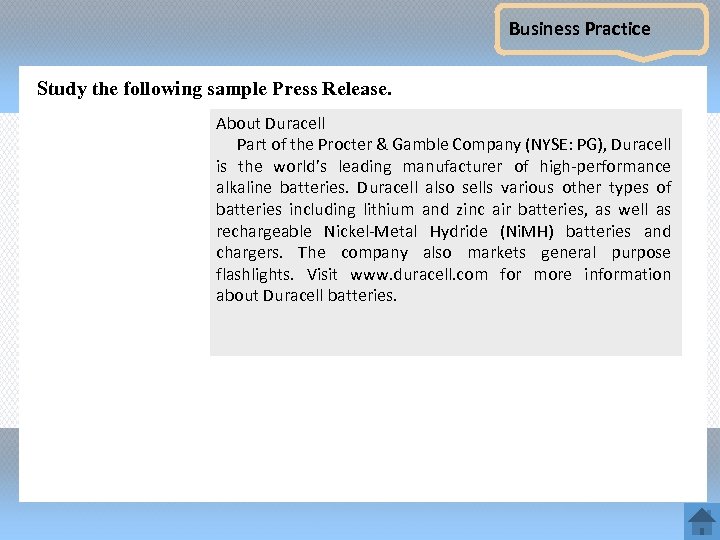
Business Practice Study the following sample Press Release. About Duracell Part of the Procter & Gamble Company (NYSE: PG), Duracell is the world’s leading manufacturer of high-performance alkaline batteries. Duracell also sells various other types of batteries including lithium and zinc air batteries, as well as rechargeable Nickel-Metal Hydride (Ni. MH) batteries and chargers. The company also markets general purpose flashlights. Visit www. duracell. com for more information about Duracell batteries.
Business Practice Study the following sample Press Release. Brief Company History Contact Information About Procter & Gamble (NYSE: PG) Three billion times a day, P&G brands touch the lives of people around the world. The company has one of the strongest portfolios of trusted, quality, leadership brands, including Pampers(R), Tide(R), Ariel(R), Always(R), Whisper(R), Pantene(R), Mach 3(R), Bounty(R), Dawn(R), Gain(R), Pringles(R), Folgers(R), Charmin(R), Downy(R), Lenor(R), Iams(R), Crest(R), Oral-B(R), Actonel(R), Duracell(R), Olay(R), Head & Shoulders(R), Wella(R), Gillette(R), and Braun(R). The P&G community consists of 138, 000 employees working in over 80 countries worldwide. Please visit http: //www. pg. com for the latest news and in-depth information about P&G and its brands. SOURCE Procter & Gamble 09/15/2008 CONTACT: Kara Salzillo of Duracell, +1 -617 -421 -7452; salzillo. kl@pg. com; or Blayne Murphy of Paine. PR, +1 -212 -613 -4924; bmurphy@painepr. com
Business Practice Write a Press Release based on the situation below. You are working in the marketing department of P&G. One day the manager gives you some information about the newly manufactured product, Febreze To Go Fabric Refresher, and asks you to send a release to The Trade Press. Following is the relevant information about the product. Febreze To Go Fabric Refresher is safe on virtually all fabrics including pillows, blankets, car interiors, carpet and clothing. The spray eliminates odors on fabrics including those caused by pets, cooking and musty smells, leaving a light fresh scent. It was created for on-the-go consumers to carry in their cars, on airplanes and to their offices. The portable bottle fits perfectly in purses, suitcases or in the glove compartment, making it easy to access and use when traveling. It also complies with current airline baggage restrictions, which prohibit travelers from having liquids over 3 oz in their carry-on luggage.
Business Practice Febreze To Go will be available nationwide beginning in September 2008. While P&G does not set retail prices, the new product is expected to retail from about $2. 00 for an individual bottle and $4. 99 for a package of three. Febreze’s Brand Manager, Eric Huston said: “Febreze has resonated with consumers because of the product’s unique technology that removes odors instead of covering them up. ” And he also said: “Fabric Refresher is one of the brand’s more popular products and consumers have expressed the need to have Febreze available anytime, anywhere. Due to this interest we created a convenient package for Febreze To Go that is now the perfect size when traveling. ”
Business Practice Three billion times a day, P&G brands touch the lives of people around the world. The company has one of the strongest portfolios of trusted, quality, leadership brands. The P&G community consists of over 135, 000 employees working in over 80 countries worldwide. The company has its own website, http: //www. pg. com, which publicizes the detailed information about P&G and its brand. Contact: (Your name) of Procter & Gamble, +1 -212 -468 -4372, marisa. abdoo@mslpr. com; or Ross Holthouse of Procter & Gamble, +1 -513 -9831108, holthouse. rh@pg. com
Words to Use in Press Release Business Practice Most people read promotional copy and press releases very quickly, often just skimming the text. It is essential to use short, basic, clear words because you are writing for more than one reader. While you should generally stay away from using too many adjectives, those that you do use should be vivid and compelling rather than predictable. Do not use overly promotional adjectives or they may be ignored. A thesaurus is extremely useful when writing releases. The three most effective words to use in writing a press release are free, best, and new. While these three words can be described in many different ways, the basic form is the most effective. Everyone understands their meanings and they describe what all of us want.
Words to Use in Press Release Business Practice Free: complimentary or cost-effective. Everyone likes something free and journalists are often happy to pass along the details. Best: top of the line or first-rate. Who doesn't want to be the best? Journalists are more likely to write about the "best" than 2 nd best. New: cutting-edge or latest. Using the word new describes your product or company as fresh and exciting. Journalists are always on the lookout for the latest and greatest. In an industry where news becomes old news in a matter of minutes, you want When writing your release, use these words throughout as appropriate.
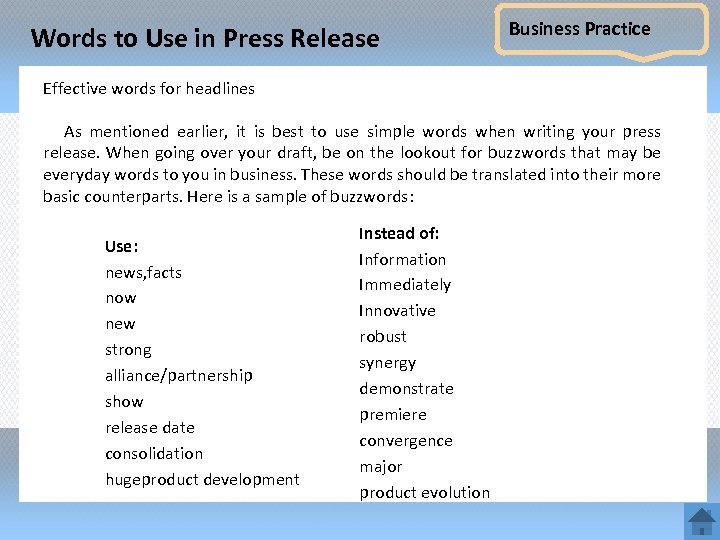
Words to Use in Press Release Business Practice Effective words for headlines As mentioned earlier, it is best to use simple words when writing your press release. When going over your draft, be on the lookout for buzzwords that may be everyday words to you in business. These words should be translated into their more basic counterparts. Here is a sample of buzzwords: Use: news, facts now new strong alliance/partnership show release date consolidation hugeproduct development Instead of: Information Immediately Innovative robust synergy demonstrate premiere convergence major product evolution
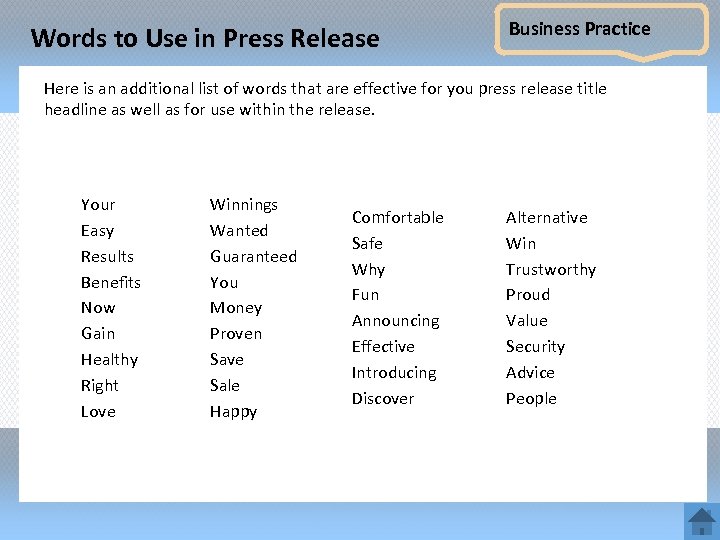
Words to Use in Press Release Business Practice Here is an additional list of words that are effective for you press release title headline as well as for use within the release. Your Easy Results Benefits Now Gain Healthy Right Love Winnings Wanted Guaranteed You Money Proven Save Sale Happy Comfortable Safe Why Fun Announcing Effective Introducing Discover Alternative Win Trustworthy Proud Value Security Advice People
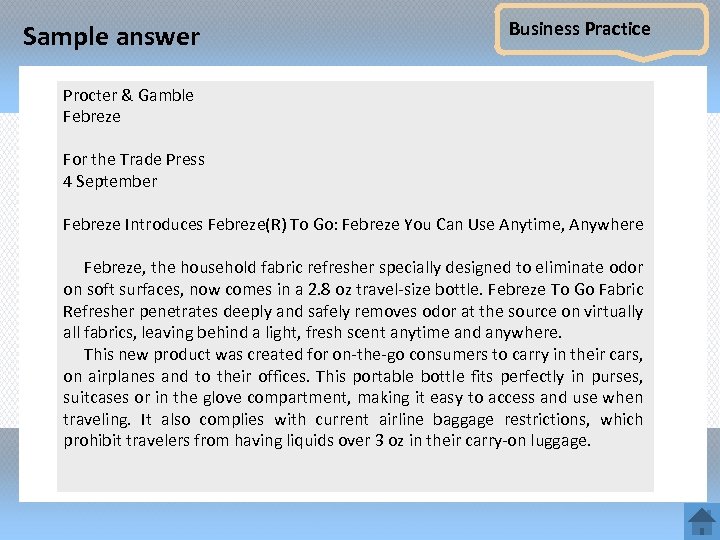
Sample answer Business Practice Procter & Gamble Febreze For the Trade Press 4 September Febreze Introduces Febreze(R) To Go: Febreze You Can Use Anytime, Anywhere Febreze, the household fabric refresher specially designed to eliminate odor on soft surfaces, now comes in a 2. 8 oz travel-size bottle. Febreze To Go Fabric Refresher penetrates deeply and safely removes odor at the source on virtually all fabrics, leaving behind a light, fresh scent anytime and anywhere. This new product was created for on-the-go consumers to carry in their cars, on airplanes and to their offices. This portable bottle fits perfectly in purses, suitcases or in the glove compartment, making it easy to access and use when traveling. It also complies with current airline baggage restrictions, which prohibit travelers from having liquids over 3 oz in their carry-on luggage.
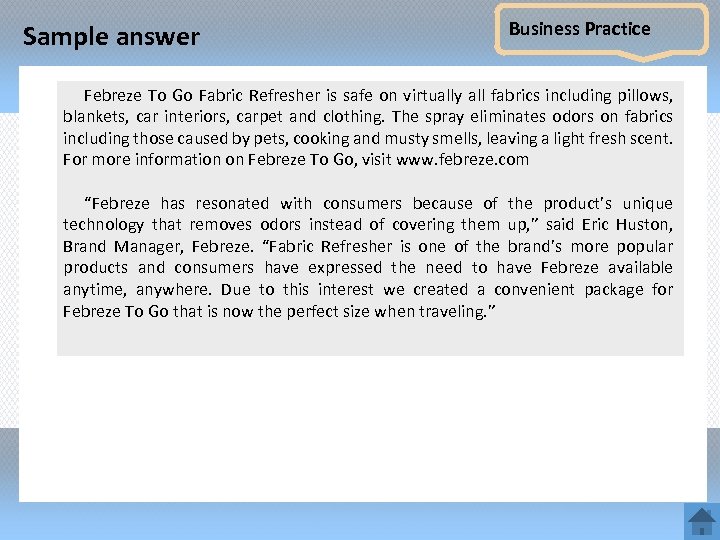
Sample answer Business Practice Febreze To Go Fabric Refresher is safe on virtually all fabrics including pillows, blankets, car interiors, carpet and clothing. The spray eliminates odors on fabrics including those caused by pets, cooking and musty smells, leaving a light fresh scent. For more information on Febreze To Go, visit www. febreze. com “Febreze has resonated with consumers because of the product’s unique technology that removes odors instead of covering them up, ” said Eric Huston, Brand Manager, Febreze. “Fabric Refresher is one of the brand’s more popular products and consumers have expressed the need to have Febreze available anytime, anywhere. Due to this interest we created a convenient package for Febreze To Go that is now the perfect size when traveling. ”
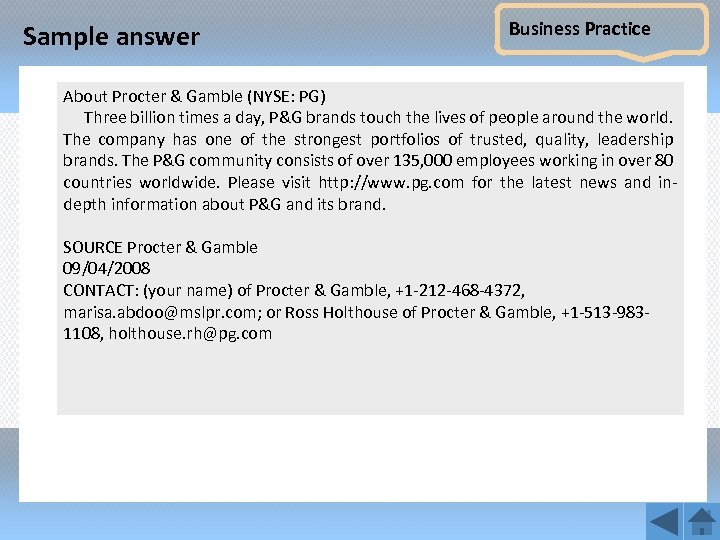
Sample answer Business Practice About Procter & Gamble (NYSE: PG) Three billion times a day, P&G brands touch the lives of people around the world. The company has one of the strongest portfolios of trusted, quality, leadership brands. The P&G community consists of over 135, 000 employees working in over 80 countries worldwide. Please visit http: //www. pg. com for the latest news and indepth information about P&G and its brand. SOURCE Procter & Gamble 09/04/2008 CONTACT: (your name) of Procter & Gamble, +1 -212 -468 -4372, marisa. abdoo@mslpr. com; or Ross Holthouse of Procter & Gamble, +1 -513 -9831108, holthouse. rh@pg. com
Exercises Ø Business Expressions Matching the expressions Completing sentences Completeing the follow-up multiple-choice exercise Ø Critical thinking
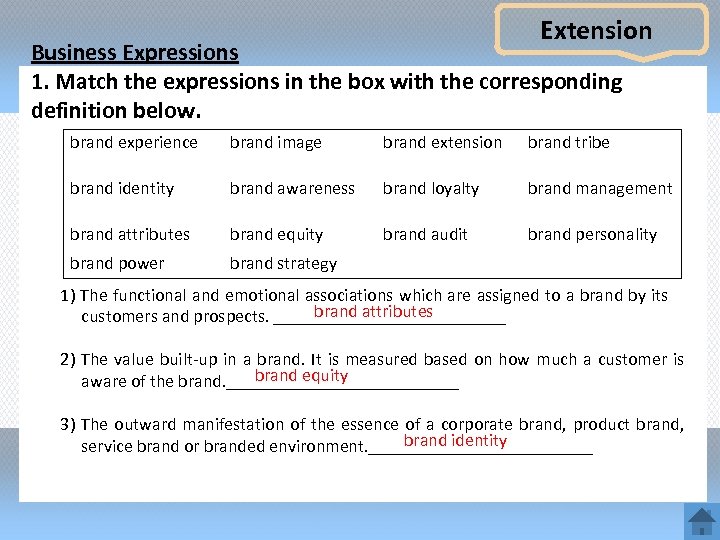
Extension Business Expressions 1. Match the expressions in the box with the corresponding definition below. brand experience brand image brand extension brand tribe brand identity brand awareness brand loyalty brand management brand attributes brand equity brand audit brand personality brand power brand strategy 1) The functional and emotional associations which are assigned to a brand by its brand attributes customers and prospects. _____________ 2) The value built-up in a brand. It is measured based on how much a customer is brand equity aware of the brand. _____________ 3) The outward manifestation of the essence of a corporate brand, product brand, brand identity service brand or branded environment. _____________
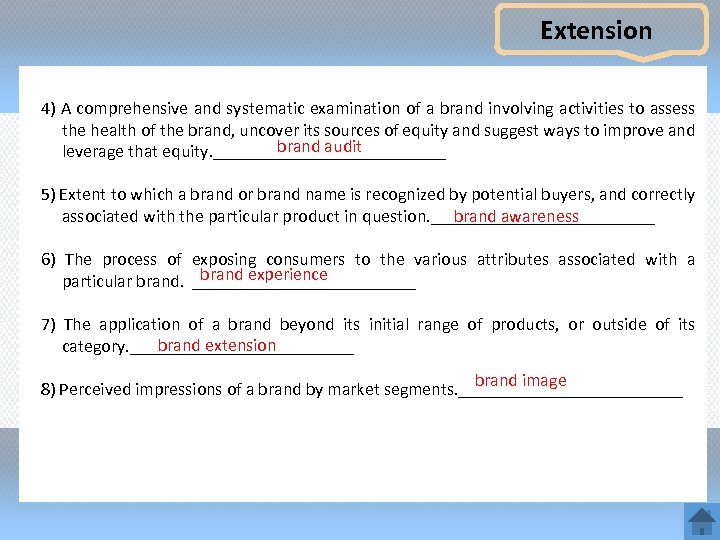
Extension 4) A comprehensive and systematic examination of a brand involving activities to assess the health of the brand, uncover its sources of equity and suggest ways to improve and brand audit leverage that equity. _____________ 5) Extent to which a brand or brand name is recognized by potential buyers, and correctly brand awareness associated with the particular product in question. _____________ 6) The process of exposing consumers to the various attributes associated with a brand experience particular brand. _____________ 7) The application of a brand beyond its initial range of products, or outside of its brand extension category. _____________ brand image 8) Perceived impressions of a brand by market segments. _____________
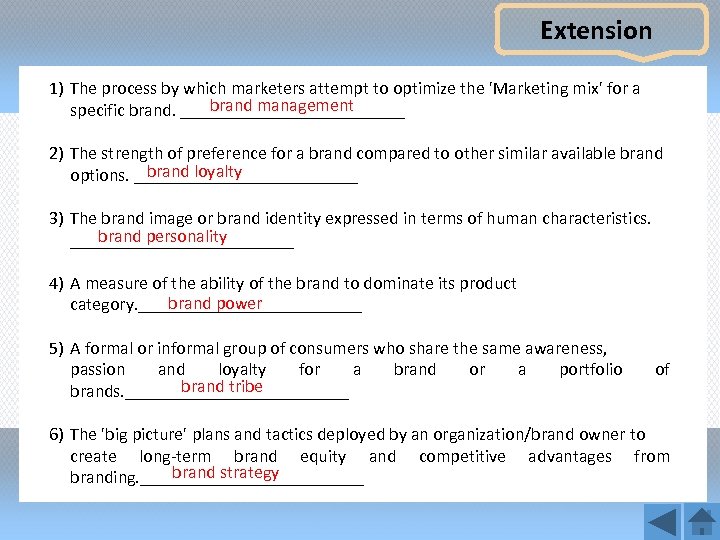
Extension 1) The process by which marketers attempt to optimize the 'Marketing mix' for a brand management specific brand. _____________ 2) The strength of preference for a brand compared to other similar available brand loyalty options. _____________ 3) The brand image or brand identity expressed in terms of human characteristics. brand personality _____________ 4) A measure of the ability of the brand to dominate its product brand power category. _____________ 5) A formal or informal group of consumers who share the same awareness, passion and loyalty for a brand or a portfolio brand tribe brands. _____________ of 6) The 'big picture' plans and tactics deployed by an organization/brand owner to create long-term brand equity and competitive advantages from brand strategy branding. _____________
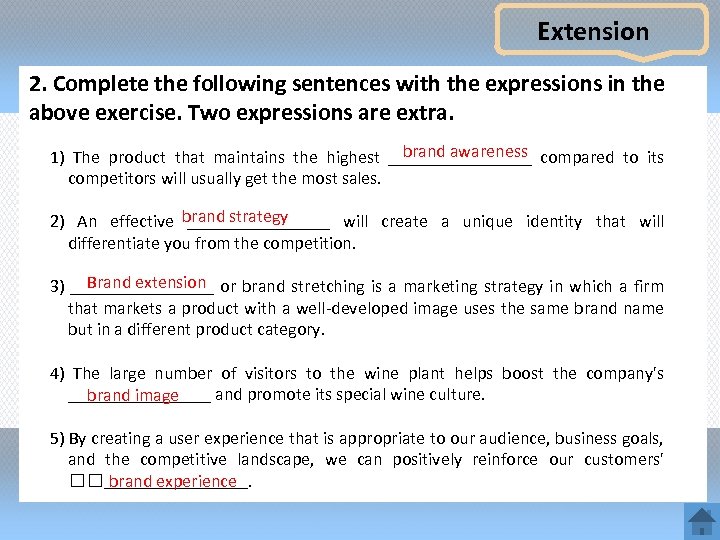
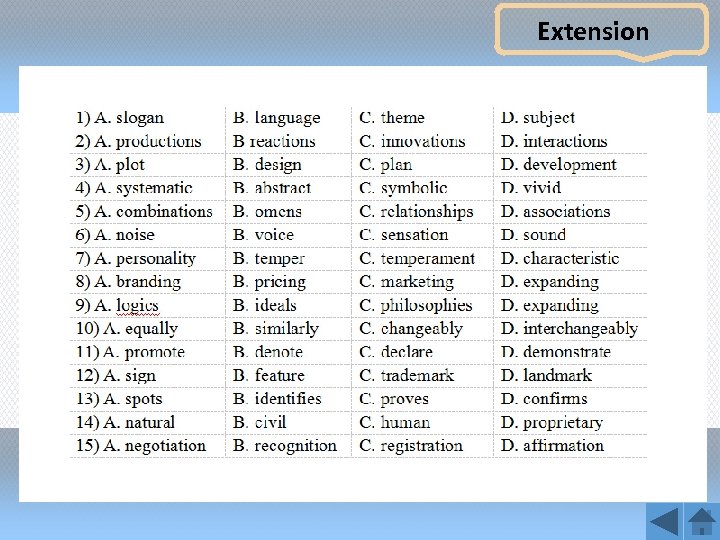
Extension 2. Complete the following sentences with the expressions in the above exercise. Two expressions are extra. brand awareness 1) The product that maintains the highest ________ compared to its competitors will usually get the most sales. 2) An effective brand strategy ________ will create a unique identity that will differentiate you from the competition. Brand extension 3) ________ or brand stretching is a marketing strategy in which a firm that markets a product with a well-developed image uses the same brand name but in a different product category. 4) The large number of visitors to the wine plant helps boost the company's ________ and promote its special wine culture. brand image 5) By creating a user experience that is appropriate to our audience, business goals, and the competitive landscape, we can positively reinforce our customers' ________. brand experience
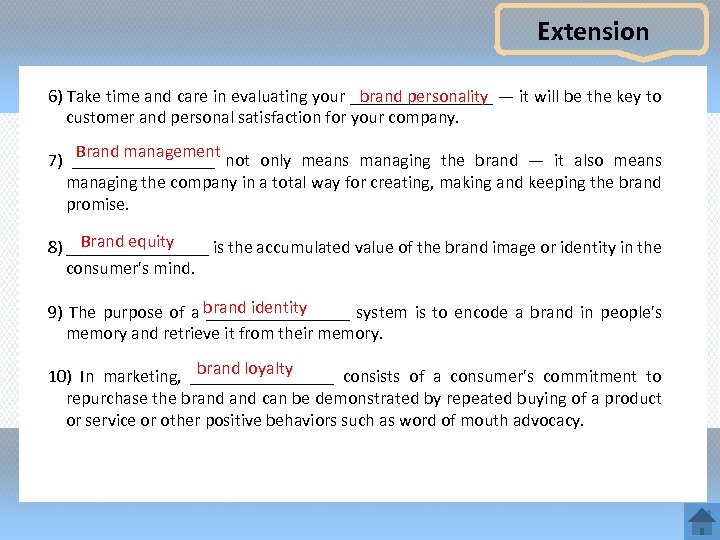
Extension brand personality 6) Take time and care in evaluating your ________ — it will be the key to customer and personal satisfaction for your company. Brand management 7) ________ not only means managing the brand — it also means managing the company in a total way for creating, making and keeping the brand promise. Brand equity 8) ________ is the accumulated value of the brand image or identity in the consumer's mind. 9) The purpose of a brand identity ________ system is to encode a brand in people's memory and retrieve it from their memory. brand loyalty 10) In marketing, ________ consists of a consumer's commitment to repurchase the brand can be demonstrated by repeated buying of a product or service or other positive behaviors such as word of mouth advocacy.
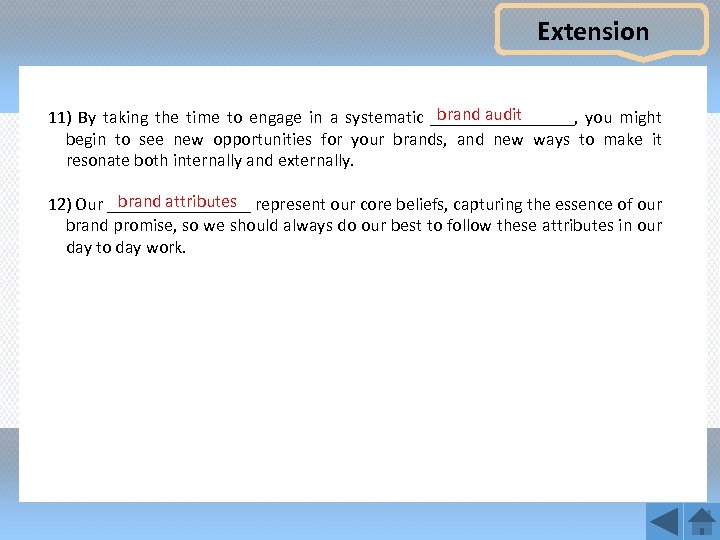
Extension brand audit 11) By taking the time to engage in a systematic ________, you might begin to see new opportunities for your brands, and new ways to make it resonate both internally and externally. brand attributes 12) Our ________ represent our core beliefs, capturing the essence of our brand promise, so we should always do our best to follow these attributes in our day to day work.
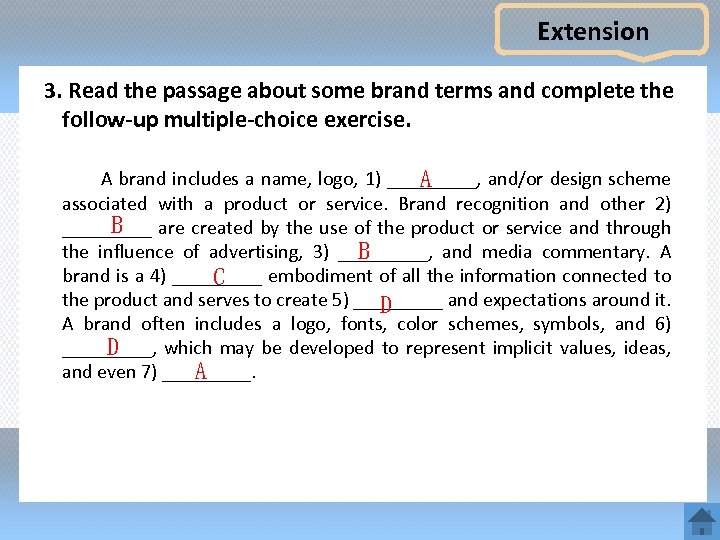
Extension 3. Read the passage about some brand terms and complete the follow-up multiple-choice exercise. A brand includes a name, logo, 1) _____, and/or design scheme A associated with a product or service. Brand recognition and other 2) B _____ are created by the use of the product or service and through the influence of advertising, 3) _____, and media commentary. A B brand is a 4) _____ embodiment of all the information connected to C the product and serves to create 5) _____ and expectations around it. D A brand often includes a logo, fonts, color schemes, symbols, and 6) _____, which may be developed to represent implicit values, ideas, D and even 7) _____. A
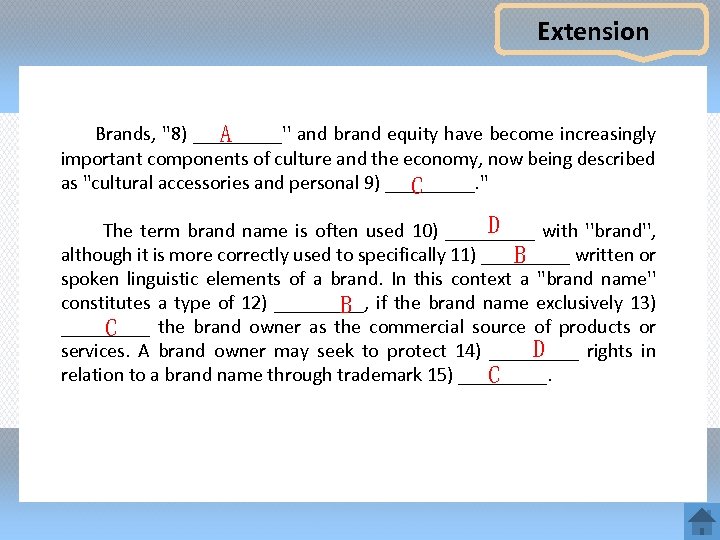
Extension Brands, ''8) _____'' and brand equity have become increasingly A important components of culture and the economy, now being described as ''cultural accessories and personal 9) _____. '' C D The term brand name is often used 10) _____ with ''brand'', although it is more correctly used to specifically 11) _____ written or B spoken linguistic elements of a brand. In this context a ''brand name'' constitutes a type of 12) _____, if the brand name exclusively 13) B _____ the brand owner as the commercial source of products or C services. A brand owner may seek to protect 14) _____ rights in D relation to a brand name through trademark 15) _____. C
Extension
Specialized Reading Extension 1. Read the following five paragraphs about a trademark or a brand, and write out the corresponding headings for each paragraph. Functions of a trademark ___________ 1) A trade mark is a badge of origin, used so that customers can recognize the product of a particular trader, and it can include, for example, words, logos or pictures. Trade mark registration is the most comprehensive protection that can be obtained to protect your business name, brand name, company logo or slogan. In other words, a trademark protects words, names, symbols, sounds, or colors that distinguish goods and services. The roar of the MGM lion, the pink of the insulation made by Owens-Corning (who uses the Pink Panther in advertising by permission from its owner!), and the shape of a Coca-Cola bottle are familiar trademarks. These are brand names and identities and are important in marketing a product or service.
Specialized Reading Extension Brand name vs. generic name ___________ 2) Naming an invention involves developing at least two names. One name is the generic name. The other name is the brand name or trademark name. For example, Pepsi ® and Coke ® are brand names or trademark names; cola or soda is the generic or product names. Big Mac ® and Whopper ® are brand names or trademark names; hamburger is the generic or product name. Nike ® and Reebok ® are brand names or trademark names; sneaker or athletic shoe is generic or product names.
Extension Specialized Reading Types of marks ___________ 3) The marks that can be registered usually include: Trademarks that are used by their owners to identify goods, that is, physical commodities, which may be natural, manufactured, or produced, and which are sold or otherwise transported or distributed via interstate commerce. Service marks that are used by their owners to identify services, that is, intangible activities, which are performed by one person for the benefit of a person or persons other than himself, either for pay or otherwise. There are other types of marks that can be registered, however, they occur infrequently and have some different requirements for registration than the more commonly applied for trademarks and service marks. Since the benefits of registration are essentially the same for all types of marks, the term ''trademark'' is often used in general information that applies to service marks, certification marks, and collective marks as well as to true trademarks, the marks used on goods.
Specialized Reading Extension The right to register, the right to use ___________ 4) The first person to either use a mark in commerce or file an application generally gains the right to trademark registration. Trademark registration can provide significant advantages to a party involved in a court proceeding. The USPTO (The United States Patent and Trademark Office) determines who can register. However, the right to use a mark can be more complicated to figure out. Two parties could begin using the same or similar marks without knowledge of one another and neither applied for trademark registration. Only a court could decide the right to use, with an injunction stopping one party from using the mark, and a settlement for damages caused by trademark infringement.
Specialized Reading Extension Not have to expire ___________ 5) When a trade mark has been registered it will remain there for several years, and it, unlike patents, can be renewed forever as long as they are being used in business. Trademark rights can last indefinitely if the owner continues to use the mark to identify goods or services. An affidavit and additional fees must be paid at certain intervals. If no affidavit is filed, the registration is canceled.
Specialized Reading Extension 2. The difference between own brands and generics is wellpresented in the following part. Read the passage and complete the following sentences. With the emergence of strong retailers, the ''own brand, '' the retailer's own branded product (or service), emerged as a major factor in the marketplace. Where the retailer has a particularly strong identity, such as, in the UK, Marks & Spencer in clothing, this ''own brand'' may be able to compete against even the strongest brand leaders, and may dominate those markets which are not otherwise strongly branded. There was a fear that such ''own brands'' might displace all other brands (as they have done in Marks & Spencer outlets), but the evidence is that — at least in supermarkets and department stores — consumers generally expect to see on display something over 50 per cent (and preferably over 60 per cent) of brands other than those of the retailer. Indeed, even the strongest own brands in the United Kingdom rarely achieve better than third place in the overall market.
Specialized Reading Extension The strength of the retailers has, perhaps, been seen more in the pressure they have been able to exert on the owners of even the strongest brands (and in particular on the owners of the weaker third and fourth brands). Relationship marketing has been applied most often to meet the wishes of such large customers (and indeed has been demanded by them as recognition of their buying power). Some of the more active marketers have now also switched to 'category marketing' — in which they take into account all the needs of a retailer in a product category rather than more narrowly focusing on their own brand. At the same time, generic (that is, effectively unbranded goods) have also emerged. These made a positive virtue of saving the cost of almost all marketing activities; emphasizing the lack of advertising and, especially, the plain packaging (which was, however, often simply a vehicle for a different kind of image). It would appear that the penetration of such generic products peaked in the early 1980 s, and most consumers still seem to be looking for the qualities that the conventional brand provides.
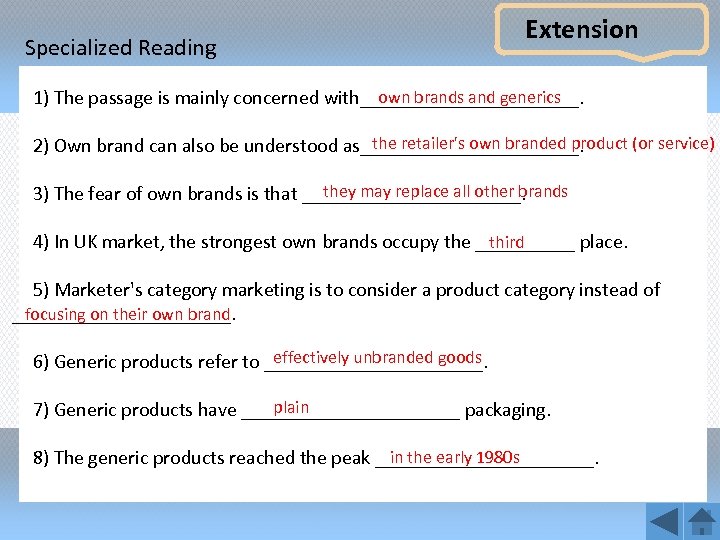
Specialized Reading Extension own brands and generics 1) The passage is mainly concerned with___________. the retailer's own branded product (or service) 2) Own brand can also be understood as___________. they may replace all other brands 3) The fear of own brands is that ___________. third 4) In UK market, the strongest own brands occupy the _____ place. 5) Marketer's category marketing is to consider a product category instead of focusing on their own brand ___________. effectively unbranded goods 6) Generic products refer to ___________. plain 7) Generic products have ___________ packaging. in the early 1980 s 8) The generic products reached the peak ___________.
Thank you!
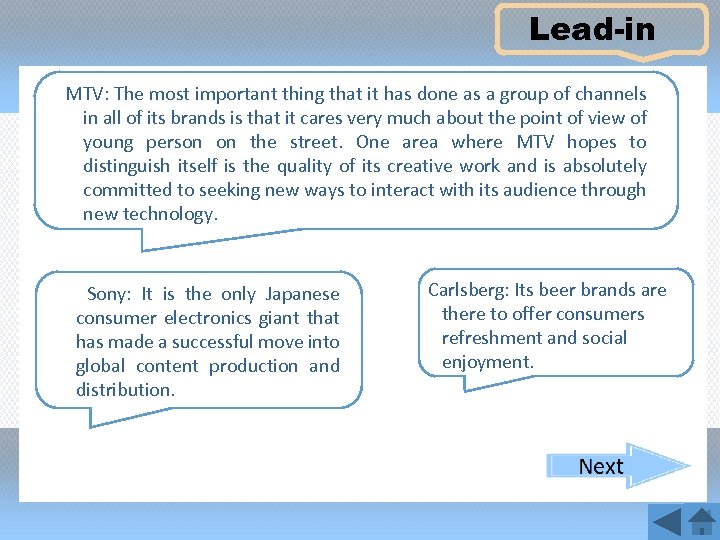
Lead-in MTV: The most important thing that it has done as a group of channels in all of its brands is that it cares very much about the point of view of young person on the street. One area where MTV hopes to distinguish itself is the quality of its creative work and is absolutely committed to seeking new ways to interact with its audience through new technology. Sony: It is the only Japanese consumer electronics giant that has made a successful move into global content production and distribution. Carlsberg: Its beer brands are there to offer consumers refreshment and social enjoyment.
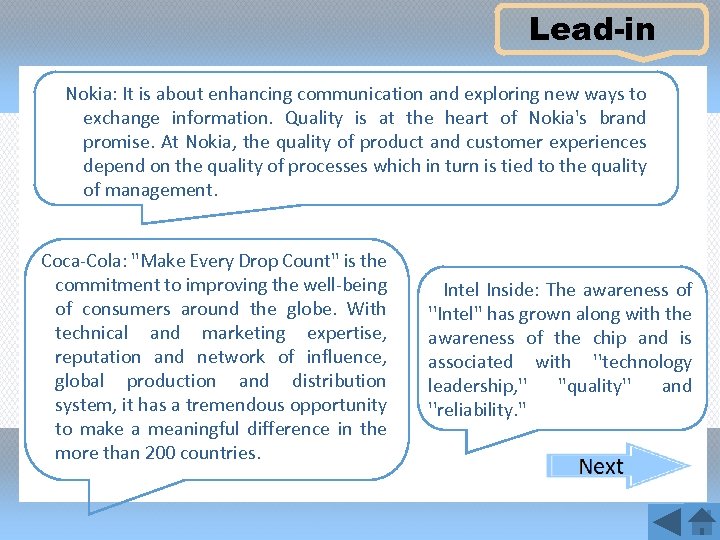
Lead-in Nokia: It is about enhancing communication and exploring new ways to exchange information. Quality is at the heart of Nokia's brand promise. At Nokia, the quality of product and customer experiences depend on the quality of processes which in turn is tied to the quality of management. Coca-Cola: ''Make Every Drop Count'' is the commitment to improving the well-being Intel Inside: The awareness of of consumers around the globe. With ''Intel'' has grown along with the technical and marketing expertise, awareness of the chip and is reputation and network of influence, associated with ''technology global production and distribution leadership, '' ''quality'' and system, it has a tremendous opportunity ''reliability. '' to make a meaningful difference in the more than 200 countries.
Lead-in Toyota: Based on the philosophy of providing ''the right car, in the right place, at the right time, '' and in accordance with the infrastructure and customer needs of each region, Toyota will continue to promote efforts to develop environmentally friendly technology and vehicles. Nike: Image is vital to the success of Nike and the only image Nike seeks from association with sports mega-heroes is to be recognized as an ''authentic'' sports brand. Rolls-Royce: It is a technology leader, providing high-value, product-related services to customers throughout the operational lives of our power system.
Lead-in Microsoft: It is the worldwide leader in software, services and solutions that help people and businesses realize their full potential. At Microsoft, software is provided for customers to find creative solutions to business problems, develop breakthrough ideas, and stay connected to what's most important to them. Lego: The Lego brand is more than simply our familiar logo. It is the expectations that people have of the company — towards its products and services, and the accountability that the LEGO Group feels towards the world around it. The brand acts as a guarantee of quality and originality. HARLEY-DAVIDSON: Harley. Davidson motorcycles are distinctive in design and sound, attracting a loyal following. The owners form a brand community.
Lead-in PLAYBOY: It is a brand-driven international multimedia entertainment company that publishes editions of Playboy magazine around the world; operates TV networks and distributes programming globally, and licenses the playboy trademark internationally for a range of consumer products and services. Canon: The Canon brand is trusted the world over. Its philosophy is based on Kyosei, which means living and working for the common good. It serves to reinforce the commitment to building a brand that customers can trust. Mercedes-Benz: It is one of the best cars in the world with perfect blend of quality, safety, performance and luxury.
Lead-in 1)Powerful brands are those that stand for and represent a distinct category or concept in consumers' minds. All of the above brands are powerful in that they produce easier sales, repeat purchase, up-selling and cross-selling, barriers to competition, and competitive platforms for higher market impact. Furthermore, they have built their brand value on providing a positive experience for their customers. Successful companies match business objectives with customer needs. They combine ongoing testing, feedback and improvement cycles into their daily practice and invest in listening, learning and modifying the user experience (the over-all perception and comprehensive interaction an individual has with a company, service or product) to create positive returns in revenue and loyalty.
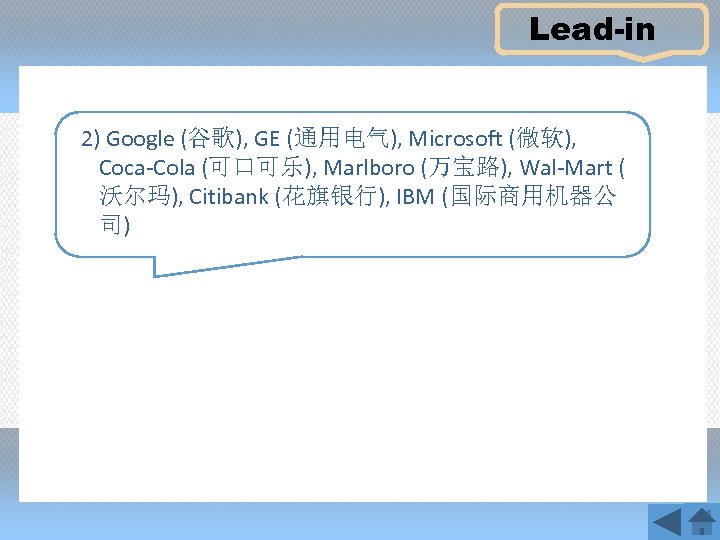
Lead-in 2) Google (谷歌), GE (通用电气), Microsoft (微软), Coca-Cola (可口可乐), Marlboro (万宝路), Wal-Mart ( 沃尔玛), Citibank (花旗银行), IBM (国际商用机器公 司)
Lead-in A brand is a symbolic embodiment of all the information connected to the product and serves to create associations and expectations around it. The brand of a company is created by the company. The company has to make clear through its brand the promise it makes to its customers, based on the strategies and vision for the future of its business and products. It is vital that the company fully comprehend exactly what the customers expect from the brand, and that it continually lives up to these expectations since customers' expectations behind the brand may create the impression that a brand associated with a product or service has certain qualities or characteristics that make it special or unique. A brand is a relationship rather than a name. It is written in the neurons of people's minds, filling its name with trust, respect, loyalty, track records, and willingness to overlook mistakes. For consumers, they mean high quality, superior reliability and advanced technology. A brand represents a mark of assurance, moments of choice and emotional involvement.
Скачать презентацию Unit Seven Brands Contents 1 Brief on
d2b2572319bb9ea4d507ff7a948f84fe.ppt