


 Скачать презентацию Unit One Nice to Meet You The First
1ddc27fca32919d5b701a194644bd2d6.ppt
- Количество слайдов: 24
 Unit One Nice to Meet You! The First Two Periods Designed by Lu Yan
 Unit One Nice to meet you! Teaching Procedures • Get the Right Sound • Listen In • Speak Out • Listen More • Assignments
 Unit One Nice to meet you! Difficulties 1. To speak with fluency 2. To make dialogues with the given words 3. To test and improve students’ listening ability
 Unit One Nice to meet you! • Get the Right Sound /i/ & /i: / /i/ 该音是个前元音,是字母i或y在重读闭音中的读 音。它是个短元音,故发此音要短促而轻快。发 音要领是:舌尖抵下齿,舌前部抬高,舌两侧抵 上齿两侧,口形偏平。 /i: / 前元音,是字母ea,ee,ie或ei在单词中的发音。此 音是长元音,一定注音把音发足。其发音要领是发音 时舌尖抵下齿,前舌尽量抬高、舌位高于/i/, 口形扁平。
 Unit One Nice to meet you! /e/ & / æ/ /e/ 该音是个前元音,是字母e或ea在单词中的发音。它是个短 元音。发音时舌尖抵下齿,舌前部稍抬起,舌位比/i: /低; 唇形中常,开口度比/i: /大。 / æ/ 该音是个前元素,是字母a在重读闭音节中的发音。/ æ/ 是短元音。发音时舌尖抵下齿;舌前部稍抬高,舌位 比/e/更低;双唇平伸,成扁平形。
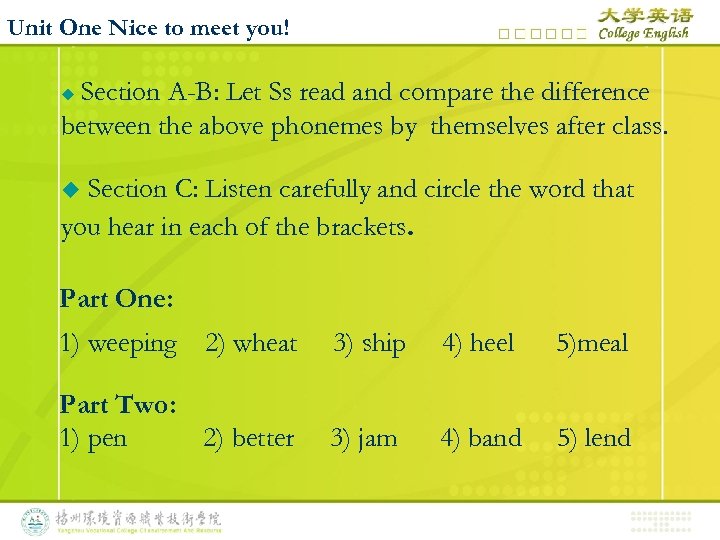 Unit One Nice to meet you! Section A-B: Let Ss read and compare the difference between the above phonemes by themselves after class. u Section C: Listen carefully and circle the word that you hear in each of the brackets. u Part One: 1) weeping 2) wheat Part Two: 1) pen 2) better 3) ship 4) heel 5)meal 3) jam 4) band 5) lend
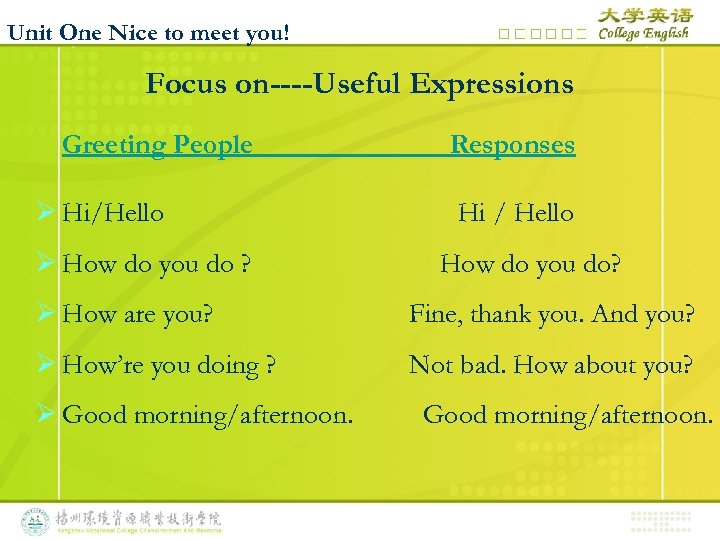 Unit One Nice to meet you! Focus on----Useful Expressions Greeting People Ø Hi/Hello Ø How do you do ? Responses Hi / Hello How do you do? Ø How are you? Fine, thank you. And you? Ø How’re you doing ? Not bad. How about you? Ø Good morning/afternoon.
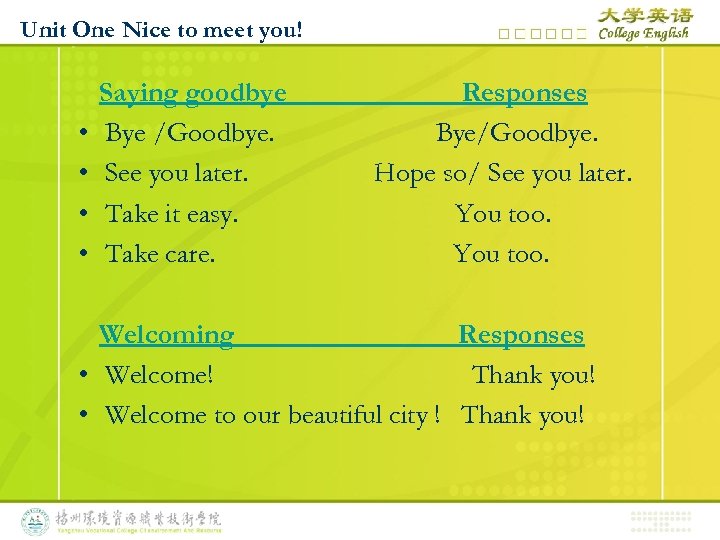 Unit One Nice to meet you! • • Saying goodbye Bye /Goodbye. See you later. Take it easy. Take care. Responses Bye/Goodbye. Hope so/ See you later. You too. Welcoming Responses • Welcome! Thank you! • Welcome to our beautiful city ! Thank you!
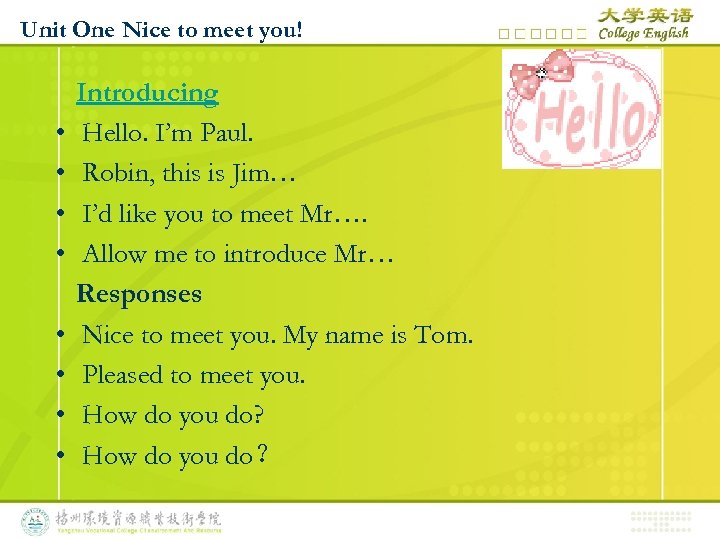 Unit One Nice to meet you! • • Introducing Hello. I’m Paul. Robin, this is Jim… I’d like you to meet Mr…. Allow me to introduce Mr… Responses Nice to meet you. My name is Tom. Pleased to meet you. How do you do? How do you do?
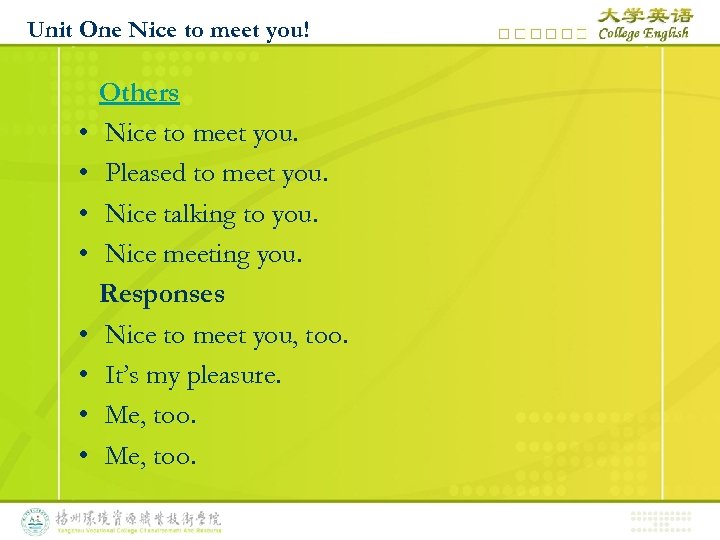 Unit One Nice to meet you! • • Others Nice to meet you. Pleased to meet you. Nice talking to you. Nice meeting you. Responses Nice to meet you, too. It’s my pleasure. Me, too.
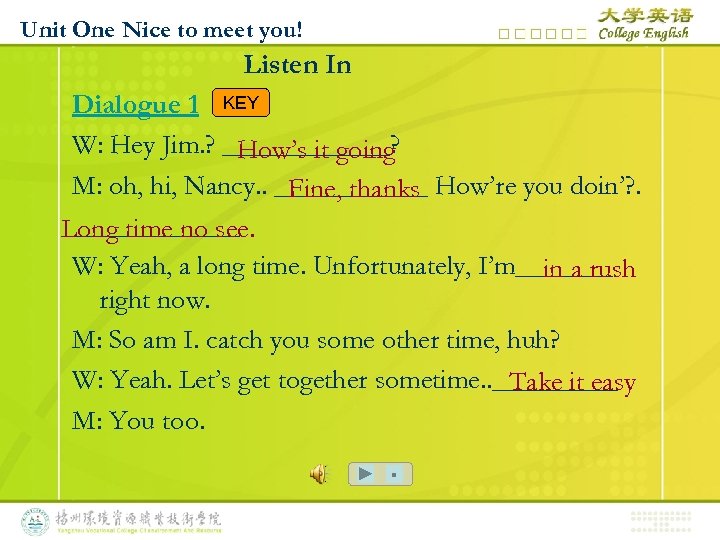 Unit One Nice to meet you! Listen In Dialogue 1 KEY W: Hey Jim. ? ______? How’s it going M: oh, hi, Nancy. . ______ How’re you doin’? . Fine, thanks ______ Long time no see. W: Yeah, a long time. Unfortunately, I’m_______ in a rush right now. M: So am I. catch you some other time, huh? W: Yeah. Let’s get together sometime. . _____ Take it easy M: You too. ■
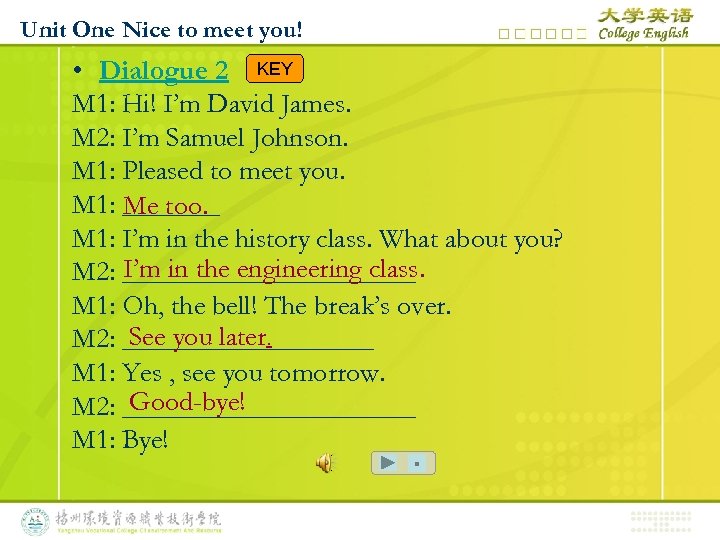 Unit One Nice to meet you! • Dialogue 2 KEY M 1: Hi! I’m David James. M 2: I’m Samuel Johnson. M 1: Pleased to meet you. M 1: _______ Me too. M 1: I’m in the history class. What about you? I’m in the engineering class. M 2: ___________ M 1: Oh, the bell! The break’s over. See you later. M 2: _________ M 1: Yes , see you tomorrow. Good-bye! M 2: ___________ M 1: Bye! ■
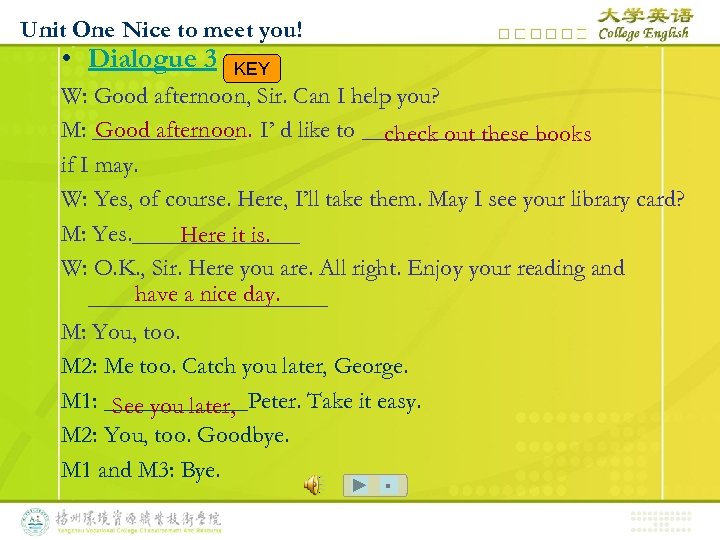 Unit One Nice to meet you! • Dialogue 3 KEY W: Good afternoon, Sir. Can I help you? Good afternoon. M: ______ I’ d like to ________ check out these books if I may. W: Yes, of course. Here, I’ll take them. May I see your library card? M: Yes. _______ Here it is. W: O. K. , Sir. Here you are. All right. Enjoy your reading and have a nice day. __________ M: You, too. M 2: Me too. Catch you later, George. M 1: ______Peter. Take it easy. See you later, M 2: You, too. Goodbye. M 1 and M 3: Bye. ■
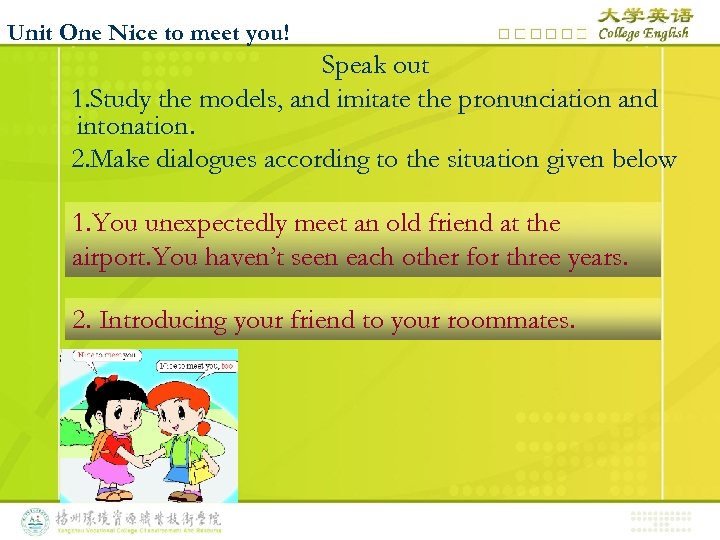 Unit One Nice to meet you! Speak out 1. Study the models, and imitate the pronunciation and intonation. 2. Make dialogues according to the situation given below 1. You unexpectedly meet an old friend at the airport. You haven’t seen each other for three years. 2. Introducing your friend to your roommates.
 Unit One Nice to meet you! Listen More Before listening, learn the following words and phrases. allergic a. 过敏的 ~ to sth 对…过敏 lobster n. 龙虾 registration n. 登记, 注册 shellfish n. 贝壳类动物 Fancy meeting you here=I’m not expecting to meet… in the same line of business=in the same field of work
 Unit One Nice to meet you! D 1: ■ Script M: Hi, my name is Tom Green. I saw you standing here alone, and I thought I might join you a moment. W: Hello, Mr. Green. It’s nice to meet you. My name is Lori Stevens. Please call me Lori. M: Ok, Lori. Please call me Tom. Are you a friend of Dick and Tracy’s? W: Yes, I am. I’ve known them for some ten years. And you? Q 1: Which of the following statement is true? Q 2: How many years has Lori known Dick and Tracy?
 Unit One Nice to meet you! D 2: ■ Script M: Oh, hello, Claire. Fancy meeting you here. W: Oh, busy, John’s uncle’s coming to dinner tonight and I’ve got to buy something special. M: Have you decided what to cook? W: Oh, yes, I think I’ll do lobster. M: Oh, is that wise? W: Why, what do you mean? M: Well, a lot of people are allergic to shellfish, you know. W: Oh, I hadn’t thought of that. Q 1: Why is Claire busy? Q 2: What is the problem with lobster?
 Unit One Nice to meet you! D 3: ■ Script M 1: Say, Mike, I don’t think you and David know each other, do you? M 2: I don’t think I’ve had pleasure of meeting him before. M 1: Well, in that case, I’d like you to meet David. Mike, this is David. M 2: How do you do, David? M 3: I’m glad to meet you, Mike. M 1: Excuse me, mike and David. I’ve just seen some other guests coming in. you shouldn’t lack for something to talk about, you ‘re both in the same line of business. Q 1: Which of the following statements is true? Q 2: Why shouldn’t mike and David lack for something to talk about ?
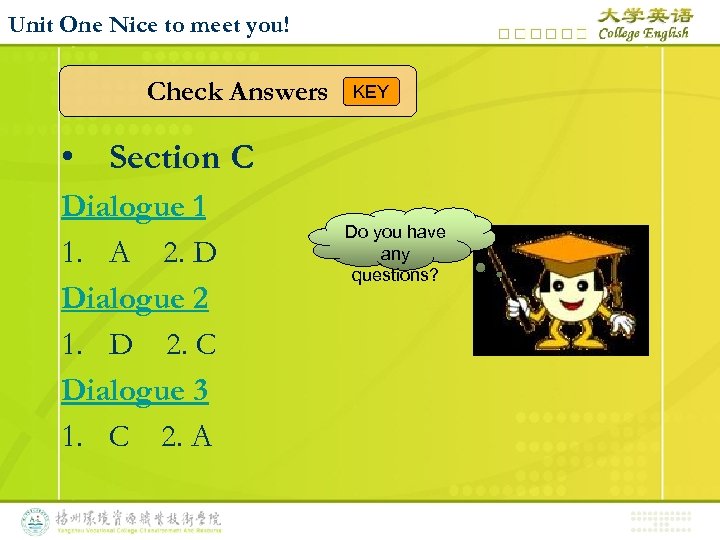 Unit One Nice to meet you! Check Answers KEY • Section C Dialogue 1 1. A 2. D Dialogue 2 1. D 2. C Dialogue 3 1. C 2. A Do you have any questions?
 Unit One Nice to meet you! Section D Circle True or False ■ 1. Yen Chu is a new student. 2. The woman has no registration card. 3. The relationship between the man and woman is roommates. 4. The conversation takes place in the classroom. KEY T F F T
 Unit One Nice to meet you! Section D Script M: Come in , please. W: I’m a new student. M: Welcome to the class. W: Here’s my registration card. M: Thank you. W: You’re welcome. M: Please sit down. This is Yen Chu. She is a new student. She’ s Chinese, from Hong.
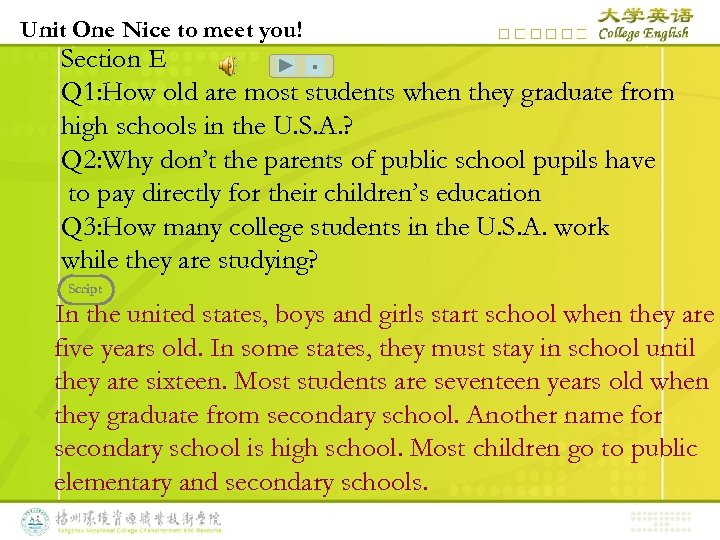 Unit One Nice to meet you! Section E Q 1: How old are most students when they graduate from high schools in the U. S. A. ? Q 2: Why don’t the parents of public school pupils have to pay directly for their children’s education Q 3: How many college students in the U. S. A. work while they are studying? ■ Script In the united states, boys and girls start school when they are five years old. In some states, they must stay in school until they are sixteen. Most students are seventeen years old when they graduate from secondary school. Another name for secondary school is high school. Most children go to public elementary and secondary schools.
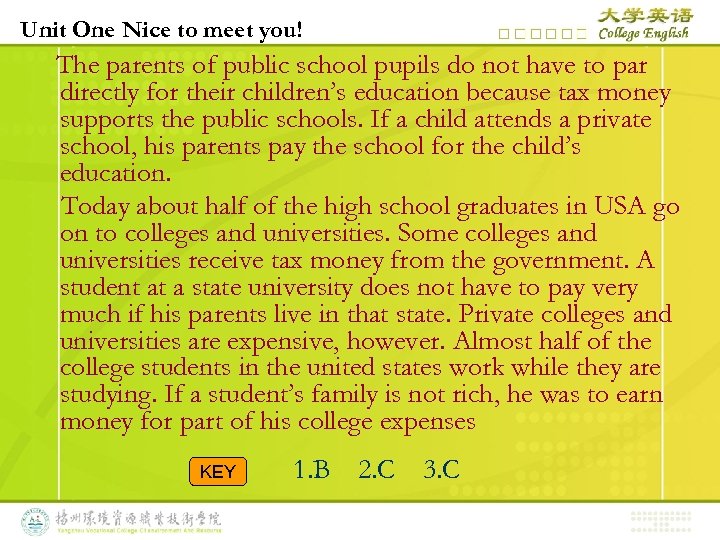 Unit One Nice to meet you! The parents of public school pupils do not have to par directly for their children’s education because tax money supports the public schools. If a child attends a private school, his parents pay the school for the child’s education. Today about half of the high school graduates in USA go on to colleges and universities. Some colleges and universities receive tax money from the government. A student at a state university does not have to pay very much if his parents live in that state. Private colleges and universities are expensive, however. Almost half of the college students in the united states work while they are studying. If a student’s family is not rich, he was to earn money for part of his college expenses KEY 1. B 2. C 3. C
 Unit One Nice to meet you! Home Assignments • • • Learn the words and expressions by heart. Practice the expressions of greet people. Preview the text.