


 Скачать презентацию Unit One Jewish history and literature in the
e8ed76fbd83fedfa4cd0fb4d9f36bea1.ppt
- Количество слайдов: 28
 Unit One Jewish history and literature in the classic age
 Judah and Judy “Ism” n n n Why the term Judaism is misleading But not as misleading as the term Israel, the traditional name for the Jewish people (and NOT a country!) What is the difference between Israel and Jew?
 Judaism – Creed, Religion, Nationality? n n n Can one be a Christian atheist? Can one be a Jewish atheist? Secular Judaism vs. Religious Judaism. Fitting the texts of classical Judaism into 19 th century categories of religion.
 A glossary of terms n n Hebrew Israel Jews Semites
 The Biblical Legacy Jews have traditionally divided the Hebrew Bible into three sections: Torah ('Law', the Five Books of Moses), Nevi'im ('Prophets'), and Ketuvim ('Writings'); the first letters of each section form the word, Ta Na Kh, which is the common Hebrew name for the Hebrew Bible.
 The Hebrew Bible is not the Old Testament! The differences between the Hebrew (or Jewish) Bible and the Old Testament of the Protestants (mostly order) and Catholic (order and books)
 The Biblical Legacy Traditionally, Jews have attributed the composition of the Torah to Moses, Nevi'im to various Prophets, and Ketuvim to Prophets and two Kings (David and Solomon). Modern scholarship sees them as the work of anonymous authors dating from the 11 th cent. b. c. e to the 3 rd cent. b. c. e.
 Torah n n The Five Books of Moses: Genesis, Exodus, Leviticus, Numbers, and Deuteronomy (these names derive from the Greek translation) Contains mostly narrative and laws – some poetry, too.
 Nevi’im (Prophets) n n Historical Narratives (Early Prophets) Records of Prophetic Writings (Later Prophets) • The prophets are more castigators than prognosticators. • Prophecy ends with after the return from the Babylonian Exile
 Historical Time Line of Torah and Nevi’im c. 1700 b. c. e. Abraham c. 1290 " Exodus from Egypt c. 1000 " David 722 " Fall of Northern Kingdom 586 " Fall or Southern Kingdom, destruction of First Temple, exile to Babylonia 516 " Some return to Israel under Haggai and Zekhariah 444 " Ezra
 Ketuvim – Writings Psalm, Wisdom literature, Song of Songs, Ruth, Lamentations, Esther, Daniel, Historical Chronicles, some of these are pseudepigraphic
 Development of Oral Tradition and Post-Biblical Writings n n n 200 -100 c. e. Apocrypha (Books excluded from Jewish (and Protestant) Canon, e. g. , Tobit, Ecclesiasticus, Judish, Maccabees. Other writings such as the Dead Sea Scrolls and Apocalyptic Works Greek and Aramaic Translation of Bible, Hellenistic Exegesis and Philosophy (Philo), History (Josephus). Little of this resonates in rabbinic Judaism
 Review of Last Class Rabbinic Period 70 c. e. – 500 n 70 c. e. – 220 Period of the Tannaim (Tanna=Teacher) n
 Tannaitic Literature n n n Two Genres – Non-midrashic and midrash Midrash = Rabbinic exegesis of scripture. Two Categories – Legal (Halakhic) and non-legal
 Non-Midrashic Literature n n n Mishnah (Law code of R. Judah the Prince, authoritative, c. 200 c. e. Tosefta (Law code of Rabbi Hiyya and Oshaiah, c. 220 c. e. , not as authoritative Beraitot (Tannaitic legal statements cited in Talmud)
 Midrashic Literature n n Midrash Halakha: Mikhilta (Exodus), Sifra (Leviticus), Sifrei (Numbers and Deuteronomy Midrash Aggadah: Midrash Rabbah, Tanhuma, Pirkei de Rabbi Eliezer, etc.
 Amoraitic Literature n n n Amoraim – Jewish Scholars in Babylonia and Palestine/Land of Israel 220 -c. 500 The Two Talmuds – Babylonian and Palestinian Differences between the Talmuds
 Medieval Literature n n The Jews under Crescent and Cross First Period (500 -1050) Savoraim (redactors of the Talmud) (500 -800) Geonim (Heads of the Babylonian Academies (800 -1050)
 800 -1050 Geonic Literature n n n Bible Studies – Fixing of the Masora and translation of Bible into Arabic Legal Studies – Mostly Responsa of the Geonim Philosophy/Science Saadia Gaon (882 -942): Exegesis, Hebrew linguistics, Halakhic writings, Polemical writings
 1050 -1550 Period of the Early Authorities (Rishonim) n n n Europe, N. Africa, and the Middle East: Ashkenazi vs. Sefardi Biblical Studies Legal Studies Philosophical Studies Kabbalah
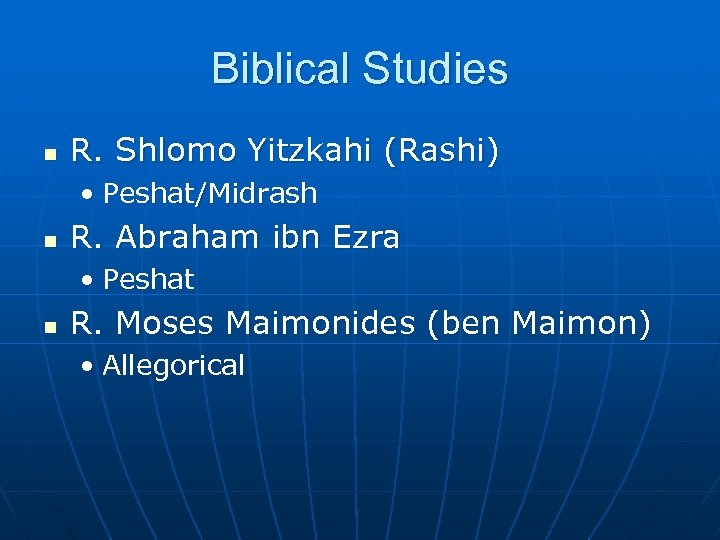 Biblical Studies n R. Shlomo Yitzkahi (Rashi) • Peshat/Midrash n R. Abraham ibn Ezra • Peshat n R. Moses Maimonides (ben Maimon) • Allegorical
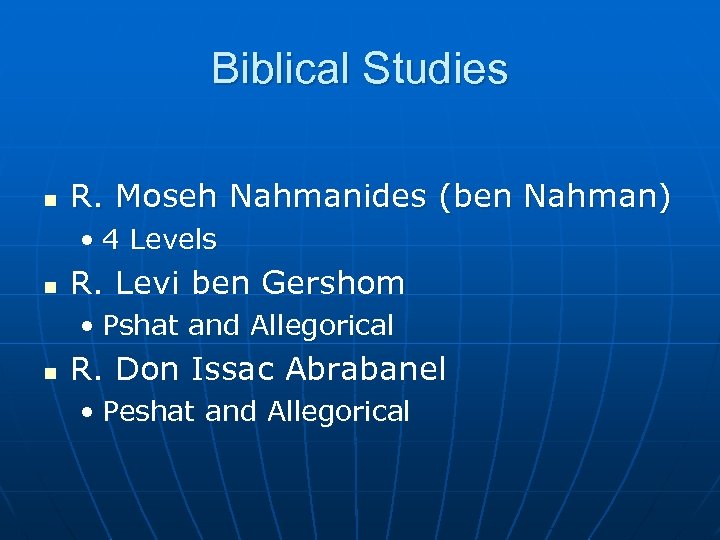 Biblical Studies n R. Moseh Nahmanides (ben Nahman) • 4 Levels n R. Levi ben Gershom • Pshat and Allegorical n R. Don Issac Abrabanel • Peshat and Allegorical
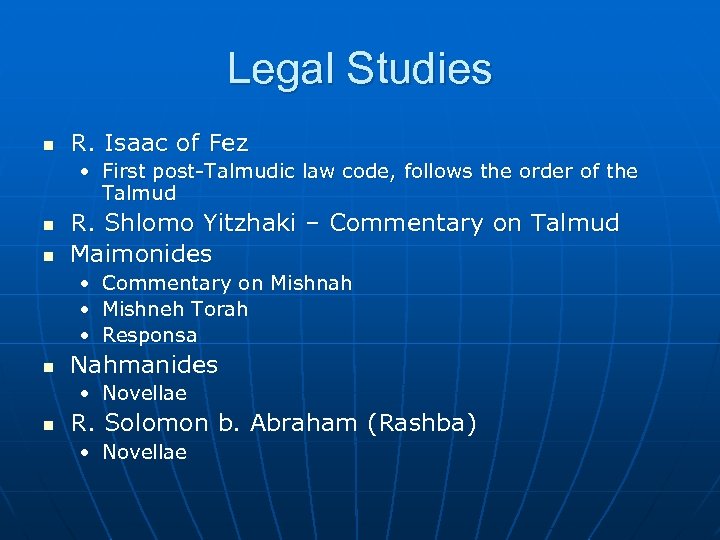 Legal Studies n R. Isaac of Fez • First post-Talmudic law code, follows the order of the Talmud n n R. Shlomo Yitzhaki – Commentary on Talmud Maimonides • • • n Commentary on Mishnah Mishneh Torah Responsa Nahmanides • Novellae n R. Solomon b. Abraham (Rashba) • Novellae
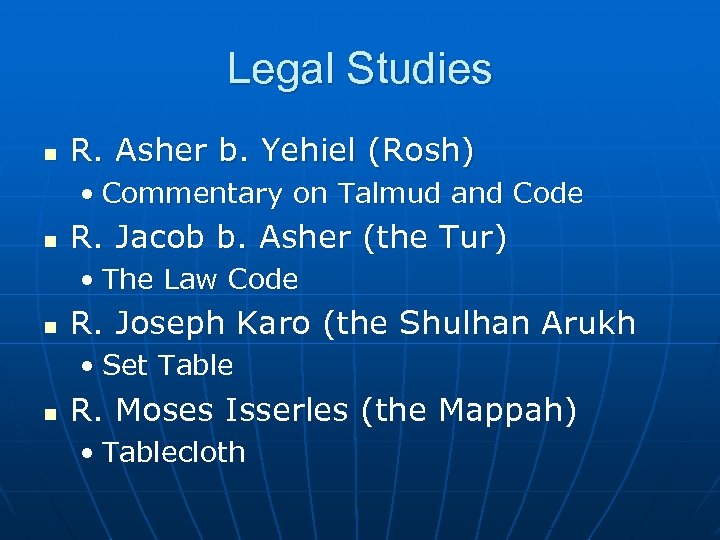 Legal Studies n R. Asher b. Yehiel (Rosh) • Commentary on Talmud and Code n R. Jacob b. Asher (the Tur) • The Law Code n R. Joseph Karo (the Shulhan Arukh • Set Table n R. Moses Isserles (the Mappah) • Tablecloth
 Philosophy and Ethics n n n 12 th cent. Abraham Ibn Ezra , Judah Halevy, Maimonides 13 th cent. Translation movement from Arabic to Hebrew, Samuel Ibn Tibbon and Shem Tov. b. Joseph Falaquera, 14 th cent. Philosophers include Gersonides, Joseph ibn Kaspi, and Moses of Narbonne, 15 th cent. Hasdai Crescas and Isaac Abrabanel, Spain.
 Ethical Studies n n Ethics: Bahya ibn Pakuda Maimonides’ Philosophical Ethics Ashkenzaic Pietists Sefer Hasidim c. 1200 Other Ethical Writings
 Kabbalah n n The Book of Luminosity (Sefer ha. Bahir), Writings of Abraham Abulafia the Zoharic literature, 13 th Spain. The Tree of Life (Etz Hayyim) of Isaac Luria, and the Orchard of Pomegranites (Pardes Rimonim) of Moshe Cordevero. R.
 Legal Studies n R. Asher b. Yehiel (Rosh) • Commentary on Talmud and Code n R. Jacob b. Asher (the Tur) • The Law Code n R. Joseph Karo (the Shulhan Arukh • Set Table n R. Moses Isserles (the Mappah) • Tablecloth