 Скачать презентацию UNIT-II STORAGE AUTOMATION By N Shivakumar AP Mech PMU
faafdac11fcf41d2e14212f5df8490c5.ppt
- Количество слайдов: 30



UNIT-II STORAGE AUTOMATION By N. Shivakumar AP/Mech/PMU
Syllabus • Automated storage and materials handling systems, • Automated materials handling (including AGV), storage and retrieval systems; • Robots and its applications in manufacturing.
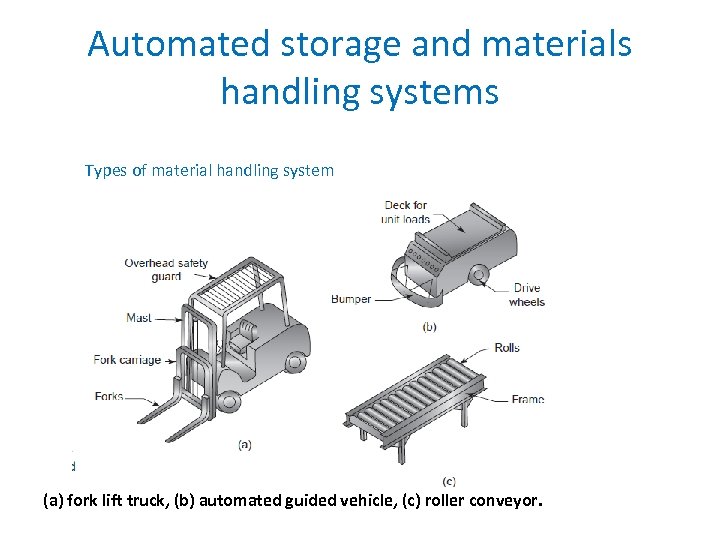
Automated storage and materials handling systems Types of material handling system (a) fork lift truck, (b) automated guided vehicle, (c) roller conveyor.
Material handling system A material-handling system can be simply defined as an integrated system involving such activities as handling, storing, and controlling of materials The word material has very broad meaning, covering all kinds of raw materials, work in process, subassemblies, and finished assemblies.
Types of material handling system 1. Industrial trucks include hand trucks such as two-wheeled, four-wheeled, hand lift, and forklift and powered trucks such as forklift, tractor-trailer trains, industrial crane trucks, and side loaders. 2. Conveyors such as belt, chute, roller, wheel, slat, chain, bucket, trolley, tow, screw, vibrating, and pneumatic. 3. Monorails, hoists, and cranes such as bridge, gantry, tower, and stacker. 4. Automated guided vehicle systems such as unit load carriers, towing, pallet trucks, fork trucks, and assembly line. 5. Automated storage and retrieval systems (AS/RS) such as unit load, miniload, person-on-board, deep lane, and storage carousel systems.
Automated guided vehicle systems An automated guided vehicle system is a batterypowered driver-less vehicle with programming capabilities for destination, path selection, and positioning. Components of an AGVS 1. The vehicle 2. The guide path. It guides the vehicle to move along the path. 3. The control unit. It monitors and directs system operations including feedback on moves, inventory, and vehicle status. 4. The computer interface. It interfaces with other computers and systems such as the mainframe host computer, the automated storage and retrieval system, and the flexible manufacturing system
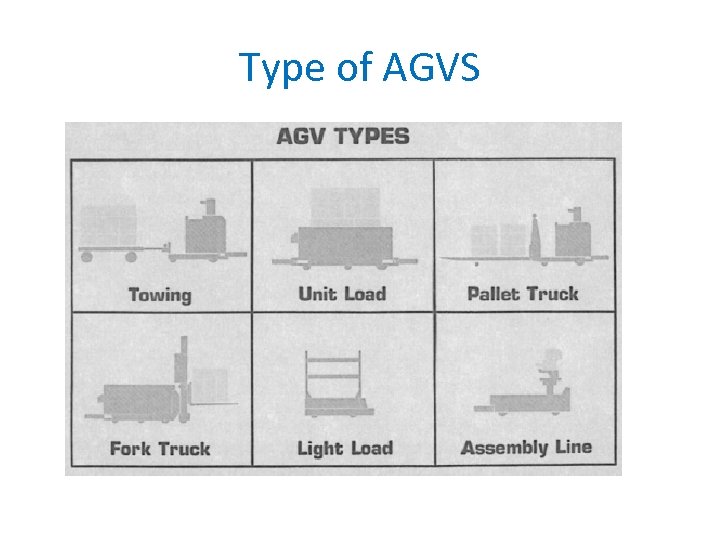
Type of AGVS
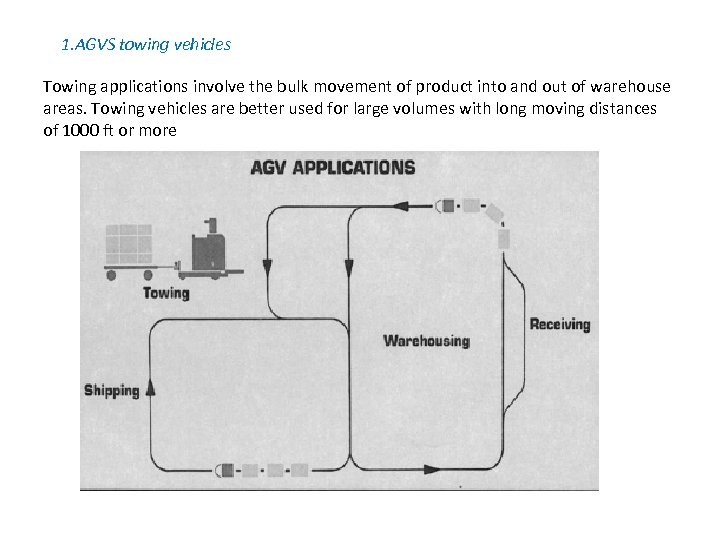
1. AGVS towing vehicles Towing applications involve the bulk movement of product into and out of warehouse areas. Towing vehicles are better used for large volumes with long moving distances of 1000 ft or more
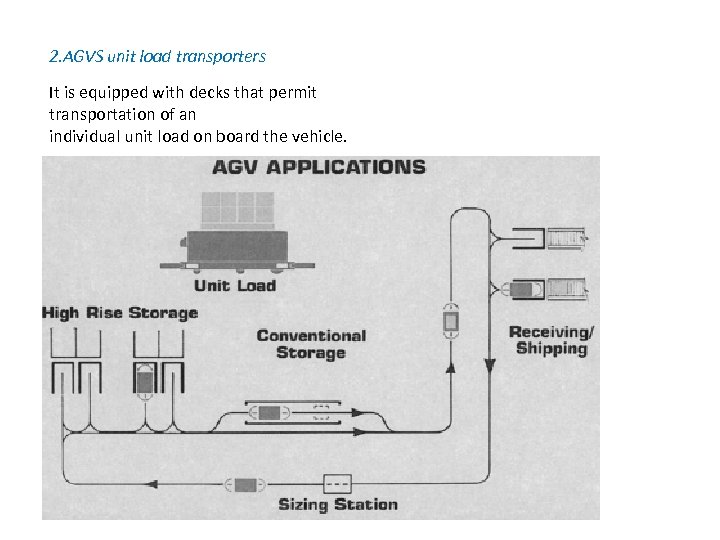
2. AGVS unit load transporters It is equipped with decks that permit transportation of an individual unit load on board the vehicle.
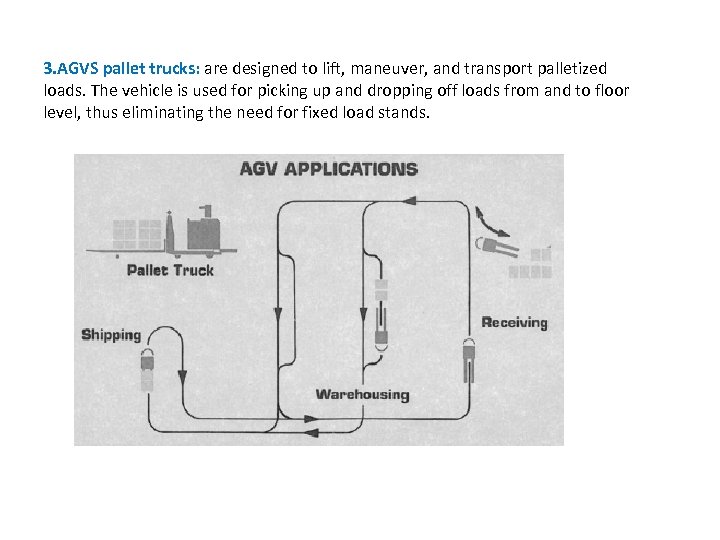
3. AGVS pallet trucks: are designed to lift, maneuver, and transport palletized loads. The vehicle is used for picking up and dropping off loads from and to floor level, thus eliminating the need for fixed load stands.
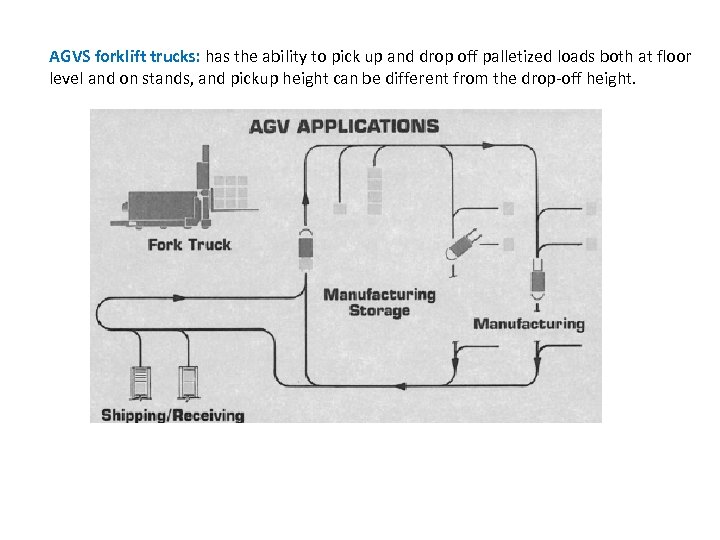
AGVS forklift trucks: has the ability to pick up and drop off palletized loads both at floor level and on stands, and pickup height can be different from the drop-off height.
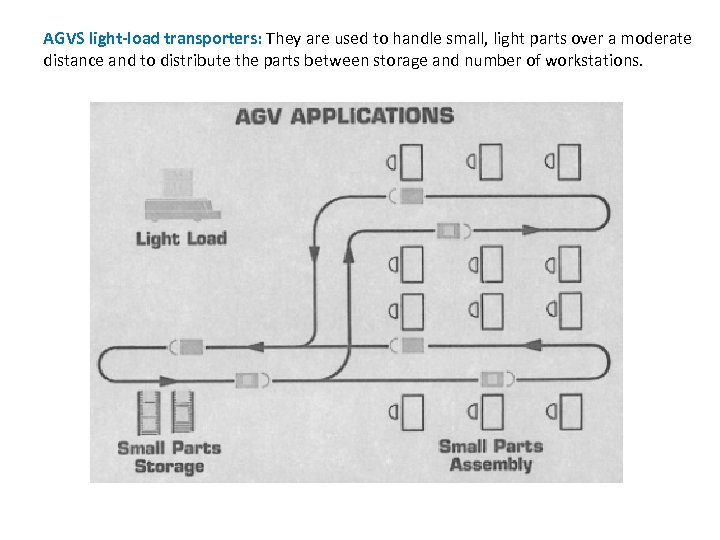
AGVS light-load transporters: They are used to handle small, light parts over a moderate distance and to distribute the parts between storage and number of workstations.
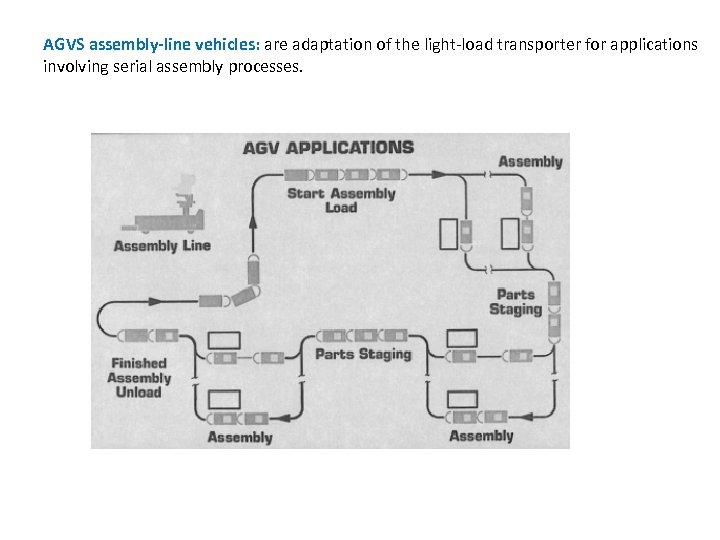
AGVS assembly-line vehicles: are adaptation of the light-load transporter for applications involving serial assembly processes.
Automated Storage and Retrieval Systems (AS/RS) To get right parts, pallets, fixtures, and tools to the right place at the right time, an efficient system for their storage and retrieval together with a material transportation system is required. An integrated FMS, AGVS, and AS/RS system provides an efficient production system for manufacturing low- to medium- volume and middle- to high-variety products. Functions of AS/RS 1. Automatic removal of an item from a storage location 2. Transportation of this item to a specific processing or interface point 3. Automatic storage of an item in a predetermined location, having received an item from a processing or interface point
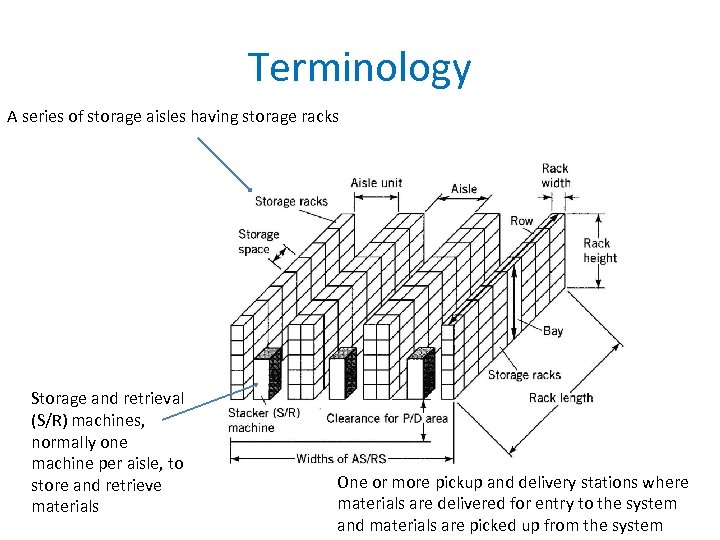
Terminology A series of storage aisles having storage racks Storage and retrieval (S/R) machines, normally one machine per aisle, to store and retrieve materials One or more pickup and delivery stations where materials are delivered for entry to the system and materials are picked up from the system
Type of AS/RS 1. Unit load AS/RS: is used to store and retrieve loads that are palletized or stored in standard-size containers. 2. Mini-load AS/RS: is designed to handle small loads such as individual parts, tools, and supplies. The system is suitable for use where there is a limit on the amount of space that can be utilized and where the volume is too low for a full-scale unit load system and tool high for a manual system. 3. Person-on-board AS/RS: allows storage of items in less than unit load quantities. 4. Deep-lane AS/RS: is another variation on the unit load system. The items are stored in multi-deep storage with up to 10 items per row rather than single or double deep. This leads to a high density of stored items. 5. Automated item retrieval system
Robots and its applications in manufacturing Def: An industrial robot is a general-purpose, programmable machine possessing certain anthropomorphic characteristics. The most obvious anthropomorphic characteristic of an industrial robot is its mechanical arm, that is used to perform various industrial tasks. Other human- like characteristics are the robot's capability to respond to sensory inputs, communicate with other machines, and make decisions. T
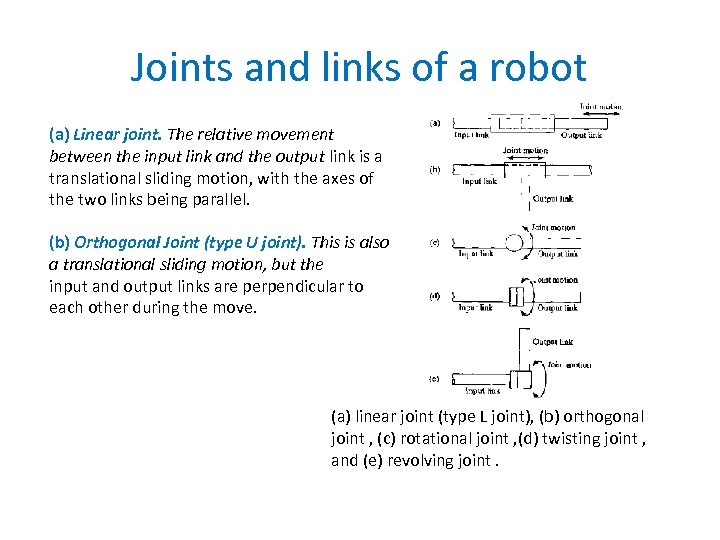
Joints and links of a robot (a) Linear joint. The relative movement between the input link and the output link is a translational sliding motion, with the axes of the two links being parallel. (b) Orthogonal Joint (type U joint). This is also a translational sliding motion, but the input and output links are perpendicular to each other during the move. (a) linear joint (type L joint), (b) orthogonal joint , (c) rotational joint , (d) twisting joint , and (e) revolving joint.
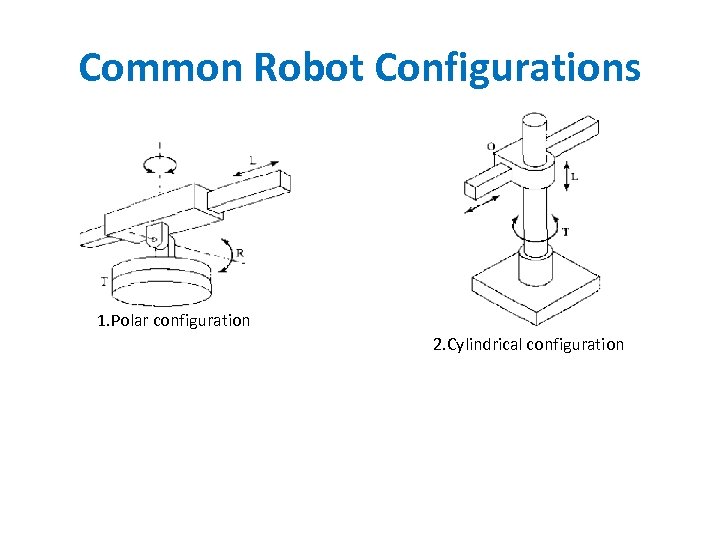
Common Robot Configurations 1. Polar configuration 2. Cylindrical configuration
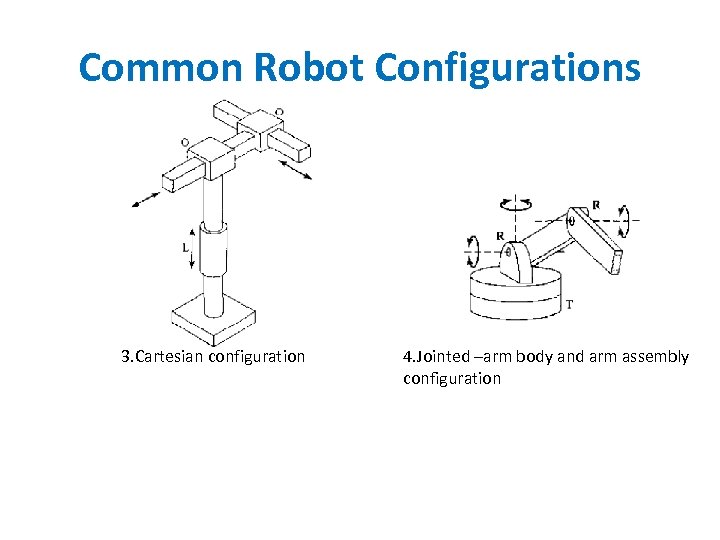
Common Robot Configurations 3. Cartesian configuration 4. Jointed –arm body and arm assembly configuration
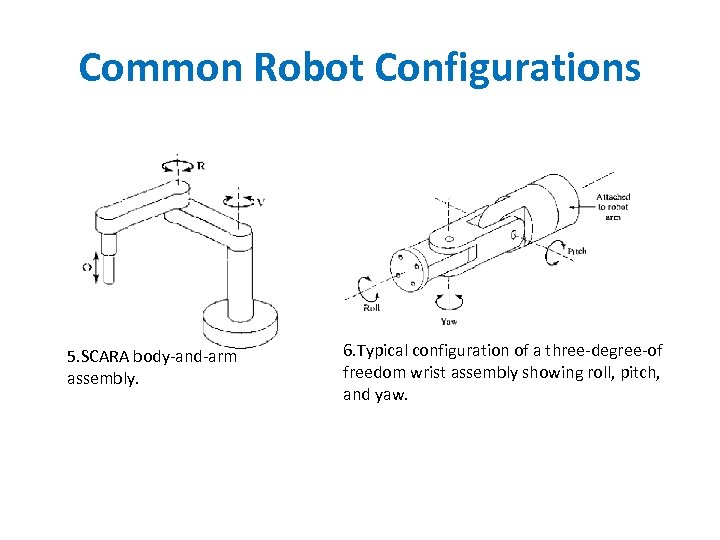
Common Robot Configurations 5. SCARA body-and-arm assembly. 6. Typical configuration of a three-degree-of freedom wrist assembly showing roll, pitch, and yaw.
INDUSTRIAL ROBOT Applications 1. Material Handling Application • Material handling applications are those in which the robot moves materials or parts from one place to another. To accomplish the transfer. the robot is equipped with a gripper type end effectors. • The gripper must be designed to handle the specific part or parts that are to be moved in the application, Included within this application category are the followings
Material Transfer. These applications are ones in which the primary purpose of the robot is to pick up parts at one location and place them at a new location. In many cases, reorientation of the part must be accomplished during the relocation.
Machine Loading and/or Unloading. In machine loading and/or unloading applications, the robot transfers parts into and/or from a production machine. The three possible cases are 1, Machine loading. This is the case in which the robot loads parts into the production machine, but the parts are unloaded from the machine by some other means 2. Machine unloading. In this case. the raw materials are fed into the machine without using the robot, and the robot unloads the finished parts. 3. Machine Loading and unloading. This case involves both loading or the raw work part and unloading of the finished part by the robot
2. Processing Operations Processing applications are those in which the robot performs a processing operation on a work part. A distinguishing feature of this category is that the robot , equipped with some type of tool as its end effectors 1. Spot Welding. Spot welding is a metal joining process in which two sheet metal parts are fused together at localized points of contact. Two copper-based electrodes are used to squeeze the metal parts together and then apply a large electrical current across the contact point to cause fusion to occur.
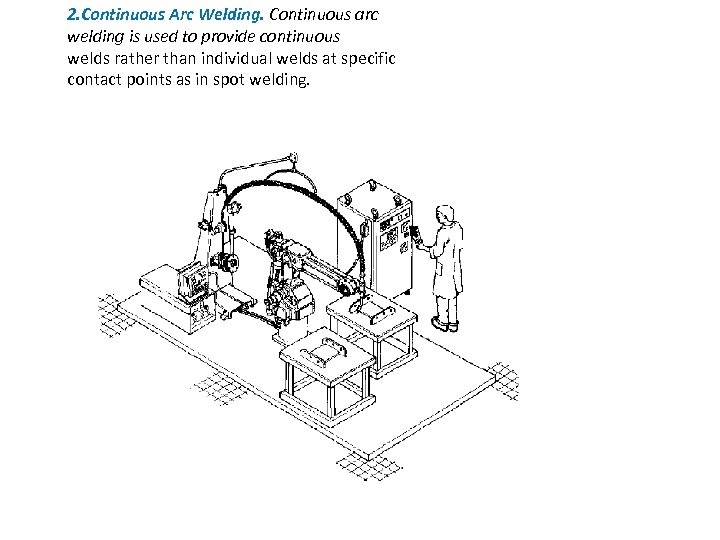
2. Continuous Arc Welding. Continuous arc welding is used to provide continuous welds rather than individual welds at specific contact points as in spot welding.
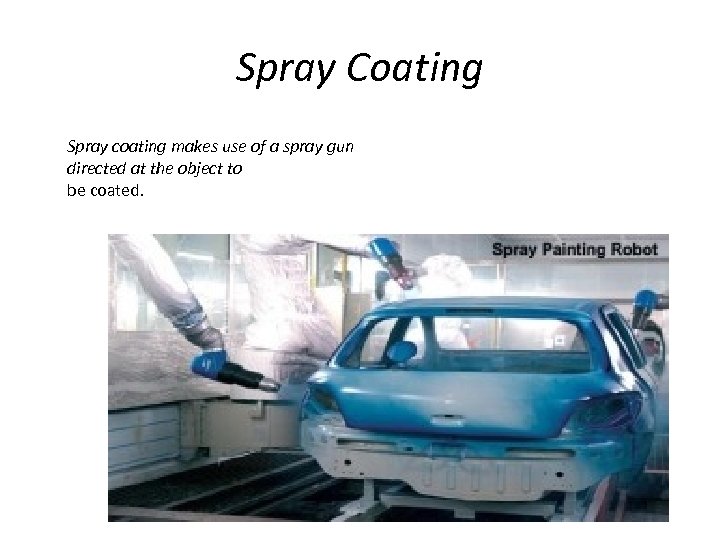
Spray Coating Spray coating makes use of a spray gun directed at the object to be coated.
Other Processing Applications. • Drilling, routing, and other machining processes • Grinding, wire brushing, and similar operations • Water jet cutting. • Laser cutting. • Riveting
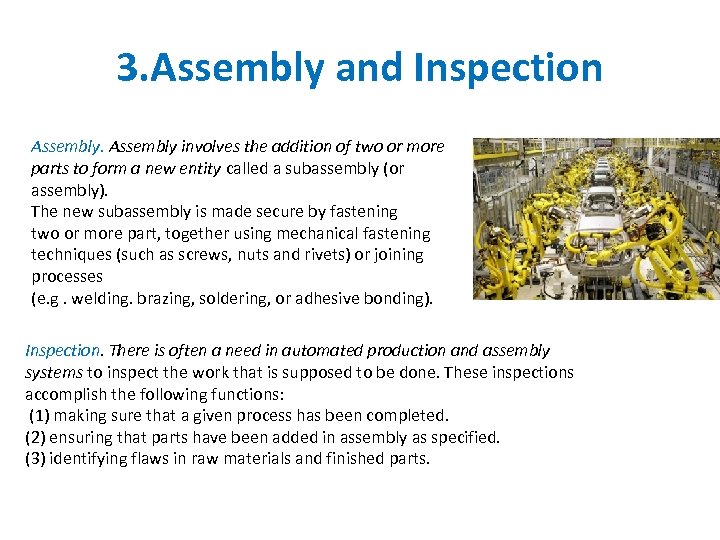
3. Assembly and Inspection Assembly involves the addition of two or more parts to form a new entity called a subassembly (or assembly). The new subassembly is made secure by fastening two or more part, together using mechanical fastening techniques (such as screws, nuts and rivets) or joining processes (e. g. welding. brazing, soldering, or adhesive bonding). Inspection. There is often a need in automated production and assembly systems to inspect the work that is supposed to be done. These inspections accomplish the following functions: (1) making sure that a given process has been completed. (2) ensuring that parts have been added in assembly as specified. (3) identifying flaws in raw materials and finished parts.

End
Скачать презентацию UNIT-II STORAGE AUTOMATION By N Shivakumar AP Mech PMU
faafdac11fcf41d2e14212f5df8490c5.ppt