 Скачать презентацию Unit B Career and Educational Exploration Competency CM
ce85e0c0fcaab41795c65488a880dab4.ppt
- Количество слайдов: 85




Unit B: Career and Educational Exploration Competency CM 03. 02 Evaluate Career Goals in terms of the experience, knowledge and skills needed to achieve them. 1

Objective CM 03. 02 Check the progression of formal and informal learning experiences toward achieving personal and career goals 2
Essential Questions 1. 2. What are the ways in which an employee can be paid? What should employees know about employment and income tax forms? 3
PAYDAY 1. Have you ever worked for pay? 2. Did you look forward to paydays? 3. Journal Entry: List words to describe you feelings on paydays. 4
A Payday candy bard could serve as a symbol of monetary compensation for work. • Eat Now and enjoy • Trade for something else • Save for later • Give away • Enjoy the smell 5
Activity l l Use available textbooks to search for all types of monetary and non-monetary compensations for work. List these on the handout Appendix 4. 01 A, “Forms of Compensation for Work, ” then write an explanation and give at least one example of each. 6
Types of Compensation for Work Types of monetary compensation---wage, salary, commissions, tips, bonuses l l l Wage---an amount of money paid for a specified quantity of labor Minimum wage---the lowest wage employers may legally pay workers Types of wages---full-time, part-time, flexible/seasonal, and overtime Salary-a set amount of income paid for a set period of time worked Commission-income paid as a percentage of sales made by a salesperson 7
Types of Compensation for Work Types of monetary compensation---wage, salary, commissions, tips, bonuses l l l Tips-also known as gratuities-monies paid by customers to those who provide services Bonus-money in addition to base pay, either as reward for performance or as share of profit 8
Types of Compensation for Work Types of non-monetary compensation---also known as benefits l Vacations, holidays and sick leave l Insurance l Savings/retirement plans l Education-related benefits---tuition, credits, job training l Family -related benefits---child care, maternity leave, adoption leave/support, family leave 9
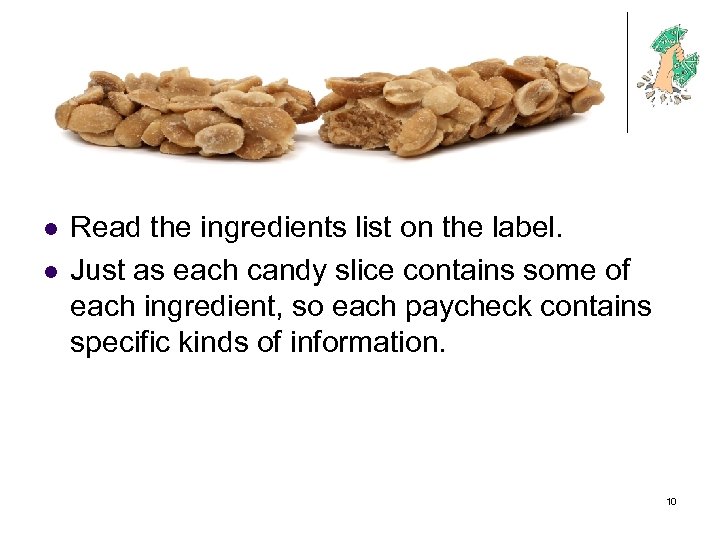
l l Read the ingredients list on the label. Just as each candy slice contains some of each ingredient, so each paycheck contains specific kinds of information. 10
Activity l Have students scan FEFE 1. 13. 1. F 1 information sheet “Understanding Your Paycheck” and complete the graphic organizers l l l Appendix 4. 01 A, “Forms of Compensation, ” Appendix 4. 01 B, “Money In, Money Out, ” and Appendix 4. 01 C, “Employment, Wage and Tax Forms” 11
Activity l l Have students complete the note-taking guide, FEFE 1. 13. 1. L 1, “Understanding Your Paycheck and Tax Forms” as they view FEFE Power. Point “Understanding your Paycheck. ” Answer questions; discuss. (In advance, download a blank Form W-4 and Form I-9 from www. irs. gov). Stop at slides 12 and 13 and guide students as they complete Form W-4 and Form I-9. 12

1. 13. 1. G 1 Family Economics & Financial Education Paychecks and Tax Forms Take Charge of your Finances © Family Economics & Financial Education – Revised March 2008 – Paychecks and Taxes Unit – Understanding Your Paycheck – Slide 13 Funded by a grant from Take Charge America, Inc. to the Norton School of Family and Consumer Sciences at the University of Arizona
1. 13. 1. G 1 Where Does My Money Go? • Almost 31% of an individual’s paycheck is deducted – Taxes are the largest expense most individuals will have – Therefore, it is important to understand the systematic deductions • U. S. tax system operates on an ongoing payment system – Taxes are immediately paid on income earned © Family Economics & Financial Education – Revised March 2008 – Paychecks and Taxes Unit – Understanding Your Paycheck – Slide 14 Funded by a grant from Take Charge America, Inc. to the Norton School of Family and Consumer Sciences at the University of Arizona
1. 13. 1. G 1 Paying Employees Three methods employers may use to pay employees: 1. Paycheck – payment given with a paper check with a paycheck stub attached • • • Most common method Employee responsible for handling the paycheck Immediately see payroll stub and deductions © Family Economics & Financial Education – Revised March 2008 – Paychecks and Taxes Unit – Understanding Your Paycheck – Slide 15 Funded by a grant from Take Charge America, Inc. to the Norton School of Family and Consumer Sciences at the University of Arizona
1. 13. 1. G 1 Paying Employees continued 2. Direct Deposit - employers directly deposit employee’s paycheck into the authorized employee’s depository institution account • • • Employee receives the paycheck stub detailing the paycheck deductions Most secure because there is no direct handling of the check Employee knows exactly when paycheck will be deposited and available © Family Economics & Financial Education – Revised March 2008 – Paychecks and Taxes Unit – Understanding Your Paycheck – Slide 16 Funded by a grant from Take Charge America, Inc. to the Norton School of Family and Consumer Sciences at the University of Arizona
1. 13. 1. G 1 Paying Employees continued 3. Payroll Card - payment electronically loaded onto a plastic card • Funds are directly deposited by an employer into an account at a depository institution that is linked to the payroll card – Parties involved: » Employer » Employee » Depository institution • Use the payroll card for ATM withdrawals or to make purchases © Family Economics & Financial Education – Revised March 2008 – Paychecks and Taxes Unit – Understanding Your Paycheck – Slide 17 Funded by a grant from Take Charge America, Inc. to the Norton School of Family and Consumer Sciences at the University of Arizona
1. 13. 1. G 1 Payroll Card • There are numerous fees associated with payroll cards – Number of fees depends upon the depository institution – Examples: • • Monthly or annual fee ATM fee Inactivity fee Fee after a specific number of transactions have been used Replacement fee if the card is lost, stolen , or destroyed Load fee (when funds are placed on the card account) Point of sale (POS) fee for using the card at a POS terminal, or an electronic payment processor © Family Economics & Financial Education – Revised March 2008 – Paychecks and Taxes Unit – Understanding Your Paycheck – Slide 18 Funded by a grant from Take Charge America, Inc. to the Norton School of Family and Consumer Sciences at the University of Arizona
1. 13. 1. G 1 Benefits of Using Payroll Cards • Employers • Employees – Lower internal costs • Costs associated with producing, handling, and distributing pay checks is eliminated • Depository Institutions – Profit from the fees charged to employees, employers, and merchants – Safer than carrying large amounts of cash – Unbanked employees do not have to pay check cashing fees • Americans roughly spend $8 billion annually in check cashing fees – Can access electronic monthly statement of transactions – Can receive a second card • Give allowances to children • Send money internationally – Easily make online purchases © Family Economics & Financial Education – Revised March 2008 – Paychecks and Taxes Unit – Understanding Your Paycheck – Slide 19 Funded by a grant from Take Charge America, Inc. to the Norton School of Family and Consumer Sciences at the University of Arizona
1. 13. 1. G 1 Consumer Protection with Payroll Cards • Regulation E – Electronic Fund Transfer Act – Protects payroll card holder from fraudulent charges on lost or stolen cards • Card holder is only liable for $50 if a lost or stolen card is reported within 48 hours – Over four million paychecks are stolen annually with no protection to employees – Regulation E provides exceptional safety and protection for payroll card holders © Family Economics & Financial Education – Revised March 2008 – Paychecks and Taxes Unit – Understanding Your Paycheck – Slide 20 Funded by a grant from Take Charge America, Inc. to the Norton School of Family and Consumer Sciences at the University of Arizona
1. 13. 1. G 1 Taxes • Taxes – Compulsory charges imposed on citizens by local, state, and federal governments. – Used to provide public goods and services. – Largest amount of taxes a person pays is on his/her income. • Internal Revenue Service (IRS) – Collects federal taxes, issues regulations, and enforces tax laws written by the United States Congress. © Family Economics & Financial Education – Revised March 2008 – Paychecks and Taxes Unit – Understanding Your Paycheck – Slide 21 Funded by a grant from Take Charge America, Inc. to the Norton School of Family and Consumer Sciences at the University of Arizona
1. 13. 1. G 1 Starting a New Job To receive a paycheck, an employee must: – Complete a Form W-4 • Employee’s Withholding Allowance Certificate – Complete a Form I-9 • Employment Eligibility Verification • http: //www. formi 9. com/form-i 9 -employmentverifications. aspx © Family Economics & Financial Education – Revised March 2008 – Paychecks and Taxes Unit – Understanding Your Paycheck – Slide 22 Funded by a grant from Take Charge America, Inc. to the Norton School of Family and Consumer Sciences at the University of Arizona
1. 13. 1. G 1 Form W-4 Employee’s Withholding Allowance Certificate – Determines the percentage of gross pay which will be withheld for taxes • Allowances – Used to determine the amount of federal taxes withheld from the paycheck – A person may claim a personal allowance if no one else claims the person as a dependent • Dependent – a person who relies on the taxpayer for financial support © Family Economics & Financial Education – Revised March 2008 – Paychecks and Taxes Unit – Understanding Your Paycheck – Slide 23 Funded by a grant from Take Charge America, Inc. to the Norton School of Family and Consumer Sciences at the University of Arizona
1. 13. 1. G 1 Steps to Completing a Form W-4 • Print or type legal name on Line 1 and home address directly below the name • Write Social Security number on Line 2 • On Line 3, check the appropriate box to indicate marital status • Enter a zero on Line 5 if not claiming any allowances • Sign name and date the form before giving it to the employer • Keep a copy for personal records © Family Economics & Financial Education – Revised March 2008 – Paychecks and Taxes Unit – Understanding Your Paycheck – Slide 24 Funded by a grant from Take Charge America, Inc. to the Norton School of Family and Consumer Sciences at the University of Arizona
1. 13. 1. G 1 Form I-9 Employment Eligibility Verification Form • Used to verify the eligibility of individuals to avoid hiring undocumented workers or others who are not eligible to work in the United States • Must provide documentation which establishes identity and employment eligibility – Examples include driver’s license, passport, Social Security card, and birth certificate © Family Economics & Financial Education – Revised March 2008 – Paychecks and Taxes Unit – Understanding Your Paycheck – Slide 25 Funded by a grant from Take Charge America, Inc. to the Norton School of Family and Consumer Sciences at the University of Arizona

1. 13. 1. G 1 Family Economics & Financial Education Reading a Paycheck © Family Economics & Financial Education – Revised March 2008 – Paychecks and Taxes Unit – Understanding Your Paycheck – Slide 26 Funded by a grant from Take Charge America, Inc. to the Norton School of Family and Consumer Sciences at the University of Arizona
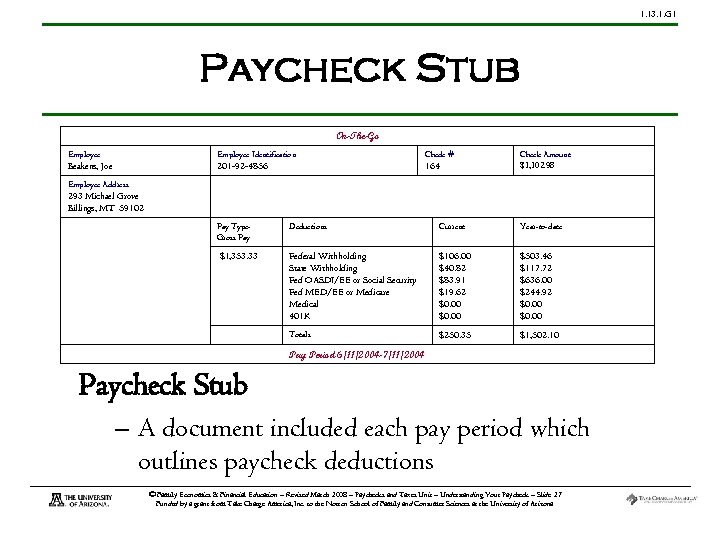
1. 13. 1. G 1 Paycheck Stub On-The-Go Employee Identification Check # Beakens, Joe 201 -92 -4856 164 Employee Address 293 Michael Grove Billings, MT 59102 Check Amount $1, 102. 98 Pay Type. Gross Pay Deductions Current Year-to-date $1, 353. 33 Federal Withholding State Withholding Fed OASDI/EE or Social Security Fed MED/EE or Medicare Medical 401 K $106. 00 $40. 82 $83. 91 $19. 62 $0. 00 $503. 46 $117. 72 $636. 00 $244. 92 $0. 00 Totals $250. 35 $1, 502. 10 Pay Period 6/11/2004 -7/11/2004 Paycheck Stub – A document included each pay period which outlines paycheck deductions © Family Economics & Financial Education – Revised March 2008 – Paychecks and Taxes Unit – Understanding Your Paycheck – Slide 27 Funded by a grant from Take Charge America, Inc. to the Norton School of Family and Consumer Sciences at the University of Arizona
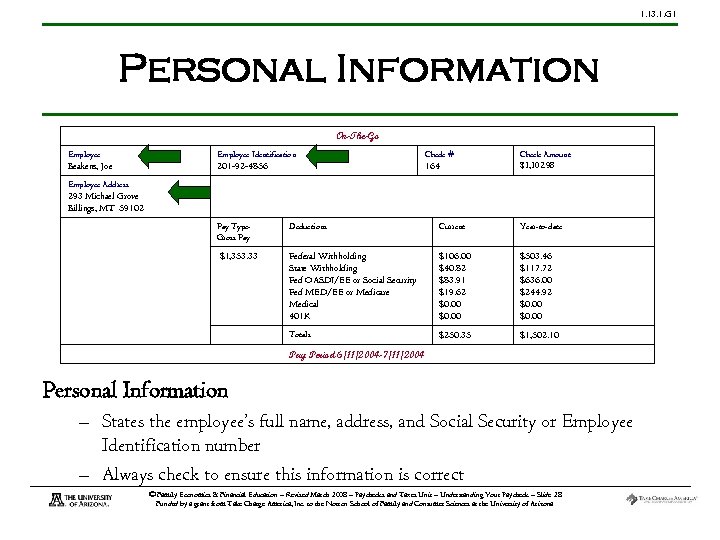
1. 13. 1. G 1 Personal Information On-The-Go Employee Identification Check # Beakens, Joe 201 -92 -4856 164 Employee Address 293 Michael Grove Billings, MT 59102 Check Amount $1, 102. 98 Pay Type. Gross Pay Deductions Current Year-to-date $1, 353. 33 Federal Withholding State Withholding Fed OASDI/EE or Social Security Fed MED/EE or Medicare Medical 401 K $106. 00 $40. 82 $83. 91 $19. 62 $0. 00 $503. 46 $117. 72 $636. 00 $244. 92 $0. 00 Totals $250. 35 $1, 502. 10 Pay Period 6/11/2004 -7/11/2004 Personal Information – States the employee’s full name, address, and Social Security or Employee Identification number – Always check to ensure this information is correct © Family Economics & Financial Education – Revised March 2008 – Paychecks and Taxes Unit – Understanding Your Paycheck – Slide 28 Funded by a grant from Take Charge America, Inc. to the Norton School of Family and Consumer Sciences at the University of Arizona
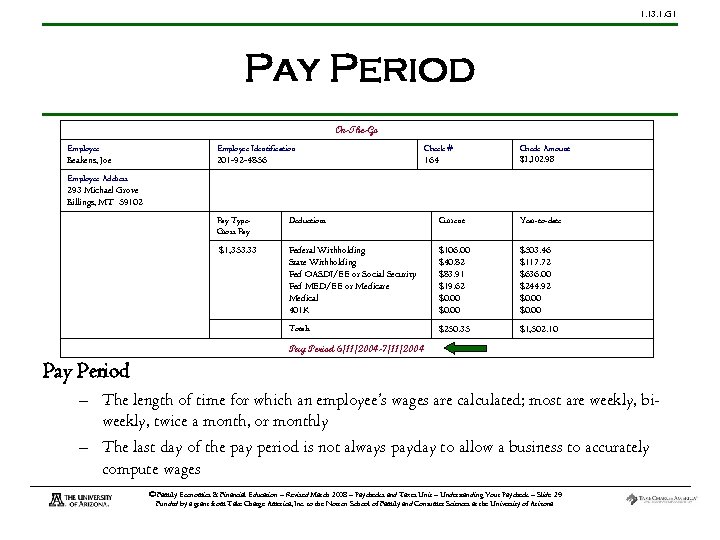
1. 13. 1. G 1 Pay Period On-The-Go Employee Identification Check # Beakens, Joe 201 -92 -4856 164 Employee Address 293 Michael Grove Billings, MT 59102 Check Amount $1, 102. 98 Pay Type. Gross Pay Deductions Current Year-to-date $1, 353. 33 Federal Withholding State Withholding Fed OASDI/EE or Social Security Fed MED/EE or Medicare Medical 401 K $106. 00 $40. 82 $83. 91 $19. 62 $0. 00 $503. 46 $117. 72 $636. 00 $244. 92 $0. 00 Totals $250. 35 $1, 502. 10 Pay Period 6/11/2004 -7/11/2004 Pay Period – The length of time for which an employee’s wages are calculated; most are weekly, biweekly, twice a month, or monthly – The last day of the pay period is not always payday to allow a business to accurately compute wages © Family Economics & Financial Education – Revised March 2008 – Paychecks and Taxes Unit – Understanding Your Paycheck – Slide 29 Funded by a grant from Take Charge America, Inc. to the Norton School of Family and Consumer Sciences at the University of Arizona
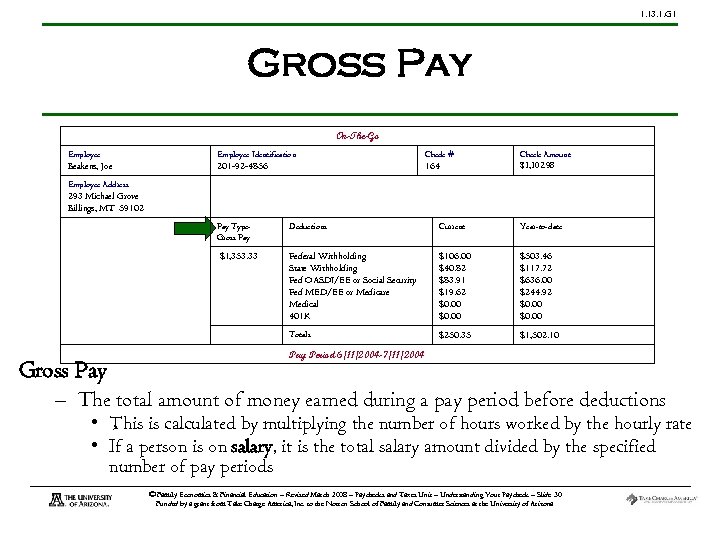
1. 13. 1. G 1 Gross Pay On-The-Go Employee Identification Check # Beakens, Joe 201 -92 -4856 164 Employee Address 293 Michael Grove Billings, MT 59102 Check Amount $1, 102. 98 Pay Type. Gross Pay Current Year-to-date Federal Withholding State Withholding Fed OASDI/EE or Social Security Fed MED/EE or Medicare Medical 401 K $106. 00 $40. 82 $83. 91 $19. 62 $0. 00 $503. 46 $117. 72 $636. 00 $244. 92 $0. 00 Gross Pay Deductions $1, 353. 33 Totals $250. 35 $1, 502. 10 Pay Period 6/11/2004 -7/11/2004 – The total amount of money earned during a pay period before deductions • This is calculated by multiplying the number of hours worked by the hourly rate • If a person is on salary, it is the total salary amount divided by the specified number of pay periods © Family Economics & Financial Education – Revised March 2008 – Paychecks and Taxes Unit – Understanding Your Paycheck – Slide 30 Funded by a grant from Take Charge America, Inc. to the Norton School of Family and Consumer Sciences at the University of Arizona
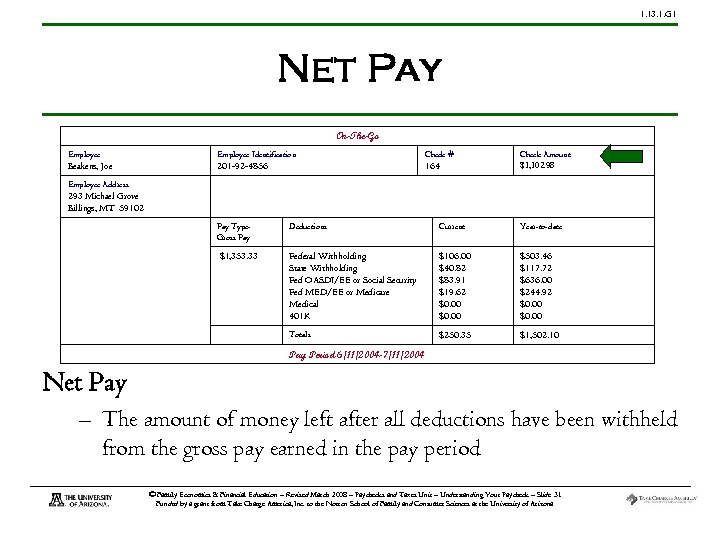
1. 13. 1. G 1 Net Pay On-The-Go Employee Identification Check # Beakens, Joe 201 -92 -4856 164 Employee Address 293 Michael Grove Billings, MT 59102 Check Amount $1, 102. 98 Pay Type. Gross Pay Deductions Current Year-to-date $1, 353. 33 Federal Withholding State Withholding Fed OASDI/EE or Social Security Fed MED/EE or Medicare Medical 401 K $106. 00 $40. 82 $83. 91 $19. 62 $0. 00 $503. 46 $117. 72 $636. 00 $244. 92 $0. 00 Totals $250. 35 $1, 502. 10 Pay Period 6/11/2004 -7/11/2004 Net Pay – The amount of money left after all deductions have been withheld from the gross pay earned in the pay period © Family Economics & Financial Education – Revised March 2008 – Paychecks and Taxes Unit – Understanding Your Paycheck – Slide 31 Funded by a grant from Take Charge America, Inc. to the Norton School of Family and Consumer Sciences at the University of Arizona
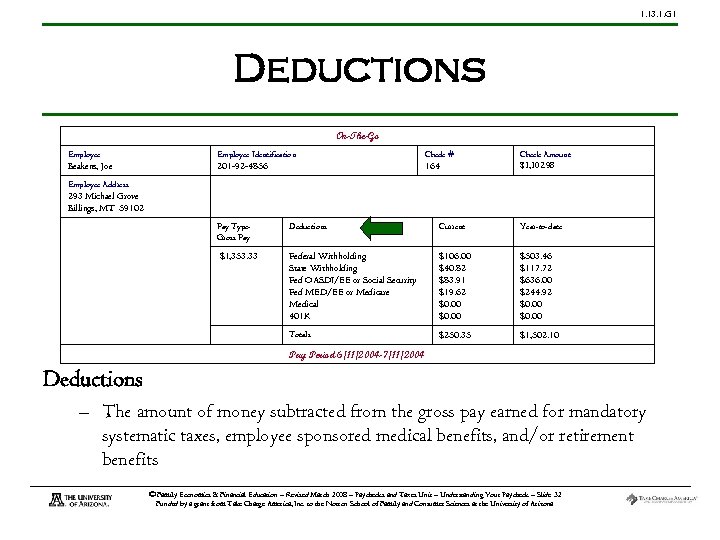
1. 13. 1. G 1 Deductions On-The-Go Employee Identification Check # Beakens, Joe 201 -92 -4856 164 Employee Address 293 Michael Grove Billings, MT 59102 Check Amount $1, 102. 98 Pay Type. Gross Pay Deductions Current Year-to-date $1, 353. 33 Federal Withholding State Withholding Fed OASDI/EE or Social Security Fed MED/EE or Medicare Medical 401 K $106. 00 $40. 82 $83. 91 $19. 62 $0. 00 $503. 46 $117. 72 $636. 00 $244. 92 $0. 00 Totals $250. 35 $1, 502. 10 Pay Period 6/11/2004 -7/11/2004 Deductions – The amount of money subtracted from the gross pay earned for mandatory systematic taxes, employee sponsored medical benefits, and/or retirement benefits © Family Economics & Financial Education – Revised March 2008 – Paychecks and Taxes Unit – Understanding Your Paycheck – Slide 32 Funded by a grant from Take Charge America, Inc. to the Norton School of Family and Consumer Sciences at the University of Arizona
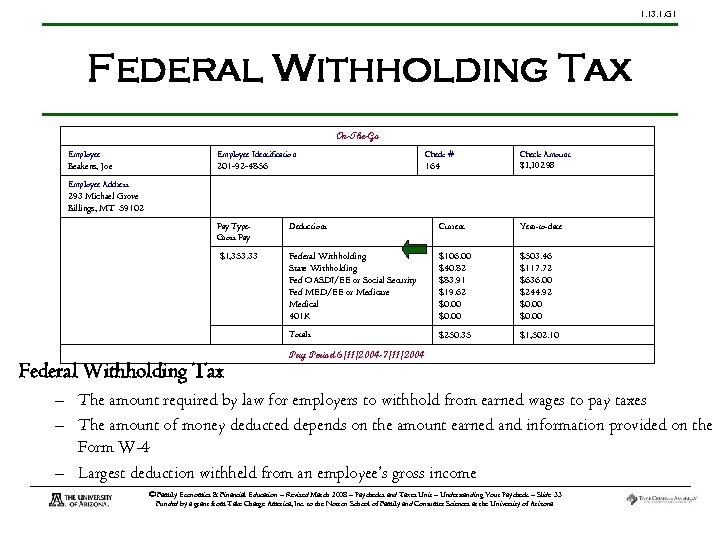
1. 13. 1. G 1 Federal Withholding Tax On-The-Go Employee Identification Check # Beakens, Joe 201 -92 -4856 164 Employee Address 293 Michael Grove Billings, MT 59102 Check Amount $1, 102. 98 Pay Type. Gross Pay Deductions Current Year-to-date $1, 353. 33 Federal Withholding State Withholding Fed OASDI/EE or Social Security Fed MED/EE or Medicare Medical 401 K $106. 00 $40. 82 $83. 91 $19. 62 $0. 00 $503. 46 $117. 72 $636. 00 $244. 92 $0. 00 Totals $250. 35 $1, 502. 10 Federal Withholding Tax Pay Period 6/11/2004 -7/11/2004 – The amount required by law for employers to withhold from earned wages to pay taxes – The amount of money deducted depends on the amount earned and information provided on the Form W-4 – Largest deduction withheld from an employee’s gross income © Family Economics & Financial Education – Revised March 2008 – Paychecks and Taxes Unit – Understanding Your Paycheck – Slide 33 Funded by a grant from Take Charge America, Inc. to the Norton School of Family and Consumer Sciences at the University of Arizona
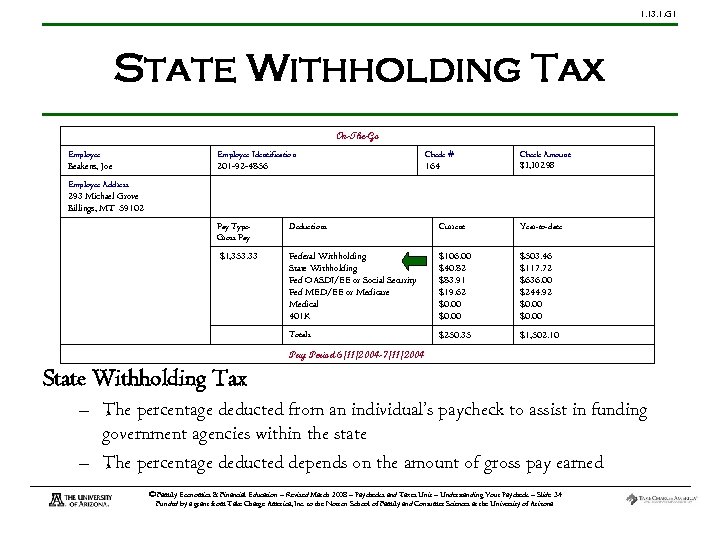
1. 13. 1. G 1 State Withholding Tax On-The-Go Employee Identification Check # Beakens, Joe 201 -92 -4856 164 Employee Address 293 Michael Grove Billings, MT 59102 Check Amount $1, 102. 98 Pay Type. Gross Pay Deductions Current Year-to-date $1, 353. 33 Federal Withholding State Withholding Fed OASDI/EE or Social Security Fed MED/EE or Medicare Medical 401 K $106. 00 $40. 82 $83. 91 $19. 62 $0. 00 $503. 46 $117. 72 $636. 00 $244. 92 $0. 00 Totals $250. 35 $1, 502. 10 Pay Period 6/11/2004 -7/11/2004 State Withholding Tax – The percentage deducted from an individual’s paycheck to assist in funding government agencies within the state – The percentage deducted depends on the amount of gross pay earned © Family Economics & Financial Education – Revised March 2008 – Paychecks and Taxes Unit – Understanding Your Paycheck – Slide 34 Funded by a grant from Take Charge America, Inc. to the Norton School of Family and Consumer Sciences at the University of Arizona
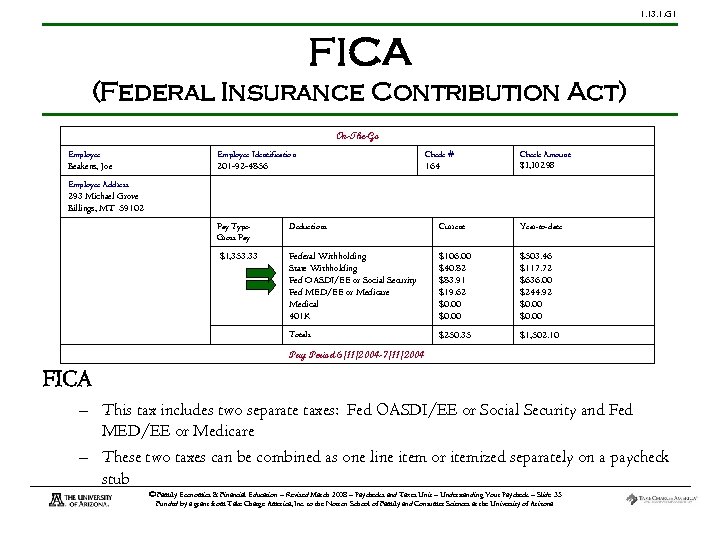
1. 13. 1. G 1 FICA (Federal Insurance Contribution Act) On-The-Go Employee Identification Check # Beakens, Joe 201 -92 -4856 164 Employee Address 293 Michael Grove Billings, MT 59102 Check Amount $1, 102. 98 Pay Type. Gross Pay Deductions Current Year-to-date $1, 353. 33 Federal Withholding State Withholding Fed OASDI/EE or Social Security Fed MED/EE or Medicare Medical 401 K $106. 00 $40. 82 $83. 91 $19. 62 $0. 00 $503. 46 $117. 72 $636. 00 $244. 92 $0. 00 Totals $250. 35 $1, 502. 10 Pay Period 6/11/2004 -7/11/2004 FICA – This tax includes two separate taxes: Fed OASDI/EE or Social Security and Fed MED/EE or Medicare – These two taxes can be combined as one line item or itemized separately on a paycheck stub © Family Economics & Financial Education – Revised March 2008 – Paychecks and Taxes Unit – Understanding Your Paycheck – Slide 35 Funded by a grant from Take Charge America, Inc. to the Norton School of Family and Consumer Sciences at the University of Arizona
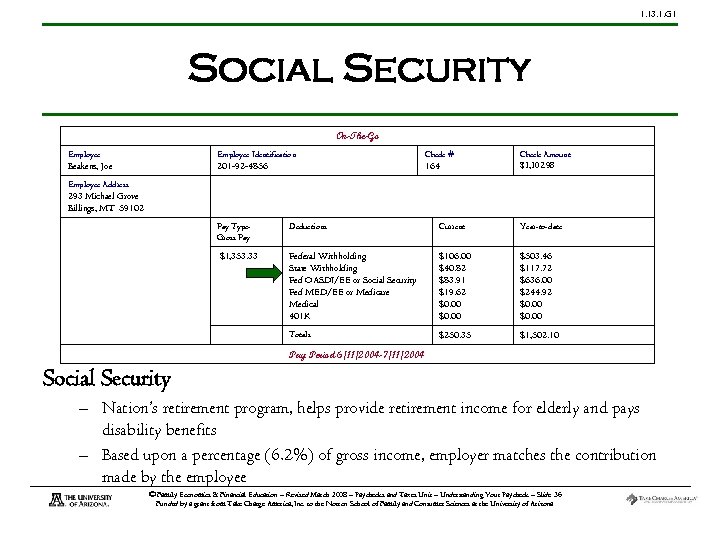
1. 13. 1. G 1 Social Security On-The-Go Employee Identification Check # Beakens, Joe 201 -92 -4856 164 Employee Address 293 Michael Grove Billings, MT 59102 Check Amount $1, 102. 98 Pay Type. Gross Pay Deductions Current Year-to-date $1, 353. 33 Federal Withholding State Withholding Fed OASDI/EE or Social Security Fed MED/EE or Medicare Medical 401 K $106. 00 $40. 82 $83. 91 $19. 62 $0. 00 $503. 46 $117. 72 $636. 00 $244. 92 $0. 00 Totals $250. 35 $1, 502. 10 Pay Period 6/11/2004 -7/11/2004 Social Security – Nation’s retirement program, helps provide retirement income for elderly and pays disability benefits – Based upon a percentage (6. 2%) of gross income, employer matches the contribution made by the employee © Family Economics & Financial Education – Revised March 2008 – Paychecks and Taxes Unit – Understanding Your Paycheck – Slide 36 Funded by a grant from Take Charge America, Inc. to the Norton School of Family and Consumer Sciences at the University of Arizona

1. 13. 1. G 1 Medicare On-The-Go Employee Identification Check # Beakens, Joe 201 -92 -4856 164 Employee Address 293 Michael Grove Billings, MT 59102 Check Amount $1, 102. 98 Pay Type. Gross Pay Deductions Current Year-to-date $1, 353. 33 Federal Withholding State Withholding Fed OASDI/EE or Social Security Fed MED/EE or Medicare Medical 401 K $106. 00 $40. 82 $83. 91 $19. 62 $0. 00 $503. 46 $117. 72 $636. 00 $244. 92 $0. 00 Totals $250. 35 $1, 502. 10 Pay Period 6/11/2004 -7/11/2004 Medicare – Nation’s health care program for the elderly and disabled, provides hospital and medical insurance to those who qualify – Based upon a percentage (1. 45%) of gross income © Family Economics & Financial Education – Revised March 2008 – Paychecks and Taxes Unit – Understanding Your Paycheck – Slide 37 Funded by a grant from Take Charge America, Inc. to the Norton School of Family and Consumer Sciences at the University of Arizona
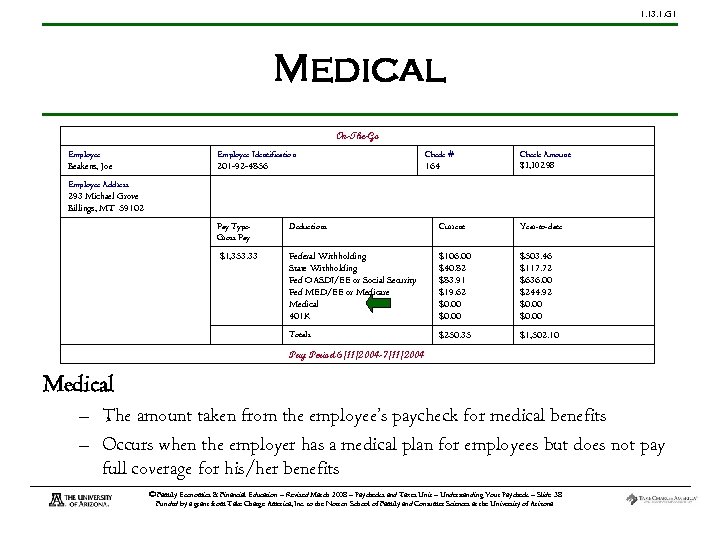
1. 13. 1. G 1 Medical On-The-Go Employee Identification Check # Beakens, Joe 201 -92 -4856 164 Employee Address 293 Michael Grove Billings, MT 59102 Check Amount $1, 102. 98 Pay Type. Gross Pay Deductions Current Year-to-date $1, 353. 33 Federal Withholding State Withholding Fed OASDI/EE or Social Security Fed MED/EE or Medicare Medical 401 K $106. 00 $40. 82 $83. 91 $19. 62 $0. 00 $503. 46 $117. 72 $636. 00 $244. 92 $0. 00 Totals $250. 35 $1, 502. 10 Pay Period 6/11/2004 -7/11/2004 Medical – The amount taken from the employee’s paycheck for medical benefits – Occurs when the employer has a medical plan for employees but does not pay full coverage for his/her benefits © Family Economics & Financial Education – Revised March 2008 – Paychecks and Taxes Unit – Understanding Your Paycheck – Slide 38 Funded by a grant from Take Charge America, Inc. to the Norton School of Family and Consumer Sciences at the University of Arizona
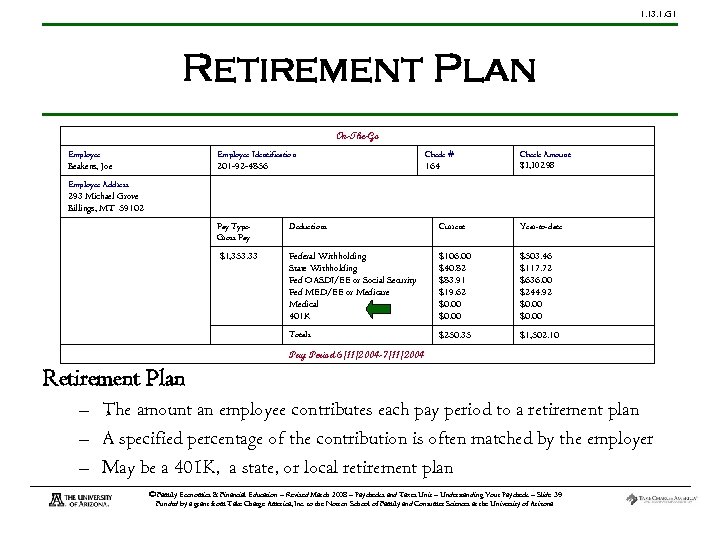
1. 13. 1. G 1 Retirement Plan On-The-Go Employee Identification Check # Beakens, Joe 201 -92 -4856 164 Employee Address 293 Michael Grove Billings, MT 59102 Check Amount $1, 102. 98 Pay Type. Gross Pay Deductions Current Year-to-date $1, 353. 33 Federal Withholding State Withholding Fed OASDI/EE or Social Security Fed MED/EE or Medicare Medical 401 K $106. 00 $40. 82 $83. 91 $19. 62 $0. 00 $503. 46 $117. 72 $636. 00 $244. 92 $0. 00 Totals $250. 35 $1, 502. 10 Pay Period 6/11/2004 -7/11/2004 Retirement Plan – The amount an employee contributes each pay period to a retirement plan – A specified percentage of the contribution is often matched by the employer – May be a 401 K, a state, or local retirement plan © Family Economics & Financial Education – Revised March 2008 – Paychecks and Taxes Unit – Understanding Your Paycheck – Slide 39 Funded by a grant from Take Charge America, Inc. to the Norton School of Family and Consumer Sciences at the University of Arizona
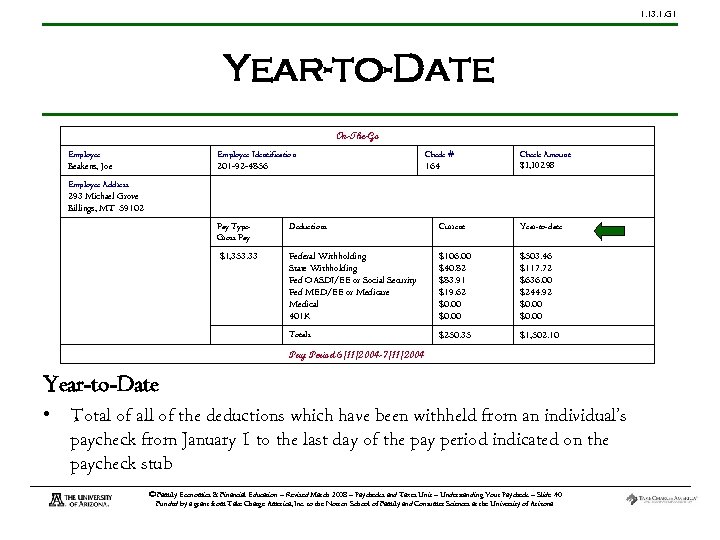
1. 13. 1. G 1 Year-to-Date On-The-Go Employee Identification Check # Beakens, Joe 201 -92 -4856 164 Employee Address 293 Michael Grove Billings, MT 59102 Check Amount $1, 102. 98 Pay Type. Gross Pay Deductions Current Year-to-date $1, 353. 33 Federal Withholding State Withholding Fed OASDI/EE or Social Security Fed MED/EE or Medicare Medical 401 K $106. 00 $40. 82 $83. 91 $19. 62 $0. 00 $503. 46 $117. 72 $636. 00 $244. 92 $0. 00 Totals $250. 35 $1, 502. 10 Pay Period 6/11/2004 -7/11/2004 Year-to-Date • Total of all of the deductions which have been withheld from an individual’s paycheck from January 1 to the last day of the pay period indicated on the paycheck stub © Family Economics & Financial Education – Revised March 2008 – Paychecks and Taxes Unit – Understanding Your Paycheck – Slide 40 Funded by a grant from Take Charge America, Inc. to the Norton School of Family and Consumer Sciences at the University of Arizona
Ways employees are paid Paycheck l Traditionally, a paper document issued to an employee for services rendered l Traditionally, the most common method of payment for work l Employer physically provides the employee with his/her paycheck 41
Ways employees are paid Paycheck stub l Attached to the paycheck to show the deductions l Monetary deductions subtracted for mandatory systematic taxes, employeesponsored medical benefits, and/or retirement benefits l Other deductions include insurance, investments, and other fringe benefits 42
Contents of paycheck stub l l l gross pay, net pay, hourly wage, hours worked, state/federal withholdings, Social Security income tax, employee’s name, Social Security number, total earned and withheld, year to date, last day of pay period 43
Ways employees are paid Direct deposit l When employers directly deposit an employee’s paycheck into an authorized account l Employee receives on payday a paycheck stub/electronic notice showing deductions l This method is more secure because there is no direct handling of the check and the employee knows exactly which day paycheck will be deposited and available for use 44
Ways employees are paid Payroll card l A prepaid card offered to employees as an alternative to paper paychecks or directly depositing wages into an employee’s financial institution account l Benefits to employees l Reduces or eliminates check cashing fees l Offers ability to make purchases using credit card networks l Offers 24 -hour access to funds via ATMs; no need to wait in lines l Reduces the need to carry a lot of cash l Makes money transfers more easily available to families l Provides a pseudo-bank account—funds do not need to be withdrawn entirely l as when using a check casher 45
Ways employees are paid Payroll card l A prepaid card offered to employees as an alternative to paper paychecks or directly depositing wages into an employee’s financial institution account l Benefits to employers l Reduces bank processing and check handling fees l Reduces check printing costs l Reduces likelihood of check fraud l Reduces check reconciliation costs l Increases employee productivity (no time off to cash or deposit paycheck) l Reduces lost/stolen check replacement costs 46
Forms for work and income taxes l l l Income taxes are taxes paid on earnings. They are known as progressive taxes; the higher the income earned, the higher the amount of taxes. In contrast, sales taxes are regressive taxes; they impose higher tax rates on those with lower incomes than those with higher. 47
Forms for work and income taxes Forms and materials l Used when a person begins a job l l W-4 – the Employee’s Withholding Allowance Certificate; information provided here determines the percentage of gross pay to be withheld for taxes I-9 – the Employment Eligibility Verification form; information gathered in this form is for employers to verify eligibility of individuals for employment; helps avoid hiring undocumented workers or others who are not eligible to work in the United State 48
Forms for work and income taxes Forms and materials l Used when filing income taxes l W-2 - states amount of money earned and taxes paid through previous year l Form 1040/1040 A/1040 EZ - common forms for filing federal income tax return l 1099 Forms - Tax forms that report other sources of income earned during a tax year. 1099 -INT for interest income, 1099 -DIV for dividends on investments, and 1099 -MISC for other sources of income 49
Forms for work and income taxes Forms and materials l Used when filing income taxes l Records of deductible expenses, including receipts and bank statements l Social Security number serves two major purposes: (1) provides a record of your covered earnings for retirement and disability benefits and (2) serves as an identification number for the Internal Revenue Service 50

Activity l Have students use the List-Group-Label literacy strategy to name the categories of terms in Appendix 4. 01 D, “List-Group. Label. ” 51
Journal Entry l l Display the Jump$tart principle, “Know your take home pay. ” Discuss the difference between gross and net pay. 52
Activity l l l Distribute FEFE 1. 13. 1. A 2, “Paycheck Stub 1” and 1. 13. 1. A 3, “Paycheck Stub 2. ” Have students work in pairs and use the KWC numeracy strategy with the Appendix 4. 02 E, “KWC Chart” to complete the first check stub activity. Have students work independently to complete the second check stub. 53
Activity l Using a Twister game mat, have students play FEFE 1. 13. 1. J 1, “Where Did All the Earnings Go? ” 54
Activity l l Have students complete Appendix 4. 01 F, “Scenarios: Payroll Forms”. Provide sample W-4, I-9, and W-2 forms for students to complete using information about the two brothers in the scenario. 55
Activity l As a review, have students complete FEFE 1. 13. 1. A 6, “Paychecks Math” and 1. 13. 1. A 5 “Paychecks. ” 56
l Internal Revenue Service l l Social Security Administration l l www. ssa. gov/online/ss-5. html Office of the Comptroller of the Currency l l www. irs. gov/formspubs www. occ. treas. gov/cdd/payrollcards Social Security Online l http: //www. ssa. gov/OACT/Prog. Data/tax. Rates. html 57
TERMS 58
l The amount of money paid for a specified quantity of labor. WAGE 59
• A set amount of money paid for a set period of time worked. Salary 60
• Income paid as a percentage of sales made by a salesman Commission 61
l Money paid by customers to those who provide services. Tip 62
l Money paid in addition to base pay, either as a reward for performance or as a share of profit. Bonus 63
l A form of payment to an employee paycheck 64
l An employer deposits the employee’s paycheck directly into the authorized employee’s depository institution account. direct deposit 65
l A prepaid card that is offered to employees as an alternative to paper paychecks or directly depositing wages into an employee’s depository institution payroll card 66
l This part lists the paycheck deductions as well as other important information. paycheck stub 67
l The length of time for which an employee’s wages are calculated. pay period 68
l The total amount of money earned during the pay period before deductions. gross pay 69
l The amount of money left after all the deductions have been taken from the gross pay earned in the pay period. net pay 70
l Money subtracted from gross pay for required taxes, employee insurance, and retirement benefits. deduction 71
l The amount required by law for employers to withhold from earned wages to pay federal income taxes. federal withholding tax 72
l The percentage deducted from an individual’s paycheck to assist in funding government agencies within the state withholding tax 73
l Federal Insurance Contributions Act. This tax includes Social Security and Medicare. Social Security taxes are based on a 6. 2 percentage of the employee’s gross income. Medicare is 1. 45% of gross income. FICA 74
l The amount an employee contributed each pay period to a retirement plan 75
l The amount taken from the employee’s paycheck for medical benefits. medical 76
l The total of all deductions which have been withheld from an individual’s paycheck from January 1 to the last day of the pay period year-to-date deductions 77
l A compulsory charge imposed on citizens by local, state, or federal governments. tax 78
l The higher the income, the higher the amount of taxes paid progressive tax 79
l They impose a higher tax rate on those with lower incomes than those with higher regressive tax 80
l States the amount of money earned and taxes paid throughout the previous year Form W-2 81
l An employee’s withholding certificate---the information provided on this form determines the percentage of gross pay to be withheld for taxes Form W-4 82
l Employment Eligibility Verification Form---the information on this form is for employers to verify the eligibility of individuals for employment. Form I-9 83
l l Tax forms that report other sources of income earned during a tax year. 1099 -INT- Interest income earned on savings and/or investment accounts during the previous year. 1099 -DIV- Dividends earned on investments during the previous year. 1099 -MISC- Income earned from self-employment, royalties, rent payments, unemployment compensation, and other sources. 1099 Forms 84

Journal Entry 85
Скачать презентацию Unit B Career and Educational Exploration Competency CM
ce85e0c0fcaab41795c65488a880dab4.ppt