 Скачать презентацию Unit 9 Distribution Channels of Distribution Distribution
0f2b01a807edcdd40b4cd4568a08bb18.ppt
- Количество слайдов: 28



Unit 9 Distribution Channels of Distribution
Distribution Basics Distribution is the Place Decision in the 4 P’s Channels of Distribution-path a product takes from producer to final user Channels end when a product changes form
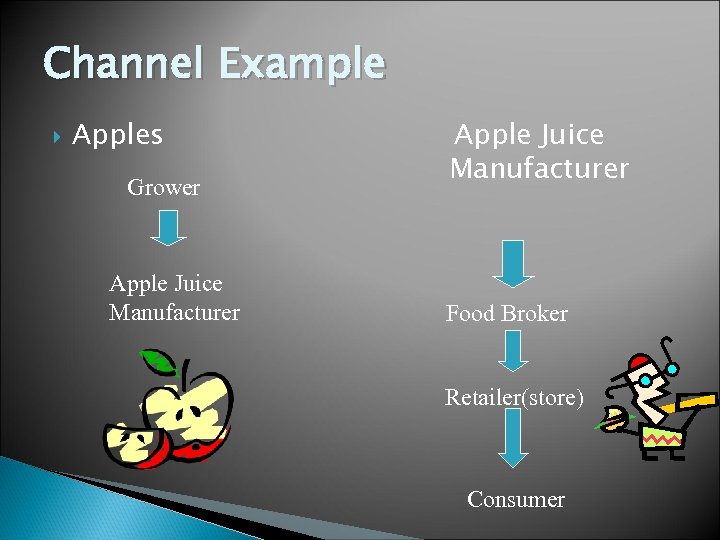
Channel Example Apples Grower Apple Juice Manufacturer Food Broker Retailer(store) Consumer
Channel Members Producer –grows a good Manufacturer-makes or assembles a good on a large scale through laborers and/or machinery Intermediaries-Channel members who help move products from producer to final user ◦ Merchant intermediaries -take title(ownership) of the good ◦ Agents-do not take title and are paid commission to help buyers and sellers get together Non-channel members ◦ transportation companies-truck, plane, barge
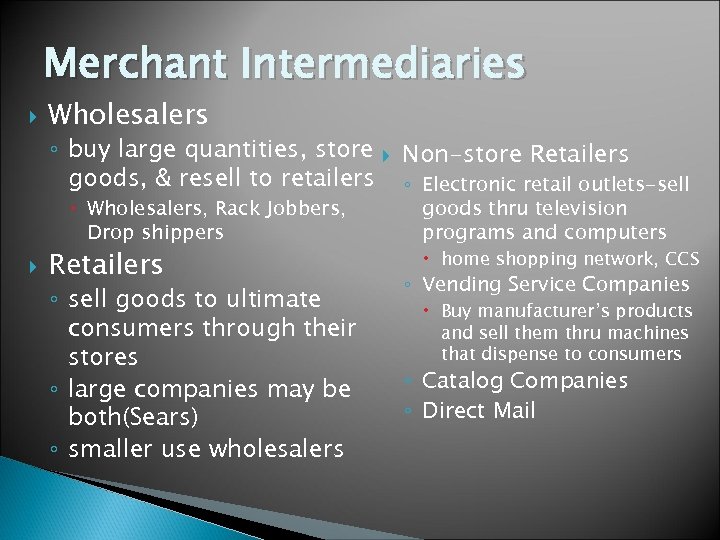
Merchant Intermediaries Wholesalers ◦ buy large quantities, store Non-store Retailers goods, & resell to retailers ◦ Electronic retail outlets-sell Wholesalers, Rack Jobbers, Drop shippers Retailers ◦ sell goods to ultimate consumers through their stores ◦ large companies may be both(Sears) ◦ smaller use wholesalers goods thru television programs and computers home shopping network, CCS ◦ Vending Service Companies Buy manufacturer’s products and sell them thru machines that dispense to consumers ◦ Catalog Companies ◦ Direct Mail
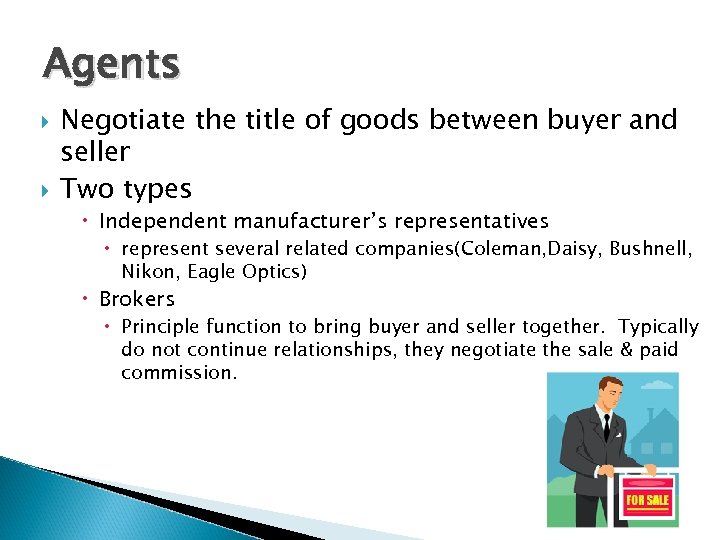
Agents Negotiate the title of goods between buyer and seller Two types Independent manufacturer’s representatives represent several related companies(Coleman, Daisy, Bushnell, Nikon, Eagle Optics) Brokers Principle function to bring buyer and seller together. Typically do not continue relationships, they negotiate the sale & paid commission.
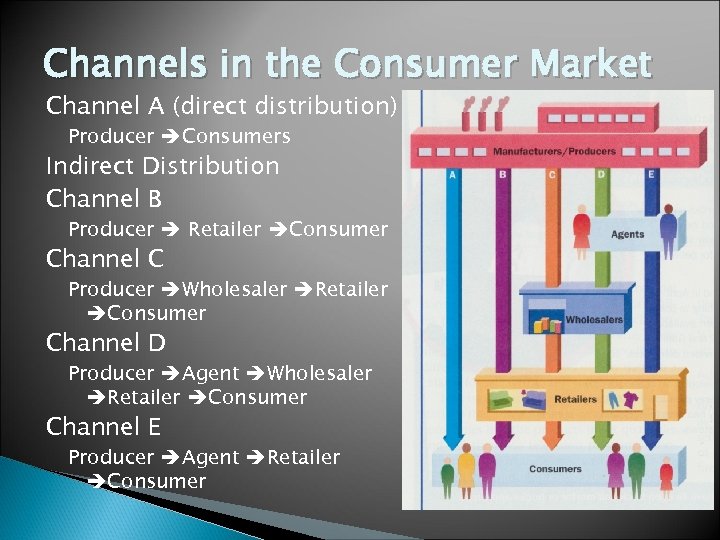
Channels in the Consumer Market Channel A (direct distribution) Producer Consumers Indirect Distribution Channel B Producer Retailer Consumer Channel C Producer Wholesaler Retailer Consumer Channel D Producer Agent Wholesaler Retailer Consumer Channel E Producer Agent Retailer Consumer
Channel Choices Manufacturer/Producer may use more than one channel to reach different customers Consumer Products ◦ Most commonly used channel is B Industrial Products ◦ Most commonly used channel is A
Nontraditional channels Using outlets to sell products where they previously weren’t sold example: i. Pods previously sold in electronic stores can be purchased through vending machines
Multiple Channels Product fits the needs of industrial and consumer users Patagonia (outdoor clothing) sells through their own stores, catalogs and other retailers
Control vs. Cost In-house sales force=most control but most costly ◦ Only use if product is well known and high sales volume If new company or new product may want to use an agent ◦ Less control but also costs less
Cost vs. Control Another issue is the power of retail giants to dictate terms to manufacturers Wal-mart, etc. may tell a manufacturer how to ship, package, and price products or else they won’t be sold there
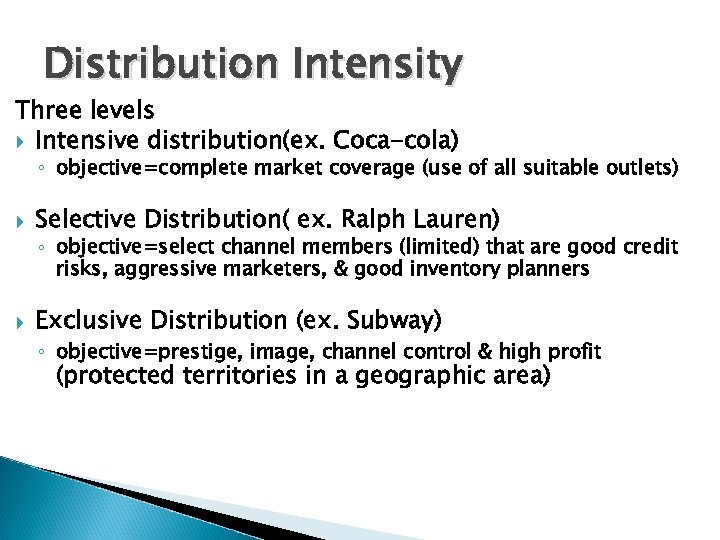
Distribution Intensity Three levels Intensive distribution(ex. Coca-cola) ◦ objective=complete market coverage (use of all suitable outlets) Selective Distribution( ex. Ralph Lauren) ◦ objective=select channel members (limited) that are good credit risks, aggressive marketers, & good inventory planners Exclusive Distribution (ex. Subway) ◦ objective=prestige, image, channel control & high profit (protected territories in a geographic area)
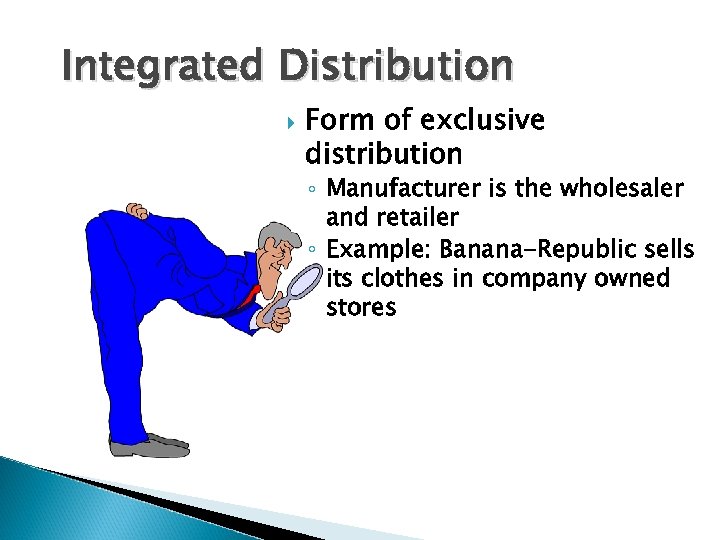
Integrated Distribution Form of exclusive distribution ◦ Manufacturer is the wholesaler and retailer ◦ Example: Banana-Republic sells its clothes in company owned stores
Physical Distribution Chapters 24 & 25 Part III
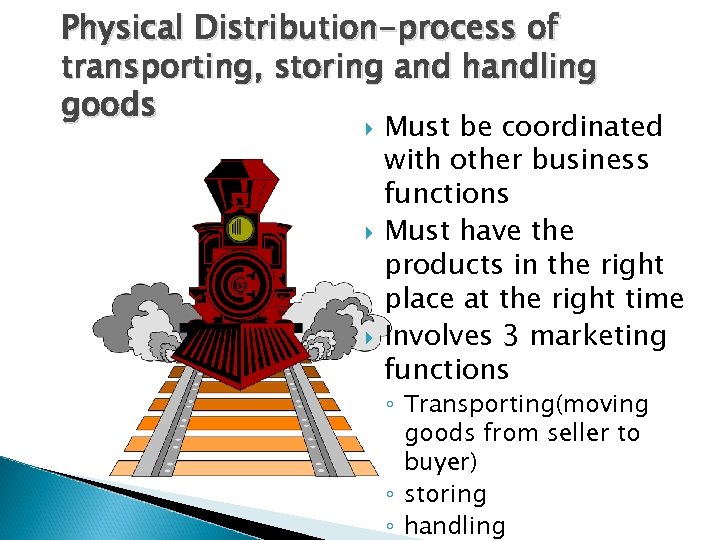
Physical Distribution-process of transporting, storing and handling goods Must be coordinated with other business functions Must have the products in the right place at the right time Involves 3 marketing functions ◦ Transporting(moving goods from seller to buyer) ◦ storing ◦ handling
Types of transportation Motor Carriers(trucking) ◦ Most frequently used ◦ lightweight shipments over moderate distances ◦ Four major types common carriers-charge a fee, usually specialize in a single commodity (good) Contracted carriers-negotiate rates with each business Private carriers-owned by business, transports own goods Exempt carriers-free from direct regulation of rates and operating procedures. Usually agricultural products
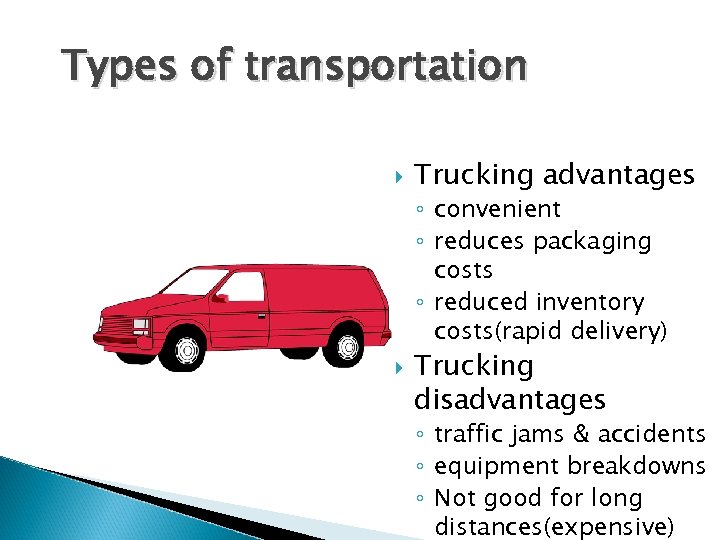
Types of transportation Trucking advantages ◦ convenient ◦ reduces packaging costs ◦ reduced inventory costs(rapid delivery) Trucking disadvantages ◦ traffic jams & accidents ◦ equipment breakdowns ◦ Not good for long distances(expensive)
Types of Transportation Rail ◦ Move heavy, bulky freight (coal) Ton mile-movement of one ton of freight one mile Carload-min. number of pounds of freight needed to fill a box car ◦ Five specialized services Piggyback & Fishyback service Specialized services (refrigerator cars) Package cars(lower rate after reaching weight) Diversion-in-Transit(redirection when in route) Processing-In-Transit(processed in route) ◦ Advantages-low costs, weather not a problem ◦ Disadvantages-lack of flexibility(limited to station stops)
Types of transportation Water Transportation ◦ oldest method ◦ Internal Waterways (river, lake ports) ◦ Intracoastal Waterways (ports along east or west coast or from Atlantic to Pacific) ◦ International Waterways-almost all international shipments due to low cost ◦ Advantages-low cost ◦ Disadvantages-slow, off-loading, bad weather
Methods of Transportation Pipelines Owned by company using them Transport oil & natural gas Carry same amount of ton-miles as trucking Advantagesdependable Disadvantage-high cost to construct, breakage
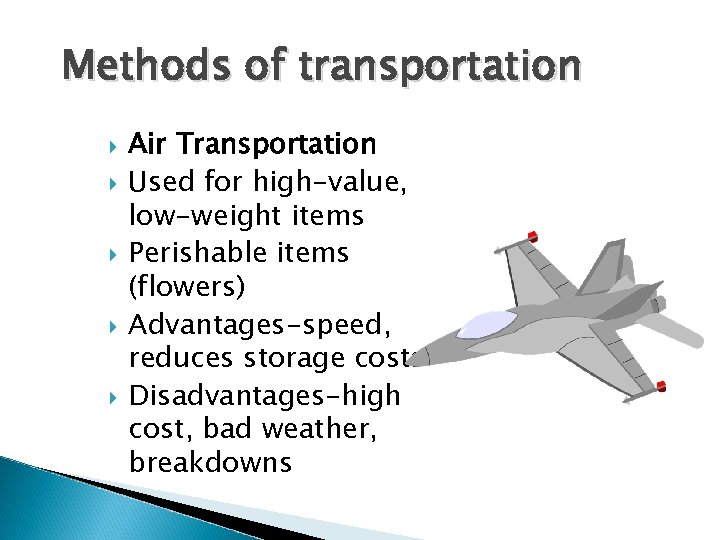
Methods of transportation Air Transportation Used for high-value, low-weight items Perishable items (flowers) Advantages-speed, reduces storage costs Disadvantages-high cost, bad weather, breakdowns
Transportation Service Companies US Postal Service-parcel post-packages weighing 16 ounces or less Express carriers-door-to-door delivery, rates based on speed, weight, & distance Bus Package companies-less than 100 lbs. , must be on scheduled route Freight Forwarders-combine shipments, use all methods, can obtain lower rates
Storage Chapter 24 and 25 Part IV
Storage of Goods Inventory=amount of goods stored Storage(holding goods till they are sold) adds time and place utility to goods Costs involve space, equipment, and personnel Also the cost of money tied up in inventory
Reasons for storage Production has outpaced consumption Product is only available during certain times of the year (agricultural) Items bought in quantity to get discount Stored in convenient locations to get faster delivery to customers
Warehouses Private warehouses(owned by business) ◦ designed to meet needs of owner, often house offices too Public warehouse(any business that will pay) ◦ rent space and provide services(shipment consolidation, barcode labeling, receiving) Distribution Center(designed to speed delivery of goods and min. storage costs) ◦ consolidate large orders and redistribute them as separate orders Bonded warehouses(store products that require the payment of federal tax) ◦ hold until taxes paid, business save by taking out goods only as they need them
Types of Public Warehouses Commodity warehouses-agricultural products Bulk storage warehouses-bulk form such as chemicals Cold storage warehouses-store perishables such as fruits Household goods warehouses-personal property storage General merchandise warehouse-any item that doesn’t require special handling
Скачать презентацию Unit 9 Distribution Channels of Distribution Distribution
0f2b01a807edcdd40b4cd4568a08bb18.ppt