 Скачать презентацию Unit 7 About China LOGO Contents Teaching
b0aff168ad50a0d397b8750a67552c3c.ppt
- Количество слайдов: 48



Unit 7 About China LOGO
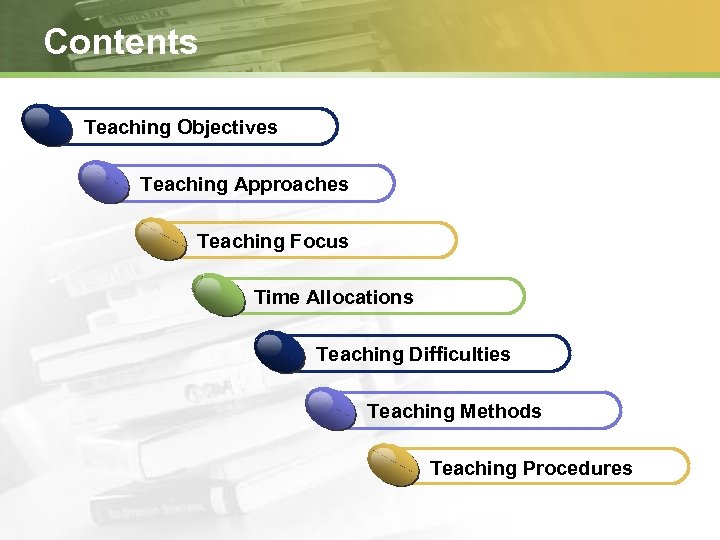
Contents Teaching Objectives Teaching Approaches Teaching Focus Time Allocations Teaching Difficulties Teaching Methods Teaching Procedures
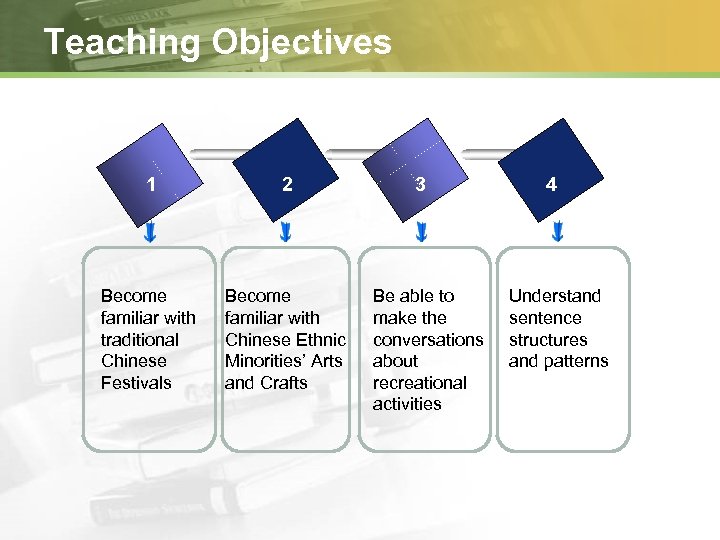
Teaching Objectives 1 2 Become familiar with traditional Chinese Festivals Become familiar with Chinese Ethnic Minorities’ Arts and Crafts 3 Be able to make the conversations about recreational activities 4 Understand sentence structures and patterns
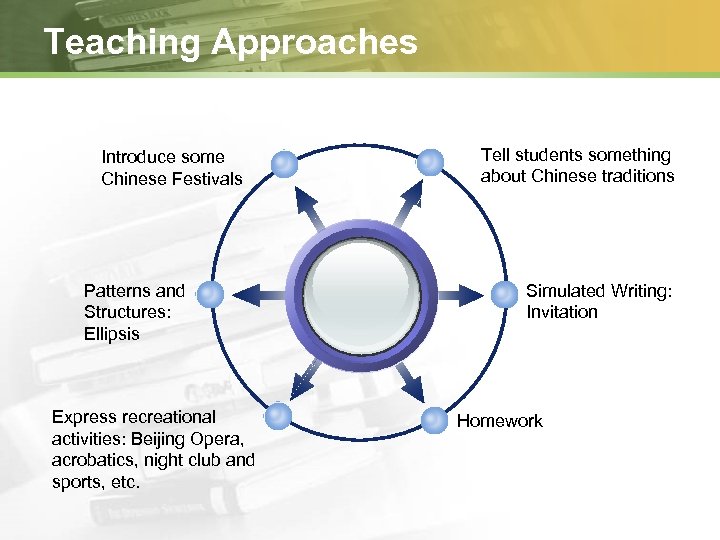
Teaching Approaches Introduce some Chinese Festivals Patterns and Structures: Ellipsis Express recreational activities: Beijing Opera, acrobatics, night club and sports, etc. Tell students something about Chinese traditions Simulated Writing: Invitation Homework
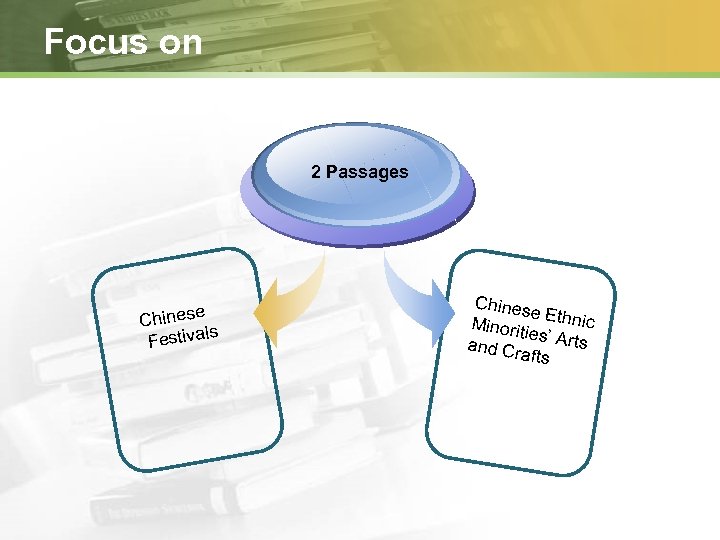
Focus on 2 Passages Chinese ls Festiva Chines e Minorit Ethnic ies and Cr ’ Arts afts
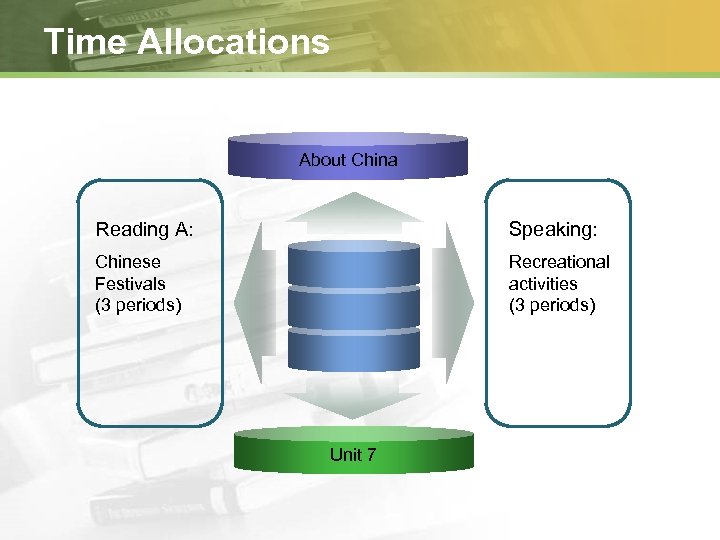
Time Allocations About China Reading A: Speaking: Chinese Festivals (3 periods) Recreational activities (3 periods) Unit 7
Teaching Difficulties The New Some Usages Useful Expressions Words Difficulties
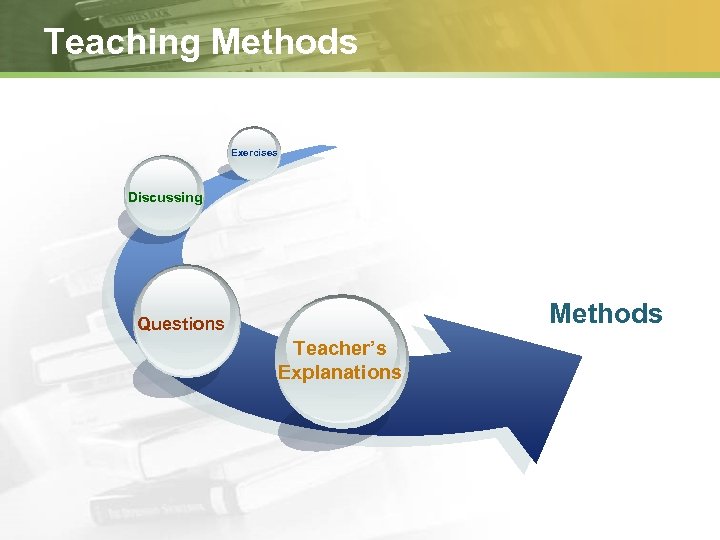
Teaching Methods Exercises Discussing Methods Questions Teacher’s Explanations
Teaching Procedures Chinese Festivals The Spring Festival The Lantern Festival The Qingming Festival National Day The Dragon Boat Festival The Moon Festival The Ghost Festival
Step 1 Leading in v What do Chinese people do on the New Year’s Eve? On New Year’s Eve, all the members of families come together to hold feasts. Jiaozi is popular in the North, while southerners favor a sticky sweet glutinous rice pudding called “Nian. Gao”. At midnight on New Year’s Eve, people used to set off fire-crackers to drive away the evil spirits and to greet the arrival of the new year. In an instant whole cities were engulfed in the deafening noise of the firecrackers. v How do Chinese people celebrate the National Day? Celebrations usually take the form of parties in amusement parks by day and fireworks and grand TV ensembles during the evening.
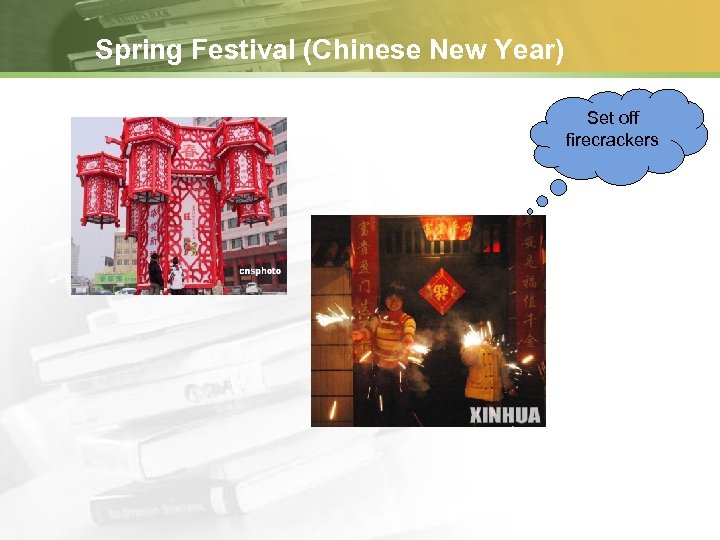
Spring Festival (Chinese New Year) Set off firecrackers
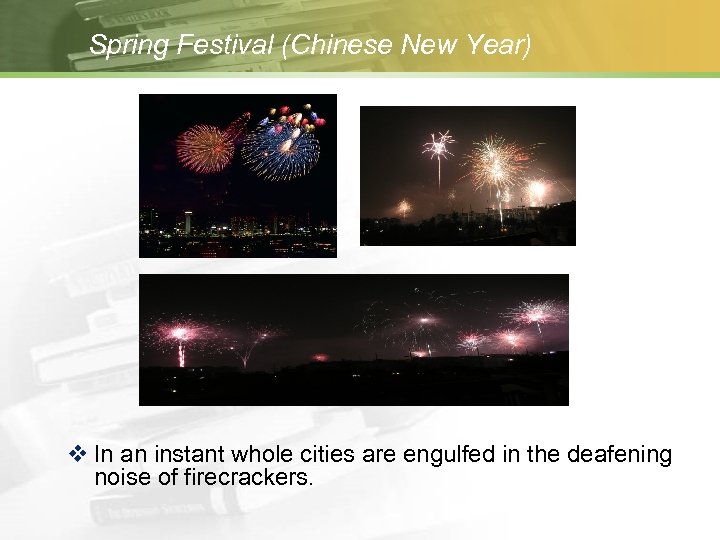
Spring Festival (Chinese New Year) v In an instant whole cities are engulfed in the deafening noise of firecrackers.
Spring Festival (Chinese New Year) v Time: January 1 of the Lunar Calendar v Activities: v Preparations: v Most families clean their homes, pay their debts, cut their hairs and buy new clothes. v Houses are festooned with paper scrolls bearing auspicious poetry. v People also burn incense at home and in the temples to pay respect to their ancestors and to pray to the gods for a happy life in the coming year. v On New Year’s Eve: v All the members of families come together to hold feasts. v People set off firecrackers to drive away the evil spirits and to greet the arrival of the new year.
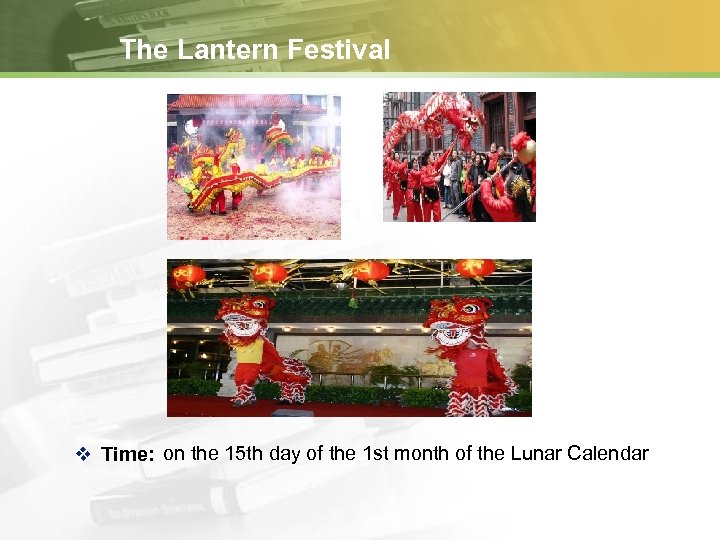
The Lantern Festival v Time: on the 15 th day of the 1 st month of the Lunar Calendar
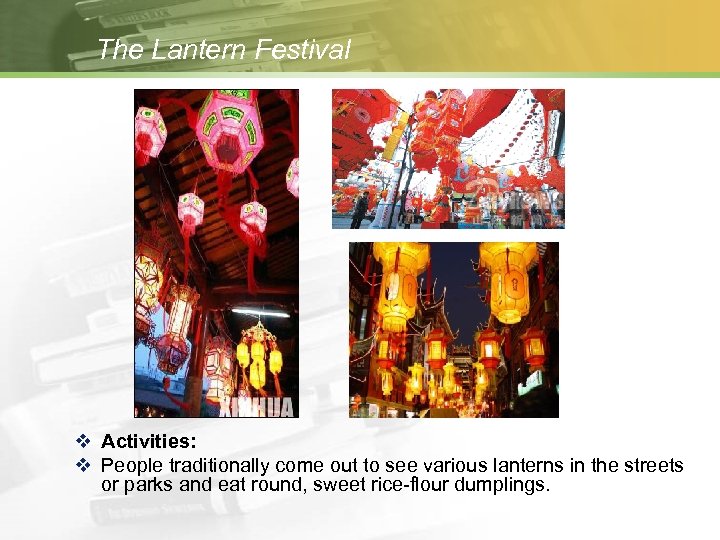
The Lantern Festival v Activities: v People traditionally come out to see various lanterns in the streets or parks and eat round, sweet rice-flour dumplings.
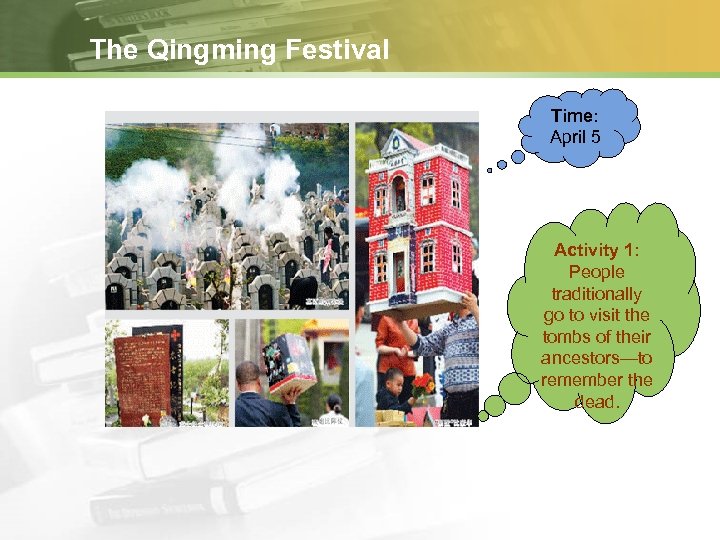
The Qingming Festival Time: April 5 Activity 1: People traditionally go to visit the tombs of their ancestors—to remember the dead.
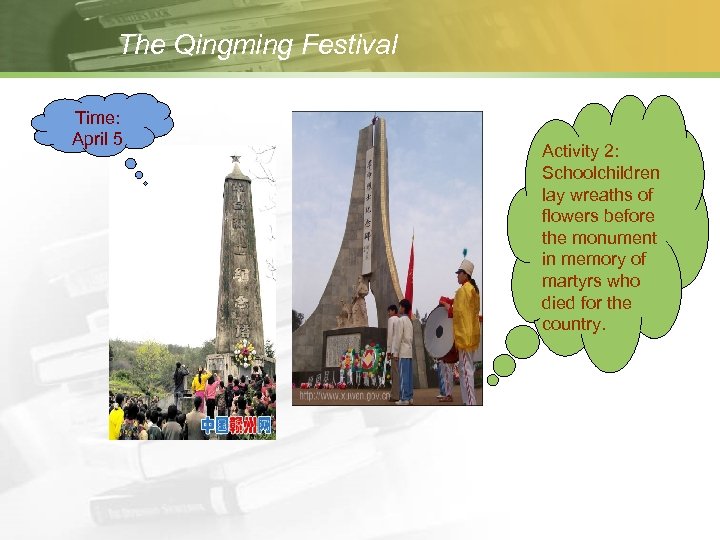
The Qingming Festival Time: April 5 Activity 2: Schoolchildren lay wreaths of flowers before the monument in memory of martyrs who died for the country.
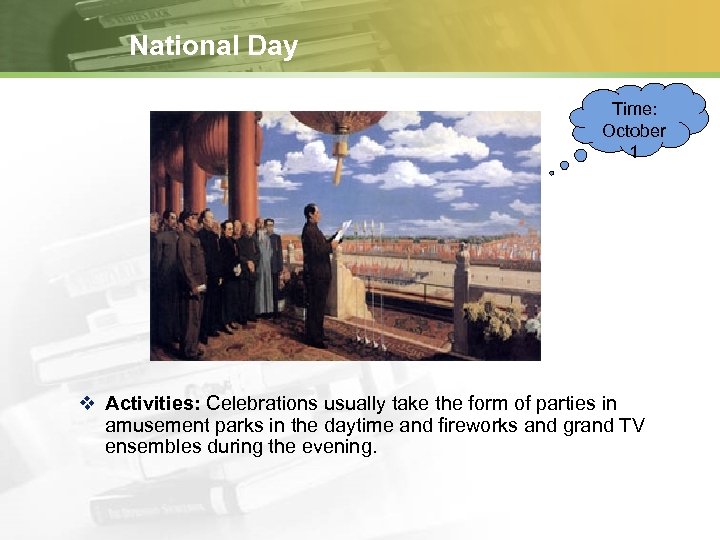
National Day Time: October 1 v Activities: Celebrations usually take the form of parties in amusement parks in the daytime and fireworks and grand TV ensembles during the evening.
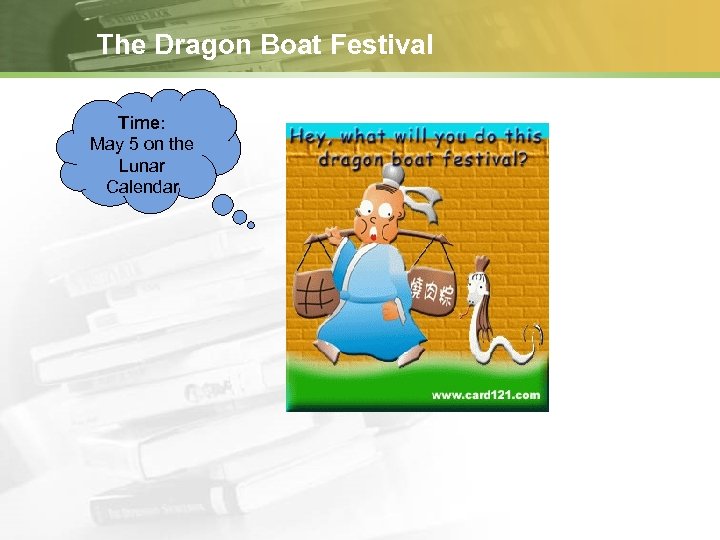
The Dragon Boat Festival Time: May 5 on the Lunar Calendar
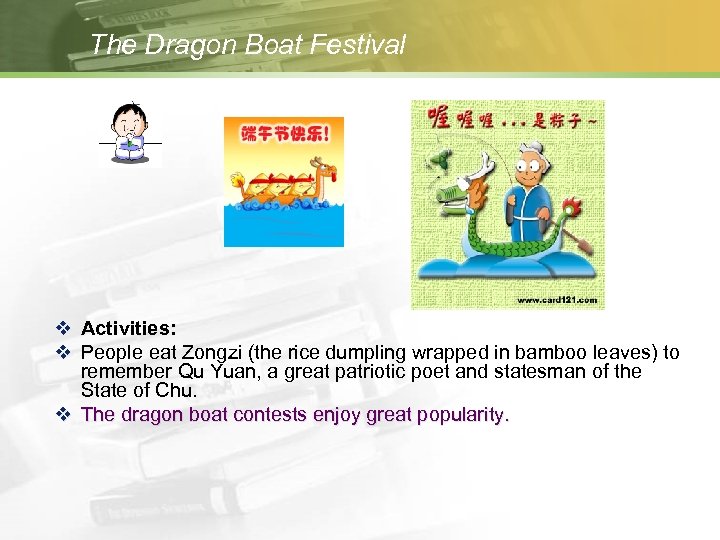
The Dragon Boat Festival v Activities: v People eat Zongzi (the rice dumpling wrapped in bamboo leaves) to remember Qu Yuan, a great patriotic poet and statesman of the State of Chu. v The dragon boat contests enjoy great popularity.
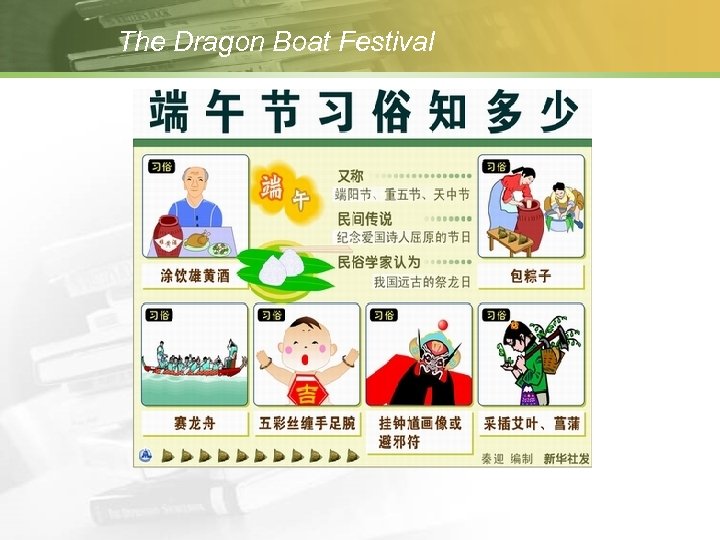
The Dragon Boat Festival
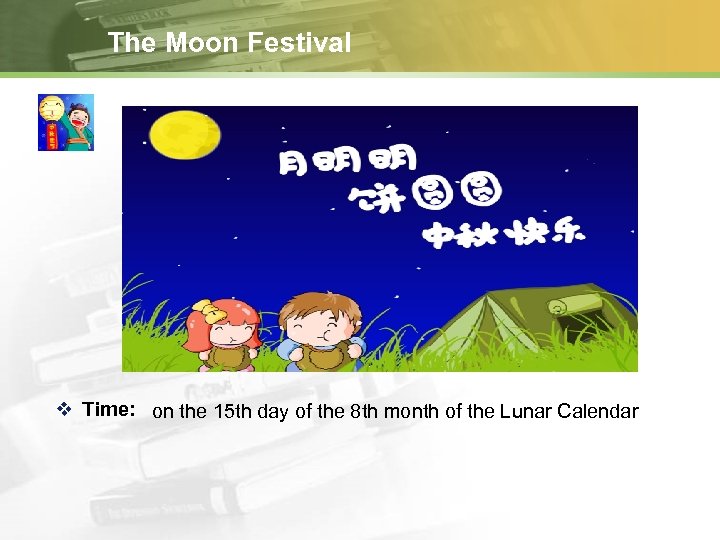
The Moon Festival v Time: on the 15 th day of the 8 th month of the Lunar Calendar
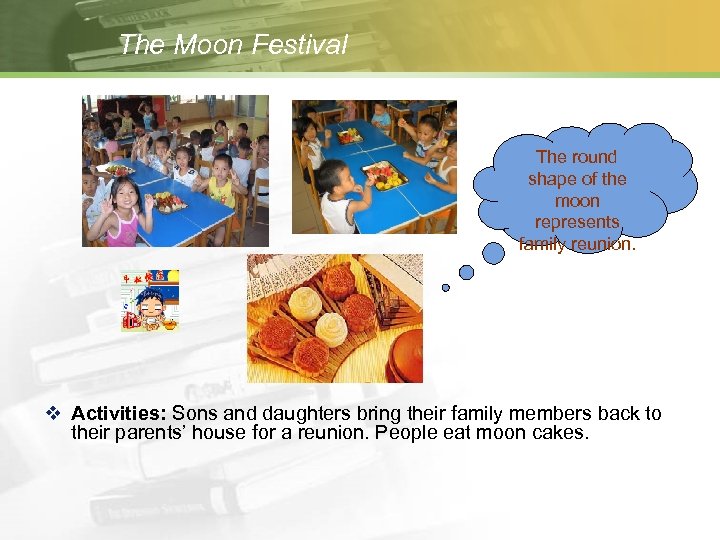
The Moon Festival The round shape of the moon represents family reunion. v Activities: Sons and daughters bring their family members back to their parents’ house for a reunion. People eat moon cakes.
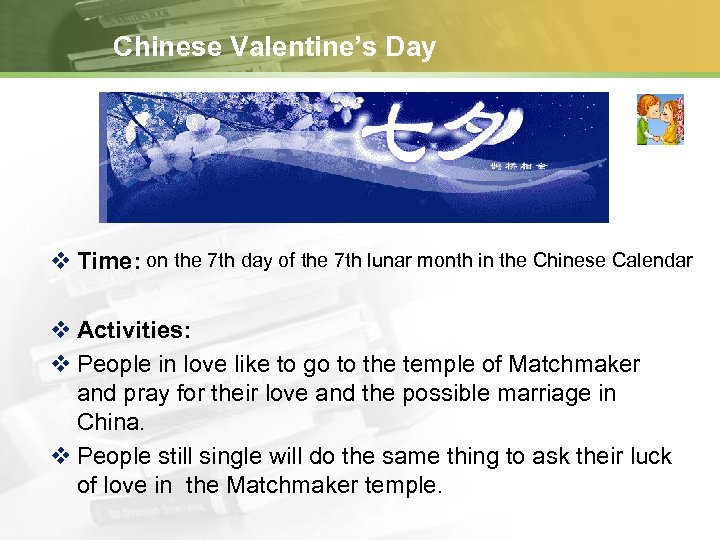
Chinese Valentine’s Day v Time: on the 7 th day of the 7 th lunar month in the Chinese Calendar v Activities: v People in love like to go to the temple of Matchmaker and pray for their love and the possible marriage in China. v People still single will do the same thing to ask their luck of love in the Matchmaker temple.
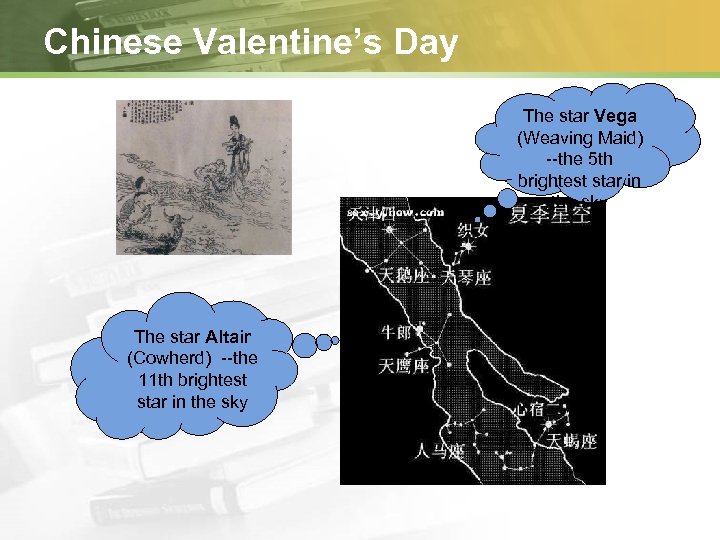
Chinese Valentine’s Day The star Vega (Weaving Maid) --the 5 th brightest star in the sky The star Altair (Cowherd) --the 11 th brightest star in the sky
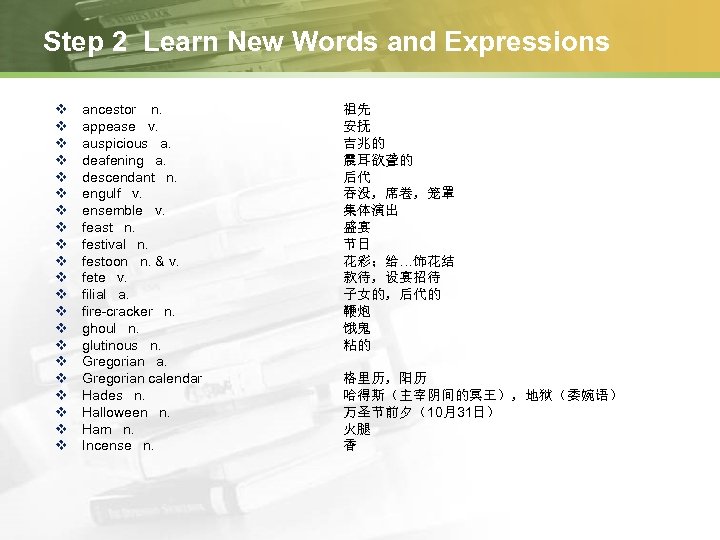
Step 2 Learn New Words and Expressions v v v v v v ancestor n. appease v. auspicious a. deafening a. descendant n. engulf v. ensemble v. feast n. festival n. festoon n. & v. fete v. filial a. fire-cracker n. ghoul n. glutinous n. Gregorian a. Gregorian calendar Hades n. Halloween n. Ham n. Incense n. 祖先 安抚 吉兆的 震耳欲聋的 后代 吞没,席卷,笼罩 集体演出 盛宴 节日 花彩;给…饰花结 款待,设宴招待 子女的,后代的 鞭炮 饿鬼 粘的 格里历,阳历 哈得斯(主宰阴间的冥王),地狱(委婉语) 万圣节前夕(10月31日) 火腿 香
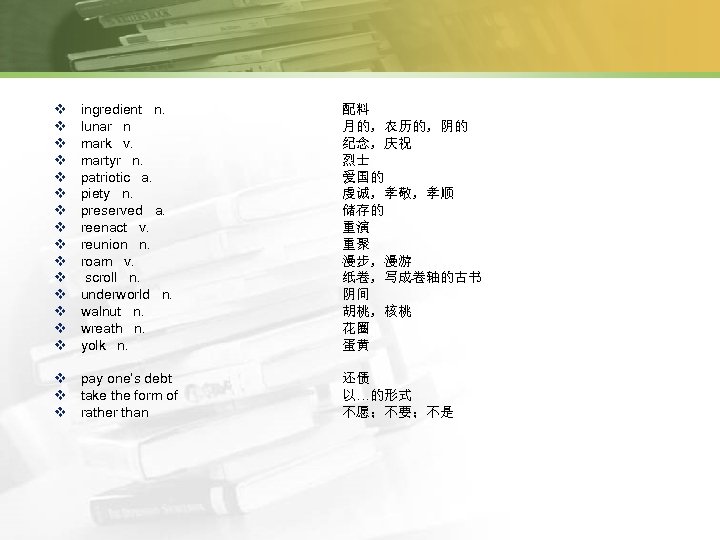
v v v v ingredient n. lunar n mark v. martyr n. patriotic a. piety n. preserved a. reenact v. reunion n. roam v. scroll n. underworld n. walnut n. wreath n. yolk n. v pay one’s debt v take the form of v rather than 配料 月的,农历的,阴的 纪念,庆祝 烈士 爱国的 虔诚,孝敬,孝顺 储存的 重演 重聚 漫步,漫游 纸卷,写成卷轴的古书 阴间 胡桃,核桃 花圈 蛋黄 还债 以…的形式 不愿;不要;不是
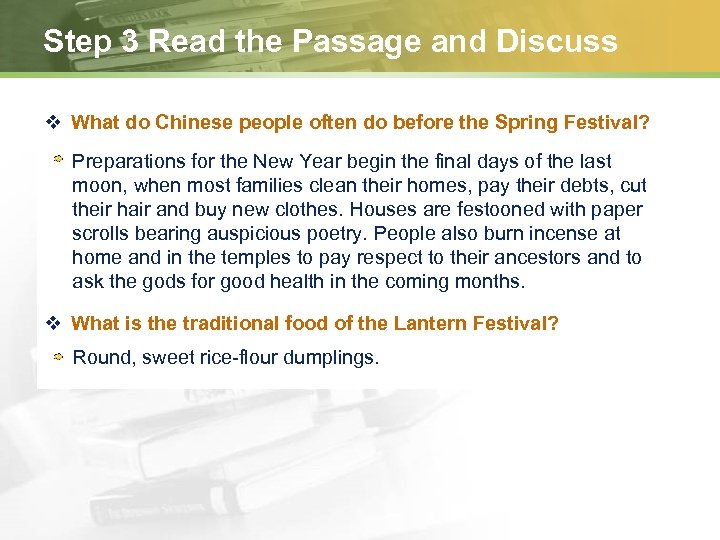
Step 3 Read the Passage and Discuss v What do Chinese people often do before the Spring Festival? Preparations for the New Year begin the final days of the last moon, when most families clean their homes, pay their debts, cut their hair and buy new clothes. Houses are festooned with paper scrolls bearing auspicious poetry. People also burn incense at home and in the temples to pay respect to their ancestors and to ask the gods for good health in the coming months. v What is the traditional food of the Lantern Festival? Round, sweet rice-flour dumplings.
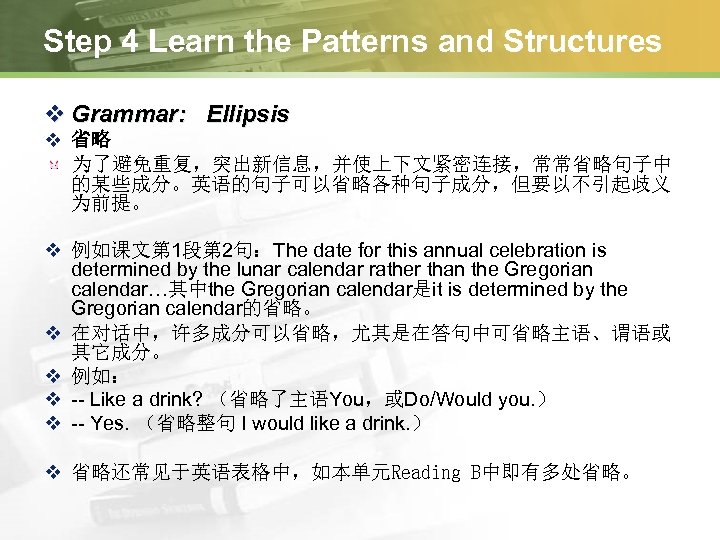
Step 4 Learn the Patterns and Structures v Grammar: Ellipsis v 省略 为了避免重复,突出新信息,并使上下文紧密连接,常常省略句子中 的某些成分。英语的句子可以省略各种句子成分,但要以不引起歧义 为前提。 v 例如课文第 1段第 2句:The date for this annual celebration is determined by the lunar calendar rather than the Gregorian calendar…其中the Gregorian calendar是it is determined by the Gregorian calendar的省略。 v 在对话中,许多成分可以省略,尤其是在答句中可省略主语、谓语或 其它成分。 v 例如: v -- Like a drink? (省略了主语You,或Do/Would you. ) v -- Yes. (省略整句 I would like a drink. ) v 省略还常见于英语表格中,如本单元Reading B中即有多处省略。
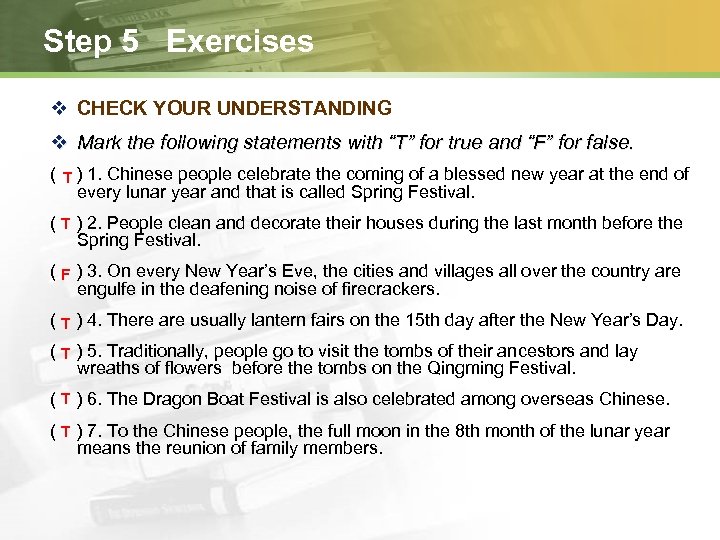
Step 5 Exercises v CHECK YOUR UNDERSTANDING v Mark the following statements with “T” for true and “F” for false. ( T ) 1. Chinese people celebrate the coming of a blessed new year at the end of every lunar year and that is called Spring Festival. ( T ) 2. People clean and decorate their houses during the last month before the Spring Festival. ( F ) 3. On every New Year’s Eve, the cities and villages all over the country are engulfe in the deafening noise of firecrackers. ( T ) 4. There are usually lantern fairs on the 15 th day after the New Year’s Day. ( T ) 5. Traditionally, people go to visit the tombs of their ancestors and lay wreaths of flowers before the tombs on the Qingming Festival. ( T ) 6. The Dragon Boat Festival is also celebrated among overseas Chinese. ( T ) 7. To the Chinese people, the full moon in the 8 th month of the lunar year means the reunion of family members.
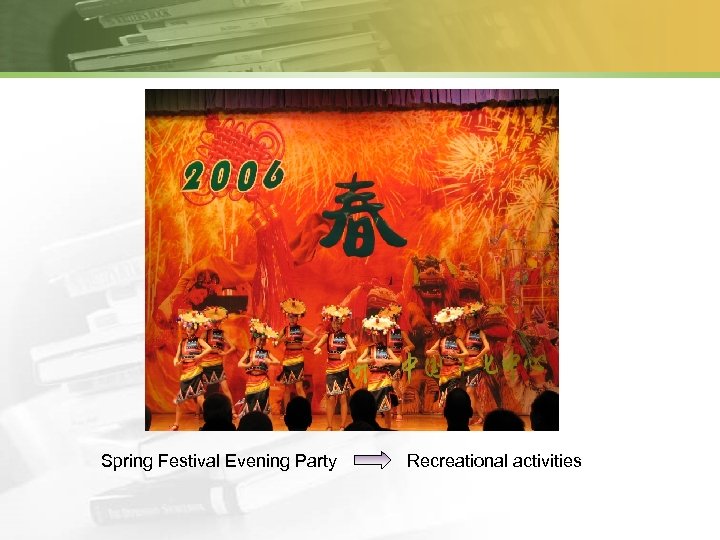
Spring Festival Evening Party Recreational activities
Listening and Speaking: Guests’ Arrival v Step 1 Leading in There are many kinds of recreational activities around us, such as Beijing opera, acrobatics, night club, sports, etc. .
Step 2 Learn New Words and Expressions v v v v v elaborate costumes and make-up 精致的戏装和化装 martial arts 武术 versatile 多才多艺 gestures 架势 A Gathering of Generals 《群英会》 acrobatics 杂技 archaeological 考古学的 calmness and balance in highly risky and mobile acts 险中求稳,动中求静 tightrope walking 走钢丝 to do splits, leaps and other dance movements on a tightrope 在钢丝上做出劈叉、大跳和其它舞蹈动作 agility 灵活 foot-juggling 蹬技 household utensils 生活用具 prop 道具 mezzanine (底楼与二楼之间的)夹层楼面 cover charge 座位费 a dress code 服装规定 slacks 西裤 Miniskirts are barred. 禁止穿超短裙。 minors under 18 18周岁以下的未成年人
v We have a live floor featuring the six piece rock band, the Toppers. 我们夜总会有特约的六人“呱呱叫”摇滚乐队现场表演。 v American top 40 s jockeyed 美国最热门的40首流行歌曲 v state-of-the-art 最尖端的 v cozy and comfortable furnishing 舒适宜人的环境 v Oman 阿曼 v A beautiful center! 好一个漂亮的传中! v That’s a good kick. . 那个球踢得很好。 v a sharp tactical awareness, excellent team work, all-out attack and defense 战术意识强,配合默契,全攻全守 v pushing lovely passes up the middle and out to the wings 灵巧地沿中路往前传球,然后又传给两翼 v He is trying for a goal. 他正准备射门。 v There goes the ref’s whistle. 裁判的哨子响了。
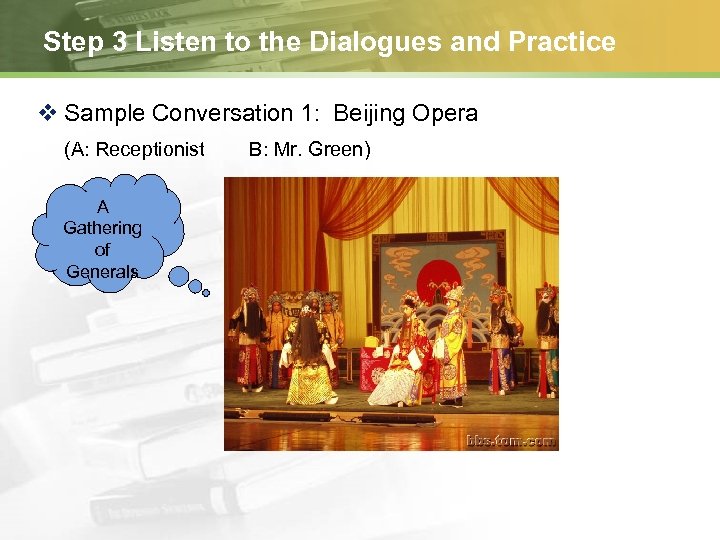
Step 3 Listen to the Dialogues and Practice v Sample Conversation 1: Beijing Opera (A: Receptionist A Gathering of Generals B: Mr. Green)
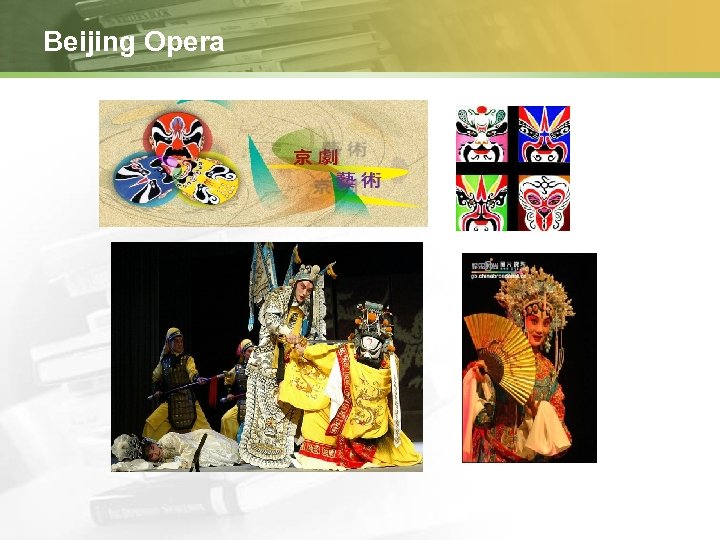
Beijing Opera
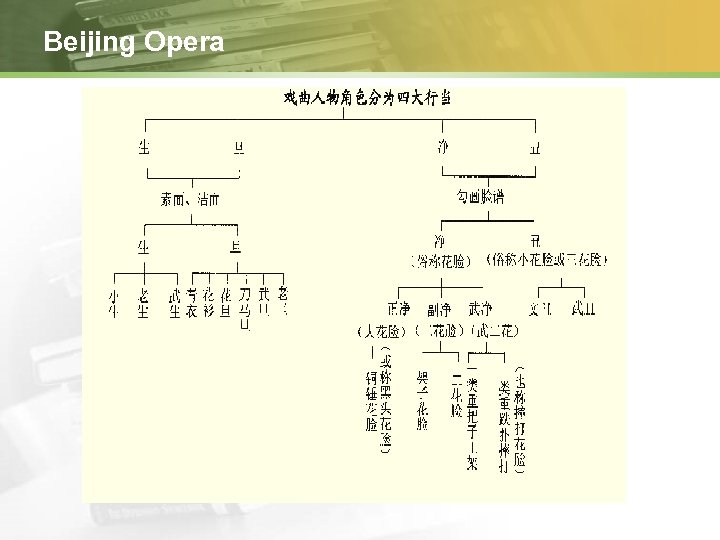
Beijing Opera
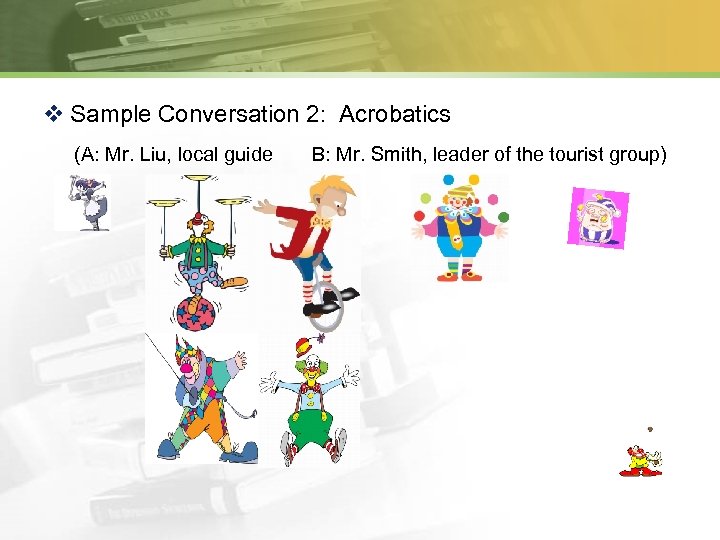
v Sample Conversation 2: Acrobatics (A: Mr. Liu, local guide B: Mr. Smith, leader of the tourist group)
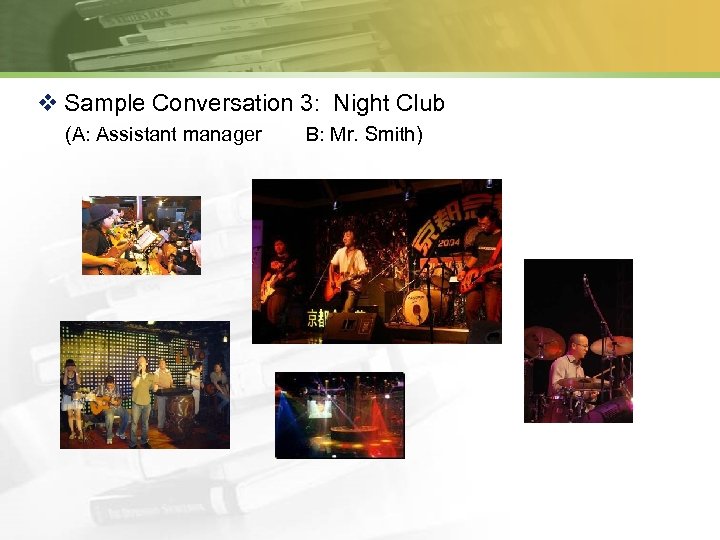
v Sample Conversation 3: Night Club (A: Assistant manager B: Mr. Smith)
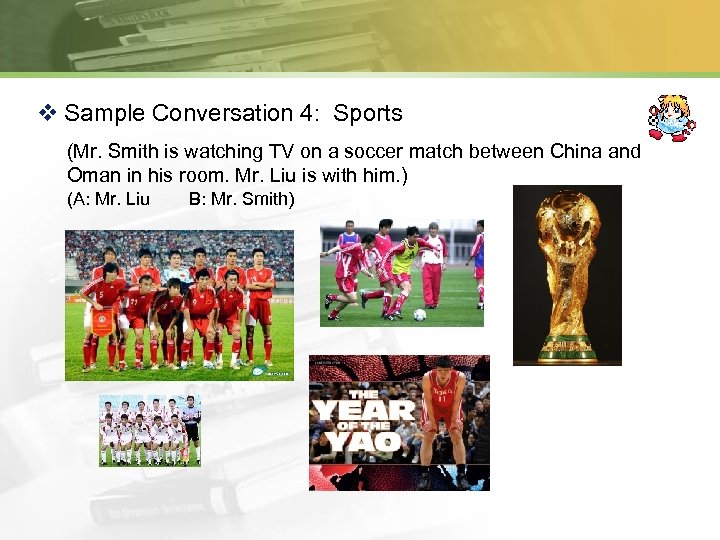
v Sample Conversation 4: Sports (Mr. Smith is watching TV on a soccer match between China and Oman in his room. Mr. Liu is with him. ) (A: Mr. Liu B: Mr. Smith)
Step 4 Learn Useful Expressions and Patterns v USEFUL EXPRESSIONS AND PATTERNS 1. 2. 3. 4. 5. 6. 7. 8. Could you help me mail this letter? Have you stuck on the stamps yet? I want some Chinese stamps. I’d like to send it by ordinary air mail. One more thing, I am going to send an e-mail to some of my friends. Where can I do it? Thank you for your information. Could you send someone for my laundry, please? But I am afraid it’s too late for today’s laundry. We can deliver it tomorrow around 5 o’clock p. m. .
9. 10. 11. 12. 13. 14. Please put your laundry in the laundry bag, and fill in the laundry list. You can find the laundry list in the dresser’s drawer. Please notify in the list whether you need your clothes ironed, washed, dry-cleaned, or mended and some special service. The rate chart is contained in the stationery folder in the dresser’s drawer. Also you can refer to the laundry list for further information. What would you like to drink? We have a variety of wines. Which kind do you prefer? Well, what about Mao Tai, one of the most famous liquors in China? Besides, we have some good Chinese red wines and white wines, such as Zhang Yu Red Wine and Great Wall Dry White Wine.
15. 16. 17. 18. 19. 20. 21. 22. It’s my pleasure. Enjoy yourself. I’d like to check out now, please. Yes, sir. Just a moment, please. Have you had any other charges after breakfast? Here you are, sir. Please check it. Are you going to pay by credit card? Will you sign on both, please? Here are your bill and receipt, Mr. Jordan. We hope you have enjoyed your stay with us and wish you a pleasant trip.
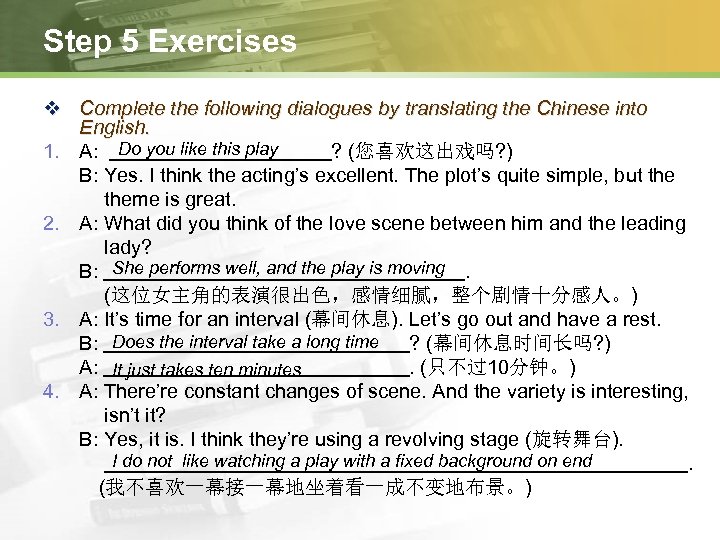
Step 5 Exercises v Complete the following dialogues by translating the Chinese into English. 1. A: Do you like this play ? (您喜欢这出戏吗? ) B: Yes. I think the acting’s excellent. The plot’s quite simple, but theme is great. 2. A: What did you think of the love scene between him and the leading lady? B: She performs well, and the play is moving. (这位女主角的表演很出色,感情细腻,整个剧情十分感人。) 3. A: It’s time for an interval (幕间休息). Let’s go out and have a rest. B: Does the interval take a long time ? (幕间休息时间长吗? ) A: It just takes ten minutes. (只不过10分钟。) 4. A: There’re constant changes of scene. And the variety is interesting, isn’t it? B: Yes, it is. I think they’re using a revolving stage (旋转舞台). I do not like watching a play with a fixed background on end. (我不喜欢一幕接一幕地坐着看一成不变地布景。)
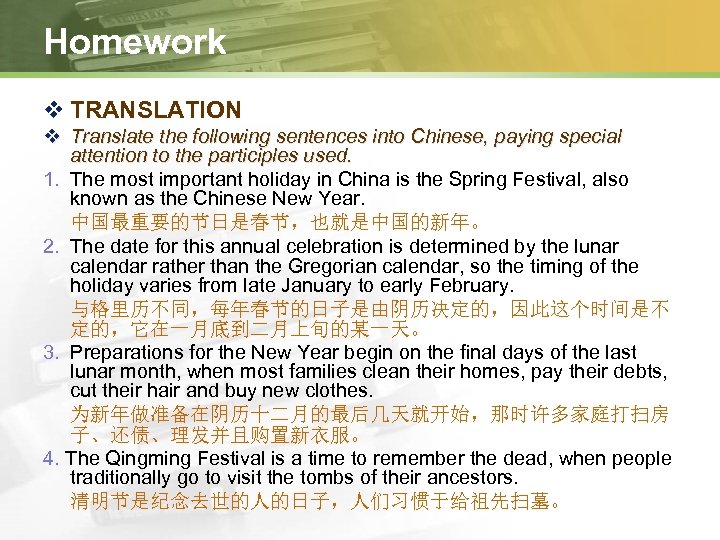
Homework v TRANSLATION v Translate the following sentences into Chinese, paying special attention to the participles used. 1. The most important holiday in China is the Spring Festival, also known as the Chinese New Year. 中国最重要的节日是春节,也就是中国的新年。 2. The date for this annual celebration is determined by the lunar calendar rather than the Gregorian calendar, so the timing of the holiday varies from late January to early February. 与格里历不同,每年春节的日子是由阴历决定的,因此这个时间是不 定的,它在一月底到二月上旬的某一天。 3. Preparations for the New Year begin on the final days of the last lunar month, when most families clean their homes, pay their debts, cut their hair and buy new clothes. 为新年做准备在阴历十二月的最后几天就开始,那时许多家庭打扫房 子、还债、理发并且购置新衣服。 4. The Qingming Festival is a time to remember the dead, when people traditionally go to visit the tombs of their ancestors. 清明节是纪念去世的人的日子,人们习惯于给祖先扫墓。
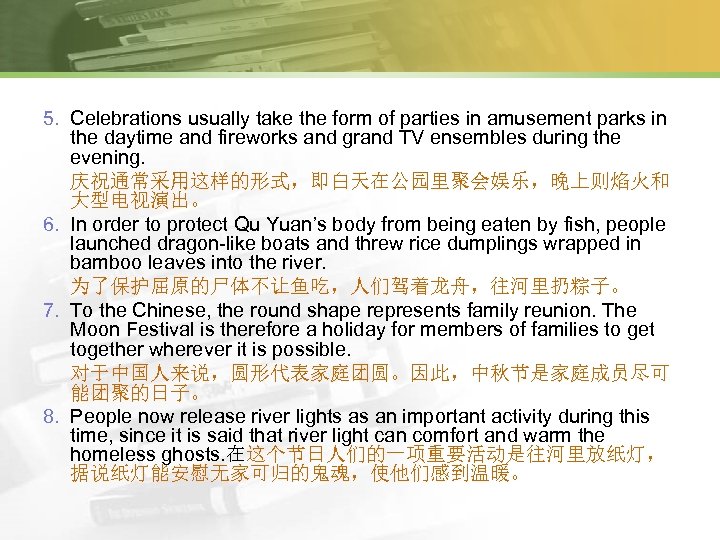
5. Celebrations usually take the form of parties in amusement parks in the daytime and fireworks and grand TV ensembles during the evening. 庆祝通常采用这样的形式,即白天在公园里聚会娱乐,晚上则焰火和 大型电视演出。 6. In order to protect Qu Yuan’s body from being eaten by fish, people launched dragon-like boats and threw rice dumplings wrapped in bamboo leaves into the river. 为了保护屈原的尸体不让鱼吃,人们驾着龙舟,往河里扔粽子。 7. To the Chinese, the round shape represents family reunion. The Moon Festival is therefore a holiday for members of families to get together wherever it is possible. 对于中国人来说,圆形代表家庭团圆。因此,中秋节是家庭成员尽可 能团聚的日子。 8. People now release river lights as an important activity during this time, since it is said that river light can comfort and warm the homeless ghosts. 在这个节日人们的一项重要活动是往河里放纸灯, 据说纸灯能安慰无家可归的鬼魂,使他们感到温暖。
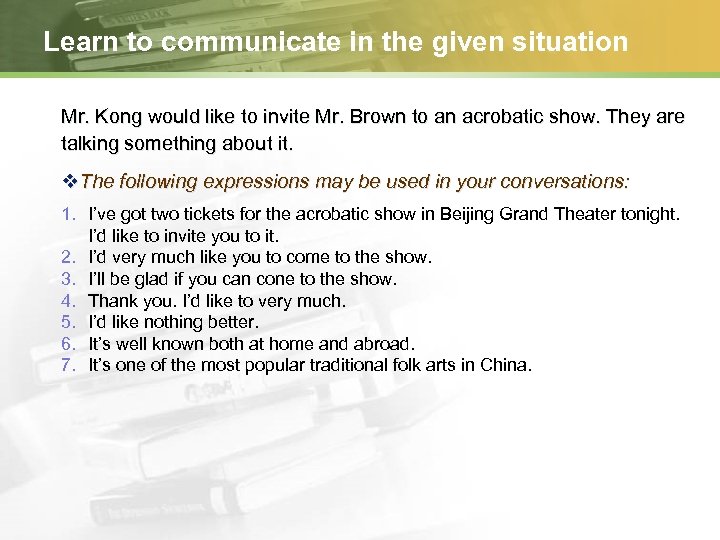
Learn to communicate in the given situation Mr. Kong would like to invite Mr. Brown to an acrobatic show. They are talking something about it. v. The following expressions may be used in your conversations: 1. I’ve got two tickets for the acrobatic show in Beijing Grand Theater tonight. I’d like to invite you to it. 2. I’d very much like you to come to the show. 3. I’ll be glad if you can cone to the show. 4. Thank you. I’d like to very much. 5. I’d like nothing better. 6. It’s well known both at home and abroad. 7. It’s one of the most popular traditional folk arts in China.

LOGO
Скачать презентацию Unit 7 About China LOGO Contents Teaching
b0aff168ad50a0d397b8750a67552c3c.ppt