 Скачать презентацию Unit 6 Social and Economic Impacts Prepared by
5fb631fd4bdb0227e77e3faf8411b2f6.ppt
- Количество слайдов: 59



Unit 6 Social and Economic Impacts Prepared by: Kevin M. Simmons, Ph. D. Austin College
Social Vulnerability • Traditional Emergency Management • Social Vulnerability Approach to Emergency Management
Social Vulnerability • Vulnerable Populations – Elderly – Children – Infirm – Low Income
Basic Economics • The price and quantity of goods available in a market are determined by the demand for the good and the supply of a good available at any given time. • To illustrate let’s consider a simple graph.
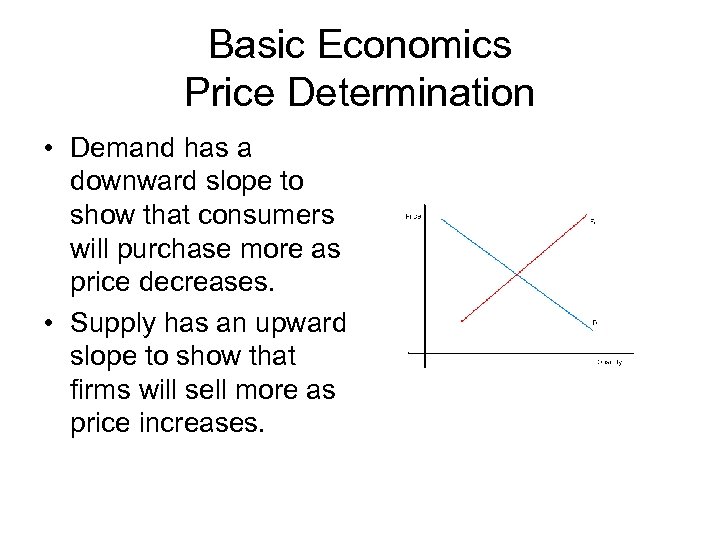
Basic Economics Price Determination • Demand has a downward slope to show that consumers will purchase more as price decreases. • Supply has an upward slope to show that firms will sell more as price increases.
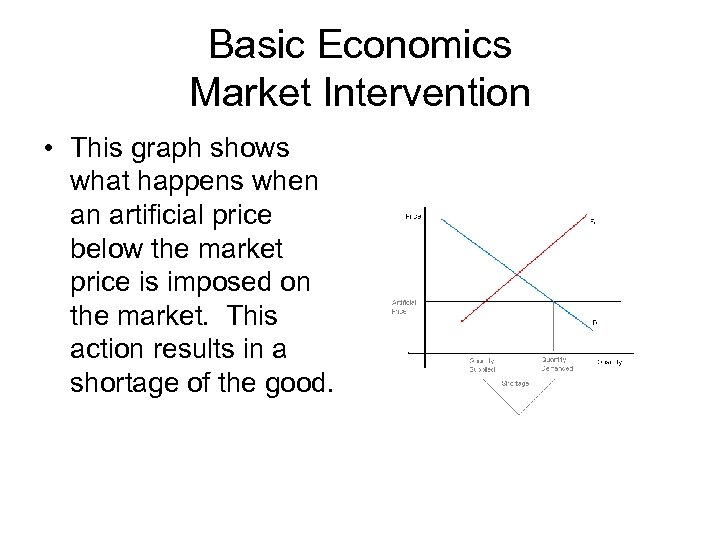
Basic Economics Market Intervention • This graph shows what happens when an artificial price below the market price is imposed on the market. This action results in a shortage of the good.
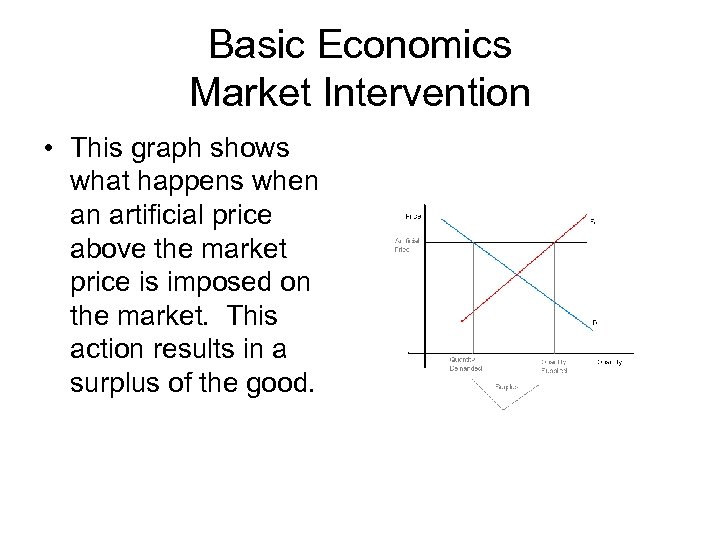
Basic Economics Market Intervention • This graph shows what happens when an artificial price above the market price is imposed on the market. This action results in a surplus of the good.
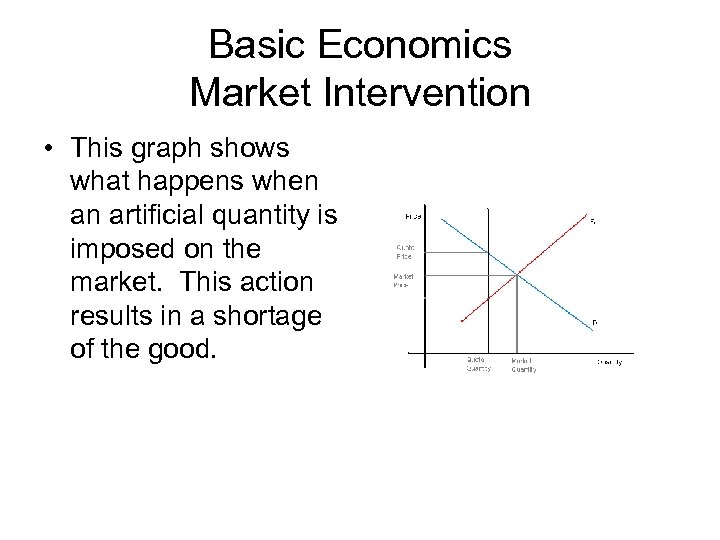
Basic Economics Market Intervention • This graph shows what happens when an artificial quantity is imposed on the market. This action results in a shortage of the good.
Basic Economics Macro Issues • Macroeconomics considers issues that extend beyond the market for a particular good. We are still concerned about price and quantity but now price is the price level of all goods and quantity is the quantity of all goods commonly referred to as Gross Domestic Product. • Long Run Aggregate Supply (LRAS) is shown as a vertical line because it represents a sustainable level of potential output.
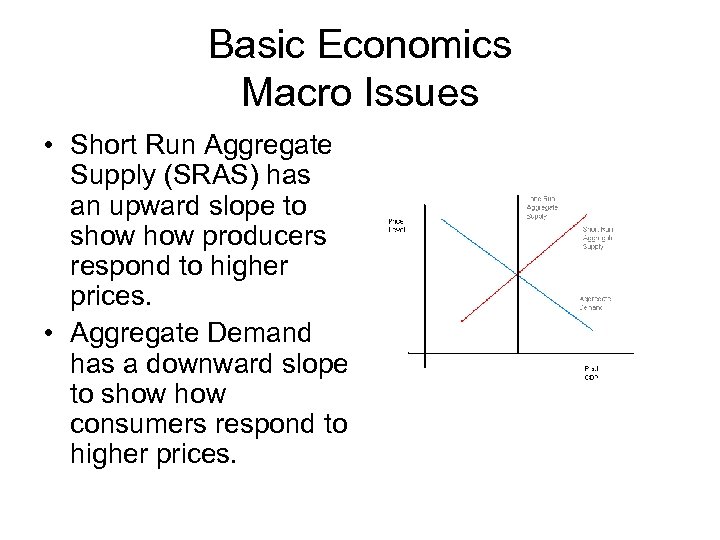
Basic Economics Macro Issues • Short Run Aggregate Supply (SRAS) has an upward slope to show producers respond to higher prices. • Aggregate Demand has a downward slope to show consumers respond to higher prices.
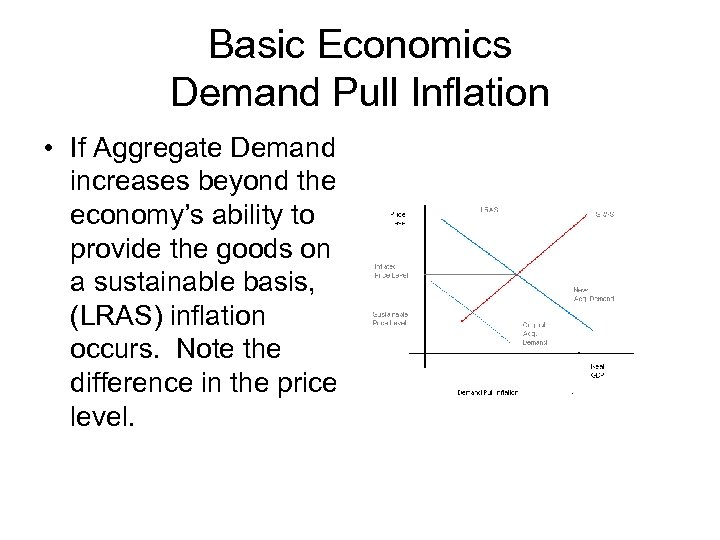
Basic Economics Demand Pull Inflation • If Aggregate Demand increases beyond the economy’s ability to provide the goods on a sustainable basis, (LRAS) inflation occurs. Note the difference in the price level.
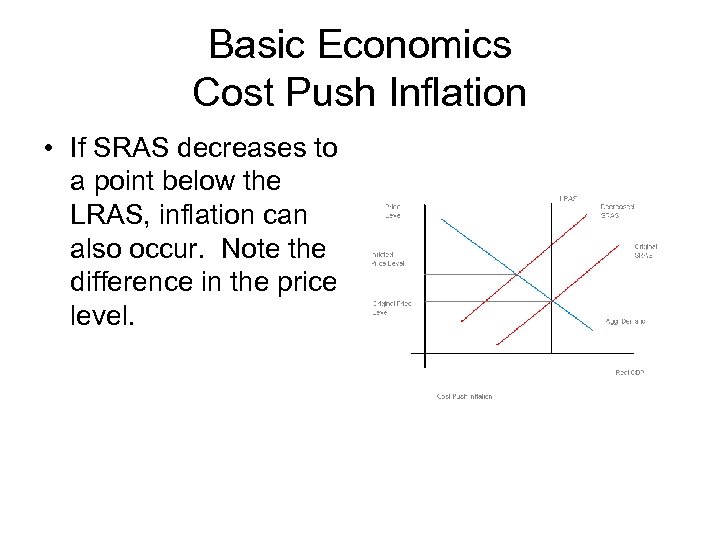
Basic Economics Cost Push Inflation • If SRAS decreases to a point below the LRAS, inflation can also occur. Note the difference in the price level.
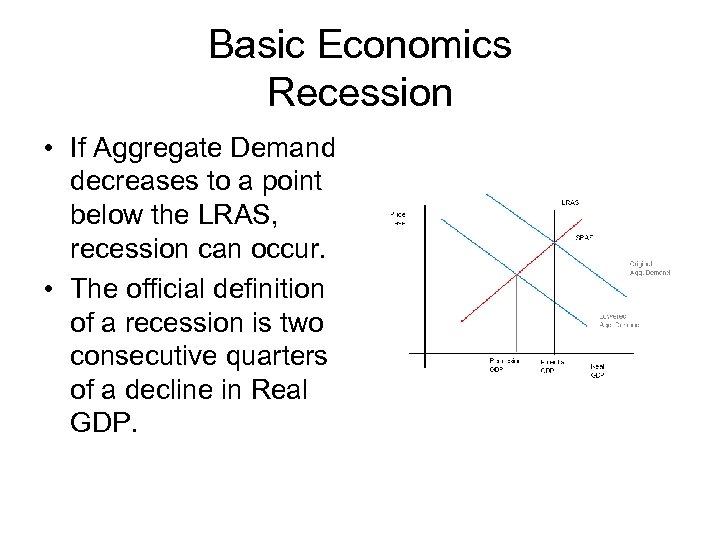
Basic Economics Recession • If Aggregate Demand decreases to a point below the LRAS, recession can occur. • The official definition of a recession is two consecutive quarters of a decline in Real GDP.
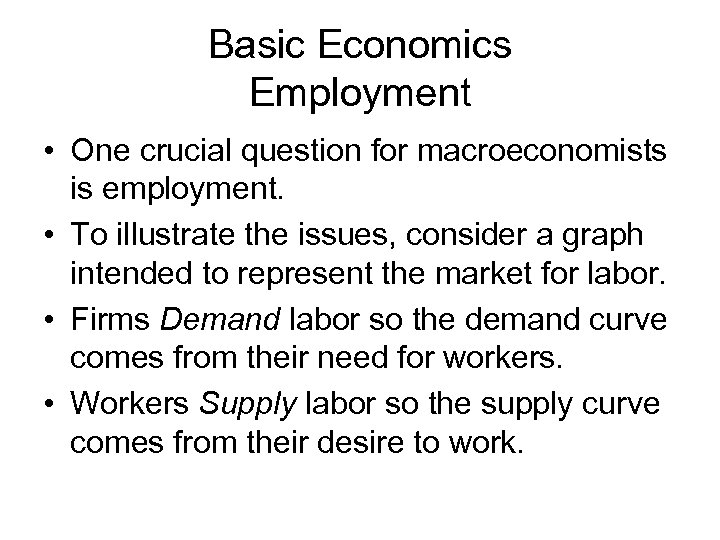
Basic Economics Employment • One crucial question for macroeconomists is employment. • To illustrate the issues, consider a graph intended to represent the market for labor. • Firms Demand labor so the demand curve comes from their need for workers. • Workers Supply labor so the supply curve comes from their desire to work.
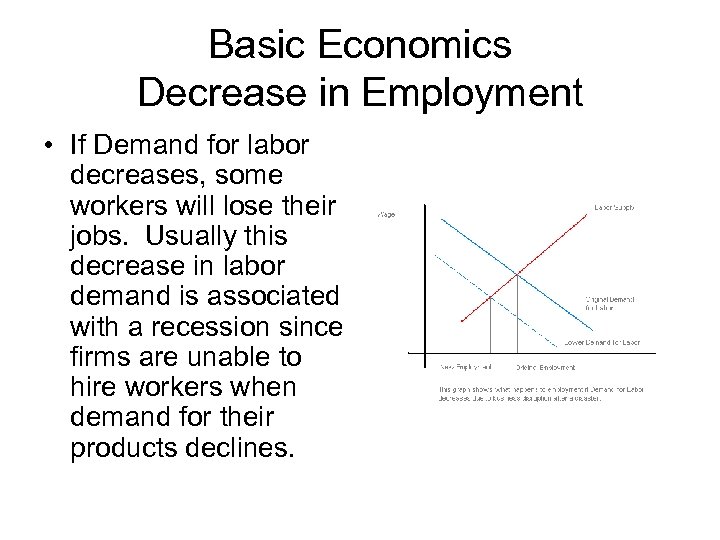
Basic Economics Decrease in Employment • If Demand for labor decreases, some workers will lose their jobs. Usually this decrease in labor demand is associated with a recession since firms are unable to hire workers when demand for their products declines.
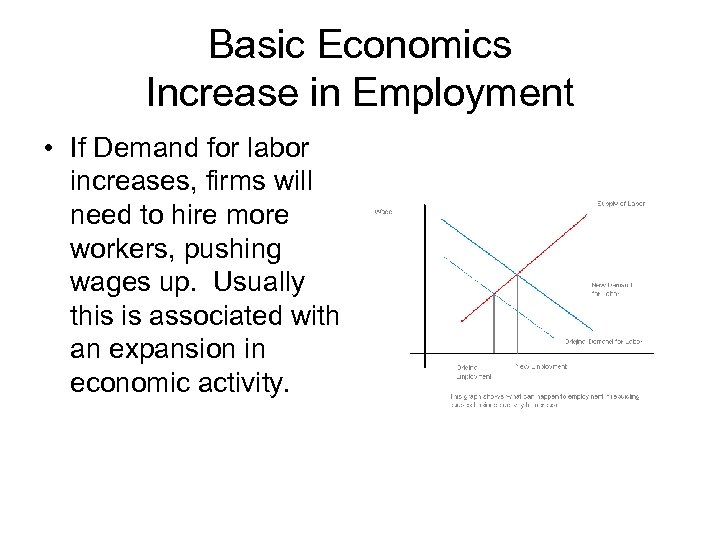
Basic Economics Increase in Employment • If Demand for labor increases, firms will need to hire more workers, pushing wages up. Usually this is associated with an expansion in economic activity.
Natural Hazard Issues Risk/Uncertainty • Risk – weighs the chance of a good outcome against the chance of a bad outcome • Example: Should I buy stock in a particular company? – Good outcome: Price of stock increases – Bad outcome: Price of stock decreases • How do you decide?
Natural Hazard Issues Risk/Uncertainty • While risk weighs the chances of a good outcome versus bad, those chances (Probabilities) can be quantified. • Uncertainty is the inability to quantify those probabilities or more broadly, the degree to which those probabilities are known.
Natural Hazard Issues Risk/Uncertainty • Which is riskier? – Purchase 100 shares of Disney? – Purchase 100 shares of a new startup company? • Since the startup has no history, the chance of an increase in price is unknown.
Natural Hazard Issues Risk/Uncertainty • Natural Hazards are a special case since they occur so infrequently that most people do not understand the risk. • Howard Kunreuther suggested that these hazards are “Low Probability, High Consequence” events. • Question: How do people, who live in threatened areas, treat this risk?
Natural Hazard Issues Mitigation • Simply put, mitigation is actions taken before a disaster or catastrophe, that will minimize the negative consequences of the event. • These actions can be by individuals or by the community.
Natural Hazard Issues Mitigation • Will individuals take actions, before an event occurs, to protect themselves? • One way to examine this question is to see if individuals place any “value” on homes that contain mitigations. • Answer appears to be yes, at least in areas where a known hazard is obvious to residents.
Natural Hazard Issues Mitigation • Can government stimulate voluntary mitigation? • Tax Incentives – SB 696 State of Oklahoma passed a measure in 2002 to grant a property tax exemption of up to 10% for homes having a tornado saferoom.
Natural Hazard Issues Mitigation • Can government stimulate voluntary mitigation? • Direct Subsidy – After the May 3, 1999 tornado in central Oklahoma, FEMA and the state of Oklahoma provided grants to homeowners who installed tornado safe-rooms.
Natural Hazard Issues Public Mitigation • What options are available to communities to lessen the impact of predictable disasters or catastrophes? • Are there competing pressures placed on officials regarding these actions?
Natural Hazard Issues Public Mitigation • Land Use Restrictions (Government) – Communities prone to floods may decide to restrict development in high risk areas • Competing Pressures? – Developers – Residents
Natural Hazard Issues Public Mitigation • Building Codes (Local Government) – Communities prone to predictable hazards can adopt requirements for builders to construct buildings/homes to withstand the hazard. • Hurricanes • Tornadoes • Earthquakes • Competing Pressures?
Natural Hazard Issues Public Mitigation • Warning Systems (Federal Government) • Tornadoes – NWS Doppler Radar • Hurricanes – NWS Flights • Geo-Hazards – USGS Monitoring
Natural Hazard Issues Public Mitigation • Evacuation (Government) – Difficult due to the uncertainty regarding storm strength, direction, etc. • Challenges – False Alarms – Voluntary vs. Mandatory – Economic Effect – Health risks during evacuation
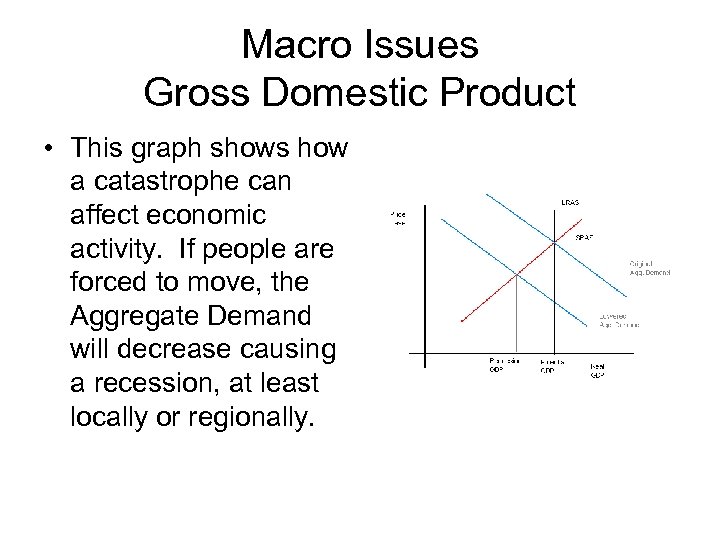
Macro Issues Gross Domestic Product • This graph shows how a catastrophe can affect economic activity. If people are forced to move, the Aggregate Demand will decrease causing a recession, at least locally or regionally.
Macro Issues Gross Domestic Product • If the affected region produces a strategic product for the rest of the country, larger problems can migrate to other parts of the country. – Example: Disruption of oil refining capacity. Disruption of transportation network.
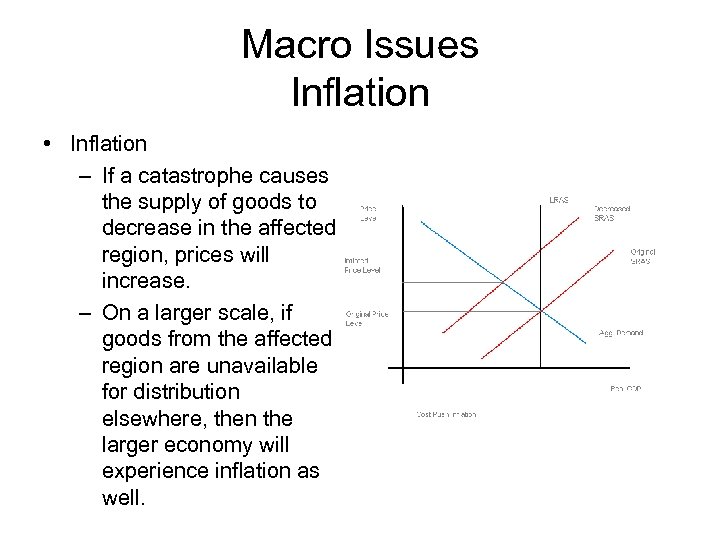
Macro Issues Inflation • Inflation – If a catastrophe causes the supply of goods to decrease in the affected region, prices will increase. – On a larger scale, if goods from the affected region are unavailable for distribution elsewhere, then the larger economy will experience inflation as well.
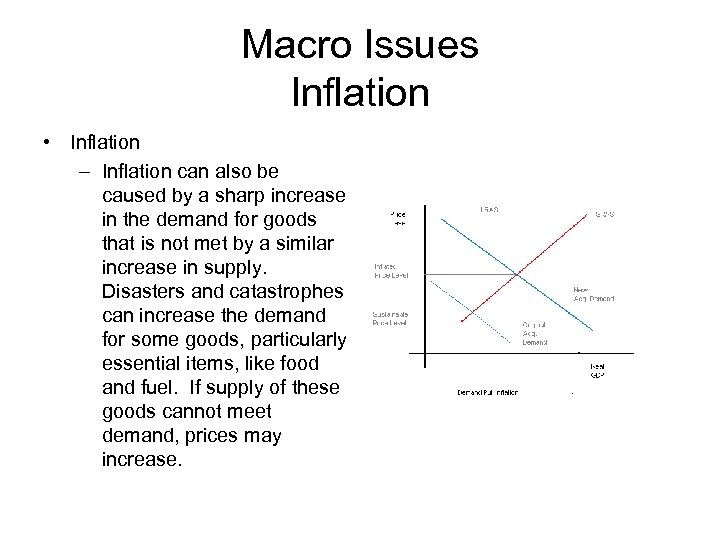
Macro Issues Inflation • Inflation – Inflation can also be caused by a sharp increase in the demand for goods that is not met by a similar increase in supply. Disasters and catastrophes can increase the demand for some goods, particularly essential items, like food and fuel. If supply of these goods cannot meet demand, prices may increase.
Macro Issues Employment • The question of how a catastrophe will affect employment can give ambiguous answers. – Increase in regional employment • Rebuilding efforts may actually increase aggregate employment in the region – Decrease in employment • A catastrophe like Hurricane Katrina may cause large migration. This will have the effect of decreasing the supply of labor thus causing an overall decrease in employment.
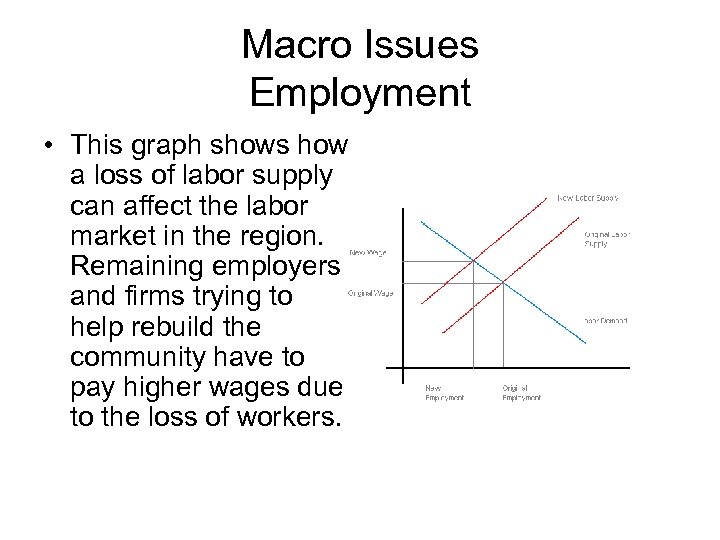
Macro Issues Employment • This graph shows how a loss of labor supply can affect the labor market in the region. Remaining employers and firms trying to help rebuild the community have to pay higher wages due to the loss of workers.
Macro Issues Migration • Voluntary Migration – A catastrophe can change the opportunities available to residents. If they perceive that they would be better off in a new location, this can prompt some migration • Involuntary Migration – When catastrophes make living or working in a region impossible for many, mass migration can occur
Macro Issues Migration • Mass Migration Examples – Western Oklahoma (1930’s) • Drought conditions caused many families who depended on farming to move. Other businesses that depended on the farmers were also affected. – Southern Louisiana/Mississippi (2005) • Hurricane Katrina caused the largest migration in recent history. Some evidence exists that those of limited means are the least likely to attempt a return to their former homes.
Financial Markets Insurance • Insurance companies are financial intermediaries which help spread the risk of various hazards. • Insurers collect premiums from a large pool of customers and provide payments to those who experience some type of loss.
Financial Markets Insurance • If an area is struck by a catastrophe, premiums will increase. • The recent hurricanes in Florida caused several insurance companies to stop issuing insurance in that state. If this trend continues, the cost to live in that state will rise dramatically, making further growth difficult.
Financial Markets Insurance • Flood Insurance – Flooding is one hazard that is not covered on a standard homeowners policy as many residents of Louisiana and Mississippi discovered after Hurricane Katrina – It is available through a federal government program at subsidized rates.
Financial Markets Insurance • To keep the cost of insurance affordable, insurance companies are strong advocates of measures that will limit property damage. – Strict Building Codes – Restricted development in vulnerable areas
Financial Markets Banking • Catastrophes may negatively affect local or regional banks more than large national banks – Loans are based on the value of pledged collateral – Any uninsured damage to that collateral makes default more likely – If the event causes businesses to cease operating, the regional banks will suffer due to the loss of loan and deposit activity
Financial Markets Banking • A solid banking system is essential for any economy to survive • The depression of the 1930’s led to the creation of the Federal Deposit Insurance Corporation (FDIC) which has made a very stable banking system. • Recent research suggests that banks are resilient even after a catastrophe.
Financial Markets Real Estate • Real estate markets are local. As a result, they rise or fall as local economies rise or fall. A catastrophe that diminishes economic activity will be felt in the value of regional real estate. • Catastrophes also reveal regional vulnerabilities that may not have been known. As a result, some jurisdictions may cease to exist following a catastrophe.
Financial Markets Real Estate • Generally speaking, real estate markets recover as the local economy recovers.
Event Analysis • Picher, OK – – Tornado (2008) Superfund Site
Event Analysis • Greensburg, KS – – Tornado (2007) Rebuilding community using “green” construction techniques
Event Analysis Galveston, TX Hurricane (1900) • Galveston, TX – – – Hurricane (1900) Isaac’s Storm Motivated community to adopt a mitigation strategy (sea wall)
Event Analysis Moore, OK Tornado (1999/2003) • Moore, OK – – – Tornado (1999/2003) Two tornados almost exactly 4 years apart followed a very similar storm path Rebuilding was immediate and the community recovered quickly
Event Analysis New Orleans, LA Hurricane (2005) • New Orleans, LA – Hurricane (2005)
Event Analysis • Creeping Catastrophe – Dust Bowl • Western Oklahoma (1930’s) – Florida (Speculative) • Rising Insurance Costs • Potential Out Migration
Event Analysis Speculative Effects of a Catastrophe Macro Effects • Inflation – Nationally – Regionally • Employment – Nationally – Regionally
Event Analysis Speculative Effects of a Catastrophe Macro Effects • Migration – Loss of an economic livelihood will drive residents to leave the area – Effects on destination cities • Destination cities after Katrina have reported significant problems as they try to absorb the new residents
Event Analysis Speculative Effects of a Catastrophe Macro Effects • Monetary Systems – Loss of local and regional banks would make credit difficult to obtain – A short term loss in the availability of cash may cause residents to resort to a primitive system of exchange (Barter) – Barter is inefficient in that it requires what economists call a “double coincidence of wants”
Event Analysis Speculative Effects of a Catastrophe Macro Effects • Strategic Infrastructure – If the catastrophe occurs in a region that supplies a commodity necessary for the economic health of the nation, the pain of the event will be felt nationally • Examples: Oil Refineries Transportation Arteries
Event Analysis Speculative Effects of a Catastrophe Micro Effects • Regional Businesses – would have to relocate or may simply cease to operate • Employment – Residents lose jobs that may be hard to replace
Event Analysis Speculative Effects of a Catastrophe Micro Effects • Social Services – Major population displacement makes it difficult to: • Man agencies designed to assist those in need • Locate families that would need assistance • Social Issues – Communities/families are dispersed – For some, these communities are a life line
Social Implications • Vulnerable Populations – Children – Elderly – Low Income
Social Implications • Barriers to Planning – Children – Elderly – Low Income
Скачать презентацию Unit 6 Social and Economic Impacts Prepared by
5fb631fd4bdb0227e77e3faf8411b2f6.ppt